Debt-Slaves in Early Modern Burma:
People Who Moved between Freedom and Servitude
SAITŌ Teruko
1. Introduction: People Called Kyun
It is well known that there existed in precolonial Burma (Myanmar) large numbers of people in various states of servitude. These were collectively known as kyun (“slave”),1) and they included prisoners of war, pagoda slaves, slaves who formed part of a household’s assets, and debt-slaves who had become slaves because of debt. Even though they were all called kyun, their positions and restrictions varied somewhat.
During the Konbaung dynasty (1752–1885), Burma’s last dynasty, prisoners of war occupied an extremely important position among those called kyun. The first six kings of the Konbaung dynasty, from its founder Alaung- hpaya to Bodaw-hpaya, overthrew the Mon kingdom of Hanthawaddy in Lower Burma in 1757 and the Arakan kingdom in 1784, and not only did they place the territory of present-day Burma under their rule, but they also launched repeated campaigns in the west against Manipur, Cachar, and Assam in northeastern India and in the east against Vientiane, Chiang Mai, and Siam. The Burmese were victorious in almost all of these wars during this period, and after each war thousands or tens of thousands of captives were brought back to Burma. But not all of them were made “slaves,” and those able to make contributions in areas such as military affairs, specialist skills, performing arts, and so on were organised into hereditary groups of servicemen called ahmudan,2) were granted good farmland in irrigated areas, and encouraged to settle permanently. Even today, the actual number of captives who settled and served the royal authorities is unclear, but they were so numerous that there is even the view that the majority of ahmudan during the Konbaung period had been prisoners of war,3) and there can be no doubt that there were extremely large numbers of settlers from outside the country.
The remaining captives were allocated as household slaves to officers and commanders who had taken part in military campaigns.
But after Burma suffered a crushing defeat in 1785 in a war against Siamese forces under the command of Taksin, who had established his capital
at Thon Buri on the coast, Burma’s military superiority collapsed. It was a time when British forces, who had already colonised Bengal in India, began to extend their feelers to Burma. Subsequently it became impossible to supplement Burma’s population with prisoners of war from neighbouring countries.
So-called pagoda slaves (paya-kyun) were either domestic slaves who had been donated to monasteries by members of the royal family or by wealthy people for the preservation of Buddhism, or people who had offered themselves to a Buddhist monastic community (sa͘ngha) in the hope of accumulating merit.
Many of them were engaged in farm labour on specific monastic lands, and any surplus produce was set aside for maintaining the pagoda or temple. Once they had been donated to a monastic community, they were considered to remain with the monastic community in perpetuity, just like other donations, especially farmland, and among those of kyun status they were the only people unable to redeem their freedom. By the nineteenth century, pagoda slaves had come to be regarded as outcastes, segregated from other social classes, and were subjected to discrimination, being, for example, unable to marry members of other classes. But at times of extreme social upheaval, many glebe lands fell into private ownership and many pagoda slaves became commoners in the resultant confusion.
Lastly, as for household slaves and debt-slaves, they were similar insofar that they carried out whatever work they were ordered to do by their masters.
But there was a major difference between them in that debt-slaves were one of two parties to human mortgage contracts, so that once they repaid the debt they regained freedom, and thus they moved between the two states of freedom and servitude. A household slave was bought and sold at the master’s wish, and any children born to such a slave also became slaves.
In the following, I shall focus on debt-slaves, the only people among so- called kyun about whom concrete details can be gleaned from contemporary sources, and consider their historical significance.
2. The Current State of Research on Human Bondage, Especially Debt-Slaves The study of human bondage in Southeast Asia began with Bruno Lasker’s Human Bondage in Southeast Asia, published in 1950, and for a long time there appeared no new research. Then in 1983 the fruits of a joint study by fifteen researchers of Southeast Asian history, edited by A. Reid, were published under the title Slavery, Bondage, and Dependency in Southeast Asia, and a new stage in the study of human bondage in Southeast Asia was opened up.
But since then it can hardly be said that research on this subject has been actively pursued, and this has been partly due to one of the difficulties attendant on the study of premodern Southeast Asian society, namely, the dearth of native local sources or, more precisely, the fact that they have not yet been fully explored. Although there exist accounts recording the observations of colonial bureaucrats and merchants from the outside world, it has been difficult to seek out records written by the people of Southeast Asian societies, especially records written by people who lived at the time, and more especially records written by ordinary people, who accounted for the greater part of society.
Reid’s “Introduction” to the above book remains even today a basic survey of human bondage in Southeast Asia, and it is worth noting that he touches on the existence of debt-slaves and emphasises their importance: “In normal times, debt was certainly the most important source of bondage in Southeast Asia, and bondsmen with such origins made up a very large section of society.”4) He also points out that “in the nineteenth century there was a marked tendency for the category of debt-bondage to be extended.”5)
V. Lieberman makes an important point about debt-slaves in Burma in his outstanding book, Burmese Administrative Cycles: Anarchy and Conquest, c.
1580–1760, in which he structurally analyses the rise and fall of Burmese dynasties from the establishment of the first Taungoo dynasty to the start of the Konbaung period (1580–1762). Taking note of the fact that slaves owned by private individuals and groups constituted a lost population for the royal authorities in that they were not liable for labour service or tax, he points out that at times when the kingdom went into decline, that is, when the burden of labour service and tax fell in concentrated fashion on the decreasing population, many of the ahmudan sold themselves to prominent members of society and became debt-slaves in order to avoid excessive demands of the royal authorities. He further argues that, as a result, the population base able to be utilised by royal authority became still smaller, accelerating the dynasty’s collapse. This means that the transformation of ahmudan into debt-slaves was an important factor in bringing about the rise and fall of dynasties.
Mention may also be made of the discussion by M. Aung Thwin, who contributed a chapter on Burma to the book edited by Reid. While making it clear that his research is still at an early stage, he puts forward several distinctive views. One point related to the present study is his assertion, which takes into account comparisons with slavery in Europe and the New World, that slavery “was never a significant part of Burmese society and economy,”6) and that the Burmese word kyun means “subject” or “servant” rather than
“slave.”7) He also states that when a kyun was “bought,” “such ‘buying’ was often an agreement between the kyun himself and the buyer, similar to a contract between employee and employer rather than one between master and slave.”8)
In addition, Daw Ohn Kyi published a short article about human mortgage contracts in 1991, but on the whole there have until now been almost no advances in research on the actual conditions of people in states of servitude in early modern Burma.
3. Source Materials
From the late 1970s U Toe Hla, then lecturer in the Department of History at Mandalay University, began discovering and collecting written contracts concluded between private individuals in the eighteenth and nineteenth centuries, generally known as thet-kayit. This was sensational news that made my heart leap since we had never expected documents written by private individuals for the Burmese early modern period, with most of the documents during the Konbaung period pertaining to royal authority, Buddhist scriptures, customary laws, and so on.
The writing medium called para-baik (black folded paper)9) had previously been thought to have been used primarily for copying Buddhist texts and customary laws, but it turned out that it also became widely used by commoners, who left a great variety of records pertaining to their own everyday lives. These records included many written contracts exchanged between private individuals. In these contracts, especially in debt contracts, the commoners of early modern Burmese society, who had in the past remained virtually invisible, made an appearance together with accurate dates, locations, and names.
The main source materials used for this paper are the human mortgage contracts (i.e., debt servitude contracts) in the following databases:
1. Salin Thugaung Manuscripts, vol. 10: Ko-ne Thet-kayit (STM-KT)
Held by the Universities Historical Research Centre at the University of Yangon. (UHRC; UHRC was reorganised as the Department of Historical Research under the Ministry of Culture in 2007)
108 items 2. Materials on Myanmar History in Microfilms created by Kagoshima
University, reel 82 (KUMF)
103 items
3. Documents of Myanmar Socio-Economic History, Aichi University, online (DMSEH)
185 items Since there are duplicates among these 396 items, the net number of debt contracts examined was 309.
4. The Proportion of Human Mortgage Contracts among Loan Contracts and Their Regional Distribution
Fig. 1 shows chronological changes in the total numbers of debt contracts during the Konbaung period included in DMSEH and KUMF.
It also shows the breakdown of debts, namely, debts with interest, human mortgage debts, and farmland mortgage debts. As shown in the diagram, the total number of debts contracts increased over time, but there were several periods when there was a marked increase in the number of debts: (1) 1786–
1790, (2) 1806–10, (3) 1826–30, and (4) from 1851 to the fall of the kingdom.
The crushing defeat in the war against Siam in 1785, and several unsuccessful counterattacks up to 1790, made one of the main causes of the sudden increase in the number of debts. The years 1806–10 marked the start of droughts that have gone down in the unprecedented severe famine. The third phase began from the year 1826, when Burma was beaten in the First Anglo-Burmese War and lost two coastal provinces. Besides, Britain imposed the enormous indemnity of 10 million pounds on the Burmese royal government which by no means she could pay quickly. Many people had to borrow money as the royal government levied a temporary silver tax to provide funds for paying the indemnity. The last phase began with the Second Anglo- Burmese War, which resulted in the defeat again, and Burma became a land- locked country as she lost the whole Lower Burma. It is evident that defeats in wars with other countries, droughts and famines, and the imposition of special taxes had an enormous impact on the lives of ordinary people and led to an increase in debts.
The expectation that debts with interest would be the most common form of borrowing money proved to be wrong, as debts with interest accounted for under 40% of the debts in the two databases, while farmland mortgage contracts were the most numerous, accounting for over 50% of the debts. Debts on human mortgage, on the other hand, were few in number and accounted for only 8%.10)
Further, there were distinctive features in the regional distribution of
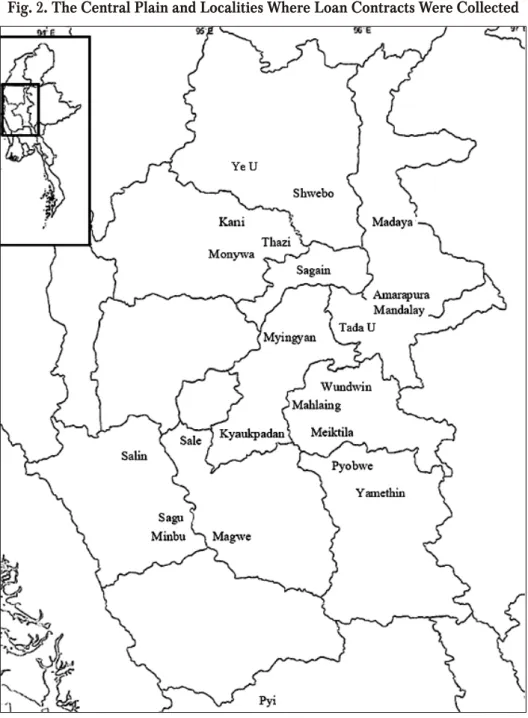
human mortgage contracts. Table 1 shows that human mortgage contracts are extremely concentrated in such areas as royal capitals, in the rice-producing areas with large irrigation networks, and especially in areas where there existed powerful local families who had amassed vast amounts of land and human resources through their money-lending operations. The human mortgage contracts from areas around the royal capitals, and the Salin region where prominent local families emerged account for more than two-thirds of the total number of such contracts. In stark contrast, debt contracts secured on farmland are found widely throughout the central plain, shown in fig. 2.
5. The Contents and Characteristics of Human Mortgage Contracts Let us now consider how human mortgage contracts were written with reference to two examples. The first is a contract from the rice-producing region of Salin, served by large-scale river irrigation on the west bank of the Ayeyarwaddy River, and the second is a contract written in the royal capital of Fig. 1. Chronological Distribution of Three Forms of Loan Contracts (1752–1885)
Loans secured on farmland: grey; loans on human mortgage: black; loans with interest: white.
Source: Saitō 2019: 230. Based on 2,242 loan contracts in DMSEH and KUMF; does not include duplicates and loans the date of which is illegible.
350 300 250 200 150 100 50 0
Until 1752 1752-55 1756-60 1761-65 1766-70 1771-75 1776-80 1781-85 1786-90 1791-95 1796-1800 1801-1805 1806-10 1811-15 1816-20 1821-25 1826-30 1831-35 1836-40 1841-45 1846-50 1851-55 1856-60 1861-65 1866-70 1871-75 1876-80 1881-85
Region DMSEH KUMF STM-KT Duplicates Net Total Remarks
Amarapura 1 1Royal capital and
surrounding area
Mandalay 22 83 105Royal capital and
surrounding area
Shwebo 10 10 Former royal capital
Monywa 2 2 Trade, agriculture
Magwe 6 6 Agriculture
Sale 2 2 Irrigated agriculture
Salin 74 104 −46 132 Irrigated agriculture
Sagu 1 1 Irrigated agriculture
Meiktila 18 18 Agriculture, trade
Wundwin 2 2 Irrigated agriculture
Kyaukpadan 12 12 Irrigated agriculture
Pyobwe 1 1 Irrigated agriculture
Pyi 22 −9 13 Held by museum
Dawei 1 1 Held by museum
Unknown 3 3
Total 157 103 104
Duplicates −55 −55
Net Total 102 103 104 309
Table 1. Geographical Distribution of Human Mortgage Contracts
Source: prepared by author.
Note: Contracts for which the locality where they were written cannot be identified have been excluded. The contracts from Pyi and Dawei were held by museums, and in the case of those held by Pyi Museum almost all of the creditors were powerful families in Salin.
Fig. 2. The Central Plain and Localities Where Loan Contracts Were Collected
Mandalay.
(1) In M.E. 1194, on 2 la-zan Wagaung (29 July 1832), Nga Lay11) and his wife Mi Hnin, in order to repay a loan to Thugaung-ma Me Hnin,12) asked Minzeya-shwedaung-kyaw and his wife, “Please buy me, Nga Lay, for 35 kyat13) under the condition of shin pwa, thei hsoun,” whereupon the husband and wife accepted the offer and bought Nga Lay. The witnesses were the taik-soe14) Maung Tha Yit and Maung Soe Gale, the money was weighed and assayed and the document drawn up by Nga Myat Toe, and the scribe is Maung Tu Pyu.15)
(2) In M.E. 1242, on 4 la-pye-gyaw Pyatho (18 January 1881), Ko Aing, a resident of Meikgagiri quarter, composed a contract that included the words, “I need money. Please order my wife Mi Yut to cross large rivers, go down rivers, and go [anywhere] throughout the rainy season and the dry season on the condition of thei ma hsoun, shin ma pwa. Please use her [to climb] tall trees and low trees. Please treat her harshly,” and he said to Maung Maung Gyi and his wife, “Please buy her and use her for 100 silver kyat coins. After five months have passed, I will repay the money and redeem Mi Yut. In the event that I should desire her redemption before five months have passed, I will add money in accordance with the customs of towns and villages and redeem her.” Ko Maung Maung Gyi and his wife agreed and drew up a contract with the conditions that they would employ Ko Aing’s wife as a slave on terms that thei ma hsoun, shin ma pwa, would order her to cross large rivers, go down rivers, and go anywhere, would use her to climb tall trees and low trees, and would treat her harshly, and they paid 100 kyat silver coins, which was exceptional for a female debt slave, and bought her. In the future, if Mi Yut would abscond, or be drafted for public duties, or in cases if there might be interference by a former patron, or any law suits would arise, Ko Aing and his wife Mi Yut will repay all the costs spent together with the price for Mi Yut recorded in this contract. He promised that if he were unable to repay the money, my guarantor U Shwe Tun, his wife Mi Nyun, and U Bo Te would repay all the costs spent all together with the price for Mi Yut, and so Maung Maung Gyi and his wife paid 100 kyat silver coins and bought Ko Aing’s wife Mi Yut. The witness is U Soe, the contract was drawn up by the creditor, and it was written down by Maung Tu Po.16) As can be seen in the above two examples, these contracts follow a set
format, starting with the date and including the debtor’s name and place of residence, the name of the person about to become a debt-slave, the amount of money borrowed (and, during the period when privately cast metallic currency was in use, the name and purity of the currency), the creditor’s name, collateral conditions, and the names of witnesses, the weigher and assayer of the money, the drafter of the contract, and the scribe. These contracts can be broadly divided into two types, namely, contracts written in a succinct style like (1) and lengthy contracts like (2), from the royal capital of Mandalay, which use many antitheses to list the collateral conditions. The creditor referred to by the long title Minzeya-shwedaung-kyaw in the contract from Salin was the ruler of this district,17) and his real name was U Saw. The local rulers of Salin came from a powerful family made up of four lineages and known as the Salin Thugaung, and they had for many years been amassing vast amounts of farmland and many debt-slaves through their money-lending operations. These money- lending operations were often managed by the wives, who had a good grasp of the debtors and often oversaw them themselves. In the case of contracts from Mandalay, on the other hand, the creditors—members of the royal family, high-ranking military officers, bureaucrats, and men of means—rarely managed debt-slaves themselves, and so the wording of the contracts tended to be quite detailed.
A point that needs to be noted regarding the terminology used in contracts is that, in spite of being debt-slave contracts, the word “sell” (yaun-de) is used instead of “mortgage” (paun-de). The above two contracts are not exceptional in this regard, and almost all human mortgage contracts refer to the buying or selling of a person. But it seems that in the case of real slave trading a contract was almost never drawn up, since I have not been able to discover a single human sales contract among several thousand written contracts. It can be confirmed from other sources that the slave trade existed at this time,18) and it is likely that, as in the case of goods, even in the case of the sale of a person, when payment was completed at the time of the transaction, there would have been no need to draw up a contract.
When farmland was put up as security, on the other hand, a sharp distinction was made between pawning and selling, and there is no confusion whatsoever to be seen in the terminology. Apart from certain districts, there were still strong constraints, both institutional and customary, on the sale of farmland. Not only were there laws prohibiting the disposal of monastic lands and appanage lands,19) but the custom and notion that farmland was linked in perpetuity to the person who had originally cleared the land and to his descendants remained deep-seated and acted as a brake on the selling of
farmland. Even in districts where farmland was bought and sold, not only were the words “sell” and “buy” used when selling farmland, but solemn adverbial expressions were invariably added to indicate that the land was being sold “in perpetuity down to the remotest descendants” or “so as to build a temple or monastery.” It is to be surmised that such wording was considered necessary because the sale of farmland often resulted in litigation in later generations.20)
In contrast, the slave trade has a long history, as can be seen in the frequent references to the trading of slaves and prices of slaves in inscriptions from the Pagan dynasty founded in the eleventh century, and there existed no provisions in royal ordinances or customary laws banning the slave trade. It is thus true that there was from early times no taboo against the buying and selling of people, but even so there remains the question of why, even in human mortgage contracts, the words “sell” and “buy” were so readily used and the word “pawn” was not used. It would seem that, unlike in the case of farmland, the absence of any socially prevalent notion or customary law preventing either the selling or pawning of people was one factor that made possible this imprecise usage.
In human mortgage contracts, it is the person about to become the debt- slave (or a family member) who, as debtor, is the principal to the contract, and it is also the debt-slave who changes his or her patron or makes further loans.
This would be inconceivable in the case of slaves sold at their master’s will.
According to M. Aung Thwin, in human sales contracts the slave-to-be is himself the principal to the contract, and this is perhaps because Aung Thwin has taken human mortgage contracts to be human sales contracts on account of the words “buy” and “sell” used in these documents. As mentioned, human sales contracts were almost never drawn up.
The above two contracts include stereotypical parallel phrases demanding submission, and contracts drawn up in Mandalay, in particular, include many such antitheses. Phrases such as “cross large rivers, go down rivers” and “tall trees and low trees” are used when demanding obedience to difficult orders or even contradictory orders without complaint. The phrase translated “Please treat her harshly” uses a verb that in modern Burmese means to contravene, overcome, or suppress. Since this phrase was used only when a woman became a debt-slave, it was probably a tacit understanding that the creditor could request sexual services from the woman about to become a debt-slave. The phrase “in accordance with the customs of towns and villages” meant that an extra payment in addition to the money borrowed would be necessary in the event that the debt-slave was redeemed with the intention of moving to another
household. These phrases show that, even though a debt-slave may have been able to become the principal to a contract, until the debt was fully repaid he or she had to obey all orders of the patron, even if they were unreasonable demands, and their mode of labour was identical to that of household slaves.
There is at least one phrase to imply protection of the debt-slave, namely,
“even if plates and bowls are broken”, which means that if the debt-slave broke any utensils during the period of servitude, he or she would not be made to reimburse the owner for the damage. However, the debt-slave contracts which include this phrase are very rare.21)
Next, I wish to consider the antitheses shin pwa, thei hsoun (1) and thei ma hsoun, shin ma pwa (2), which are invariably found in human mortgage contracts of the Konbaung period. Shin means “to live,” thei “to die,” pwa “to increase,”
and hsoun “to lose,” and the particle ma preceding a verb signifies negation.
Therefore, shin pwa, thei hsoun means literally “lives and increases, dies and loses,” while thei ma hsoun, shin ma pwa means “dies and does not lose, lives and does not increase.”
Regarding the interpretation of these phrases, Daw Ohn Kyi wrote in an article published in 1982 that shin ma pwa has two meanings: it means that interest is not added to the debt while the slave is alive, or that a child born to a parent working as a slave would not become a debt-slave.22) But in 1991 she narrowed the meaning down to the former meaning, namely, that interest is not added to the debt while the slave is alive.23)
In the case of contracts for debt-slaves, however, the labour provided by the debt-slave represents the interest on the debt, and so it should be obvious that interest in cash was not paid on the loan. That being the case, how can we interpret these antitheses? A clue for interpreting their meaning can be found in the following document written in Salin in November 1841.
8 November 1841
Reply of Mi U and her elder sister
I recall that my younger sister Mi U was born after my father and mother had been bought as debt-slaves on the condition of shin pwa, thei hsoun by Zayat Daga-ma-gyi (Great Donor of the Rest House). I have not heard whether or not [my mother] was pregnant before my parents became debt-slaves. Together with Mi U, her elder sister Mi Kyan Tha deposed the above in the presence of the town clerk Maung Kya Yit, the cavalry commander Maung Maw, Maung Pe Ta Lu, and Nga Chin Ok.
The document was written by Maung Pein.24)
Reply of Mi U’s husband Nga Zi
Nga Zi replied on the same day. My wife Mi U was born during the time when my father-in-law was being used as a debt-slave at the house of Zayat Daga-ma-gyi. I have heard that, before she died, my mother-in-law told Mi Thei that when she became a debt-slave of the female donor of the rest house, she was four months pregnant with my wife Mi U. If Mi Thei makes a deposition, it should become clear.25)
According to these materials, in order to determine the affiliation of a woman called Mi U, Mi U herself, her husband, and her elder sister were questioned, the point at issue being whether or not Mi U had been born during the time when her parents, in particular her mother, were being used as debt- slaves. The contract drawn up when her parents became debt-slaves included the condition shin pwa, thei hsoun, and it is clear from the above replies that the phrase shin pwa is unrelated to interest. It means that a child born while the mother is a debt-slave automatically becomes a slave, while shin ma pwa, with the negative particle ma, can be taken to mean that a child born while the mother is a debt-slave will not be made a slave.
As for thei hsoun and thei ma hsoun, their meaning becomes clear from the following contract. This contract was written in 1850 and is from the Pyi region, and its contents may be summarised as follows: Maung Pe, a resident of the village of Min, had offered his two sons as debt-slaves to the monastery donor U Pu and his wife for 175 kyat in 25 kyat alloy on the condition of thei ma hsoun, shin ma pwa. But both sons died. U Pu and his wife demanded repayment of the 175 kyat from their father, but because he was unable to pay, he was forced to pawn the fields he owned for that amount as security for his deceased sons, and a contract was drawn up in which he pledged to pay 5% interest monthly if he was unable to repay the full amount by the due date.26) This is an example of thei ma hsoun and shows that it meant that, when a debt-slave died, the debt was not written off and had to be borne by surviving family members.
As time passed, the condition that a child born to a mother while she was a debt-slave would become a slave owned by her master fell into desuetude, and in human mortgage contracts drawn up after 1836 in Salin, for example, the conditions shin pwa, thei hsoun completely disappeared, and only the conditions shin ma pwa, thei ma hsoun were included. In other words, rather than taking ownership of a child born to a debt-slave as a slave, creditors came to give priority to recovering the loan in cash. But in reality there are almost no examples of sons or daughters who were able to pay in full the debts
accumulated by their parents over many years, and in the overwhelming majority of cases they took upon themselves the total amount of the loan and worked as debt-slaves for the creditor.
6. How Did People Move between Freedom and Servitude?
A debt-slave regained his or her freedom once the debt had been fully paid. But it can be readily imagined that for people who had already found themselves in straitened circumstances when they concluded a debt-slave contract, it would have been extremely difficult to save enough money to repay the loan while engaged in restrictive labour as debt-slaves. Among the contracts from Salin, there are many examples demonstrating just how difficult it was for debt-slaves to repay their debts.
Let us consider the records left by a man called Nga Shwe Pe and his family over twelve years from 1838 to 1850.27) In 1838 Nga Shwe Pe, who had become a debt-slave of Ma Hkaing and her husband, who belonged to a powerful local family, borrowed a further 35 kyat from them by also making his wife a debt-slave. Three years later, in 1841, the family was unable to pay 2 kyat for paddy and maize they had borrowed from the granary of the creditor, and this sum was added to the wife’s debt. In the same year, they were once again unable to pay for extra paddy they had bought, and 8 kyat was added to the wife’s debt, but because this was still not enough, they made their elder daughter a debt-slave of the same creditors for a loan of 20 kyat. In 1843, they ran out of rice to eat and borrowed twenty-two baskets of paddy from their creditors and added the price of approximately 13 kyat to the wife’s debts. In 1845, they offered their second daughter as a debt-slave in order to pay for paddy and various other debts and borrowed 30 kyat. In 1847 they again borrowed approximately 7 kyat which was added to the elder daughter’s debts, and in 1850 they borrowed another 2 kyat to add to the younger daughter’s debts.
There are many examples of families like that of Nga Shwe Pe. When one member of the family became a debt-slave, it would become increasingly difficult for the other family members to maintain their livelihood and they, too, would become debt-slaves one after another. There occurred a chain reaction in which first the father would become a debt-slave, then the mother, and then the sons and daughters. In such circumstances, the total debts would grow enormously, and the path for the family to return to freedom would grow ever narrower. But insofar that a bare minimum of food and shelter was guaranteed by becoming debt-slaves, it could perhaps be said that human
mortgage contracts represented a safety net for the very poorest people.
The Salin Thugaung documents include an example in which both the husband and the wife became debt-slaves, but with the help of the wife’s relatives they all worked together to gradually repay the enormous debt. In this instance, the wife’s debt and 400 of the 470 baskets of paddy they had borrowed were repaid in cash, but because the records are incomplete, it is not known whether the husband’s debt and the remaining 70 baskets of rice were repaid.28)
There is also the following example, in which a debt-slave died and repayment of the debt was demanded of his parents, but this was averted through the mediation and intervention of people thought to have been local elders. However, I have seen only this one example of such a document, and it would seem to have been a rare case.
Annulment of price of Nga Pwa, a debt-slave 9 April 1873
A man called Nga Pwa, who had been put out as a debt-slave by his parents twelve years ago, died, and the creditors demanded of Nga Pwa’s parents 80 kyat as the price of his debts, whereupon U Ba Zi and [missing letters] U Pyaun said that his price as a debt-slave had already been met and the contract should be annulled, and so the contract was annulled in the presence of Nga Pwa’s wife, uncle, father-in-law, father, sisters, and their husbands, and this was recorded.29)
There was one other drastic measure for escaping from the state of a debt-slave. This was abscondment. Quite a number of examples of debt-slaves having run away can be seen both in areas around the royal capital and in farming regions. These include the following examples, the first of which is notable for its planning and the fact that the entire family ran away.
Abscondment from the residence of Min Maha Mintin Yaza30)
(1) In 1861, having become a debt-slave of a queen living in the women’s quarters of the palace, Nga Tei and his wife Mi Ngwe, three sons, a daughter, and her husband, a family of seven in all, proposed to Min Maha Mintin Yaza and his wife that he wished to change his patron from the queen and that he wished them to redeem him and buy them as debt-slaves. This proposal was accepted, and the family, having become debt-slaves of the couple, each applied one after another for additional loans, and just in the contracts that have survived they added loans of 170 kyat in total over twenty-two
occasions.31) During this time, they succeeded in having their son, who was a debt-slave of another family, change to the couple’s place, and in the end the family, nine in total, ended up working for the couple. But Nga Tei’s entire family ran away in 1863, and a document calling for cooperation in the search has been dispatched.32)
(2) Nga Tei and his wife Mi Sa U and their son and daughter, a family of four, total loan 266 kyat 5 mu, ran away in 1863.33)
(3) Nga Chit Pwe and his wife Mi Lay, a married couple, ran away in 1864.34)
(4) Nga Kyu and his wife Mi Kyaw and their children, a family of four, ran away in 1865.35)
In each case, the debt-slaves moved from their previous creditor to the residence of the minister of the navy after having requested permission to change patrons, whereupon they gathered the remaining family members at the residence of the minister of the navy, and after having made additional loans, they all ran away. The reason that several instances of abscondment by debt-slaves occurred one after another in the course of only a few years may have been that they made clever use of loose supervision by a high-ranking patron who left such matters to other people, or else a broker who helped them run away may have been involved. But it is not known whether or not these families made good their escape and succeeded in making a living as free people.
One further type of emancipation of debt-slaves was that carried out as the practice or performance of Buddhist compassion on the part of the patron.
For instance, debt-slaves were released in the royal capital of King Thibaw in the final year of the Konbaung dynasty.36) There are also said to have been instances of a creditor or slave owner freeing his slaves when he took the tonsure and became a Buddhist monk.
7. Debt-Slaves in the Context of History
In the above, we have examined actual conditions of debt-slaves that appear in human mortgage contracts during the Konbaung period. Next, I wish to consider the question of what sort of characteristics and significance the existence of debt-slaves during this period possesses when put in a historical context.
As was seen earlier, in his discussion dealing with Southeast Asia as a whole, Reid states that debt-slaves were the most important form of various
kinds of bondsmen in the eighteenth and nineteenth centuries and that in the nineteenth century they increased markedly. But in the case of Burma it would seem rather that debt-slaves were on the decline during this period. This difference is partly due to differences in the history of insular Southeast Asia, where colonisation by European powers had been taking place from an early stage, and Burma, which maintained its independence until the late nineteenth century. But a cause for this difference would also seem to lie in the distinctive physiography of Burma, situated as it is on the western edge of mainland Southeast Asia. The Konbaung dynasty was established with its base on the central plain, the most arid part of Southeast Asia’s inland savannah belt. The production of rice, the main grain crop, in this arid zone, where it was difficult to grow rice, was underpinned by a large-scale irrigation network that had its origins in eleventh- to thirteenth-century Pagan, or even in an earlier period, and had been built, maintained, and managed by the royal authorities. It is hardly surprising that during the Konbaung period, when a monetary economy had penetrated every corner of society and droughts and famines were regular occurrences, the importance of irrigated paddy fields as a scarce asset should have risen even further. Paddy fields became the most reliable form of security for loans, and this began to undermine the basis of the land system that had been maintained by royal governments. Conversely, people as security for loans, i.e., debt-slaves, came to be restricted to certain regions, and their numbers, too, were clearly trending downwards.
Does the historical picture painted by Lieberman with regard to the Taungoo period—namely, that debt-slaves were an important factor behind the dynasty’s rise and fall—also apply to the Konbaung period? The situation regarding source materials able to be utilised with regard to the 1st and 2nd Taungoo dynasties from the sixteenth century to the mid-eighteenth century differs. There have not been discovered any thet-kayit, or written contracts exchanged between private individuals, that date from the Taungoo period. It is to be surmised that the writing medium of black folded paper spread widely among the general populace during the Konbaung period, but even if it had existed prior to this, there is almost no possibility of its having survived because of its poor durability.
The source materials used by Lieberman were royal edicts, and it is true that in the latter part of the Taungoo period edicts were frequently issued to prohibit or restrict the debt-slavery of ahmudan or their children, who served the royal authorities in military or professional capacities.37) The status class of ahmudan accounted for close to half of the population, and consisting as they did of members of the king’s army, cultivators of royal estates, officials,
technicians and craftsmen, and people serving at the royal court in various capacities, they formed a group that underpinned the foundations of royal authority. Therefore, if they became debt-slaves of private individuals, this would gradually encroach on royal authority itself, and it was for this reason that the authorities had to do everything possible to prevent ahmudan from becoming debt-slaves.
With the exception of one or two such edicts issued during the founding period of the Konbaung dynasty, no such edicts are to be seen during the Konbaung period. Whereas The Royal Orders of Burma includes eleven edicts from the first month of 1636 to 1692 that impose restrictions on ahmudan becoming debt-slaves,38) there is not a single such edict from the Konbaung period.
Coinciding with the fact that such interdictory edicts were no longer issued during the Konbaung period, the 309 debt-slave contracts that I have been able to examine included very few contracts in which someone belonging to the ahmudan class made himself or a family member a debt-slave, and I have found only the following three examples.
(1) Around the late 1790s, a cavalry commander in Wundwin district offered his son to a broker as a debt-slave. This was because he had borrowed a horse and the campaign expenses for one of his subordinates from this broker, but had been unable to repay him.39)
(2) In 1862, an ahmudan belonging to the Ahsaun-kain group, whose duties involved acting as bodyguard for the king, and his wife became debt- slaves of Min Maha Mintin Yaza and his wife.40)
(3) In 1875, a village headman’s son in Salin who was a debt-slave ran away, and the village headman and a guarantor wrote a pledge in which they promised to repay the son’s total debt and the money for the labour that the son had not provided.41)
What is shown by the remaining 306 debt-slave contracts is a picture of people who, having repeatedly borrowed rice and money and having become so poverty-stricken that they were unable to borrow any more from anyone, were looking for a way to survive by making themselves and family members debt-slaves. It is to be surmised that the schema of ahmudan escaping the excessive demands of the royal authorities by becoming debt-slaves of influentials, such as was seen during the Taungoo period, had disappeared in the Konbaung period.
8. Conclusion
In light of the above investigations, it is certain that during the Konbaung period not only was there a sharp decline in the debt-servitude of ahmudan, but the debt-servitude of all people, including commoners (athi), who became debt-slaves was also in decline. During this period farmland became the main type of security for loans, and the demand for debt-slaves existed only in concentrated fashion among the royal family, high-ranking officials, and wealthy class in towns and among powerful families in irrigated rice-producing areas who had accumulated vast amounts of farmland. Those who became debt-slaves were people with the weakest base for surviving in society, namely, people who had almost no land to cultivate and were constantly exposed to difficulties in making a living. Even though they may have been on an equal footing with the creditor in the sense that they themselves concluded the contract and became a debt-slave, in reality it became increasingly difficult for the remaining family to make a living once one of its members was engaged in restrictive labour for a creditor, and there are many examples of people going down a path in which the family took out more and more loans and other family members became debt-slaves one after another.
In contracts from the early and mid-Konbaung period, there are also many that include the condition that any child born to a debt-slave would automatically become a slave of the creditor. In addition, the use of the words
“buy” and “sell” in reference to people when drawing up debt-slave contracts also served to obscure the distinction between debt-slaves and household slaves. But from the 1830s onwards creditors began to give priority to recovering the debt rather than owning as household slaves’ children born to debt-slaves, and greater importance came to be attached to securing their money than controlling people. It is to be surmised that, for people who had no access to land and were constantly exposed to difficulties in making a living, the option of becoming a debt-slave functioned as a means of ensuring their survival as it at least guaranteed food and shelter, even if they were tied down by bonded labour for as long as they did not repay their debt.
When compared with the Taungoo period, debt-slaves of the Konbaung period gradually lost their importance as historical actors. It could be said to have been a time when the need for bonded labour in society slowly declined and the emphasis shifted from the restrictive control of people to the procurement of resources by monetary means. As for the background against which these changes arose, there is a need to examine in greater detail the intertwining of various socio-economic factors that were in play at the time,
including (1) changes in foreign relations from the middle of the Konbaung period (the closing of the avenue for acquiring human resources through military campaigns, the loss of territory in the wars with Great Britain that began in 1826, the collapse of economic self-sufficiency through interregional trade within the kingdom, etc.), (2) the penetration of money to every corner of society, and (3) the emergence of the option of movement as seasonal workers to development projects centred on the development of paddy fields that were undertaken in the delta region of Lower Burma in the latter part of the Konbaung period, that is, the period when Lower Burma came into British possession as a result of the Second Anglo-Burmese War.
Notes
1) The word kyun is translated as “slave,” but when the honorific suffix daw is added to make kyun-daw, it becomes the first-person masculine in modern Burmese, and when the feminine suffix ma is added to this to make kyun-daw-ma, it becomes the first-person feminine. This is said to be because during the dynastic period there was the notion that all people were the king’s slaves or subjects (kyun).
2) The ahmudan formed a class who performed hereditary service for the royal authorities, and their mainstay was soldiers, but in addition they included a great variety of professional groups, such as entertainers, builders, ceramists, and court cooks. For their services they were granted a certain area of land, depending on their duties. The people called athi (commoners) as opposed to ahmudan were subject to conscription in times of war, but in times of peace they were liable only for taxes. They were able to freely clear and own land. During the Konbaung period, the population balance between ahmudan and athi fluctuated between about 1:1 and 1:1.5.
3) Toe Hla 1987: 36.
4) Reid 1983: 12.
5) Ibid.: 11.
6) Aung Thwin 1983: 73.
7) Ibid.: 67–68.
8) Ibid.: 69.
9) A para-baik is a type of notebook made of thick paper produced chiefly in Shan and folded accordion-style, and it was convenient for carrying on one’s person. The variety that spread among the general populace was that made of black paper infused with ink, and people used white soapstone to write in these notebooks.
10) Saitō 2019: 228–229.
11) The names of men are prefixed by Nga, Maung, Ko, U, etc., and the names of women by Mi, Me, Ma, etc.
12) The clan of four family lines that produced the rulers of Salin from the sixteenth century onwards and were closely related by marriage was called Salin Thugaung, and Thugaung-ma refers to a female Thugaung.
13) Kyat was originally a unit of weight, corresponding to approx. 16.3 grams, but it also
became a unit of currency.
14) A taik-soe was the ruler of a regional administrative unit called taik.
15) STM-KT, no. 12.
16) DMSEH, vol. 11, no. 0025 (here and below, words in brackets have been added by the author).
17) Titles (bwe) were bestowed by the king on account of some meritorious deed, and they were held for only one generation. In contracts, a title was invariably used instead of the person’s name.
18) ROB, vol. 9: 474. There are materials showing that a transaction tax was levied on the buying and selling of slaves.
19) The system of appanage lands disappeared with the reforms introduced in 1861 during the reign of King Mindon. Thereafter, remuneration for all ahmudan changed to a system of fixed monthly salaries. This reform did not extend to monastic lands.
See Saitō 2001: 61.
20) The phrase “like building a temple (or pagoda)” is an expression used to stress that once one has made a promise, one will never break it. On special terminology relating to the sale of farmland, see Saitō 2019: 203–204.
21) DMSEH, vol. 2, no. 0177.
22) Ohn Kyi 1982.
23) Ohn Kyi 1991.
24) STM-KT, no. 31.
25) STM-KT, no. 32.
26) DMSEH, vol. 5, no. 0471.
27) STM-KT, nos. 25, 26, 29, 30, 37, 42, 53, 61.
28) STM-KT, nos. 57–58.
29) STM-KT, no. 77.
30) The person known by this royally bestowed name was the elder brother of one of King Mindon’s four main wives and was also the uncle of her daughter, the wife of the crown prince. He himself held important posts such as Minister of the Navy, liaison official for the king, and minister in charge of royal estates. Among contemporary members of the royal family, he appears with conspicuous frequency as a creditor.
31) KUMF, reel 82, no. 9, 8–17 (doc. 9, image nos. 8–17).
32) KUMF, reel 82, no. 9, 17-2 (doc. 9, image no. 17, image 2 [ditto below]).
33) KUMF, reel 82, no. 9, 26, 28.
34) KUMF, reel 82, no. 9, 6, 17.
35) KUMF, reel 82, no. 9, 28-2, 29, 29-2, 3.
36) In 1885, the final year of the Konbaung dynasty, King Thibaw disbursed more than 40,000 kyat and freed the debt-slaves in the royal capital (Maung Maung Tin 2003:
451).
37) Than Tun 1983–90 (ROB).
38) ROB, vol. 1 (1636/1/14, 1636/8/5), vol. 2 (1664, 1668, 1671, 1673, 1679 [twice], 1681, 1692 [twice]). In each case, severe punishment was to be inflicted on both the creditor and the debtor if ahmudan or their children were made debt-slaves.
39) DMSEH, vol. 11, no. 1059.
40) KUMF, reel 82, no. 9-6.
41) DMSEH, vol. 5, no. 0582.
References Primary Sources
DMSEH: Documents of Myanmar Socio-Economic History, online (https://taweb.aichi-u.
ac.jp/DMSEH/), vol. 2, no. 0177, vol. 5, nos. 0471, 0582, vol. 11, nos. 0025, 1059.
KUMF: Materials on Myanmar History in Microfilms created by Kagoshima University, reel 82, doc. no. 9, image nos. 6, 8–17, 26, 28, 29.
STM-KT: Salin Thugaung documents held by the Universities Historical Research Centre at the University of Yangon, vol. 10, Ko-ne Thet-kayit, nos. 12, 25, 26, 29, 30, 31, 32, 37, 42, 53, 57, 58, 61, 77.
Comparative Tables of the Burmese and Western Calendars
Irwin, A. M. B. 1901. The Burmese Calendar. London: Sampson Low, Marston and Company.
Moyle, J. Copley. 1906. An Almanac of Corresponding English and Burmese Dates for One Hundred Years, from A.D. 1820 to the End of A.D. 1920. Rangoon: American Baptist Mission Press.
Yi Yi. 1969. Myanmar Ingaleik Pyat-kadein, 1710–1820. 2 vols. Yangon: Ministry of Culture, Myanmar Naing-ngan Thamaing Komashin.
Secondary Sources
Aung Thwin, Michael. 1983. “Athi, Kyun-Taw, Hpayà-kyun: Varieties of Commendation and Dependency in Pre-Colonial Burma.” In A. Reid, ed., Slavery, Bondage, and Dependency in Southeast Asia, 64–89. St. Lucia; London; New York: University of Queensland Press.
Lasker, Bruno. 1950. Human Bondage in Southeast Asia. Chapel Hill: University of North Carolina Press.
Lieberman, Victor B. 1984. Burmese Administrative Cycles: Anarchy and Conquest, c. 1580–1760.
Princeton: Princeton University Press.
Maung Maung Tin, ed. 2003. Konbaung-hset Maha Yazawin-daw-gyi [Great royal chronicle of the Konbaung dynasty] (new revised edition). Yangon: Universities Historical Research Centre.
Ohn Kyi. 1982. “Salin Thugaung Thamaing (Achyin)” [Brief history of the Salin Thugaung].
In Colleagues of Dr. Than Tun, eds., Bama Thamaing Hinley [Studies in Burmese history], 55–82. Mandalay: History Department, Mandalay University.
———. 1991. “Ko-ne Thet-kayit mya wa Lu-paung Sagyok” [Ko-ne thet-kauit, or human mortgage contracts]. Magwe Degree College Annual Magazine 1: 48–52.
Reid, Anthony. 1983. “Introduction: Slavery and Bondage in Southeast Asian History.” In id., ed., Slavery, Bondage, and Dependency in Southeast Asia, 1–43. St. Lucia; London; New York: University of Queensland Press.
ROB: Than Tun, ed. 1983–90. The Royal Orders of Burma, A.D. 1598–1885. 10 vols. Kyoto:
The Center for Southeast Asian Studies, Kyoto University.
Saitō Teruko 斎藤照子. 2001. “Kindai e no taiō: 19 seiki ōchō Biruma no shakai keizai henka to kaikaku shisō” 近代への対応:19世紀王朝ビルマの社会経済変化と改 革思想 [Responses to the modern age: Socio-economic change and reformist ideology in 19th-century dynastic Burma]. In id., ed., Tōnan Ajia sekai no saihen 東南アジア世界
の再編 [The reorganisation of Southeast Asia], vol. 5 of Iwanami kōza Tōnan Ajia shi 岩 波講座東南アジア史 [Lecture series on Southeast Asian history], 49–74. Tokyo:
Iwanami Shoten 岩波書店.
———. 2009. “Jinshin teitō shōmon kara miru 19 seiki Biruma no saimu dorei: Sarin chihō no jirei” 人身抵当証文から見る19世紀ビルマの債務奴隷―サリン地方の事例 [Debt servitude in 19th century Burma: A study on human mortgage contracts in Salin region]. Tōnan Ajia: Rekishi to Bunka 東南アジア―歴史と文化 [Southeast Asia:
History and Culture] 38: 13–45.
———. 2019. 18–19 seiki Biruma shakkin shōmon no kenkyū: Tōnan Ajia no hitotsu no kinsei 18-19 世紀ビルマ借金証文の研究―東南アジアの一つの近世 [A study of loan contracts in 18th–19th-century Burma: Another interpretation of early modern Southeast Asia].
Kyoto: Kyōto Daigaku Gakujutsu Shuppankai 京都大学学術出版会.
Toe Hla. 1987. “Money-lending and Contractual ‘Thet-kayits’: A Socio-Economic Pattern of the Later Kon-baung Period, 1819–1885.” Ph.D. dissertation, Northern Illinois University.