フォトニクス材料
5
Synthesis of Polyimide Microparticles
ポリイミドマイクロ粒子の合成
応用化学生物学科 カートハウス オラフ(Olaf KARTHAUS)
本研究の目的はポリイミドのマイクロ粒子の合成である。一般的な合成方法ではテトラ カルボン酸 2 無水物とジアミンを原料に等モルで高温で重合させ、ポリイミドの前駆体で あるポリアミド酸(ポリアミック酸)を得た。溶媒はエチレングリコール、乳化剤はポリ ピロリドンを使用した。生成された粒子を電子顕微鏡で観察し、ナノスケールの表面構造 を確認した。
本研究の一部は、文部科学省ナノテクノロジープラットフォーム事業(分子・物質合成) の支援により千歳科学技術大学で実施された。
The topic of this research is to study the formation of polyimide particles similar to a published method by heating an ethylene glycol solution of the various diamines and dianhydrides for 24 h.
The particle diameter and surface decoration should not only depend on the kind of diamine and di- anhydride that was used, but also on the cooling rate, and other parameters. Furthermore, by this simple method it should be possible to produce hollow spherical polyimide microparticles that show a dense surface decoration with nanoscale polyimide particles.
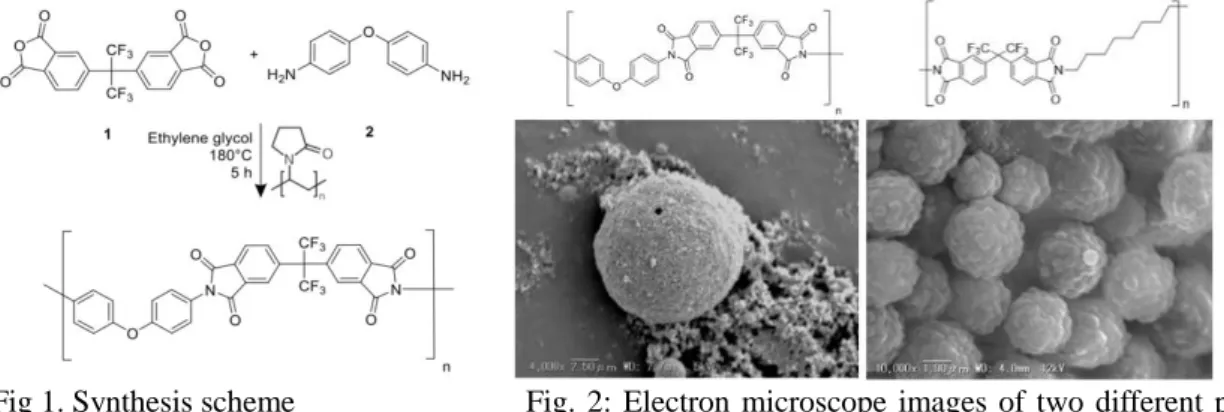
A general synthesis method is shown in Figure 1. Both monomers were dissolved in ethylene glycol and kept at elevated temperature for several hours.
The SEM image of a 10 µm microparticle synthesized by this method shows a very fine nanoscale surface decoration (Figure 2 (left)). Other combinations, especially those with aliphatic amines, gave polymer particles with smaller diameter (1-2 µm diameter) and larger surface ornamentation (100 nm), as can be seen in Figure 2 (right)
Fig 1. Synthesis scheme Fig. 2: Electron microscope images of two different pol- ymers.
A part of this work was conducted in Chitose Institute of Science and Technology, supported by Nanotechnology Platform Program (Synthesis of Molecules and Materials) of the Ministry of Edu- cation, Culture, Sports, Science and Technology (MEXT), Japan.