Establishing the First Shariah Compliant Private Equity Fund in Japan:
A Practical Way to Introduce the Concept of Islamic Finance in Japan
Tadashi Mizushima
1Abstract On March 31, 2014, the first Shariah compliant private equity fund (SPEF) was established in Japan. Taking this fund (the Fund) as an example, the author will explain how the concept of Islamic finance can be introduced in Japan.
Japan has had private equity funds since 1998. Although, there are now more than 200 private equity funds in Japan, there have not been any SPEFs before. In major international financial centers, such as New York and London, there are several SPEFs. The Fund was established in order to fill the gap in Japan. It provides opportunities not only to Japanese institutional investors but also Shariah compliant investors in Islamic countries to have investment opportunities to SMEs (small and medium-size enterprises), which are major investment target of the Fund, in Japan.
The Fund can provide scarce risk money to SMEs in Japan. It is structured to provide market access to Islamic countries for Japanese SMEs by understanding Muslim culture, obtainingHalalcertification, etc.
A major difficulty in preparing a SPEF in Japan is to make the fund Shariah compliant. This can be overcome by having the support of an Islamic, in the Fundʼs case, a Malaysian institution. Close communication among the General Partners, who are used to be working with Shariah constraints, and Limited Partners, who may not be, is key to success of the Fund.
The investment results of the Fund are yet to be seen, but the Fund demonstrates there is a way to implement the concept of Islamic finance proactively in non-Muslim environment.
Keywords:Islamic finance, private equity fund, Shariah compliance, investment fund JEL:F30, G29, F59, M29
1 Former Representative Director, PNB Asset Management (Japan) Co., Ltd. and Visiting fellow, Reitaku Institute of Political Economics and Social Studies. The views expressed here are solely those of the author in his private capacity and do not in any way represent the views of PNB Asset Management (Japan) Co., Ltd nor PNB Malaysia.
Journal of Economic Studies Vol.25, December 2017
INTRODUCTION: THE DEVELOPMENT OF ISLAMIC FINANCE IN JAPAN The author tries to explain the concept of Islamic finance first to the readers who are unfamiliar with Islamic finance. After that, the author explains the development of Islamic finance in Japan.
It will become clear why Islamic finance is not yet popular in Japan.
Islamic finance has been expanding throughout the world mainly because of an increase in the Islamic population and the economic development of Islamic nations. Islamic finance is gaining attention from Western financial circles due to its development as a source of additional revenue and its unique concepts as demonstrated in successful transactions provide a plausible alternative to the Western financial system which is sometimes explained as “conventional finance” in the context of Islamic finance.
The increasing Muslim population is a key factor. Currently it is estimated to reach 1.6 billion. If current trend in demographics continues, one in three people in the world will be Muslim in 10 years. The size of Islamic finance is currently said to be around US$1.631 trillion with an annualized growth rate of 20.4% for the past five years as of the end of March 2012.
2The total size is still smaller than the size of the worldʼs largest financial institutions, with 18 banks in the world having assets of more than US$1.631 trillion, according to The Bankerʼs magazineʼs World Ranking of Banks 2013. However, this market scale is expected to continue to show dramatic growth.
Islamic finance is a way to accommodate the values of Islam in financial activities. It is based on Shariah
3which is designed to promote social and economic justice. Shariah prohibits interest or usury (Riba), speculation or gambling (Maisir), excessive risk or uncertainty (Gharar) and oppressive practices. Muslims must evaluate business activities to determine whether the business is Halal (“permissible”), which can be handled, or Haram (“non-permissible”), which cannot be handled in financing. Haram business activities include (but are not limited to) the manufacturing or marketing of such products as alcohol, gambling or gambling activities, pork and pork related products, and certain forms of adult entertainment.
It is important to mention that Shariah specifies no finance is given without contracts (aqad) unless and until all contracts (aqad) meet the essential-must-have-elements as per follows: (i) Contracting parties; there must be a minimum of two parties to an arrangement; (ii) Subject matter of the contract; the product must be real, deliverable & must be owned by one party ; (iii) Form of the contract (offer (ijab) & acceptance (Qabul)); there must be an offer and an acceptance of the offer;
A simple example: a contract involving a prohibited product, such as alcohol or pork, is not acceptable. A more complicated example: in Indonesia, Ajinomoto products were once boycotted by consumers in Indonesia because of the rumors that Ajinomoto contains
2 Data From Edbiz Consulting (2013) Global Islamic Finance Report 2013
3 Shariah is sometimes mentioned as “Islamic law” by even Muslim scholars. The purpose of this paper is not to make research on Islamic law, but Shariah is not a “law” prepared by human legislation. Shariah is the Divine law of right and wrong. It is based on the basic concepts derived from the religious percepts of Islam, particularly from the Qurun and the Hadith. The term Shariah comes from the Arabic wordshariah, which means a body of moral and religious law derived from religious prophecy.
ingredients derived from pork. Financial contracts with Ajinomoto would be viable because Ajinomoto is producing non-permissible products.
The requirements (ii) and (iii) make it difficult to do derivatives transactions under Islamic finance. The Bank for International Settlement (BIS) announced that the balance of derivatives as of December 2013 was USD710 trillion. This number is ten times larger than the actual total GDP of the world economy.
4This abnormal growth of derivatives in the conventional finance world cannot take place in Islamic finance, which is strictly based on transactions of actual assets.
In addition to qualitative restrictions, there are three types of quantitative restrictions that are widely applied in investment activities. These are the result of deploying modern meanings from classic law(Table 1, page 7).
The first is debt availed by the company. This restriction is to exclude companies where interest-bearing debt liabilities exceed or equal one third (1/3) of the companyʼs total assets or market capitalization (depending on methodology used). This ration (1/3) is chosen by analogy to the hadith in Bukhari where the Prophet describes one-third as “quite enough.” This test is not applicable to Shariah compliant financing. You can borrow more than one third of total assets if you use Islamic financing.
Secondly, there are limitations on holdings of account receivables. The criteria are to exclude companies where account receivables exceed or equal one third (1/3) of the companyʼs total assets or market capitalization (depending on methodology used).
Thirdly, there are limitations on the cash plus interest bearing securities on a companyʼs balance sheet. It must be less than 33% of total assets or market capitalization (depending on methodology used). This test is not applicable to Shariah compliant financial assets. You can add more if you have utilized an Islamic way of investment.
These qualitative restrictions give the company more financial stability (having less debt) and more operating efficiency (having less cash and account receivables), which are particularly desirable when the economy is unstable and/or sluggish.
Contemporary Islamic finance has been a challenge for an alternative to conventional (Western style) financing, which is composed of interest-bearing loans and transactions. This finance can be achieved through the use of various Islamic contracts, such as sales, leases and partnerships, in place since the beginning of Shariah history. Islamic financing typically takes the form of (i) sales-purchase, and (ii) risk-sharing-investments. The use of these contracts in Islamic finance means a whole new way of doing business be it in banking, capital market transactions or takaful (Islamic insurance).
The demand for financing modes and investment vehicles that are in accordance with Shariah has impacted the growth of Islamic finance today. “Shariah governance” is typically described as “a set of institutional and organisational arrangements through which Islamic Financial Institutions (IFIs) ensure that there is an effective independent oversight of Shariah compliance over the issuance of relevant Shariah pronouncements, dissemination of information
4 BIS Derivatives Statistics 8 May 2014 “Amounts outstanding of over-the ‒counter (OTC) derivatives”
and an internal Shariah compliance review.”
5“Shariah compliance” is defined as “to describe financial activities and investments that comply with Islamic law, which prohibits the charging of interest and involvement in any enterprise associated with activities and products forbidden by Islamic law.”
6Japan has a developed financial market. The core concept of Islamic finance, however, is neither well understood nor popular in Japan. There are several studies on the Japanese legal system and how it prevents Islamic finance from gaining popularity.
7, 8Letʼs divide Islamic finance into the following groups. i) Islamic banking, ii) Sukuk (Islamic bond), iii) Takaful (Islamic insurance) and iv) Islamic investment, and find out which have potential in Japan.
ⅰ) Islamic banking
Japanese banking law does not allow banks in Japan to offer Islamic-style banking. Business of sales-purchase is prohibited to banks in Japan. Even if it were to become legally possible, Islamic banking would have difficulty gaining acceptance in Japan. The Muslim population in Japan is estimated to be only 100, 000 to 200, 000. With such a small supporting Muslim population, it would be difficult to have a debt-financing system specifically for them. Financial intermediation needs depositors and customers. The financial system is only workable when it has a large number of depositors and a correspondingly large number of customers. The Japanese authorities are sometimes criticized for the lack of Islamic banking in Japan. To be fair, whether or not they are slow in preparing the legal framework to enable Islamic banking in Japan, without public support of the system, the debt financing cannot take root.
This situation is not peculiar to Japan. In the financial centers of New York, London or Shanghai, all of which have insufficient Muslim population densities, it is difficult to develop Islamic banking markets based on domestic activities. If we talk about off-short based banking transactions at the financial centers, particularly in London, there is some euro-dollar based transactions, as the off-shore based transactions do not require the fundamentals of depositors and customers.
Japanese banks can and do offer Islamic banking outside Japan where there is demand.
Japanese mega-banks have established Islamic banking subsidiaries in Malaysia, and have started Islamic banking services there. They can do so where there is sufficient density of customers and depositors.
ⅱ) Sukuk (Islamic bonds)
Japanese tax authorities have amended taxation rules on sukuk (Islamic bonds), in 2011. The amendment makes it easier for Japanese investors to invest in sukuk without incurring double
5 Islamic Financial Services Board (IFSB), 2009, IFSB-10, Kuala Lumpur
6 QFinanceʼs Dictionary, “Definition of Shariʼah Compliant” www.qfinance.com reviewed on November 1, 2013 7 Kazuo Tawara. Islamic Finance Transactions under Japanese Transactions (original in Japanese), March 2009. Kyoto
Bulletin of Islamic Area Studies
8 Etsuaki Yoshida (2014) Japan- A Comprehensive Picture of Islamic Finance. Chapter12. The Islamic Finance Handbook. Kuala Lumpur
taxation. There has been, however, no issue of sukuk in Japan. The reason is simple. There is no demand and supply of sukuk in Japan.
Who will be issuers of sukuk in Japan? Letʼs look at sukuk issuers in Malaysia, the most popular market for sukuk issuance with a 68.8% market share of USD 119.7 billion world-wide.
More than 60% of the issuers in Malaysia are government/governmental agencies, followed by financial institutions, 10%, and power & utilities, 9.4%.
9Those foreign issuers who are thinking about fund raising in Tokyo are also looking at the Samurai Bond market, i.e., the JPY-denominated bond market for foreign issuers in Japan. If they are looking for a low interest rate of Yen debt, the choice is most likely to be Samurai Bonds over sukuk. Currently, it is much simpler to issue Samurai Bonds than to take the difficult route for the first sukuk issuance.
How about Japanese issuers? If they look for Yen financing, bank loans and corporate bonds are easier and cheaper alternatives than sukuk.
On the investor side, there is a deep layer of institutional investors, such as banks and insurance/takaful companies in Malaysia, who are looking for Shariah-compliant-financial- instruments with long-term fixed-rate returns. This makes demand for sukuk very high in Malaysia, because there are no other Shariah compliant instruments that have a fixed rate of return.
Japanese institutional investors have access to many different financial instruments that have fixed rate returns, and so Japanese institutions will buy sukuk only when they can get better returns from them.
If we talk about the Malaysian market, the situation is different. Japanese institutions can issue sukuk if they feel it a reasonable way of financing, because there is a demand for sukuk in Malaysia. The Bank of Tokyo Mitsubishi UFJ, the largest bank in Japan, is reported to be issuing sukuk through its Malaysian subsidiary. (Nikkei Asian Week, June 4th, 2014) Other Japanese firms like Aeon Credit Malaysia, Toyota (Malaysia) and Nomura have issued sukuk already in Malaysia. For clarification, Nomura sukuk was issued in USD while the others were issued in Malaysia Ringit.
ⅲ) Takaful (Islamic insurance)
Islamic insurance is called takaful. In the Japanese market, takaful has not been introduced because there is no demand. Conceptually, insurance does not contradict the practices &
requirement of Shariah, however Muslim jurist are of the opinion that the operation of conventional insurance does not conform to the rules and requirements of Shariah as it involves the element of uncertainty (gharar) in the insurance contract, gambling (Maysir) as the consequences of the presence of uncertainty and interest (riba) in its investment activities.
Takaful is structured around the Tabaru concept whereby a group of participants mutually agree among themselves to guarantee each other against loss or damage that may inflict upon any of them by contributing as donation or Tabaru in the takaful fund. This concept is to
9 2013 Annual Global Sukuk Report. January 2014. Rasameel Structured Finance
eliminate the element of uncertainty in the takaful contract.
In terms of its primary objective however, both takaful and conventional insurance shares the same objective of risk protection with the principal difference being the manner in which the objective of risk protection is achieved. As conventional insurance already provides risk protection, the majority of Japanese consider conventional insurance as sufficient. Should the Muslim population become larger, Japanese insurance companies may offer takaful at some point.
Takaful is not importable into Japan, but Japanese insurers can readily convert their product into takaful for outbound marketing into Islamic countries.
Tokio Marine was one of the innovators of takaful outside Japan. In the early 2000s, it started a takaful business in Saudi Arabia, Singapore and Indonesia. In 2006, a JV company to offer takaful was established in Malaysia. Tokio Marine got a takaful license in Egypt in 2008.
Takaful represents a new business frontier for Tokio Marine and other insurance companies in Japan.
ⅳ) Islamic investments
A risk-sharing investment is permissible under Shariah. So, this is the area where Japanese financial institutions can promote Islamic finance concepts without much difficulty.
In fact, Japanese securities companies floated mutual funds that label themselves “Shariah mutual funds.” There are two publicly placed Shariah mutual funds. One is “Daiwa FTSE Shariah Japan 100,” which was listed on the Singapore Stock Exchange on May 20, 2008. The fund itself is not Shariah compliant, but the selection of the stocks is based on Shariah-compliant screening methods created by FTSE. There are several methods of stock selection, and the widely used method is shown on Table 1. The fund, managed by Daiwa Asset Management Co., Ltd., attracted only about USD7.5 million and was closed on March 31, 2012.
Another fund is “Japanese Equities based on Value and Shariah Screening,” which was placed by Mitsubishi UFJ Securities on April 30, 2008. The manager is BNP Paribas Investment Partners. This is also not strictly a Shariah compliant fund as only its screening methodology is based on some specific Shariah methods developed by Deutsche Bank. The NAV as of May 31, 2014, is JPY 1.3 billion, which is also small for a public fund. Unit price as of May 31, 2014, was JPY 10,400. The fact that those two funds were launched in April-May 2008 shows that there was a perception of some enthusiasm for Islamic finance in Japan at the time.
The Tokyo Stock Exchange was not an exception in this enthusiasm. It announced an S&P/TOPIX 150 Shariah Index in December 3, 2007. The index was created from S&P/TOPIX 150 by selecting Shariah compliant stocks. The index, however, has not been used widely to date.
The positive mood for Islamic finance in Japan during 2007-2008 has since dissipated
without leaving truly Shariah compliant finance, because the employment of Islamic finance did
not bring any significant business opportunities to Japanese financial institutions. Also, the
global financial crisis from 2009 diverted financial institution attention away from Islamic
financing.
One interesting fact is the distinctive difference in performance of TOPIX and TOPIX Shariah. Period 1 is a period where the stock market in Japan rapidly advanced under the early days of Abenomics championed by Prime Minister Shinzo Abe, who was elected in late 2012.
During this booming period for public equity, the conventional TOPIX outperformed the Shariah index by more than 1800bps. Period 2 is regarded as an adjustment period after the initial boom. During this period of adjustment, TOPIX Shariah outperformed TOPIX by over 500bps.
Table 2 reflects the Shariah indexʼs exclusion of stocks in the financial sector, which have had high volatility following the recent financial crisis. The index does not include companies with heavy debt, i.e., less stable, and companies with high cash and account receivables, i.e., less efficient. This nature of Shariah screening works defensively in adverse market conditions. In the equity investment industry, “smart beta” has become very popular. Smart beta will give better performance by comparing a stock to an index-based investment. The author believes there is a way to create a smart beta by having Shariah screening as a key element in forming a portfolio.
Private equity (PE) investment is another area where Islamic finance concept can be used in Japan. The nature of the PEinvestment itself, risk-taking and nurturing business, is not violating Shariah compliance. Japan has a well-developed PEfund market, but there have been no Shariah compliant PEfunds up until now. On April 1, 2014, the first Shariah PEfund was established in Japan. In the next chapter, the author will explain the PEmarket in Japan and why it was difficult to establish the fund which is regarded as Shariah-compliant in Japan from
Table 1 Comparison of Typical Screening Methodologies (as of December 2014) Dow Jones Islamic Mar-
ket Index
MSCI Global Islamic FTSE Shariah Global Equity Index
AAOIFI Business ac-
tivity Negative list Negative list Negative list Negative list
Company debt
Total Debt/Market Cap must not exceed 33%.
Total Debt/Total As- sets must not exceed 33%.
Total Debt/Total As- set must not exceed 33%.
Total Debt/Total As- set must not exceed 30%.
Tradability Account Receivables /Market Capmust not exceed33%.
Account Receivables /Total Assetsmust not exceed33%.
Account Receivables /Total Assetmust not exceed50%.
Account Receivables /Total Assetmust not exceed70%.
Interest ear- nings
Cash plus Interest- bearing Securities /Market Capmust not exceed33%.
Cash plus Interest- bearing Securities /To- tal Assets must not exceed33%.
Cash plus Interest- bearing Securities /To- tal Assetmust not ex- ceed33%.
Cash plus Interest- bearing Securities /To- tal Asset must not ex- ceed30%.
Table 2Comparison of Performance, TOPIX vs. TOPIX Shariah Period 1 = Boom
2012/12/30-2013/12/30
Period 2 = Shaky 2013/12/30-2014/5/23
TOPIX +51.46% -9.36%
TOPIX Shariah +36.29% -4.08%
Difference -18.1% +5.09%
the standpoint of a General Partner of the Fund.
1. PRIVATE EQUITY FUND MARKET IN JAPAN
Private equity means stock that is not publicly listed. Because of this, private equity usually has less liquidity than public equity. Broadly, however, private equity can offer superior returns to investors. There are three types of private equity investments: venture capital, buy-out and turnaround.
Types of PE Investment
ⅰ) Venture capital (VC) investment
VC usually means an equity investment in small-to-medium sized companies with the potential of exceptional growth where investors sometimes can enjoy a very high return through an initial public offering (IPO). Since investors put in money at an early stage, the risk of loss on an individual investment is high, but a winner or two in a portfolio can justify the risk.
In Japan, there are 51 registered VCs as of December 2015 according to the Japan Venture Capital Association (JVCA), the VC industryʼ s organization.
10JVCA announces industry statistics from time to time, and the most recent report was as of December 2011. The snapshot of the VC market in Japan is shown in Table 3.
Table 3 The Market Size of Venture Capital in Japan as of December 2011 Investments per year Funds raised per year Balance of investment JPY 24.6 billion JPY 39.0 billion JPY 649.5 billion
An organization called Venture Enterprises Center (VEC) is a research center which promotes venture business under the guidance of Ministry of Economy, Trade and Industry (METI). VEC issues annual report on VC activities in Japan. According to the report for the year 2014, the VC fund raised in Japan was JPY 91.1 billion, and investment done was JPY 117.1 billion for 2014.
11There is a big difference in the numbers from JVCA and VEC, but, the amount is still quite small if we consider the size of financial business in Japan.
ⅱ) Buy-out investment
Buy-out investments usually look for investment opportunities where the target company can produce cash flow. In fact, the value of the target company is assessed on the basis of the amount of cash flow the company generates. Since buy-out investments deal with later-stage companies compared to VC investments, the individual risk is less, on average. In typical buy-out investments, the investor often puts up as much debt as the investment target can carry: the higher the debt, the higher the return on equity. This is the effect of leverage. When the buy-out investment involves high leverage, it is called a leveraged buy-out or LBO.
In Japan there are 25 buy-out investment firms as of December 2015 according to the
10 Japan Venture Capital Association www.jvca.jp 11 Venture Enterprises Center www.vec.or.jp
Japan Private Equity Association, the buy-out industry association.
12Japan Buy-out Research Institute Corporation (JBORI) summarizes buy-out fund activities. The development of the buy-out market in Japan is summarized in Figure 1.
Both fund raising and investment of buy-out funds peaked in the late 2000s. Since 2010 the market has become inactive, but from 2013, there has been some renewed uptrend in fund raising. Investment activity also started to increase recently. An active stock market is a help to private equity investment, also. As long as Abenomics appeals to overseas investors, who account for a large share of market capitalization, the recovery trend of private equity will continue.
ⅲ) Turnaround investment
Turnaround investment is usually to a mature company that is facing difficult financial and operational conditions. The company already has substantial debt and does not have enough cash flow to pay it back. The investment manager becomes the turnaround manager, and leads the restructuring with the aim to reduce debt and increase the return on equity.
There are no statistics on the number of turnaround funds in Japan. Taking into account that each regional bank has established at least one turnaround fund in its prefecture, it is easily estimated that there are more than 50 turnaround funds in Japan. The total investment amount should be more than JPY 100 billion, assuming each fund has an average balance of JPY 2 billion.
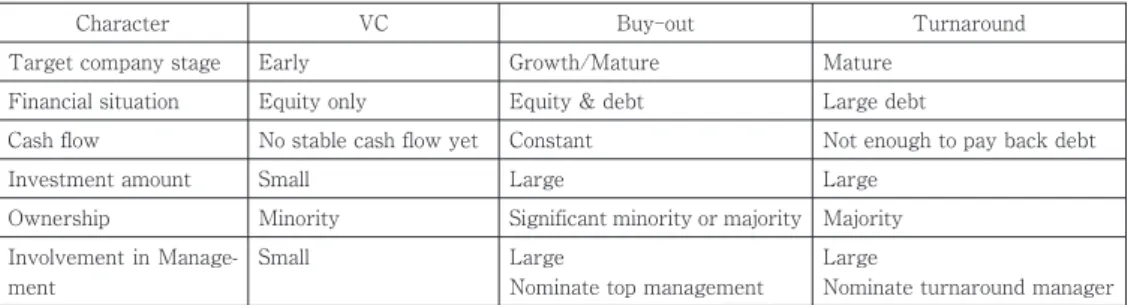
Table 4 shows the comparison of VC, buy-out and turnaround investments.
12 Japan Private Equity Association www.japanpea.jp
Figure 1 Annual Movement of Japanese PE Fund
2013 2012 2011 2010 2009 2008 2007 2006 2005 2004 2003 2002 2001 2000 1999 1998 1997 0.0 200.0 400.0 600.0 800.0 1,000.0 1,000.0 1,400.0 (Billion Yen)
Fund Raised Fund Invested
Table 4 Comparison of Three Typical Types of PE Investment
Character VC Buy-out Turnaround
Target company stage Early Growth/Mature Mature
Financial situation Equity only Equity & debt Large debt
Cash flow No stable cash flow yet Constant Not enough to pay back debt
Investment amount Small Large Large
Ownership Minority Significant minority or majority Majority Involvement in Manage-
ment
Small Large
Nominate top management
Large
Nominate turnaround manager
Regulatory Framework of PE funds
Managing a PEfund thorough a limited partnership is the most plausible way to start investment banking and/or fund management business in Japan. There is a big regulatory difference between liquid assets funds (usually offered through public placement) and illiquid assets funds (usually offered through private placement).
Pursuant to the Financial Instruments and Exchange Law (FIEL), you may not engage in a
“financial instruments and exchange business” in Japan unless you have been registered as a
“financial instruments and exchange business operator” or unless an exemption from registration is available.
The General Partner of the Fund, which is structured as a limited liability partnership, who plans to market the Fundʼs interests to Japanese investors, is required to file a Form 20 with Kanto Finance Bureau, a regional organization under Financial Services Agency. Once approved, the GP can solicit to any number of QIIs ‒ qualified institutional investors, such as insurance companies and bank, as well as up to 49 investors resident in Japan who are not QIIs.
Regulatory issues can be summarized as follows:
Table 5 Regulations on Equity Related Transactions in Japan
Type of Equities Sales of Securities Fund Management
Liquid / Public Equity through public-offering
Not allowed
Sales license is needed
Not allowed
Fund management license is needed Illiquid / Private Equity
with QII exemption
Allowed
GP can raise funds
Allowed
GP can manage funds
Tax Rules on Foreign Investors of Japanese Limited Partnerships
Usually PEfunds take the form of a Limited Liability partnership. Whether it is a Limited Partnership registered in the Cayman Islands, in Labuan or in Japan, the most important element of the limited partnership is its “conduit” nature. The limited partnership should not be taxed, and the revenue of the partnership, whether it is a capital gain or income gain, should be distributed to the partners, who are responsible individually for their taxes.
When a foreign investor joins a PEfund in Japan as a Limited Partner (LP), if the LP is
regarded to have a permanent domicile in Japan, the income from the partnership will be taxed
in Japan. A permanent domicile is a fixed place of business that is regarded as generating income or incurring tax liability. A foreign fund investor who meets all the conditions below and fulfills filing requirements as a Specified Foreign Member is treated as not having a permanent domicile in Japan. The requirements are as follows:
⑴ The member must be a limited liability member (LP).
⑵ The member must not execute the fundʼs business activities.
⑶ The percentage of the memberʼs interest in the fundʼs property aggregated with the interest held by the memberʼs special affiliates must be less than 25%.
⑷ The member must not be a special affiliate of an unlimited liability member (GP).
⑸ The member must not hold a permanent establishment in Japan other than the permanent establishment of the fund.
In short, if a foreign investor becomes a limited partner of the fund by having less than 25%
ownership of the entire fund, and does not have affiliation with the General Partner, its interest is not taxable in Japan; the income/gain from the fund can be distributed to the limited partner without incurring any tax in Japan.
2. SHARIAH COMPLIANT PE FUND
According to the Guidelines and Best Practices on Islamic Venture Capital from the Securities Commission, Islamic VC requirements are defined as follows:
⒜ An independent Shariah adviser
13must be appointed to provide expertise and guidance on conformance to Shariah principles in all matters of the Islamic VCC (Venture Capital Company) or VCMC (Venture Capital Management Company); and
⒝ The activities of the venture companies must be Shariah compliant, Non-permissi- ble activities include:
+ Financial services based on riba (interest);
, Gambling/gaming;
- Manufacture or sale of non-halal products or related products;
. Conventional insurance;
/ Entertainment activities not permissible according to Shariah;
0 Manufacture or sale of tobacco-based products or related products;
1 Stock broking or share trading in Shariah non-compliant securities; and 2 Hotels and resorts.
By ijtihad,
14other activities the Shariah adviser may deem non-permissible.
Those conditions are basically not different from the general requirements in Islamic finance. The number one priority is to keep Shariah compliance, and the process to guarantee it is to have a Shariah adviser, usually by establishing a Shariah Advisory Board comprised of
13 Shariah adviser means a person or a company approved and registered with the Securities Commission as a Shariah adviser, or recognized or appointed by a foreign financial services provider as a Shariah adviser. (Definition by the Guidelines)
14 Ijtihad: Reasoning by qualified scholars to obtain legal rulings from the sources of the Shariah.
experienced Shariah scholars.
Although those requirements are not new, there has never been a Shariah compliant PE fund in Japan. The reason was the same as that for Islamic banking. There was no demand and supply of such funds in Japan. On the demand side, Japanese companies do not need such funds because there are many finance providers. On the supply side, Japanese investors are not interested in such funds because they are not Shariah-oriented investors.
However, the situation has changed recently. On the demand side, there appears to be more demand for risk money, but the supply of risk money is limited as shown on Table 1 and Table 2.
Even combining VC and PE, the supply of risk money was less than JPY 400 billion, which is less than 0.1% of Japanʼs GDP. Whether it is Shariah compliant or conventional, there is a demand for risk money. On the supply side, Islamic investors have started paying attention to Japanese PE funds, mainly because of the active stock market in Japan in 2013. The time has come to create the first Shariah compliant PEfund in Japan.
Fund Structure
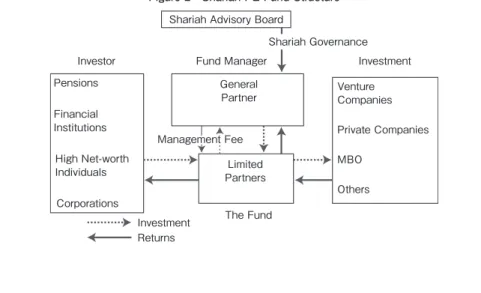
A typical Shariah PEstructure is shown in Figure 2.
An investor joins the fund as a limited partner, and provides risk money to new ventures, private companies and management buy-out opportunities. The fund manager usually becomes the General Partner and takes responsibility for selecting good investment opportunities to improve the investeeʼs operation and create value for the limited partners. The General Partner takes his/her portion of the success from the investment that he/she manages. This is basically the same idea as Musharakah in Islamic finance. Musharakah is defined as follows.
15“Musharakah (Partnership) : The Shafi’ is defined it as an establishment of collective rights (pertaining to some property) for two or more people”
Figure 2Shariah PE Fund Structure
The Fund
Others MBO
Private Companies Venture
Companies Investment
Limited Partners Management Fee
General Partner Fund Manager
Corporations High Net-worth Individuals Financial Institutions Pensions
Investor
Shariah Governance Shariah Advisory Board
Returns Investment
15 Dr Wahbah Al-Zuhayli, Financial Transaction in Islamic Jurisprudence Volume 1,trans. Mahmoud A. El-Gamal (Damascus : Dar al-Fikr 2001) 447
Shariah Advisory Board
The major difference between conventional PEfunds and Shariah compliant PEfunds is the existence of a Shariah Advisory Board (SAB). In Figure 2, note the SAB on top of the organization chart.
The SAB is a key element in the structure of an Islamic institution, and comprises of Shariah experts particularly in fiqh al-mu’amalat (a branch of Islamic jurisprudence that deals with commercial and business activities in an economy, or Islamic commercial law in short) and Islamic finance. As committee members they are entrusted with the duties of directing, reviewing and supervising the activities related to Islamic finance in order to ensure that they are in compliance with Shariah rules & principles at all times. SAB will deliberate and decide on investments made by the fund management company comply with Shariah screening but also that the operation of the entire fund satisfies the requirements of Shariah. Since we have PNB, which has its own SAB, as a partner to the Shariah PEFund, there are three alternatives in establishing a SAB.
ⅰ)The Fundʼs compliance is included in the overall Shariah compliance of PNB, which is catered for by its Shariah supervisory board.
ⅱ)The Fundʼ s compliance is segregated from PNBʼ s but the Fundʼ s Shariah supervisory board is organized as a subset of the same members as PNBʼs.
ⅲ)The Fundʼs compliance is fully segregated from PNB and the Fund appoints its own Shariah supervisory board.
Alternative ii) was selected at the first Shariah-compliant PEfund in Japan, as such structure is simple, effective and cost efficient to a start-up fund.
Three Stages of Shariah Screening
There are three stages to implement Shariah screening, which guarantees the compliance of a Shariah compliant PEfund. Three stages are the Setting up Stage, the Review and Monitoring Stage and the Annual Audit Stage.
ⅰ) Setting Up Stage
Setting up a fund is a one-time process requiring a Shariah compliant framework to ensure all services are delivered with due regard for Shariah requirements.
The setting-up process is split into three steps, namely Structuring, Reviewing, and Endorsing.
a) Structuring: Design the structure of the proposed PEfund to be Shariah compliant b) Review and Monitoring: Shariah review of legal documents for the fund, such as the limited partnership agreement, private placement memorandum, and all legal documents governing the fundʼ s constitution, marketing materials, investment guidelines, appointment and terms of the Shariah advisory board.
c) Endorsing: The output is a Shariah endorsement of the fund on the agreed structure
and legal documentation related to the fund.
ⅱ) Review and Monitoring Stage
The review and monitoring stage is divided into three steps, namely, Reviewing, Benchmarking and Endorsing.
a) Reviewing: Shariah review of fund activities on a periodical basis to ensure that the fund is managed and operated in accordance with the Shariah precept.
b) Benchmarking: The fund manager needs to adopt one of the widely accepted screening methodologies shown in Figure 3. Whichever methodology the fund accepts, it usually covers two (2) areas: Core Activities Screening and Financial Ratios.
c) Endorsing: Report on the review should be prepared periodically, and certified by the Shariah Advisory Board.
ⅲ) Annual Audit Stage
An external Shariah audit should be done annually to ensure that the structure of the fund and the fund activities are in line with Shariah principles. Shariah audit processes are composed of three steps, as follows.
a) Audit of financial statements: Independent assessment and objective assurance to ensure a sound and effective internal control system for Shariah compliance.
b) Compliance audit on organizational structure, people and processes: Scope of Shariah audit to cover all aspects of business operations and activities.
c) Review on adequacy of the Shariah governance process: Provide recommendations to the audit committee and Shariah advisory board.
Non-Compliant Situations
A periodic assess review must be conducted to the Shariah compliant funds or products. If a security in the fund or product changes status from Shariah compliant to non-Shariah compliant, then the SAB will decide whether or not the security should be processed for purification.
Purification is a process whereby the non Shariah compliant elements is identified, calculated and the tainted fund income to be channeled to approved charitable entities by SAB..
There are two main approaches for purification of equity stocks:
Dividend Purification
Prohibited Income/Total Income x Dividend Received Non Permissible Income Purification
Total Prohibited Income (including interest income)/Number of Issued Shares (at the end of the period) x Number of Shares Held
In the event where the fund or investment is regarded as non-Shariah compliant due to
several factors (i.e., sudden market/economy changes, mixture of Halal & non Halal goods,
stock reclassified as non Shariah compliant, gaining income from void transaction due to
absence in one of essential element in contract. etc), the GP Company should take necessary
action to resolve the situation upon purification is endorsed by SAB. Since it may take time to
adjust the situation at the investee company, as well as to see the investment, the GP Company may be provided enough time, likely six (6) months, to amend the situation.
16Actual Shariah Screening Process
How is the screening process conducted at a Shariah PEFund? In the process to complete one deal, usually, the following steps are taken.
Deal Sourcing
Due Diligence (preliminary)
First Investment Committee Meeting Shariah Review of the Deal
Due Diligence (if needed)
Second Investment Committee Meeting
The Shariah review of the deal, which is set between two investment committee meetings, is unique to Shariah PEfunds. Other steps are not different from those of conventional PEfunds.
The GP Company does its own Shariah screening in the first due diligence process by utilizing the negative list of the business and financial ratio analysis.
Figure 3 Shariah Screening in the Deal flow
・Hands-on support for business growth
・Periodical report to LPs
・Shariah advise when needed
・Annual Shariah au- dit
Investment and Follow-up
・Final investment decision
・Capital Call No- tice be sent to LPs
2nd investment Committee
・Shariah review by Shariah Advisors, 㾎Business line 㾎Financial ratio 㾎Other concerns Shariah Screening
・Discuss invest- ment opportunity by experienced members 1st Investment Committee
・DD on 㾎Business Plan 㾎Tech + IPs 㾎Market & Social
needs 㾎HR
㾎EXIT and Return Due Diligence (3‑4 deals /month)
・Regional banksʼ introduction
・Carving out from large corpora- tions
・Introduction from local government Deal
Sourcing
As the fund is first Shariah compliant PE fund in Japan, it will be reviewed by Shariah Advisory Board at PNB and will be audited by an external Shariah advisor
16 For the general risk on Shariah non-compliance, see following article: Tadashi Mizushima. Corporate Governance and Shariah Governance at Islamic Financial Institutions: Assessing from Current Practice in Malaysia.Reitaku Journal of Interdisciplinary Studies. Volume 22, No.1, Spring 2014, pp. 59-84.
3. THE FIRST SHARIAH COMPLIANT PE FUND IN JAPAN
Let me introduce the first Shariah PEfund in Japan. The fund is called “PNB-INSPIREEthical Fund 1.” Taking this fund (the Fund) as an example, we will analyze why the first Shariah compliant PEbecame possible in Japan.
Investment Strategy
The purposes of the Fund are, among others:
a) To support SMEs in Japan, which has an international competitive edge in high-tech, clean-tech and green-tech areas;
b) To facilitate the expansion and introduction of Japanese SMEs with innovative technologies to Islamic and Asian countries through Malaysia as a gateway; and
c) To provide institutional investors with a new asset class of investments.
Fund Structure
The Fund has a GP Company called PNB-INSPIREPartners Co. This is a 50:50 joint venture company between PNB Japan and INSPIRE. INSPIRE, a limited company in Japan, has managed several venture capital funds and has a good track record. The GP Company has a management team with extensive experience in managing a PEinvestment company.
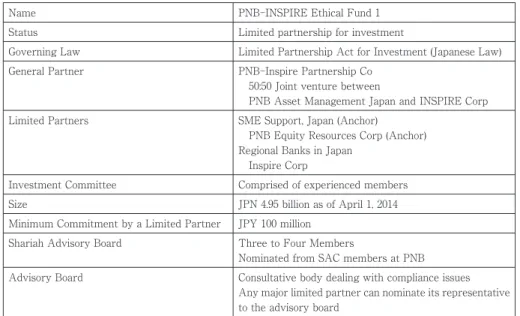
PNB-INSPIREbecame a Japanese limited partnership because of a request from the largest contributor to the fund, SMESupport, Japan. As a governmental entity, SMESupport, Japan is not allowed to join a limited partnership under foreign jurisdiction such as Cayman or Bermuda. The summary of the Fund is shown below.
Table 6 Summary of the First Shariah Compliant PE Fund in Japan
Name PNB-INSPIREEthical Fund 1
Status Limited partnership for investment
Governing Law Limited Partnership Act for Investment (Japanese Law)
General Partner PNB-Inspire Partnership Co
50:50 Joint venture between
PNB Asset Management Japan and INSPIRECorp
Limited Partners SMESupport, Japan (Anchor)
PNB Equity Resources Corp (Anchor) Regional Banks in Japan
Inspire Corp
Investment Committee Comprised of experienced members
Size JPN 4.95 billion as of April 1, 2014
Minimum Commitment by a Limited Partner JPY 100 million
Shariah Advisory Board Three to Four Members
Nominated from SAC members at PNB Advisory Board Consultative body dealing with compliance issues
Any major limited partner can nominate its representative to the advisory board
Another anchor investor is PNB Equity Resources Corporation (PERC), a subsidiary of
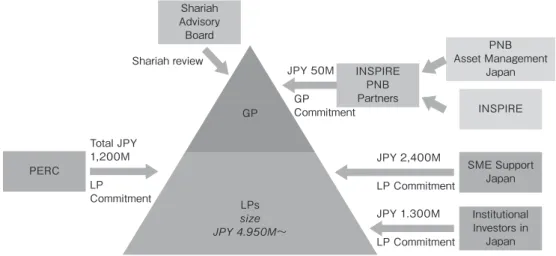
PNB, which has less than 25% of the ownership because of the aforementioned consideration of domicile. Although the Japanese limited partnership was a new experience to PERC, a detailed legal review by both Malaysian and Japanese law firms made it possible for PERC to join the partnership.
The GP has the support of a Shariah Advisory Board to make the operation of the Fund Shariah compliant.
Figure 4 Structure of PNB-INSPIRE Ethical Fund 1
Institutional Investors in
Japan SME Support
Japan INSPIRE
PNB Asset Management
Japan
LP Commitment JPY 1.300M LP Commitment JPY 2,400M INSPIRE
PNB Partners GP
Commitment JPY 50M
PERC LP Commitment Total JPY 1,200M
Shariah Advisory Board Shariah review
LPs
〜
GP
Fund Raising
The critical element to establishing a fund is fund raising. However magnificent the fund concept is, it is impossible to establish a fund without raising capital. PNB-INSPIREhas moved strategically to raise funds. GP Companyʼs strategy was as follows.
ⅰ)To secure a reputable overseas partner, a Shariah investor, to the Fund
ⅱ)To secure a reputable anchor partner in Japan
ⅲ)To find limited partners in Japan who are helpful in deal sourcing
As a result of this fund raising effort, the Fund was able to have the first close on March 31, 2014, with JPY 4.95 billion.
Deal Sourcing
The Fund has four regional Japanese bank LPs, namely Hokuto Bank, Shonai Bank (both in northern Japan), Hiroshima Bank (in western Japan) and Oita Bank (in southern Japan) as the first-closing-invesotrs. There is one LP that is a leasing company, Fuyo General Lease (in Tokyo), as a first-round-contributor.
The GP is working hard with those limited partners to source good investment
opportunities throughout Japan. It is sometimes difficult for the GP to approach regional
companies with a long history and established management. In such cases, regional banks act as
door openers to their management.
Investment Structuring
The Fund will propose to establish a joint venture with local companies in Japan. Those companies are usually reluctant to give equity ownership to outsiders, particularly to investment funds. They will listen to the story of Halal markets and accept equity partnership by the Fund if they think the Fundʼ s investment would be beneficial. There are many food-processing companies that fall into this investment structure.
The Fund is also looking for minority ownership of newly started venture businesses or carved-out businesses from large corporations. In such cases, the Fund will make direct investments in companies that need capital for growth.
As for Monitoring, Value Creation and Exit, the author is seeking another opportunity to discuss these areas in detail as the Fund evolves.
4. INVESTMENT OPPORTUNITIES FROM A SHARIAH PERSPECTIVE The Fund has several opportunities for investment. By analyzing those cases, it will become clear how the Shariah review will affect fund operations and how Shariah concepts can be
“positively” utilized to realize the notion of Shariah.
Case 1 Sauce Manufacture Name of the Company ABC Sauce Manufacturing Co.
Business Production of Traditional Japanese Sauces and Vinegars Background Long established regional giant company
Annual Sales About US$200 million
What do they need? ・Support to expand to overseas markets
・Support to enter into the Islamic market
・Reliable partner in Malaysia
What can the Fund offer? ・Connection to JAKIM and HDC, and assistance to get halal certification
・Connection to SMECorp, Malaysia, and assistance to find a partner in Malaysia Shariah Compliant? Need to make the entire production process Shariah compliant.
All ingredients should be halal.
Investment from the Fund Possibly US$5 million, in order to install a new production facility in Malaysia
Exit Sale to ABC Co.
Positive Meaning in Shariah Compliance
The Fund will facilitate a traditional Japanese companyʼs efforts to start producing halal products.
Case 2Immuno-Cell Therapy Name of the Company DEF Medical Co.
Business Produce cells for immuno-cell therapy Sell those cells to clinics and hospitals Background Newly established in early 2014 Annual Sales US$ 5 million in 5 years What do they need? ・Capital for growth
・Support to get into Islamic markets through Malaysia
What can the Fund offer? ・Connection to PNB, and assistance in finding a partner in Malaysia
・Capital for growth
Shariah Compliance? Materials used to produce immuno-cells contain material from mice.
Investment from the Fund Possibly US$2 million to install a new production facility in Tokyo to meet increased demand.
Exit IPO
Comparables: Tella (TSE2191) Medinet (TSE2370) Positive Meaning in Shariah
Compliance
Immune cell therapy is the fourth treatment for cancer after surgery, radiation and chemotherapy. There are no clinics or hospitals that offer this treatment in Malaysia yet.
The Fund will help introduce this new cancer remedy in Malaysia if the process is judged as Shariah compliant.
Case 3 Cloud Data Storage Name of the Company GHI Data Co.
Business Software provider of an on-line back-up storage system Sales of the software though large vendors
Background Established in 2013
Annual Sales US$ 60 million in 5 years What do they need? ・Capital for growth
・Support to get into Islamic markets through Malaysia
What can the Fund offer? ・Connection to PNB, and assistance in finding a partner in Malaysia
・Capital for growth
Shariah Compliant? Provides software thorough OEM. No control of end-usersʼ line of business.
Investment from the Fund Possibly US$1 million to increase R&D expenses.
Exit IPO
Comparables: Sugar Sync, Dropbox and Zenprise Positive Meaning in Shariah
Compliance
The Fund will request investee company to promote the business to be used by Halal end-users.
Case 4 Medicine for Animals Name of the Company KLM Animal Co.
Business Production of medicine for animals
Production of nutritional supplements for pets
Background Established in 1950s
Annual Sales US$300 million
What do they need? Advice on Halal medicine and supplements for animals.
May need a partner in Malaysia What can the Fund offer? ・Introduce JAKIM and HDC
・Connection to PNB, and assistance in finding a partner in Malaysia
Shariah Compliant? JAKIM does not have standards for medicine for animals or supplements for pets.
Investment from the Fund Possibly US$5 million to install a new production facility in Malaysia to start production of halal animal medicine and halal supplements for pets.
Exit Sale to KLM Animal Co.
Positive Meaning in Shariah Compliance
This is a path finding effort for KLM to produce halal products in animal medicine and supplements for pets.
Among those four potential deals, the investment to Case 3 was done from the Fund in July 2015. The name of the investee is Keepdata, and the initial investment amount was Yen 80 million.
The money from the fund is used to R&D at the firm. The firm is currently expanding its business form cloud-data-base provider to a solution provider in big-data storage and big-data analysis. The money from the Fund keeps financial ration at the Company Shariah-compliant, which is preferable to a start-up company because of its small dependence on bank loans.
17Except Case 3, other deals have not come to actual investment yet and business due diligence is not yet done. The feasibility of the project and the investment conditions are yet to be determined. But if these deals are realized, the following positive effect will take place from the standpoint of realizing Shariah.
Case 1 is a typical example to recommend Japanese companies to start production of Halal products in Malaysia. This has a strong positive impact on Shariah compliance on food production.
Case 2 is a good example to introduce a Halal way of treatment to Islamic countries.
Case 4 is a way to prepare a Shariah standard where there were no standards before.
Making a standard is a strong step toward realizing Shariah compliance.
CONCLUDING REMARKS
Japan is late among developed economies in accepting Islamic finance. Islamic banking, Sukuk (Islamic bond) and Takaful have yet to become popular in Japan. There are several plausible reasons for the current situation, such as a small Muslim population, the availability of a wide variety of other financial products and no identifiable demand or supply of Islamic products.
Although debt instruments are more complex to make them Shariah compliant, securities investments are easier to be Shariah compliant. Private equity investments bear similarity to Musharakah, and it could be introduced to Japan easily. Having said so, there was no Shariah compliant PEfund in Japan before April 2014.
PNB INSPIREEthical Fund 1 is the path finder of Shariah compliant PEFunds in Japan.
This fund was realized because many parties found it is desirable to have one in Japan.
;Japan needs a risk money provider to SMEs.
;Japanese SMEs need some reliable funds that can give not only money but also advice in conducting business in Islamic countries.
;Islamic investors are looking for Shariah compliant investment products in Japan.
; Japan has reemerged in the investment universe because of Mr. Abeʼ s dynamic economic policies.
These conditions made the first Shariah PEfund possible in Japan.
The Fund has just started. The Fund has been accumulating Shariah screening know-how with the support of the Shariah Advisory Board as for the screening process. Actual investment
17 Please see the home page of the comparison, URL: https://www.keepdata.asia
and value creation through the investment by the Fund is yet to see. The process of Shariah compliance in value creation and exit stage will be next topics to be discussed after the author acquires enough know-how by actually experiencing such stages.
Although the Fund has just started, there are several elements that will positively make the investee company Shariah compliant, if we see the deal pipelines. In other words, Shariah concept is not just a screening process to keep the investment Shariah compliant or not. The Fund can proactively make the investee companies Shariah compliant by guiding them. The First Shariah PEfund in Japan will give one positive answer to utilize Islamic finance in non-Islamic country.
18References
Edbiz Consulting, 2013,Global Islamic Finance Report 2013, London
Fara Madehah Ahmad Farid, 2012, Shari’ ah Compliant Private Equity and Islamic Venture Capital, Edinburgh University Press
Hassan, Zulkifli, 2012,Shariah Governance in Islamic Banks, Edinburgh University Press Morris, Virginia B., 2009,A Muslim’s Guide to Investment & Personal Finance, Lightbulb Press Natalie Schoon, 2011, Islamic Asset Management, Edinburgh University Press
Porter, Michael M & Kramer, Mark R, January 2011, “Creating Shared Value,”Harvard Business Review 89,nos 1-2, pp. 62-77.
Power, Carla, 2015,If the Oceans Were Ink, Henry Holt and Company LLC
Saiful Azhar Rosly, 2005,Critical Issues on Islamic Banking and Financial Markets, Dinama Publishing Tadashi Mizushima, 2004,Corporate Restructuring Fund(Japanese original title: Kigyou Saisei Fund No
Jitsumu), Kinnyuu Zaiseijijou Kenkyuukai
Vissar, Hans, 2009,Islamic Finance Principles and Practice, Edward Elgar Publishing Limited.
Zaid Hamzah, 2011,Islamic Private Equity & Venture Capital, IBFIM
(
Received for publication, January 19, 2016 Revision accepted for publication, November 18, 2017)
18 The author is grateful to Mr. Nik Norishky Tani at PNB for his continuous support in sharing his knowledge of Shariah finance.