Sources of Comprehension Failure in EFL Reading
Hiroyuki llJlMA Ibaraki National College ofTechnology
Abstract
lIDs study investigates the causes of comprehension difficulty that Japanese learners ofEnglish encounter while reading expository texts. The subjects were 197 students at a college of technology.
A que.."ltionnaire survey was conducted to measure their awareness of the extent to which each category of difficulty is pertaining to their reading comprehension failures. Factor analysis perfOlmed on the data obtained extracted five factors of reading comprehension failure, which are (a) integration of textual information, (b) use of schemata, (c) abstracting information (d) motivation for reading English, and (e) understanding the whole structure. Further analysis using ANOVA showed that poor readers feel they have more serious problems than good readers in (a) integrating textual information, (b) motivation for reading English, and (c) understanding the whole structure.
These results imply that foreign language instructors should pay more attention to improving students' basic text-processing skills and strive to motivate them toward reading in order to prevent the vicious circle of low motivation and poor reading achievement
KEY WORDS: comprehension, decoding skills, motivation, affective factor, cognitive resources 1. Background of the Study
It is widely accepted that reading comprehension is a complex linguistic and cognitive activity
in which different skills at all levels interact with one al;lother simultaneously in the processing and
interpretation of a text Therefore, all of the skills involved in the complex process can be the cause
of comprehension failure. Carrell (1988) claimed that reading comprehension is characterized as a
combination of top-down and bottom-up processing and that the breakdown of bidirectional
pro~ssing causes comprehension failure in reading. Carrell (1988) hypothesized and discussed the
causes for the breakdown of bidirectnal processing in ESL reading under the headings of (a) schema
.availability, (b) sc.\1ema activation, (c) skill deficiencies, (d) misconceptions about reading, and (e)
individual differences in cognitive styles. Gough Hoover and Peterson (1996) advocated that reading ability (r) is the product of decoding (d) and comprehension skills (c). or r=dxc. In this hypothesis. each variable ranges from 0 (no skiff) to I (perfection). and reading comprehension takes place only when both d and c are nonzero. Perfetti. Marron and Foltz (1996) proposed a ftmdamental list of potential sources of reading comprehension failure and suggested that comprehension difficulty can stem from six components: (a) working memo!)' limitations. (b) lexical processes, (c) inference making. (d) comprehension monitoring. (e) word meanings. and (f) domain knowledge. These studies on the possible causes of comprehension difficulty have fanned the theoretical framework in developing a questiOlll1aire consisting of specific examples of causes of EFL reading comprehension failure.
In addition. previous experimental studies concerning '1he Linguistic Threshold Hypothesis"
and "Linguistic Interdependence Hypothesis" were considered. Most studies (Bernhardt and Kamil.
1995: CarrelL 1991; Lee and Schallert 1997: Perkins, Brutten and Pohlmann. 1989; Taillever. 1996) conducted to ascertain the que~1ion of "Is toreign language reading a lanbruage problem or a reading problemT (Alderson, 1984) indicated that (a) ooth Ll reading ability and L2language proficiency are important variables in L2 reading achievement. ·but (b) L2 language proficiency is a more powerfil! predictor of L2 reading ability. These results have suggested that a questionnaire dealing with reading comprehension failure in L2 needs to be comprehensive enough to include both higher level comprehension skills and lower level decoding skills. ranging from skills concerning schema activation to vocabulary knowledge. Affective factors. such as the reader's interest and motivation.
also need to be considered in order to elucidate the total concept of comprehension failure in EFL reading. as is pointed out by Takanashi and Ushiro (2000).
Based on the theoretical and experimental studies mentioned above in addition to EFL learners' vvritten reports, a comprehensive questionnaire aoout the possible sources of comprehension failure in EFL reading has been developed in this present study.
2. Purpose of the Study
The present study aims to (a) elucidate the factors of comprehension failure in EFL reading through analyzing data obtained from a questionnaire which has been specifically developed for Japanese EFL students. and (b) ascertain the differences and reasons thereof between good and poor readers and the extent and implications they have upon reading comprehension of an exposito!)' text.
3. Method 3. 1 Subjects
The subjects of this study were 197 second-year students at a national college of technology~ who
correspond to the second-year students in an ordinary Japanese senior high school. Bilingual students or those who had lived in English speaking countries were not included in the survey.
3.2 Reading Comprehension Test
The reading comprehension test (lijima 1993) was administered to all the subjects to determine their reading abilities and group them into categories of good or poor readers. The test used was adapted from the D grade test of the United Nations Association's Test of English (UNATE) 1991 Edition. The average readability grade level of the three passages. which does not require special background knowledge to comprehend. was calculated to be 5.3 on a scale of the Flesch readability fonnula No change was made for the original passages. but a few changes were made in the alternatives of the multiple choice questions when the alternatives themselves gave apparent clues to the answers. Based on the results of a pilot study, items judged to be poor in terms of the index of discrimination (D < 0.21) were excluded to when making the final version. The final version of the reading comprehension test consists of three passages combined \\;th a total of 20 multiple-choice questions each containing four possible answers.
3.3 Questionnaire
A five-point Likert scale questionnaire on reading difficulties consisting of 33 specific questionnaire items with answers that ranged from ;;strOlW1y disagree(l point)" to "stronglyagree(5 points)" was developed based on (a) previous theoretical studies. (b) 77 second-year high school students' description of difficulties they often face when reading an English expository text. (c) the author's experiences as a senior high school teacher, and (d) opinions of another senior high school English teacher who allowed the author to administer the preliminary study using this questionnaire to check on its' feasibility study. The final version of the questionnaire (Appendix I) was determined after administration of a feasibility study involving 112 second-year senior· high school students.
3.4 Procedure
The reading comprehension test (20 question items in 40 minutes) and the questionnaire (33 questionnaire items) were conducted during ordinary English lessons. The questionnaire was conducted immediately after the reading comprehension test and the subjects were given as much time as they needed to answer the 33 items.
4. Results 4.1 Reading Comprehension Test
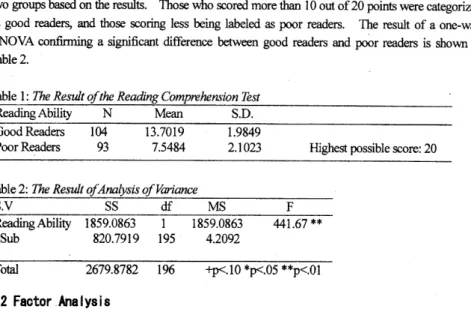
Table 1 shows the results of the reading comprehension test. The subjects were divided into
two groups based on the results. Those who scored more than 10 out of 20 points were categorized as good readers, and those scoring less being labeled as poor readers. The result of a one-way ANOVA confinning a significant difference between good readers and poor readers is shown in Table 2.
Table 1: The Result ofthe Reading Comprehension Yest
Reading Ability N Mean S.D.
Good Readers 104 13.7019 1.9849
Poor Readers 93 7.5484 2.1023
Table 2: The Result ofAnalysis qfVariance
Highest possible score: 20
S.V SS df
ReadingAbility 1859.0863 1
Sub 820.7919 195
MS 1859.0863
4.2092
F 441.67 **
Total 2679.8782 1% +p<.10 *p<.05 **p<.Ol 4.2 Factor Analysis
The data obtained from the questionnaire carried out after the reading comprehension test was calculated using a factor analysis (Varimax Rotation). The data obtained from the thirty-three questionnaire items went through a correlation matrix, factor extraction and rotation procedures.
Five factors which explained 83.93 % of the variance were extracted using a minimum-eigen value of .83. Each factor was labeled accordingly reflecting the contents of selected questionnaire items based on the factor loading of .40 as the criterion of factor salience (see Table 3).
Table 3: Five Contributory Factors to Comprehension Failure in EFL Reading
Factors Questionnaire Items Loading
Factor 1 Q 12 I have trouble understanding what "one" and "so" refer to. 0.66462 Integration of Textual Q 18 I have trouble locating a sentence stating the author's 0.64527 Information contention or opinion.
Q20 I have trouble grasping important points of a passage. 0.55024 Qll I have trouble what pronouns refer to. 0.54065 Q 17 I have trouble locating a topic sentence of each paragraph. 0.52641 Q7 I have trouble understanding a sentence with an inanimate 0.46923
subject.
Q6 I have trouble understanding the structure of a sentence. 0.43316 Q 19 I have trouble understanding figurative expressions. 0.42500 Q 16 I have trouble understanding roles and interrelationships 0.41187
of paragraphs.
Factor 2 Q25 I cannot fully utilize my backgrOlmd knowledge on the 0.71018 Use of Schemata topic of a passage.
Q24 I don't have enough background knowledge on the topic 0.69211 of a passage.
Q27 I have trouble making predictions. 0.41214
Factor 3 Q22 I have trouble understanding the outline of a passage. 0.48713 Abstracting
Information Q3 I have trouble understanding a passage with abstract 0.44069 words.
Factor 4 Q29 I am not interested in the topic of a passage. 0.58256 Motivation
Q33 I don't like studying English. 0.54949
for Reading English
Q31 I don't like the task of reading comprehension itself 0.49982 Q32 I cannot concentrate on reading until I finish reading a 0.45737
passage.
Factor 5 Q9 I have trouble understanding the meaning of a sentence as 0.50954 Understanding the a whole even when I know the words.
Whole Structure QlO I have trouble understanding the interrelationships of 0.40363 sentences.
4.3 AWJVA
After extracting these five factors, the average scores of standardized scoring coefficients for good readers and poor readers were calculated for each factor respectively, which are shown in Table 4, and were analyzed using a one-way ANOVA. The results of the ANOVA revealed significant differences between good and poor readers in Factor 1(F(1,195)=7.41, p<.01», Factor 4(F(l,195)=8.65, p<.01» and Factor 5(F(1,195)=6.76 p<.05). On the other hand, significant differences were not found in Factor 2(F(1,195)=O.02,p>.lO) and Factor 3(F(I.l95)=o·00,P>.10).
Table 4' The Means and SDs a/Standardized Scoring Coefficients
Factors Reading Proficiency N Mean SD
Level
Factor 1 Good Readers 104 -0.1599 0.8302
Integration ofTextual Information Poor Readers 93 0.1787 0.9158
Factor 2 Good Readers 104 0.0086 0.8655
Use of Schemata Poor Readers 93 -0.0096 0.8516
Factor3 Good Readers 104 -0.0008 0.8628
Abstracting Information Poor Readers 93 0.0009 0.7274
Factor 4 Good Readers 104 -0.1595 0.8240
Motivation for Reading English Poor Readers 93 0.1783 0.7827
Factor 5
Understanding the Whole Structure
Good Readers Poor Readers
5. Discussion and Conclusion
Factor 1 is the ability to integrate textual information, which is involved in both decoding and comprehension skills. The question items in Factor 2 show that this factor is the ability to utilize background knowledge. The questionnaire items in Factor 3 show that this factor is the ability to abstract information. Factor 4 is an affective factor related to motivation to read in English. Factor 5 is the ability to connect and correlate smaller parts and thus find a meaningful overall structure.
"Integration of Textual Information" and "Understanding the Whole Structure" are involved in both decoding and comprehension skills, and are the keys to success in reading comprehension.
''Use of Schemata" and "Abstracting Information" are factors mainly related to comprehension skills.
"Motivation for Reading English" is an affective factor, which is essential for foreign language learning which does require a long process of continuous efforts.
The results of the one-way ANOVA show significant differences between the good and poor readers within the realms of "Integration of Textual Information," "Motivation for Reading English," and "Understanding the Whole Structure." This demonstrates that poor readers feel more strongly than good readers that they do have problems in these three categories. However, in "Use of Schemata" and "Abstracting Information," no significant differences were found, implying that both good readers and poor readers share the same level of difficulty in both of these categories.
The significant difference between the good and poor readers in "Integration of Textual Information" supports previous studies conceming the differences between groups of different levels of reading proficiency in both L1 and L2. Block (1986) pointed out that "integrators" who were aware of text structure and monitored their understanding consistently improved their scores on the second test, while most "nonintegrators" stayed the same or even decreased. Oakhill and Yuill (1986) stated that more-skilled comprehenders made correct anaphoric references and integrated information more efficiently than less-skilled comprehenders did. The fact that a significant difference appeared between the good and poor readers in "Integration of Textual Information"
supports these previous studies on the differences in the ability of integrating information and making inferences between groups of different levels of reading proficiency in both L1 and L2.
"Motivation for Reading English" includes four items regarding motivation for reading or
studying English. Baker and Wigfield (1999) point out the vicious circle of low motivation and
poor learning from and about reading. Carlisle and Rice (2002, p 23) conclude that "the relation of
basic word ~g skill and motivation is one of the complex causal interactions that develop over
time for children who struggle to learn to read" In the current study, significant difference was
found between the good and poor readers in "Motivation for Reading English" and concurs with
these previous fmdings.
"Understanding the Whole Structure" consists of two items about the understanding of the interrelationship of words in a sentence and that of sentences. Finding meaningful units in a sentence is the central element of automatic processing. From this, the conclusion can be drawn that poor readers who have difficulty in lower level decoding skills cannot use their cognitive resources for higher level processes such as integrating information across sentences.
Apart from "Motivation for Reading English," which is an affective factor, the two factors above in which significant differences were found between the good and poor readers are equally involved in both basic decoding skills and higher level comprehension skills. On the other hand, the two factors which showed no significant differences between the good and poor readers are more involved in higher level comprehension skills. Questionnaire items of "Use of Schemata" are concerned with the possession and activation of appropriate· schemata This suggests that this factor is related to comprehension skills such as making inferences. "Abstracting Information" is made up of two items involved in the comprehension of abstract words and grasping the outline of a passage.
The lack of significant differences between the good and poor readers in "Use of Schemata"
and "Abstracting Information" may be due to the possibility that both the good and poor readers in the present study have not achieved automaticity in decoding. Therefore, the use of lower level skills may have been prioritized over higher level skills becau'3e of their limited cognitive resources.
The results of this study confirm the widely accepted view that reading comprehension is an interactive process in which various component skills work together simultaneously, and also imply that ensuring automaticity in lower level decoding skills is essential in order to enable EFL readers to use their higher level comprehension skills so that they can integrate textual information and make inferences. At the same time, concern for learners' motivation is be critical in order to let them develop into autonomous learners, since EFL learners tend to be engaged in rote learning to ensure basic decoding skills instead of task-based activities. As poor motivation can be the result as well as the cause of low achievement in foreign language learning, language instructors' concern for expanding readers' decoding skills should not beat the expense of motivation to read, which is so crucial in EFL reading instruction.
Note
The research on which this article is based is supported by Grant-in-Aid for Young Scientist (B)(No.13780156).
References
Alderson, le. (1984). Reading in a foreign language: A reading problem or a language problem?
In J.e. Alderson &A.H. Urquhart (eds.) Reading in a Foreign Language. London: Longman.
Baker,L., & WIffield, A. (1999). Dimensions of children's motivation for reading and their relations to reading activity and reading achievement. Reading Research Quarterly, 34,452-477.
Bernhardt, E & Kamil, M.(1995). Interpreting relationships between Ll and L2 reading:
Consolidating the linguistic threshold and the linguistic interdependence hypotheses. Applied Linguistics, 16, ( 1 ), 15-34.
Block, E.(1986). The comprehension strategies of second language readers. TESOL Quarterly, 20, ( 3 ), 463-494.
Carlisle, JF. And Rice, M.S. (2002). Improving Reading Comprehension. Baltimore, Maryland: York Press.
Carrell, p.L. (1988). Some causes of text-boundedness and schema interference in ESL reading.
In P.L. Carrell, et al . (eds.) Interactive Approaches to Second Language Reading.
Cambridge: CUP.
Carrell, P.L. (1991). Second language reading: Reading ability or language proficiency? Applied Linguistics, 12, (2), 159-179.
Gough, P.B., Hoover, WA. & Peterson, C.L. (1996). Some observations on a simple view ofreading.
In e. Comoldi and J. Oakhill(Eds.), Reading Comprehension Difficulties Processes and Intervetion. New Jersey: Lawrence Erlbaum Associates.
Iijirna, H. (1993). A Study on the Effects ofPre-Reading Activities on EFL Reading Comprehension.
Unpublished MA thesis presented to Joetsu University of Education.
Lee, J. & Schallert, D.L. (1997). The relative contribution ofL2language proficiency and L1 reading ability to L2 reading performance: A test of the threshold hypothesis in an EFL context. TESOL Quarterly, 31, (4),713-739.
Oakhill, J. & Yuill, N. (1986). Pronoun resolution in skilled and less-skilled comprehenders: Effects of Memory load and inferential complexity. Language and Speech 29 , ( 1 ), 25-37.
Perfetti, e.A., Marron, M.A., & Foltz, P.W. (1996). Sources of comprehension failure: Theoretical perspectives and case studies. In C. Comoldi and J. Oakhill(eds.), Reading Comprehension Difficulties Processes and Intervetion, New Jersey: Lawrence Erlbawn Associates.
Perkins, K., Brutten, S.R., & Pohlmann, J.T. (1989). First and second language reading comprehension. RELCJournal, 20, (2), 1-9.
Taillefer, G.P. (1996). L2 reading ability: Further insight into the short-circuit hypothesis.
The Modern Language Journal. 80, ( 4 ), 461-477.
iii_at . B~,§]. (2000) . OOlf V ~T' -1 /' 7'.~~*JR : ~t±I±IJfN
MffJ¥~AI3*~~-g-1Zb~.(l991). Wl991 &F~~il~~r~~M~DW n : ~~t±
Appendix 1: Means and SDs of 33 Questionnaire Items
No Questions Mean SD
1 I don't have enough vocabulary. 4.34 0.75
2 I have trouble understanding ambiguous words. 3.21 0.92
3 I have trouble understanding a passage with abstract words. 3.50 0.95
4 I am not good at guessing the meanings of new words. 3.34 1.04
5 I don't have enough knowledge of grammar. 3.50 0.97
6 I have trouble understanding the structure of a sentence. 2.67 1.02 7 I have trouble understanding a sentence with an inaninlate subject. 2.37 0.99 8 I understand a passage by translating every sentence into Japanese. 3.07 1.20 9 I have trouble understanding the meaning of a sentence as a whole even when 2.80 0.96
I know the words.
10 I have trouble understanding the interrelationships of sentences. 2.70 0.86
11 I have trouble with what pronouns refer to. 2.31 0.86
12 I have trouble understanding what "one" and "so" refer to. 2.41 1.00
13 I have trouble understanding what phrases refer to. 3.02 0.98
I