大学生英語学習者の自律性の発達におけるセルフ・エ フィカシーの変化
Change of the Perceived Self-Efficacy of EFL Undergraduates in Developing L2 Learning Autonomy
松岡 弥生子
MATSUOKA, Yaoko
● 國學院大學,国際基督教大学教育研究所
Kokugakuin University / International Christian University, Institute for Educational Research and Service
セルフ・エフィカシー,自律性,ローカス・オブ・コントロール,英語学習 self-efficacy, autonomy, locus of control, English language learning
ABSTRACT
昨今,日本の大学教育において「教える」から「学ぶ」への規範変容が見られる中,英語教育におい ても「知識を教える」だけでなく,学生自身が「如何によりよく学び,効果的に習得するか」の重要性 が中止されている。本研究ノートでは,そうした「学び」における学習者の自律性の育成と変化を,
Self-Efficacy(セルフ・エフィカシー:自己効力感)およびLocus of Control(ローカス・オブ・コントロー
ル:自己統制感)の面から考察する。データは,日本語版のセルフ・エフィカシー測定アンケートを37 名の大学生に実施した結果を基に収集し,又その中の7名はTOEIC講座の開始前と終了後の2回,同じ アンケートに回答した。それらの結果から,セルフ・エフィカシーの度合いは短い期間でも変化するこ とがあり,一定量の学習の完結によって上昇することが分かった。
Shift from ‘teaching’ to ‘learning’ in the paradigm of tertiary education in Japan has led to the focus of English education on how effectively learners learn and acquire knowledge and skills at higher educational institutions. This research note aimed to examine development of L2 learning autonomy of Japanese non- English major undergraduates from the perspectives of self-efficacy and locus of control. A Japanese version of self-efficacy questionnaire was conducted to 37 participants, and seven of them answered the same questionnaire before and after attending the TOEIC course in a semester. The results indicated the degree of
研 究 ノ ー ト RESEARCH NOTE
1. Introduction
As recent trends showing a shift from the teaching to the learning in the paradigm of tertiary education in Japan, English as second or foreign language education needs more attention to the factors relating to learning, such as individual differences of learners, learners’ prerequisite knowledge, learning strategies, and motivation, besides the factors relating to teaching, such as teaching principles and instructional methodologies.
Factors concerning the notion of a learner’s “self”
are becoming more and more important in the situation, where limitation is found in language teaching in a big class, and focus is increasing on the necessity of L2/FL learning and practice outside the classroom in university education. This research note aimed to summarize the results of a research and examine current situation and development of self-efficacy of Japanese non-English major undergraduates in English as foreign language (EFL) learning. Self-efficacy (SE), with consideration to locus of control, was focused on as a theoretical framework to examine and promote learner autonomy. A self-efficacy questionnaire was conducted to investigate the current self-efficacy levels of 37 undergraduates. The results were also analyzed to examine correlation between the degree of self-efficacy and academic achievement.
Furthermore, the same questionnaire was conducted in the end of the semester again so that change of the degree of self-efficacy was examined. For this study, following research questions are raised.
RQ1: What is a current situation of the degree of self-efficacy of Japanese non-English major undergraduates?
RQ2: Is there correlation between their degree of self-efficacy and learning achievement,
e.g., test scores?
RQ3: Is there a possibility that the degree of self- efficacy may change?
2. Literature Review: Self-Efficacy, Learner Autonomy, and Locus of Control
Self-efficacy is a central concept presented in Social Learning Theory by Bandura (1977), who was concerned with how cognitive factors, such as, attention, retention, reproduction, and motivation influence children’s (and adults’) development.
Bandura (1997) defined self-efficacy as the
“beliefs in one’s capabilities to organize and execute the courses of action required to produce given attainments” (p. 3). Self-efficacy plays an important role in how people perceive situations and behave in response to the situation, and whether one can feel high level of self-efficacy or not is attributed to four major factors: mastery experiences, self-modeling (vicarious experience), verbal persuasion (encouragement), and emotional/
physiological states (Bandura, 1977). It should be noted that self-efficacy is not identical to self- esteem or mere self-confidence (general feelings of self-worth or self-value). In Self-Efficacy Theory, efficacy expectation and outcome expectation are distinguished. Efficacy expectation is the belief that one has the power to produce that effect by completing a given task or activity related to that competency, while, outcome expectation refers to the expectation that one can master a situation, and produce a positive outcome (Bandura, 1977).
Efficacy expectation is concerned with self- efficacy, and outcome expectation relates to locus of control.
Self-efficacy is a vital part of motivation theory and a strong motivational factor that promotes self-efficacy may change even in a short time by completing a certain amount of study.
learning (Dörnyei, 2001). Major measurement tools of the degree of self-efficacy include Motivated Strategies for Learning Questionnaire (MSLQ) (Dörnyei, 2001) and General Self Efficacy Scale (GSE) (Schwarzer, 1993), which has a Japanese version developed by Ito, Schwarzer, and Jerusalem (2005).
Existing research of self-efficacy indicates learners with high degree of self-efficacy tend to use a variety of learning strategies effectively in English learning. In fact, Mori (2004), conducting a self-efficacy questionnaire based on MSLQ, showed that self-efficacy plays a significant role in the use of English learning strategies by students from junior high school to university levels.
Zimmerman and Martinez-Ponds (1990) examined the relationship between self-efficacy and learning strategies of different age, gender, and achievement groups. They found that high achievers tend to have high level of self-efficacy with high degree of self-regulation in learning, although the relation between students’ age and the use of self-regulated learning strategies is not proved. On the other hand, Kusuoku and Nakano (2015) showed a positive correlation between the university students’ self- efficacy in their study and that of determining their future professions. They suggest that enhancing self-efficacy of university students may help solving the current problems of job-hunting.
Self-efficacy has close relationship with locus of control (LOC). SE and LOC are the important constituents of core self-evaluations (Judge, Locke,
& Durham, 1997), along with self-esteem and neuroticism. The concept of LOC, developed by Rotter (1960, 1966) in Social Learning Theory, concerns an individual’s perception regarding the concomitant of the reinforcement or reward and an event in various situations he/she faces in own life.
This may be determined by “the degree to which the individual perceives that the reward follows from, or is contingent upon, his own behavior or
attributes versus the degree to which he feels the reward is controlled by forces outside of himself and may occur independently of his own actions”
(Rotter, 1966, p.1). According to Rotter (1966), locus of control is conceptualized as either internal or external. Internal versus external control refers to “the degree to which persons expect that a reinforcement or an outcome of their behavior is contingent on their own behavior or personal characteristics versus the degree to which persons expect that the reinforcement or outcome is a function of chance, luck, or fate, is under the control of powerful others, or is simply unpredictable” (Rotter, 1990, p.489). A person with strong internal control is likely to believe that successes in life are the results of his/her own efforts and actions, while a person with external control tend to think that they cannot control their life events because of the complex forces surrounding him. The concept of LOC closely relates to raising and sustaining learners’
motivation in learning, and the learning of English as L2/FL is no exception. Although the influence of LOC on L2 learning might not be as large as other factors such as language proficiency, aptitude, and task importance (Ebrahim, 1998), it seems that combination of the strong self-efficacy (e.g., believing that one can complete his planned study) and internal LOC (e.g., recognizing whether one can accomplish the given task or not attributes to his/her efforts) may produce positive effects.
Self-efficacy and learner autonomy are two most important predictors of academic success in the field of language learning (Yalcin & Seyma Ciftci, 2011). Learner autonomy is defined as the ability to take charge of one’s own learning (Holec, 1981;
Lee, I., 1998), or “the freedom and ability to manage one’s own affairs, which entails the right to make decisions as well” (Scharle & Szabo, 2000, p.4). According to Wenden (1991), “autonomous learners are self-confident learners believing in
their ability to learn and to self-direct or manage their learning” (p.53). Candy (1991) lists main characteristics of the autonomous learners as:
“methodical and disciplined, logical and analytic, reflective and self-aware, flexible, interdependent and interpersonally competent, persistent and responsible, venturesome and creative, independent and self-sufficient….” (p.459-466).
3. Data Collection
Data were collected through a Japanese version of self-efficacy questionnaire, which was conducted twice, in the beginning and the end of 2017 spring semester. Participants of the first questionnaire were 37 undergraduates, with their ages ranging from 18 to 24. They were participating TOEIC preparatory courses the university’s Language Learning Center offered in both Shibuya and Yokohama campuses. The course was non-credit based and students participated in it spontaneously.
The classes met 8 times during three months including additional two ‘home study assignment’
weeks with quite a lot of tasks. Furthermore, a good deal of homework was assigned to students in every class. During the class, about 15 to 20 minutes were spent for oral practice, such as synchro-reading and shadowing, aiming to help learners improve listening skills and reading comprehension. The participants’ English proficiency levels ranged from intermediate to upper-intermediate with two advanced ones. Some had TOEIC IP scores of allover 400-550, two advanced students had 620 and 650 respectively, and others obtained Eiken 2nd or pre-2nd levels.
Material used was a questionnaire with 10 items based on General Self-Efficacy Scale. Japanese version of a questionnaire on self-efficacy was conducted paper-based to the students at the Language Learning Center. The questions include items as follows:
1. I can always manage to solve difficult problems if I try hard enough.
2. If someone opposes me, I can find the means and ways to get what I want.
3. It is easy for me to stick to my aims and accomplish my goals.
4. I am confident that I could deal efficiently with unexpected events.
5. Thanks to my resourcefulness, I know how to handle unforeseen situations.
6. I can solve most problems if I invest the necessary effort.
7. I can remain calm when facing difficulties because I can rely on my coping abilities.
8. When I am confronted with a problem, I can usually find several solutions.
9. If I am in trouble, I can usually think of a solution.
10. I can usually handle whatever comes my way.
Respondents were asked to choose one answer based on the four-level Likert scale: agree (4 points), somewhat agree (3 points), somewhat disagree (2points), and disagree (1 point). The number of point were added and the total points were compared and examined.
In the last part of the TOEIC course in July, 20 out of 37 participants took a TOEIC mock test, a half-version of the official test. The mock test scores of these 20 students were compared with their results of the first SE questionnaire.
Seven participants in Yokohama campus voluntarily accepted answering the same SE questionnaire again. They included four males and three females, and attended both the three-month TOEIC preparatory course and a mock test in our local campus in Yokohama. Consequently, they took SE questionnaire twice, on the first and the last days of the course. The results were compared to examine whether any change of the SE level could be found among them.
4. Results and Discussion
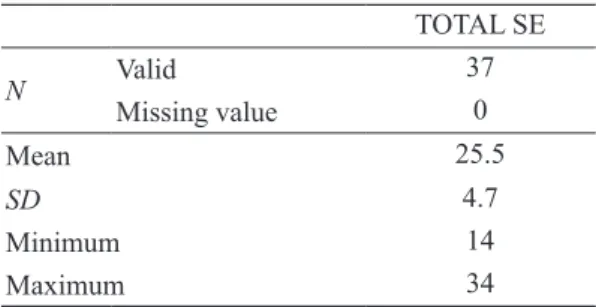
The answer for RQ1: What is a current situation of the degree of self-efficacy of Japanese non- English major undergraduates? was drawn from the results of first SE questionnaire conducted to 37 students. Statistical results of the total score of self- efficacy (addition of the point that respondents checked according to the Likert scale) in Table 1 show that mean score of SE was 25.5, with minimum score 14 and maximum score 34. In terms of each question, it was found that Question 6.
I can solve most problems if I invest the necessary effort gained the highest point, with average 2.9. As for Q6, five participants chose ‘agree’ (4 points), and twenty-two chose ‘somewhat agree’ (3 points).
Ten chose ‘somewhat disagree’ (2 points), but no one chose ‘disagree’ (1 point). Conversely, answers for Question 5: Thanks to my resourcefulness, I know how to handle unforeseen situations found that no one chose ‘agree’ (4 points), only eight chose ‘somewhat agree’ (3 points), and actually,
twenty-nine students (about 78%) chose either
‘somewhat disagree’ (2 points) or ‘disagree’ (1 point). These indicate that many students seem to be ready to invest the necessary effort to achieve good results in their study, while they might be unconfident whether they are resourceful enough to accomplish their goals.
Table 1 Statistic of the Current Situation of Self-Efficacy of 37 Undergraduates
TOTAL SE
N Valid 37
Missing value 0
Mean 25.5
SD 4.7
Minimum 14
Maximum 34
0.0 1.0 2.0 3.0 4.0
1. I can always manage to solve difficult problems if I try hard enough.
2. If someone opposes me, I can find the means and ways to get what I want.
3. It is easy for me to stick to my aims and accomplish my goals.
4. I am confident that I could deal efficiently with unexpected events.
5. Thanks to my resourcefulness, I know how to handle unforeseen situations.
6. I can solve most problems if I invest the necessary effort.
7. I can remain calm when facing difficulties because I can rely on my coping abilities.
8. When I am confronted with a problem, I can usually find several solutions.
9. If I am in trouble, I can usually think of a solution.
10. I can usually handle whatever comes my way. 2.7
2.6 2.7 2.4
2.9 2.0
2.3 2.6
2.6 2.7
Figure 1 Results of the Added Likert Scale Points in each Question.
SE question
Avaerage Points for each question
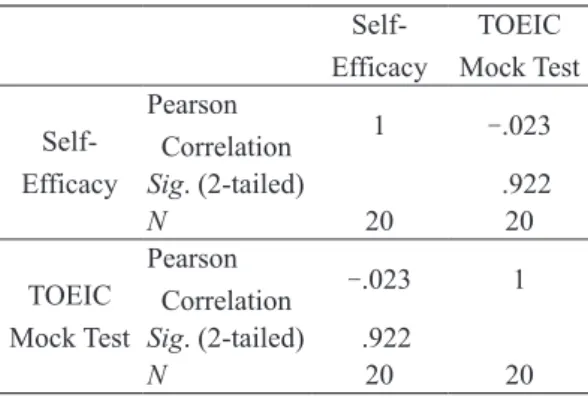
In order to answer RQ 2: Is there correlation between their degree of self-efficacy and learning achievement, e.g., test scores?, correlation of SE level and learning achievement of twenty participants who took TOEIC mock test was examined by Pearson Correlation Coefficient using SPSS. The mean score of the TOEIC mock test was 510, ranging from minimum 280 to maximum 720. As shown in Table 2, however, there was no significant correlation found between the degree of total score of self-efficacy and TOEIC mock test scores. r = -.023 (n.s.), p = .922.
Finally, RQ 3: Is there a possibility that the degree of self-efficacy may change? was responded by comparing the results of the first and second questionnaires. The second questionnaire was conducted to seven participants on the last day of the TOEIC Preparatory Course in mid-July at Yokohama campus. Due to the limitation of the time, it was not implemented in the same course in Shibuya campus. Figure 2 shows the change in the degree of perceived self-efficacy of seven participants. According to the graph, six out of seven (85.7%) students made a slight progress in the total degree of SE, although one student’s SE point remained the same. The change of SE degree includes: 1 point increase (minimum) by two students, 2 points increase by three students, and 9 points increase (maximum) by one student.
Integrating these results with the results of follow-up course evaluation questionnaire, it was found that, in addition to teaching factors such as appropriacy of the course level/ contents and understandability of instruction, factors relating to learning or learners themselves might have affected the change in students’ perceived SE. Below are the pieces of student comment concerning SE and a SE questionnaire in the course evaluation questionnaire (translated from Japanese to English by the present researcher).
• I think I learned much in this course.
• This was the first time for me to think of my mental state in relation with study.
• I’m not sure thinking deeply about myself is important for my study, but any way it was interesting.
• It was good I completed the course.
The results indicated the degree of self-efficacy may change by completing a certain amount of study, even in a short time. The factors relating to learners included how much assignment they actually did at home, how they positively participated in the class activities, and how many
Table 2 Correlations between Self-Efficacy Level and TOEIC Mock Test Scores
Self- Efficacy
TOEIC Mock Test Self-
Efficacy
Pearson
Correlation 1 -.023
Sig. (2-tailed) .922
N 20 20
TOEIC Mock Test
Pearson
Correlation -.023 1 Sig. (2-tailed) .922
N 20 20
0 5 10 15 20 25 30 35
1 2 3 4 5 6 7
Pretest total points Posttest total points Participants
Total SE points
Figure 2 Change of the Individual Degree of SE before and after the TOEIC Preparatory Course
times they attended classes. Although the course was demanding and required them additional home assignment, the attendees gained a sense of accomplishment on the completion of the course, and this may have led to the improvement of the degree of SE.
5. Implications
As Rubin and Thompson (1994) state, self- discipline is very important for successful learning.
In the process of English as L2/FL learning, learners’ beliefs are of great value and the key to become an autonomous learner. Teachers and educators are encouraged to remind the significance to examine how to develop a sense of responsibility in their learners so that they will understand why and how they learn and be willing to take an active role in their learning (Scharle. & Szabo, 2000).
Further research will be needed to examine the level of self-efficacy with relation to other personal cognitive factors, such as locus of control and self- esteem, with extended number of participants so that findings would be generalized and more applicable to learner improvement.
References
Bandura, A. (1977). Self-efficacy: Toward a unifying theory of behavioral change. Psychological Review, 84, 191-215.
Bandura, A. (1997). Self-efficacy: The exercise of control. W H Freeman/Times Books/ Henry Holt
& Co, New York, NY. Retrieved from https://
search-proquest-com.othmer1.icu.ac.jp:2443/do cview/619147930?accountid=10105
Candy, P. C. (1991). Self-direction for lifelong learning: A comprehensive guide to theory and practice. San-Francisco, Jossey-Bass.
Dörnyei, Z. (2001). Motivational strategies in the language classroom. Cambridge, U.K.: Cambridge University Press.
Ebrahim, S. A. (1998). The effects of locus of control, working memory, motivation, and verbal ability on foreign language learning (Doctoral dissertation).
Retrieved from ProQuest Dissertations & Theses A&I.
(304444300).
Holec, H. (1981) Autonomy and Foreign Language Learning, Oxford: Pergamon Press.
Hsieh, H. (2010). Self-access center and autonomous learning: EFL college students’ motivations, activities and perceptions of learning effectiveness (Doctoral dissertation). Retrieved from ProQuest Central; ProQuest Dissertations &
Theses A&I. (851182568).
Ito, K., Schwarzer, R. & Jerusalem, M. (2005). Japanese Adaptation of the General Self Efficacy Scale. Retrieved from: http://www.ralfschwarzer.de.
Judge, T.A., Locke, E.A. and Durham, C.C. (1997) The Dispositional Causes of Job Satisfaction: A Core Evaluations Approach. Research in Organizational Behavior, 19, 151-188.
Kusuoku, S. & Nakano, K. (2015). A Study on undergraduates’ academic motivation based on self- efficacy theory: A case of the successor cultivation program for “Sixth Industrialization”. Journal of University Education Research, 12, 8-20. (In Japanese)
Lee, I. (1998). Supporting greater autonomy in language learning. ELT Journal, 52(4), 282-291.
Mori, Y. (2004). Relationships between self-efficacy and learning strategies of English in college students. Japan Journal of Educational Technology, 28(Suppl), 45-48. (In Japanese) Rotter, J. B. (1960). Some implications of a social
learning theory for the prediction of goal directed behavior from testing procedures. Psychological Review, 67, 301-316. doi: 10.1037/h0039601.
Rotter, J. B. (1966). Generalized expectancies for internal versus external control of reinforcement:
Psychological Monographs: General & Applied, 80(1), 1-28.
Rotter, J. B. (1990). Internal versus external control of reinforcement: A case history of a variable. American Psychologist, 45(4), 489-493.
Rubin, J., & Thompson, I. (1994). How to be a more successful language learner, 2nd ed. Boston: Heinle
& Heinle.
Scharle, A. & Szabo, A. (2000). Learner Autonomy: A guide to developing learner responsibility. Cambridge, UK: Cambridge University Press.
Schwarzer, R. (1993). Measurement of perceived self- efficacy: Psychometric scales for cross-cultural research. Berlin, Germany: Freie Universität Berlin.
Wenden, A. (1991). Learner strategies for learner autonomy: Planning and implementing learner training for language learners. UK: Prentice Hall International.
Yalcin, F. & Seyma Ciftci, F. (2011). Supporting self- efficacy and learner autonomy in relation to academic success in EFL classrooms: A case study.
Theory and Practice in Language Studies, 1(10), 1284-1294.
Zimmerman, B. J. & Martinez−Ponds, M. (1990).
Student Differences in self-regulated learning:
Relating grade, sex, and giftedness to self−
efficacy and strategy use. Journal of Educational Psychology, 82(1), 51-59.