Although it is a cliche to say that you don’t know where you are going if you don’t know where you have been, this truth is often ignored by those with ambitions to be innovators because revealing historical precedents might cast doubt on the claim to originality. This tendency is especially true in English language teaching (ELT), a field in which rapid growth has created a heady impression of novelty, and this has been easily exploited by those who could first lay claim to ‘new’ discover- ies.
This paper illustrates how historical knowledge has been lacking in foreign lan- guage teaching, and argues for the benefits and possibilities of authentic innovation that would come with more attention focused in this area. The historical perspective sheds light on a time when language teaching was an integral part of other fields of knowledge, and thus this paper also argues for greater cross-disciplinary awareness and training in the sciences that have become increasingly relevant to language stud- ies and education in general.
Part 1 reviews the only thorough history of language teaching that has been written in the last fifty years, L. G. Kelly’s 25 Centuries of Language Teaching: 500 B.C.–1969 (Kelly, 1969), a book hailed at the time by Bernard Spolsky and other reviewers (on book jacket) as destined to be a “major work in the field,” but since then it has been rarely cited, forgotten and is now out of print.
第2巻第1号(51−86)
2006年12月
History and innovation:
Looking back to look forward in English language teaching
Dennis Riches
―51―
Although Kelly’s book refers to foreign language teaching, which in his study involved the teaching of Greek, Latin and European languages throughout Western civilization, my analysis and comments about the state of my profession refer to my own experience and knowledge in the teaching of English as a foreign or second language. Because I refer to a canon of literature about foreign language teaching written in English for the global English teaching industry, I acknowledge from the start that this paper is limited in scope. Academics from English speaking countries have come to dominate applied linguistics globally. This might lead us to assume that everything worth saying in this field is being discussed and published in English, but there is no way to know for sure, and I wish to acknowledge this limitation at the outset.
Part 2 surveys a sample of the above mentioned canon for the existence or ab- sence of historical studies and references, and discusses the effects of its bias on contemporary views of language teaching.
Part 3 proposes that a greater awareness of the history of foreign language teaching could point the field in the direction of real innovation. It places the mal- aise of the profession within the wider malaise of higher education, and refers to critics who regret the division between the humanities and the sciences, and the lack of scientific knowledge informing socio-cultural theory. It concludes with an exam- ple of how language teaching could benefit from being informed by research results from the life sciences.
Part 1 Review of a History of Foreign Language Teaching
Part 1 is much shorter than it should be, but this is the reason for this paper:
there is a dearth of material on the history of language teaching. Kelly’s 25 Centu- ries of Language Teaching: 500 B.C. –1969 is the only thorough history that has been written. Stern wrote a chapter on the topic in 1983, noting that Kelly’s work is the only significant in−depth treatment. His review of the historical studies at that time included these comments:
Unfortunately, the current state of historical documentation is far from satis-
―52―
factory. Language teaching theory has a short memory. Perhaps because of our involvement in current problems and polemics, we have tended to ignore the past or to distort its lessons, and to re-enact old battles over and over again ... many of the writings on language teaching begin with an historical introduction to current developments,... but... the historical antecedents are often no more than a backdrop to set off with bold strokes those aspects the writer wishes to emphasize... (pp. 76-77).
Since the 1980’s, this situation has not changed. A query of the Internet’s search engines and book stores returns only one title containing all the key words history, language and teaching, Howatt’s 1984 A History of English Language Teaching and Howatt and Widdowson’s 2004 second edition of the same title. It covers much of the same ground as Kelly, but offers some much needed background, for example biographical information and context on the life of Comenius and other figures.
Kelly’s work is exceptional in the thorough use of over a thousand primary sources, and in the way it reveals the themes of language teaching that have ap- peared repeatedly and evolved since 500 B.C. If one has read first the contempo- rary books on foreign language teaching, it is striking to read this history and notice the resemblance of many ancient teaching conditions, methods and views about them to those of the modern era. For example, St. Augustine in the 4th century wrote of the importance of understanding a word’s meaning from its context (St. Augustine 1841-86b, part xi, in Ke, p. 10)1),and this idea was discovered as if it were new in the 20thcentury, and at several times in between. Comenius in the 17th century con- textualized his lessons as well and introduced active demonstration, realia and pic- tures in the classroom. All this too was rediscovered in modern times (Comenius, 1657, p. 162, in Ke, p. 13-14). Just as is common now, educators of the past also debated the merits of these methods when compared with direct translation, explana- tions in the native language, the use of bilingual dictionaries and so on.
Perhaps the oldest and most central controversy in language teaching is the role of grammar. Throughout the 25 centuries covered by Kelly, educators debated how grammar should be presented, whether it should be taught inductively or deductively,
―53―
or not at all (p. 34). Kelly says, “St. Augustine popularized dialogued methods of teaching, making the pupil’s role in the dialogue part of the act of discovery” (St.
Augustine 1841-86b, XI p. 36, in Ke, p. 35). One can see in this the earlier classical method of rhetoric teaching, as well as the seed of 20th century dialogics of Bakhtin, Vygotsky’s concept of scaffolding, and Krashen’s concept of comprehensible input.
The common thread is the presence of a caring elder selecting lessons suited the pupil’s next level of competence and taking him there through social interaction.2)
In contrast to these inductive and humanistic approaches, deductive and behav- iouristic methods were also used long ago. Chria, a type of pattern drill suited for inflected languages, were used by Greeks and Romans (Ke, p. 116). Pattern practice, substitution drills and dictation were used in the Renaissance (Ke, p. 101). “The [scripted] dialogue was in constant use in the language classroom right through the history of language teaching” (Ke, p. 120).
In the 17th century, Lamy, sounding much like Krashen and other theorists in the 20th century, proposed that foreign languages are learned in the same way as one’s native language (St. Augustine 1841-86a, p. 94, in Ke, p. 39). But Erasmus disagreed, noting the efficacy of children (Erasmus, 1529, p. 501, in Ke, p. 317) for language acquisition. Penfield (1953), in the 20th century, studied brain physiology and came to the same conclusions as Erasmus.
In the 16th century, Erasmus advocated a blended approach of both inductive and deductive methods, an approach that Caroll, in the 20th century, concurred with (Caroll, 1967, p. 578, in Ke, p. 310). As one would expect, balance was seldom achieved and the methods in favor at one time led to a backlash and rise of an op- posing method, aided by the changing demands of the social and educational context.
In fact, the effect of reading Kelly’s book is that one notices that balanced, humanis- tic approaches have been the norm through most of the history covered, even if this was in theory more than in practice. The dominance of formal approaches occurred only as an aberration of in two ‘dark ages’ – the Middle Ages and the 17th. - 19th century – periods when the languages taught had been divorced from their social relevance and the dreaded grammar translation method was used (see Table 1, Kelly’s Schema of Evolution of Language Teaching, p. 394). However, there is also evidence of this trend of excessive formalization and subsequent backlash dating
―54―
back to antiquity. In Satyricon, Petronius (1st century A.D.) wrote, “Children in school become immensely stupid because they see or hear nothing that is in com- mon use” (Ke, p. 380).
In addition to debating classroom methods, people of the past also speculated about how to best learn a language outside the classroom. Romans liked to have a Greek slave to tutor their children, and an educated Greek slave was ten times as valuable as a slave who did manual work. A sophisticated person was a sophist – a Greek scholar living in Rome during the age of Greek decline and Roman rise, earn- ing his living by lecturing and entertaining the elite. People traveled, studied abroad, inter-married, went to church services in the target language, and tried to select their children’s companions by the languages they spoke. One of the first American offi- cials to be stationed in Paris was advised to “take a mistress and go to the comedie”
(Chompre, 1743, p. 19, in Ke, p. 295).
All of these practices have their modern equivalents. Native speakers of English working as teachers in Asia are the equivalent of the Greek slaves, as the visiting American lecturers at Asian universities are modern sophists from a declining culture hired by a rising one. Parents and students in various parts of the globe select travel, overseas studies and various social and educational experiences for their children to help them acquire English.
Kelly also traces the history of psychology and language teaching, finding precedents to motivation theory, behaviorism, and affective influences on learning.
Although motivation is a 20th century concept, St. Augustine wrote, “Free curiosity has a more positive effect on learning than necessity and fear” (St. Augustine, 1950, 1, p. 64, in Ke, p. 323). A millennium later Comenius advised teachers to consider the emotional and intellectual readiness of the pupil in order for learning to occur (p. 324), as did Rousseau in the 18th century in L’education d’Emile. As teaching practices hardened during the Age of Reason, Lemare lamented the loss of this hu- manistic perspective. “We have substituted for the infallible guide of need our own ideas and pet theories in the study and teaching of languages, and our tedious way has been sown with thorns” (Lemare, 1819, p. xiv, in Ke, p. 324). Kelly uses this quote as indicating a criticism of excess authoritarianism and de-motivating methods, but it should be noted that it is a neutral warning about blind adherence to any
―55―
methodology.
In the chapter on linguistics, Kelly notes what Chomsky acknowledged about his theory of universal grammar: that it had its precedents in antiquity and the 15th and 16thcentury concept of logical grammar and innate knowledge (Chomsky, 1964, p. 51, in Ke, p. 351). Roger Bacon, in the 13th. century wrote, “The substance of grammar is one and the same in all languages” (in Kukenheim, 1962, p. 15, in Ke, p.
354). A few years after Kelly’s study appeared, Chomsky elaborated on this topic further:
The questions that I want to consider are classical ones... From Plato to the present time, serious philosophers have been baffled and intrigued by the question that Bertrand Russell.... formulated this way, “How comes it that human beings, whose contacts with the world are so brief and personal and limited, are nevertheless able to know as much as they do know?” (Chomsky, 1975, p. 5, citing Russell, 1948, p. 5).
After this quote Chomsky refers in the same passage to the “16th. century rationalists who dwelt on the same question.”
The final part of Kelly’s book deals with “what has happened to the ideas” and he notes from the start, “The total corpus of ideas accessible to language teachers has not changed basically in 2,000 years.” What changes are the “ways of building methods from them” and the “form in which the ideas present themselves” (Ke, p.
363). He states that few teaching ideas are inherently bad. They are subject to their social setting or “sensorium” in which teaching takes place. Thus the cyclical ap- pearance and disappearance of ideas and methods is a reflection of this changing en- vironment, and the teaching profession, more than others, is heavily influenced, as it must be, by outside amateurs (no pejorative connotation intended) – politicians and all other interested parties outside the school.
It would be worthwhile to speculate here on a point Kelly never raised. If two civilizations with developed systems of writing and philosophy lived in isolation for centuries on the same island, but then discovered each other and began active trade and cultural exchange with one another, would they, within a generation, discover
―56―
all the truisms, intuitive knowledge and wisdom about language learning that has ac- cumulated in Western civilization? It seems that by showing the cyclical nature of language teaching trends, Kelly made it clear that it is an art that arises naturally out of the human condition. The same font of wisdom appears wherever the challenge is encountered.
In reading this chapter, one begins to get a sense of why Kelly’s work never became more well known. He had too much insight and skepticism about his pro- fession to ever become one of its leaders, and the truths he spoke would be too un- comfortable for most to discuss openly at an academic conference. Consider this passage:
When an idea first appears and appeals to the most creative in the field, it is developed little by little. At all stages of the development of ideas and meth- ods, the less original follow the successful innovators like sheep, accepting as received doctrine what is really a transitional stage. Inevitably, the idea reaches the limit of its growth. At this stage, it is applied slavishly by the unoriginal, who are always in the majority, catches the attention of the inter- ested dabbler, and repels the creative who turn elsewhere (Ke, p. 363).
You just can’t stand up at a convention and say such things to a room full of your professional peers.
There are numerous examples of such shifts in trends, a good one being the changeable attitude toward delayed gratification, or whether learning should be fun to be of any worth. In the Medieval era, ... “the discipline required to plow through the aridity of the first stages of language study was looked on, not as the result of bad teaching, but as desirable in the formation of character” (Ke, p. 374). However, in 2004, Krashen published an article in The Language Teacher entitled “Why sup- port a delayed-gratification approach to language education?” (answering the ques- tion, of course, by saying there is no reason to). This is not to say that this issue is not controversial in the modern day, or wasn’t in the Medieval era, either, but it does illustrate how each side of a controversy alternates in dominance over time. In the present era, Krashen and other educators who agree with him have been hugely
―57―
influential. Kelly notes that the controlling influence is the demands of society on educators:
Until this century it was a relatively small aristocratic community that con- trolled policy. With the advent of universal education, those who learned languages were usually the more intelligent, those who aimed at professional careers. In these cases a philosophical approach was desirable. But as at- tempts were also made to teach languages to an unselected group, a func- tional approach was indicated, as it was easier for the pupils to understand and more interesting as well (Ke, p. 383).
Unfortunately, attitudes and beliefs about teaching develop with the social setting taken for granted and left unanalyzed. Adherents debate their hardened posi- tions on an issue, such as delayed gratification, without acknowledging that the way an education system approaches it is entirely a matter of the value judgments and trade-offs it is willing to make.
In the section entitled “Ideas and the Teacher” Kelly gives a detailed account of who taught languages over the centuries. The key point to note here is that the pre- ceding chapters illustrated “the total corpus of ideas accessible to language teachers has not changed basically in 2,000 years;” (Ke, p. 363) however, all these ideas were expressed before there was any specialist training of language teachers. They were developed by philosophers, clerics, psychologists and pedagogues. Language was viewed as integral to other fields of knowledge. Latin and Greek grammar were believed to develop strong minds and logical thinking. On the other hand, languages were sometimes viewed with suspicion as a form of cultural pollution. Christian clerics had to teach Latin and Greek, but this risked exposing their pupils to the classical pantheon or philosophers who posed uncomfortable questions about religion and authority. Before this era, Romans were wary that “Greek rhetoric did not fit with the traditional values of Rome” (Ke, p. 388). This tension still plays out in 21st century Japan, and elsewhere in Asia, where foreign teachers are wanted for impart- ing the English language skills necessary to facilitate economic development, but sometimes not for the values they might impart, or the behavior they might display
―58―
outside the classroom. One example of these foreign values and beliefs is, of course, none other than the Socratic method, the unconscious supposition of Westerners that students should question the teacher and engage in dialogue in order to learn.
While the central figures in language teaching were philosophers, clerics, psy- chologists and pedagogues, Kelly comments about the actual teachers that “the pro- fession, and to a large extent the language teaching part of it, has traditionally been the refuge of educated people who have failed elsewhere” (Ke, p. 389). He notes Thomas Hughes’ account of English education in the19th century saying “...many teachers... had come into teaching as disappointed men, who aimed at law and the church” (Hughes, 1879, in Ke, p. 390). Brandt, in 1885 wrote, “The feeling is, any- body can teach French and German... By introducing scientific methods we will show that anybody cannot so teach, that the teacher must be scientifically trained...”
(Brandt, 1885, p. 60, in Ke, p. 390). Right through the 20th century this discussion continued. In the 1950’s and 60’s, when the audio-lingual method was in wide use, its advocates debated who would be best to put in the classroom. The method seemed to require an educated person, but too highly an educated person would be bored by it. Moutlon thought, “The employment of graduate students provides for a gradual but constant turnover, which is desirable on the theory that none but the most devoted should teach exclusively elementary language courses for more than few years” (Moulton, 1952, p. 45, in Diller, 1971, p. 78). Graves was more caustic in his analysis: “If he is willing to spend twenty or thirty hours a week employing such high qualifications in the incessant and boring, and unintellectual drill which is so imperative in language learning, there is something else wrong with him” (Graves,
1963, p. 2-3, in Diller, 1971, p. 78). But when did this problem not exist, and when was it ever resolved? Horace lamented about his epistles, “This too will be your fate.
Your doddering old age will be spent in teaching the elements of Latin to boys in remote corners of the world” (Horace, Epp. I.xx. 17-18, in Ke, p. 258).
We can see that the profession still struggles to gain respect when we look at the nature of the English language teaching industry today. Some would say that the problem has been resolved because English teaching has become highly specialized and professionalized, as evidenced by the number of academic organizations, confer- ences, publications and graduate level teaching programs, and the ever-increasing
―59―
qualifications of those fated to teach the ‘elements of’ English ‘to boys (and girls) in the remote corners of the world.’ Nonetheless, what is notable about this impressive display of professionalism is that it is incredibly prolific compared with what outsid- ers might consider its social import. It doth protest too much. Perhaps it is due to psychological over-compensation for the underlying ancient insecurity that language teaching is, as they say, not rocket science.3)Say what you will about the intellect and training required to teach English as a foreign language, the truth is many of its practitioners pursue intellectual stimulation elsewhere, bring other pet interests into their classrooms, lose interest in repetitive themes of professional development, or leave the field altogether. To emphasize the point, I challenge readers to find one English teacher whose youthful ambition it was to live in a far off land and become a teacher of English to speakers of other languages.
Kelly concludes his book with an overview of the historical shifts in emphasis that repeat cyclically, and he also includes many snide observations on the historical amnesia and slavish devotion to fashion of his contemporaries. It is little wonder that his book was out of print by the 1980’s. The profession, just like a state, naturally and unconsciously filters out dissenting voices that cause too much cognitive disso- nance.
He sums up by classifying three broad aims of language teaching – social, artis- tic and philosophical - each dominating at different times. Social aims were domi- nant in the classical (7thcentury B.C. –5th century A.D.), Renaissance (14th-16th cen- tury) and modern era (19th century ~ ). Philosophical, or analytical, aims were domi- nant in the Middle Ages (6th. century – 13th. century) and the Age of Reason (17th− 19thcentury). In each era, artistic and literary aims of teaching served to balance the era from being completely dominated by one aim. (See Table 1, Kelly’s Schema of the Evolution of Second Language Teaching).
In the last pages, with the following selection of withering remarks, Kelly makes his final assault on the language teaching profession for its blindness to his- torical and social influences:
Language teaching has shared neither the honesty nor the self-knowledge of the fine arts. Whereas artists are willing to seek inspiration from the past,
―60―
teachers, being cursed with the assumption that their discoveries are necessar- ily an improvement on what went on before, are reluctant to learn from his- tory (Ke, p. 396).
...one has the impression of constant improvement when what is really hap- pening is constant updating (Ke, p. 396).
[During the Renaissance]... the first fully documented appearance of many techniques often considered proper to the 20thcentury produced an oral meth- odology which in no way relied on linguistic analysis (Ke, p. 402).
That the expert in language teaching acts with the purity of motive and de- sign expected from a scientist is demonstrably untrue (Ke, p. 407).
What suits the circumstances is what is considered proved (Ke, p. 407).
...in the stampede toward [an emphasis on] spoken language, ... opinions by equally reputable linguists and psychologists were ignored (Ke, p. 408).
Every age, in fact, has its rebels whose teaching techniques, though scientifi- cally justifiable, failed to gain acceptance because they did not fit the atmos- phere of the time. Teaching, being an art, looks to its market and takes from its parent sciences what will sell (Ke, p. 408).
...needs, approaches and resources change, and one generation’s heresy be- comes the orthodoxy of the next (Ke, p. 408).
In Part 2 I select examples from the canon of applied linguistics sources to dis- cuss the continuing lack of historical reference in the professional formation of lan- guage teachers, and the ongoing self−deception that language teaching is a science, rather than an art adapted to its social context. In Part 3 I discuss how this state of affairs has left language teaching more poorly informed by science and the truly
―61―
ERAPARENT SCIENCES ART CRITICAL SCIENCES
Table 1 Kelly’s (1969, p. 394) Schema of the Evolution of Language Teaching
AIMS Lit.ScholarlySocial
METHODS InformalFormal Classical Logic Grammar Rhetoric Philosophy Theology
CLMLCLMLCLMLIntroductionathome &inSocietyLiterary&Rhetorical schooling Parentscienceswith normativebias–observations erectedintorulestogovern activitiesdrawnfromthem.
Gr !"# XX Gr !"# XX Gr !"# XX
Middle AgesXXYTeachingbybook–social usesofLatinsecondry– contemporarylanguages taughtforliterarypurposes.12th–15th centuriesX RenaissnceEducation Grammar rhetoric
XXXYX
MethodsinMLmainly oral–examplefollowed bysomeClassicsteachers
MethodsinCLfollow medievalpattern–MLenter translationteachingfor literarypurposes 17th,18th& 19thcenturies
Grammar Philosophy Education Rhetoric
YXX
Logicalorientationof grammar–socialpurposesof languagesubordinate– grammar–translationevolves 19th&carly 20th
Linguistics Psychology Education Anatomy
XYX
Natural&Directmethods, etc.predominate–experimen- tationinDirectand ‘structural’methodsfor Latin Classicallanguagescontinue 19th-centuryPractice–many modern–languageteachers dolikewise.
ExperimentalPsychology. LanguageDidactics, MethodsAnalysis. XMainaimCLClassicalLanguagesGrGreek YMostimportantsubsidiaryaimMLModernLanguagesLit.Literature Figure27.SchemaofEvolutionofSecondLanguageTeaching.
―62―
relevant discoveries about human nature.
Part 2 The Missing Historical Perspective in ELT
Kelly found fault in his profession for its unwillingness to learn its own history and distinguish between old and new ideas in language teaching. He also faulted it for its failure to acknowledge that teaching is an art that adapts itself to changing demands from society, and that it is not a science able to discover absolute truths re- garding language teaching. Part 2 reviews a small sample, with regard to these criti- cisms of Kelly’s, of the canon of sources that practitioners of ELT (English as a for- eign/second language – henceforth referred to as only ELT) are exposed to in their training.
A good way to begin the analysis is to assess what influence Kelly’s book, or historical studies in general, have had in the last forty years. Kelly’s study was obvi- ously a long time in the making, as it lists 1,171 primary and often arcane sources, and 226 secondary sources. Kelly must have spent many years working in solitude in libraries, museums and monasteries in Europe and North America to produce this single book. One could say that he just wasn’t very prolific when compared with many of the star names in ELT who have authored and edited numerous books and student textbooks within a decade, in addition to having multiple, (sometimes simul- taneous) faculty appointments and board memberships, and participating in confer- ences and teacher training programs. Yet the contrast between such academics and Kelly suggests that quantity of publications might mean very little in evaluating an individual’s contribution to his field. The more often someone publishes, the more readers can suspect he has nothing new to say. The rise of the profession’s leaders may have more to do with their temperament as charismatic purveyors of a new, or old, idea whose time has come, and with their political instincts and appetite for staying at the top.
Gladwell (2000), in The Tipping Point, describes the personality profiles that sociologists have identified as necessary to spread a new idea. ‘Connectors’ are the rare persons with extraordinary networks of social contacts, and they bring disparate groups together. ‘Mavens’ like to acquire extraordinary amounts of knowledge and
―63―
pass it along, and ‘salesmen’ are the charismatics who persuade and inspire mimicry.
Popular ideas about language teaching rise in new packaging by the same phenome- non, promoted by key players who look to the market and take from the sciences what will sell, as Kelly remarked (Ke, p. 408).
It is also important to consider that ‘scientific’ experiments involving observa- tions of learners and teachers are much more problematic than those in the pure sci- ences. The problems are such that many linguists have little interest or faith in them, and they are wary of how results can be interpreted and used. The ELT literature of recent decades has shown little evidence of an awareness of this problem, but in ear- lier times Caroll found technical flaws and serious conceptual errors in almost every study of foreign language teaching (Caroll, 1969, p. 233, in Diller, 1971 p. 93). Dil- ler (1971, p. 93) noted the problem of controlling variables on human subjects. Ex- periments involve observations and judgments of human behavior, the causes and motivations of which are always obscure. Causal relations are difficult to determine, and cause can be confused for effect, and vice versa. A theory might appear to be proven by some experimental result, but if the researcher understands the scientific method he knows that ultimately nothing is provable. A hypothesis becomes a con- vincing, but never totally proven theory only after surviving several attempts at falsi- fication, and the need for these is often overlooked, let alone acted upon in ELT. It is remarkable that research findings in the ‘hard’ sciences are usually written up very tentatively, even when the results temptingly point to an exciting breakthrough.
Chomsky described the problem thus: “The social and behavioral sciences provide evidence that objectivity can be pursued with little consequent gain in insight or un- derstanding” (Chomsky 1965, p. 20, in Diller, 1971, p. 95).
In ELT research, where causes and effects are much more obscure and tangled, the need to come to tentative conclusions should be even higher, but confidence in research findings tends to much more absolute. There are many working in ELT who have come to it from a humanities background, carrying their own ideological baggage and social theories, but little knowledge of science and basic procedures of the scientific method mentioned above. This leaves the field susceptible to being dis- torted by the aforementioned connectors, mavens and salesmen who may be moti- vated to cherry−pick evidence and hide the historical antecedents to their messages.
―64―
It is in this light that we can compare the fate of Kelly’s work with that of other scholars who have become the central figures in the field. Google’s advanced book search lists Kelly’s A History of English Language Teaching as cited in 33 books, while Krashen and Terrell’s (1983) The Natural Approach: Language Acqui- sition in the Classroom is cited in 74 books, and Krashen’s (1982) Principles and Practice in Second Language Acquisition is cited in 148 books. The disparity would grow if I listed the statistics for the many other books by Krashen, but I list only these two examples.
Steven Krashen is perhaps the most influential and cited author in ELT, re- quired reading for every teacher in training. Ellis’ definitive reference book on sec- ond language acquisition (Ellis, 1994) lists nineteen of his publications as references.
Yet Krashen’s ideas are derived from some very old ones. He reiterated the ancient idea that grammar cannot be taught, and emphasized classroom interaction in learn- ing. He built a lucrative career and based all his books on ideas that are intuitive and obvious to anyone who teaches anything (ideas with a very long history, expressed in other ways) – the ideas that negative emotions impair learning, comprehension precedes production, and learners require “comprehensible input” and carefully se- lected material that is slightly above their level of proficiency in order to learn.
In addition to surveying how often Krashen is cited, we can survey what he has or has not cited, and we find that his view of the history of language teaching goes back only about three centuries. He has cited the historical record of explicit gram- mar teaching because it provides the examples of how bad things used to be. In fact, it seems there is a clear denial of the historical record that had been established be- fore him. The Natural Approach (Krashen & Terrell, 1983, p. 1) opens with the statement, “...in terms of the history of mankind... it is unlikely that much use was made of formal grammar studies to aid in this task [foreign language learning]. In this view, formal grammar teaching was just an aberration of the last three hundred years, a failed, short experiment, and not a product of ancient civilizations as they developed writing systems and formal education.
In addition to denying the long history of grammar teaching, Krashen also ig- nores how his ideas fit into the long history of the “‘anti-grammar’ strand of lan- guage teaching” (Howatt and Widdowson, 2004, p. 39). For example, in the 17th
―65―
century, Webbe claimed, “No man can run speedily to the mark of language that is shackled...with grammar precepts” (Webbe, 1622 p. 9, in Howatt & Widdowson, 2004, p. 39), but Webbe, Comenius, St. Augustine and other historical antecedents, as well as Kelly’s 1969 study, are unlisted in Krashen’s references.
Another influential leader in ELT is David Nunan, who has written numerous learner textbooks and teacher development textbooks. He has been on several univer- sity faculties, sometimes simultaneously, is a board member of Global English Cor- poration, past president of TESOL, and winner of a US congressional award for con- tributions to education (TESOL, 2006). His books are valuable, balanced sources for teacher training, written without a slavish devotion to a single method or claim to the revolutionary new thing. I do not wish to impugn Nunan’s contributions to his field, but it is worthwhile to underline the difference between Nunan and Kelly as academics. Nunan’s work has prevailed and become well known certainly on its merits, but also to a great degree because he is a busy social and political animal who could not possibly be devoting time to the sort of cloistered research that Kelly did.
Nunan refers mostly to his contemporaries in his work. Syllabus Design (Nunan,
1988), for example, lists one reference to a 1963 publication, while the rest come from the 1970’s and 1980’s.
Although it is not possible to prove a systematic omission with only a few ex- amples, I focused on two prominent leaders in the field to make what I hope is an uncontroversial point that needs no further illustration. Stern’s observation that “lan- guage teaching has a short memory” (Stern, 1983, p. 76) is applicable two decades later.
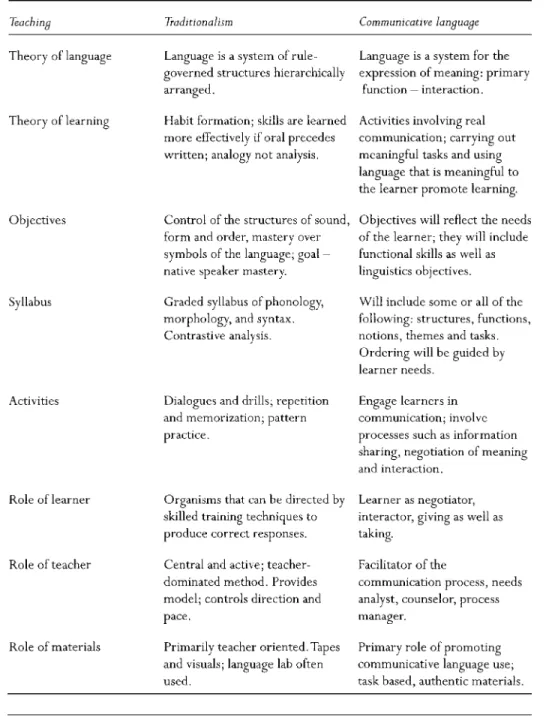
In addition, a paper authored by Nunan shows the effect of this short memory on perceptions that are passed down to new teachers. Table 2 is from a 2001 paper by Lamb and Nunan entitled Managing the Learning Process. It sets up a dichot- omy between “Traditionalism” and the modern development called “Communicative Language Teaching (CLT).” The authors do not disparage traditionalism; in fact, they acknowledge that it does, and should, play a role, determined by local needs, in language teaching. This is commendable, but what is erroneous is the portrayal of CLT as something new.
―66―
If we read beyond the modern paraphrasing in Table 2, we can see some very old ideas about language learning, already discussed in Part 1. Thus the use of the term “traditionalism” is a misleading term to use in contrast to CLT. CLT, in other guises, has also been a traditional constant since the Renaissance. Although it may not have always been in wide practice, as a philosophy of learning it has been con- ceived of for a very long time.
It is also unfortunate that Lamb and Nunan adopt the usual pejorative terminol- ogy to describe ‘traditionalism,’ and the usual warm, caring words to describe CLT.
In Table 2, ‘traditionalism’ describes learners as “organisms” and methods are
“teacher-dominated.” In CLT, the teacher is a “facilitator” and “counselor” attuned to student needs. Proponents of ‘traditionalist’ methods have always been frustrated by such language, especially when used in a liberal profession that commonly de- cries the use of language by the powerful to dehumanize their opponents. Many of the defenders of ‘traditionalist’ methods resented the claim that they were not inter- ested in helping learners communicate. When was there ever a language teaching ap- proach that did not have as its goal the promotion of communicative language use?
The ‘traditionalists’ simply believed in a delayed-gratification route to this goal.
In contrast, CLT is not necessarily as kind and gentle as its adherents claim. It is ultimately teacher-dominated and controlled by institutional and social factors. It is also biased against classroom learners who want a traditionalist method, or who wish to retain their privacy and keep their opinions to themselves in the ‘caring and sharing’ classroom. The de-emphasis of analysis and memorization in CLT also car- ries the implication that it is for learners lacking these strengths, those who cannot handle a heavy ‘cognitive load,’ to cite one of the common euphemisms for the ta- boo topics of aptitude and IQ.
In spite of this general absence of socio-historical perspectives, there are some notable exceptions that have appeared since the 1990’s. Tollefson describes the stan- dard approach in ELT as a neoclassical:
...the key to understanding social systems is the individual; that differences between sociopolitical systems are the result of the cumulative effect of indi- vidual decisions; that individual decisions are predictable but free; and that
―67―
the proper focus of social research is analysis of individual decisions (Tollef- son, 1991, p. 28).
Tollefson advocates for the use of the historical-structural approach in language
Table 2 from Managing the Learning Process. Lamb and Nunan (2001)
―68―
planning which “emphasizes the origins of the costs and benefits confronting indi- viduals and groups” (p. 32). Tollefson is concerned with the broad historical and social context in which teaching takes place, but not the history of language teach- ing.
Pennycook (1994) sees the entire field of applied linguistics and ELT being gradually bent toward the instrumental requirements of what has become a billion- dollar industry, and speaks of the “disciplining of applied linguistics” (p. 126). He notes, “the export of applied linguistic theory and of Western-trained language teach- ers constantly promotes inappropriate teaching approaches to diverse settings” (p.
159).
These are only some of the known criticisms, published in English. It is diffi- cult to know what academics in other cultures and language groups say, in the midst of a global ‘war on terror,’ in their own languages, about ELT practices and their ef- fect. A paper on critical language studies by Nakamura sheds light on a vigorous de- bate in Japan about the country’s English education policy and practices promoted by foreign teachers. What is notable about this paper is that Nakamura wrote a care- ful justification for choosing to write in the language of the linguistic hegemon. This suggests that there may be large bodies of academic literature, written in languages other than English, by academics who reject the foreign conventional wisdom so thoroughly that they do not even see a point in engaging with it. Kelly’s book, by his own admission, is only a history of the Western tradition of language teaching.
A truly global survey of language education, and a global dialogue about it, does not exist, and this shortcoming should be noted about the ‘state-of-the-art’ knowledge that is produced within the English speaking community of applied linguists and lan- guage teachers.
Part 3 Accounting for the Problem
Thus far I have tried to demonstrate the lack of historical, social and scientific perspective in ELT. In Part 3 I wander outside my discipline to explore some possi- ble reasons for this situation, describe some of the problem’s manifestations, and dis- cuss how a change in focus could improve language teaching and increase awareness
―69―
of discoveries that are happening in other related fields of knowledge.
The problem can be approached by first considering who becomes a language teacher or academic in ELT, and then asking how the commonalities of this group shape perspectives and biases. First of all, the field is comprised of a majority of women, even though its ‘leaders’ are disproportionately male. This has led to the dominance of feminine styles of communication and assumptions that they should be the normative goal of language teaching. Secondly, most practitioners have an un- dergraduate education in the humanities, so they come to the field with a lack of sci- entific knowledge and knowledge of scientific method. Many critics of higher educa- tion argue also that they don’t get even a proper humanities education. Thirdly, a more general and subjective comment often made about teachers may apply even more to ELT. They can’t do, so they teach. ELT teachers tend to have left the main- stream of their own societies to travel, work abroad and make a better world, or to reject participation in the societies they came from. This idealism makes for a field of social critics and reformers, rather than one of social conservatives with a con- strained vision of human nature. This can lead at times to an odd sense of a dissi- dent’s mission on the part of people who have been hired by parents and institutions to impart in young learners the English proficiency needed to achieve purely merce- nary objectives.
I must emphasize at the start that when I describe the effects of female domi- nance in the field, I make no value judgment or claim that it has become a ‘repres- sive matriarchy.’ I do argue, however, that the effects need to be recognized and not taken as an absolute norm by which to measure effective communication or effective teaching.
Innate sex differences in temperament and cognitive skills (that apply to group averages, not every individual in the group) are non-controversial in biology, but they remain a no-go zone in North American intellectual life, as is evidenced by the fate of the Harvard University president Lawrence Summers who was forced to re- sign in 2006 for having wished to discuss the possibility that innate sex differences might partially explain the lower number of females in the sciences (Harvard Uni- versity Gazette, 2006, February 21). Interestingly, no one has ever been forced to re- sign for speculating on why women outnumber men in other careers, or for stating
―70―
the findings that they are superior in many of the skills, such as empathy, language, and social skills, that give them advantages in the workplace of the information age.
Outside of politicized spheres of discourse, the studies on sex differences are able to proceed. There is strong evidence that males are better at spatial organization and mathematical reasoning, while females score higher for earlier and higher devel- opment of social and language skills, a fact which could account for their majority status in a field such as ELT. This biological difference is a plausible explanation of the imbalance in the ELT profession,4)and it could account, partially, for the domi- nance in our time of communicative language teaching. Even if the leaders and pro- ponents of current approaches are male, what counts is the buyers of the ideas, not the sellers.
The disadvantages of a humanities background are twofold. One is that it is split off from science, and the other is that in its present state, it is cut off from a strong foundation in the humanities. The root of the first problem is the split of knowledge that has developed over the last century, so that undergraduates specialize in either humanities or sciences, and never the twain shall meet. E.O. Wilson in Consilience argues for a return to a unity of knowledge that erases unnecessary di- vides which are “not a reflection of the real world but artifacts of scholarship” (Wil- son, 1998, p. 6). He writes a devastating critique of postmodern social theorizing, crediting it only with “the relief it affords those who have chosen not to encumber themselves with a scientific education” (p. 46). Camille Paglia, a social scientist her- self, has been unrestrained in her criticism of her own field:
The overwhelming majority of today’s gender theorists belong to humanities departments and have made little or no effort to inform themselves about anatomy, physiology, endocrinology or evolutionary biology, without which their social constructionist dogma is baseless. I have constantly argued that science courses should be required for anyone credentialed to teach gender issues at the college level. Right now, there are no prerequisites at all for fac- ulty positions in this field: Just wave a gay or feminist flag, and voilà, you’re an instant expert!” (Paglia, 1999, February 10).
―71―
Filling in the black holes of a liberal arts education means returning to the stacks with an open mind and open notebook... I pity the graduates of the elite schools of the past 20 years, whose fast-track humanities teachers have treated historicity like so much confetti to toss in the air... I know what erudition looks and acts like - - and it sure isn’t to be found on the slick academic circuit with its feeble superstars whose work won’t survive their lifetimes” (Paglia, 1998, November 4).
As it is one of the social sciences, ELT has shown signs of the same malaise.
In recent decades, coinciding with the period Paglia refers to, the field has had its share of superstars who have crossed the line from objective research into advocacy on policy issues, and engaged in cherry-picking data that suit their agendas. An example of such is the role played by Steven Krashen in the 1998 California state referendum to end bilingual education.
Bilingual education got its legitimacy from the uncontroversial finding that chil- dren cannot gain literacy or content knowledge in a language which they cannot speak. Originally, California bilingual programs were to teach literacy of the stu- dents’ native Spanish, then quickly make a transition to teaching English language and literacy. However, once the program became a bureaucratic endeavor, problems that emerged were ignored. The problem became politicized as Hispanic parents and students demanded access to English education and the general population came to question the purpose of the program. The public resented being told by academics that they had to accept that immersion education in the home language would lead to proficiency in the language of the community, and academics failed to grasp the significance of their ‘counterintuitive’ program’s lack of face validity with the public.
In particular, they refused to address the main complaint that too many older stu- dents were failing to transition to competency in English.
Several years after the referendum ended bilingual education, the issue was still being discussed in trade literature. Segota (2002) explained the public’s rejection of bilingual education in the fashion of a commissar who believes in the people, but not in their ability to decide matters that concern them. “... it [the proposition] asks the general public, largely uninformed about the complexities of second language
―72―
acquisition, to make a decision on pedagogical matters. That is like asking the gen- eral public to vote on the best way to perform open-heart surgery.” Smith made the same faulty comparison when he encouraged teachers to stand up for their convic- tions, writing that engineers do not consider public opinion on how to build bridges, nor do surgeons allow the public to tell them how to perform operations (Smith, 1986, paraphrased by Krashen, 2004, p. 5) But actually, the public does control these professionals. Engineers and surgeons implicitly know that the public demands bridges that don’t collapse and patients whose conditions do not worsen because of surgery. In education, the accountability problem is simply more difficult because of the complex variables and diffused responsibility for failures. In fact, as partisans on both sides of educational policy debates take credit for successes and assign blame for failures, the truth no one acknowledges is that outcomes depend largely on the circumstances of students’ lives outside of school.
The equating of a language teacher with a heart surgeon in the above quote is laughable in itself for its over-reach for social status, but mainly this statement points to the profession’s refusal to acknowledge that it serves at the behest of the public. In this case, language teaching is not heart surgery. The layman’s common sense wisdom and interest in the matter deserves to be given much more respect. In California, the public exerted its authority over the teaching profession, but the pro- fession seems to have learned no lessons from its failure to persuade the public that its methods were sound.
An article by Jill Stewart that appeared during the campaign in New Times LA (1998, May 29) gives a detailed account of Krashen’s involvement in the opposition to the referendum proposal. Although the article has its own biases, it is a revealing outsider’s glimpse into the career of a leader in ELT who has received rather uncriti- cal acceptance, or polite (cowered?)5)tolerance by his critics within his own profes- sion. The respect for his work is so high that students in teacher training programs have felt no encouragement to criticize his work. However, this review of his career by an outsider, rather than by an academic steeped in admiration for his work, found logical inconsistencies in his theories, and his academic objectivity (at the time he was on the faculty of USC) seriously compromised by his paid, high profile advo- cacy during the referendum.6)
―73―
Although she is ‘just’ a journalist who may not have grasped the ‘complexities’
of language acquisition, in her research Stewart found the disturbing illogical incon- sistency in Krashen’s theory and policy advocacy. Krashen notes in his own writing that he loves to analyze language but that “most people get their pleasures else- where” (Krashen, 2004, p. 5). Although Krashen and his followers view themselves as progressives, always on the side of the angels fighting to make learning fun, en- joyable and accessible for the underdog, the distinction Krashen makes here draws a line between himself and the masses. Conscious, analytical study is alright for the elite, but the masses have to be consigned to ‘natural’ learning. The contradiction was caught by a Hispanic LA magazine editor, quoted by Stewart, who fought against bilingual education programs:
Most ironic to Cubillos is what Krashen recommends in his latest book for educators who want to learn Spanish in order to be bilingual teachers. He recommends immersion language training in a foreign country. Snorts Cubil- los: “His whole theory just blew up in my face when I realized Krashen rec- ommends immersion for people who really want to learn a second language - - but no immersion for Latino kids” (Stewart, 1998, May 29).
Stewart interviewed Christine Rossell, a researcher who has conducted “exhaus- tive analysis of the studies used by Krashen as proof of his theories,” and Rossell found the data, and Krashen’s use of it, lacking:
In fact, Rossell found, only 72 studies of bilingual education exist that both- ered to use scientifically accepted methods, such as control groups and ran- dom selection; most of the hundreds of other studies have been conducted by bilingual education true believers who skewed their research and rendered it meaningless... “I see Steve Krashen as an incredible cynic and opportunist, not as a believer,” says Rossell. “He was an avid backer of immersion Eng- lish ... until the big money went a completely different direction. It is my belief that Krashen and Cummins came up with their theory of language ac- quisition to justify a practice that was spreading like wildfire through the
―74―
schools” (Stewart, 1998, May 29).
This illustration of one ELT leader’s career activity corroborates Kelly’s obser- vations of forty years ago, quoted at the end of Part 1, summed up best as: “Teach- ing, being an art, looks to its market and takes from its parent sciences what will sell” (Ke, p. 408).
So far I have attempted to demonstrate a lack of historical and social awareness and a neglect of science and scientific method within the ELT profession. In the fi- nal section of Part 3, I wish to discuss how this situation has caused the profession to miss the more relevant discoveries about human nature that are occurring in other related disciplines of science.
Pinker has written extensively on this malaise as it applies to the social sciences in general. He describes the standard social science model (SSSM) as a flawed belief system on which all social theorizing has been based since the 1920’s (Pinker, 1994, p. 406). In the SSSM “human behavior is determined by culture... human infants are born with.... a few reflexes and an ability to learn. Learning is a general purpose process, used in all domains of knowledge.” The model acknowledges few human universals across cultures, and sees the scientific method as Eurocentric and male oriented. As empirical evidence accumulated in the life sciences casting doubt on many of the foundational theories of the 20th. century, such as Freudianism, social theorists remained unaware, or dismissed the findings as only those of a biased ‘sci- entism.’
Pinker developed this criticism further in his 2002 book The Blank Sate: The Modern Denial of Human Nature, in which he outlined three broad secular dogmas that have dominated intellectual life in recent decades. The first is the Blank Slate which places a strong emphasis on nurture over nature. The second is the Noble Savage, the belief that history, experience and social structures have corrupted civi- lized humans from their original pure state of peaceful co-existence. The third is the Ghost in the Machine, the belief in an immaterial soul that enters a body at concep- tion and leaves it at death. All three belief systems are untenable in the face of mounting discoveries in the life sciences. The mind is not a blank slate but rather a modular organ evolved to carry out specific functions and learn specific skills as it
―75―
interacts with the environment. The potential for violence and competition is found to be inextricable from the evolution of an intelligent, social animal. The soul is no- where to be found and not necessary to explain the complex activity and organiza- tion of a brain. These discoveries present discomfiting challenges to the three secular belief systems, so they are denied and ignored, remain in our assumptions about hu- man nature, and persist as obstacles to the development of public policy (Pinker, 2002, pp. 5-13).
There are numerous examples of the influence of these dogmas in ELT. One of them is the ‘blank slate’ denial of the critical period hypothesis (CPH), long after it has become uncontroversial in biology. This leads to the debate over whether learn- ing a first language is different from learning a foreign language after adulthood.
Deniers of the CPH have pointed out the often superior attainment of adults in learn- ing a foreign language, confusing ends with the means. They ignore the fact that most adults learning a foreign language never reach high proficiency, and those who do are able to succeed by doing things that children cannot. They read, write notes, analyze the new language and compare it with their native language.
The motivation to deny the CPH has always been to advance the trend of using non-analytical methods in teaching adults. If adults learn like children, they can learn through loosely structured social interaction and guided communicative tasks.
Besides ignoring the common, intuitive wisdom that all people have about childhood language learning, these proponents have had to ignore massive amounts research that have found critical developmental periods are universal in many traits, in all species. Hurford (1991), a self-described “computational evolutionary linguist” did computer modeling of adaptive pressure on language acquisition in human popula- tions. He concluded the existence of the critical period for language acquisition was a by-product of natural selection pressures on language acquisition. Language con- fers advantages in physical and social survival and reproduction, so individuals with fortunate mutations that caused the quick acquisition of language would have greater reproductive success than those who lacked the mutations. Also, because learning uses up the brain’s resources, it doesn’t need to continue after the task is complete.
Since humanity evolved, in almost all of its history, in monolingual communities, there was no selective pressure on keeping language learning ability after puberty.
―76―
Another aspect of language learning that has been a taboo area for several decades is language learning aptitude and intelligence. In the 1950’s, Caroll studied language learning aptitude in depth and developed the Modern Language Aptitude Test. He identified several areas of competence, not necessarily related to verbal in- telligence in the first language, such as memorization, phonetic coding, and recogni- tion of grammatical analogy (Caroll & Sappon, 1959, in Bachman, 1990, p. 72). At the time, researchers who worked in this area must have assumed, naively, that their work would be considered beneficial, helping in the planning of language education policy, helping individual learners identify their strengths with regard to other areas where their aptitude might be different, or assisting institutions in selection of candi- dates for language programs. Instead, ELT became oriented toward the demands of educational planners who wanted universal, compulsory programs, or programs that were appealing to a large market. In such a context, talk of innate aptitude became unfavorable.
Although the impulse to deny intelligence and aptitude has humane motivations, its implications contradict this impulse. If abilities are equal, differences in achieve- ment can only be explained as differences in effort, so the less gifted are blamed for an innate disadvantage or disinterest. With the lowest achieving individuals, if it be- comes impossible to deny their innate disadvantage, they must be labeled as having a ‘disability,’ and interventions must be applied, whereas in the past they were just accepted as those who naturally made up the left tail of the bell curve. Finally, an educator cannot deny differences in intelligence if he wants to advocate for the benefits of good nutrition and the elimination of environmental toxins.
I saved this topic for my final point because it presents a good example of how various disciplines of science can inform educators of the most pertinent issues on the horizon. In order to discuss it, I will have to discuss some subjective and anec- dotal experience discussed with colleagues at Japanese universities, and make some impolitic observations about the elephant in the room, or in the classroom as the case may be. Quite simply, the general observation seems to be that the younger generation is more difficult to teach than those of old.
There is much talk these days of how to deal with an increasing number of stu- dents who appear to have mental health or learning problems. Declining academic
―77―
achievement has been noted in numerous studies in several developed countries.
Teachers feel frustrated because it is difficult to apply the standard methods that as- sume learners are the motivated, and basically competent learners they were trained to deal with.
In ELT in Japan, this problem can be explained partially by structural factors, that college and high school English classes are mandatory and filled with many stu- dents uninterested in the subject. Nonetheless, the problem appears in Japan, as in other industrialized countries, with increasing levels of various cognitive disorders – autism, attention deficit, hyperactivity, short term memory impairments, poor emo- tional control, eating disorders, social skill disorders, gender and sexual preference disorders7), language delays, depression, dyslexia, passive-aggressive tendencies, and so on. The rise in diagnosed disorders can be partly explained by our society’s greater awareness of these problems, as well as its inability to accommodate people who are maladapted to the information age. In the industrial age, the people with
‘disorders’ had occupations and social roles they could go to without their aptitudes and personalities being considered overly problematic.
Nonetheless, a change in awareness does not likely account for the rising inci- dence of these disabilities. Society and its educational institutions are acutely aware that the contemporary situation is showing some alarming trends. A recent letter signed by 110 leading British academics (The Telegraph, 2006, Sep. 9) reflects the sentiment, finding fault in the stressful and impoverished social environment of chil- dren. Though this open letter to a leading newspaper offers insight into the concern of experts about this crisis, they adopt the usual experience-is-everything assumption of intellectual culture. These scholars may be failing to see the ultimate causes of the problem. Moralizing and hand-wringing about social ills seem to be the natural reaction to the crisis. Explanations and solutions may come from the left or right of the political spectrum, but they amount to the same thing. Students don’t get enough discipline, or they are oppressed by an overbearing system. We need more patriotism, or maybe less. We need more religion, or perhaps less religion. Mothers are too busy to prepare nutritious meals, or we need better social support for mothers.
Video games make children violent and anti-social, or they sharpen reflexes and en- gage all the senses. Certainly, there is much that society can do to cause, prevent
―78―