DOI: http://dx.doi.org/10.14246/irspsd.3.2_39
Copyright@SPSD Press from 2010, SPSD Press, Kanazawa
User Behaviour Analysis of the Public Bike System in Taipei
Jen Te Pai
1and Shih Ying Pai
2*1. Associate Professor, Department of Land Economics, National ChengChi University 2. Master, Department of Land Economics, National ChengChi University
* Corresponding Author, Email: [email protected] Received 16 February, 2014; Accepted 28 July, 2014
Key words: Public Bike System, Bike -sharing System, User Behaviour, YouBike, Environmental Cognition, PBS Cognition
Abstract: Public Bike System, PBS, usually named Bike-sharing System in the west, is a category of green transport to provide a low-carbon solution of the “first/last mile” problem in a city. Indeed, there were only five bike-sharing programs in 2000. Now over 400 cities in 30 different countries have PBS programs, with more than 350,000 bikes worldwide. However, the studies for bike-sharing are still limited, and it is hard to find some related research of bike-sharing programs in the East-Asia region. The factors of a successful bike-sharing system vary between different cultures, geographic limits, and models of provision. The experience in the west is not adaptable in east. Therefore, more research is necessary for a better understanding of bike-sharing systems especially in the East-Asia region. To comprehend the elements of a successful bike-sharing system, this study examined the factors that influence the bike- use intentions of bike-sharing programs, and analysed the user behaviour based on a survey of 557 respondents in Taipei, Taiwan. Results show the system cognition, environment cognition, personal perception and personal preference are four vital aspects influencing the user behaviour, and the extent is varied by different travel purposes. The location of docking stations is the most critical factor influencing user behaviour with regard to each aspect.
1. INTRODUCTION 1.1 Preface
Since the 21st century, energy shortages, the greenhouse effect and global warming have always been major topics of discussion, and sustainable development has thus become an important goal of urban development policies around the world. Research shows that carbon dioxide, a greenhouse gas, is mainly caused by transportation emissions (i.e. motor vehicles). Therefore, the development of green transportation has become a primary goal of transport agencies in major cities to mitigate the environmental impact of transportation emissions. Hence, a Public Bike System (PBS) or Bike-Sharing System (BSS) has been introduced in Europe.
PBS is a bike system in which individuals can lend and return bicycles freely at any stations located in the city. It has undergone four development stages since first launching in 1965 (Shaheen and Guzman, 2011). In fact, there were only five bicycle systems as of October 2000. However, there
39
were as many as 350,000 bike-sharing systems in 400 cities in more than 30 countries around the world by October 2012 (Larsen, 2013; Midgley, 2011).
In Asia, Taipei also invented the first Public Bike System “YouBike” in Taiwan. It was officially launched in 2009.
1.2 Motivation and Objective
The public bike system is a new urban traffic system. There is limited academic research on the subject in Asia compared to Europe and America (Shaheen, Guzman and Zhang, 2010). There are actually many factors affecting the use of public bikes that need to be discussed. Moreover, the development experience in one city cannot be fully applied to other regions since there are cultural differences between Europe, America and Asia.
Therefore, it is necessary to conduct related studies to improve the operating efficiency of public bicycles in order to help achieve sustainable development, reduce CO
2emissions and save energy.
Based on the discussion and classification of foreign PBS cases (Bike- Share Studio, 2010; Curran, 2008; DeMaio and Gifford, 2004; Dill and Carr, 2003; JZTI and Bonnette Consulting, 2010; New York City Department of City Planning, 2009; Transport Canada, 2009), this research has summarized the factors that affect the use of public bikes and analysed PBS user behaviour in Taipei through a questionnaire survey. The research objectives are as follows:
1. To summarize the factors that affect the sustainable operation of PBS based on the development of public bicycle systems in foreign countries.
2. To analyse PBS user behaviour in Taipei through a questionnaire survey conducted in Taipei’s metropolitan area.
2. LITERATURE REVIEW 2.1 Public Bike System
2.1.1 Definition
Bicycle sharing system or bike sharing, is a bike system in which individuals can lend and return bikes freely at any station in the city. Its concept is to provide free or affordable access to bicycles for short-distance trips in an urban area as an alternative to private vehicles, thereby reducing traffic congestion, noise and air pollution. It can connect users to public transit networks effectively, so it has also been cited as a way to solve the
“last mile” problem (DeMaio, 2009).
In Europe and America, the system is called bicycle sharing but in Asian countries, Public Bike System is the term more commonly used. When comparing the two terms, bicycle sharing emphasizes the concept of sharing.
On one hand, it suggests that sharing bicycles should solve the “last mile”
problem as well as reduce air, noise and environmental pollution through green transportation. On the other hand, PBS emphasizes more on public transit network than sharing. It is a system in which individuals can lend and return bikes freely at any station in the city and serves as a means of transportation.
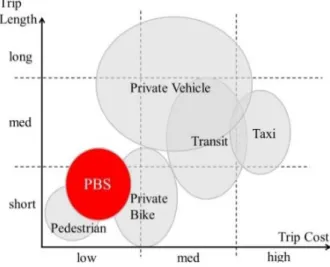
For short-term trips, public bikes are fast and flexible, so they are
considered as a highly efficient alternative, especially compared to private
vehicles and public transportation. For long-term trips, public bikes are considered as a part of intermodality by connecting to other forms of transportation or walking trips. Indeed, most systems integrate a member’s card to regional transportation user cards for an easier way to access public bikes (JZTI and Bonnette Consulting, 2010; Transport Canada, 2009).
Figure 1. Position of PBS in Urban Transportation System Data source: (Curran, 2008)
2.1.2 Components of PBS
A complete PBS is composed of different essential elements, the design and scale of which are adjusted according to the conditions in each country.
These elements include specially designed bicycles, docking stations, system access and user registration systems, status information systems, maintenance programs, and bicycle redistribution mechanisms (Curran, 2008; Midgley, 2011; Transport Canada, 2009).
The elements above, including bicycles, docking stations, system access
and user registration, and service systems, are developed by cities or
companies independently ( Midgley, 2011 ). Bike maintenance and
management are the biggest challenges in the whole maintenance program
due to excessive and frequent use of public bicycles ( Curran, 2008 ). The
rent ratio is also an important factor affecting the use of public bikes. If the
rate is too high, it discourages the use of public bikes; if it is too low, it
affects the fiscal balance of system operation ( Midgley, 2011 ). Therefore,
the rent ratio must be set based on many factors. It is only through
adjustment can we set an optimum price. The position of the docking
stations is also very important. The distance between docking stations
depends on the size of the PBS and the size of the city region. For example,
the distance between each docking station in both Paris and Barcelona is
about 300 m (Shaheen and Guzman, 2011). In addition, given the
asymmetric travel times, the PBS system must be able to prevent shortage of
bikes to borrow or docking stations for returning bicycles through a
dispatching system. Therefore, it can be concluded that the bicycle
redistribution mechanism is the most important element in the whole system
(JZTI and Bonnette Consulting, 2010) .
2.2 Success factors of PBS
Bicycling is an environmentally friendly mode of transportation and important means of green transportation. There have been quite a number of studies here and abroad on the environmental benefits of bicycles. However, there is a difference between the characteristics of public bikes and ordinary bikes. Even though they share similar features, there are still some points to consider and adjust when it comes to operating PBS successfully.
This research lists four important influencing factors based on foreign and domestic literature. These are system characteristics (Youbike, 2012; Bike-Share Studio, 2010; CityRyde, 2009; Curran, 2008; Dill and Carr, 2003; JZTI and Bonnette Consulting, 2010; Midgley, 2011; Shaheen, Guzman and Zhang, 2010; University of Washington, 2009), environmental characteristics (Benson, 2009; Bike-Share Studio, 2010; Dill and Carr, 2003; Jacobsen, 2003; JZTI and Bonnette Consulting, 2010; Land Transport Safety Authority NZ, 2004; Midgley, 2011; Saneinejad, Roorda and Kennedy, 2012), existing restrictions of cities (Bike-Share Studio, 2010; DeMaio and Gifford, 2004; JZTI and Bonnette Consulting.
2010; Midgley, 2011; Saneinejad et al., 2012; Shaheen et al., 2010; Transport Canada, 2009) and PBS users’ preference (JZTI and Bonnett0e Consulting, 2010) . The dimension and the influencing factors are as follows in Table 1.
Table 1. Success Factors of PBS
Dimension Influencing Factors
System Characteristics
1. Bicycle design and quality (comfort, commonality, bicycle lock, night use)
2. Number of docking stations and bikes
3. Convenience of leasing and returning procedures (complexity, time spent)
4. Accessibility of docking stations (operating time, location) 5. Charge rate
6. Publicity and emergency preparedness and response 7. Maintenance program and bike redistribution
Environmental Characteristics
1. Bike lane quality (lane surface, roadside obstacles, gradient) 2. Related bike infrastructures
3. Slow lane design for bikes (facilities that separate them from general traffic flow)
4. Consistency and identification of bike lanes and related signs 5. Covered area for bicycles
6. Night lighting facility
7. Completeness of road network for bikes (shortest path, multiple paths, continuous path)
8. System status information systems (location, number, road condition and docking stations)
9. Quality of public transit service (transfer convenience, rate preference) 10. Different trip requirements
11. Water station, toilet and emergency equipment
Existing Urban Restrictions
1. Geographical condition 2. Urban climate
3. Social climate and culture (transportation practices, bike theft rate, safety awareness)
4. Policies (support of the whole system) PBS Users’ 1. Gender
2. Social and economic status (age, educational status, occupation, etc.)
Dimension Influencing Factors
Preference 3. Original trip features and distribution in the city
4. Others (biking ability, credit card ownership, time limit…, etc.)
3. RESEARCH DESIGN 3.1 Questionnaire Design
This research analyses the behavioural characteristics of users of YouBike, Taipei’s Bike Sharing System, through questionnaire survey. The questionnaire covers four parts and is designed based on the Success Factors of PBS presented in Table 1.
1. Use Experience of YouBike
This part covers questions that evaluate respondents’ understanding and use of YouBike in Taipei, including use time, use purpose, use frequency, use hours and use area.
2. PBS System cognition, Environmental Cognition and Users Preference This part explores people’s cognition of the YouBike system and biking environment in Taipei as well as preference and demand for YouBike. The questionnaire uses the Likert Scale. The system cognition section covers the characteristics of a system’s sustainable operation, including leasing and returning procedure efficiency, difficulty, rate, preference, and bicycle design of YouBike.
Cognition of Taipei’s biking environment corresponds to environmental characteristics involved in the sustainable operation of PBS, including awareness of the environmental benefits of bicycles and bike lanes in Taipei, as well as the effects of supporting facilities of YouBike on use intention.
The questionnaire explores user preference and demand for YouBike. It evaluates the purpose and intention of respondents in using YouBike at different times.
3. User Perception
This part evaluates the experience and feelings of people while using the system. To simplify the questionnaire, a check list is provided on items that need improvement, such as bike borrowing method, bike returning method, the number and location of docking stations, status information systems, bicycle design, comfort, bicycle lock design, and night lighting and state of disrepair.
4. Personal data
This part covers some basic questions such as gender, age, occupation, educational status and income. Factors that may affect users’ behaviour and intention are also included; these are respondents’ height and weight, physical fitness, monthly commuting expense, monthly YouBike expense, possession of driving license, ownership and number of vehicles, and biking and road practices.
3.2 Sample Selection
Convenience sampling was used for this from different docking stations.
In addition, an online questionnaire was distributed from Jan. 15, 2013 to
Feb. 15, 2013 to include additional users at different time intervals and non- PBS users.
3.2.1 Time Scale
The questionnaires were distributed in Jan., 2013. Since PBS user groups and use features are different during holidays and weekdays, separate questionnaires were given during both periods. However, due to the time, funding and manpower limitations, all questionnaires were distributed between 12 a.m. and 6 p.m., excluding morning and evening use.
3.2.2 Space Scale
The locations where the questionnaires were distributed are the busiest docking stations. These include MRT Taipei City Hall Station, Sun Yat-sen Memorial Hall Station, Gongguan Station, Shi-Da University Library and MRT Technology Building Station.
4. RESULTS AND ANALYSIS 4.1 Basic Information Analysis
This research collected a total of 557 valid questionnaires, among which 325 were from the online survey, which covered 158 people who had used YouBike and 167 who hadn’t. The remaining 232 questionnaires were from the convenience sampling survey conducted at random; these included 211 people who had used YouBike and 21 people who hadn’t. The reliability analysis was conducted using 557 valid questionnaires, and the Cronbachs α is 0.85, indicating the questionnaire’s high reliability.
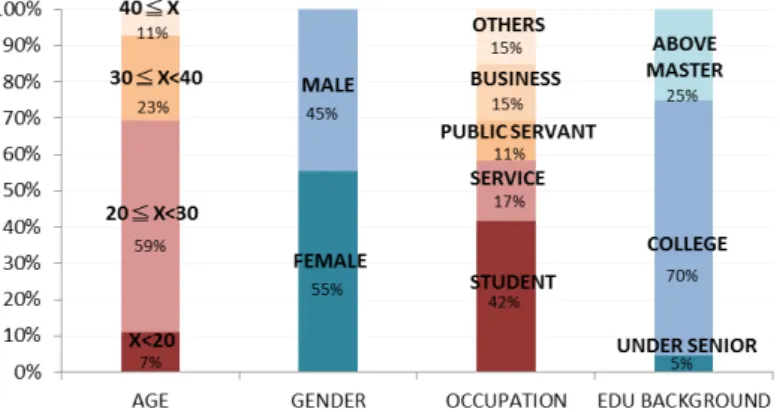
As shown in Figure 2, the samples in this research are people between 20 and 40 years old, almost evenly divided according to gender. In terms of occupation, students constitute the majority while service comes in second.
In terms of educational background, which is influenced by the high academic qualifications in Taiwan, more than 90% of the samples have a bachelor’s degree or above.
Figure 2. Basic Data Analysis of Questionnaire
Figure 3 shows the most commonly used vehicles in the samples. Almost 70% of people walk or use public transport and private bikes, and only 30%
use cars or motorbikes, a non-green means of transportation. Figure 4
illustrates the use of YouBike, 98% of the total sampled know YouBike, 86% know how to use YouBike, but only 66% have actually used it.
Figure 3. Percentage of Traffic Practices
Figure 4. Use of YouBike
As shown in Figure 5, most people use bikes for short trips (i.e. within 30 minutes); 23% of people’s riding time is between 30 and 60 minutes, only 6% of people’s riding time exceeds 60 minutes. Figure 6 shows the use frequency, 21% ride bikes less than once a month, 42% ride bikes less than 5 times a month. The results above show that at present, most PBS users ride bikes occasionally.
Figure 5. Average Use Time
Figure 6. Use Frequency
4.2 User Behaviour Effect Factor of PBS
Based on the questionnaire, people use YouBike mainly to transit to public transport (31%) and for commuting (30%), a few people use it for recreation (28%), as shown in Figure 7. However, the result of the questionnaire survey regarding the hypothetical intention to use, as shown in Figure 8, shows that about 90% of people are willing to use YouBike as a means of recreation, while more than 80% are willing to use YouBike as a mode of transportation. This shows that people who are willing to use PBS for leisure travel are a big potential user group, which hasn’t been developed in actuality.
Figure 7. Travel Purpose of YouBike
Figure 8. Use Intention in Different Purposes and Time
Figure 9 shows that among the modes of transportation which were
replaced by YouBike, 93% was a replacement of public transport, walking
and private bikes, which are all green transportation. and only 7% are cars or
motorbikes which are non-green transportation. This means that most
YouBike users are highly dependent on public transport.
Figure 9. Means of Transportation Replaced by YouBike
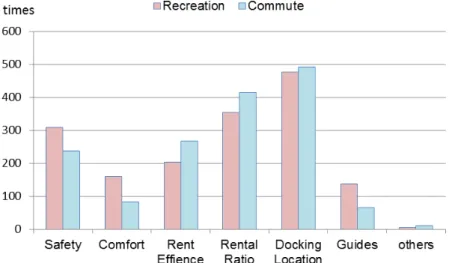
In Figure 10, the most important factors that affect leisure travel are docking locations, rental ratio and safety. The factors that affect commuters are docking locations, rental ratio and rent efficiency. However, in Figure 11, based on the questionnaire, people considered the items needing to be improved are the following: location, number of docking stations, and shortage of bikes to borrow and lack of empty docks for returning bikes. At present, people believed that for YouBike, the most important factors are also those that need improvement, whether for leisure or transport.
Figure 10. Factors that Affect Intention to Use for Different Purposes
Figure 11. Factors that YouBike Needs to Improve on
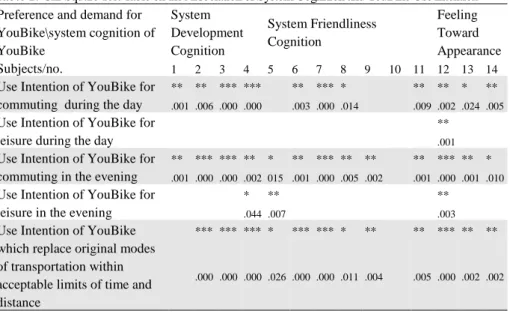
To know more about factors that affect the use intention of YouBike, the research conducted a cross-over analysis of system cognition, environmental cognition and use intention. In the cross-tabulations as shown in Table 2 and Table 3, each number represents different questions in the questionnaire, which are related to different kinds of cognition. For example, in Table 2, number 1 to number 4 are four questions about the system development cognition, and number 12 to number 14 are three questions about the cognition of the YouBike appearance. Hence, we can figure if there are any relations between different sorts of cognition and use intention. The result shows that the intention of using YouBike for commuting is significantly related to both system cognition and environmental cognition. In comparison, intentions for leisure purposes are related to neither system cognition nor environmental cognition. In addition, the correlation between system cognition and the use intention is higher than environmental cognition and use intention. That is to say, use intention for commuting is correlated to both system cognition and environmental cognition, but the use intention for leisure is not. The reason for this result could be inferred. In this study, the questionnaire is designed from commuter type-related literatures, and the original purpose of a public bike system is for commuting use. Obviously, some other variables which affect leisure use intention are ignored in this study.
Table 2. Chi-Square Test Table on the Association of System Cognition and YouBike Use Intention Preference and demand for
YouBike\system cognition of YouBike
System Development Cognition
System Friendliness Cognition
Feeling Toward Appearance Subjects/no. 1 2 3 4 5 6 7 8 9 10 11 12 13 14 Use Intention of YouBike for
commuting during the day
** ** *** *** ** *** * ** ** * **
.001 .006 .000 .000 .003 .000 .014 .009 .002 .024 .005
Use Intention of YouBike for leisure during the day
**
.001
Use Intention of YouBike for commuting in the evening
** *** *** ** * ** *** ** ** ** *** ** * .001 .000 .000 .002 015 .001 .000 .005 .002 .001 .000 .001 .010
Use Intention of YouBike for leisure in the evening
* ** **
.044 .007 .003
Use Intention of YouBike which replace original modes of transportation within acceptable limits of time and distance
*** *** *** * *** *** * ** ** *** ** **
.000 .000 .000 .026 .000 .000 .011 .004 .005 .000 .002 .002
Table 3. Chi-Square Test Table on the Association of Environmental Cognition and YouBike Use Intention
Preference and demand for YouBike\system cognition of YouBike
Climate Biking Environment
Biking Conven- ience
Overall Cognition of Environment
Subjects/no. 1 2 3 4 5 6 7 8 9 10 11 12
Use Intention of YouBike for commuting during the day
** ** * ** **
.004 .001 .027 .001 .001
Use Intention of YouBike for leisure during the day
**
.007
Use Intention of YouBike for commuting in the evening
*** * *** ** ** * * * ** *** ** *
.000 .015 .000 .002 .006 .015 .012 .043 .005 .000 .007 .017
Use Intention of YouBike for leisure in the evening
**
.003
Use Intention of YouBike which *** ** * ** ** * * ** ** **
replace original modes of transportation within acceptable limits of time and distance
.000 .001 .020 .006 .004 .048 .040 .003 .005 .002
4.3 Principal Component Analysis
To furthermore discuss the relation between cognition and use intentions, this research conducts a principal component analysis to simplify the questions in the questionnaire and determine the important factors that affect the intention to use. The results are shown below.
4.3.1 Principal Component Analysis of System Cognition
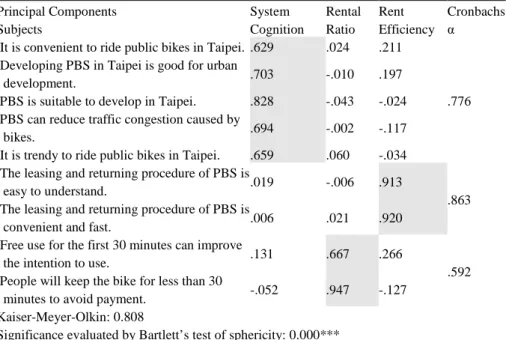
As Table 4 shows, in the system cognition section, three principal components - system cognition, rental ratio and rent efficiency - are considered as important factors that affect the intention to use. The Kaiser- Meyer-Olkin measure (KMO) of this part is 0.808, stating the result is good.
The Bartlett Test of Sphericity is 0.000, attaining a three-star significance (p<0.001). Therefore, we can say that it is suitable to conduct a principal component analysis on this particular section.
Table 4. The Result of Principal Component Analysis of System Cognition Principal Components
Subjects
System Cognition
Rental Ratio
Rent Efficiency
Cronbachs α
It is convenient to ride public bikes in Taipei. .629 .024 .211
.776 Developing PBS in Taipei is good for urban
development. .703 -.010 .197
PBS is suitable to develop in Taipei. .828 -.043 -.024 PBS can reduce traffic congestion caused by
bikes. .694 -.002 -.117
It is trendy to ride public bikes in Taipei. .659 .060 -.034 The leasing and returning procedure of PBS is
easy to understand. .019 -.006 .913
.863 The leasing and returning procedure of PBS is
convenient and fast. .006 .021 .920
Free use for the first 30 minutes can improve
the intention to use. .131 .667 .266
.592 People will keep the bike for less than 30
minutes to avoid payment. -.052 .947 -.127
Kaiser-Meyer-Olkin: 0.808
Significance evaluated by Bartlett’s test of sphericity: 0.000***
4.3.2 Principal Component Analysis of Environmental Cognition
In the environmental cognition section, environmental cognition and facility improvement are considered important factors that affect the intention to use. The KMO of this part is 0.808, stating a good result. The Bartlett Test of Sphericity result is 0.000, which attains a three-star significance. Overall, we can say that it is suitable to conduct a principal component analysis on this section.
Table 5. The Result of Principal Component Analysis of Environmental Cognition Principal Components
Subjects
Environmental Cognition
Facility Improvement
Cronbach's α Taipei’s climate is suitable for PBS development. .535 .163 .837
It is safe to ride a bike in Taipei. .860 -.034 It is smooth and hassle-free to ride a bike in
Taipei. .896 -.082
There are adequate signals, signs and marks for
bikes in Taipei. .767 -.093
On the whole, Taipei is a bike-friendly city. .796 .090 Real-time information app for smart phones can
improve the intention to use. .105 .632
.644 Increasing green lanes on roads can improve
people’s intention to use PBS in Taipei. .020 .836 On the whole, improving infrastructure of bikes
can improve people’s intention to use PBS in Taipei.
-.107 .802
Kaiser-Meyer-Olkin: 0.808
Significance evaluated by of Bartlett’s test of sphericity: 0.000***
5. CONCLUSION AND RECOMMENDATION 5.1 Conclusion
This research analyses PBS user behaviour characteristics in Taipei’s metropolitan area. The conclusions are as follows.
1. Most users use YouBike on occasion.
Based on the characteristics of YouBike users, it can be observed that most people use YouBike on occasion regardless of time or frequency. Users of YouBike have grown rapidly since YouBike expanded its service area in Aug. 2012. Their impression and experience during this period affected their decision to use YouBike in the future. In terms of user impression, it can be gathered from the survey result that the promotion of YouBike has had an effect on Taipei’s metropolitan area and most people have an idea of the system.
2. People who are willing to use PBS for leisure travel are a big potential user group.
The questionnaire results show that factors that affect people’s intention to use PBS for leisure and commuting purposes are different. In present, people use YouBike mostly for commuting. However, Figure 8 shows the proportion of people’s intentions to use PBS for leisure is larger than for commuting. This indicates that a group of people who are willing to use PBS for leisure haven’t started using YouBike yet. This is also a factor that needs to be emphasized for future operating strategies.
3. System cognition and environmental cognition are important influencing factors that affect people’s intentions to use YouBike for commuting.
Based on the cross-over analysis, system cognition and environmental cognition are strongly associated with the use intention or commuting.
Consequently, they are important factors that affect the intention to use.
Based on the principal component analyses, system cognition, rental ratio
and rent efficiency are important factors that affect people’s system
cognition. Environmental cognition and facility improvement are important
factors that affect people’s environmental cognition. Figure 10 shows that
docking locations, rental ratio, rent efficiency and safety which coincide
with rate, efficiency and facility improvement, are factors that users consider
the most important based on the result of principal component analysis. This shows that for PBS development in Taipei, people’s cognition of system and environment, rental ratio and rent efficiency as well as environmental safety, affect people’s intentions to use PBS. System operators should pay attention to these factors to avoid people’s negative impressions of PBS operation.
5.2 Recommendation
Bikes are an important means of green transportation. There have been many related studies on bike-friendly environments. Since PBS started, past research findings on bike-friendly environments have been applied to PBS planning. However, the essence and characteristics of PBS are different from those of ordinary bikes and their user characteristics are likewise different.
The research results show that PBS users pay more attention to rate and efficiency rather than the environment.
PBS is a new means of transportation. Related studies have been increasing gradually in Europe and America. However, in Asia, many countries lack experience in PBS operation. Therefore, it is suggested that follow-up studies be conducted in the following areas which can serve as an important reference for the sustainable operation of PBS.
1. Comparison between PBS development experience of Asian countries, and different cities in Europe and America
2. Study of PBS evaluation mechanism from the point of supplier (government or operator)
3. Establishing evaluation indexes for docking stations of PBS 4. Establishing a redistribution system for PBS
5.3 Research Limitation
Since this research has time and manpower limitations, using an equal number of people of different ages and occupations to study their characteristics was not feasible. Interviewing PBS users at different time periods to distinguish user characteristics was not possible either. It suggests that follow-up studies should be conducted to complete the research on user’s characteristics.
REFERENCES
Benson, T. (2009). “Public Use Bike Share Feasibility Study: Volume Two: Demand Analysis”.
Bike-Share Studio (2010). Seattle Bicycle Share Feasibility Study, Department of Urban Design and Planning, College of Built Environment, University of Washington.
CityRyde (2009), CityRyde Bike-sharing Informational Webinar, Philadelphia.
Curran, A. (2008). Translink public bike system feasibility study, Quay Communications Inc., Vancouver.
DeMaio, P. (2009). “Bike-sharing: History, Impacts, Models of Provision, and Future”, Journal of Public Transportation, 12(4), 41-56.
DeMaio, P. and Gifford, J. (2004). “Will Smart Bikes Succeed as Public Transportation in the United States?” Journal of Public Transportation, 7(2), 1-15.
Dill H. and Carr T. (2003). “Bicycle Commuting and Facilities in Major U.S. Cities: If You Build Them, Commuters Will Use Them”, Journal of the Transportation Research Board, 1828, 116-123.
Jacobsen, P. L. (2003). “Safety in numbers: more walkers and bicyclists, safer walking and bicycling”, Injury Prevention, 9, 205-209.
JZTI and Bonnette Consulting (2010). Philadelphia Bikeshare Concept Study.
Land Transport Safety Authority NZ (2004). Cycle Network and Route Planning Guide, New Zealand.
Larsen, J. (2013). “Bike-Sharing Programs Hit the Streets in Over 500 Cities Worldwide”, Earth Policy Institute.
Midgley, P. (2011). Bicycle-sharing schemes: enhancing sustainable mobility in urban areas”, Commission on Sustainable Development Nineteenth Session, New York.
New York City Department of City Planning (2009). Bike-Share Opportunities in New York City, PTCP08D00.G05, New York.
Saneinejad, S., Roorda, M. J. and Kennedy, C. (2012). “Modelling the impact of weather conditions on active transportation travel behaviour”, Transportation Research Part D, (17), 129-137.
Shaheen, S. and Guzman, S. (2011). “Worldwide Bikesharing”, ACCESS, 39:22-27.
Shaheen, S., Guzman, S., and Zhang, H. (2010). “Bikesharing in Europe, the Americas, and Asia- Past, Present, and Future”, Journal of the Transportation Research Board, 2143, 159-167.
Transport Canada (2009). Bike-Sharing Guide, T22-180/2009E.
University of Washington (2009). Climate Action Plan.
The Bike-sharing World Map. (Accessed Oct. 18, 2012)
https://maps.google.com/maps/ms?ie=UTF8&hl=en&om=1&msa=0&msid=10422731830 4000014160.00043d80f9456b3416ced&ll=43.580391,-
42.890625&spn=143.80149,154.6875&z=1&source=embed
Website of YouBike. (Accessed Sep. 20, 2012). http://www.youbike.com.tw/