― ―21
JSAP1/JIP3 Cooperates with FAK to Regulate c-Jun N-terminal Kinase and Cell Migration
T. Takino, M. Nakada, K. Yoshioka
1, H. Miyamori, Y. Watanabe, K. M. Yamada
2and H.
Sato (
1Dept. Cell Cycle Regulation, Cancer Res. Inst. Kanazawa Univ.,
2CDBRB, NIDCR, NIH, USA)
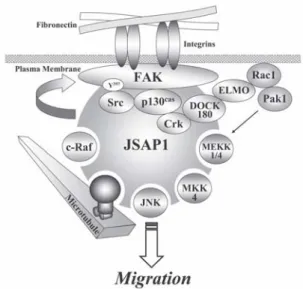
c-Jun N-terminal kinase (JNK)/stress-activated protein kinase-associated protein 1 (JSAP1) (also termed JNK interacting protein 3; JIP3) is a member of a family of scaffold factors for the mitogen-activated protein kinase (MAPK) cascades, and it also forms a complex with focal adhesion kinase (FAK). Here we demonstrate that JSAP1 serves as a cooperative scaffold for activation of JNK and regulation of cell migration in response to fibronectin (FN) stimulation. JSAP1 mediated an association between FAK and JNK, which was induced by either co-expression of Src or attachment of cells to FN. Complex formation of FAK with JSAP1 and p130 Crk-associated substrate (p130
Cas) resulted in augmentation of FAK activity and phosphorylation of both JSAP1 and p130
Cas, which required p130
Cashyperphosphorylation and was abolished by inhibition of Src. JNK activation by FN was enhanced by JSAP1, which was suppressed by disrupting the FAK/p130
Caspathway by expression of a dominant-negative form of p130
Casor by inhibiting Src. We also documented the co-localization of JSAP1 with JNK and phosphorylated FAK at the leading edge and stimulation of cell migration by JSAP1 expression, which depended on its JNK binding domain and was suppressed by inhibition of JNK. The level of JSAP1 mRNA correlated with advanced malignancy in brain tumors, unlike other JIPs. We propose that the JSAP1/FAK complex functions cooperatively as a scaffold for the JNK signaling pathway and regulator of cell migration on FN, and we suggest that JSAP1 is also associated with malignancy in brain tumors.
Fig. 1. Model depicting a FAK-JSAP1 scaffold for JNK activation and cell migration. JSAP1 seems to be a modulator of cell migration by associating with MAPK signaling pathways and possibly microtubules.