Cinchona Alkaloid Derivatives for their Application in Asymmetric Catalysis
(シンコナアルカロイド誘導体を用いるキラル高分子有機触媒の合成と 不斉反応への応用)
January 2019
DOCTOR OF PHILOSOPHY (ENGINEERING)
Kumpuga Bahati Thom
クンプガ バハティ
トム
TOYOHASHI UNIVERSITY OF TECHNOLOGY
Abstract
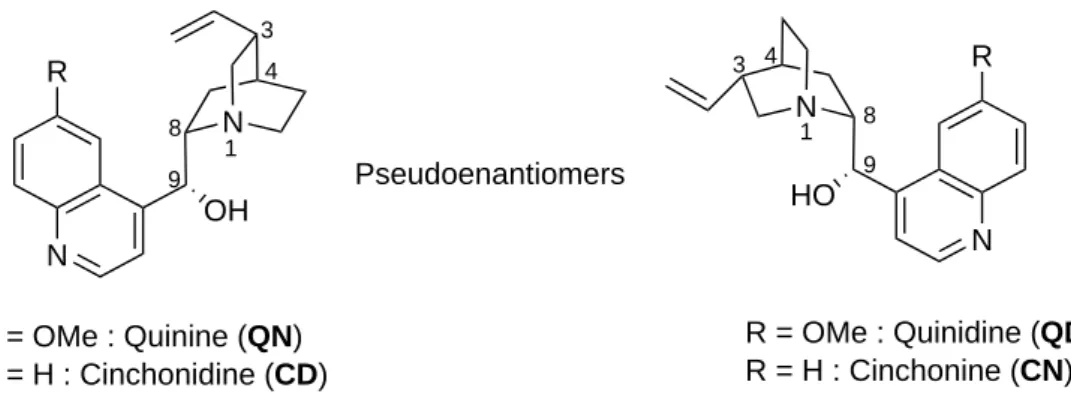
Chiral organocatalysis is one of the important synthetic tool in asymmetric synthesis owing to their advantages of being cost effective, readily available, non-toxic and environ- mental friendly. Cinchona alkaloids are some of the most important sources of various kinds of efficient chiral organocatalysts. Each of the cinchona alkaloids, namely, quinine, cinchonidine, quinidine, and cinchonine, contain several functionalities such as secondary alcohol, quinuclidine, and quinoline rings in addition to the vinyl group. These func- tionalities can be exploited for various chemical modifications. Several different kinds of chiral organocatalysts have been developed and they play a vital role in modern asymmet- ric catalysis. Cinchona alkaloids and their derivatives are classified as privileged organic chirality inducers, efficiently catalyzing many classes of organic reactions in a highly enantioselective fashion.
As a unique class of bifunctional cinchona organocatalysts, cupreines and cupreidines have also been proved as a powerful chiral catalysts for a wide array of asymmetric transformations. Compared to traditional cinchona catalysts, one of the most noticeable features of cupreines and cupreidines is that they bear a phenolic OH group at the C6’ position and a free hydroxyl moiety at C9 position. These could be utilized to tune the steric conformation by further functionalization to achieve higher efficiency in asymmetric reaction. In the aspect of asymmetric organocatalysis for the synthesis of enantiopure organic products in medicinal chemistry, cinchona alkaloids and their derivatives have been well explored. Even though chiral organocatalysts supports green chemistry practices, factors such as unable to be recycled and low catalyst loading are the disadvantages associated with their applications in organic reactions.
On the other hand, chiral polymeric catalysts have received significant attention owing to their easy separation from the reaction mixture and their recyclability. Chiral polymeric organocatalysts as a class of chiral organocatalysis possesses additional advantages of being derived from a metal-free catalyst, hence, providing a clean and safe alternative to conventional methods of asymmetric processes. Not only that they can be applied to a continuous flow system and their practicability, but also, the particular microenvironment they create in a polymer network makes them attractive for utilization in organic reactions especially in stereoselective synthesis.
Even though polymeric organocatalysts in asymmetric synthesis, sometimes exhibit
poor reactivity by virtual of their heterogeneity, in some cases, a well-designed poly-
meric chiral organocatalyst may leads to higher selectivity with sufficient reactivity in
catalytic use became an important tool for understanding the polymeric catalytic efficiency in asymmetric synthesis for fine chemicals production.
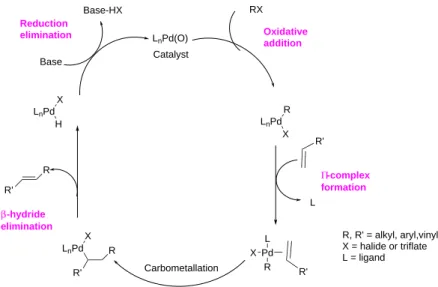
As a privileged class of chirality inducers, cinchona alkaloids have found part in chiral polymeric organocatalysts design. With the advancement made in chiral polymeric organocatalysis, the polymeric catalysts design is an essential tool to understand the ef- ficient catalytic process in asymmetric transformations. As for this reason, in this work, cinchona alkaloids derivatives were used for the design of chiral polymeric organocata- lysts. Two types of chiral polymers were synthesized; main-chain chiral polymers and cross-linked chiral polymers of cinchona alkaloids derivatives. Through Mizoroki-Heck coupling reaction catalyzed by Pd, the main-chain chiral polymers of cinchona alkaloids were obtained. The synthetic approaches and the design is explained in Chapter 3 and Chapter 4 of this thesis. In Chapter 3 the main-chain chiral polyesters of cinchona alka- loids are reported, while, in Chapter 4, the main-chain chiral polyurethanes of cinchona alkaloids are reported. Both C6’-OMe and C6’-OH free containing chiral polymeric catalysts of cinchona alkaloids were synthesized.
On the other hand, Pt catalyzed hydrosiylation reaction was employed for synthesis of the cross-linked chiral polymers of cinchona alkaloids derivatives. The design and synthetic approach are explained in Chapter 5. We also tried other alternative approach to synthesize main-chain chiral polymers of cinchona alkaloids that are shortly described in Chapter 6.
The catalytic performance of chiral polymers of cinchona alkaloids were evaluated in asymmetric Michael addition reactions. The asymmetric Michael additions of anthrone to β -nitrostyrene as well as the addition of β -ketoester to β -nitrostyrene were used for the evaluation. Both C6’-OMe and C6’-OH free chiral polymeric catalysts of cinchona alkaloids were used for evaluation. The C6’-OH free chiral polymers have been proved to be effective chiral inducers for the Michael addition reactions reported herein.
During catalytic evaluation, factors such as; the chiral organocatalysts’ structural
effects (i.e. monomeric, dimeric or polymeric structural effect), reaction conditions
(this includes solvent, temperature or catalyst loading effects), substrate scope as well as
recyclability test were used to evaluate the catalytic performance of the chiral polymeric
catalysts. In general, each chiral polymeric catalyst showed different catalytic effects in
asymmetric Michael addition reaction transformations. However, it was found that the
chiral polymeric catalysts involves mild reaction conditions, stable and recyclable for
the Michael addition transformations while their corresponding lower molecular weight
catalysts were not. In some cases, higher catalytic activities and enantioselectivities
were achieved with the chiral polymeric catalysts in the enantioselective synthesis for
the Michael addition reactions compared to their corresponding lower molecular weight
Acknowledgements
First and foremost, I would like to thank the Almighty God for His grace, love and blessings over my life. As without Him this would not be possible.
I would like to express my sincere gratitude to my advisor Prof. Dr. Shinichi Itsuno for the continuous support during my PhD study and life in general, for his patience, encouragement and immense knowledge. His guidance helped me in all the time of research and writing of this thesis. I could not have imagined having a better advisor and mentor for my PhD study.
Besides my advisor, I would like to thank Prof. Dr. Seiji Iwasa and Prof. Dr. Naoki Haraguchi for their acceptance for being my thesis examiners in their valuable time.
Their insightful comments, suggestions, questions and encouragement contributed to the successful completion of the thesis and my study in general.
My sincere thanks also goes to Dr. Ikuhide Fujisawa and my fellow former and present labmates for their contributions and being available to help me for experimental works all the time during my study.
I am very grateful to the former Tanzanian’s government chemists Prof. Dr. S.V.
Manyele of University of Dar es salaam for his recommendations during my masters’
admission in this University. I especially like to extend my thanks to my former supervisor, Prof. Dr. Seiji Yokoyama of Toyohashi University of Technology in thin film laboratory for accepting me in his research group at the first time.
A very special gratitude goes to Toyohashi University of Technology committee for helping and providing financial support during my period of study.
Words can’t explain how grateful I am to my parents, parent in-laws relatives and friends for their prayers, encouragements and availability during the hard times of pursuing my PhD. My appreciations to Toyoda’s family who has been the parents to my family since we came to Japan. Thanks to my sister and brother in-law Ms Emmy A. Mahenge and Mr. Mathew Msukwa for their valuable time to take care of my family after the delivery of my second baby. Special thanks to my children Ayumi and Isaac for being good, happy, patience and healthy even at hard times when I was not available for them.
Many thanks to Kojika children’s school for providing convenient environment and time for my children for the whole time of my study.
Finally, I would like to express my heartfelt gratitude to my beloved husband Dr.
Kenneth R. Simba for his love, caring and support. Thank you for being strong, patient and responsible in all the hard times we have been through, the time when I was not available for the family. Thank you for the encouragements, advice and help during my study. You are and have been a wonderful father to our children.
Thank you very much all for your support and encouragements. I am always indebted.
Contents
Abstract i
Acknowledgements iii
1 Introduction 1
1.1 Background . . . . 1
1.2 Importance of organocatalysis . . . . 2
1.3 Problem definition . . . . 4
1.4 Research objectives . . . . 5
1.5 Literature review . . . . 6
1.5.1 Asymmetric catalysis . . . . 6
1.5.2 Low molecular weight chiral organocatalysts . . . . 6
1.5.3 Polymeric chiral organocatalysts . . . . 9
1.5.4 Polymer-immobilized chiral organocatalyst . . . 10
1.5.5 Main-chain chiral polymeric organocatalysts . . . 13
Bibliography . . . 16
2 Cinchona alkaloids derivatives in asymmetric catalysis 20 2.1 Introduction . . . 20
2.2 The cinchona alkaloids structure . . . 21
2.3 Cinchona alkaloids as bifunctional chiral catalysts . . . 23
2.4 Cinchona derivatives as chiral organocatalysts . . . 25
2.4.1 Monomeric cinchona derivatives . . . 25
2.4.2 Dimeric cinchona alkaloids derivatives . . . 26
2.4.3 Polymeric cinchona alkaloids derivatives . . . 29
2.5 General introduction on synthesis methods . . . 31
2.5.1 The Mizoroki-Heck reaction . . . 31
2.5.2 The hydrosiylation reaction . . . 33
Bibliography . . . 37
3 Synthesis of chiral polyesters of cinchona alkaloids for the enantioselective catalysis in the Michael addition of anthrone to nitroalkenes 40 3.1 Introduction . . . 40
3.2 Results and Discussion . . . 42
3.2.1 Preparation of quinine based chiral polyesters by one-component self-polycondensation . . . 42
3.2.2 Preparation of quinine based chiral polyesters by two-component polycondensation . . . 43
3.2.3 Asymmetric Michael addition of anthrone and β -nitrostyrene with monomeric and dimeric cinchona derived ester catalysts . . . 46
3.2.4 Asymmetric Michael addition of anthrone and β -nitrostyrene with chiral polyester catalysts . . . 47
3.2.5 Substrate scope evaluation . . . 50
3.2.6 Recyclability evaluation of chiral polyesters . . . 50
3.3 Conclusion . . . 52
3.4 Experimental Part . . . 53
3.4.1 General methods and materials . . . 53
3.4.2 Synthesis of cinchona ester monomer IBzQN . . . 53
3.4.3 Synthesis of cinchona ester dimer 2QNb . . . 54
3.4.4 Synthesis of cinchona ester dimer 2QNe . . . 55
3.4.5 Synthesis of C6’-OH free cinchona ester derivatives . . . 55
3.4.6 Synthesis of chiral polyester PBzCPN . . . 58
3.4.7 Synthesis of chiral polyester PCPNea . . . 58
3.4.8 Asymmetric catalysis in the Michael addition reaction with cin- chona ester derivatives . . . 60
Bibliography . . . 61
4 Synthesis of chiral polyurethanes of cinchona alkaloids for the enantioselec- tive synthesis in asymmetric catalysis 65 4.1 Introduction . . . 65
4.2 Results and discussion . . . 67
4.2.1 Preparation of cinchona urethane monomer . . . 67
4.2.3 Preparation of cinchona-based chiral polyurethanes by MH poly-
merization . . . 67
4.2.4 Asymmetric catalysis with cinchona urethane derivatives in Michael addition reactions . . . 68
4.2.4.1 Lower molecular weight chiral catalysts . . . 68
4.2.4.2 Chiral polyurethanes derivatives in catalyst screening . 69 4.2.4.3 Solvent screening with chiral polyurethane as catalyst . 71 4.2.4.4 Reaction conditions optimization with chiral polyurethane as catalyst . . . 71
4.2.4.5 Substrate scope study with cinchona chiral polyurethane as a catalyst . . . 73
4.2.4.6 Recyclability test with cinchona chiral polyurethane as catalyst . . . 73
4.3 Conclusion . . . 75
4.4 Experimental section . . . 75
4.4.1 General methods and materials . . . 75
4.4.2 Synthesis of cinchona-based urethane derivatives . . . 76
4.4.2.1 C6’-OMe cinchona urethane derivatives . . . 76
4.4.2.2 C6’-OH cinchona urethane derivatives . . . 78
4.4.3 Synthesis of aryl diiodide derivatives . . . 80
4.4.4 Synthesis of main-chain cinchona chiral polyurethanes . . . 81
4.4.5 Enantioselective synthesis for the Michael reaction with chiral urethanes derivatives . . . 82
4.4.5.1 Asymmetric Michael addition of anthrone to nitroalkenes 82 4.4.5.2 Asymmetric reaction of β -ketoester to β -nitrostyrene . 82 4.4.5.3 Asymmetric Michael addition of anthrone to β -nitrostyrene for recyclability test . . . 83
Bibliography . . . 83
5 Synthesis of cross-linked chiral polysiloxanes of cinchona alkaloid derivatives for their applications in asymmetric catalysis 86 5.1 Introduction . . . 87
5.2 Results and discussion . . . 88
5.2.2 Preparation of cinchona urethane derivatives . . . 89
5.2.3 Synthesis of cross-linked chiral polysiloxanes of cinchona deriva- tives . . . 90
5.2.3.1 Synthesis of cross-linked chiral polysiloxane of cin- chona monomer . . . 91
5.2.3.2 Synthesis of cross-linked chiral polysiloxane of dimeric cinchona derivatives . . . 92
5.2.4 Asymmetric catalysis with cross-linked chiral polysiloxanes of cinchona alkaloid . . . 97
5.2.4.1 Asymmetric Michael addition of anthrone and β -nitrostyrene 97 5.2.4.2 Asymmetric Michael addition of β -ketoester and β - nitrostyrene . . . 97
5.3 Conclusion . . . 102
5.4 Experimental part . . . 103
5.4.1 General methods and materials . . . 103
5.4.2 General experimental procedures . . . 103
5.4.2.1 Synthesis of CPN2b . . . 103
5.4.2.2 Asymmetric Michael addition of anthrone to β -nitrostyrene104 5.4.2.3 Asymmetric reaction of β -ketoester to β -nitrostyrene . 104 Bibliography . . . 105
6 General Conclusion 108 6.1 Introduction . . . 108
6.2 The main-chain chiral polymers of cinchona alkaloids by MH-polymerization109 6.2.1 Synthesis of main-chain chiral polyurethanes by diisocyanates- diols reaction . . . 111
6.2.2 The catalytic performance of main-chain chiral polymers of cin- chona alkaloids . . . 112
6.3 The Cross-linked chiral polysiloxanes of cinchona alkaloids . . . 116
6.3.1 The catalytic performance of the cross-linked chiral polysiloxanes 117 6.4 General catalytic mechanism . . . 118
6.5 Conclusion . . . 121
A.1 Journal papers . . . 124 A.2 Conference presentations . . . 124
B Supporting document for Chapter 3 126
B.1
1H and
13C NMR data for cinchona ester derivatives . . . 126 B.2 FT/IR spectrum for chiral polyesters . . . 134 B.3 Chromatogram data for Michael products . . . 140
C Supporting document for Chapter 4 143
C.1
1H and
13C NMR for urethane derivatives of cinchona alkaloid . . . 143 C.2 FT/IR for chiral polyurethanes of cinchona alkaloids . . . 153 C.3 Chromatogram data for Michael products . . . 157
D Supporting document for Chapter 5 159
D.1 FT/IR spectrum for cross-linked chiral polysiloxanes of cinchona derivatives159 D.2 Chromatogram data for Michael products . . . 163
E Supporting document for Chapter 6 165
List of Figures
1.1 Few famous examples of organocatalysts and their advantages. . . . 4 2.1 Important structural features of cinchona alkaloids. . . 21 2.2 Cinchona alkaloids structures showing their name and specific stereocenters. 22 2.3 Common active sites in cinchona alkaloids and their possible derivatives. 22 2.4 Cooperative catalysis in the quinine-catalyzed asymmetric conjugate ad-
dition. . . 24 2.5 Main-chain type chiral polymers of cinchona alkaloid derivatives prepared
by Mizoroki-Heck reaction. . . 30 2.6 General mechanism of Mizoroki-Heck coupling reaction. . . 32 2.7 Possible reactions of olefin with hydrosilane in the presence of a Pt catalyst. 34 2.8 Hydrosilylation reaction mechanism for platinum catalysis as adopted by
Chalk-Harrod. . . 35 2.9 General mechanism for a base catalyzed Michael addition reaction. . . 37 4.1 The recyclability test results for the enantioselective Michael addition
reaction. . . 74 5.1 Physical states of polysiloxanes. . . . 93 5.2 Structure confirmation of chiral polysiloxane PSiBzCPN by IR spectrum
comparison with the reacting substrates. . . 94 5.3 Structure confirmation of chiral polysiloxane PSiCPN2a by IR spectrum
comparison. . . 96 6.1 Ester derivatives of cinchona alkaloids organocatalysts. . . 113 6.2 Urethane derivatives of cinchona alkaloids organocatalysts. . . 114 6.3 Examples of cross-linked gel-type chiral polysiloxanes of cinchona alka-
loids. . . 117
List of Schemes
1.1 Example on enantioselective asymmetric aldo reaction with plolinamine derivative as a catalyst. . . . 7 1.2 Example on asymmetric α -fluorination of aldehydes with MacMillans
catalyst; DCA (dichloroacetic acid). . . . 8 1.3 Asymmetric aldo reaction of silyl ketene acetal with chiral bis-phosphoramides
as catalyst. . . . 8 1.4 Asymmetric Michael addition of anthrone to 4-methyl-trans β -styrene
with cinchona organocatalysts. . . . 9 1.5 Enantioselective Michael addition catalyzed by polymer immobilized chi-
ral pyrrolidine. . . . 11 1.6 Polymer-immobilized imidazolidinone sulfonate in the catalytic asym-
metric Diels-Alder reaction. . . . 12 1.7 Polystyrene-immobilized BINOL in the catalytic asymmetric allylation
of ketones. . . 13 1.8 Polymer immobilized cinchona alkaloid in enantioselective α fluorination. 13 1.9 Main-chain chiral polymer of imidazolidinone sulfonate in the catalytic
asymmetric Diels-Alder reaction. . . 15 1.10 The asymmetric reaction of aldehydes with diethylzinc in the presence of
polybinaphthol. . . 15 1.11 Enantioselective Michael addition of β ketoester to nitroolefin in the
presence of main-chain cinchona polymeric catalyst. . . . 16 2.1 Quinine catalyzed direct conjugate addition between acyclic tert-butyl
ketoester and phenyl maleimide. . . 24 2.2 Asymmetric construction of 2,3-dihydroisoxazoles with monomeric cin-
chona derived organocatalysts. . . 26
2.3 Asymmetric Michael addition of β -ketoester and β -nitrostyrene catalyzed
of olefin. . . 28
2.5 Example of C9-cinchona ester derivative in diastereoselective Diels-Alder reaction. . . 29
2.6 N1-chiral quarternary ammonium salts in asymmetric benzylation of glycine ester. . . . 29
2.7 General scheme for Mizoroki-Heck coupling reaction. . . 31
2.8 General catalysis classification of hydrosilylation reaction. . . 34
3.1 Synthetic route for the preparation of main-chain chiral polyesters of cinchona alkaloid by one-component MH polymerization. . . 43
3.2 Preparation of quinine-derived ester dimers. . . 43
3.3 Preparation of main-chain cinchona based chiral polyesters PQN and PCPN by MH polymerization. . . 44
3.4 Synthetic route of chiral polyester PCPDea derived from quinidine. . . . 45
3.5 Asymmetric Michael addition of anthrone to β -nitrostyrene in the pres- ence of chiral organocatalysts. . . . 46
3.6 Substrate scope of asymmetric Michael addition of anthrone to nitro alkene derivatives with PCPNea as a catalyst. . . 51
4.1 Synthetic route for cinchona-based urethane monomers and dimers. . . . 68
4.2 Synthesis of main-chain cinchona based chiral polyurethanes by MH polymerization. . . 69
4.3 Asymmetric Michael addition of anthrone to nitroalkenes catalyzed by cinchona based urethane derivatives. . . 69
4.4 Enantioselective synthesis of 8 with chiral polyurethanes of cinchona alkaloids. . . 73
4.5 Enantioselective Michael addition of β -ketoester to β -nitrostyrene cat- alyzed by cinchona-urethane derivatives. . . 74
5.1 Synthetic route for the preparation of cinchona ester derivatives. . . 89
5.2 Synthesis of cinchona urethane dimers. . . 90
5.3 Hydrosiylation reaction between BzQN and chlorodimethylsilane. . . 90
5.4 Synthesis of cross-linked gel-type chiral polysiloxanes of cinchona alkaloids. 91
Pt catalysis. . . 93 5.6 Synthesis of cross-linked chiral polysiloxanes PSiCPN of cinchona alka-
loid derivatives by hydrosiylation reaction. . . 96 5.7 Enantioselective synthesis with chiral polysiloxanes of cinchona alkaloid
derivatives. . . 98 5.8 Enantioselective Michael addition of β -ketoester and β -nitrostyrene by
cinchona ester chiral polysiloxanes. . . 99 5.9 Enantioselective Michael addition of β -ketoester and nitroalkene deriva-
tives with cinchona ester chiral polysiloxanes. . . 100 6.1 Synthetic route of main-chain chiral polymeric organocatalysts. . . 110 6.2 Functionalization of the main-chain chiral polymer by demethylation re-
action. . . 111 6.3 Synthesis of main-chain chiral polymer by diisocyanates-diols reaction. . 114 6.4 Cinchona derivatives organocatalysts in the enantioselective synthesis . . 115 6.5 Asymmetric Michael addition of β -ketoester to β -nitrostyrene. . . 116 6.6 Proposed transition state of asymmetric Michael addition of anthrone to
β -nitrostyrene with C6’-OH free. . . 119 6.7 Proposed transition state of asymmetric Michael addition of anthrone to
β -nitrostyrene with C6’-OMe. . . 120 6.8 Proposed transition state of asymmetric Michael addition of anthrone to
β -nitrostyrene with urethanes C6’-OH free. . . 121
List of Tables
3.1 Synthesis of chiral polyesters by MH coupling reaction. . . 44 3.2 Monomeric and dimeric effect of cinchona derived ester catalysts in the
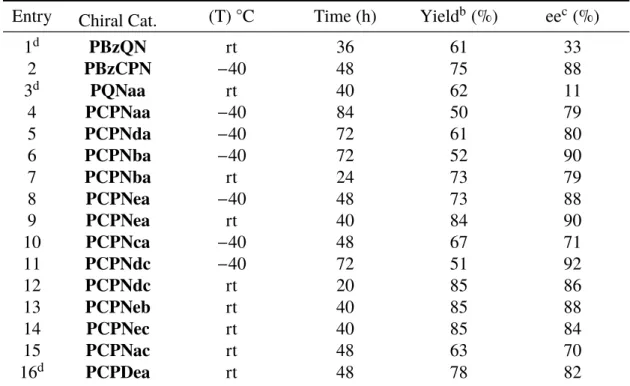
Michael addition of anthrone to β -nitrostyrene. . . 47 3.3 Cinchona based chiral polyester catalysts screening for the Michael addi-
tion of anthrone to β -nitrostyrene. . . 48 3.4 Effect of solvent in the Michael addition of anthrone to β -nitrostyrene
with PCPNea as a catalyst. . . 49 3.5 Reaction condition optimizations for the Michael addition of anthrone to
β -nitrostyrene in the formation of with PCPNea as a catalyst. . . 50 3.6 Recyclability evaluation with PCPNeb as a catalyst. . . 52 4.1 Synthesis of chiral polyurethanes via Mizoroki-Heck coupling reaction. . 70 4.2 Monomeric and dimeric effect of chiral urethane derivatives as catalysts
in the Michael reaction. . . 70 4.3 Chiral polyurethanes PCPN catalysts screening in the Michael addition
of anthrone to β -nitrostyrene. . . 71 4.4 Solvent screening with PCPNce as catalyst. . . 72 4.5 Reaction condition optimization using chiral polyurethane PCPNce in
the Michael reaction. . . 72 4.6 Enantioselective Michael addition of β -ketoester to nitrostyrene with
cinchona-urethane derivatives. . . 74 5.1 Reaction conditions optimization using BzCPN for immobilization into
PMHSKF-99 by hydrosiylation reaction. . . 92 5.2 Reaction conditions optimization using CPN2a for immobilization into
PMHS KF-99 by hydrosiylation reaction. . . 95 5.3 Synthesis of cross-linked chiral polysiloxanes of cinchona alkaloids deriva-
tives. . . 95
5.5 Effect of low molecular weight chiral organocatalysts in the Michael reaction. . . 99 5.6 Asymmetric Michael addition of β -ketoestor and β -nitrostyrene catalyzed
by chiral polysiloxanes. . . 99 5.7 Asymmetric Michael addition of β -ketoestor and β -nitrostyrene catalyzed
by low molecular weight cinchona derivatives. . . 100 5.8 Reaction conditions optimization with cinchona ester chiral polysiloxane
PSiCPN2a. . . 101 5.9 Recyclability test with cinchona ester chiral polysiloxanes PSiCPN2a. . . 102 6.1 Asymmetric Michael addition of anthrone to β -nitrostyrene with chiral
polymeric catalysts of cinchona alkaloids
a. . . 118 6.2 Asymmetric Michael addition of β -ketoester to β -nitrostyrene with chiral
polymeric catalysts of cinchona alkaloids
a. . . 118
Introduction
1.1 Background
Organocatalysis is the acceleration of chemical reactions with a substoichiometric amount of an organic compound which does not contain a metal atom. Green chemistry has been recognized as a culture and methodology for achieving sustainable development.
Green chemistry is a chemistry able to promote innovative technologies that reduce or eliminate the use or generation of hazardous substances. Catalysis (including enzyme catalysis, organometallic catalysis, and organocatalysis, in particular) is identified to be at the heart of greening of chemistry, because this branch of science is found to reduce the environmental impact of chemical processes.
1Besides producing useful chemicals, implementation of “clean" and “green" chemical technology in industries may help ad- dress the problem of environmental degradation. Nowadays organocatalysis is one of the hot research topics in advanced organic chemistry. The term “organocatalysis" described the use of small chiral organic molecules as catalysts, has proven to be a valuable and attractive tool for the synthesis of enantiomerically enriched molecules. It is a novel synthetic philosophy and mostly an alternative to the prevalent transition metal catalysis.
The absence of metal in organocatalyst brings an undeniable advantage considering both the principles of “green chemistry" and the economic point of view.
The interest in this field has been increasing spectacularly due to the novelty of
the concept and, more importantly, the fact that the efficiency and selectivity of many
organocatalytic reactions meet the standards of established organic reactions.
2–5Although
organic molecules have been used since the beginnings of chemistry as catalysts, their ap-
plication in enantioselective catalysis has emerged as a major concept in organic chemistry
todate. Because of both determined scientific interest’s as well technological advances
practices, it is now widely accepted that, organocatalysis is one of the main branches of enantioselective synthesis.
1.2 Importance of organocatalysis
New synthetic methods are most likely to be encountered in the field of biological and organometallic chemistry, however, several review articles has demonstrated the novelty of organocatalysis as a synthetic tool for asymmetric transformations.
1–5Forexample, D.
W. MacMillan explained three crucial factors that contributed to the rapid development of this important tool ‘organocatalysis’ in the field of enantioselective synthesis for the chemists scientific communities. These factors are grouped as explained below:
i. Conceptualization of the field of organocatalysis: The concept describes that, small organocatalysts could be used to solve important problems in chemical synthesis such as industrial chemical wastes management. The term organocatalysis provides a strong identity and helped to unify a fledgling field, as well as attracting the attention of the broader chemical synthesis community.
ii. The advantages of organocatalytic research: The chemical synthesis community recognized the fundamental advantages of organocatalysis, namely the ease and low cost of carrying out such reactions in the laboratory and the potential for new lines of academic thought and investigation. Although the impact of metal-based catalysts on chemical synthesis cannot be understated, some (but certainly not all) organometallic systems can be expensive, toxic and/or sensitive to air and moisture. The advent of organocatalysis brought the prospect of a complementary mode of catalysis, with the potential for savings in cost, time and energy, an easier experimental procedure, and reductions in chemical waste.
First, organic molecules are generally insensitive to oxygen and moisture in the atmosphere, so there is no need for special reaction vessels, storage containers and experimental techniques, or for ultra-dry reagents and solvents.
Second, a wide variety of organic reagents, such as amino acids, carbohydrates,
hydroxy acids and cinchona alkaloids; are naturally available from biological sources
as single enantiomers. There are several examples of organocatalysts, chiral and
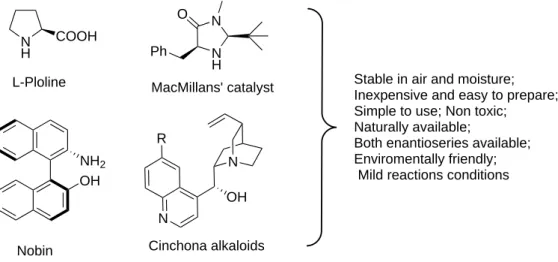
achiral organocatalysts are readily available, and Fig 1.1 shows the examples of
organocatalysts are therefore usually cheap, easy to prepare and readily accessible in a range of quantities, suitable for small-scale reactions to industrial-scale reactions.
Third, small organic molecules are typically non-toxic and environmentally friendly, increasing the safety of catalysis in both biological research and chemical research across all research settings, including industry and academic institutions. The combi- nation of these factors substantially lowered the entry costs for researchers interested in developing enantioselective catalysts. With no need for inert gases, ultra-dry sol- vents or even high levels of experimental expertise, it is not surprising that the field quickly became flooded with research groups from around the globe. For any large- scale catalytic process, the most salient considerations are cost and safety. Because organocatalysts are often cheaper than metal-based catalysts, organocatalysts can be used in larger quantities than metal-based ones for the same price. Moreover, it is widely recognized in manufacturing that the removal of toxic catalyst related impuri- ties from the waste stream can often have a larger financial impact. Organocatalysts are typically less toxic than metal-based catalysts, can be tolerated to a large extent in waste streams and are more easily removed from waste streams. With respect to in- dustrial applications, organocatalytic reactions are of great use to medicinal chemists.
Medicinal chemists need to find rapid, broadly applicable ways of constructing new candidate drugs for testing, so the most important considerations for a catalyst are its generality, convenience and robustness. Organocatalysts meet all of these operational requirements.
iii. The advent of generic modes of catalyst activation, induction and reactivity: A generic activation mode describes a reactive species that can participate in many reaction types with consistently high enantioselectivity. Such reactive species arise from the interaction of a single chiral catalyst with a basic functional group (such as a ketone, aldehyde, alkene or imine) in a highly organized and predictable manner.
The value of generic activation modes is that, after they have been established, it is
relatively straightforward to use them as a platform for designing new enantioselective
reactions. The small number of activation modes in organocatalysis (and in catalysis
in general) is not surprising, when devising a new enantioselective reaction, it is far
easier to make use of a known activation mode than to invent a new one (together
with a new catalyst). In many ways, this is beneficial to chemists, because it leads to
NH
COOH
N NH O Ph
NH2 OH
Nobin
MacMillans' catalyst L-Ploline
N
N R
OH
Cinchona alkaloids
Stable in air and moisture;
Inexpensive and easy to prepare;
Simple to use; Non toxic;
Naturally available;
Both enantioseries available;
Enviromentally friendly;
Mild reactions conditions
Figure 1.1: Few famous examples of organocatalysts and their advantages.
5asymmetric reactions. At the same time, it is clear that discovering new activation modes is important for all types of catalysis.
1.3 Problem definition
Significant advancement have been made by many scientific researchers to solve ex- isting challenges of recyclability and low catalyst loading associated with lower molecular weight chiral organocatalysts in asymmetric synthesis. With further advances in the un- derstanding of polymers, and with new applications being researched, there is no reason to believe that the revolution of macromolecular sciences will stop any time soon, there are numbers of polymer applications in elastomers, plastics, fibers and as industrial cat- alyst. Polymeric chiral organocatalysts and reagents have received considerable attention in regard to organic synthesis of optically active compounds.
The use of chiral polymer catalysts has become one of the essential techniques in organic synthesis. Due to the fact that, they can be easily separated from the reaction mixture and reused many times. It is even possible to apply the polymeric catalysts to a continuous flow system. From the point of view of green chemistry, the chiral polymeric organocatalysis method provides a clean and safe alternative to conventional methods of asymmetric processes. Not only the practical aspect of the polymeric catalyst but also the particular micro environment they create in a polymer network, that make them attractive for utilization in organic reactions especially in stereoselective synthesis.
Design of chiral polymers and their catalytic use is now extremely required in organic
been done on the use of the side chain functionalized polymers including cross-linked polymers. Only a limited number of investigations have been performed to elucidate the use of main-chain functional polymers. Some examples include; polymeric chiral salen ligand, poly(amino acid), poly(tartrate), poly binaphthols, and helical polymers.
These main-chain chiral polymers have been successfully applied to a chiral catalyst in various kinds of asymmetric reactions. The rigid and sterically regular polymer catalysts may provide a better-defined microenvironment at the catalytic sites and could allow a systematic modification of their catalytic properties.
There are so many different types of synthetic polymers, including both organic and inorganic polymers. Not only linear polymers but also cross-linked, branched, dendritic polymers are available as support for the chiral catalyst. Each polymer support, would provide a specific microenvironment for the reaction if they can be precisely designed.
Despite of the applicability of polymeric organocatalysts, sometimes using polymeric catalyst exhibit poor reactivity by virtual of their heterogeneity.
However, in some cases, a well-designed polymeric chiral catalyst may lead to higher selectivity with sufficient reactivity in asymmetric reactions. These information shows clearly that the design of a polymeric catalyst is very important in oder to understand the efficient catalytic process. Effort has been done in several studies providing the feasibility to address the existing problems.
Recently, some main-chain chiral polymers, including helical polymers and cross- linked chiral polymers have been synthesized and applied in various kinds of asymmetric reactions and they showed good catalytic performances. With these facts, in order to promote green chemistry practices, there is still a need to develop new strategies and methodologies in the class of chiral polymeric organocatalysts for their applications in asymmetric synthesis
1.4 Research objectives
The main objective of this research is the design and synthesis of chiral polymeric
organocatalysts for their applications in asymmetric synthesis. To start with the design
stage that involves the use of cinchona alkaloids derivatives to obtain either main-chain
chiral polymers or cross-linked chiral polymers. Then, Mizoroki-Heck coupling reaction
and hydrosiylation reaction were used as synthetic methodology to obtain the main-chain
performance of chiral polymeric catalysts were evaluated in asymmetric Michael addition reactions.
1.5 Literature review
1.5.1 Asymmetric catalysis
Asymmetric catalysis constitutes one of the most important subjects in synthetic organic chemistry. Asymmetric synthesis achieving atom economy is a challenge for organic synthesis, and heterogeneous catalysis using metal complexes leads the way.
However, the application of such methodologies in chemical industry is rather limited due to the high cost of chiral ligands and noble metals used in such transformations. Moreover, the pharmaceutical entities and food industry products do not tolerate a contamination, of even traces, of any such metals for that matter.
As optically active drugs become increasingly important for the treatment of diseases in patients, still more enantiopure drugs are introduced to the market either as new drugs or as the result of a racemic mixture.
5An important goal for asymmetric catalysis is to develop new reactions that afford optically active compounds from simple and easily available starting materials and catalysts. The need from chemical industry, especially pharmaceutical, for reliable asymmetric transformations of molecular skeletons is higher than ever. Therefore, asymmetric organocatalysis is in a process of attaining maturity into a very powerful, practical, and broadly applicable methodological approach in the catalytic asymmetric synthesis.
1.5.2 Low molecular weight chiral organocatalysts
The development of new chemical transformations for efficient and practical syn-
thesis of complex structures has emerged as the main objective in synthetic organic
chemistry. Different enantioselective organocatalysis transformation with low molecu-
lar weight catalysts has been reported by chemists researchers,
6–21these includes C-C
bond formation,
11–17C-O bond formation
18–20as well as desymmetrization
21asymmet-
ric transformations. Describing some examples for the commercially available chiral
organocatalysts (shown in Fig 1.1) and their derivatives, as successful synthetic tool
in asymmetric transformations, gives a clear picture over the precedencies made for
organocatalysis applications in asymmetric synthesis.
N H
N 1
H Ar O +
Cat 1 / CF3CO2H (10 mol%) H2O, 25 oC, 24 - 72 h
Ar OH
O up to 99% yield up to 91:9 dr up to 99% ee 2.0 equiv.
O
Scheme 1.1: Example on enantioselective asymmetric aldo reaction with plolinamine deriva- tive as a catalyst.
12L-proline: Among several organocatalysts derived form L-proline as chiral source, pyrrolidine-tertially amine conjugates constitutes a powerful and useful family in asym- metric synthesis.They have been applied in different asymmetric reaction.
11,12Forexam- ple prolinamide derivatives are readily available through the condensation of proline with amines and they can be utilized in different asymmetric transformation reactions.
3The Barbas group reported on the effective enantioselective C-C bond formation by proli- namine with lipophilic side chain 1 as a catalyst for the asymmetric aldo reaction.
12The chiral organocatalyst allowed cyclohexanone to react smoothly with various aldehydes in water to afford the desired aldo products in high yields with excellent diastereo and enantioselectivity (Scheme 1.1).
MacMillans’ catalyst: The chiral imidazolidin-4-ones as chiral secondary amines had been successfully used in asymmetric synthesis as organocatalysts. They were deployed as chiral auxiliaries for alkylation processes, Michael additions and aldo reactions.
3The abil- ity to activate both carbonyl compounds by enamine formation as well as α, β -unsaturated carbonyl compounds by intermediate formation of iminium ions makes imidadazolidin- 4-ones a valuable class of organocatalysts in both series.
22As shown in Scheme 1.2, the direct asymmetric fluorination of aldehydes using N-fluorobenzenesulfonamide (NFSI) as a source of electrophilic fluorine depicts the investigations.
Lewis acid/base catalysts: The development and application of chiral C
2-symmetry
organic molecules possessing appropriate Lewis basic/acidic functionalities has made
significant contribution in the advancement of asymmetric organocatalysis.
3Taking an
example of Lewis base activation of Lewis acids concepts introduced by Denmark, where
its validity and synthetic potential were demonstrated in various bond forming reactions
using bis-phosphoramides 3 as catalysts.
23The aldol asymmetric addition of silyl ketene
acetals to aldehydes is well explored by the use of catalyst 3. The combination of 3
N NH Bn
Bn CHO
+
FBn OH 71% yield 96% ee O
NFSI
1. 20 mol% 2, DCA 2. NaBH4
2
Scheme 1.2: Example on asymmetric α -fluorination of aldehydes with MacMillans catalyst;
DCA (dichloroacetic acid).
+
97% yield 96.5:3.5 dr 5 mol% 3, SiCl4
(1.1 equiv) 3
Ph H
O OSiMe3tBu
OMe CH2Cl2, -78 oC
Ph OMe
O OH N
NH Me
Me PN
O Me
(CH2)2 2
Scheme 1.3: Asymmetric aldo reaction of silyl ketene acetal with chiral bis-phosphoramides as catalyst.
23and a stoichiometric quantity of SiCl
4was very effective for the reactions of methyl acetate-derived silyl ketene acetal with aldehyde (Scheme 1.3).
Cinchona alkaloids: These are well known natural products with a fascinating medic- inal history. Cinchona alkaloids have long been known as very useful and robust catalysts for many kinds of organic reactions before the explosion of organocatalysis’.
24Although the first example of asymmetric reaction catalyzed by cinchona alkaloids can be dated back to 1912,
25only after 1960s, with the development of asymmetric phase transfer catalysts (chiral PTC),
26and asymmetric dihydroxylation by Sharpless,
27cinchona organocatalysts have drawn much more attention and have been widely used in a variety of asymmetric reactions.
28Compared to tradition cinchona catalysts, as a unique class of bifunctional cinchona organocatalysts, cupreines and cupreidines have been proved to be powerful chiral catalysts for a wide array of asymmetric transformations.
29Cinchona alkaloids and their derivatives play an important role in asymmetric syn-
thesis as chiral organocatalysts and have been reported as chiral promoters in organic
reactions as described in several review articles.
30Forexample Shi. M and coworkers
they have reported on a highly efficient asymmetric Michael addition of anthrone to
+
10 mol%
Catalyst CH2Cl2, -40,
8 - 24 h.
O
O
NO2 H3C
NO2 H3C
4c : R = Me 4d : R = H
N
N OR
O O 4a : R = Me
4b : R = H N
N OR
OH
4a : 99% Yield; 51% ee 4b : 95% Yield; 80% ee 4c : 13% Yield; 0% ee 4d : 95% Yield; 80% ee
Scheme 1.4: Asymmetric Michael addition of anthrone to 4-methyl-trans β-styrene with cinchona organocatalysts.
28nitroalkenes with cinchona organocatalysts for the first time.
28Nitroalkenes as reactive Michael acceptors could exclusively produce the corresponding Michael adducts in the presence of bifunctional cinchona organocatalysts. As shown in Scheme 1.4 the impor- tance of the C6’-OH free for the enantioselective synthesis in the asymmetric Michael reaction is observed.
In this thesis too, cinchona alkaloid and their derivatives for their asymmetric catalysis reactions is the main point of interest. Next chapters focuces more on their classifications for asymmetric catalysis.
1.5.3 Polymeric chiral organocatalysts
Synthetic chiral polymers includes; polymers possessing side-chain chirality, main-
chain chirality, dendritic molecules containing chiral ligands and helical polymers. Poly-
meric chiral organocatalysts have received considerable attention in regard to organic
synthesis of optically active compounds.
31The use of polymeric catalysts has become
one of the essential techniques in organic synthesis, as they can be easily separared from
the reaction mixture and reused many times. From the point of view of green chem-
istry the polymeric chiral organocatalysis method provide a clean and safe alternative
to conventional methods of asymmetric processes. It is not only the fact that they can
also be applied to a contionous flow system and their practicality but also the particular
microenvironment they create in a polymer network makes them attractive for utilization
in organic reactions especially in stereoselective synthesis.
It has been reported that, despite of the applicability of polymeric organocatalysts, sometimes using polymeric catalyst exhibit poor reactivity by virtual of their heterogene- ity. However, in some cases, a well-designed polymeric chiral catalyst may lead to higher selectivity with sufficient reactivity in asymmetric reactions. These information clearly show that the design of a polymeric catalyst is very important in understanding the efficient catalytic process. There are different types of polymeric catalysts that have been reported by different researchers; based on this thesis the focus is on chiral polymeric catalyst design related to polymer immobilized organocatalysts and main-chain chiral polymer organocatalysts.
1.5.4 Polymer-immobilized chiral organocatalyst
Polymer supported chiral organocatalysts have mainly been prepared by two methods;
a coupling reaction of a functional polymer with a chiral organocatalysts and copolymer- ization of a monomer with a chiral organocatalyst.
31–33Most polymeric support materials used for the chiral catalyst have been cross-linked polystyrene derivatives,mainly because of their easy preparation and introduction of functional groups on the side chain of the polymer. However, there are so many different types of synthetic polymers, including both organic and inorganic polymers. Not only linear polymers but also cross-linked, branched, dendritic polymers are available as support for the chiral catalyst. Various kinds of poly- mers have been used as support for the chiral catalyst and the suitable polymer network for each reaction have been reported.
31With the progress that has been made in organic chemistry, several coupling reaction
techniques are available for coupling of a chiral ligand precursor with functionalized
polymers. The coupling reaction and functionalization of the chiral organocatalysts should
be carefully selected under consideration of the reactivity of the chiral organocatalysts. In
the coupling method the quantitative coupling reaction is preferable, and the quantitative
characterization of the coupling efficiency is necessary when the coupling reaction is
not complete. Because Merrifield-like resin and PEG are the commonly used as a
functionalized polymer, the Williamson reaction is mostly employed. The other important
bond formation reaction are such as Diels-Alder reaction, Suzuki Miyaura coupling
reaction, aldo reaction, Grignard reaction, Mitsunobu reaction and click reaction are
available in the coupling reaction.
31+
10 mol%
catalyst 5 2.5 mol%
TFA, 10, 3 d.
O
NO2
up to 99% yield up to >99% ee up to >99:1 dr O
NO2
NH O
N N
N PS
5
Scheme 1.5: Enantioselective Michael addition catalyzed by polymer immobilized chiral pyrrolidine 5.
The degree of cross-linkage of a cross-linked functional polymer and the choice of solvent mainly determine the swelling rate of the cross-linked functional polymer. The rate is of significance in the coupling efficiency of the reaction and accessibility of a substrate to the polymer-support chiral catalyst in the asymmetric reaction. A polymer- support chiral organocatalyst can also be synthesized by polymerization of a functional polymer possessing a chiral ligand, and a variety of monomers can be used according to the style of polymerization. Not only these but also the ion exchange method can be used for the immobilization technique. Cation and anion-exchange resins using a polymer support are commonly employed method in the industrial process. The advantage of using ion exchange method is that further functionalization of a chiral ligand or catalyst is not required for immobilization. A variety of polymerization techniques can be for the preparation of a polymer-supported catalyst. Some examples of polymer supported catalyst are discussed in this chapter based on their application in asymmetric synthesis with their corresponding low molecular weight structure shown in Fig 1.1.
Polymer immobilized pyrrolidine derivatives: Pyrrolidine derivatives as shortly ex- plained earlier are among the most efficient motifs as a chiral organocatalysts. They have been used in different asymmetric transformation for an example in Scheme 1.1.
Polystyrene-immobilized chiral pyrrolidines containing triazole were prepared by the copper-mediated 1,3-dipolar cycloaddition between the pyrrolidine derivative with azide and polystyrene resins with alkyne. The resulting polystyrene-immobilized chiral pyrroli- dine 5 was used in the Michael addition of cyclohexanone to β -nitrostyrene (Scheme 1.5).
An excellent enantioselectivity (>99 % ee) was accomplished and the catalyst could be recovered and reused for ten times without loss of the diastereo- and enantioselectivity.
34Polymer-immobilized MacMillan catalysts: Like conventional effective chiral cata-
10 mol%
Catalyst 6 CH3OH/H2O, rt.
+
CHO
Ph Ph
CHO
CHO + Ph
N NH
O
O NH
SO3
+ -
Ph x
O O
O O
y
O NH
z
6
88% ee 91% ee
Scheme 1.6: Polymer-immobilized imidazolidinone sulfonate 6 in the catalytic asymmetric Diels-Alder reaction.
35polymeric materials has been developed.
34–36Several approaches for their immobiliza- tion make use of a covalent bond between the polymer support and the catalyst moiety.
An alternative method is via ionic bond formation. Imidazolidinones readily form its sulfonates allowing their immobilization through an ionic bond with the ammonium sul- fonate structure.
35The immobilized imidazolidinone sulfonate 6 was successfully used to catalyze the asymmetric Diels-Alder reaction of cyclopentadiene and cinnamaldehyde in Scheme 1.6 to form the Alder products with good enantioselectivities.
Polymer-immobilized BINOL derivatives catalyst: BINOL derivatives has also been reported for their applications in polymer immobilized chiral organocatalysts. Forex- ample, the synthetic and application approaches in different asymmetric reactions was reported by S. Itsunos’ review article in polymer-immobilized chiral catalysts.
36By using a simple, and convenient synthetic route, enantiopure 6ethynylBINOL (BINOL=1,1binaphthol) was synthesized and anchored to an azido methylpolystyrene resin through a coppercat- alyzed alkyne-azide cycloaddition (CuAAC) reaction.
37The polystyrene-immobilized BINOL ligand was converted into its diisopropoxytitanium derivative in situ and used as a heterogeneous catalyst in the asymmetric allylation of ketones with tetraallyl tin as shown in Scheme 1.7. The catalyst showed good activity and excellent enantioselectivity.
Polymer-immobilized cinchona alkaloid derivatives: Cinchona alkaloids as the most
privileged chirality inducers in the area of asymmetric reactions, they possess some
reactive sites that are suitable for the immobilization onto a polymer.
38,39The vinyl group
+
96% yield 95% ee 7, Ti(OiPr)4
7
O
OiPr, CH2Cl2 OH OH
Sn 4
HO N N
N
Scheme 1.7: Polystyrene-immobilized BINOL 7 in the catalytic asymmetric allylation of ketones.
3798% yield up to 82% ee 8 (0.1 mol%), Selectfluor
8
THF-MeCN, -40 oC, 18 h.
N
N OMe
O O
Bn OSiMe3
O F
Bn
Scheme 1.8: Polymer immobilized cinchona alkaloid 8 in enantioselective α-fluorination.
39at the C3, hydroxyl group at C9 and hydroxyl group at C6’ of the quinoline moiety after demethylation are readily available.
31For example Cahard and coworkers synthesized linear polystyrene-immobilized cinchona alkaloids 8 and applied it to enantioselective α -fluorination (Scheme 1.8). The polymer showed good enantioselectivity and could be reused without loss of enantioselectivities for fourth cycles.
391.5.5 Main-chain chiral polymeric organocatalysts
Main-chain chiral polymeric organocatalysts are polymeric catalysts that contain chiral
organocatalysts molecules as their repeating units in the main-chain moiety. The primary
advantage of polymeric catalysts is their ease of separation from the reaction mixture,
that allows very efficient recovery, and reuse of the catalysts in asymmetric synthesis.
40,41benefit to polymeric organocatalysts. In comparison with polymer-immobilized chiral organocatalysts, main-chain chiral polymers have several important structural advantages for their applications in asymmetric synthesis, these includes;
i. Rigid and defined structure ii. Constant repeating unit moiety iii. Possesses high catalyst loading
iv. Gives a well-defined micro-environment
Chiral organocatalysts as privileged class of chiral inducers in asymmetric trans- formation, have been used in the preparation of different main-chain polymeric chiral organocatalysts. Different synthetic methods and approaches have been explored in the preparation of main-chain chiral polymers. Some of the reported methods includes; ionic polymerization,
42quartinization polymerization,
43–45Mizorocki-Heck polymerization,
45–51and ADMET polymerization.
52The resulted main chiral polymers were used as catalysts in different asymmetric reaction, where in many cases they showed higher enantioselectiv- ity with sufficient catalytic activities.
42–52Examples on some of the reported main-chain chiral polymeric catalysts are as decribed below;
Main-chain chiral polymeric catalyst of imidazolidinone: Haraguchi, N and coworkers reported on the synthesis of main-chain chiral polymers of imidazolidinone prepared by reaction of chiral imidazolidinone dimers with disulfonic acid. Chiral imidazolidinones were incorporated into the main-chain of the polymer by ionic bonding.
53The polymer was used as polymeric chiral organocatalyst for asymmetric Diels-Alder reactions and gave higher enantioselectivities of the corresponding asymmetric product (Scheme 1.9).
Main-chain chiral polymeric catalyst of BINOL derivatives: A minor groove polymer of (R)-1,1’-binaphthyls 10 was obtained from the Suzuki coupling reaction with Pd as a catalyst followed by hydrolysis as reported by Pu, L.
54The polymer was insoluble in common organic solvents. R(10) induced excellent enantioselectivity in the reaction of benzaldehyde with diethylzinc (Scheme 1.10). In the presence of 5 mol% catalyst at 0
◦C in toluene 92% ee of the asymmetric product was produced. The polymer was easily recovered by precipitation with methanol and the recovered polymer showed the same enantioselectivity as the original polymer.
Main-chain chiral polymeric catalyst of cinchona alkaloids: Recently there are several
10 mol%
Catalyst 9 CH3OH/H2O, rt.
+
CHO
Ph Ph
CHO
CHO + Ph
N
NH2 O
+
9
93% ee 97% ee
O
O
N N
O
+
SO3 O3S
- -
Scheme 1.9: Main-chain chiral polymer of imidazolidinone sulfonate 9 in the catalytic asymmetric Diels-Alder reaction.
53HO HO
10(R) 5 mol%
+
92% ee H
O
ZnEt2 ∗∗ Et
OH
HO HO HO HO
OH OH
RO OR RO OR RO OR
OH OH
RO OR O
RO R
10 (R)
Toluene, 10 oC R = C6H13
Scheme 1.10: The asymmetric reaction of aldehydes with diethylzinc in the presence of polybinaphthol 10(R).
54by Mizorocki-Heck polymerization method.
45–51As for example, Ullah, M. S and Itsuno.
S. have reported on the synthesis of main-chain type cinchona-based squaramides and their application to asymmetric catalysis.
50Their design involves the use of cinchona squaramide dimer that contains two cinchona squaramide units connected by diamines.
The olefinic double bonds in the cinchona squaramide dimer were then used for Mizoroki-
Heck (MH) polymerization with aromatic diiodides. The MH polymerization of the cin-
HN N
H O
O
O O
N H N
NH MeO
N N
H HN
OMe
11
n
Ph NO2
O
COOCH3 Ph H
NO2 +
11 Catalyst 5 mol%
MeOH, rt, 19 h.
COOCH3 O
99% ee 33:1 dr