17 札幌医学雑誌 83(1 − 6)17 〜 20(2014)
ORIGINAL
Introduction
Urinary incontinence (UI) is one of the most common health conditions in women, affecting personal quality of life (QOL). The estimated prevalence of UI varies from 10% to 60% depending on the population studied [1, 2].
Although cross-sectional epidemiological studies have estimated the prevalence of UI in various populations, limited data are available quantifying change of UI regarding remission or progression. Describing change of UI can aid its prevention and treatment [3, 4].
The International Consultation on Incontinence Questionnaire-Short Form (ICIQ-SF) was developed in order to be utilized in epidemiological research, as well as routine clinical practice [5], and has been increasingly used [6-9]. The Japanese version of ICIQ-SF was validated by Gotoh et al. [10, 11], and has been utilized in Japan [12, 13]. ICIQ-SF consists of 4 categories: frequency of leakage (range; 0-5 point), amount of leakage (range; 0-6 point), interference with everyday life (range; 0-10 point), and
perceived cause of leakage. Scores for the first 3 questions were summed up to obtain the total score (range; 0-21), and a higher total score of ICIQ-SF indicates more severity.
To grasp the change of UI, we conducted surveys for UI in the same elderly women once a year for 3 times, from 2010 to 2012, with a self-administrated questionnaire including the Japanese version of the ICIQ-SF.
Methods
We obtained the approval from the Ethical Committee of Sapporo Medical University in 2010. To conduct the time-series survey, 1,600 women aged between 65 and 74 years, corresponding to 1.4% of women with the ages of citizens in Sapporo City, were randomly selected from the resident registration [14]. In the postal survey, 803 women returned a completed self-administrated questionnaire with a written informed consent in October, 2010 (response rate, 50.2%). In addition, we obtained a completed second self- administrated questionnaire from 746 women in October,
Time-series survey of prevalence and severity in urinary incontinence among elderly Japanese women
Mika H
ARAI*
1, Asae O
URA2,3, and Mitsuru M
ORI3*: Corresponding author.
1. School of Nursing, Sapporo City University.
2. Department of Public Health, Kochi University School of Medicine.
3. Department of Public Health, Sapporo Medical University, School of Medicine.
ABSTRACT
Objectives: We conducted time-series surveys of urinary incontinence (UI) with the same elderly women once a year for 3 times, from 2010 to 2012, with a self-administrated questionnaire including the Japanese version of the International Consultation on Incontinence Questionnaire-Short Form (ICIQ-SF).
Methods: We randomly selected 1,600 women, aged between 65 and 74 years, from the 2010 Sapporo City resident registration, and 803 women in October, 2010, 746 women in October, 2011, and 718 women in October, 2012 responded to our study. UI was defined as frequent UI when it occurred at least once a week or less often, and, namely, more than or equal to 1 point in the score of ICIQ-SF.
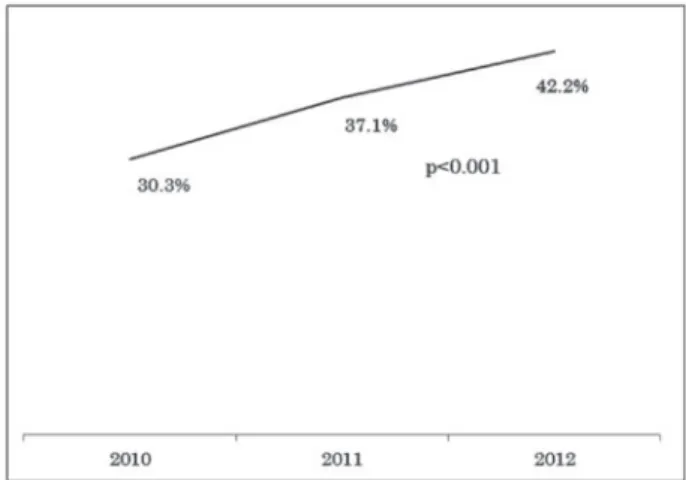
Results: The prevalence of UI was 30.3%, 37.1%, and 42.2%, in 2010, 2011, and 2012, respectively, and the increasing trend of the prevalence was significantly noted (p<0.001). The severities of UI shown by the ICIQ-SF scores were 1.70. 2.03, and 2.23 in 2010, 2011, and 2012, respectively, and the score significantly increased between 2010 and 2012 (p=0.003).
Conclusion: Increasing trends on the prevalence and severity of UI were shown, and aging may cause these trends.
(Received January 27, 2014 and Accepted February 14, 2014) Key words: Elderly women, Urinary incontinence, Prevalence, Severity
18 Mika Harai, Asae Oura, And Mitsuru Mori
2011 (response rate of the second survey among the 803 women, 92.9%), and we obtained a completed third self- administrated questionnaire from 718 women in October, 2012 (response rate of the third survey among the 803 women, 89.4%). The existence of UI was defined as frequency of leakage at least once a week or less often, and, namely, more than or equal to 1 point in the score of ICIQ- SF.
The Mantel-Haenszel test was used for changes in the prevalence of UI. Analysis of variance with the post- hoc Scheffe test was used for change of severity shown by the ICIQ-SF scores among elderly Japanese women.
PASW® Statistics18 (SPSS) was utilized for analysis, and the statistical significance was set up at a 5% level.
Results
As shown in Fig. 1, the prevalence of UI was 30.3%, 37.1%, and 42.2%, in 2010, 2011, and 2012, respectively, and the increasing trend of the prevalence was significantly noted (p
<0.001). As shown in Fig. 2, change of thescore of ICIQ-SF among women were 1.70. 2.03, and 2.23 in 2010, 2011, and 2012, respectively, and the score significantly increased between 2010 and 2012 (p=0.003).
Discussion
Increasing trends on the prevalence and severity of UI were shown from the time-series surveys of UI with the same elderly women once a year for 3 times. The most plausible reason for increasing trends on the prevalence and severity of UI may be aging of the study subjects.
Actually, the average ages of the study subjects were 69.8±
2.6 years in 2010, 70.8 ±2.6 in 2011, 71.8±2.6 in 2012 (p
<0.001). Several cross-sectional studies have also indicated that aging is a risk factor for UI [15, 16]. Aging has been shown to be associated with changes in the bladder and pelvic structures [2], physiological and structural changes of the urinary tract [16], and medical conditions such as diabetes [2] and hemorrhoids [17]. Hemorrhoids have been shown to increase with age [17], and were also indicated as a risk factor of UI in our previous article [14]. However, increasing trends on the prevalence and severity were shown in very short period such as 2 years. Accordingly, change in willingness to report UI for health profession may be another reason for increasing trends on the prevalence and severity of UI.
Several limitations of our study should be kept in mind when interpreting our findings, because all of the data were ascertained by self-report. The potential for an information bias would be induced by self-reported
information. However, self-report may best represent UI from women in a study with a reasonable sample size, as stated by Thom et al. [18]. Furthermore, 997 (49.8%) of 1,600 randomly selected women did not respond to our request to participate in the study, and 57 subjects in 2011 and 28 subjects in 2012 had dropped out from the survey.
The potential for selection bias may be induced by an imperfect response rate. However, to our knowledge, our results were obtained from the first time-series survey for UI among randomly selected elderly women from the resident registration in Japan.
In conclusion, increasing trends on the prevalence and severity, which may be caused by aging, were shown in the present study. Thus research on the prevention of UI in older women may be particularly important.
Acknowledgments
This study was supported with a grant from Sapporo
Fig. 1. Change of prevalence in urinary incontinence among elderlyJapanese women analyzed by the Mantel-Haenszel test.
Fig. 2. Change of the ICIQ-SF score among elderly Japanese women evaluated by analysis of variance with the post-hoc Scheffe test.
19 Time-series survey of prevalence and severity in urinary incontinence among elderly Japanese women.
City University.
References
1. Thom D. Variation in estimates of urinary incontinence prevalence in the community: effects of differences in definition, population characteristics, and study type. J Am Geriatr Soc 1998; 46: 473-480.
2. Hunskaar S, Arnold EP, Burgio K, Diokno AC, Herzog AR, Mallett VT. Epidemiology and natural history of urinary incontinence. Int Urogynecol J 2000; 11: 301-319.
3. Lifford KL, Townsend MK, Curhan GC, Resnick NM, Grodstein F. The epidemiology of urinary incontinence in older women: incidence, progression, and remission. J Am Geriatr Soc 2008; 56: 1191-1198.
4. Townsend MK, Danforth KD, Lifford KL, Rosner B, Curhan GC, Resnick NM, Grodstein F. Incidence and remission of urinary incontinence in middle-aged women.
Am J Obstet Gynecol 2007; 197: 167e1-167e5.
5. Avery K, Donovan J, Peters TJ, Shaw C, Gotoh M, Abrams P. ICIQ: A brief and robust measure for evaluating the symptoms and impact of urinary incontinence. Neurourol Urodynam 2004; 23: 322-330.
6. Klovning A, Avery K, Sandvik H, Hunskaar S. Comparison of two questionnaires for assessing the severity of urinary incontinence: the ICIQ-UI SF versus the incontinence severity index. Neurourol Urodynam 2009; 28: 411-415.
7. Bakali E, Gafni-Kane A, Botros S, Tincello DG. Factors influencing womenʼs participation in urogynecology research in the UK and USA. Neurourol Urodynam 2011;
30: 1462-1466.
8. Fozzatti C, Riccetto C, Herrmann V, Brancallion C, Raimondi M, Nascif CH, Marques LR, Palma PP.
Prevalence study of stress urinary incontinence in women who perform high-impact exercises. Int Urogynecol J 2012;
23: 1687-1691.
9. Maggiore ULR, Alessandri F, Medica M, Gabelli M, Venturini PL, Ferrero S. Outpatient periurethral injections of polyacrylamide hydrogel for the treatment of female stress urinary incontinence: effectiveness and safety. Arch Gynecol Obstet 2013; doi: 10.1007/s00404-013-2718-y.
10. Gotoh M, Donovan J, Corcos J, Badia X, Kelleher CJ, Naughton M, Shaw C, Avery K, Homma Y. Scored ICIQ-SF (International consultation on Incontinence Questionnaire
Short-Form) for symptoms and QOL assessment in patients with urinary incontinence. J Neurog Bladder Soc 2001; 12:
227-231 (Japanese text with English abstract).
11. Gotoh M, Homma Y, Funahashi Y, et al. Psychometric validation of the Japanese version of the International Consultation on Incontinence Questionnaire- Short Form.
Int J Urol 2009; 16: 303-306.
12. Komatsu T, Gotoh M, Funahashi Y, Matsukawa Y, Sassa N, Kato K, Kato M, Hattori R. Efficacy of propiverine in improving symptoms and quality of life in female patients with wet overactive bladder. Lower Urinary Tracts Sympt 2009; 1: 20-24.
13. Hirakawa T, Suzuki S, Kato K, Gotoh M, Yoshikawa Y.
Randomized controlled trial of pelvic floor muscle training with or without biofeedback for urinary incontinence. Int Urogynecol J 2013; 24(8): 1347-1354
14. Harai M, Oura A, Mori M. Risk factors for urinary incontinence in Japanese elderly women. Lower Urinary Tract Symptoms 2014; 6(2): 94-97
15. Hannestad Y, Rortveit G, Sandvik H, Hunskaar S. A community-based epidemiological survey of female urinary incontinence: The Norwegian EPINCONT study. J Clin Epidemiol 2000; 53: 1150-1157.
16. Ge J, Yang P, Yi Zhang Y, Li X, Wang Q, Lu Y. Prevalence and risk factors of urinary incontinence in Chinese women:
A population-based study. Asia-Pacific J Publ Health 2011;
doi: 10.1177/1010539511429370.
17. MacLennan AH, Taylor AW, Wilson DH, Wilson D. The prevalence of pelvic floor disorders and their relationship to gender, age, parity and more of delivery. Br J Obstet Gynaecol 2000; 107: 1460-1470.
18. Thom DH, Brown JS, Schembri M, Ragins AI, Subak LL, Van Den Eden SK. Incidence of and risk factors for change in urinary incontinence status in a prospective cohort of middle-aged and older women: the reproductive risk of incontinence study in Kaiser. J Urol 2010; 184: 1394-1401.
別刷請求先: 原井美佳
〒060-0011 札幌市中央区北11条西13丁目 札幌市立大学 看護学部
E-mail:[email protected]
20 Mika Harai, Asae Oura, And Mitsuru Mori
日本の高齢女性における尿失禁の有病率と 重症度に関する時系列調査
原 井 美 佳
1), 大 浦 麻 絵
2)3), 森 満
3)1)札幌市立大学看護学部
2)高知大学医学部医療学講座(公衆衛生学)
3)札幌医科大学医学部公衆衛生学講座
和文要旨 目的
2010
年から2012
年の3
年間にわたり,同一の高齢女 性に対して,International Consultation on Incontinence Questionnaire-Short Form
(ICIQ-SF
)を含む自記式質問紙 を用いた郵送法調査を実施した.方法
札幌市の住民基本台帳より前期高齢者(
65
歳以上74
歳 以下)の女性1600
人を無作為抽出した.そのうち,2010
年10
月には803
人,2011
年10
月には746
人,2012
年10
月には718
人から回答があった.尿失禁の定義は,「少なく とも週に1
回あるいはそれ以下の尿失禁,すなわちICIQ- SF
の得点が1
点以上」とした.結果
2010
年の尿失禁の有病率は30.3
%,2011
年は37.1
%,2012
年は42.2
%であり,加齢に伴う有病率の増加が認めら れた(p
<0.001
).ICIQ-SF
の得点は2010
年は1.70
,2011
年は2.03
,2012
年は2.23
であり,2010
年と2012
年の得 点に有意差が認められた(p=0.003).結論
尿失禁の有病率と重症度に増加の傾向が認められた.こ れらの傾向には加齢が関連している可能性がある.
キーワード
高齢女性,尿失禁,有病率,重症度