AN ANALYSIS OF FACTORS ASSOCIATED WITH PERSONAL AND PERCEIVED STIGMA AGAINST TALKING ABOUT
SUICIDE IN A RURAL JAPANESE COMMUNITY
Hisanaga Sasaki, Toyoto Iwata, Eri Maeda and Katsuyuki Murata Department of Environmental Health Sciences, Akita University Graduate School of Medicine
(received 10 December 2018, accepted 21 December 2018)
Abstract
A cross-sectional study was conducted to clarify what factors were associated with personal and perceived stigma against talking about suicide, considered as prejudicial attitudes, prior to a com- munity-based intervention for suicide prevention. Among 1,442 residents aged 20 years and over who lived in a rural town in northern Japan and returned questionnaire forms containing complete information, 852 answered that they avoided talking about suicide (i.e., personal stigma) and 897 answered that they thought that people avoided talking about suicide (i.e., perceived stigma). The personal and perceived stigma was observed more frequently in females and those aged 40 years and over. The perceived stigma was significantly associated with both bereave- ment experiences from suicide of a family member and of a friend, belief that suicide is prevent- able (i.e., preventability), and suicidal ideation within one month. The personal stigma was significantly associated with bereavement experience from suicide of a friend and preventabil- ity. This is the first report to demonstrate stigma against talking about suicide at the community level. In addition, these data suggest that persons with perceived stigma against talking about suicide have stronger suicidal ideation than those with the personal stigma. A community-based education is needed to reduce such prejudicial attitudes toward suicide.
Key words: Suicide prevention, Perceived stigma, Personal stigma, Talking about suicide, Rural community
Correspondence : Katsuyuki Murata
Department of Environmental Health Sciences, Akita University School of Medicine, Akita 010-8543, Japan Tel : 81-18-884-6085
Fax : 81-18-836-2608
E-mail : [email protected]-u.ac.jp
there are a high-risk strategy targeting suicide attempt- ers and psychiatric patients with suicidal ideation and a community-based intervention through a health promo- tion approach targeting such residents. Specifically in the latter, public awareness-raising activities emphasiz- ing the empowerment of residents and civic participation are conducted2), and residents start to confront suicide thereupon. Some residents will avoid talking about sui- cide, but may be encouraged to talk about it if suicide prevention measures are introduced in the communi- ty. Avoidance in talking about suicide often comes about due to prejudicial attitudes (i.e., stigma) toward suicide3). In fact, although suicidality is frequently the cause of stigma, it is conversely true that stigma may be the cause Introduction
Since suicide is a sensitive public health issue, the World Health Organization describes that communities play a critical role in suicide prevention and that they can provide social support to vulnerable individuals and en- gage in follow-up care, fight stigma and support those be- reaved by suicide1). In regard to suicide prevention,
of suicidality4). For effective suicide prevention, it may be crucial to remove such stigma from the society.
There are many studies of stigma associated with men- tal disorders5-8). Personal and perceived stigmatizations of depression have already been established 9), which are thought to be concerned with the respondent’s personal attitudes to depression and respondent’s beliefs about the attitudes of others to depression, respectively, using the Depression Stigma Scale10,11). In contrast, there is little information on personal and perceived stigma around sui- cide. Pitman and coworkers reported that stigma was perceived more acutely by the relatives and friends of those who died by suicide than those bereaved by other causes of sudden natural or unnatural death12). Among college students, perceived, but not personal, stigma scores involved in help-seeking were conclusively differ- ent between two groups with and without suicidal ide- ation13). Before beginning a community-based interven- tion for suicide prevention, it is important to understand the feature of widespread stigma around suicide in the community because of the absence of such basic data in Japan. Of such stigma, we focus on personal and per- ceived stigma against talking about suicide in a rural community, inasmuch as there exists a myth that talking about suicide always increases the risk of suicide14). The objective of this study is to clarify what factors affect the personal and perceived stigma. On the basis of pre- vious studies, factors included in the research question were distressed state15,16), bereavement experience from suicide of a family member/friend17,18), attachment to community16), help-seeking from others1,14,19), belief that suicide is preventable (i.e., preventability)20,21), and suicid- al ideation13,14,22,23).
Methods Study population
In March 2015, a self-reported questionnaire was dis- tributed to approximately 3,000 residents aged 20 years and over, living in a rural town in Akita prefecture, north- ern Japan. Of them, 1,976 subjects consented to our proposal and returned the forms to community health volunteers (response rate = 65%). Five hundred and thirty-four respondents were excluded because they re-
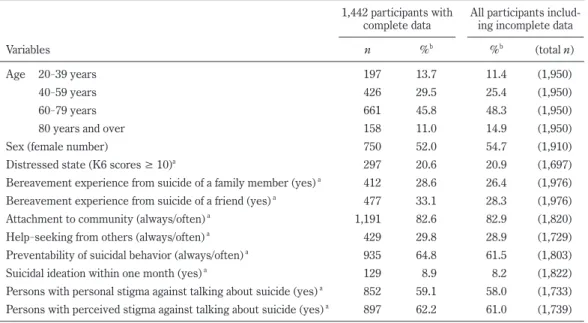
turned questionnaire forms that contained imperfect in- formation (Table 1). Finally, 1,442 residents were en- rolled in the present study. Crude suicide death rates per 100,000 people in 2014 were 19.5 (males, 27.3 ; females, 11.5) in Japan, 26.0 (males, 38.7 ; females, 14.7) in Akita prefecture, and 85.7 (males, 120.8 ; females, 54.2) in that town. Akita prefecture has recorded the highest or considerably high suicide death rate in Japan since 1995. All procedures involving human subjects were approved by the Ethical Review Committee of Akita University Graduate School of Medicine. Written in- formed consent was obtained from all participants.
Measurements
Psychological distress and individual thoughts about sui- cide or community, together with age and sex, were in- quired via the questionnaire. Psychological distress was assessed by K624), and the Japanese version of K6 has been validated in a previous study25). K6 consists of six ques- tions about how often an individual has felt the following in the last month : (1) nervous ; (2) hopeless ; (3) restless or fidgety ; (4) so sad that nothing could cheer you up ; (5) everything was an effort ; and (6) worthless. A total K6 score ranges from 0 to 24. In previous studies, three cut- off points of 5, 10 and 13 have been commonly used to screen for psychological stress 26-28); in this study, dis- tressed state was regarded as K6 score≥10. Questions about individual thoughts were : 1) “Have you lost a family member (or friend) due to suicide ?” (i.e., bereave- ment experience from suicide of a family member/
friend) ; 2) “Do you feel attachment to the place where you live ?” (i.e., attachment to community) ; 3) “Do you seek help from others ?” (i.e., help-seeking from oth- ers) ; 4) “Do you think it possible to prevent suicide ?”
(i.e., preventability of suicidal behavior) ; 5) “Have you thought about suicide within the last one month ?” (i.e., suicidal ideation within one month) ; 6) “Do you avoid talking about suicide in your community ?” (i.e., personal stigma against talking about suicide) ; and, 7) “Do you think that most other people avoid talking about suicide in your community ?” (i.e., perceived stigma against talking about suicide). An answer “yes” (or, always/of- ten) was scored as 1, and others were scored as 0.
Statistical analyses
Dichotomous values between subgroups with and without personal/perceived stigma against talking about suicide were compared by χ2 test with Yates correction.
The difference in proportions of persons with the person- al and perceived stigma was compared by McNemar test. The above factors, including age and sex, affecting personal/perceived stigma against talking about suicide were analyzed using multiple logistic regression analy- sis. All analyses with two-side P values were per- formed using the Statistical Package for the Biosciences (SPBS Ver. 9.68)29), and the significance level was set at P
< 0.05.
Results
Table 1 represents background characteristics of 1,442 participants in the rural community. The proportions of age-specific population groups for habitants of this town in October 2015 were 13.4% for 20-39 years, 25.8% for 40-59 years, 41.9% for 60-79 years, and 18.9% for 80
years and over, and the sex ratio was 0.892, implying that the subjects of this study reflected almost the same age and sex distributions of this town. There were 96 sub- jects (6.7%) who lost both a family member and friend due to suicide, 381 (26.4%) who did not lose a family member, but a friend, 316 (21.9%) who did not lose a friend, but a family member, and 649 (45.0%) who had no experience with bereavement due to suicide. Concern- ing the stigma against talking about suicide, there were 701 subjects (48.6%) having both personal and perceived stigma, 151 subjects (10.5%) with personal stigma and without perceived stigma, 196 subjects (13.6%) with per- ceived stigma and without personal stigma, and 394 sub- jects (27.3%) without both personal and perceived stigma (P = 0.018 by McNemar test).
As shown in Table 2, female subjects had personal and perceived stigma against talking about suicide more fre- quently than the males, and the preventability of suicidal behavior was significantly higher in those with the per- sonal or perceived stigma than without it. Those with the personal or perceived stigma had bereavement expe- rience from suicide of a friend more frequently than those
Table 1. Basal characteristics of 1,442 participants in a rural community of northern Akita
1,442 participants with
complete data All participants includ- ing incomplete data
Variables n %b %b (total n)
Age 20-39 years 197 13.7 11.4 (1,950)
40-59 years 426 29.5 25.4 (1,950)
60-79 years 661 45.8 48.3 (1,950)
80 years and over 158 11.0 14.9 (1,950)
Sex (female number) 750 52.0 54.7 (1,910)
Distressed state (K6 scores ≥ 10)a 297 20.6 20.9 (1,697)
Bereavement experience from suicide of a family member (yes) a 412 28.6 26.4 (1,976) Bereavement experience from suicide of a friend (yes) a 477 33.1 28.3 (1,976)
Attachment to community (always/often) a 1,191 82.6 82.9 (1,820)
Help-seeking from others (always/often) a 429 29.8 28.9 (1,729)
Preventability of suicidal behavior (always/often) a 935 64.8 61.5 (1,803)
Suicidal ideation within one month (yes) a 129 8.9 8.2 (1,822)
Persons with personal stigma against talking about suicide (yes) a 852 59.1 58.0 (1,733) Persons with perceived stigma against talking about suicide (yes) a 897 62.2 61.0 (1,739)
a See the Methods section.
b Comparison of percent between 1,442 participants and all participants was made using paired t test (P > 0.2, degree of freedom = 13).
without it (P < 0.05). Bereavement experience from suicide of a family member was significantly higher only in those with the perceived stigma than without it. Af- ter distressed state and attachment to community were excluded because they did not show a close relation to the personal or perceived stigma (P > 0.1 in Table 2),
factors affecting the stigma were analyzed using multiple logistic regression analysis (Table 3). The results were similar to Table 2, and a significant association between the perceived stigma and suicidal ideation within one month (P = 0.0492) was newly observed ; the results adding distressed state into the independent variables Table 2. Characteristics of persons with or without personal and perceived stigma against talking about suicide
Variables
Personal stigma Perceived stigma Persons
with%
Persons without
% P*
Persons with%
Persons without
% P*
Age group 0.079 0.001
20-39 11.7 16.4 11.3 17.6
40-59 30.6 28.0 30.0 28.8
60-79 46.4 45.1 48.6 41.3
80- 11.3 10.5 10.1 12.3
Females 54.5 48.5 0.028 54.5 47.9 0.017
Distressed state (K6 score ≥ 10) 20.3 21.0 0.741 19.6 22.2 0.254
Bereavement experience from suicide of a family member 30.2 26.3 0.110 31.4 23.9 0.002 Bereavement experience from suicide of a friend 35.4 29.7 0.023 35.1 29.7 0.040
Attachment to community 83.0 82.0 0.672 83.8 80.6 0.115
Help-seeking from others 30.6 28.5 0.412 31.5 26.8 0.057
Preventability of suicidal behavior 68.4 59.7 0.001 69.3 57.4 <0.001
Suicidal ideation within one month 10.1 7.3 0.073 10.0 7.2 0.071
*χ2 test with Yates correction.
Table 3. Factors affecting personal/perceived stigma against talking about suicide : results of multiple logistic regression analysis
Variables
Personal stigma Perceived stigma Odds ratio 95% CI* Odds ratio 95% CI*
Age group
20-39 1.00 1.00
40-59 1.56 1.10-2.20 1.66 1.17 -2.36
60-79 1.60 1.15-2.22 2.09 1.50-2.93
80- 1.76 1.14-2.73 1.55 1.00-2.40
Females 1.31 1.05-1.62 1.33 1.06-1.66
Bereavement experience from suicide of a family member 1.21 0.96-1.55 1.46 1.14-1.87 Bereavement experience from suicide of a friend 1.42 1.12-1.80 1.44 1.13-1.84
Help-seeking from others 1.02 0.80-1.29 1.17 0.92-1.50
Preventability of suicidal behavior 1.52 1.22-1.91 1.74 1.39-2.19
Suicidal ideation within one month 1.45 0.98-2.14 1.50 1.00 -2.24
*Confidence interval.
also were unchanged.
Discussion
In a rural Japanese community examined by us, 59.1%
(95% confidence interval (CI), 56.5-61.6%) of the partici- pants had a personal stigma against talking about suicide and 62.2% (95% CI, 59.6-64.7%) had the perceived stig- ma. The proportion of those with personal and per- ceived stigma was higher in females (61.9% and 65.2%, respectively) and at 40 years and over of age than in males (56.1% and 59.0%, respectively) and those aged 20-39 years, respectively, whereas sex difference could not explain why the suicide death rate was approximately twice higher in males than in females in Japan30). In contrast, personal stigma associated with depression was lower in females than males5,8,9,31) and decreased with age9), and the concept of personal stigma appears to differ between suicide and depression. To our knowledge, since there are no previous studies addressing preva- lence of such stigma in the community, this is the first report to demonstrate features of stigma related to sui- cide. According to a guideline for suicide prevention1), given the widespread stigma around suicide, most people who are contemplating suicide do not know who to speak to ; and talking openly can give an individual other op- tions or time to rethink his/her decision, thereby pre- venting suicide. More actively, talking about suicide in- creases the likelihood that suicidal individuals will meet with accepting responses in the community32). There- fore, community members including health workers, edu- cators, police and other gatekeepers must endeavor to reduce such stigma against talking about suicide.
Fifty-five percent of the subjects in this study reported that at least one of their acquaintances (a family member and/or friend) had committed suicide, which is similar to the rate (52.6%) of another report in Japan33). In Tables 2 and 3, perceived stigma against talking about suicide was associated with both bereavement experiences from suicide of a family member and of a friend, and the per- sonal stigma was associated with bereavement experi- ence of only a friend. Two possible explanations for the difference between the perceived and personal stigma in relation to bereavement experience are as follows : peo-
ple with greater exposure to anxiety disorders and people reporting a previous anxiety diagnosis had lower personal stigma toward anxiety in a community of Australian adults31); by contrast, higher exposure to anxiety disor- ders was significantly associated with higher perceived anxiety stigma. Next, identification with deceased friends and awareness of shared vulnerabilities to sui- cide34) could readily build various attitudes to suicide (i.e., both perceived and personal stigma). Since relatives are concerned about genetic vulnerabilities to mental illness and suicide, feeling powerless to escape inherited traits35), it is likely that people who tend to hide genetic or inherited characteristics may not hold the personal stigma. In either case, stigma against talking about sui- cide appears to be affected by who died due to sui- cide. Further study is required to gather evidence of the link between stigma and bereavement experience in relation to suicide.
Approximately 9% of the participants employed in this study answered that they had thought about suicide with- in the past one month. Such suicidal ideation was shown to exist in 31.3% of female college students in Ja- pan36) and in 6.7% of undergraduate and graduate stu- dents from US universities13). Regarding suicidal ide- ation, although there was no significant difference between those with and without personal or perceived stigma against talking about suicide (Table 2), it was sig- nificantly associated with the perceived stigma after ad- justing for other factors (Table 3). Apart from talking about suicide, one study using college students reported that the majority of respondents with past year suicidal ideation (81.8%) perceived the need for help for emotion- al or mental health problems as compared to 35.3% of nonsuicidal peers, though there was no significant differ- ence in the personal stigma score between the two groups13). Also, persons labeled “mentally ill” reported significantly higher frequencies of suicidal ideation and feel- ing of hopelessness, and more perceived stigma was associ- ated with suicidal ideation among such persons 23). Thus, since it is possible that people with perceived stigma have stronger suicidal ideation than people with personal stigma, the target population for preventing suicide may be mainly those with perceived stigma.
Our results indicated that the residents who thought it
possible to prevent suicide had personal and perceived stigma against talking about suicide more frequently than those who did not think so. Abbott and Zakriski report- ed that preventability of suicidal behavior was positively correlated with perceived social support from friends and family, and also that perceived social support from friends and family was negatively correlated with resignation or tabooing against talking about suicide21), such as “Suicide is an easy escape, one that cowards use,” “Suicide is an act of anger, aggression, or revenge,” and “If people want to die by suicide, we cannot stop them.” Taken togeth- er, it is suggested that people with the personal and/or perceived stigma tended to believe that suicidal behavior was preventable. The implication is, paradoxically, that social support from community member including close friends and family is one form of various effective mea- sures for suicide prevention.
In the present study, although the proportion of dis- tressed state (K6 score > 9) was significantly higher in the persons with suicidal ideation (62.0%) than those without it (16.5%), neither distressed state nor help-seeking from others was significantly associated with stigma against talking about suicide. There are some reports supporting links between them. For in- stance, one research reported that global psychological distress, measured by the Global Severity Index score, was significantly related to the Stigma of Suicide Survi- vor Scale score37). Another demonstrated that low sui- cide stigma and high suicide literacy were significantly associated with more positive help-seeking attitudes14). The difference of results from these two reports and ours may have been due to study subjects, i.e., suicide survi- vors, adults recruited via Facebook, and communi- ty-based population, respectively. Nevertheless, since these are factors possibly affecting stigma around suicide, further studies with subjects residing in other rural and urban communities are necessary to identify such associ- ations.
The current study may have some limitations that should be highlighted. First, this study was cross-sec- tional in nature, which means that temporal relationships between personal and perceived stigma against talking about suicide and related factors cannot be drawn. Lon- gitudinal studies would need to be conducted to identify
and understand temporal relationships, and should be considered in future studies. Second, approximately 500 respondents giving written informed consent were excluded from this study due to incomplete data in the questionnaire, but there were no significant differences in the background data, shown in Table 1, between the 1,442 participants with complete information and all par- ticipants including incomplete data, and also, age and sex distributions of the participants were similar to those of the population in the rural town. Third, comparison of self-reported rates across groups may have been prob- lematic1), because most of questions used in this study were dichotomous and subjective ; however, we em- ployed a large number of community-based subjects to mitigate such problems. In addition, age and sex were considered in the data analysis. Therefore, it is sug- gested that our data were not heavily influenced by se- lection or measurement bias or confounders. Population to which our findings are applied, though, should be con- sidered carefully, because the suicide death rate in this town was extremely high, even in Akita prefecture.
Conclusions
In a rural Japanese community with a considerably high suicide death rate, the proportion of residents with perceived stigma against talking about suicide (62.2%) was significantly higher than that with the personal stig- ma (59.1%). The perceived stigma was associated with both bereavement experiences from suicide of a family member and of a friend, preventability of suicidal behav- ior, and suicidal ideation within one month, together with those of middle age and elderly and females. The per- sonal stigma was associated with bereavement experi- ence from suicide of a friend and preventability of suicidal behavior, as well as for the middle aged, elderly and fe- males. In light of preceding and our studies, these data suggest that persons with the perceived stigma may have stronger suicidal ideation than those with the personal stigma. Social support from community member includ- ing close friends and family appears to be one of the most effective suicide prevention measures for such per- sons. Concurrently, community-based education is needed to reduce prejudicial attitudes toward suicide.
Conflicts of Interest The authors declare no conflict of interest.
Acknowledgements
The authors would like to thank Prof. Yutaka Moto- hashi, Dr. Yoshihiro Kaneko, Dr. Koji Fujita, Dr. Sachiko Minamizono, and Dr. Yong Kim Fong Roseline for their assistance to data collection. This study was supported partly by a Grand-in-Aid for Scientific Research (C) from the Japan Society for the Promotion of Science (No.
15K08726).
References
1) World Health Organization (WHO) (2014) Prevent- ing Suicide : A Global Imperative. WHO, Geneva.
2) Motohashi, Y., Kaneko, Y., Sasaki, H. and Yamaji, M.
(2007) A decrease in suicide rates in Japanese rural towns after community-based intervention by the health promotion approach. Suicide Life-Threat.
Behav., 37, 593-599.
3) Clark, W., Welch, S.N., Berry, S.H., Collentine, A.M., Collins, R., Lebron, D. and Shearer, A.L. (2013) California’s historic effort to reduce the stigma of mental illness : the Mental Health Services Act.
Am. J. Public Health, 103, 786-794.
4) Carpiniello, B. and Pinna, F. (2017) The reciprocal relationship between suicidality and stigma. Front.
Psychiatry, 8, 35.
5) Griffiths, K.M., Christensen, H. and Jorm, A.F. (2008) Predictors of depression stigma. BMC Psychiatry, 8, 25.
6) Griffiths, K.M., Crisp, D.A., Jorm, A.F. and Chris- tensen, H. (2011) Does stigma predict a belief in dealing with depression alone ? J. Affect. Disord., 132, 413-417.
7) Calear, A.L., Griffiths, K.M. and Christensen, H.
(2011) Personal and perceived depression stigma in Australian adolescents : magnitude and predic- tors. J. Affect. Disord., 129, 104-108.
8) Coppens, E., van Audenhove, C., Scheerder, G., et al.
(2013) Public attitudes toward depression and help-seeking in four European countries baseline
survey prior to the OSPI-Europe intervention. J.
Affect. Disord., 150, 320-329.
9) Dietrich, S., Mergl, R. and Rummel-Kluge, C. (2014) Personal and perceived stigmatization of depres- sion : a comparison of data from the general popula- tion, participants of a depression congress and job placement officers in Germany. Psychiatry Res., 220, 598-603.
10) Griffiths, K.M., Christensen, H., Jorm, A.F., Evans, K.
and Groves, C. (2004) Effect of web-based depres- sion literacy and cognitive-behavioural therapy interventions on stigmatising attitudes to depres- sion : randomised controlled trial. Brit. J. Psychia- try, 185, 342-349.
11) Griffiths, K.M., Nakane, Y., Christensen, H., Yoshi- oka, K., Jorm, A.F. and Nakane, H. (2006) Stigma in response to mental disorders : a comparison of Aus- tralia and Japan. BMC Psychiatry, 6, 21.
12) Pitman, A.L., Osborn, D.P.J., Rantell, K. and King, M.B. (2016) The stigma perceived by people bereaved by suicide and other sudden deaths : a cross-sectional UK study of 3432 bereaved adults. J.
Psychosom. Res., 87, 22-29.
13) Downs, M.F. and Eisenberg, D. (2012) Help seek- ing and treatment use among suicidal college stu- dents. J. Am. Coll. Health, 60, 104-114.
14) Calear, A.L., Batterham, P.J. and Christensen, H.
(2014) Predictors of help-seeking for suicidal ide- ation in the community : risks and opportunities for public suicide prevention campaigns. Psychiatry Res., 219, 525-530.
15) Cheng, D.R., Poon, F., Nguyen, T.T., Woodman, R.J.
and Parker, J.D. (2013) Stigma and perception of psychological distress and depression in Austra- lian-trained medical students : results from an inter- state medical school survey. Psychiatry Res., 209, 684-690.
16) Minamizono, T., Kaneko, Y., Minamizono, S. and Motohashi, Y. (2013) Association of festival obser- vance with psychological distress in a rural Japanese community. Open J. Prev. Med., 3, 368-373.
17) Pitman, A.L., Osborn, D.P.J., Rantell, K. and King, M.B. (2016) Bereavement by suicide as a risk fac- tor for suicide attempt : a cross-sectional national UK-wide study of 3432 young bereaved adults.
BMJ Open, 6, e009948.
18) Pitman, A., Rantell, K., Marston, L., King, M. and Osborn, D. (2017) Perceived stigma of sudden bereavement as a risk factor for suicidal thoughts and suicide attempt : analysis of British cross-sec- tional survey data on 3387 young bereaved adults.
Int. J. Environ. Res. Public Health, 14, 286.
19) Reynders, A., Kerkhof, A.J.F.M., Molenberghs, G.
and van Audenhove, C. (2014) Attitudes and stigma in relation to help-seeking intentions for psychologi- cal problems in low and high suicide rate regions.
Soc. Psychiatry Psychiatr. Epidemiol., 49, 231-239.
20) Renberg, E.S., Hjelmeland, H. and Koposov, R. (2008) Building models for the relationship between atti- tudes toward suicide and suicidal behavior : based on data from general population surveys in Sweden, Norway, and Russia. Suicide Life-Threat. Behav., 38, 661-675.
21) Abbott, C.H. and Zakriski, A.L. (2014) Grief and attitudes toward suicide in peers affected by a cluster of suicides as adolescents. Suicide Life-Threat.
Behav., 44, 668-681.
22) Yamamura, E. (2015) Comparison of social trust’s effect on suicide ideation between urban and non-ur- ban areas : the case of Japanese adults in 2006. Soc.
Sci. Med., 140, 118-126.
23) Oexle, N., Ajdacic-Gross, V., Kilian, R., Müller, M., Rodgers, S., Xu, Z., Rössler, W. and Rüsch, N. (2017) Mental illness stigma, secrecy and suicidal ideation.
Epidemiol. Psychiatry Sci., 26, 53-60.
24) Kessler, R.C., Andrews, G., Colpe, I.J., Hiripi,E., Mroczek, D.K., Normand, S.L., Walters, E.E. and Zaslavsky, A.M. (2002) Short screening scales to monitor population prevalences and trends in non-specific psychological distress. Psychol. Med., 32, 959-976.
25) Furukawa, T.A., Kawakami, N., Saitoh, M., et al.
(2008) The performance of the Japanese version of the K6 and K10 in the World Mental Health Survey Japan. Int. J. Methods Psychiatry Res., 17, 152-158.
26) Fushimi, M., Saito, S., Shimizu, T., Kudo, Y., Seki, M.
and Murata, K. (2012) Prevalence of psychological distress, as measured by the Kessler 6 (K6), and related factors in Japanese employees. Community Ment. Health J., 48, 328-335.
27) Sone, T., Nakaya, N., Sugawara, Y., Tomata, Y., Wata-
nabe, T. and Tsuji, I. (2016) Longitudinal associa- tion between time-varying social isolation and psychological distress after the Great East Japan earthquake. Soc. Sci. Med., 152, 96-101.
28) Tanji, F., Tomata, Y., Sekiguchi, T. and Tsuji, I. (2018) Period of residence in prefabricated temporary hous- ing and psychological distress after the Great East Japan earthquake : a longitudinal study. BMJ Open, 8, e018211.
29) Murata, K. and Yano, E. (2002) Medical Statistics for Evidence-Based Medicine with SPBS Users’
Guide. Nankodo Publisher, Tokyo.
30) Fukuoka, A., Iwasaki, Y., Wood, D.C., Iwata, T. and Murata, K. (2012) Suicide mortality for young, mid- dle-aged and elderly persons in the period of Japa- nese economic transition, 1975-2005. Akita J. Med., 39, 33-44.
31) Batterham, P.J., Griffiths, K.M., Barney, L.J. and Par- sons, A. (2013) Predictors of generalized anxiety disorder stigma. Psychiatry Res., 206, 282-286.
32) Stein, D., Brom, D., Elizur, A. and Witztum, E. (1998) The association between attitudes toward suicide and suicidal ideation in adolescents. Acta Psychiatr.
Scand., 97, 195-201.
33) Minamizono, S., Motohashi, Y., Yamaji, M. and Kaneko, Y. (2008) Attitudes towards those bereaved by a suicide : a population-based, cross-sectional study in rural Japan. BMC Public Health, 8, 334.
34) Pitman, A., Nesse, H., Morant, N., Azorina, V., Ste- venson, F., King, M. and Osborn, D. (2017) Atti- tudes to suicide following the suicide of a friend or relative : a qualitative study of the views of 429 young bereaved adults in the UK. BMC Psychiatry, 17, 400.
35) Pitman, A.I., Stevenson, F., Osborn, D.P.J. and King, M.B. (2018) The stigma associated with bereave- ment by suicide and other sudden deaths : a qualita- tive interview study. Soc. Sci. Med., 198, 121-129.
36) Iwakiri, M., Araki, S. and Murata, K. (1987) Per- sonality traits of female college students with sui- cidal ideation : case-control study by Y-G persnality test. Jpn. J. Public Health, 34, 81-83.
37) Scocco, P., Preti, A., Totaro, S., Ferrari, A. and Toffol, E. (2017) Stigma and psychological distress in sui- cide survivors. J. Psychosom. Res., 94, 39-46.