1.Introduction
Japanese compulsory English education has been criticized for putting too much emphasis on teaching students about the English language instead of how to use it as a means of communication. Students are taught grammatical knowledge in phases, from simple to complex. Translation is the main
method of instruction in many classrooms. Memorizing thousands of words and phrases, without relevant context and a fuller understanding, with the sole purpose to prepare for the university entrance examination is still a common practice among high school students. English is merely one of the subjects that students study in order to pass the entrance
An Examination of the Effects of Project-Based Learning on University Student
Attitude Toward English Learning
– A Case Study at a Japanese Women’s University –
GOMEZ, CHIKAMORI Yumi
PBL による探究的学習がもたらす
大学生の英語学習姿勢への影響
―日本の女子大学生における事例研究―
ゴメス 近森 由美
要旨 本研究では、プロジェクトベースの発信型学習が、日本の大学生の英語学習姿勢に与える影響を事例的に考察す る。過去の英語学習における失敗体験などから苦手意識を持ち、英語学習に意欲を感じられずに大学に入学してく る学生は少なくない。しかし、英語は本来、異言語・異文化をベースとする人々とつながるためのコミュニケーショ ンのツールであり、文法などの知識を学習すること自体が目的ではない。プロジェクト学習を通して、そのことを 学生自身が体験し、英語学習に自ら意義を発見することは、学習意欲の向上に有益だと考える。今回の研究では、 自国の文化を他国の人々に英語で紹介する動画を作成するという課題をグループで行わせた。意識調査の結果、学 生の英語学習に対する姿勢には大きな変化は見られなかったが、質的分析からは、多くの学生が物事を多角的に見 ることや、協同的にコミュニケーションを取り合うことの重要性に気づいたことがわかった。 キーワード プロジェクト学習(PBL)、学習意欲、協同学習、コミュニケーションのツールとしての英語、探究的学習 AbstractThe purpose of this study is to examine the effects of project-based learning on student attitude toward learning English. Quite a few students enter university feeling uninterested in learning English. Some may have feelings of helplessness due to past failures in their English learning. Others may have trauma from having to cram grammar knowledge for entrance examinations. The true purpose of learning English is to learn the language as a means of communication to connect with people of different linguistic and cultural backgrounds. Thus, learning grammar knowledge itself should not be the ultimate goal. Project-based learning (PBL) provides students with opportunities to discover that for themselves by experiencing language use for meaningful purposes. In this study, students worked in collaboration with peers to create a YouTube video to introduce Japanese culture to the outside world. Quantitative analysis of questionnaires taken from students indicated that there was no significant change in student attitude toward English learning. However, qualitative analysis of students’ self-reflection after the PBL suggested that many of the students noticed the importance of looking at things from multiple perspectives and communicating with peers in collaboration towards the same goal.
Key words
Project-based learning (PBL), motivation to learn, collaborative learning, English as a communication tool, expeditionary learning
examinations. This is seen as a serious demotivating factor for students to learn English. Mcveigh (2004) says the main problem of foreign language instruction in Japanese higher education is a problem of motivation. Mcveigh warns that “when language is studied to please someone else (e.g. educational authorities, corporations, a vague sense of the national collective), enthusiasm for the humanistic impulse of self-edification is hampered.” In fact, students in Japan have no choice but to study English because it is a compulsory subject in school and is an important subject if they want to enter a good university. Thus, while a language is a tool to communicate with other people and should be taught for that purpose, language learning becomes a solitary task of cramming knowledge for many Japanese students. The seriousness of this problem lies in the fact that students are deprived of chances to think for themselves how exactly learning English would help them become their ideal self in their present and future life. Instead, the purpose of learning English for many students is to learn grammar and to memorize English words and phrases in order to get good grades on tests. When students are driven to study English for tests, they lose the true sight of the practicability of such knowledge in their everyday life. As a consequence, learning English would seem meaningless for them after they have managed to pass entrance tests and enter their chosen university.
If we want our students to become motivated to learn English, we need to provide them with opportunities to discover their own meaning in learning English for their personal growth. I believe project-based learning (PBL) is an ideal learning method for that purpose as PBL prepares learners to approach learning in their own way that fits their abilities, styles, and preferences (Skehan, 1998). In PBL, learners set their own project goal by exploring topics of their interest and look for knowledge and skills needed to accomplish it. Along the process of such exploration, learners are forced to autonomously relate the knowledge from the textbook to the practical knowledge that is personally more meaningful to their everyday life. When learners can make a personal connection with the knowledge and skills to be learned, they start to look for meaning in that learning process. Also, in the PBL method, students often work in collaboration with other students. This promotes interactive communication with other students, which is an essential aspect of language learning as language is ultimately a means of communication. Experiences like these,
consequently, can be a great motivating factor for students to learn English. They would want to learn English not only because they need credits for graduation, but also, they would truly value the meaning of such learning for their future growth. In this study, I will probe the possibility of such effects with Japanese university students by using PBL as the primary learning framework in an English course.
2.Background
2.1. Theory In the research of foreign language education, from the 18th century to the early 20th century, researchers have primarily tried to find the most effective and efficient way to learn or teach foreign languages. This trend of looking at language teaching as the matter of methods and approaches was based on the assumption that if teachers improve their teaching styles, all learners should be able to learn the language effectively. However, what was missing in this assumption was the fact that learners are different individuals driven by their own unique psychological needs and wants. No matter how hard teachers try to help them, the success or failure in acquiring a foreign language is ultimately up to the learners’ dedication to their own learning process. Thus, learners are different individuals and their “cognitive abilities and personality traits are involved in the determination of the direction and intensity of intellectual investments” (Ackerman, Chamorro-Premuzic, & Furnham, 2011, p. 33). Since the mid-20th century, this focus has provided ways for further research in learners’ psychological states and the factors influencing learners’ motivation, which are closely related to how they approach their language learning.extrinsic motivation comes from the desire to act for outside rewards. However, personality and social dimensions must be taken into account when talking about L2 motivation (Dörnyei, 1998).
Pintrich & Schunk (1996) indicate that learners' constructive interpretations of events and the role that their beliefs, cognition, affects, and values play in achievement situations must also be considered. Thus, motivation is no longer seen as a reflection of certain inner forces such as instincts or volition, but personal interests or characteristics that drive individuals’ actions, such as desire for knowledge and need for achievement (Dörnyei, 1990). The socio-educational model of second language acquisition (Gardner, 2010) shows how motivation is related to other learner characteristics and language achievement, and it places motivation within a system of four distinct aspects of the second-language acquisition process (Dörnyei & Ryan, 2015). According to this model, L2 learning is not solely defined by learners’ aptitude but rather cultural and social contexts play a significant role in influencing the learners’ attitude and motivation in learning an L2.
Many English teachers and researchers in Japan have pointed out the problem of students’ low motivation level, especially in higher education. One of the main factors blamed for this problem is the English education system that is essentially geared toward university entrance examinations. Berwick & Ross (1989) say that, for Japanese learners of English, the intensity of motivation to "learn English" hits a peak in the last year of high school. Therefore, when they finally get into a university, they are like “exam-worn survivors with no apparent academic purpose at university” (p. 206). Mcveigh (2004) cites the country’ s nationalist and economistic policies as the culprit for Japanese students’ low motivation level and states that students are victims who have no say in whether and how they learn English. Goodman (2003) blames testing-focused English education and argues that the Japanese education system is an “enormously elaborated, very expensive testing system with some educational spin-offs, rather than the other way around” (p. 7). In addition to these socially driven factors, anxiety toward English learning is also a prominent factor among Japanese students. Japanese learners of English have “inhibitory factors operating against learning English such as anxiety, past negative experiences, or preferring teacher- dominated lectures” (Kimura, Nakata, & Okumura, 2001, p.60-61). Motivational self-system of L2 learning, which is composed of three components: the ideal L2 self, ought-to L2 self, and L2 learning experience (Dörnyei, 2005), is a theoretical framework that provides some understanding to this learner psychology. The conflict between one’s ideal L2 self and ought-to L2 self can be understood by the fact that Japanese learners of English tend to worry about the observations and evaluations of others (Ryan, 2009). Hence, Japanese learners of English, who are barraged with language knowledge and constantly being tested on their understanding of this knowledge, may find themselves in conflict with their ideal L2 self and ought-to L2 self when they are unable to attain good grades on tests or live up to teachers’ expectations. Such feelings of inadequacy can lead to feelings of anxiety and subsequently to a decrease in their motivation toward English learning. Japanese students with low motivation need to become self-motivated and self-determined learners. In self-determination theory (SDT; Deci & Ryan, 1985), people have three inherent psychological needs: 1) the needs for competence, 2) relatedness, and 3) autonomy. These components are”required for proactivity, optimal development, and psychological health of all people” (Deci & Vansteenkiste, 2004, p.25) and their lack would result in”passivity, ill-being, fragmentation, and alienated functioning” (p.25).
Project-based learning (PBL), also referred to as expeditionary learning (Udall & Mednick, 1996), promotes learners’ deep understanding (Entwistle, McCune, & Walker, 2001). In PBL, students begin their project with a driving question (Blumenfeld et al., 1991) from which they start thinking about the topic they intend to explore. Unlike a well-designed teacher-led learning style, learners are forced to become the agent (Swain, 2006) in their own learning process. When learners are given the freedom to look for knowledge and information needed to accomplish their own learning goal, they learn to work autonomously (Fried-Booth, 2002). In addition, PBL enables students to relate the real world to the classroom as they work to realize their authentic results (Gordon, 1998), which can give them the feeling of competence.
learning is effective in dealing with the environment surrounding the learners, providing experiences that will lead to feeling of competence (White, 1959). Thus, PBL is considered as an effective learning style in foreign language education (EFL) as well, and some educational institutions have incorporated the method in their EFL curriculum, particularly in content-based second language education (Stoller, 1997) and English for specific purposes (Fried-Booth, 2002).
There has been research on the effects of PBL on students’ motivation and some research has shown that PBL can encourage student motivation and develop learner autonomy. Lam, Cheng, & Ma (2009) examined the relationship between teacher and student intrinsic motivation in a semester-long project-based program targeting secondary school teachers and their students in Hong Kong. The results showed that teacher intrinsic motivation predicted student intrinsic motivation directly as well as indirectly through the mediation of instructional support. Previous research has also shown that PBL can encourage student motivation in foreign language learning. Shin (2018) indicated that project-based learning had a positive effect on motivation and self-efficacy of university students in South Korea. However, no research has yet to be conducted on the effects of PBL on motivation of foreign-language learning in higher education in Japan.
2.2. Research Questions
In this study, I will discuss how students’ perceptions of English learning and cross-cultural understanding changed through the experience of group production of a YouTube video with the aim of introducing Japanese culture to the outside world. I will also discuss how working on the project in cooperation with peers affected students’ perceptions of their learning outcome.
Three research questions are as follows:
1)How does PBL affect student attitude toward learning English? 2)How does PBL affect student attitude toward understanding and relating with other cultures? 3)How do students perceive their own learning outcome in PBL?
3.Methodology
3.1. Participants and Course Background
The participants for this study are 20 students from a private women’s university in Japan who took an elective liberal-arts course on English through project-based learning.
The course had 20 enrolled students who were between the second year and the third year in university with mixed majors, mainly nursing as well as major and language and culture majors. No requirements on English proficiency level were set for this course so the participants’ English level varied. While no language proficiency assessment was conducted on the students at the start of this course, teachers’ observation throughout the course indicated that many of them were in the elementary to intermediate level with some students more proficient in speaking than others.
The 15-week course took place in the Spring of 2019, meeting once a week for 90 minutes. This course was content-based and was designed to develop students’ four skills of reading, listening, speaking, and writing through the comprehensive practice of these four skills in English. Another goal of this course was to get a deeper understanding of Japanese culture and appreciate the differences between their own culture and that of other countries through expeditionary inquiries in collaboration with peers. The main language of instruction was Japanese and Japanese usage was allowed in order to enable students to communicate effectively with their peers. However, students were instructed to use English in their final product, a YouTube video.
3.2. Description of the Project
Table 1. Pre- and Post-Results on English-Learning Attitudes and foreign cultures. In the second part, students made a five-minute YouTube video incorporating the information collected and analyzed in the first part. The final product was required to be in English only. The teacher emphasized on multiple occasions the importance of considering audience viewpoints when composing the video. This was meant to encourage students understanding and appreciation of different cultural values.
In week one and two, students formed groups and icebreaking activities were conducted so that they would get well acquainted with each other before the project began. Students were put together in heterogeneous groups in terms of year in school and their majors. Week three to six were for investigatory research. Before they started their investigation, each group made a detailed project plan. Week seven was an interim reporting session in which each group presented their research results using a poster. On Week eight through 10, they engaged in video-making tasks. Week 11 was for the first video presentation. Each group presented their first compilation of their product and the teacher and other students gave feedback. Week 12 and 13 were used to revise their work reflecting on the feedback received. On Week 14, the final work was presented to the class. Week 15 was a summation of the project and students reflected on their experience of the whole project. During the project, the teacher intervened when students were found struggling with the project task itself, experiencing inner-group conflicts or management problems, or having questions about the contents of the project. 3.3. Data Collection The purpose and the method of this study was screened and approved by the university’s ethical screening committee before the data were collected. The data used for this study was collected from anonymous questionnaires before the project started and after the project terminated and a reflection sheet that students filled out at the end of the course. Data collection took place from April 2018 to July 2018. The questionnaire data were collected from 20 students who agreed to participate in this study after being given the explanations of their rights and the purpose of this study, both orally and in writing. However, two students who had agreed to participate in the study dropped out of the course soon after the project began. Therefore, the number of students who provided data for the post-test turned out to be 18. The reflection sheet was collected at the end of the course from 17 out of the 18 students as one student failed to turn one in. 3.4. Instruments The questionnaire took the form of a five-point Likert Scale and consists of three measurement dimensions: 1) English learning attitudes, 2) cross-cultural understanding, and 3) cooperative learning (see Appendix). The cooperative learning measurement questions were adopted from the “The Belief in Cooperation Scale” (Nagahama et al., 2009). There were 18 questions to measure three sub-dimensions, 1) individual orientation, 2) cooperation efficacy, and 3) reluctancy to cooperate. The cross-cultural understanding dimension included 11 questions and English learning attitude had eight question items. Collected data for each dimension were given a value of one to five and then summed up for comparison between pre-and post-results. Internal consistency of the question items was checked using Cronbach. The results showed that the reliability levels for the English learning attitude factor was 0.90, the cross-cultural understanding factor was 0.87, and the cooperative learning factor was 0.73. It can be said that the overall reliability levels are sufficient. In addition, the self-reflection sheet students wrote at the end of the project was qualitatively analyzed. Students were asked to write two things they had learned from the PBL experience and elaborate on them. Their written responses were factored into concepts that share similar meaning.
4.Results
4.1. Effects on English-Learning Attitudes
4.2. Effects on Cross-Cultural Understanding The mean for the sub-factor, understanding different cultures, increased from 25.65 to 26.11, but the mean for other sub-factor, co-existence orientation, slightly decreased (Table 2). The p values stood at 0.81 (p > .05) for understanding different cultures and 0.87 (p > .05) for co-existence orientation. The data showed no significant difference in either of them.
Table 2. Pre- and Post-Results on Cross-Cultural Understanding
4.3. Effects on Cooperative Learning Attitudes
The mean for individual orientation and reluctancy to cooperate showed an increase in the mean, but cooperation efficacy showed a slight decrease (Table 3). While individual orientation and cooperation efficacy did not show a meaningful change in the p value, reluctancy to cooperate had the t =-3.01 and p = 0.01 (p < .05), indicating a significant difference in the post test.
Table 3. Pre- and Post-Results on Cooperative Learning
4.4. Learning Outcome from PBL
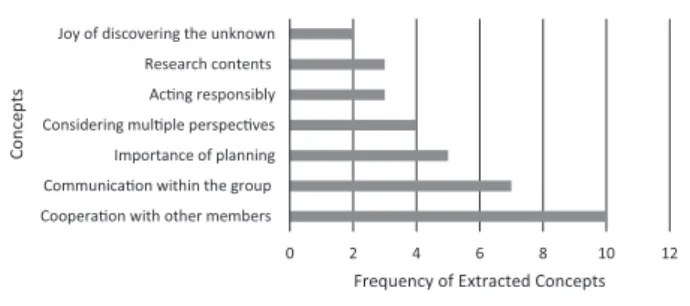
The content analysis of students’ narrative on the question, “What are the two things you learned most from participating in PBL in this course?” in the reflection sheet provided 34 data sets which were factored into seven concepts (Figure 1). Students were asked to write two things instead of one. The reason for that was to encourage students to give a varied and detailed description of their inner thoughts. The text data from their narratives were first factored into sub-concepts according to their similarity in meaning. Then, those with the overlapping concepts were grouped together to make the key seven concepts. The two most frequently mentioned concepts were about how to relate to peers with “cooperation
with other members” topping the list, followed by “communication within the group.”“Joy of discovering the unknown” and “considering multiple perspectives” indicate that student attitude toward acquiring knowledge is affected. These results suggest that students’ learning outcome went beyond just processing knowledge passed on to them but extended to how to acquire knowledge through communication with others.
5.Discussion
As regard to RQ 1, the quantitative results on English-learning attitudes show an insignificant rise in motivation to learn English and English-learning efficacy. These results can be explained in three ways. First, English proficiency levels of the target students were relatively low. Therefore, the main language of use among students during PBL was Japanese. This may have prevented them from feeling the efficacy of English learning. Second, many of the students had no previous experiences of participating in PBL, so 15 weeks was perhaps too short for the students to get used to this new learning style. Thus, they could not see the effects or benefits of PBL in learning English. Third, due to low English proficiency and limited experience in PBL, students may have experienced a great number of difficulties in language use as well as working together with peers. When they found a big gap between what they were capable of and what needed to be done, they may have ended up feeling at a loss. This may have negatively affected their self-efficacy (Bandura, 1995) in English learning. A small increase was shown in students’ perceptions of understanding different cultures, but no significant effect was observed in cross-cultural understanding as regard to RQ 2. One way to explain this is the nature of the task involved in this study. While students did research about other countries to find out the needs of the audience by searching for information on the Internet and interviewing foreigners, the main goal set for the project was to introduce Japan to foreigners. Thus, students may not have realized the connection between Figure 1. Key Concepts Extracted from Students' Reflectionintroducing Japan and cross-cultural understanding. Another point to explain this is students’ inefficient research skills. Their low English proficiency could have added to this problem. Even when students may have found useful information, it took much time and effort for them to understand and interpret the information. This may have worked negatively on their understanding of other cultures. The teacher’s role in how to assist students in these situations is great and that can change the students’ learning process.
In terms of RQ 3, qualitative analysis suggests that students learned the significance of communication with peers. On the other hand, quantitative analysis of students’ perceptions of cooperative learning shows negative results. These rather contradicting results indicate students’ struggles in working with peers in the project. It is essential that students establish an interdependent relationship for an effective cooperative learning environment to take place (Johnson, Johnson, & Holubec, 1994). Again, the teacher plays an enormously important role in whether students can get the best out of PBL. Therefore, the teacher needs to pay attention to how students relate with each other and to give advice and assistance accordingly because the quality of students’ learning in PBL depends on such efforts by the teacher. Another significant revelation was extracted from the qualitative data, which show that students realized the joy of discovering the unknown and the importance of considering multiple perspectives. Having attitudes like these is in fact the foundation for effective English learning. Learning a foreign language requires significant amounts of learners’ dedication of time and efforts. When the learner can find joy in learning new content, they willingly invest such time and effort. In addition, learning a foreign language is closely related to understanding the cultures that form the language. Therefore, it is extremely important to have the attitude of considering multiple perspectives. Qualities like these are what teachers need to aim at fostering in their students, rather than showering students with grammatical knowledge and constantly testing how well they have mastered the knowledge they were taught, at least at the introductory level.
6.Conclusion
In this study, the effects of PBL on learners’ English learning attitude was not substantialized. However, it was found that students noticed the significance of having self-directed learning attitudes from the PBL experience. What this finding means for practical teaching practice is that classroom instruction needs to be designed and managed to foster students’ self-directed learning attitudes instead of merely teaching existing knowledge and testing their understanding. This research was a case study on a short-term PBL practice with a small group of students. A slight skewness in the data distribution and a small data sample may have negatively affected the statistical results of the quantitative data. For future research, a bigger data sample can provide a better normality distribution which will enable factor analysis. Also, a longer-term PBL practice would provide a deeper understanding of how PBL can influence students’ English learning attitudes. In addition, further research needs to be done on how the self-directed attitudes like having multiple perspectives and finding joy in learning the unknown lead to learners’ positive English-learning attitudes. References Ackerman, P. L., Chamorro-Premuzic, T., & Furnham, A. (2011). Trait complexes and academic achievement: Old and new ways of examining personality in educational contexts. British Journal of Educational Psychology, 81(1), 27-40. Bandura, A. (1995). Comments on the crusade against the causal efficacy of human thought. Journal of Behavior Therapy and Experimental Psychiatry, 26(3), 179-190. Berwick, R., & Ross, S. (1989). Motivation after matriculation; Are Japanese learners of English still alive after exam hell? JALT Journal, 11(2), 193-210. Blumenfeld, P. C., Soloway, E., Marx, R. W., Krajcik, J. S., Guzdial, M., & Palincsar, A. (1991). Motivating project- based learning: Sustaining the doing, supporting the learning. Educational Psychologist, 26(3-4), 369-398.Deci, E. L., & Ryan, R. M. (1985). Intrinsic motivation and self- determination in human behavior. New York: Plenum Press. Deci, E. L., & Vansteenkiste, M. (2004). Self-determination theory and basic need satisfaction: Understanding human development in positive psychology. Ricerche di Psicologia. Dörnyei, Z. (1990). Conceptualizing motivation in foreign- language learning. Language Learning, 40(1), 45-78. Dörnyei, Z. (1998). Motivation in second and foreign language learning. Language Teaching, 31(3), 117-135.
Dörnyei, Z. (2005). The Psychology of the language learner: Individual differences in second language acquisition. Mahwar, NJ: Lawrence Erlbaum.
Dörnyei, Z., & Ryan, S. (2015). The psychology of the language learner revisited. NY, NY: Routledge.
Entwistle, N., McCune, V., & Walker, P. (2001). Conceptions, styles, and approaches within higher education: Analytic abstractions and everyday experience. Perspectives on Thinking, Learning, and Cognitive Styles, 103-136. Fried-Booth, D. L. (2002). Project work (2nd ed.). New York: Oxford University Press.
language acquisition. In Giles, H. & St. Clair, R. (eds.) Language and social psychology. (pp. 193-220). Oxford: Basil Blackwell.
Gardner, R. C. (2010). Motivation and second language acquisition: The socio-educational model (Vol. 10). Peter Lang.
Gardner, R.C. & Lambert, W.E. (1972). Motivational variables in second language acquisition. In R.C. Gardner & W. Lambert (eds.) Attitudes and motivation in second language learning. (pp.119-216). Rowley, MA: Newbury House.
Goodman, R. (2003). The why, what and how of educational reform in Japan. In R. Goodman & D. Phillips (Eds.), Can the Japanese change their education system? (pp.7-30).
Wallingford: Symposium Books.
Gordon, R. (1998). Balancing real-world problems with real- world results. Phi Delta Kappan, 390-393.
Hiroishi, H. (2006). Consideration of a workshop: Participatory learning from the theory of social constructionism. Research Journal of Educational Methods, 31, 1-11.
Johnson, D. W., Johnson, R. T., & Holubec., E. J. (1994). The new circles of learning. Cooperation in the classroom. ASCD. Kimura, Y., Nakata, Y., & Okumura, T. (2001). Language learning motivation of EFL learners in Japan-A cross- sectional analysis of various learning milieus. JALT Journal, 23(1), 47-68. Lam, S. F., Cheng, R. W. Y., & Ma, W. Y. (2009). Teacher and student intrinsic motivation in project-based learning. Instructional Science, 37(6), 565. Mcveigh, B. J. (2004). Foreign language instruction in Japanese higher education: The humanistic vision or nationalist utilitarianism?. Arts and Humanities in Higher Education, 3(2), 211-227. Nagahama, F., Yasunaga, S., Sekita, K., & Kouhara, S. (2009). Kyodousagyou Ninshiki Shakudo no Kaihatsu [Development of a Scale to Measure Belief in Cooperation]. Kyouiku Shinrigaku Kenkyuu [Japanese Journal of Educational Psychology], 57(1), 24–37. Pintrich, P.R. & Schunk, D.H. (1996). Motivation in education: Theory, research and applications. Englewood Cliffs, NJ: Prentice Hall Merrill.
Ryan, S. (2009). Self and identity in L2 motivation in Japan: The ideal L2 self and Japanese learners of English. Motivation, language identity and the L2 self, 120-143. Bristol, UK: Multilingual Matters.
Shin, M. H. (2018). Effects of Project-Based Learning on Students' Motivation and Self-efficacy. English Teaching, 73(1).
Skehan, P. (1998). A cognitive approach to language learning. Oxford University Press.
Stoller, F. (1997). Project work: A means to promote language and content. Methodology in language teaching: An anthology of current practice, 107-119.
Swain, M. (2006). Languaging, agency and collaboration in advanced second language proficiency. In H. Byrnes (Ed.), Advanced language learning: The contribution of Halliday and Vygotsky (pp.95–108). London: Continuum.
Udall, D. & Mednick, A. (1996). Journeys through our classrooms. Dubuque, IA: Kendall/Hunt. White, R. W. (1959). Motivation reconsidered: The concept of competence. Psychological Review, 66(5), 297. A p p e n d i x : T h e q u e s t i o n n a i r e i t e m s a n d measurement factors Q1 I find it more rewarding to work by myself than
work with others. Cooperative Learning Factor (Individual orientation) Q2 When I work with others, I cannot do what I want to do. Q3 If I may be held responsible for mistakes made by the peers, I would rather work by myself. Q4 I do not want to work with people who tell me what to do. Q5 It takes time to discuss in group. Q6 There is always a free rider in group work. Q7 Cooperation is for people who are not capable to
do work on their own. Learning FactorCooperative (Reluctancy to cooperate) Q8 People who are capable do not need to cooperate with others. Q9 The weak flock together to help each other but the strong do not need to do so.
Q10 I can get a lot of work done when working
cooperatively with others. Learning FactorCooperative (Cooperation efficacy) Q11 High-achievers can get even better results if they cooperate with others. Q12 It is beneficial to exchange opinions with peers. Q13 Individual qualities are enriched when interacting with a variety of other individuals.
Q14 My knowledge gets enriched in group work because I can hear various opinions. Q15 Trust is the foundation for cooperation. Q16 Working cooperatively leads to better results than working alone. Q17 It is enjoyable to contribute my talent and skills for the group.
Q18 Low-achievers can get good results when cooperating with others in group work.
Q19 I know well about Japanese culture and its
current affairs. Understanding Cross-Cultural Factor (Understanding different cultures) Q20 I want to be able to explain to foreigners about Japanese culture and its current affairs. Q21 Understanding Japanese culture and its current affairs leads to the development of the Japanese society. Q22 Understanding Japanese culture and its current affairs leads to cross-cultural understanding. Q23 I am interested in foreign countries and their cultures. Q24 I want to get acquainted with people who have different cultural backgrounds.
Q25 Understanding foreign cultures leads to the development of the Japanese society.
Q26 I try to make contacts with people who have
different cultural backgrounds. Understanding Cross-Cultural Factor (Co-existence orientation) Q27 Japanese need to try harder to understand people who have different cultural backgrounds. Q28 Coexisting with people who have different cultural backgrounds leads to the development of the Japanese society. Q29 Getting well acquainted with people who have different cultural backgrounds is beneficial for me. Q30 I like English. English-Learning Attitudes Factor (English-learning motivation) Q31 I want to get better at English. Q32 I am working hard to learn English at school. Q33 I am trying to force myself to use English outside the classroom to improve my English skills. Q34 Learning English leads to cross-cultural
understanding between Japan and other countries. English-Learning Attitudes Factor (English-learning
efficacy) Q35 Learning English leads to the development of the
Japanese society.
Q36 English learned at university will benefit my future life and career.
Q37 Learning English at university is beneficial for my future.