• 検索結果がありません。

Determinant Factors of the Great Trade Collapse during the 2008-09: Reexamina- tion by Japanese Macro Economic Data

N/A
N/A
Protected

Academic year: 2021

シェア "Determinant Factors of the Great Trade Collapse during the 2008-09: Reexamina- tion by Japanese Macro Economic Data"

Copied!
21
0
0

読み込み中.... (全文を見る)

全文

(1)

 Key words: Great trade collapse, Trade finance, Yen appreciation, Vertical linkages, Inventory adjustment

研究ノート

Determinant Factors of the Great Trade Collapse during the 2008-09: Reexamina- tion by Japanese Macro Economic Data

Iwao Tanaka

 Japan was one of the countries hit hardest by the financial crisis of 2008. The rate of trade reduction is about 50%, which is almost the highest among major countries. Based on the factors suggested by lit- erature, this study reexamines the determinants of exports and im- ports during the great trade collapse by using Japanese macro-eco- nomic monthly data. It also attempts to add two modifications: one is to introduce a new measure of the constraint of trade finance, and the other is to take the exchange rate into consideration since the sharp appreciation of the yen is contrasted to the depreciation of other cur- rencies. As empirical results imply, demand contraction is the most important factor of the Japanese trade collapse, and disruption of ver- tical linkages follows. Although the sample size is small, this study also detects some roles of yen appreciation and constraint of trade fi- nance in the unprecedented decline of Japanese trade. (JEL Classifica- tion code: F14, F31)

Abstract

(2)

1. Introduction

 During most of the post-war era, the world trade grew at a higher pace than the world GDP. In 2008 and 2009, when the financial crisis and severe economic recession triggered by the Lehman Brothers’ bankruptcy took place, however, the world trade substantially decreased, especially com- pared to the world GDP. This reduction was historically enormous and thus it is called “the Great Trade Collapse” in economic literature. Feen- stra (2011) mentions that the ratio of world trade relative to the world GDP fell by nearly 30 percent in these years and became the highest among the recessions in the past 60 years. Using quarterly data, Bems, Johnson, and Yi (2011) show that while the real world GDP fell by 3.7 per- cent, the real world trade also fell by 15 percent between the two years.

 Japanese economy was not the exception as it experienced rather dras- tic decreases in GDP and trade as well. From the second quarter of 2008 to the first quarter of 2009, the real GDP decreased by 8.1 percent, while exports and imports both fell by 35.7 percent and by 14.4 percent in real terms. The declining paces of trade were particularly fast in recent years.

These huge contractions become more pronounced when we look at the monthly data. Figure 1 plots Japanese total trade with the world. Both ex- ports and imports plunged from over 7 trillion yen in August of 2008 to below 4 trillion yen in February of 2009. The corresponding declining rates were 50 percent for exports and 53 percent for imports.

 Regarding the explanations of the great trade collapse, 4 major factors

have been summarized: recession of demand for durable goods, inventory

adjustments, disruption of vertical linkages, and constraint of trade fi-

nance. In the past studies, the explanation trade financial constraint has

provided does not have much credit (Levchenko, Lewis, and Tesar, 2010).

(3)

Ahn, Amiti, and Weinstein (2011) and Amiti and Weinstein (2011), how- ever, suggest that there should be important connections between exports and their financiers. In the context of Japanese export in particular, it is highly considerable that the financing conditions of banks affect exports, since the Japanese banking sector underwent integration and operates un- der the low or zero interest-rate policy.

 It should be also noticed that after the financial crisis, the Japanese yen appreciated against the U.S. dollar by 16.4 percent (from August 2008 to February 2009). This shows a clear contrast with other major countries’

experiences: For example, the both euro and the British pound depreciat- ed against the U.S. dollar. Combined with the movement of trade, one would naturally wonder that the yen appreciation may have had impacts on the reduction of exports during the great trade collapse, but not so

Figure 1. Japanese Total Exports and Imports with World: January 2008 - De- cember 2010

Sources: Ministry of Finance, Trade Statistics of Japan

(4)

many studies try to research on the role of exchange rate changes.

 Therefore, this study aims at investigating the factors of Japanese trade collapse in line with the literature at hand, with particular focus on the roles of trade finance and yen appreciation, and by using monthly data in attempts to adjust the data set to the period of collapse and derive more direct implications. The structure of the paper is as follows: Section 2 overviews the great trade collapse through literature surveys and Japa- nese data, Section 3 deals with empirical investigation, and the last section concludes the paper.

2. Global trade collapse: literature review and the Japanese experience  It is widely known that the financial crisis triggered by the Lehman Brothers bankruptcy and the successive simultaneous world recession lead to the unprecedentedly substantial shrinking of the world trade, and that the trade volume recovered relatively quickly in a couple of years af- ter the incident. Plenty of research on the causes and mechanisms of this great trade collapse has been conducted. As Feenstra (2011) describes, the main points can be summarized in four aspects: decline of demand; in- ventory adjustments; constraints of trade credit

1 )

; and disruption of sup- ply chains. In this section, we will discuss the Japanese great trade col- lapse along with the before mentioned aspects and beyond, by using monthly or quarterly data.

2-1. Exchange rate, exports, and imports during the trade collapse

 First, we will examine the overall trend of the exchange rate and inter-

national trade. Table 1 shows a percentage change in the yen-dollar ex-

change rate and the total exports and imports in value term, and the

changes in import values, volumes, and unit prices of some sectors. During

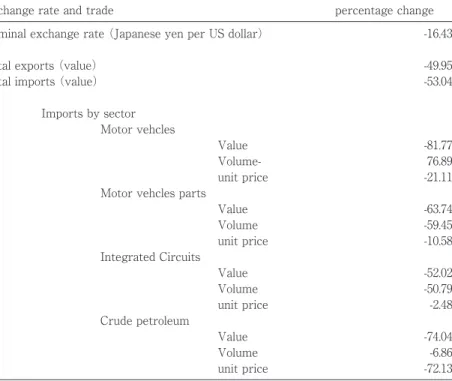
(5)

the collapsed period, even though the yen appreciated, Japanese imports drastically fell. If we look at the sectoral data, we recognize that the motor vehicles sector encountered severe trade reductions (-82%). This could be compared to other sectors like motor vehicles parts (-64%) and integrated circuit (-52%) sectors, whose import reductions were relatively smaller than the reduction of motor vehicles. Final goods or durable goods were faced with more severe damages than the intermediate goods.

 On the changes in import unit prices, we understand that the percent- age decrease is bigger for motor vehicles than for motor vehicles parts or integrated circuits. It is therefore implied that part of the decrease in im-

Table 1. Reduction of Japanese Trade between August 2008 and February 2009

Exchange rate and trade percentage change

Nominal exchange rate (Japanese yen per US dollar) -16.43

Total exports (value) -49.95

Total imports (value) -53.04

     Imports by sector Motor vehcles

Value -81.77

Volume- 76.89

unit price -21.11

Motor vehcles parts

Value -63.74

Volume -59.45

unit price -10.58

Integrated Circuits

Value -52.02

Volume -50.79

unit price -2.48

Crude petroleum

Value -74.04

Volume -6.86

unit price -72.13

Sources: International Monetary Fund, International Financial Statistics, and Ministry of Finance,

Trade Statistics of Japan.

(6)

port values of final goods can be explained by the reduction of unit prices, whereas most of the decrease in values can be captured by the decrease of import volumes for intermediate goods. This is extended to the extreme case: crude petroleum. Almost all of the percentage decrease in the import value can be explained by the decrease in import unit price. As Levchen- ko, Lewis, and Tesar (2010) and Feenstra (2011) point out the importance of the role of intermediate input trade, a composition of trade matters when explaining the Japanese global trade collapse as well.

2-2. Trend in GDP, consumption, and inventory

 Next, we look at Figure 2, which shows the trend of the Japanese real GDP and consumption. The decline of the real GDP during the trade col- lapse was huge; the magnitude was greater than the GDP decrease when the earthquake and tsunami disasters occurred in March of 2011. Com-

Figure 2. Japanese Real GDP and Consumption (right scale): 2006Q1-2012Q4

Sources: Cabinet Office, Government of Japan, National Accounts of Japan

Notes: Quarterly data, seasonally adjusted.

(7)

pared to the GDP, Japanese consumption did not fall as much as the GDP did, but its growth rate was negative 2.3 percent between the second quarter of 2008 and the first quarter of 2009. These declines of the real GDP and domestic consumption can well explain the great trade collapse of Japan as well as of the world, as in literature, the reduction of demand for durable manufactured goods accounts for more than 80 percent of the decrease of world trade per GDP (Feenstra, 2011).

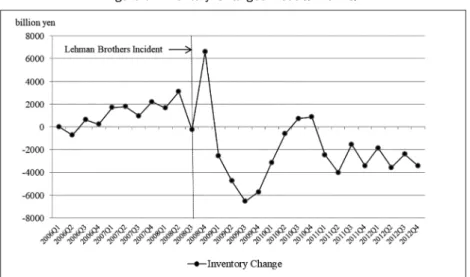
 Inventory adjustments are also one of the strong factors of the decrease in trade. When final demand is weak due to severe recession, manufactur- ers tend to reduce production and instead increase sales of final goods and the use of intermediate goods out of inventories. Figure 3 shows the trend in Japanese inventory changes. The value drastically decreased during the trade collapse; especially in the first quarter of 2009 it dropped into nega- tive numbers. Thus, the decline of Japanese trade may have reflected the

Figure 3. Inventory Changes: 2006Q1-2012Q4

Sources: Cabinet Office, Government of Japan, National Accounts of Japan

Notes: Quarterly data, seasonally adjusted.

(8)

inventory adjustments.

2-3. Trade finance, vertical linkages, and exchange rate

 In literature, some studies particularly focus on banks’ health as an im- portant determinant of international trade, which is referred to as trade credit condition (Ahn, Amiti, and Weinstein, 2011; Amiti and Weinstein, 2011; Levchenko, Lewis, and Tesar, 2010). The extent of the ease of bor- rowing external capital matters when firms engage in exporting and/or importing, because trade costs more than domestic sales. Since the finan- cial or banking crisis is likely to increase external capital costs, this would make it difficult to raise short-term funds for banks. Thus, firms are faced with credit constraint and they are not able to export without such funds even though they want to engage in exports. Using Japanese data, Ahn, Amiti and Weinstein found that trade credit conditions became very tight when the crisis happened, and that Japanese exports decreased more than domestic sales.

 Trade finance is defined differently from trade credit. Useful measures of this are developed as a health of a bank. Ahn et al (2011) uses the in- terbank lending rate, Levchenko et al (2010) defines the weighted inter- bank lending rate as a weight for U.S. trade shares, and Amiti and Wein- stein (2011) examines the market-to-book value of a bank. Levchenko and others did not obtain clear evidence that U.S. imports from countries that experienced hard credit crunch fell.

 During the lost decades, Japanese monetary policy was eased to stimu-

late the economy and was expected to achieve positive inflation rate. As a

result, interest rate has been kept very close to zero and quantitative eas-

ing rather than interest rate policies are beginning to adopt. The low in-

terest rate suggests that the borrowing or deposit rate should be low for

(9)

the majority of banks, whereas the lending rate could be high or low de- pending on the profit performance of a bank. This study constructs and uses a new measure for bank’s health as follows: A bank with good perfor- mance could lend money to the public at relatively lower rate, while a bank with poor performance has no other way but setting the lending rate higher. Accordingly, the difference can be considered as a measure of the bank’s or the money market health conditions. We define the measure, BH, for an overall country’s financing conditions as the difference between lending rate (L) and deposit rate (D) divided by lending rate (L): BH =

(L - D)/L, where a lower BH means better financing conditions while a higher BH means worse financing conditions.

2 )

Figure 4. Lending-Deposit Rate and Inflation Rate (CPI, right axis, %) in Japan:

January 2006 – December 2012

Sources: International Monetary Fund, International Financial Statistics

Notes: The lending-deposit rates are calculated by dividing the difference between the lending

rate (L) and the deposit rate (D) by the lending rate (L). Inflation rates are the percentage

change in CPI (Consumer Price Index) consisting of all items over the previous year.

(10)

 Figure 4 plots the lending-deposit rate (bank’s health measure, BH, 0 <

BH < 1) together with the inflation rate (Consumer Price Index, CPI).

The bank’s health measure basically shows a cyclical movement, but obvi- ously it hit a peak during the trade collapse. As Amiti, Weinstein and oth- ers have shown, this measure also implies that the tightened trade finance condition plays a role in trade contraction. The hypothesis shall be empiri- cally tested in the next section. During the same period of time, the infla- tion rate drastically dropped from positive rates to negative ones.

 Research on the disruption of vertical production linkages has been able to find meaningful implications for the trade collapse. Multinational firms have developed production networks over many countries, which acceler- ated trade in intermediate inputs as a form of intra-firm trade. However, a firm with the headquarter function located in a crisis-hit country is very likely to reduce production and therefore decrease imports of intermediate inputs. It is evidenced that those industries with higher imported-input in- tensity tend to decrease imports (Levchenko et al, 2010).

 The vertical production network reflects firms’ decision making on whether to outsource or not. When the production cost of a particular part is very expensive for the manufacturer, it tends to outsource the part pro- duction to an outside special supplier. This production relationship is usu- ally governed by a contract, and thus price and volume changes would not be so quick, even if a negative shock happened. The impact on trade in specific parts is of concern, but will be explored in future study.

 To the extent that the imports of intermediate inputs depend on the do-

mestic level of final good production, decline of final good production most

likely reduces imported intermediate inputs. Indices for manufacturing,

electronic products, motor vehicles, passenger cars, electric parts, and mo-

tor vehicles parts are depicted in Figure 5. Obviously all of the production

(11)

levels sharply declined during the trade collapse, which implies drastic de- crease in imported inputs. Compared to the line for manufacturing, the lines for motor vehicles and for their parts go down well below. Thus the damage placed on the motor vehicles industry can be regarded as far big- ger than the manufacturing average. The negative impacts, however, are more pronounced for motor vehicles production after the earthquake and tsunami hit in March 2011, in the north-east region of Japan.

3 )

 Turning to the movements of the nominal effective exchange rate

(NEER) and real effective exchange rate (REER) of the Japanese yen de- picted in Figure 6, one can see that both NEER and REER rose very sharply during the trade collapse. By construction, these indices show that when the number increases, the currency is appreciated. Rigorously speaking, the yen’s REER is an overall purchasing power of the currency relative to the world, or all countries with which Japan trades.

Figure 5. Trend in Japanese Industrial Production Index:

Selected Sectors, January 2006 - December 2012, 2010=100

Source: Ministry of Economy, Trade and Industry

(12)

 Before the Lehman Brothers incident, the nominal rate of the yen was relatively weaker due to the Government’s low interest rate policy and carry trade (UNCTAD, 2009). The yen was borrowed by foreign inrestors in Japan, where the interest rate was very low, and the investors ex- changed the yen with foreign currencies with which they invested for projects with higher expected returns in other countries. Thus, the supply of the yen increased in the foreign exchange market and the yen likely de- preciated. After the financial crisis, however, the yen began appreciating.

 The Figure also shows that NEER caught up with REER as time passed, which means that the nominal rate increased faster than the real rate. Based on the definition of the real exchange rate, this suggests that the inflation rate is relatively lower in Japan than the average rate of infla- Figure 6. Evolution of Japanese Nominal Effective Exchange Rate (NEER) and

Real Effective Exchange Rate (REER): January 2006 - December 2012, 2010=100

Sources: International Monetary Fund, International Financial Statistics

Notes: By construction, for both NEER and REER, the Japanese yen appreciates when the index

goes up.

(13)

tion of the world.

4 )

3. Empirical investigation

 Levchenko et al (2010) and Feenstra (2011) mentioned that the main contributing factor of world trade contraction at this time was the reduc- tion of demand, which could account for 80 percent of the decrease. But, the exception was Japan and China, where other factors such as trade credit constraints, were also important. Levchenko and others examined those factors together and found that trade composition and vertical link- ages explained U.S. trade much better than the trade credit constraint. In this section, we reexamine the determinant factors of the great Japanese trade collapse by using monthly macro-economic data.

3-1. Empirical specification and data

 The purpose of this empirical analysis is to see which factors of the trade collapse are significant, and which are not. We use export/import volume index as a dependent variable. In the previous section, we argued the factors suggested by the literature. It would be desirable if we could use the variables as such, but mostly we have to use proxies for them, since our analysis is based on monthly data.

 The volume indices of exports and imports are downloaded from the IMF, International Financial Statistics (IFS). Industrial production indices

(INDPROD^) are used as a proxy for domestic demand and obtained

from the IFS. Although domestic demand is defined as a sum of consump-

tion and investment, unfortunately the data is not available on the monthly

basis in the National Account. Similarly, inventory adjustments might be

important, but the monthly data is not available in the National Account,

and then we decided to omit this variable from estimation equation.

(14)

 Multinational enterprises are spreading production networks over coun- tries by increasing foreign direct investment (FDI). In this research, the FDI stock (FDI^) is used as a proxy for vertical linkages. When the FDI stock is higher, the vertical linkages are deepened and the effect of disrup- tion of the linkages on trade would be larger. The end of FDI stock value for 2005 is obtained from JETRO, and monthly FDI outflow data are ob- tained from Ministry of Finance. Then, we construct the monthly FDI stock data by first adding the outflow value of January 2006 to the 2005 end-of stock value, and thereafter repeating the addition month-by-month.

 The real effective exchange rate (REER) comes from the IFS, which is defined as per yen. As in the previous section, the yen appreciates when REER goes up. The spread ratio of lending and deposit interest rates

(BNKHLTH^) is the proxy for trade finance. A higher ratio implies over- all poor performance in the banking sector, and the degree of constraint of trade finance becomes tighter. The lending and deposit interest rates are obtained from the IFS. Consumer price index (CPI^) is used for price lev- el. GDP deflator might be a better index, but again, the monthly data are not available. Sales of manufacturing and trade in the U.S. (USSALE^) are used as a proxy for the world economic condition. The data is CMRMT U.S. Sales (Real Manufacturing and Trade Industries Sales) and obtained from Federal Reserve Economic Data.

3-2. Estimation results

(1) Relatively larger sample case

 Table 2 presents the estimation results using the data set of a relatively

longer period (January 2007 to December 2012). All of the variables are in

the form of percentage change over the same month in previous year. The

coefficient of Industrial production (INDPROD^), proxy for domestic de-

(15)

mand, is positive and statistically significant for both export and import estimations. The magnitude is largest among explanatory variables, and thus the past study’s result which showed that the demand factor is the most important is reassured for Japanese trade.

 FDI stock (FDI^), proxy for vertical linkages, is negative but not statis- tically significant in the export model (model 1). In the import model, on the contrary, this variable has negative and statistically significant coeffi- cients. Since the vertical integration is deepened more, Japanese imports will decrease more when the disruption of linkages occurs.

 The coefficient of real effective exchange rate (REER^) is negative in the export estimation while positive in the import estimation, and all of the estimates are statistically significant. These results are consistent with the basic theory: the yen’s appreciation leads to a decrease in Japanese ex- ports and increase in the imports.

 The estimates of the proxy variable for trade finance (BNKHLTH^) are positive and significant in the export estimation, and they are negative but not significant in the import estimation. The predicted sign is negative, but the opposite result is obtained: Japanese exports decrease as the con- straint of export finance improves. This contradiction should be resolved, but we will leave this for future analysis.

 The coefficient of price index (CPI^) is statistically significant only for

imports. The sign is positive, meaning that deflation is associated with im-

port reduction. The proxy for the world economic conditions, sales in the

U.S. (USSALE^) has significant estimates that are negative in the export

estimation and positive in the import estimation. These results are, again,

opposite to the prediction. How to interpret them will be left for future re-

search.

(16)

(2) Small sample case

 Table 3 represents the estimation results using small sample limited to the period of the great trade collapse and some more months before and after it. The demand factor (INDPROD^) is the most important, reassur- ing the common view for Japanese trade. Vertical integration now has

Table 2. Determinants of Japanese World Trade, January 2007 to December 2012

Model 1 Model 2 Model 3 Model 4

Dependent Variable: Percentage change in volume index over previous year

Coefficient Exports Exports Imports Imports

Constant 5.65* 6.51** 7.43*** 7.61***

(1.75) (2.10) (3.22) (3.55)

INDPROD^ 151.11*** 150.45*** 54.57*** 54.66***

(16.33) (16.32) (8.29) (8.38)

FDI^ -21.08 -24.60* -34.19*** -35.10***

(-1.43) (-1.73) (-3.27) (-3.67)

REER^ -32.53** -32.69** 22.74** 21.60**

(-2.23) (-2.24) (2.19) (2.42)

BNKHLTH^ 12.19** 10.98** -0.80

(2.38) (2.22) (-0.22)

CPI^ -0.76 1.21** 1.18**

(-0.93) (2.07) (2.10)

USSALE^ -73.66** -76.76** 41.20* 39.95*

(-2.44) (2.56) (1.92) (1.94)

Adj. R-squared 0.899 0.899 0.820 0.823

F statistics 105.8 127.0 55.0 67.0

No. of observations 72 72 72 72

Notes: The sample period spans from January 2007 to December 2012. Monthly data is estimated

by OLS. Numbers in parentheses are t-ratio. The asterisks show: *** as 1% level of signifi-

cance; ** as 5% level of significance; and * as 10% level of significance. The dependent vari-

able is a percentage change in the index of trade volume over the previous year, for either

exports or imports. The explanatory variables are mostly proxies of the determinant fac-

tors suggested by the literature and all calculated as a percentage change over previous

year. INDPROD^ means the change in the Japanese industrial production index as a proxy

for domestic demand. FDI^ shows the change in the stock of Japanese outward FDI, im-

plying the degree of vertical integration. REER^ is the change in Japanese yen’s real effec-

tive exchange rate with higher value representing yen appreciation. BNKHLTH^ is the

lending-deposit ratio as a proxy for bank’s health, the extent that trade finance is con-

strained. CPI^ is an inflation rate based on a consumer price index, and USSALE^ shows

the change in U.S. sales as a proxy for world demand.

(17)

negative and statistically significant estimates in the export equation. By limiting the sample, a more direct effect of the disruption of vertical link- ages on exports is obtained. Exporters with more FDI stock resort to more vertical networks in production and trade, and so that once the net-

Table 3. Determinants of Japanese World Trade with Focus on the Great Trade Collapse Period, January 2007 to December 2009

Model 1 Model 2 Model 3 Model 4

Dependent Variable: Percentage change in volume index over previous year

Coefficient Exports Exports Imports Imports

Constant 21.81*** 19.30*** 9.89 9.77*

(3.31) (3.74) (1.37) (1.70)

INDPROD^ 127.75*** 132.58*** 70.23*** 69.16***

(7.47) (13.61) (3.75) (-6.47)

FDI^ -76.28*** -66.19*** -42.79 -42.88**

(-3.30) (-3.57) (-1.69) (-2.06)

REER^ -27.63** -20.98* 17.25 15.10

(-2.10) (-1.95) (-1.20) (-1.43)

BNKHLTH^ 9.65** 10.68*** -1.45

(2.74) (3.18) (-0.38)

CPI^ 0.95 1.60** 1.55**

(1.49) (2.28) (2.54)

USSALE^ -7.50 0.51

(-0.17) (0.01)

Adj. R-squared 0.962 0.960 0.789 0.802

F statistics 146.7 213.0 22.9 36.4

No. of observations 36 36 36 36

Notes: The sample period spans from January 2007 to December 2009. Monthly data is estimated

by OLS. Numbers in parentheses are t-ratio. The asterisks show: *** as 1% level of signifi-

cance; ** as 5% level of significance; and * as 10% level of significance. The dependent vari-

able is a percentage change in the index of trade volume over the previous year, for either

exports or imports. The explanatory variables are mostly proxies of the determinant fac-

tors suggested by the literature and all calculated as a percentage change over previous

year. INDPROD^ means the change in the Japanese industrial production index as a proxy

for domestic demand. FDI^ shows the change in the stock of Japanese outward FDI, im-

plying the degree of vertical integration. REER^ is the change in Japanese yen’s real effec-

tive exchange rate with higher value representing yen appreciation. BNKHLTH^ is the

lending-deposit ratio as a proxy for bank’s health, the extent that trade finance is con-

strained. CPI^ is an inflation rate based on a consumer price index, and USSALE^ shows

the change in U.S. sales as a proxy for world demand.

(18)

work is disconnected, exports will decrease. This empirical association is not obtained from the analysis of the longer data in sub-seetion (1).

 The real effective exchange rate (REER^) has negative and statistically significant estimates in the export models, which assures that the real yen appreciation does have an impact on the export collapse. In the import equation, on the other hand, the estimates are positive but not statistically significant. This is also suggesting that there should be another factor in Japanese importing behavior during the collapse. Trade in intermediate in- puts may be better explained by the intra-firm trade and outsourcing the- ory, which has different implications for trade (Grossman and Helpman, 2003; Hanson, Mataloni, and Slaughter, 2005). Concerning the trade finance proxy (BNKHLTH^), the estimates are again positive in the export equa- tion. A further investigation is necessary on this regard.

4. Conclusion

 The objective of this study is to examine the impact of financial crisis in 2008 on Japanese trade. The impact on trade is actually so significant that the situation has been named great trade collapse. In the literature, four factors of the world trade collapse were detected. Thus, in this study we attempted to reexamine those factors more directly by using Japanese macro-economic monthly data. It has been reassured that the reduction of demand and disruption of vertical linkages are clearly the important con- tributing factors for the explanation of Japanese trade. Our new measure of the constraint of trade finance unfortunately has had an opposite sign for exports, but it is implied that there should be some connections be- tween exporters and their financiers as mentioned by Amiti and Weinstein

(2011). Further investigation on this issue will be a future research topic.

 In the past studies, the role of the exchange rate has not been fully con-

(19)

sidered in the context of great trade collapse. This study directly deals with it and makes suggestions that the real yen appreciation should be as- sociated with the decline of Japanese exports during the collapsed period.

This can be considered as one of our contributions to the literature. On the import side, the estimates are not significant. There may be vertical integration and outsourcing behavior of Japanese firms behind the rela- tionship between trade and exchange rate, and therefore, further investi- gation is necessary.

 Since our research is based on monthly data, there are a lot of data re- strictions. We especially omitted inventory adjustment data. Shioji and Uchino (2011) suggest that inventory adjustment in the motor vehicles in- dustry is particularly important during the collapse period. We have to consider a model including inventory adjustments in the future. We also have to use proxies. This means that there is a possibility that some of the interpretations of the results may have been interpreted differently. In a future study we would like to improve this issue.

Notes

1 ) Trade credit is a conceptually different term from trade finance. Refer to Amiti and Weinstein (2011) for the explanation. This study uses the term, trade finance.

2 ) Better performed banks could raise the deposit rate, which means again, the smaller the difference is, the better the bank’s health is.

3 ) The analysis based on the incomplete contract model about the Japanese motor vehicles industry after the earthquake can be seen in Tanaka

(2013), for example.

4 ) Consider the formula of relative purchasing power parity condition in

logarithms: qˆ

/yen

=ê

/yen

+Pˆ

JP

-Pˆ

world

, where

/yen

is the real effective ex-

change rate represented by per yen, ê

/yen

is the nominal effective exchange

rate represented by per yen, Pˆ

JP

and

world

are the price levels of Japan

(20)

and the world, respectively. The symbol, hat (^) shows that the variable is represented as a percentage change. When the change in the nominal rate is bigger than the change in the real rate, the inflation rate must be higher in the world than in Japan.

References

Ahn, JaeBin, Mary Amiti, and David Weinstein, “Trade Finance and the Great Trade Collapse,” The American Economic Review, Vol. 101, No. 3, May 2011, pp. 298―302.

Amiti, Mary, and David Weinstein, “Exports and Financial Shocks,” The Quar- terly Journal of Economics, Vol.126, No. 4, November 2011, pp. 1841―1877.

Bems, Rudolfs, Robert Johnson, and Kei-Mu Yi, “Vertical Linkages and the Col- lapse of Global Trade,” The American Economic Review, Vol. 101, No. 3, May 2011, pp. 308―312.

Feenstra, R., “The International Trade and Investment Program,” NBER Re- porter, No. 2, (Reporter Online) 2011, pp. 1―9.

Grossman, Gene, and Elhanan Helpman, “Outsourcing versus FDI in Industry Equilibrium,” Journal of the European Economic Association, 1, 2003, pp. 317―

327.

Hanson, Gordon, Raymond Mataloni, and Matthew Slaughter, “Vertical Produc- tion Networks in Multinational Firms,” Review of Economics and Statistics, 87

(4). 2005, pp. 664―678.

Levchenko, Andrei, Logan Lewis, and Linda Tesar, “The Collapse of Interna- tional Trade during the 2008―09 Crisis: In Search of the Smoking Gun,” IMF Economic Review, Vol. 58, No. 2, 2010.

Ministry of Economy, Trade and Industry, Japan, White Paper on International Economy and Trade 2009.

Shioji, Etsuro, and Yasusuke Uchino, “Gaiteki-shokku to Nihon-no Keiki Hen- dou: Jidosha Sangyo ni okeru “Great Trade Collapse” no Jissho-Bunseki” (in Japanese), The Bank of Japan, Working Paper Series, No.11-J-1, January 2011.

Tanaka, Iwao, “Uniqueness of Japanese Auto Inputs: An Investigation by the

Concept of Incomplete Contract and the Elasticity of Substitution,” Business

(21)

and Economic Review, Vol. 3, No. 2, Toyo Gakuen University, July 2013, pp.73

―97.

United Nations Conference on Trade and Development, The Global Economic Crisis: Systemic Failures and Multilateral Remedies. Report by the UNCTAD Secretariat Task Force on Systemic Issues and Economic Cooperation, 2009.

(たなか・いわお/東洋学園大学現代経営学部教授)

Figure 1.  Japanese Total Exports and Imports with World: January 2008 - De- De-cember 2010
Table 1. Reduction of Japanese Trade between August 2008 and February 2009
Figure 2. Japanese Real GDP and Consumption (right scale): 2006Q1-2012Q4
Figure 3. Inventory Changes: 2006Q1-2012Q4
+5

参照

関連したドキュメント

We are going to represent λ-calculus via a translation into MELL proofnets MELL proofnets are going to be presented via a mix between sharing graphs (i.e. numbered interaction nets)

An easy-to-use procedure is presented for improving the ε-constraint method for computing the efficient frontier of the portfolio selection problem endowed with additional cardinality

By applying the Schauder fixed point theorem, we show existence of the solutions to the suitable approximate problem and then obtain the solutions of the considered periodic

Then it follows immediately from a suitable version of “Hensel’s Lemma” [cf., e.g., the argument of [4], Lemma 2.1] that S may be obtained, as the notation suggests, as the m A

Our method of proof can also be used to recover the rational homotopy of L K(2) S 0 as well as the chromatic splitting conjecture at primes p &gt; 3 [16]; we only need to use the

We study the classical invariant theory of the B´ ezoutiant R(A, B) of a pair of binary forms A, B.. We also describe a ‘generic reduc- tion formula’ which recovers B from R(A, B)

For X-valued vector functions the Dinculeanu integral with respect to a σ-additive scalar measure on P (see Note 1) is the same as the Bochner integral and hence the Dinculeanu

The hypothesis of Hawkins & Hattori 2006 does not predict the failure of the successive cyclic wh-movement like 13; the [uFoc*] feature in the left periphery of an embedded