Author(s)
Mirza, Hanane H.; Thai, Hien D.; Nakao, Zensho
Citation
琉球大学工学部紀要(69): 71-75
Issue Date
2008-05
URL
http://hdl.handle.net/20.500.12000/7108
A new intelligent Digital Right Management technique for
E-learning content*
Hanane H. Mirza, Hien D. Thai, and Zensho Nakao
Department of Electrical and Electronics Engineering, University of the Ryukyus,
Okinawa 903-0213, Japan
email:{hanane, tdhien, nakao} @augusta.eee.u-ryukyu.ac.jp).
Abstract—The digitization of E-learning sources makes it an easy target for frauds, conterfeiting and content stealing. In this paper we present a new technique to deal with the security problems of e-learning content, its authentication and Digital Right Management The proposed technique is done by inserting a digital logo image, which serves as watermark signals, in the audio stream of E-learning material. This technique is based on Modulated Complex Lapped Transform that was selected for its audio reconstruction properties and the extraction of the watermark is performed using an Independent Component Analysis algorithm. To demonstrate the effectiveness of the proposed method, a real world implementation has been done and the algorithm shows quite good visual and audible quality in watermarked content, as well as a high robustness against
common signal processing attacks.
I. Introduction
Over the past few years, the world of educational material publishing has been marked by the process of innovation and integration, caused by the advent of digital technologies. As a result of these changes, a new digital educational content market is emerging with a new commercial approach: from the distribution and sale of tangible products to the distribution and licensing of intangible products. This commercial change also has a very strong impact on educational content rights management (copyright and licensing, etc.).
While the availability of digital content has created oppor tunities for universities and publishers to enlarge the student community around the world, at the same time, illegal down loads and the fight between legal digital content producers and organizations that are distributing the same content online for free are still ongoing, making copyright protection as well as authenticity of the digital means and its integrity a vital issue for many companies and users around the globe. Especially with the powerful publicly available audio/visual processing software that makes digital forgeries very accessible, it is simple for anyone to alter the content of a digital file, by adding or deleting features from the original file without causing detectable edges/#/.
In the light of these factors, DRM (Digital Rights Manage ment) becomes a need that cannot be delayed/77/27. The digital watermarking seems to be the intended solution to this problems of data copyright, content protection, and ownership * Part of the work will be presented at IEEE World Congress on Computa
tional Intelligence, Hong Kong, June 2008.
proof. Digital watermarking is technically a process of insert ing pieces of information into digital data (audio, video, or still images), which can be detected or extracted later to make an assertion about the data.
Among all the presented papers in the field of watermarking for E-learning protection, few have dealt with the issue in its integrity, but most of the proposed papers have focused on the encryption technique/57 to secure the transmission path to the end user, but the real problem started after the end-user re ceives the e-learning material and decrypted, when this data is no longer protected, where its content can be altered, misused and content stealable. A real time watermarking scheme has been proposed in the past/3/, dealing with the issue of real time broadcasting by designing a three level watermark system for audio e-learning content. In this paper we are proposing a technique that can be largely used in all the E-learning materials, either CDs, DVDs, data distributed via a network or even a real time broad-casting system. This technique consists of using the Binary Logo watermark as an invisible and inaudible digital signature of the E-learning content. First, we consider that each E-learning visual content is accompanied by an audio stream, we can use any 64 x 64 binary logo image that belongs to the content editor or publisher and insert it in the audio stream using the Modulated Complex Lapped Transform (MCLT). The presented scheme relies on the imperfections of the Human Auditory System (HAS). Zezula et al/97 exploits the magnitude coefficients of the MCLT domain as previously exhibited by Malvar [6].Tht MCLT is considered as the appropriate transform for audio signals as it presents a very low loss in the reconstruction phase. Afterwards, the content owner can always claim ownership of the content by extracting the embedded digital logo using the Independent Components Analysis (ICA) algorithm as we will demonstrate in next sections. This technique shows high robustness to the common signal processing attacks.
II. Background A E-learning content structure
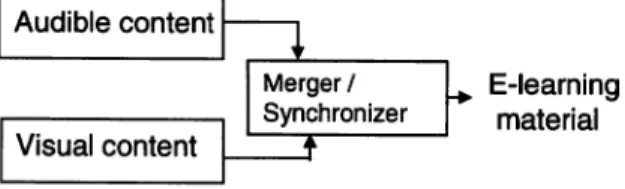
In this paper we will propose an algorithm for E-learning material authentication based on ICA computing tool. Before we proceed to embed the watermark we first need to know the content structure of an E-learning course content. The development of an E-learning tools are always designed by
involving text, images, videos and audio files [7]. The E-learning content is a synchronization function of a visual and an audible content (Fig.l). In this paper we will be inserting
Audible content
Visual content
Merger /
Synchronizer E-learningmaterial
Fig. 1. Structure of E-learning material content
a digital logo as a watermark in the audio stream of an E-learning course for copyright purposes.
B. Watermarking model
A watermarking system can be considered as a communication channel: a message is sent from the watermark encoder to the decoder through some communication channel. Let us denote the original cover text or signal by the real vector x. The binary message vector to be embedded into x is denoted by w, using a watermarking encoder E. Additional information k may be required, such as a secret key. The watermarked signal Y = E(x, w, k) is then conveyed; various attacks may occur during transmission, such as corruption by noise, lossy compression, or malicious attacks aimed at removing the watermark. These attacks are denoted by
D so that Y' = D(Y). Finally, the receiver estimates the
message from the attacked cover signal: X* = R(Y\ k). The
watermarking system is subjected to several requirements. The similarity between the original and watermarked signal is called fidelity, and depends on the selected distortion measure. A watermark should be retrievable from the cover signal even if the latter has been been subject to distortion; this ability is called robustness. Attacks can be sorted into two types: malicious, aimed at removing the watermark, and non malicious, such as common signal processing or lossy compression. Robustness is assessed with respect to a given set of attacks.
Four criteria were carefully selected as part of the evaluation framework. They were chosen to reflect the fact that water marking is effectively a communications system. In addition, the criteria are simple to test, and may be applied to any type of watermarking system (audio, image, or video). It is important to note that the requirements of a practical watermarking system vary between applications, and so one criterion may be more important in some situations than in others. For example, a low computational cost may be vital to ensure that an algorithm can be implemented in real time on a given DSP system. The criteria are described in the following subsections. 1) Bit Rate: Bit rate refers to the amount of watermark data that may be reliably embedded within a host signal per unit of time or space, such as bits per second or bits per pixel. A higher bit rate may be desirable in some applications in order to embed more copyright
information. In this paper, reliability was measured as the bit error rate (BER) of extracted watermark data. For embedded and extracted watermark sequences of length B bits, the BER (in percent) is given by the expression:
100 TB-i
n
0)
10, w*=w
while w* is the extracted watermark after the distribu tion.
2) Perceptual Quality: Perceptual quality refers to the im-perceptibility of embedded watermark logo within the host signal. In most applications, it is important that the watermark is undetectable to a listener. This ensures that the quality of the host signal is not perceivably distorted, and does not indicate the presence or location of a watermark. In this study, the signal-to-noise ratio (SNR) of the watermarked signal versus the host signal was used as a quality measure:
SNR =
3) Computational Complexity: Computational complexity refers to the processing required to embed watermark data into a host signal, and/or to extract the data from the signal. Algorithm complexity is important to know, for it may influence the choice of implementation structure or DSP architecture. Although there are many ways to measure complexity, such as complexity analysis, for practical applications more quantitative values are required, so that we chose to measure by the actual CPU timings (in seconds) of our algorithm implementation. 4) Robustness to Signal Processing: Watermarked digital
content may undergo common signal processing opera tions such as linear filtering, D/A and A/D conversion, and lossy compression. Although these operations may not affect the perceived quality of the host signal, they may corrupt the watermark data embedded within the signal. It is important to know, for a given level of host signal distortion, which watermarking algorithm will produce a more reliable embedding. In this study, robustness was measured by the bit error rate (BER) of extracted watermark data as a function of the amount of distortion introduced by a given operation.
5) Correlation measure: After the watermark is extracted, users compare the extracted watermarks subjectively, the similarity of extracted watermark w*(i,j) and the original watermark w(i,j) are defined by the normalized correlation {NC).
(3) The value of the NC lies in the range of [0,1], and if we acquire higher NC values, the embedded watermark is more similar to the extracted one.
In this paper we will watermark the audio stream of the E-learning file using the MCLT transform.
C. Modulated Complex Lapped Transform
A number of watermarking schemes rely on the imperfec tions of the Human Auditory System (HAS). Zezula et al[6] exploits the magnitude coefficients of the MCLT domain as previously exhibited by Malvar [6]. We demonstrate in [10] that the MCLT is considered as the appropriate transform for audio signals as it presents a very low loss in the reconstruction phase which allowed us to embed more information in the audio signal than the precisely used transforms. The modulated complex lapped transform(MCLT) has been applied to noise reduction and echo cancelation with promising resultsfl]; it has been proposed as a very simple extension to the MLT that includes in addition, a sine modulated function, which forms a transform with explicit phase information. The MCLT transform coefficients X(k) are computed from the input signal block x(n) with length 2M by:
2M-1
(4)
n=0
For every M real valued input samples, MCLT computes M complex frequency components, and the basis functions for analysis are introduced by:
Pain, k) =
with j = V—T and
(n, k) + jpsa(n, k)
Vlin, k) = ha(n)yj—caa[(n
Pain, k) = ha{n)yj — sin[(n
M-f-l
-) —] Af 1 Wf 1. 7T ,
— )(k + j)^]
From the above analysis we can see that the MCLT in fact is similar to a twice oversampled DFT filter bank(using a doubly odd DFT[10]instead of the traditional DFT). The MCLT basis functions for the synthesis are computed as.
M-l
Vcin)= Y,Y(k)ps(n,k)
(5)
fc=0
where
Pa(n,k) = -\pcsin,k) -jp8sin,k)} and
p<(n,k) = pss(n, k) = with
The fact that the MCLT coefficients carry at the same time the real and imaginary parts which make it a good transform for audio theoretically since there is no information loss in the audio file reconstruction.
In first step we will split the audio and visual content, transform the audio content to the MCLT domain and proceed to the embedding as shown in next sections.
III. Proposed algorithm A. Watermark embedding process
The algorithm contains the following the steps(Fig.2):the watermark embedding is performed in the MCLT domain. After the audible content is split from the visual accompanying content, The input audio signal is first segmented into a number of frames F, at the sampling frequency of 44100Hz, the frames are of 2048 samples each, and for each audio frame the MCLT transform was applied.
The watermark data w is a 64 x 64 binary logo {+1, -1}, are we chose a logo structure, because it is robust against most of signal processing attacks. It always preserves its degree of structural information, that is meaningful and recognizable and can be verified by the human eye. The used logo (Fig.6) is permuted and then transformed to one dimensional sequence. The sequence is equally divided to half number of frame F/2
LogoH Permute
\-Audio content E-learning Material Splitter/ Synchroni zer»| MCLT .»[ Embedding
Visual content Merger/ Synchroni zer Watermarked E-learning materialFig. 2. Digital watermarking embedding process 1 Divide the input signal to frames.
2 Perform the MCLT transform for each frame, [subection II-C]
3 Form pairs of frames using a predetermined secret mapping function.
4 For each pair (Fp,Fq) we modify the MCLT coefficients with the same content wp,q, so that the frame Fp contain half of the information of wP}q, and the other half is contained in Fp. for example, if the signature embedded in both frames is 8 bits Fp contain the first 4 bits and Fq contain the other 4 bits. The advantage of using the pair frame technique is to detect after extraction which audio frames exactly were altered. 5 Only selected MCLT coefficients are modified .
6 The embedding secret key contains the frame pair order #, the embedded pixels location in w. The secret key is kept with the E-learning material producer and not exposed to the public.
B. Detection and extraction process
1) Independent Component Analysis: (ICA) is probably the most powerful method used for performing Blind Source Separation, and it is a statistical technique to recover the independent sources given only linear mixtures of independent sources [a,b,c]. An ICA model assumes the existence of n independent components si, 52, ...sn, and the same number of linear mixtures of these sources, xux2, ...xn, in a way that:
Xj = + Cij2S2 + ... + a,jnSn (6)
while 1 < j < n. ICA is widely used in audio processing and signal processing applications.
Among the various ICA algorithms, we chose to use the robust Batch algorithm, detailed in [4] for its suitability for blind detection and extraction. This algorithm is based on two stages, that is, PCA, whitening process for watermark detection, followed by the robust batch ICA algorithm for watermark extraction.
The standard Principal Component Analysis (PCA) is often used for whitening process, since it can compress information optimally in the mean-squared error sense, while filtering possible noise simultaneously.
Mixture 1 Mixture 2 | Mixture 3 Watermark Detection (PCA Whitening) — Watermark extraction (ICA algorithm) Extracted Logo *\ Extracted Key Extracted original audio stream
Fig. 3. ICA algorithm process
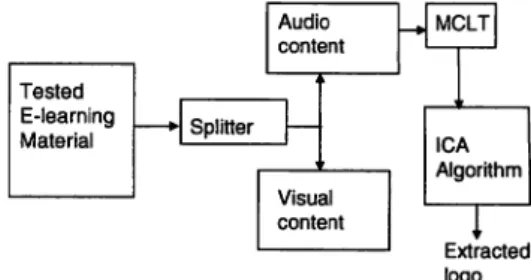
For the ICA algorithm initialization, we need to create mixing matrices, and to assure the identifiability of the ICA model (Fig.3), it is required that the number of the linear mixture inputs is at least equal to or larger than the number of independent sources. Using the embedding key k, the original audio stream X and the watermarked audio stream Y, three matrices X1,X2,X3, can be be written as
Xx = Y
X2 = Y + ck
X3 = Y + dX
while c and d are arbitrary real numbers.
(7)
2) Watermark extraction: The above created mixture Xi,X2, X3, are also mixtures of the MCLT samples of the original audio stream X: we denote the MCLT coefficient by Xi and the pixels of the logo W{, we can write (7) as
X2 = a2\x2 + a22w -^3 = 0,31X3 +
where aije{au^...,a^} is an arbitrary real number. Using the above described mixtures we can extract the em bedded logo, using the ICA algorithm, from the watermarked Audio stream Y. Tested E-learning Material Audio content Splitter Visual content Fig. 4. logo
Implementation of ICA algorithm for extraction of the embedded
IV. Real world implementation
In order to evaluate the feasibility of the proposed technique, we came up with a fully functional implementation. The E-learning material used in this simulation is an E-E-learning course for teaching the "C programming language," it is developed based on Java script for skill builder, and the experiment will be performed on the first three minute duration of course (Fig. 5). The course contains moving picture (video sequences, images, text, audio stream all explaining each step). The chosen watermark is a binary logo that contain a Japanese
Fig. 5. The E-learning material for teaching the C-language Kanji character shown in Fig.6.
(a) Original logo (b) Extracted logo
TABLE I
Evaluation results of the embedding algorithm
NC 0.93
SNR 44.8
Processing time in sec. Embedding 8.63 Extraction 12.10 Duration 3min Transmission 50Mbps TABLE II Simulation results Attacks Noise addition (10 sec, of white noise) Echo addition (100ms with 40% decay) MP3
Band-pass filter (cutoff 100HZ and 6kHZ frequencies) Resampling (44. lkHZ-22.05kHZ-44.lkHZ) BER 0.45 0.65 0.83 0.76 0.81 SNR 23.1 12.1 34.3 25.6 9.12
A. Before the distributionPrimary results)
Before broadcasting the watermarked E-learning material to the student community, the embedding steps were performed (subsection III-A). The algorithm was built using Matlab for all functions, the watermarked content was distributed to a virtual community of 30 users, and the results are shown in Table I. The measures are explained in subsection(I-B).
The algorithm does not require much time and the SNR is high, indicating that the quality of the watermarked file is very similar to the original file and no change has been detected. B. After the distribution
To evaluate the effectiveness of the proposed technique, we first extract the embedded logo at user-end (Fig.6-b), and to test the robustness, we performed a set of typical attacks that our watermarked file could be subjected to in the real world. Table II shows the results. The watermarked document was subjected to common attacks online, targeting at its visual and audible content. (table.II).
As we can see in Table II , even after the watermarked e-learning material was distributed through a network of lOOMbps and being subjected to the common signal process ing attacks defined in [11], we still can extract most of the inserted logo, in order to claim ownership of the original E-learning material. It is possible for authentication reasons to compare the extracted logo with the original logo by reference to the secret key to detect which are approximately the removed frames from the audio signal, and therefore we can detect which is the accompanying visual content removed and estimate the kind of attack performed.
V. Conclusions
In this paper we watermarked an E-learning material using a digital 2D Logo, through which we demonstrate that it is possible to authenticate an E-learning material by embedding a big amount of information (logo) in its audio stream without affecting its quality, as shown by high PSNR. The algorithm shows robustness against common attacks.
ACKNOWLEDGMENTS
This research was supported in part by Ministry of Internal Affairs and Communications (Japan) under Grant: SCOPE 072311002, for which the authors are grateful.
References
[i] M. Mourad, G. Hanely, B. Biedsperling and J. Gunther, "Toward an enlectronic Marketplace for higher education," IEEE Computer Society, June 2005, pp. 66-76.
[2] Downes, S., Mourad, M. and Piccariello.H.,"Digital Rights Management in e-learning," Proc. The Association for Advancement of computing in
Education, 2003.
[3] J. Hani. Shervin, S., Zahoa J.,"Watermarking of Audio learning objects with Quality of Service," International Journal of Advanced Media and Communication (IJAMC), Vol. 1, No. 4, 2007.
[4] Yu, D., Sattar, F. and Ma, K.K., "Watermark Detection and Extraction Using ICA," Proc. Eurasip Journal on Applied Signal Processing, Sept. 2002, vol. 1 pp. 92-104.
[5] Graf, E, "Providing security for e-Learning," Proc. Elsevier Science,
Vol.26, April 2002, pp.355-365.
[6] Malvar, H.,"A modulated Complex Lapped Transform And Its Applica tions to Audio Processing" IEEE. ICASSP, Phoenix, March (1999). [7] Otto Hutter, Terezia Sarvary Istvan Simonies, and Balazs Wagner,
"Elearning: Frameworks, Contents and Standards, Survey" Computer and Automation Research Institute, Hungarian Academy of Sciences, 2003. [8] Rehmeyer, J, "Computing Photographic Forgeries," Science News,
volin, (2007).
[9] Zezula, R., Misurec, J. "Audio signal Watrmarking in MCET domain with the Aid of 2D Pattern1; IEEE, CS, ICDT'06, (2006).
[10] Mirza, H., Adli, A., Hien, T.D., Nakao, Z., Nagata, Y., "Audio Wa termarking Based on the Psychoacoustic Model and Modulated Complex Lapped Transform? LNCS, Springer, vol. 4693/2007, (2006).
[11] Cvejic, N., Seppanen, T, "Audio watermarking using attacks character isation," Electronics Letters, IEEE, vol. 39,pp 1020-1021, (2003).