INVITED PAPER
Special Section on the Architectures, Protocols, and Applications for the Future InternetOntology Based Framework for Interactive Self-Assessment of e-Health Applications
Wasin PASSORNPAKORN†a),Nonmember andSinchai KAMOLPHIWONG†b),Member
SUMMARY Personal e-healthcare service is growing significantly. A large number of personal e-health measuring and monitoring devices are now in the market. However, to achieve better health outcome, various de- vices or services need to work together. This coordination among services remains challenge, due to their variations and complexities. To address this issue, we have proposed an ontology-based framework for interactive self- assessment of RESTful e-health services. Unlike existing e-health service frameworks where they had tightly coupling between services, as well as their data schemas were difficult to change and extend in the future. In our work, the loosely coupling among services and flexibility of each service are achieved through the design and implementation based on HYDRA vo- cabulary and REST principles. We have implemented clinical knowledge through the combination of OWL-DL and SPARQL rules. All of these ser- vices evolve independently; their interfaces are based on REST principles, especially HATEOAS constraints. We have demonstrated how to apply our framework for interactive self-assessment in e-health applications. We have shown that it allows the medical knowledge to drive the system workflow according to the event-driven principles. New data schema can be main- tained during run-time. This is the essential feature to support arriving of IoT (Internet of Things) based medical devices, which have their own data schema and evolve overtime.
key words:ontology-based knowledge model, ontology-based health infor- mation, ontology-based application programming interface, RESTful ser- vice composition, HATEOAS
1. Introduction
Decision Support System (DSS)[1] has been developed over four decades to address a huge amount of informa- tion issues. In healthcare, DSS is the computer-based set of tools, which provides clinical knowledge and patient-related information to clinicians at appropriate time[2]. DSS has been applied in various fields of healthcare domain such as to improve diagnosis result[3], to visualize the diagno- sis path and their criteria[4], and to validate drug forma- tion[5]. These DSSs can be categorized by their objectives in clinical-oriented, and patient-oriented.
In clinical-oriented, DSS is commonly known as Clini- cal Decision Support System (CDSS)[6], which aims to ad- dress problems knowledge in the form of Clinical Interven- tion Guideline (CIG)[7]. There are various types of CIGs reviewed/discussed[8]. Most of these representations were based on ontology-based models, which aimed to represent
Manuscript received June 3, 2015.
Manuscript revised September 11, 2015.
Manuscript publicized October 21, 2015.
†The authors are with the Department of Computer Engineer- ing, Faculty of Engineering, Prince of Songkla University, Thai- land.
a) E-mail: [email protected]
b) E-mail: [email protected] (Corresponding author) DOI: 10.1587/transinf.2015NTI0001
control-flow for clinical tasks in a form of hierarchy task network. These ontology-based models addressed interop- erability problems, which were commonly found in clinical domain. These models covered various expression logic’s requirements of medical knowledge representation such as intension-base task (goal-base), temporal reasoning (e.g., overlap, meet, and trend of data). Some efforts attempted to develop their representation languages, or to address some existing problems of CIGs for solving their specific prob- lems in clinical domain[9]–[13].
In contrast with CDSS, patient-oriented CDSS aims to deal with patient’s self-care process. Since patients have different requirements from physicians[14]. These require- ments need a system to treat patients as a primary user by tracking patient’s current health statuses and delivering the timely recommendations. For example, medical devices in- side a small briefcase[15]were used to diagnose, catego- rize, and deliver health risk of patients to telemedicine call center by using mobile networks. Beyond healthcare track- ing system[16]was able to collect lifestyle events and con- verted them to exercised suggestions according to their pro- vided training plan. A concept of intelligent PHR (Personal Health Record: it is an electronic health record for each indi- vidual use purpose)[17]has been proposed, which focused on monitoring and triggering mechanism such as data col- lecting, data preprocessing, abnormal event detection, and linking the result to related medical devices. MONARCA 2.0 system[18] aimed to improve the health awareness of patients to disease insight. Their system estimated the trend of mood state for allowing physician to provide proactive and prevention treatment. StudentLife system[19]was pro- posed to assess the relationship between stress and life-style activities, while GRiST[20]tried to assess patient’s mental health. Their system delivered expertise decision to specific patient group through different assessment setting. Embed- ding clinical guideline into patient-oriented CDSS[21]was developed for allowing clinical nurse to evaluate patient sta- tus and deliver healthcare intervention to patient.
These CDSSs addressed their primary goals such as in- tegration with clinical workflow and support self-care pro- cess. However, these CDSSs did not focus on system dy- namic environments such as flexibility, scalability, adapt- ability, and evolution of the system. Their systems lacked of the handling and interfacing capability for other software interactions. As a result, difficulty on communicating with external software modules will be faced.
To address these issues, we propose the ontology-based Copyright c2016 The Institute of Electronics, Information and Communication Engineers
framework for interactive healthcare self-assessment. Our framework allows medical knowledge and patient’s context to drive various services to achieve the agreement goals.
REST design pattern[22] is adopted to address the flexi- bility and evolution issue of services. However, allowing service working together in RESTful manner still has some big open challenges[23]such as self-description, composi- tion modelling, and resource state management. We address these issues by adopting hypermedia driven interface and linked data protocol such as A Vocabulary for Hypermedia- Driven Web APIs (HYDRA)[24], and Linked Data Platform (LDP)[25].
The rest of this paper is organized as follows: First, we investigate related works in next section. In Sect. 3, we overview our proposed system. In Sect. 4, we describe our proposed domain data model. Next, in Sect. 5, we present the mapping model between our proposed domain model with HYDRA, and LDP. In Sect. 6, we demonstrate our test- case scenarios that allow various services working together, samples of e-health scenarios are given. In Sect. 7, some main benefits of our work will be discussed. Then, we sum- marize our paper in the last section.
2. Related Works
2.1 Service-Oriented Clinical Decision Support System SOA (Service-oriented Architecture) enables various bene- fits in software development and maintenance[26]. How- ever, there are still few implementations of SOA in CDSS.
Therefore, various efforts establish the standard and guide- line for developing the CDSS in SOA manner. For example, HL7 working group identified basic component services of service-oriented CDSS[27], and drafted the required infor- mation and functionality for decision support service[28].
Health eDecisions (HeD)[29]defined interaction model for stateless interaction between CDSS guidance requester and CDSS guidance supplier.
According to the above efforts, some works adopted these standards and guidelines. For example, MobiGuide ar- chitecture[30]provided ubiquitous functionality for patient guidance system. They adopted SOA to facilitate indepen- dent software development. They addressed some issues in the standard[27]through their PHR mapping service.
Some efforts applied existing service technologies in healthcare domain. For example, Weitzel[31]developed a medical protocol as a service. Their system allowed services to adapt themselves to meet the requirements of healthcare experts. Their system adopted OpenSocial API[32] with HL7 standard format[33]. This adaptation provided chan- nels for accessing patient’s information through standard management interfaces (i.e., OpenSocial API). Ontology- based information and knowledge management framework for chronic disease care management[34]was proposed as a reminding and alerting system. Their system was based on SOA, which provided the data schema editor, and rule- editing interface. Aside from traditional service-oriented,
the extension framework of European Telecommunications Standards Institute (ETSI) was presented in [35]. Their proposed framework relied on ETSI for resources gather- ing process. They extend ETSI with reasoning mecha- nism, adaptation, event-handler, and patient’s profile man- agement.
Some efforts focused on CDSS context-aware system.
Their system could adapt the system behavior according to input contexts. For example, Paganelli[36] proposed ontology-based context aware for supporting home-based continuing care with various serviced supports such as infor- mation sharing, multichannel information accessing, patient health monitoring, and alarm handling. Ongenae[37]pro- posed automatic knowledge adaptable behaviors of context- aware applications for reducing the user adaptation. From aforementioned SOA-based system in healthcare, we found that most of them focused on features of systems. Most of them did not consider the issues about REST principles[22], especially Hypermedia as the Engine of Application State (HATEOAS) concept. The HATEOAS together with other REST constraints can reduce out-of-band information and coupling between services.
2.2 Restful Service Composition
Usually, SOA is comprised of several services working to- gether. Each service may re-use other services for archiv- ing certain goals[38]. To allow various services working together, a predefine agreement needs to be defined. As a result, these services will be difficult to change in the future.
REST constraints[22]alleviate these problems, since it requires the service to provide necessary information for processing each request through link or reference to re- lated information. These constraints allow the service to change or increase their features without breaking the ex- isting clients during the run-time period, since clients can claw from existing resource to their interested resource.
However, REST cannot remove all out-of-band information.
Some agreements need to be defined on hard coding such as the location of operations and their expected inputs/outputs.
These agreements can be called as media-type of resource.
To reduce the coupling between client and services, the me- dia type should not be changed frequently. Therefore the standardize media type is more suitable than customized media-type. In addition, the media type should fit to hy- permedia control for allowing the service to work together automatically. That is, it must be able to present the func- tional operation of each resource. Therefore, we extend the design in our previous work[39]with HYDRA and LDP.
HYDRA[24] is the set of vocabulary for defining media-type of hypermedia service interface. HYDRA fo- cuses on functionality description of resources such as op- erations, hint for their expected inputs and possible out- puts. These description describe through hydra:operation, hydra:expect, and hydra:return respectively. These descrip- tions allow service to chain together by mapping between service outputs and other service inputs. LDP[25]is W3C
Fig. 1 Overview of proposed system
recommendation that defines the set of rules and vocabu- lary for management of ontology-based information through HTTP protocol. The LDP will be the most importance part for management of the medical knowledge. Since, the ontology-based information is often used as the en- coded format of medical knowledge. This combination al- lows ontology-based medical knowledge to drive the service composition process.
3. Ontology Based Interactive Self-Assessment Service Model for e-Healht Services
The patient needs are often diverse, uncertain, personalized, and dynamic. To satisfy these requirements, the framework should be atomic, extensible, and flexible enough. There- fore, the components in this system are designed as RESTful service. As shown in Fig. 1, our proposed system consists of service manager, health portal, decision-making service (DM), personal health record service (PHR), and external services (e.g. medical device applications).
From Fig. 1, firstly, all of the services need to register (R) their root URLs to the service manager. This process al- lows various services in our framework to discover their in- terested resources at run-time (D). To illustrate the function- ality of each service, we construct health portal for allowing human user to manage resources in each service. The health portal allows user to manage their health data (Md) and data type (Ms) through PHR service’s APIs. The health portal also provides assessment interface (As) and medical knowl- edge editor (Ke) by connecting to medical knowledge in- terface of DM. During decision process, the DM may need to subscribe necessary data (Sd) at PHR service. When the data is available, the PHR service will send notification to the DM for their decision process. The result of DM service is updated to the user’s data storage (Ud) at PHR service.
Our proposed framework allows an interoperability with Internet of Things (IoT) based medical monitoring devices, for example blood pressure, heart rate, weighing scale, or glucose meter. Data of these devices can be flowed to the DM for analyzing and updating a new result according to related algorithms and current patient states.
4. Domain Data Model
This section describes our domain data model, which con-
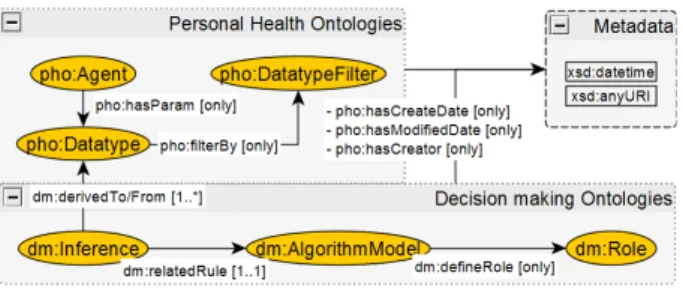
Fig. 2 Top-level model of proposed data model
sists of personal health ontologies, and decision-making ontologies. In addition from Fig. 2, both classes and their instances can have their metadata through var- ious annotation properties such as pho:hasCreateDate, pho:hasModifiedDate, and pho:hasCreator.
4.1 Personal Health Data Model
The personal health ontologies (PHO) are a representation of patient’s data. These ontologies allow various services to understand the meaning and constrains of each data type in the consistency way. They consist of two main classes such as pho:Agent, and pho:Datatype. The instances of these classes are used for representation of user’s instance, and user’s parameter type, respectively. The instance of pho:Agent can link with instance of pho:Datatype through object property named, pho:hasParam.
4.2 Decision-Making Data Model
Decision-making model has its own data types that relate to medical decision such as event, condition, and its enu- meration value. These data types are the extension part of pho:DataType from Fig. 2. Aside from pho:Datatype exten- sion, the decision model consists of dm:Inference, dm:Role, and dm:AlgorithmModel. The dm:Inference is responsible to link the input, output, and decision node together. The dm:Role is used to represent rule’s characteristic. In addi- tion, it is used to map with algorithm implementation such as SPARQL rule. The dm:AlgorithmModel contains proper- ties of algorithm structure (e.g., sub/sibling algorithm) and their metadata. These three classes describe functionality facet of algorithm, which allow decision-making process to map with service’s resource.
There are various subclasses of dm:Role such as dm:IfStmt, dm:ThenStmt, dm:Derive, dm:Assert, dm:StartTimeMax, and dm:AtLeastN operators. These subclasses are used to represent different characteristics of rules, for example, dm:Role structure is described in Fig. 3. From dm:MatchStmt Role in Fig. 3, it is used to map the instance of dm:AlgorithmModel with SPARQL simple statement such as subject, predicate, object, filter comparator, and union. The dm:MatchStmt has two sub- classes: dm:IfStmt, and dm:ThenStmt. These two sub- classes are used to translate instance into statement and con- struct statement of SPARQL, respectively. Each instances
Fig. 3 Example of Role: MatchStmt descriptions
of dm:MatchStmt has dm:matchType property, which rep- resents data type of subject. The predicate and object are represented thorough dm:matchPropValue that links to dm:PropValue class. The dm:PropValue class can be linked to other instances of dm:PropValue. The dm:PropValue class has two subclasses: dm:NumericalCompare, and dm:DatatypeCompare, which represent criterion filtering for object numerical value and object data type value respec- tively. There are other example of dm:Role. For example, dm:Derive and dm:Assert are used for updating the existing data. The dm:StartTimeMax are used to specify location of input’s time metadata, which allows the system to generate time metadata according to input’s data.
The instance of dm:AlgorithmModel will be used for generating SPARQL rule. The generating rule then will be embedded into decision-making model as the spin rule ac- cording to SPIN (SPARQL Inferencing Notation) vocabu- lary[40] (i.e., spin:rule). These spin rule will be used for reasoning process. After instance of dm:AlgorithmModel is defined, the instance of inference classes can link the related rule with their inputs and their outputs together. Both inputs and outputs are the instance of pho:Datatype, which are gen- erated from property dm:matchType of dm:MatchStmt in- stance. These relations allow the initialization of gathering process, which describe at Sect. 6.2.
5. Hypermedia Interface Model
To allow various services working together with min- imum out-of-band information, we adopt Hypermedia- Driven Web APIs (HYDRA) vocabulary and Linked Data Protocol (LDP). The HYDRA is the vocabulary, which is adopted to present the supported operation and their in- puts/outputs to client. On the other hand, the operation type that will be presented is based on LDP.
We design our APIs by adopting hydra:Collection as the entry point for management of our domain resource.
Each instance of hydra:Collection supports two main opera- tions: view and create operations through hydra:filter, and hydra:operation/hydra:method=“POST” respectively. The
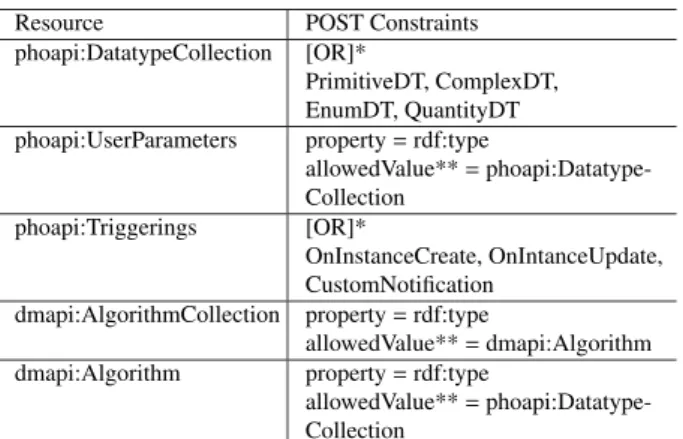
Table 1 Example of resource and its constraints.
Resource POST Constraints
phoapi:DatatypeCollection [OR]*
PrimitiveDT, ComplexDT, EnumDT, QuantityDT phoapi:UserParameters property=rdf:type
allowedValue**=phoapi:Datatype- Collection
phoapi:Triggerings [OR]*
OnInstanceCreate, OnIntanceUpdate, CustomNotification
dmapi:AlgorithmCollection property=rdf:type
allowedValue**=dmapi:Algorithm dmapi:Algorithm property=rdf:type
allowedValue**=phoapi:Datatype- Collection
*[OR]: the correct resource must has its constraint match with one of these constraints. Each constraint may contains valueType, allowed- Value, parent, and hasValue property.
**allowedValue: the property’s value must be one member of the col- lection. The collection is the value of allowedValue. The member of collection describes through hydra:member property.
view operation allows client to retrieve the resource ac- cording to some URL templates. The create operation al- lows client to perform the POST operation with input’s constraints described as hydra:expect. In addition, since HYDRA vocabulary does not provide enough information for constraint definition. Therefore, we extend HYDRA vocabulary with the constraints concept similar to devel- oping vocabulary named shape[41]. Our extended vocab- ulary is the property of hydra:SupportedProperty, which can be placed on any classes to describe constraints of class’s instance. Usually, they can be used together with the hy- dra:expect to guide the client about the constrains of newly create resource. This vocabulary consists of valuetype, allowedValue, parent, and hasValue. The valuetype ref- erences to xsd:datatype or resource that has property hy- dra:supportedProperty. The allowedValue references to hy- dra:Collection. The parent property describes the nested properties, which is one of the issues in HYDRA commu- nity. Lastly, the hasValue describes the property and its value that must be presented.
We adopt hydra:Collection for management of the following domain data: 1) pho:Datatype and its subclass managed through phoapi:DatatypeCollection. 2) The in- stance of pho:Agent with pho:hasParam property man- aged through phoapi:UserParameters. 3) The instance of pho:Agent with pho:hasTriggering property managed through phoapi:Trigerrings 4) dm:AlgorithmModel and its subclass managed through dmapi:AlgorithmCollection.
Aside from collection management, we provide the dmapi:Algorithm for initialization of decision-making pro- cess. This resource allows client to enter health’s data through POST operation. More detail descriptions of re- source’s constraints are shown in Table 1.
In addition to resource’s constraints shown in Ta- ble 1, some resources contain hydra:supportedOperation, which is used to specify hydra:operation on instance that has type as the current resource. For example, the
phoapi:UserParameters has hydra:supportedOperation for PUT and DELTE operations. Therefore, all instances of phoapi:UserParameters (i.e., patient’s health parameters) will have PUT and DELETE operations for allowing pa- tients to manage their existing data. This property also de- scribes on the dmapi:Algorithm for management of medical algorithm.
6. Test Scenarios
6.1 The Management of PHR Schema and Decision- making Knowledge
Both construction processes of PHR schema and decision- making knowledge at the client side are similar. Since, health portal acts as a generic client that performs the op- eration according to HYDRA and LDP vocabulary. How- ever, there are some differences in server side process.
In the PHR schema management, a new schema needs to be validated with the schema constraints that define at PrimitiveDT, ComplexDT, EnumDT, and QuantityDT. In the medical knowledge management, there are two needed mechanisms to perform such as filtering and classification mechanisms. The filtering is used for dealing with du- plicated or similar rules. The classification is used for medical knowledge management, which consists of group- ing, merging, and hierarchy. These mechanisms perform through ontology-based reasoning module such as OWL-RL of SPIN library or OWL-DL classification of Pellet.
6.2 Data Monitoring and Triggering Process
From Fig. 4, DM process can be started by notification triggering rules in PHR (1.1), or by patient entering ab- normal symptom (1.2). In the first case, firstly, DM needs to subscribe the interested events to PHO service.
When the matching event occurs, the notification will be send to DM. In the latter case, patient needs to POST his/her symptoms according to hydra:expect property’s value of dmapi:Algorithm. After receiving the input, e.g.
pho:VomitOccur, the service will create the user model (e.g.
instance of pho:Agent) according to the received input, and will send them to analyzing module. This module is the
Fig. 4 Sample use-case of data monitoring and triggering process
rule-engine, which consists of several SPARQL based rules that are able to produce the set of dm:Inference’s instances.
These instances contain some numbers of related inputs, outputs, and rules. According to dm:AlgorithmModel de- scribed in Sect. 4.2, the input and output of each algo- rithm can be presented. Therefore, the planning module can find the missing data of each algorithm by matching algorithm descriptions to the existing user’s data model.
These missing data are the resources that need to gather for further analyzing processes. In this example, the miss- ing data is EventStat of vomit occur (2). This resource is the summary information of pho:VomitOccur event that re- quires system to monitor pho:VomitOccur event overtime.
However, it does not contain in the current user’s model.
Therefore, the analyzing module will mark on them and send them to the planning module. The planning mod- ule is responsible for location discovery of missing data (3). This discovery process can be achieved through re- source discovery of service manager. The service manager is able to discover certain resource by matching the con- straints of EventStat of vomit occurred with constraints of hydra:return in operation of each registered service APIs.
These constraints are specified by HYDRA vocabulary and constraints extension, which describe in Sect. 5. As- sume that the constraints of EventStat of vomit occurred consists of property = pho:eventFreqOf, and valueType
= pho:VomitOccur. Therefore, the hydra:return value of matching service must have pho:eventFreqOf as the prop- erty’s value; and its valueType must be pho:VomitOccur or super class of pho:VomitOccur (e.g., pho:Event). In this case, the service manager finds EventStat resource on one operation of Event Stat service (ESS) match with Event- Stat of vomit occurred constraints. Therefore, the planning module will pair URL of ESS’s resource with its related op- eration, and then sends it to the execution module for run- ning the gathering process (4).
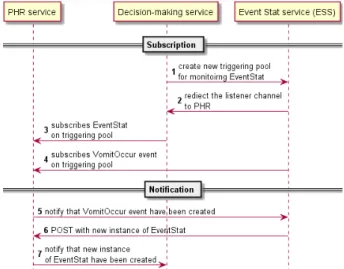
From Fig. 5, DM starts a gathering process by perform- ing POST on the ESS with necessary data described in the
Fig. 5 Event Subscription and Event notification
constraints value of hydra:expect such as the type of input data, (e.g., EventStat of vomit occur). The ESS will re- turn the listener URL to DM, e.g., triggering pool of Event- Stat at PHR. Therefore, DM will subscribe on such trig- gering pool URL. The process of ESS then starts by sub- scribing the pho:VomitOccur at PHR service. When the pho:VomitOccur is updated, the PHR will notify ESS which allows ESS to calculate the EventStat of pho:VomiOccur and updates them on PHR. When the EventStat is updated, DM will receive the notification, which allows DM to re- sume its analyzing process.
7. Discussion
In the Personal e-Health service, the schema of data can be extended and changed overtime. The proposed schema cov- ers various types of information such as patient health in- formation, clinical knowledge, and event matching. Unlike data types of exiting personal health records (e.g. SMART platform[42], Indivo[43], FHIR[44]) where they are un- changeable and difficult to extend. Moreover, each data type can have their own metadata such as author, date, and label.
New data types may inherit constraints from existing data types. These features achieve through the implementation of hydra:supportedProperty in their classes, which allow them to specify data constrains of their instances.
In our decision-making module, we have implemented clinical knowledge through the combination of OWL-DL and SPARQL rules. SPARQL rule has some advantages over SWRL[45]and Jena built-in rule[46]. For example, SPARQL’s rule syntaxes allow new instances and metadata (e.g. author, time stamp) to generate, and can be embedded into OWL class through SPIN vocabulary.
However, SPARQL-based rule is difficult to maintain because of their flexibility characteristic. The failure of rule construction may cause the reasoning process running infinitely. Therefore, we provide SPARQL rule templates (e.g., dm:AlgorithmModel) and management interface (e.g., dmapi:AlgorithmCollection). The rule templates allow the algorithm to be traced and allow physician or patient to en- sure the correction of their decision results. In addition, the rule template can be used for explaining the missing re- sources that need to be gathered for further analysis. This approach is similar to SPARQL template in[47]. However, our approach attempts to describe the functionality facet of algorithm and apply into generic use-cases. The rule man- agement interface is ease for developing of knowledge man- agement by providing supported constraints that can be de- fined in each rule.
After the knowledge has been provided, the suggestion can be sent to patient. The suggestion and action result come from various services working together. For example, Al- ice is a pregnant woman with vomit symptom employs our framework for dealing with her symptom consulting. This initial condition may require various processes such as to estimate the vomiting severity, to provide the suggestion ac- cording to diagnosis result, to follow-up the symptom and
related conditions, and to provide the map and transporta- tion of a hospital if needed. In order to allow each compo- nent to evolve overtime, these components can be deployed as a separated service in our framework.
In our proposed framework, these scenarios achieved through various services working together such as the ser- vice manager that registers available resources of each ser- vice, the event-subscription service that monitors the data, and the decision-making service that executes each service according to medical knowledge and service requirements.
In order to let these services working together, each service must expose the functionality of its resource. This issue can be achieved through HYDRA vocabulary such as hy- dra:operation, hydra:expect, and hydra:return. For example, a patient enters vomit symptom into the DM. The DM then needs to run its analyzing process, which requires more data to run its algorithm. These required data are the comparing result between dm:Algorithm and current user’s data repos- itory. For gathering data, the DM needs to find another ser- vice’s operations which have hydra:return matching to such data. When service is found, the DM needs to invoke the service’s operation by providing necessary data according to hydra:expect. To provide such necessary data, the DM needs to invoke another service. This invoking loop allows the DM to chain various services together according to ini- tial required data of the DM.
After the services are able to working together, these services may be changed or evolved in the future. For ex- ample, a developer of ESS decides to change their services according to Separation of Concern Principle (SPC). That is, instead of letting ESS queries the necessary input from patient’s URL, the client of ESS must provide all necessary information to ESS. Therefore, ESS changes its interface from two input parameters to one input parameter. This input parameter is the URL referred to collection of target event, e.g., pho:VomitOccur collection. This change will break the coordination process between ESS and DM. Since, hard coding of DM is used to interface with ESS, therefore, every modification of each service requires code changing.
This issue is hard to maintain if the system consists of vari- ous service working together.
To address this issue, we design and develop our framework according to REST. The importance constraints of REST that address this issue is self-descriptive and HATEOAS. These two constraints require service to de- liver the message with necessary information for perform- ing the process according to such message. Therefore, the client can perform the recursive retrieval operation from cur- rent resource, until the desired resource is found. For exam- ple, when DM needs to gather EventStat of vomit occur re- source, which is the resource of Event Stat service (ESS).
DM requires service manager to discovery this resource from its registered service. The discovery process in non- HATEOAS approach requires fixed information at the ser- vice manager such as resource locations and their supported operations. If the ESS is changed, the ESS needs to inform the service manager to change the registered information.
On the other hand, in HATEOAS approach, this mechanism can be avoided. Since, the service manager requires only the root URL of the registered services, i.e., ESS root URL.
The service manager then can perform recursive retrieval operation (e.g., GET) from root URL, until it finds Event- Stat of vomit occurred. In this case, the service manager does not need to fix any information in its implementation, except the root URL of each service. This approach allows a service to change its implementation overtime, as long as the semantic of resources has not changed. The limitation of this approach is it requires client to support the clawing process. However, this clawing process does not need to change overtime. Since, the clawing process is based on the standardize media-type (e.g., HYDRA and LDP) of re- source that are not often changed.
8. Conclusions
This paper presents a design ontology-based framework for interactive self-assessment of e-Health services. Our work focuses on the flexibility of service interface that allows coordination among various services to achieve interactive self-assessment results. This flexibility achieves through the design and implementation based on HYDRA, LDP, and REST principles. The proposed system bridges the gap be- tween the medical knowledge and medical management ser- vice interfacing. We have demonstrated how to apply our framework for self-assessment in e-health applications. Fur- thermore, our framework allows the medical knowledge to drive the system workflow according to event-driven prin- ciples. In addition, our framework considers an integration process of various services in IoT (Internet of Things), while allows them independently involve.
Acknowledgments
This work was supported by the Higher Education Re- search Promotion and National Research University Project of Thailand, Office of the Higher Education Commission (under the funding no. MED540548S at Prince of Songkla University). Thanks to Prof. Veerapol Chandeying, Faculty of Medicine, University of Phayao, for his valuable advising on medical knowledge to this project.
References
[1] K. Vizecky and O. El-Gayar, “Increasing research relevance in dss:
Looking forward by reflecting on 40 years of progress,” in System Sciences (HICSS), 2011 44th Hawaii International Conference on, pp.1–9, IEEE, 2011.
[2] M. Osheroff, A. Jerome, M. Teich, J.M. Fhimss, M. Levick, F. Mba, M. Saldana, M. Velasco, T. Ferdinand, and D.F. Fhimss, Improving outcomes with clinical decision support: An implementer’s guide, HIMSS Pub., 2012.
[3] J.L.M. Amaral, A.J. Lopes, J.M. Jansen, A.C.D. Faria, and P.L.
Melo, “Machine learning algorithms and forced oscillation mea- surements applied to the automatic identification of chronic ob- structive pulmonary disease,” Computer methods and programs in biomedicine, vol.105, no.3, pp.183–193, 2012.
[4] F.L. Seixas, B. Zadrozny, J. Laks, A. Conci, and D.C.M. Saade, “A bayesian network decision model for supporting the diagnosis of de- mentia, alzheimer’s disease and mild cognitive impairment,” Com- puters in biology and medicine, vol.51, pp.140–158, 2014.
[5] N. Chalortham, P. Leesawat, T. Ruangrajitpakorn, and T. Supnithi,
“A framework of ontology-based tablet production supporting sys- tem for a drug reformulation,” IEICE Trans. Inf. & Syst., vol.E94-D, no.3, pp.448–455, 2011.
[6] M.A. Musen, B. Middleton, and R.A. Greenes, “Clinical decision- support systems,” in Biomedical informatics, pp.643–674, Springer, 2014.
[7] M. Peleg, “Computer-interpretable clinical guidelines: A method- ological review,” Journal of biomedical informatics, vol.46, no.4, pp.744–763, 2013.
[8] P. Fraccaro, D. O·Sullivan, P. Plastiras, H. O·Sullivan, C. Dentone, A.D. Biagio, and P. Weller, “Behind the screens: Clinical decision support methodologies–a review,” Health Policy and Technology, vol.4, no.1, pp.29–38, 2015.
[9] D. Ria˜no, F. Real, F. Campana, S. Ercolani, and R. Annicchiarico,
“An ontology for the care of the elder at home,” in Artificial intelli- gence in medicine, vol.5651, pp.235–239, Springer, 2009.
[10] D. Ria˜nO, F. Real, J.A. L´oPez-Vallverd´u, F. Campana, S. Ercolani, P.
Mecocci, R. Annicchiarico, and C. Caltagirone, “An ontology-based personalization of health-care knowledge to support clinical deci- sions for chronically ill patients,” Journal of biomedical informatics, vol.45, no.3, pp.429–446, 2012.
[11] D.A. Alexandrou, I.E. Skitsas, and G.N. Mentzas, “A holistic environment for the design and execution of self-adaptive clini- cal pathways.” IEEE Trans. Inf. Technol. Biomed., vol.15, no.1, pp.108–118, 2011.
[12] C. Bratsas, P. Bamidis, D.D. Kehagias, E. Kaimakamis, and N.
Maglaveras, “Dynamic composition of semantic pathways for med- ical computational problem solving by means of semantic rules,”
IEEE Trans. Inf. Technol. Biomed., vol.15, no.2, pp.334–343, 2011.
[13] C. Bratsas, V. Koutkias, E. Kaimakamis, P.D. Bamidis, G.I.
Pangalos, and N. Maglaveras, “Knowbasics-m: An ontology-based system for semantic management of medical problems and comput- erised algorithmic solutions,” Computer methods and programs in biomedicine, vol.88, no.1, pp.39–51, 2007.
[14] T. Andersen, J. Bansler, F. Kensing, J. Moll, and K.D. Nielsen,
“Alignment of concerns: A design rationale for patient participation in ehealth,” in System Sciences (HICSS), 2014 47th Hawaii Interna- tional Conference on, pp.2587–2596, IEEE, 2014.
[15] A. Ahmed, A. Rebeiro-Hargrave, Y. Nohara, E. Kai, Z.H. Ripon, and N. Nakashima, “Targeting morbidity in unreached communi- ties using portable health clinic system,” IEICE Trans. Commun., vol.E97-B, no.3, pp.540–545, 2014.
[16] F. Daniel, F. Casati, P. Silveira, M. Verga, and M.N. Alin, “Beyond health tracking: A personal health and lifestyle platform,” Internet Computing, IEEE, vol.15, no.4, pp.14–22, 2011.
[17] G. Luo, “Triggers and monitoring in intelligent personal health record,” Journal of medical systems, vol.36, no.5, pp.2993–3009, 2012.
[18] M. Frost, A. Doryab, M. Faurholt-Jepsen, L.V. Kessing, and J.E.
Bardram, “Supporting disease insight through data analysis: Refine- ments of the monarca self-assessment system,” in Proceedings of the 2013 ACM international joint conference on Pervasive and ubiqui- tous computing, pp.133–142, ACM, 2013.
[19] R. Wang, F. Chen, Z. Chen, T. Li, G. Harari, S. Tignor, X. Zhou, D. Ben-Zeev, and A.T. Campbell, “Studentlife: Assessing mental health, academic performance and behavioral trends of college stu- dents using smartphones,” in Proceedings of the 2014 ACM Inter- national Joint Conference on Pervasive and Ubiquitous Computing, pp.3–14, ACM, 2014.
[20] C.D. Buckingham, A. Ahmed, and A. Adams, “Designing multiple user perspectives and functionality for clinical decision support sys- tems,” in Computer Science and Information Systems (FedCSIS),
2013 Federated Conference on, pp.211–218, IEEE, 2013.
[21] P.J. Fortier, B. Puntin, and O. Aljaroudi, “Improved patient out- comes through collaborative monitoring and management of subtle behavioral and physiological health changes,” in System Sciences (HICSS), 2011 44th Hawaii International Conference on, pp.1–10, IEEE, 2011.
[22] R.T. Fielding, “Architectural styles and the design of network-based software architectures,” University of California, Irvine, 2000.
[23] Q.Z. Sheng, X. Qiao, A.V. Vasilakos, C. Szabo, S. Bourne, and X.
Xu, “Web services composition: A decade’s overview,” Information Sciences, vol.280, pp.218–238 2014.
[24] M. Lanthaler and C. G¨utl, “Seamless integration of restful services into the web of data,” Advances in Multimedia, vol.2012, pp.1–14, 2012.
[25] S. Speicher, J. Arwe, A. Malhotra, “Linked Data Platform 1.0,”
http://www.w3.org/TR/ldp/, accessed Feb. 28, 2015.
[26] R. Dobrescu and V. Purcarea, “Impact of information technology on the quality of health services,” in Service orientation in holonic and multi-agent manufacturing control, vol.402, pp.307–319, Springer, 2012.
[27] K. Kawamoto, J. Jacobs, B.M. Welch, V. Huser, M.D. Paterno, G.
Del Fiol, D. Shields, H.R. Strasberg, P.J. Haug, and Z. Liu, “Clini- cal information system services and capabilities desired for scalable, standards-based, service-oriented decision support: Consensus as- sessment of the health level 7 clinical decision support work group,”
in AMIA Annual Symposium Proceedings, p.446, American Medi- cal Informatics Association, 2012.
[28] HL7 CDS and SOA working group, “HL7 Decision Support Service (DSS),” http://www.hl7.org/implement/standards/product brief.
cfm?product id=12, accessed Feb. 3, 2015.
[29] S&I Community & Staff: HeD, “Health eDecisions CDS Guidance Service,” http://wiki.siframework.org/HeD+Use+Case+2+ Consensus+-+CDS+Guidance+Service, accessed Feb. 3, 2015.
[30] M. Peleg, T. Broens, A. Gonz´alez-Ferrer, and E. Shalom, “Archi- tecture for a ubiquitous context-aware clinical guidance system for patients and care providers,” KR4HC’13/ProHealth’13, pp.161–167, 2013.
[31] M. Weitzel, A. Smith, S.D. Deugd, and R. Yates, “A web 2.0 model for patient-centered health informatics applications,” Com- puter, vol.43, no.7, pp.43–50, 2010.
[32] OpenSocial, http://www.w3.org/blog/2014/12/opensocial- foundation-moves-standards-work-to-w3c-social-web-activity/, ac- cess Feb. 3, 2015.
[33] G.W. Beeler, “Hl7 version 3–an object-oriented methodology for collaborative standards development,” International Journal of Med- ical Informatics, vol.48, no.1-3, pp.151–161, 1998.
[34] M. Buranarach, N. Chalortham, Y.M. Thein, and T. Supnithi, “De- sign and implementation of an ontology-based clinical reminder sys- tem to support chronic disease healthcare,” IEICE Trans. Inf. &
Syst., vol.E94-D, no.3, pp.432–439, 2011.
[35] M. Fengou, G. Mantas, D. Lymberopoulos, N. Komninos, S. Fengos, and N. Lazarou, “A new framework architecture for next generation e-health services,” Biomedical and Health Informatics, IEEE Journal of, vol.17, no.1, pp.9–18, 2013.
[36] F. Paganelli and D. Giuli, “An ontology-based system for contex- t-aware and configurable services to support home-based continu- ous care,” Information Technology in Biomedicine, IEEE Trans. Inf.
Technol. Biomed., vol.15, no.2, pp.324–333, 2011.
[37] F. Ongenae, M. Claeys, T. Dupont, W. Kerckhove, P. Verhoeve, T.
Dhaene, and F. De Turck, “A probabilistic ontology-based platform for self-learning context-aware healthcare applications,” Expert Sys- tems With Applications, vol.40, no.18, pp.7629–7646, 2013.
[38] C. Pautasso, “Composing restful services with jopera,” in Software Composition, vol.5634, pp.142–159, Springer, 2009.
[39] W. Passornpakorn, S. Kamolphiwong, T. Kamolphiwong, and V.
Chandeeying, “Design framework for ontology based interactive e-health services,” in Ubiquitous and Future Networks (ICUFN),
2013 Fifth International Conference on, pp.389–394, IEEE, 2013.
[40] “SPARQL Inferencing Notation,” http://spinrdf.org/, accessed March 1, 2015.
[41] E. Prud’hommeaux and H. Knublauch, “SHACL (Shapes Constraint Language) Primer,” http://w3c.github.io/data-shapes/data-shapes- primer, accessed May 10, 2015.
[42] K.D. Mandl, J.C. Mandel, S.N. Murphy, E.V. Bernstam, R.L.
Ramoni, D.A. Kreda, J.M. McCoy, B. Adida, and I.S. Kohane, “The smart platform: Early experience enabling substitutable applications for electronic health records,” Journal of the American Medical In- formatics Association, vol.19, no.4, pp.597–603, 2012.
[43] B. Adida, A. Sanyal, S. Zabak, I.S. Kohane, and K.D. Mandl, “In- divo x: Developing a fully substitutable personally controlled health record platform,” in AMIA Annual Symposium Proceedings, p.6, American Medical Informatics Association, 2010.
[44] “FHIR: Fast healthcare interoperability resources,” http://hl7.org/ implement/standards/fhir/, accessed Feb. 20, 2015.
[45] I. Horrocks, P.F. Patel-Schneider, H. Boley, S. Tabet, B. Grosof, and M. Dean, “Swrl: A semantic web rule language combining owl and ruleml,” W3C Member submission, vol.21, p.79, 2004.
[46] Jena, http://jena.apache.org/, access Feb. 3, 2015.
[47] G. Meditskos, S. Dasiopoulou, and I. Kompatsiaris, “Metaq: A knowledge-driven framework for context-aware activity recognition combining sparql and owl 2 activity patterns,” Pervasive and Mobile Computing, 2015.
Wasin Passornpakorn received the B.S. de- grees in Computer Engineering from Prince of Songkla University in 2011. During 2011–2015, he stayed with Centre for Network Research (CNR), Department of Computer Engineering, Faculty of Engineering, Prince of Songkla Uni- versity, Thailand. He is now studying M.Eng.
degree.
Sinchai Kamolphiwong received Ph.D.
from the University of New South Wales, Aus- tralia. He is now an Associate Professor in the Department of Computer Engineering, Faculty of Engineering, Prince of Songkla University, Thailand. He publishes some of 100 technical papers. His main interest research areas are:
NGN/NGI, Multimedia Communications, Tele- Medicine, Network Mobility, P2P, and Perfor- mance Evaluation.