INVITED PAPER
Special Section on Recent Progress in Microwave and Millimeter-Wave Photonics TechnologyMobile Backhaul Optical Access Networks for Coordinated Multipoint Transmission / Reception (CoMP) Techniques in Future Cellular Systems
Changsoon CHOI†a), Thorsten BIERMANN†, Qing WEI†, Kazuyuki KOZU†,Nonmembers, andMasami YABUSAKI†,Member
SUMMARY This paper describes mobile backhaul optical access net- work designs for future cellular systems, in particular, for those sys- tems that exploit coordinated multipoints (CoMP) transmission/reception techniques. Wavelength-division-multiplexing passive optical networks (WDM-PON) are primarily considered and two proposals to enhance mo- bile backhaul capability of WDM-PONs for CoMP are presented. One is physical X2 links that support dedicated low latency and high capacity data exchange between base stations (BSs). The other is multicasting in WDM-PONs. It effectively reduces data/control transmission time from central node to multiple BSs joining CoMP. Evaluation results verify that the proposed X2 links and the multicasting enable more BSs to join CoMP by enhancing the mobile backhaul capability, which results in improved service quality for users.
key words: mobile backhaul access networks, wavelength-division mul- tiplexing passive optical networks (WDM-PON), coordinated multi-points (CoMP), X2 interface, multicasting
1. Introduction
Recent years have seen exploding growth in mobile data traffic with the rapid evolution of smart phones. This ac- celerates commercial LTE services in cellular networks, and the LTE-Advanced has gained all gravity of research and de- velopment activities in both network and radio design. Ac- cording to the 3GPP discussion, the LTE-Advanced is sup- posed to provide 1 Gbps for downlink and 500 Mbps for up- link transmissions per cell. Considering that future cellu- lar systems will continuously increase maximum capacity to cope with mobile data traffic increase, it is necessary to design a mobile network architecture that is able to scale with future demands. Given that the average revenue per user (APRU) is likely to increase at much lower rate than traffic demand increases, or even decreases with increasing traffic demands, it is critical to develop cost-effective mo- bile network architectures. This implies to strive for ease of network operation and management, as well as energy ef- ficiency to reduce OPEX. There is no doubt that reducing CAPEX is far more important than any other factor when designing mobile networks.
We believe that optical network technologies play an important role to meet such requirements as well as to deal
Manuscript received June 19, 2012.
Manuscript revised October 3, 2012.
†The authors are with DOCOMO Communications Laborato- ries Europe GmbH, Munich, 80335, Germany.
a) E-mail: [email protected] DOI: 10.1587/transele.E96.C.147
with increasing traffic in next mobile network (NMN) [1].
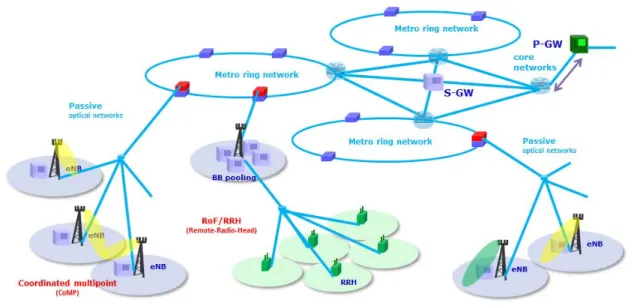
Figure 1 illustrates the concept of NMN based on opti- cal technologies. All mobile traffics typically go through a Serving gateway (S-GW) and a PDN gateway (P-GW), therefore the entire mobile network architecture is rather centralized. Ring networks can be used for metro/access ar- eas where high resilience is critical. For access networks, passive optical networks (PONs) are a viable and cost- effective alternative to provide the large numbers of base stations (BSs) with backhaul connectivity. However, it is not straightforward to use conventional PONs for mobile back- haul access networks. Higher operability including higher resilience and reliability is required in mobile backhaul ac- cess networks than in fixed access networks. This is because a single BS provides connectivity to many users whereas an optical network unit (ONU) only connects to single or few end-users. Among all requirements, the most important one for mobile backhaul access networks is to fully support fu- ture radio access techniques.
Coordinated multipoint (CoMP) transmission/reception is a promising future radio access technique that requires higher mobile backhaul capability than current cellular net- works would need. It has been extensively discussed in 3GPP as a promising technique to improve cell through- put (particularly for cell-edge users) by allowing different BSs to cooperatively manage interference and/or to partic- ipate in joint transmission/reception [2], [3]. However, it comes with increased backhaul traffic because neighboring BSs joining CoMP need to exchange user data and/or cell in- formation such as channel state information (CSI) through the backhaul networks that connects cooperating BSs. This exchange needs to be done while CSI is valid (typically a few milliseconds). Therefore, not only higher bandwidth re- quirements but also more stringent latency requirements for the exchange via the backhaul networks have to be fulfilled.
This paper presents mobile backhaul access network designs for CoMP techniques in LTE-Advanced and future cellular networks. We primarily consider PON technolo- gies to build mobile backhaul access networks in NMN. In current fiber-to-the-home (FTTH) markets, time-division- multiplexing passive optical networks (TDM-PONs) have been widely used due to its cost effectiveness and now evolved to 10GPON where the maximum link capacity from optical line terminal (OLT) to optical network units (ONUs) Copyright c2013 The Institute of Electronics, Information and Communication Engineers
Fig. 1 Next mobile network based on optical technologies.
is 10 Gbps. However, since this link capacity is shared among all ONUs, a 10GPON has not enough capacity for mobile backhaul access networks. This becomes visible when looking at LTE-Advanced where each cell supports up to 1 Gbps and a site corresponding to an ONU in a PON is typically equipped with 3 sectors (cells). Therefore, we be- lieve wavelength-division-multiplexing passive optical net- works (WDM-PONs) capable of providing several Gbps to each ONU is better suitable for future mobile backhaul ac- cess networks. Nevertheless, it is not straightforward to simply use conventional WDM-PONs for mobile backhaul access networks supporting CoMP due to its stringent la- tency requirements. Section 2 describes a modified WDM- PON architecture with physical X2 links that promises much shorter delay for CoMP compared to conventional WDM- PON. Performance evaluations for different mobile back- haul access network designs are also presented. In Sect. 3, physical layer multicast is proposed for WDM-PONs and its influence on CoMP is presented. Finally, the paper ends with summary and conclusion in Sect. 4.
2. WDM-PON with Physical X2 Links
2.1 Proposed Architecture
To enable CoMP, it is indispensable for cooperating BSs to share user data and/or cell information via mobile backhaul access networks. Such exchanges are usually carried out among neighboring BSs that gives substantial influence on received radio signal power of user elements (UEs). The X2 interface, which is a logical interface between two BSs in the 3GPP standard is supposed to be used for such data exchange.
The X2 interface is not a physical link but a logical interface whose performance strongly depends on physical link implementation. In conventional mobile backhaul ac- cess networks, as shown in Fig. 2, the X2 interface is real-
Fig. 2 Illustration of logical X2 interface, the conventional way of phys- ical X2 implementation and the proposed physical X2 implementation.
ized through a central switching node (an OLT in a PON), not direct connection between BSs in order to reduce hard- ware costs. This way of X2 link implementation has been no issue so far because the conventional uses of the X2 in- terface, such as data forwarding for handover and control plane support in radio resource management, require a max- imum latency of 10∼20 ms, which can be easily achieved by this way of implementation. However, this delay is not enough to support CoMP. Several works have reported that CoMP generally requires less than a few millisecond la- tency with several Gbps capacity where detailed numbers depend on the used CoMP technique and UE mobility [2].
In addition, it is likely that this conventional X2 implemen- tation ends up with much longer delays in the future since next-generation passive optical networks (NG-PON2) target much longer transmission distances of longer than 100 km.
This leads to the idea of physical X2 links, meaning a direct communication link between BSs.
One of physical X2 link solutions commercially avail- able is a microwave point-to-point (p-to-p) link for con-
necting two BSs. This approach, however, significantly in- creases BS construction costs since it requires a lot of addi- tional hardware for microwave p-to-p links to cover all BSs in a cellular network. Furthermore, additional frequency li- censes for microwave bands are needed. The limited band- width in these microwave bands makes it even more chal- lenging to provide more than 1 Gbps. The use of higher frequency bands, such as millimeter-wave, could be an al- ternative solution. However, its components are much more expensive than for microwave. No matter what technique is used for p-to-p wireless links, it cannot provide link quality comparable to fiber links due to the susceptibility to envi- ronments. From the performance point of view, it would be ideal to build dedicated fiber links for the X2 interface between neighboring BSs. However, it is not practical to deploy another optical fiber only for the purpose of having a physical X2 link. In addition, cooperating BSs can be dy- namically changed as UEs move, therefore X2 links should not be static to support UE mobility. In this paper, we pro- posed a cost-effective solution to realize physical X2 links in WDM-PONs as follows.
Figure 3 shows the comparison between the conven- tional WDM-PON and the proposed WDM-PON with phys- ical X2 links. All components used in this design are fully compliant with a conventional WDM-PON utilizing a tun- able laser as a colorless optical source in ONU [4]. The main idea is to use another tunable laser source for trans- mitting optical X2 signals and to attach passive optical cou- pler into an N-by-N arrayed waveguide grating (AWG) for re-routing optical X2 signals. For physical X2 point-to- point communication, a source ONU generates the allocated wavelength of a target ONU by utilizing a tunable laser, modulates X2 signals and transmits it through the same op- tical fiber. Because the uplink outputs of the AWG at the remote node (RN) are combined and applied to the main downlink port using the passive optical coupler, optical X2 signals are automatically re-routed to the target ONU ac- cording to its wavelength. This routing is fully done in pas- sive devices including the optical combiner and the AWG.
Hence, no active component is necessary in RN. (A Fiber Bragg Grating could be used to reflect optical X2 signals going into the main input of the AWG) Besides additional capacity, this approach also promises extremely low latency for X2 interface, coming from both no IP processing and shorter fiber transmission distance than in conventional link as shown in Fig. 3. In addition, lower loss in fiber trans- mission can be achieved, resulting in higher data rate. This low loss feature also makes it possible to use another wave- length band whose wavelength separation to the already used wavelength bands (C-band or L-Band) corresponds to free spectral range (FSR) of the AWG as shown in Fig. 3(B).
The unavailability of a low noise figure optical amplifier in this new band is not an issue since optical X2 links do not suffer high transmission loss due to short traveling distance.
It is also possible to use just one tunable laser and one pho- todetector for both uses of down/uplinks and X2 links if the wavelength tuning time of the tunable laser is short enough.
Fig. 3 (A) conventional WDM-PON (B) proposed WDM-PON with physical X2 links.
From these features, the proposed physical X2 links are expected to provide high capacity and low latency point-to- point links between ONUs. For point-to-multipoints trans- mission, the wavelength tuning time of the tunable laser has to be minimized because it needs to be changed every time the destination ONU is changed. Detailed analysis and a proposal to mitigate such dependence will be given later. Al- ternatively, optical X2 broadcasting to all ONUs in one PON is also feasible if a broadspectrum optical source like super- luminescent light emitting diode (SLED) is used instead of a tunable laser. A broadspectrum optical source contains all wavelengths in one band, therefore optical X2 signals are distributed to all ONUs through the AWG. In general, an SLED is much cheaper than a tunable laser. Hence, co- locating two optical transmitters in an ONU is economically feasible. There will be cases where multiple ONUs need to simultaneously transmit optical X2 signals to one target ONU via only one wavelength. To avoid such optical X2 signal collision, a multiple access scheme can be used, for example, time domain multiple access (TDMA) or subcar- rier multiple access (SCMA).
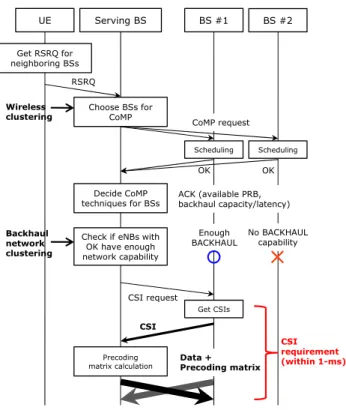
Fig. 4 CoMP system architecture used for simulation analysis. It con- sists of two main clustering steps: wireless clustering and backhaul network clustering.
2.2 Evaluation of Mobile Backhaul Access Network De- sign with Physical X2 Links for CoMP Applications In order to optimize WDM-PON architecture and proposed physical X2 links, we developed system-level simulators for CoMP applications. We consider a distributed implementa- tion of CoMP, where each BS is equipped with a CoMP sig- nal processing unit [3]. In previous work [5], we proposed a CoMP system architecture with multiple clustering steps, wireless clustering and backhaul network clustering, shown in Fig. 4. When requested for CoMP, a serving BS decides a set of cooperating BSs according to reference signal re- ceived Quality (RSRQ) feedbacks from UEs. In this step of wireless clustering, a neighboring BS giving higher RSRP to a UE has higher priority to join a cluster. The more BSs in a cluster, the higher UE throughput can be expected. There- fore we set the number of BSs in this desired wireless clus- ter as a main input parameter calledcluster size. Exploit- ing backhaul network information, a serving BS checks all BSs in a desired cluster if each BS fulfills backhaul network properties required for CoMP signal and/or data exchanges between itself and a serving BS. This procedure we call backhaul network clustering [6] starts from the strongest neighboring BS in terms of RSRP, and excludes BSs which have no enough backhaul network capability. This avoids unnecessary signaling overhead in the following CSI col- lection step. We observed a new metric,cluster feasibility, which is the ratio of BSs that fulfill the backhaul network
requirements of CoMP to the desired wireless cluster size (BSs chosen in the wireless clustering step).
For simulation, we generated more than 2000 hexag- onal cells and distributed them in a square with the inter- BS distance of 500 m. Then, neighboring BSs are grouped according to proximity and each group consists of 40 BSs which are connected via the same PON tree. The RN is con- nected to an OLT via optical fiber and we assume all OLTs are co-located in one point that we callOLT hotel. The loca- tion of the OLT hotel is determined such that the maximum transmission distance, LPON is fully exploited. We calcu- late the fiber propagation delay byLPON/(c·2/3) where c is the speed of light and 2/3 comes from the inverse of the re- fraction index (1.5) of typical single-mode optical fiber. The total IP processing delay depends on how many IP process- ing steps are done for fiber link, and we assume 0.1 ms for one IP processing node which corresponds to OLT here. If they are in different PON group, it takes two times larger, 0.2 ms. Based on the assumption that OLTs are co-located in OLT hotel and their connections are mesh-like with very fast L2 switch, we consider link latency between OLT are neg- ligible. Unlike TDM-PONs, WDM-PONs use a dedicated wavelength to each ONU, therefore link capacities of ONUs are fully independent each other. RPON is the normalized link capacity factor indicating the ratio of fiber link capacity to the average data rate required for CoMP. For simplifica- tion, we used 1 Gbps UE data rate and additional 100 Mbps CSI exchange required for multiuser MIMO. Practically, it is possible to deploy 1 Gbps, 2.5 Gbps and 5 Gbps link ca- pacity in WDM-PONs, therefore we have RPON of 1, 2.5 and 5. We also assume that downlink and uplink are sym- metric. Over entire networks, UEs are uniformly randomly distributed and only one single UE is associated to each BS.
The simulation has been repeated for 1000 different UE lo- cations and all results have been averaged to get the final results. For each simulation run, only one wireless cluster initiated by a UE in center cell is considered. In order to take into account practical large-scale fading channels for wireless clustering, we generated the shadow fading map of 61 cells where a UE mainly interested is located in the center cell [7]. A lognormal shadow fading model with the standard deviation of 8 dB is used. The shadowing correla- tions for inter-BS and intra-BS are 0.5 and 1, respectively.
The path loss model used in the simulation is PL [dB] = 128.1+37.6·log(L) whereLis distance in kilometers.
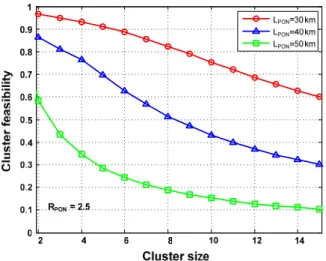
Figure 5 shows the simulated CoMP cluster feasibili- ties in conventional WDM-PONs shown in Fig. 3(A) for dif- ferent maximum transmission distance as a function of dif- ferent number of clusters.RPONis 2.5, meaning that WDM- PON link capacity is 2.5 times larger than data rate required for data exchange in CoMP. As cluster size increases, clus- ter feasibility decreases due to the increased traffic support- ing more BSs for CoMP. It also indicates that cluster fea- sibility degrades if PON coverage increases, which mainly arises from the increased propagation time for fiber trans- mission. As stated earlier, NG-PON2 are likely to be de- ployed with increased PON coverage, however the result
Fig. 5 CoMP cluster feasibilities for WDM-PONs with different maximum transmission distance.
Fig. 6 CoMP cluster feasibilities for WDM-PONs with different link capacities and maximum transmission distance.
implies that this approach may introduce a critical problem to use WDM-PONs for mobile backhaul access networks supporting CoMP.
Increasing the link capacity in WDM-PONs would be a solution to increase CoMP cluster feasibility with a min- imum of hardware upgrades. Figure 6 shows the CoMP cluster feasibility for different link capacities,RPON=1 and RPON =5. It is effective to increase link capacity for higher cluster feasibility in case of LPON = 30 km and LPON = 40 km. However, the improvement forLPON=50 km is only marginal where the limitation is dominated by long propaga- tion time in fiber transmission. This implies that we need to come up with physical X2 links, particularly for long-range WDM-PONs to support CoMP.
Figure 7 compares CoMP cluster feasibility of the pro- posed WDM-PON with physical X2 links with the conven- tional WDM-PON forLPON =50 km. We clearly see that the proposed X2 link significantly improve CoMP cluster feasibility, which would result in increased UE throughput or service quality by CoMP. It mainly comes from the fea-
Fig. 7 CoMP cluster feasibilities for conventional WDM-PON and the proposed WDM-PON with physical X2 links.
Fig. 8 CoMP cluster feasibilities as a function of wavelength tuning time in a tunable laser in the proposed physical X2 links.
ture that the proposed X2 link enables optical X2 signals to bypass via RN, resulting in shorter transmission distance and shorter latency. For multipoints-to-point transmission that is required to collect CSIs from cooperative BSs in a cluster, we assume TDMA is used with guard time of 1µsec to avoid collision.
In case that point-to-multipoints transmissions are re- quired for UE data distribution from a serving BS to sev- eral cooperating BSs, the proposed physical X2 link requires wavelength tuning whenever a destination ONU is changed.
Tuning or switching optical wavelength in a tunable laser usually takes considerable time, therefore we investigate its influence on CoMP cluster feasibility of the proposed physical X2 links. Figure 8 shows different CoMP cluster feasibilities of the proposed X2 links with different tuning times for a tunable laser. It significantly degrades as wave- length tuning time increases, which means that it is crucial to minimize wavelength tuning time to support more BSs for CoMP. Even though several works have reported tun-
able lasers with∼µsec or even nsec wavelength tuning time, most of tunable laser used in a colorless ONU in WDM- PONs have the tuning time in order of∼msec due to cost reasons. These insights suggest finding a solution that miti- gate the influence of tuning time in a tunable laser on clus- ter feasibility. For this problem, we propose a new point- to-multipoint transmission scheme that will be described in detail in the following section.
2.3 Point-to-Multipoint Transmission Scheme with the Reduced Latency in the Physical X2 Links
The main idea of the proposed transmission scheme is to use receiving BSs as transmitting BSs to forward UE data to other BSs in next transmission time slot. In the conven- tional approach for point-to-multpoints transmission in the physical X2 link, only a serving BS transmits UE data to other cooperating BSs. The proposed transmission scheme enables BSs that have received UE data in the first time slot to forward the data in the second time slot to other cooper- ating BSs that have not received UE data. Figure 9 shows the comparison between the proposed scheme and the con- ventional scheme used for analysis.
The left one is a serving BS which first chooses coop- erating BSs based on UE feedback information. In the first time slot, the serving BS sends UE data to cooperating BS with the highest priority. Transmissions for the proposed and the conventional schemes become different in the sec- ond time slot. In the conventional one, the serving BS tunes its wavelength allocated to the second highest priority BS, and sends the UE data to that BS. The proposed scheme en- ables the BS that previously received UE data to forward it to the third priority BS. In the meantime, the serving BS sends UE data to the fourth priority BS. It allows to expo- nentially increase the number of BS that have received UE data from a serving BS. In the third transmission scheme, the proposed scheme has completed transmission to 8 BSs while the conventional one has only reached 3 BSs. The required transmission time for the proposed scheme can be expressed as
Ttotal =(TT L+TD)·ceil(log2N)
whereTT Lis tunable laser tuning time,TDis data transmis- sion time,Nis the cluster size andceil( ) is a function that maps a real number to the largest previous integer. On the other hand, the time for the conventional scheme is
Ttotal =(TT L+TD)·N
These equations indicate that the difference gets larger as cluster size increases, meaning that the proposed scheme is more advantageous to support a CoMP with larger cluster.
We also simulated CoMP cluster feasibilities for the proposed and the conventional transmission schemes as shown in Fig. 10. It shows that the proposed scheme pro- vides higher cluster feasibility, particularly for larger clus- ter size. For this evaluation, a tunable laser tuning time of
Fig. 9 Comparison of the proposed and the conventional schemes for point-to-multipoint transmission in physical X2 links. TTLis tunable laser tuning time and TDis data transmission time.
Fig. 10 CoMP cluster feasibilities for the proposed and the conventional transmission schemes in the physical X2 links.
0.1 ms was assumed. We expect the proposed scheme to im- prove cluster feasibility more significantly for larger tuning time in a tunable laser because reducing number of tuning becomes more effective to keep time requirement when us- ing larger tuning time.
3. WDM-PON with Multicasting
3.1 Proposed Architecture
WDM-PONs offer virtual point-to-point links to each ONU.
This makes it difficult to use WDM-PONs for mobile back- haul access networks which need broadcasting and multi- casting capabilities. For downlink CoMP joint processing techniques, multiple BSs need to have the same UE data.
This is where we need multicasting that allows one central unit to transmit a single UE data to multiple BSs. Besides, there are several mobile applications that require multicas- ting capability, for example, paging and multimedia broad- cast multicast service (MBMS). IP layer multicasting could provide the same functionality as physical layer (L1) mul- ticasting does, however it cannot avoid the duplication of one multicast packet into several packets. This causes large network overhead, which results in inefficient network op- eration. L1 multicasting is most efficient than IP layer mul- ticasting from the viewpoint of network operations.
There have been several approaches for the implemen- tation of L1 broadcasting in WDM-PONs. One technique is to use a broadspectrum optical source at OLT [8]. It cov- ers the entire wavelength spectrum in a band, thus it can deliver one broadcasting signal to all ONUs that belong to an OLT. To avoid signal collision between the broadcast- ing wavelength and downlink wavelengths, one could utilize another wavelength band with FSR separation to the down- link/uplink wavelength band. This way of implementation is very useful to provide cable TV or broadcasting services to FTTH subscribers. For mobile backhaul access networks, however, multicasting capability is missing. For CoMP ap- plications, not every BS joins CoMP, meaning that the num- ber of cooperating BS is usually limited where the detailed number depends on several radio and network parameters.
Moreover, it is likely to have different cooperating groups of BSs serving different UEs simultaneously in a PON system.
To provide different multicasting data to different groups of BSs, a mobile backhaul access network needs multicasting capability, not broadcasting capability.
Figure 11 schematically illustrates the proposed WDM-PON with L1 multicasting. It uses an N-by-N AWG instead of N-by-1 at the OLT with a broadspectrum opti- cal source. With the help of the AWG, different optical wavelengths are spatially separated in the AWG and routed to each port according to the wavelength. An AWG used for this purpose can also be used for multiplexing and de- multiplexing of down-/uplink optical signals, so no addi- tional AWG is required for multicasting. At each output port of the AWG, an optical modulator or a switch is connected and outputs are combined into the main downlink port by a
Fig. 11 Proposed WDM-PON with L1 (physical layer) multicasting. LD is laser diode and MOD is optical modulator.
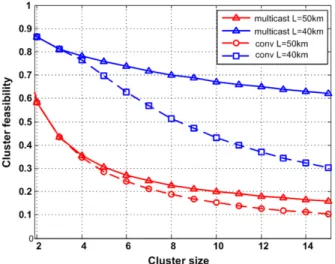
Fig. 12 CoMP cluster feasibilities for conventional WDM-PON and proposed WDM-PON with multicasting.
passive optical coupler. Using optical modulators enables to apply different multicasting data into different wavelengths allocated to different ONUs. A simpler approach is also fea- sible with applying optical switches instead of optical mod- ulators, to block transmission to ONUs not involved in mul- ticasting.
3.2 Evaluation of Mobile Backhaul Access Network De- sign with Multicasting for CoMP Applications We performed simulations of CoMP cluster feasibilities again to verify the advantage of multicasting for CoMP. Fig- ure 12 compares CoMP cluster feasibilities between a con- ventional WDM-PON and the proposed WDM-PON with the multicasting capability for LPON = 40 km and LPON
=50 km. It verifies that multicasting capability improves CoMP cluster feasibility, due to the reduced time to sequen- tially transmit single user data to multiple ONUs. It also shows that multicasting starts losing its advantage as trans- mission distance increases (LPON =50 km). As obviously seen in Fig. 7, physical X2 links are good solutions to this
problem.
4. Conclusion
We presented mobile backhaul access network designs to better support CoMP in future cellular systems. WDM- PONs have been mainly considered and the two key en- ablers, a physical X2 link and a multicasting enabled OLT architecture, are proposed to make WDM-PONs a promis- ing technologies for mobile backhaul access networks sup- porting CoMP. We verified their structural advantages of both approaches for CoMP applications by the developed CoMP system-level simulators. The results show that, using WDM-PONs with the proposed designs as mobile backhaul access networks, future radio technologies like CoMP can easily supported throughout the upcoming cellular network generations.
References
[1] M. Yabusaki, J. Widmer, and L. Scalia, “Next mobile network based on optical switching,” COIN 2010, Jeju, Korea, 2010.
[2] M. Sawahashi, Y. Kishiyama, A. Morimoto, D. Nishikawa, and M.
Tanno, “Coordinated multipoint transmission/reception techniques for LTE-Advanced,” IEEE Wireless Commun., vol.19, no.3, pp.26–34, June 2010.
[3] V. Jungnickel, L. Thiele, T. Wirth, T. Haustein, S. Schiffermuller, A.
Fork, S. Wahls, S. Jaeckel, S. Schubert, H. Gabler, C. Juchems, F.
Luhn, R. Zavrtak, H. Droste, G. Kadel, W. Kreher, J. Mueller, W.
Stoermer, and G. Wannemacher, “Coordinated multipoint trials in the downlink,” IEEE Globecom, Nov. 2009.
[4] C. Choi, Q. Wei, T. Biermann, and L. Scalia, “Mobile WDM backhaul access networks with inter-base-station links for coordinated mul- tipoint transmission and reception systems,” IEEE Globecom, Nov.
2011.
[5] C. Choi, L. Scalia, T. Biermann, and S. Mizuta, “Coordinated multi- point multiuser MIMO transmissions over backhaul-constrained mo- bile access networks,” IEEE PIMRC, Sept. 2009.
[6] T. Biermann, L. Scalia, C. Choi, H. Karl, and W. Kellere, “Backhaul network pre-clustering in cooperative mobile access networks,” IEEE WoWMoM, Sept. 2009.
[7] A. Benjeboour, M. Shirakabe, Y. Ohwatari, J. Hagiwara, and T. Ohya,
“Evaluation of user throughput for MU-MIMO coordinated wireless networks,” IEEE PIMRC, Sept. 2009.
[8] J.-H. Moon, K.-M. Choi, and C.-H. Lee, “Overlay of broadcasting signal in a WDM-PON,” Optical Fiber Communication (OFC) Con- ference, 2009.
Changsoon Choi received B.S., M.S. and Ph.D. degree in electrical and electronic engi- neering from Yonsei University, Seoul, Korea, in 1999, 2001, 2005. He is now with DO- COMO Communications Laboratory Europe GmbH, Munich, Germany, where he is work- ing on cooperative MIMO systems, energy effi- cient cellular networks and mobile backhaul net- works for LTE-Advanced and future radio ac- cess systems. His industrial affiliation includes NICT, Japan, and IHP microelectronics, Ger- many, where he worked on next-generation wireless LAN systems and wireless backhaul links for LTE-Advanced.
Thorsten Biermann received his B.S. and M.S. degree in computer science from the Uni- versity of Paderborn, Germany, in 2006 and 2008. Currently, he is pursuing Ph.D. studies on backhaul networks for Coordinated Multi-Point (CoMP) cellular systems at DOCOMO Commu- nications Laboratory Europe GmbH, Munich, Germany.
Qing Wei received B.S. of Electrical En- gineering, B.S. of Accounting from Shanghai Jiao Tong Univ., Shanghai, P.R.China in 1997.
From 1997∼1999 she worked in Philips Light- ing Electronics (Shanghai) Co. Ltd as a research engineer. In 2001, she received a M.Sc. de- gree in Communications Engineering from the Technical University of Munich, Germany with academic award. In 2002, she joined DoCoMo Euro-Labs and has been worked on QoS, active network technology, cross layer design, sensor networks, IEEE802.11 MAC and mobility management. Her current work- ing focus is next generation optical mobile network.
Kazuyuki Kozu is a research manager at DOCOMO Communications Laboratories Eu- rope GmbH. He received his B.E. and M.E.
degree from Yokohama National University in 1995 and 1997, respectively. He joined NTT DOCOMO in 1997. He has worked for NTT DOCOMO in the area of mobile core networks.
His research and development activities cov- ered designing mobile network architecture and 3GPP standardization. Since 2010, he is a mem- ber of DOCOMO Euro-labs and is involved in research on next mobile networks.
Masami Yabusaki is a president and CEO in DOCOMO Communications Laboratories Eu- rope GmbH. He received the B.S. M.S., Ph.D.
degrees in electrical engineering from Waseda University in 1982 1984, and 1993 respectively.
He joined NTT (Nippon Telegraph and Tele- phone Corporation) in 1984. He was engaged in research of on-board baseband switch for an SS-TDMA system during 1984–1987, develop- ment of switch hardware and software for PDC (Personal Digital Cellular) system during 1988–
1991, and development and standardization of third generation mobile net- work, IMT-2000 during 1992–1999. He was the CEO of DoCoMo Europe S.A. in Paris during 1998–2000. He has led All- IP network research, devel- opment and SAE (System Architecture Evolution) standardization during 2000–2008. He is currently leading the research on next mobile core net- work, network value-added services, and 5G cellular wireless. He has been promoting the RCS (Rich Communication Services) nationally and inter- nationally. In academic activity, he has served as a chairman of the mobile multimedia communication study committee in the IEICE and chairman of several special issues in the IEICE communication transaction. He has served also as a co-editor of special issues in IEEE Wireless Communica- tion Magazine and a chairman of technical and panel session in the major conferences such as ICC and Globecom. In global standardization activity, he has served as a rapporteur of ITU-T SG11 on IMT-2000 radio access signaling and as a vice-chairman of 3GPP TSG-CN on GSM evolved IMT- 2000 CN. He is now a convener of 3GPP improvement adhoc. He was awarded several prizes including the Young Engineers Award from IEICE in 1989, the Global Activity Promotion Award and the Achievement Award from ITU-AJ in 1998 and 2004, etc.