$\alpha$
-Conservative
Approximation for
Probabilistically Constrained Convex
Programs
*筑波大学・システム情報工学研究科 高野 祐一 (YuichiTakano)
Graduate School of Systems and InformationEngineering,
University ofTsukuba
中央大学・経営システムエ学科 後藤 順哉 (Jun-yaGotoh)
Department ofIndustrial and Systems Engineering,
Chuo University
Abstract
In thispaper,we addraesanapproximate$\epsilon o1_{11}tion$ofa$probabilis\cdot tically$
cootrained$\infty nvex$
program (PCCP), where a$\infty nvex$objective $h_{1}nction$is $minin\dot{u}zed$over solutions$sati\alpha fying$,
with agiven probabihty, convex cootraints that aoe parameterized by random variableg.
In order to approach to a $801_{11}tion,$ we $\Re t$ forth a $con\epsilon ervative$ approximation problem by
introducingaparameter $\alpha$ which$indicat\infty$ an approximate
ucllracy, and formulate it $a\epsilon$a
D.C.optimization problem.
A8an exampleofthe PCCP,the $Valu\triangleright at- Ri_{8}k(VaR)$ minimizationis comidered $\iota mder$
theassumptionthat theIlllpportof the probabihty of the$fl_{\mathfrak{l}}\Re ociated$random$10\epsilon\epsilon$isgiven by
afinitely largenumber$of_{\mathfrak{X}}ena\dot{n}os.$ It$i\epsilon ad_{V 1}ntag\infty u\epsilon$in aolvingthe$D.C.$optimization
that
the ntlmbers ofvariable\epsilonand cootrainttIareindependent of the nllmber of$8oenario\epsilon$,
and a
simplicialbranch-and-bound algorithm is$p_{08}ed$ to finda$\infty lution$ oftheD.C. optimization.
$N_{11mericalexperiment\S dem\circ n\epsilon tratethef\circ u_{owing:}}(i)$ by $Muf;ting$ aparameter
$\alpha,$ the
pro-$po\Re d$problemcanachieve asmaUer$VaR$than the otherconvex
aPproximation$approa\bm{t}e\epsilon$; $(\ddot{u})$whenthenumberof$\epsilon cenariosi\epsilon$large,atypical$0\cdot 1$mixedintegerformtationforthe$VaR$
$\min\dot{u}$nization cannot besolved in
areuonabletime and theimprovement of theincumbent
$va1_{11}e\epsilon$ is \S low, wherew the
propoeedmethod canuhieve agood \S olution.
$KeyWords:$ chance$con8tra\dot{m}t,$ $D.C.$ optimization, branch-and-bound, $m1u\triangleright at- ri_{f}km\dot{\bm{o}}$
i-mization, probabbtically $co\iota 1\epsilon tr\dot{u}ned$ Program.
1
Introduction
In this paper,we consIder
an
approach toa
solution oftheprobabilisticallyconstrainedconvex
program (PCCP), in which aconvexobjective function is minimized
over
constraints includinga
probabilistic constraint which imposes that thesolutionwould satisfyadesignatedportionofgiven
convex
constraints. SinceCharnes, Cooper and Symonds [5] introducedamodel involvingprobabilstic constraints,
enormous
number of such models have been studied (e.g., [9, 13]), andmostofthemare inthe fom ofthe PCCP.
Manymethodshave beenproposedto solve generalPCCPproblems, and theycanbe roughly
classified into three types: (a) nonlinearProgramming methods (see [6] for references), (b)
sce-narioapproximationbasedonMonte Carlosampling techniques(e.g., [3, 4]),and (c) conservative
aPproximation (e.g., [1, 2, 10, 11]). The type (c) $approach\propto$ buildan altemative tractable
opti-mizationproblem whose feasiblesetis containedinthat ofthe PCCP. In particular, Nemirovski
andShapiro [11] considera
convex
conservativeapproach tothegeneralPCCP. However, suchaconservative approachfaces a criticism that the solution is excessively conservative. For
exam-ple, in the numerical illustration of [11], although a solution is allowedto take up to 5% of the
associated probability, the obtained solution achieves only less than 1%, which indicates that
the solution was too conservative to be a good approximationfor the global optimality ofthe
original problem.
In this raeearch, motivat\’e by [11], we cooider acooervative approximation approach to
thePCCP, and apply it tothe minimizationofthe$Valu\triangleright at- Risk(VaR)$ of afinancial portfolio
byemploying $determini_{8}tic$ global optimizationalgorithms. By introducing aparmeter which
$indicat\infty$ theconservativenaes (or, equivalently,approximation
accuracy), the$r\infty \bm{t}ting$problem
has
anonconvex
feasible region rePre8ent\’e bythe differenoeof twoconvex
set8, or an$in\eta ual-$$itycon8tra\dot{\bm{o}}t$ whose Ieft-hand side is given by the differenoe of two
convex
functions. These
formulatioo areknown astheD.C. formulation, and severalglobal orlocal solution algorithm8
have beendevelop\’e ($8ae$ ffiy [15], for example). Many of$D.C.$ algorithmscan achieve
aglob-ally optimal solution in practical time oty when the number of $varIabl\infty$ associat\’e with the
nonconvexity $i8$ relatively smag ([8]). Anice point of the propoeed
$D.C.$ fomulation is that
the degroe ofthe nonconvexIty is almost independent of the number ofscenarioe, which
con-trasts with thefact that the typical $MIP$ fomulation requirae 0-1 $variabl\infty$with the number of
$s\infty narios$
.
Abranch-and-bound
algorithm is pos\’e tosolve the
nonconvex
progr$m,$ $rd$some
comparative computational$r\propto ults$will be given, praeenting the perfomance and
iaracteristioe
ofthe $prop\propto ed$algorithm.
The rest of the paper is organized as follows. In Section 2, the
convex
conservativeap-proximation of [11] is briefly explained, and a new conservative approximation is introduced.
Section 3 explains the VaR minimization andpresents the formulationof the proposed
conser-vative aPproximation. Section 4 is devoted to a $branch-and$-bound algorithm for solving the
new
aPproximation problem of the VaR minimization. Also, aremark will be provided on theapplication of
an
outer aPproximation algorithm. In Section 5, computational experiment8are
proeent\’e, showing the comparative superiority of theproposed approach.
2
Probabilistically
Constrained
Convex
Program and
$\alpha$-Conservative
Approximation
In this section, we first formulate the probabilistically constrained
convex
program and next2.1 $\alpha$
-conservative
aPproximation problem ofPCCP
A probabilistically constrained
convex
program (PCCP) is formulatedas thefollowingoptimiza-tion problem:
(PCCP) $|^{\min imize}subjecttoae\in R^{\hslash}$
$Prob\{g(x,\tilde{\xi})>0\}x\in Xf(x)\leq 1-\beta$
,
(1)
where
$x$ : decision variable,$x\in R^{n}$
$X$ : closed convexset whichrepresents a feasibleset of
$x,$ $X\subseteq R$“
$f$ : objective function which is assumed to be
convex
in$x,$ $f:R^{n}arrow R$
$\tilde{\xi}$ : $d$dimensionalreal random vector (tilde (“‘) denotes random
variables)
$\Xi$ : support of random variable $\xi,$ $\Xi\subseteq R^{d}$
Prob : probability measure, $Prob\{F\}$ denotesprobability ofan event $F$
9 : function which is convex in $x$ for anyfixed $\tilde{\xi}\in\Xi,$ $g:R^{n}xR^{d}arrow R$
$\beta$ : user-defined parameter forrepresenting aconfidencelevel,
$\beta\in(0,1)$
andthe constraint
$VP(x)$ $:=Prob\{g(x,\xi)>0\}\leq 1-\beta$ (2)
is referred to as the probabihstic constraintor the chance constraint, and the left-hand side of
the constraint is called the violationprobabihty. Intuitively, this constraint forces $g(x,\xi)$ tobe
non-positivewith probability $\beta$
.
The function9 is here assumed to be scalar-valued without loss
of generality. Indeed, if the probabilistic constraint is repraeent\’e as $Prob\{g_{i}(x, \xi)\leq 0,$ $\forall i=$
$1,$$\ldots,\ell$
}
$\geq\beta$, and the functions$g_{i}$ are convex in $x$ for any fixed $\tilde{\xi}$,then this can be converted
into aconstraint (2) by putting$g(x,\tilde{\xi})$ $:= \max\{g_{i}(x,\tilde{\xi})|i=1, \ldots, \ell\}$.
Though functions $f$ and 9 are
convex
in $x$ (for any fixed $\xi$), this problem hasnonconvex
feasible region in general, and consequently, is intractable
as
mentioned in Introduction. Inparticular,it may havemultiplelocal minima when thesupportof the associatedprobabilitiesis
given byaflnitesetof scenarios. In ordertotame such adifficulty arising fromthe nonconvexity,
Nemirovski and Shapiro [11] introducea
convex
conservative aPproximation, $pr\infty enting$a convexoptimization problem which provides a feasible solution of theoriginal problem (1). Although
theirapproachenjoys theconvexstructure,the distance totheoriginal problem (1) is not clear.
In this paper, weextend the conservative approach by relinquishing to keep convexity, and next
In [11], an conservativeconstraint of the form
$\inf\{tE[\psi(\frac{1}{t}g(x,\xi))]-t(1-\beta)|t>0\}\leq 0$ (3)
is adopted in place of the probabilistic constraint (2) of Problem (1), and this is shown to
be a
convex
conservative constraint in $x$.
Though the left-hand side of the constraint (3) isrepresented via an optimization
over
$t>0$,
the resulting conservative approximation problemcan
be solved viaan one-level (nonlinear)convex
optimizationdueto the convexity:$| \min_{\approx,t}imizef(x)$ subject to $x\in X,$ $t E[\psi(\frac{1}{t}9(x,\tilde{\xi}))]-t(1-\beta)\leq 0,$ $t\geq 0$
.
(4)A criticism of this approach focusesonthe fact that the obtained solutioncan betoo
conser-vative in tems ofviolation probability $VP(\cdot)$, that is, it can provide asolution with violation
probabihty much smaller than $1-\beta$
.
In order toovercome
this drawback, they propoee astrategy of iteratively solving this problem by replacing$\beta$ with a smaller value$\beta^{-}$ in (4) until
the violation probabihty will become as close as $1-\beta$
.
Although this strategymay succeed infindinga feasible solution to theoriginal problem(1) with higher violation probability, there is
a possibility that the obtained objective value has much larger than the optimal value of the
original problem (1).
In contrast totheir strategy, webelowintroduce a newapproximation approach toProblem
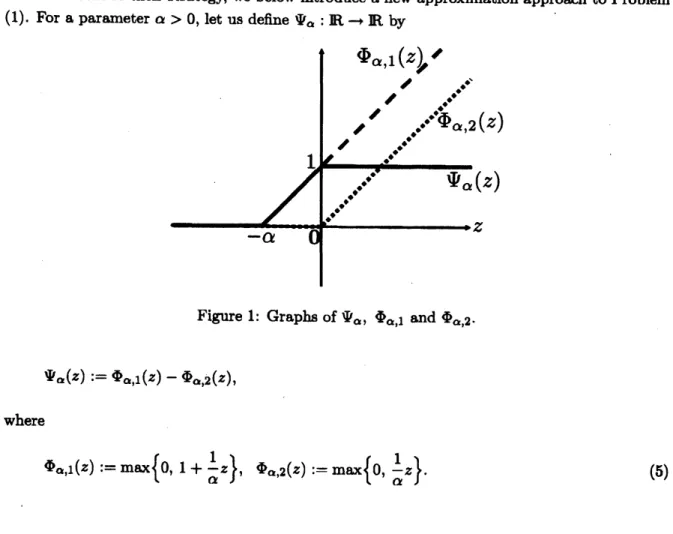
(1). For aparameter$\alpha>0$, let us define $\Psi_{\alpha}$ : $Rarrow R$ by
Figure 1: Graphs of$\Psi_{\alpha},$ $\Phi_{\alpha,1}$ and $\Phi_{\alpha,2}$.
$\Psi_{\alpha}(z)$ $:=\Phi_{\alpha,1}(z)-\Phi_{\alpha,2}(z)$,
where
For a scalar valued random variable $\tilde{Z}$,
one
then has
$E[\Psi_{\alpha}(\tilde{Z})]\geq E[1_{[0,+\infty)}(\tilde{Z})]=Prob\{\tilde{Z}\geq 0\}\geq Prob\{\tilde{Z}>0\}$,
where $E[\cdot]$ is the mathematical exp$e$ctation operator, and $1_{A}$ : $Rarrow\{0,1\}$ is the indicator
function ofaset $A$, i.e.,
$1_{A}(z)$ $:=\{\begin{array}{ll}1 if z\in A0 if z\not\in A.\end{array}$
From this relation, bytaking $\tilde{Z}=g(x,\tilde{\xi})$, it is clearthat
$\{x\in R|E[\Psi_{\alpha}(g(x,\xi))]\leq 1-\beta\}\subseteq\{x\in R^{n}|VP(x)\leq 1-\beta\}$
.
Consequently, weobtain an another conservativeapproximation problem:
(CAP$(\alpha)$) $|^{\ovalbox{\tt\small REJECT} e}subjaettox\in R^{n}$
$E[\Psi_{\alpha}(g(x,\tilde{\xi}))]x\in Xf(x)=E[\Phi_{\alpha,1}(g(x,\tilde{\xi}))]-E[\Phi_{\alpha,2}(g(x,\tilde{\xi}))]\leq 1-\beta$
.
(6)
Werefertothis problemas$\alpha$-conservative aPpmnimation problemof(1), and
thenewconstraint
as$\alpha$-conservative apprormationconstraintof (2). Itshouldbenotedthat both
$E[\Phi_{\alpha,1}(g(x,\xi))]$
and$E[\Phi_{a,2}(g(x,\tilde{\xi}))]$
are
convex
in $x$ since both $\Phi_{\alpha,1}$ and $\Phi_{\alpha,2}$ arenondecreasin$g$convex
func-tions, and$ac\infty rd\dot{m}$gly,$E[\Psi_{\alpha}(g(x,\tilde{\xi}))]$ isaD.C. functionandProblem (6) isaD.C. optimization
problem, for whichseveralglobal optimizationalgorithms have been developed (e.g. Tuy [15]).
3
Portfolio Selection via Value-at-Risk
Minimization
In this section, we fomulate the minimization of the Value-at-Risk $(VaR)$ of a financial asset
portfolio as an example of the PCCP.
The VaRminimizationofafinancialassetportfolioistodetermine theamountofinvestment
(orinvestmentratio) to$N$kin$ds$offinancial assetsso thatit achievestheninimum$\beta-VaR$, which
is defined as the -quantileof the loss distribution of the portfolio. Fomally, it is fomulated
as the followingoptimization problem:
$|^{(oe,m)\in R^{N}xR}subjaettom\dot{\bm{o}}imize$
$mProb\{x^{T}\tilde{y}-m>0\}\leq 1-\beta x\in.X$ (7)
$x$ : investment ratio to$N$ kinds offinancial assets (decision variable), $x\in R^{N}$
$m$ : VaR (decision variable), $m\in R$
$X$ : set of
feasible
portfolio$x,$ $X\subseteq R^{N}$
$\tilde{y}$ : $N$dimensional random vector representing the
lossassociat$ed$with the financial assets
$\beta$ : confidence level,
$\beta\in(0,1)$
.
Therandom loss$\tilde{y}$is sometimes definedas $(-1)x$(rate
ofreturn),“ andbesides,the
Probabbtic
constraint in Problem (7) $imp\propto oe$ that the probability of the portfolio loss being greater than
$m$ isno more than $1-\beta$
.
In the rest part of the paper, we assume that thesupport of the random loss $\tilde{y}$ is given by
a finiteset ofscenarios $\{y^{*}\}_{e\in S}$, and let
Assumption 1 $p_{*};=Prob\{\tilde{y}=y^{l}\}$, where
$\sum_{\in S}p_{l}=1$ and$p_{*}>0$
for
all$s\in S$, and$|S|<\infty.\star$It is worth noting that this assumptionispractical especially when the scenariosare generated
from a (non-nomal) distribution. Rrthemore, we assumethe following:
Assumption 2 The
feasible
rqion$X$of
$x$ is a polytope. $\star$This assumption seems reasonable since the constraints $1^{T}x=1$ and $x\geq 0$ are included in
many practicalsituations, and many otherconstraints are $repr\propto entable$bylinear inequalities.
Themost typical way to an exact solution ofProblem (7) is to equivalentlyfomulate it as
a0-1 mixedinteger program;
$|(ae,m,u)\in R^{N}xRxR^{|s|}mi\dot{m}mizesubjaetto$
$x^{T}y^{l}x \in X\sum_{\epsilon\in S}^{m}p_{l}u_{l}\leq 1-\beta-m\leq\overline{M}u_{\iota},$
$u_{\epsilon}\in\{0,1\}$, $\forall s\in S$,
(8)
where$\overline{M}$
isasufficientlylargenumbersatisfying$\overline{M}>\max\{x^{T}y^{l}|x\in X, s\in S\}-$
mm
$\{x^{T}y^{l}|x\in$$X,$ $s\in S$
}.
It should be notedthat the number of kl variables$u_{l}$ is equaltothat of scenarios,
i.e., $|S|$
.
In the following sections,weconsider the$\alpha$-conservative approximation ofProblem(7)under
Assumptions 1 and 2.
$|(x,m)\in R^{N}xRminimizesubjaetto$
$x \in X\sum_{a\in S}^{m}p_{l}\Phi_{\alpha,1}(x^{T}y^{\iota}-m)-\sum_{\iota\in S}p_{*}\Phi_{\alpha,2}(x^{T}y^{l}-m)\leq 1-\beta$
.
4
Global
Optimization Algorithms
In this section, asimplicial branch-and-bound algorithm is presented for computing aglobally
optimal solution of Problem (9). Also, a remark on application of an outer approximation
algorithm will be provided.
4.1 Simplicial $Branch-and$
-Bound
AlgorithmsBy denoting
$h^{D}(x,m):= \sum_{\epsilon\in S}p_{\iota}\Phi_{\alpha,1}(x^{T}y-m)$, $h^{C}(x,m):= \sum_{\iota\in S}p_{*}\Phi_{\alpha,2}(x^{T}y^{l}-m)$,
Problem (9) can be rewritten as
$|(x,m)\in R^{N}xRminimizem$ subject to $x\in X,$ $h^{D}(x,m)-h^{C}(x,m)\leq 1-\beta$
.
(10)Let $M\subset R^{N+1}$ beasimplex, andlet $\{v^{M,1},v^{M,2}, \ldots,v^{M,N+2}\}$beaset of
verticesof$M$
.
For$M$, we consider
$(RSP(M))|^{\min imize}subjectto\lambda\in R^{N+3}$
$h \sum_{N+2}^{N+2}\lambda_{*}\cdot v_{N}^{M}\sum_{=:_{D}1}^{i--1}\lambda.\cdot v^{M,i}\in Xx[m_{L},m_{U}],\lambda\geq 0,$
$1^{T} \lambda=1(\sum_{:=1}^{1}\lambda.v^{M,i})-\sum_{=1}^{N+2}\lambda_{1}h^{C}(v^{M,i})\leq 1-\beta N+2\dotplus.’$ (11)
where$m\iota$ and $m_{U}$ are, respectively, lower and upper bounds onthe optimal objective value of
Problem (10).
It is easy to see that $RSP(M)$ is arelaxed subproblem of Problem (10) over a simplex $M$,
providing a lower bound on the objective value ofProblem (10) over $M$
.
Technically, $m_{L}$ canbe computed via an algorithm of Pang and Leyffer [12], for example, and $m$ of any feasible
solution $(x,m)$ can be employed as $m_{U}$, whereas, in the experiments reported in Section 5, we
used sufficiently small and largenumbers as $m_{L}$ and$m_{U}$, respectively.
The $\dot{\bm{o}}$itial simplex $M_{0}$ is set up so that
$M_{0}\supseteq Xx[m_{L}, m_{U}]$ and an optimal solution of
Problem (10) is contained in $M_{0}$
.
For such $M_{0}$, we solve $RSP(M_{0})$, obtaining a lower boundon
the optimal value of Problem (10). It should be noted that onecan
easily find a feasiblesolution of Problem (10) if any $x\in X$ is available because, for any $x\in X$, sufficiently large
$m$ satisfies the D.C. inequality. In addition, due to the monotonicity of the left-hand side of
the D.C. inequality with respect to $m$, we canfind $m$ satisfying the inequality at equality and
optimal value). We then split the simplex $M_{0}$ into two simplices $M_{1}$ and $M_{2}$ by dividing at
the middle point of the longest edge, and compute lower bounds over $M_{1}$ and $M_{2}$ by solving
$RSP(M_{1})$ and $RSP(M_{2})$, respectively. Ifone ofthe two subproblems findsa feasible solutionof
Problem (10) with objective value smaller than the incumbent, the incumbent is updated with
the better solution. If the lower bound
on
each simplex is no less than the incumbent value,the corresponding simplex is discardedbecause such asimplex is guaranteed to havenobetter
solution.
In the followingstep ofthe algorithm, as long as any simplex remains tobe considered, we
choose asimplex$M$with the lowest lower bound and bisect $M$, i.e.,splt$M$ at the middle of the
longest edge, generating two simplices inplaceof$M$ (branching procedure). For the two simplices,
say, $M’$ and$M”$, the lower bounds
are
computed bysolving $RSP(M’)$ and $RSP(M”)$.
If
one
ofthem attains a better feasible solution of Problem (10), the incumbent solution is updated by
the solution. Let $\gamma$ be the incumbent objective value, i.e., the best objective value obtained so
far. Ifthelower bound on asimplex$M$is
no
less than$\gamma$,wediscard it from further consideration(bounding pfocedufe). Ifthere isno simplex to be considered, the algorithmteminates and the
global optimalityis guaranteed.
4.2
On
the Computation of the Relaxed ProblemIn the above $branch-and$-bound scheme, each relaxed problem $RSP(M)$ on a simplex $M$ is a
convex
programwithasingle nonlinear constraint $h^{D}( \sum_{1=1}^{N+2}\lambda:v^{M,i})-\sum_{1=1}^{N+2}\lambda_{i}h^{C}(v^{M,i})\leq 1-\beta$where $h^{D}( \sum_{1=1}^{N+2}\lambda_{i}v^{M,i})$ is
a
convex
andpiecewiselinear functionin $\lambda$
.
Accordngly, we employ LP based subroutines for computing the lower bound. The first
strategy “Linear Relaxation”
uses
apartoflinear functions which coincides with $h^{D}$ at extremepoints and the center ofeach simplex. Thisstrategy provides a relaxed solutionofthe relaxed
problem$RSP(M)$whilethe sizeof theresulting LP isstillindependent of the number ofscenarios.
Anotherstrategy “Kelly’sMethod” isastraightforward application ofthewell-knownKelly’s
cuttingplaneidea. Thisstrategycancomputetherelaxed problem$RSP(M)$inanexactmanner,
and accordingly, it may deal with a number ofcootraints in the order of scenarios. However,
this strategy is expected to work efficiently because it brings in needed constraints effectively,
and the efficient dual simplex algorithm
can
be adopted when a linear \infty otraint is added ateachiteration.
Remark 1 (On the Application
of
the Outer Appro rimation Method) The second approach to$\pi$, Problem (9) can be rewritten as follows;
$|(oe,m,\pi)\in R^{N}xRxRsubj\bm{r}ttominimize$
$l \in Sx\in Xm\sum_{\iota\in S}^{\iota\alpha,1(x^{T}y^{s}-m)-\pi\leq 1-\beta}\sum p\Phi p_{l}\Phi_{\alpha,2}(x^{T}y^{l}-m)-\pi\geq 0$
.
(12)
By introducing twosets in$R^{N+2}$ defined by
$D$ $:=\{(x,m,\pi)|x\in X,$ $g^{D}(x,m,\pi)\leq 0\}$, $C$
$:=\{(x,m,\pi)|g^{C}(x,m,\pi)\leq 0\}$,
where $g^{D}(x,m,\pi):=h^{D}(x,m)-\pi-(1-\beta)$ and $g^{C}(x,m,\pi)$ $:=h^{C}(x,m)-\pi$, Problm (12)
can becooider\’e as the following D.C. program:
$|minimizexR\cross Rm$ subject to $(x,m,\pi)\in D\backslash intC$, (13)
where Int$C$ is the interior of $C$
.
We apply an outer aPproximation method described in [15]to the formulation(13). Through some preliminary computational experiment, this method is
found to be inferiorto the simplicIal
branch-and-bound
method which is combined with severalstrategies, and therefore, theexplanation andexperimental result of this methodareomitted in
this article. $\star$
5
Computational Experiments
In this section, we report
some
numerical results of the VaR min$imi_{\mathbb{Z}}ation$ algorithms. Weconsider the minimization of the VaR ofa portfolioconsistingof five aesets where theloss $\tilde{y}_{1}$ of
asset$i$ isgiven as anindependent random
variable, and it isfomulatedas thefollowingPCCP:
$|subjectto(a,m)\in R^{N}xRminimize$
$|=10_{N} \leq x\sum_{Prob}^{m}X_{1}=1,.\sum_{=1}^{N}\mu.\cdot x_{*}\geq 1.2\{X_{1\tilde{y}_{i}-}\iota\leq 0.49,i.=1,\ldots,$
$N$
.
(14)
where $N=5$
,
and $\mu_{i}$ is the expected return of$a8seti$, and weset $\mu_{i}=1.25$ ($i$ is odd) or 1.1 $(i$iseven). The loss scenarios of aesets 1 and 2 are generated from a Cauchy distribution where
the location ofthe peak of the density is $0$, and the half-width at half-maximum is 2. On the
the interval $[-12.5,12.5]$. Weconsider three cases 100, 1,000, 10,000 for the scenariosize $|S|$,
and assume $p_{s};=\beta^{1}\lceil$ for all $s\in S$.
We implemented five approaches to a solution of Problem (14): (a) the propos\’e
branch-and-boundalgorithm with linear relaxation, (b) theproposed
branch-and-bound
algorithm withKelly’smethod, (c) the
convex
aPproximation (4) byNemirovski and Shapiro [11] using$\psi(z)=$$\max\{0,1+z\},$ $(d)$ the CVaR minimization, (e) the typical
MIP fomulation (8) to Problem
(14), and we compare these in terms of the resulting $VaR(x^{*})$ and the violation Probability
$VP(x^{*},m^{*}):=Prob\{(x^{*})^{T}\tilde{y}-m^{*}>0\}$ of the obtained solution $(x^{*},m^{*})$
.
$(a)$ and (b) arethe
Proposed simplicial
branch-and-bound
algorithms, andsolvethe relaxedsubproblemby the tworelaxation strategies, and we set $\epsilon=0.5$ as the tolerance for optimality. Incumbent
solutions
are
updat\’e via the VaR evaluationrule and thesubroutine for searching a feasible solution isemployed in the proposed algorithms. Detailed explanation of them is omitted in this article
for lack of space. (d) is the Conditional Valueat-Risk $(CVaR)$ minimization fomulated as the
following LP ([14]):
$|(x,m,\tau)\in R^{N}xRxR^{|S|}subjectto\ovalbox{\tt\small REJECT} e$ $\tau_{l}\geq 0,r_{l}\geq x^{T}y^{l}-mx\in Xm+\frac{1}{1-\beta}\sum_{\epsilon\in S}p_{*}r_{l}$
$\forall s\in S$
.
(15)
Accordin$g$to [14],the$\beta- CVaR$
can
be approximately regarded as the conditionalexpectationof
the loss exceeding the$\beta- VaR$, and for $\beta$ closeto one, the $\beta$-CVaRminimizer is expected to be
similarto the $\beta-$-VaRminimizer.
All $\infty mputations$areconductedonapersonal computerwithPentium4
procaesor(3.4 GHz)
and 2 GB memory. MATLAB R2006b with optimization toolbox is employed for
implement-ing the proposed algorithms and the
convex
approximation, while the LP (15) for the CVaRminimizationand the MIP
fomulation
are solved by using$Xpr\infty\epsilon-MP$ release $2006B$.
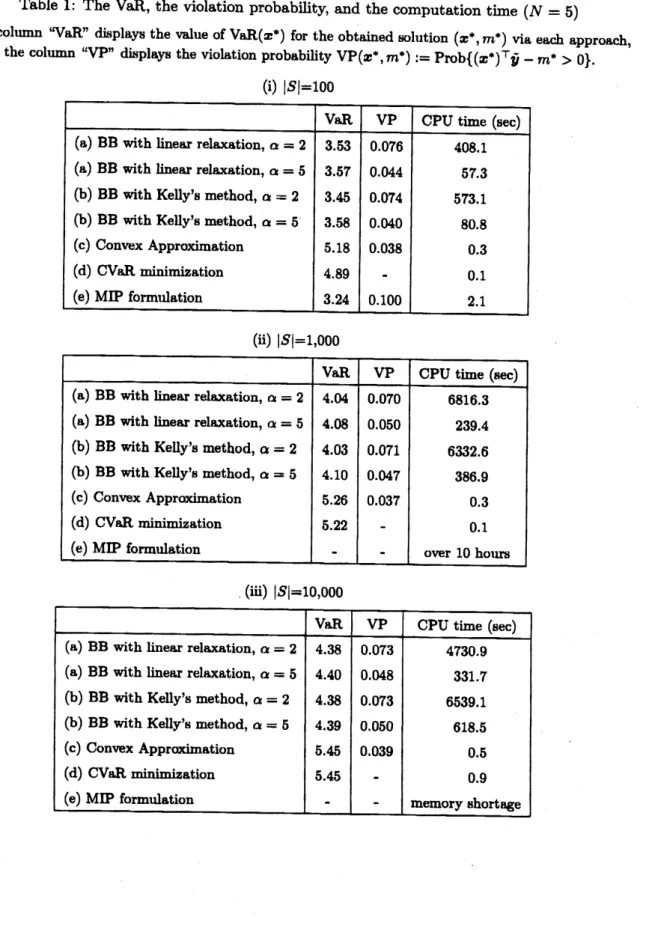
Tables 1 (i) to (ili) show the computational results, each table corresponding to
one
ofthe three scenario sizes $|S|=100$, 1,000 and 10,000. All the values show the average of five
experiments, each using different scenario set, but generated from the identical distribution
mentioned above. When $|S|=100$, the MIP fomulation quickly achieves the VaR in an exact
manner.
However, when $|S|=1,000$ and 10,000, the MIP fomulation cannot be solved withln10 hours or results in memory shortage. On the other hand, the proposed algorithms which
attain better solutions than that ofthe
convex
approximation (c) and the CVaR minimization(d). $Mor\infty ver$, ifaPproximation accuracy
$\alpha$ is relaxed from 2 to 5, CPU
timedecreasessharply
whereas thedifference of the achiev\’eVaRs is small. This tendency motivatesus to reducethe
computation timeby relaxing theapproximationaccuracy. When $|S|=10,0m$
,
CPU timeoftheproposed algorithmsdoes not changeso much comparedwith that in the
case
of$|S|=1,000$.
Itmay be worthmentioningthat whenaPproximation wcuracy$\alpha$ issosmall orthenumber
Table 1: The $VaR$, the violation probabihty, and thecomputation time $(N=5)$
The column $VaR$’ displays the value of
$VaR(x^{*})$ for theobtained solution $(x^{*}, m^{*})$ via each approach,
since the siz$e$ ofbranch-and-bound tree becomes larger owing to the excessIvely relaxed linear
relaxation. Besides, it is noted that the resulting VaR of the
convex
approximation is no lessthan that of the CVaR minimization in a\"u the results.
6
Conclusion
In this paper, we construct the $\alpha$-conservative approximation problem of the Probabilistically
constrained
convex
program(PCCP), andshow thatitcanbe fomulatedas a D.Coptimizationproblem. It is$advantag\infty us$that the number of (sampled) scenarios doesnotaffect thenumber
ofvariables
or
constraints while it doesnothold inthe MIP fomulation whichrequiresanumberof Ol variables, each$\infty rr\infty pond_{\dot{i}}g$to
one
scenario.Although solving
a
genuine D.C. problem ina
deteministicmanner
is known to be veryhard, severalalgorithms areshown to haveapotential to solve theproblemespecially when the
number of variables concerned with the nonconvexity is up to ten (see, e.g., [8]).
In this paper, the simplcial $bran\bm{i}-and$-bound method which is a famous deterministic
algorithms for achieving a globally optimal solution is mainly investigated, and is applied to
the VaR minimization of a financial portfolio. Through the numerical experiments,
we
showthecomparative superiority ofthe proposed approach. Although, when the number of assets is
hundredormore,the problem clearlybecomes (prohibitively)hardand this
nonconvex
approachmaynot lookappealing,itisworth noting that the number of scenarios is criticalfor theaccuracy
ofthesolution, and the number of scenariosrequiredforsufficient accuracy drastically increases
asthe number ofassetsgrows.
Acknowledgment
Research of the first author is support\’e by MEXT Grant-in-Aid for Young Scientists (B)
17710125, andDash Optimizationprovides
XPrae8-MP
used in the computational experiment8.References
[1] A. Ben-Ihl and A. Nemirovski, ”Robust solutions ofLinear Programming problems
con-$tam\dot{\bm{o}}$ated with uncertain data,” Mathematical Programming,
88, 411-424 (200).
[2] D. Bertsimas and M. Sim, “Price
ofRobustness,” Operations Research, 52, 35-53 (2004).
[3] G. Calafiore and M. C. Campi, “Decision making inan
$uncert\dot{u}n$environment: the
scenario-basedoptimization approach,” In Multiple Participant Decision Making, J. Andrysek, M.
Kgnyand J. Kracik (Eds.), Advanced KnowledgeInternational,
99-111
(2004).[4] G. Calafiore and M. C. Campi, “Uncertain convex
programs: randomized solutions and
[5] A. Charnes, W.W. Cooper and G.H. Symonds, “Cost horizons and certainty equivalents:
an approach to stochastic programming ofheating oil,” Management Science, 4, 235-263
(1958).
[6] D. Dentcheva, “Optimization Models with Probabilistic Constraints,” In Probabilistic and
Randomized Methods
for
Design under Uncertainty, G. Calafiore and F. Dabbene (Eds.),Springer, London, $4k97$ (2006).
[7] J.Gotoh andY. Ihlmo, “
$\alpha$-ConservativeApproximationfor ProbabilisticallyCootrain\’e
ConvexPrograms,” Discussion paper, Chuo University (2007).
[8] H. Konno, P. T. Thach and H. Tuy, Optimization on Low Rank Nonconvex Structures,
Kluwer Academic Publishers (1997).
[9] L. B. Miller and H. Wagner, “Chance constrained programming with Joint constraints,”
Operations Research, 13, 930-945 (1965).
[10] A. Nemirovski, “On tractable approximations of randomlyperturbed convexcootraints,”
Proceedings
of
the $42nd$ IEEEConference
on Decision and Control, 3, 2419-2422 (2003).[11] A. Nemirovski and A. Shapiro, “Convex Approximations of Chance Constrained
Pro-grams,” SIAM Joumal on Optimization, 17, 969-996 (2006).
[12] J.S. Pang andS.Leyffer, “OntheGlobalMinimization ofthe Valueat-Risk,” Optimization
Methods and Software, 19, 611-631 (2004).
[13] A. Pr\’ekopa, On Probabilistic Constrained Programming, Proceedings
of
the PnncetonSymposium on Mathematical Programming, Princeton University Press, Princeton,
113-138 (1970).
[14] R. T. RockafellarandS.Uryasev, “Conditional$valu\triangleright at$-risk for general lossdistributions,”
$Jo$umal