Enumerating Maximal Clique Sets with K-plex Constraint
by using Meta-cliques
Hongjie Zhai
∗1Makoto Haraguchi
∗1Yoshiaki Okubo
∗1Etsuji Tomita
∗2 ∗1Graduate School of Information Science and Technology, Hokkaido University
∗2
The Advanced Algorithms Resaerch Laboratory, UEC Tokyo
Many variants of pseudo-cliques have been introduced as relaxation models of cliques to detect communities in real world networks. For most types of pseudo-cliques, enumeration algorithms can be designed just similar to maximal clique enumerator. However, the problem of enumerating pseudo-cliques are computationally hard, because the number of maximal pseudo-cliques is huge in general. Furthermore, because of the weak requirement of k-plex, sparse communities are also allowed depending on the parameter k. To obtain a class of more dense pseudo cliques and to improve the computational performance, we introdue a derived graph whose vertices are cliques in the original input graph. Then our target must be cliques or pseudo cliques of the derived graph under an additional constraint requiring high density in the original graph. An enumerator for this new class is designed and its computational efficientcy is experimentally verfied.
1.
Introduction
For graph theory, cliques are subgraphs in which all ver-tices connect to each other. It is usually used to detect densely connected communities. However, for real-world datasets, there exist many noises to make dense communi-ties not to be cliques. The strict definition of clique is not suited for real applications. To address this issue, many relaxation models of clique, also called pseudo-cliques, are introduced [3]. Every pseudo-clique model weaken some re-quirements of clique. k-clique and k-clan are defined by weakening reachability. k-core, k-plex are defined by relax-ing the requirement of closeness. In cases of k-cores and k-plexes, some vertices may not be connected. In this pa-per, we will mainly discuss k-plex.
K-plex was introduced by Seidman [1]. K-plex is a sub-graph in which each member is connected to at least n− k other members. When k = 1, k-plex becomes clique. For k-plex model with small k values as (k = 2, 3), k-plexes can detect the densely connected subgraphs. However, when k grows larger, sparse graph such as chain or circle will become k-plexes. The number of k-plexes also grows ex-ponentially. Even though clique enumeration can be done efficiently, the task of finding all the maximal k-plexes for larger k is actually impractical, because k-plex allows much more combinations of vertices than clique.
In this paper, our target is to obtain densely connected k-plexes with cliques as their components, inluding overlap-ping cliques in paper [8]. We consider the k-plexes are only combined from maximal cliques whose size is larger than a given lower bound. In other words, the target of this paper is to detect the maximal clique sets under the k-plex con-Contact: Zhai Hongjie
Kita 14, Nishi 9, Kita-ku, Sapporo, Hokkaido, 060-0814 Graduate School of Information Science and Technol-ogy, Hokkaido University
E-mail: [email protected]
straint. By introducing the concept of k-Maximal-Clique-Set(k-MCS) and k-clique-graph, maximal clique sets can be found efficiently with a simple algorithm. Moreover, to ex-clude the k-plexes which have sparsely connected core, we also introduce bond measure as an extra constraint into our algorithm. The bond constraint can cut off most combina-tion of sparsely connected k-plexes with small “cores”. The rest of this paper is organized as follows. Basic definitions, notations are presented in Section 2.1. Section 2.2 presents the basic idea of k-MCS and k-clique-graph. Our algorithms are given in Section 2.3 and an additional constraint called bond measure is introduced in Section 2.4. We also show experiments of our algorithms in Section 3. Finally the pa-per is concluded with a summary and direction for future works.
2.
Proposed Method
2.1 Notations
Let G = (V, E) be a simple undirected graph. Vertices V ={v1, v2, . . . , vn} and edges E = {e1, e2, . . . , em}. |G|
denotes the number of vertices in G. A subset of vertices c⊆ V is a clique if all the pairs of vertices are connected to each other. A clique is maximal if it is not a proper subset of another cliques. C(G) ={c1, c2, . . . , cj} denotes all the
maximal cilques of G, and all its members are sorted by size so that|c1| ≥ |c2| ≥ · · · ≥ |cj|. The problem of enumerating
all maximal cliques is “Maximal Clique Problem” and the base algorithm is called BK which was first introduced in 1973 [2].
Definition 1 A subset of vertices S ⊆ V is a k-plex if
degG[S](v)≥ |S| − k for every vertex v in S.
A k-plex is called maximal if it is not a proper subgraph of other k-plex. Because of the weak requirement of k-plexes, target vertices are not guranteed to be connected. k-plex is anti-monotonic, it means that if vertices set X is k-plex, for any subset Y ⊂ X, ∀x ∈ X − Y , {x} ∪ Y is also a k-plex.
1
The 29th Annual Conference of the Japanese Society for Artificial Intelligence, 2015
Definition 2 A subset of cliques T ⊆ C(G) is a k-MCS if
for T = {ca, cb, . . . , cu} (a ≤ j, b ≤ j, . . . , u ≤ j), vertices
set ca∪ cb∪ · · · ∪ cu is a k-plex in G.
A k-MCS is maximal if it is not a proper subgraph of any other k-MCS. But it is clear that maximal k-MCSes are not always maximal plexes in graph G. Different maximal k-MCS may represent the same vertices set in G. Eventhough deleting duplicated point can be easily done as post-process, here we still treat them as different k-MCS. According to the definition, k-MCS is also anti-monotonic. From now on, we will say a clique set C ={ca, cb, . . . , cu} is a k-plex in G
by meaning ca∪ cb∪ · · · ∪ cuis a k-plex in G.
2.2 Basic Idea
For a given graph G, integer k and size parameter L, we enumerate all the maximal cliques ciin G with constraint
|ci| ≥ L and search for all the maximal k-MCSes based on
this clique set. If L = 1, we are using all the maximal cliques. Size constraints on cliques is extremely useful for the graphs that contain large amount of triangles or soli-tude vertices. We should also point out that enumerating all maximal k-MCSes equals the process that searching for all maximal k-plexes on a graph in which all the vertices are cliques. To give a clear state, we have the following definition:
Definition 3 A graph CG = (CV, CE) is called
k-clique-graph if every vertex ci ∈ CV is a clique in graph G and
an edge exists between two vertices ci and cj if and only if
ci∪ cj is a k-MCS.
According to Definition 3, only the pairs that can be k-plexes are connected to each other. From anti-monotonicity of k-MCS, we know that for a vertices set C⊆ CV, C is a
clique on k-clique-graph CG if C is a k-plex in G. When
searching for maximal k-MCSes, this property allows us to limit candidates in a small range, which is all the maximal clique on graph. We call the cliques on k-clique-graph “meta-clique” because they are the cliques of cliques for graph G. We have to point out that cliques on k-clique-graph are not always k-MCSes when the size of meta-cliques is larger than 2. It is necessary to validate all the meta-cliques with more than 2 members if they are k-MCSes or not.
2.3 Algorithms
Algorithm 1 gives a general steps for enumerating all maximal k-MCSes. In this algorithm, Build-K-Clique-Graph (Algorithm 2) will build a k-clique-graph from nor-mal graph. Then it is able to list all meta-cliques by Enumerate-Maximal-Clique-K-plexes (Algorithm 3). In Al-gorithm 2, we first enumerate all the maximal cliques, then validate all the cliques pair-wisely if they can be a k-clique-graph or not. In Algorithm 3, we search for all maximal “meta-cliques” on k-clique-graph which is built in previous step. The algorithm is designed based on CLIQUES [6], an efficient algorithm for enumerating max-imal cliques. A clique set X will be expanded into a larger clique set Xx = X∪ {x} under k-plex constraints
by adding a vertex x∈ Cand(X), where Cand(X) = {v ∈ ∩N(X)|X ∪{v} is a k-plex in G}. Starting from the empty k-plex X =∅ and Cand(X) = Cv, we recursively iterate
this process until there is no clique set can be expanded. In all these algorithms, FindMaximalCliqeus can be any algorithm to enumerate all maximal cliques on undirected graph. Here we use the BronKerbosch algorithm which was introduced in [2].
Algorithm 1: Maximal-k-MCS
Input: An undirected graph G = (V, E) Output: All maximal k-MCSes
CG= BuildKCliqueGraph (G);
result = EnumerateMaximalCliqueKplexes (CG);
return result ;
Algorithm 2: Build-K-Clique-Graph Input: Graph G, Integer K, L Output: k-clique-graph
Initialize CV =∅, CE=∅;
cand = FindMaximalCliques (G);
while cand̸= ∅ do
curCand = a clique in cand; cand = cand− curCand;
if |CV| < L then
continue;
end
for all cliques ci in CV do
if ci∪ curCand is k-plex then
CE= CE+ e(i,∥CV∥); end end CV = CV + curCand; end return G(CV, CE); 2.4 Bond Constraint
In many cases, our target is to find dense parts of graphs. However, as we have already discussed, k-plex does not have constraint on connectivity. In the algorithm 2 (Build-K-Clique-Graph), clique sets can be k-MCSes regardless of whether they are connected or not. For this reason, we use bond [5], an extended Jaccard coefficient, to calculate the degree of overlappingness of two vertices sets. The defini-tion of Bond is shown in Definidefini-tion 4. By only considering the clique pairs whose bonds are above certain degree, it allows us to focus on the dense connected parts of graphs. Algorithm 4 shows the algorithm for building k-clique-graph with bond measure.
Definition 4 For two vertices set A and B, the Bond
Mea-sure is defined as Bond(A, B) =|A∩B||A∪B|
For dense graphs, there usually exist large amount of maximal cliques. In Algorithm 2, all cliques are checked
2
Algorithm 3: Meta-Clique(CG, R, P , X)
Input: k-clique-graph CG, compsub R, candidate set
P , not set X
Output: Set of maximal k-MCSes if P and X are both empty then
output R;
return; end
choose the pivot vertex u in P∪ X as the vertex with the highest number of neighbors in P ;
cand = P N (u);
while cand̸= ∅ do
curCand = smallest clique in cand; tmpP = P∩ N(v);
tmpX = X∩ N(X);
newP = all clique in tmpP that can form k-plex with R;
newX = all clique in tmpX that can form k-plex with R;
Meta-Clique(CG, newP , newX);
cand = cand− curCand; P = P− curCand; X = X + curCand;
end return;
Algorithm 4: Build-K-Clique-Graph-With-Bond Input: Graph G, Integer K, L, Float B Output: k-clique-graph
Initialize CV =∅, CE=∅;
cand = FindMaximalCliques (G);
while cand̸= ∅ do
curCand = a clique in cand; cand = cand− curCand;
if |CV| < L then
continue;
end
for all cliques ciin CV do
if Bond(ci, curCand) > B then
if ci∪ curCand is k-plex then
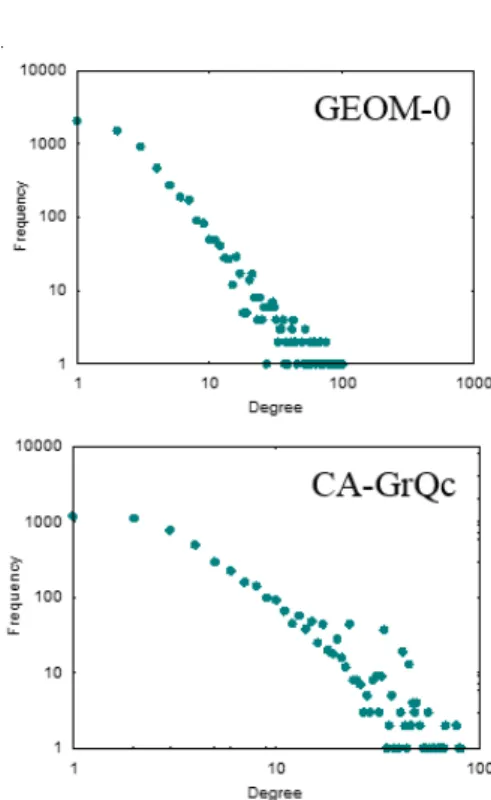
CE= CE+ e(i,∥CV∥); end end end CV = CV + curCand; end return G(CV, CE); Name # of N. # of E. Density GEOM-0 7343 11898 0.00044 CA-GrQc 5242 14484 0.00105
Table 1: Statistics of datasets
Figure 1: Degree Distribution
pair-wisely if they are k-MCSes or not. This will take a long time. By introducing bond measure, we are able to cut most useless candidates to improve the performance of enumerating algorithms.
3.
Experiment
In order to evaluate the efficiency and scalability of our algorithm, we perform experiments on several benchmark graph datasets. The basic statistics of graph datasets are shown in Table 3.. Test instances are mainly real-world social networks. ca-GrQc is provided by Stanford Large Network Dataset Collection [7]. ca-GrQc is a collabora-tion network of Arxiv General Relativity. Geom0 is a part of Pajek [4]. This dataset is a collaboration network in computational geometry. The degree distribution of these dataset is plotted in Figure. 3.
The whole program is impremented in C with libGC and compiled with Clang. Our experiments are performed on Linux with single core 2.4GHz CPU and 8 Gbytes mem-ory. The program is terminated if it runs for more than 180 minutes (three hours). As a comparison, we also per-formance the same experiments with the stardard k-plex enumerator, which is referred as MS-MaxKPlex [9]. The standard enumerator contains the following constraints on target maximal k-plexes:
3
Figure 2: Dataset: GEOM0 • k-plex is connected.
• k-plex is not a path.
• k-plex contains at least k + 1 vertices.
Furthermore, to compare with Meta-Clique, we added a minimum size constraint for MS-MaxKPlex. The constraint is that for given input integer L, only the k-plexes contain more than L vertices will be outputed. Figure 2 and Fig-ure 3 shows the comparison of the number of k-plexes enu-merated by meta-clique and MS-MaxKPlex. Here j repre-sents the size constraint of cliques in meta-clique and size of k-plex in MS-MaxKPlex. Bond constraint of meta-cliques is set to 0. This means only connected k-MCSes will be enu-merated. We can see that comparing with maximal k-plex enumerating, the meta-clique algorithm can restrict target into a small part of dense subgraphs. We also find that the number of meta-cliques is not so affected by the change of k. This means that the meta-clique may be able to be used as as index to characterize graphs.
4.
Conclusion and Future Work
By restricting target on the combination of cliques, k-plexes can be found efficiently for large k. We introduce the concept of k-MCS and k-clique-graph, and propose an effi-cient maximal k-MCS enumeration algorithm. Proposed al-gorithm is shown to be powerful even for large-scale dataset. We also introduce constraints on size of clique and bond measure to analyze large network. The future work mainly focuses on improving the performance of k-MCS enumer-ator. We are also interested in combination pseudo-clique models other than k-plex with k-MCS framework.
References
[1] Stephen B. Seidman and Brian L. Foster. A graph‐
theoretic generalization of the clique concept. Journal
Figure 3: Dataset: ca-GrQc of Mathematical sociology 6.1 (1978): 139-154. [2] Coen Bron and Joep Kerbosch. Algorithm 457: finding
all cliques of an undirected graph. Communications of the ACM 16.9 (1973): 575-577.
[3] Jeffrey Pattillo, Nataly Youssef, and Sergiy Butenko. Clique relaxations in social network analysis. In M. T. Thai and P. M. Pardalos (Eds.), Handbook of Opti-mization in Complex Networks: Communication and Social Networks, pages 143-162. Spinger Science + Business Media, 2012.
[4] Vladimir Batagelj and Andrej Mrvar. Pajek datasets. http://vlado.fmf.uni-lj.si/pub/networks/data/ (2006). [5] Edward R. Omiecinski Alternative interest measures for mining associations in databases. Knowledge and Data Engineering , IEEE Transactions on 15.1 (2003): 57-69.
[6] Etsuji Tomita, Akira Tanaka, and Haruhisa Takahashi. The worst-case time complexity for generating all max-imal cliques and computational experiments. Theoret-ical Computer Science 363.1 (2006): 28-42.
[7] Jure Leskovec and Andrej Krevl. SNAP Datasets: Stanford Large Network Dataset Collection. http://snap.stanford.edu/data, jun, 2014.
[8] Makoto Haraguchi and Yoshiaki Okubo. A method for pinpoint clustering of web pages with pseudo-clique search. Federation over the Web. Springer Berlin Hei-delberg, 2006. 59-78.
[9] Yoshiaki Okubo, Masanobu Matsudaira, and Makoto Haraguchi. Detecting Maximum k-Plex with Iterative Proper l-Plex Search. Discovery Science: 17th Interna-tional Conference, DS 2014, Bled, Slovenia, October 8-10, 2014.
4