星・惑星系の形成過程 入門
中本泰史
(東工大)1. 形成過程の概観
2. 分子雲の重力収縮
3. 原始惑星系円盤
4. 固体微粒子の進化
5. 微惑星から惑星へ
6. 惑星系の形成
オリオン座
巨大分子雲
距離:1500光年
星形成領域 (1)
大質量星・
小質量星が
生まれている
3x10
AU
おうし座・ぎょしゃ座
暗黒星雲
距離
140pc
星形成領域 (2)
小質量星のみが
生まれている
おうし座分子雲:CO(2-1)電波強度
10
分子雲
密度:
10
3個
cm
-3; H
2, He
温度:
約10K〜数十K
加熱:周囲の星からの輻射
宇宙線
冷却:輻射(原子)
分子雲コア
密度:
10
5個
cm
-3以上
温度:約
10K
サイズ:数万
AU
参考:地球大気
密度:
3×10
19個
cm
-3温度:
約290K
加熱:太陽からの放射
冷却:宇宙空間への放射
塵
大きさ ~0.1μm = 0.0001 mm
質量:ガスの約 100分の1
数: 水素分子:塵粒子 = 1:10
-12水素分子 10
4個cm
-3のとき
塵粒子 10
-8個cm
-3大きさ ~0.1μm
数 空気分子:黄砂粒子 = 1:10
-15黄砂粒子 10
4個cm
-3参考:黄砂
渦巻き銀河
(M64)
分子雲内での星形成
NGC1333 ~1pc ~103M 星 ~150個 星形成効率~10% ほとんどの星は星団で誕生する (Lada & Lada 03, Allen et al. 07) 1. 多くの分子質量は分子雲にある 2. 分子雲中では,若い星が内部 に多く,周辺部に少ない(例., L1630, Mon OB1, Rosette)
孤立・単独 星形成モード
Aquila
Polaris
Andre et al. 2010
コアの質量分布
1970MmRAS..74..139M
銀河系内の磁場(向き)
可視光偏光観測
星間雲中の磁場強度
Troland & Heiles 1986
エネルギー密度
u
m=
B
28
p
=
4
´
10
-12B
100
m
Gauss
æ
è
ç
ö
ø
÷
2erg cm
-3u
p=
5
2
nkT
=
3.5
´
10
-12n
10
3cm
-3æ
è
ç
ö
ø
÷
T
10 K
æ
è
ç
ö
ø
÷
erg cm
-3Troland & Heiles 1986
um >up
Li & Nakamura 2004
星間雲
星・惑星系形成
星の進化
超新星爆発
Inter Stellar Dust Matsuura et al. 2011
SN1987Aから
放出された物質
が固体微粒子に
なっている
Molster et al. 2001
赤外線天文衛星(ISO)で
AGB星周りの固体微粒子
を観測
・たくさんある
・結晶質シリケイトもある
Kemper et al. 2004
星間ダストのシリケイトで
結晶質のもの:
0.2 ± 0.2 %
↓
星間空間には,結晶質の
固体微粒子は存在しない
結晶質固体微粒子は,星間空間
で,速やかにアモルファス化
される
赤外線(ISO)で,銀河中心
方向の星間ダストの
スペクトルを観測
1 9 7 7 A p J . . . 2 1 7 . . 4 2 5 M
Mathis et al. 1977
紫外線〜可視光の
星間吸収
→
星間固体微粒子の
組成とサイズ分布を
推定:MRN モデル
n(a) ~ a
-3.50.005 μm < a < 0.25 μm
グラファイト + オリビン
重力
ガス圧力
重力 >
圧力
… 重力不安定
重力収縮する
重力不安定
重力収縮
星形成, 分子雲の重力収縮
pV
=
nRT
dU
=
nc
VdT
=
TdS
-
pdV
断熱変化のとき
pV
g=
const.
-
1
r
dp
dr
»
1
r
p
r
µ
r
-3(g-1)-1-
GM
r
2µ
r
-2-3γ+2
r
r
0f
presf
=
f
presf
æ
è
çç
ö
ø
÷÷
r
0r
æ
è
ç
ö
ø
÷
3g-4ガスは冷えないと収縮できない
p
=
K
r
gM
Jeans 不安定
f
pres= -
1
r
dp
dr
»
1
r
p
l
=
c
s2l
f
grav= -
G
r
l
3l
2l
d
2r
dt
2=
f
pres+
f
grav=
c
s2l
-G
r
l
3l
2=
l
c
s2l
2-
G
r
æ
è
ç
ö
ø
÷
温度 = 一定 → c
s= 一定
p
=
r
m
kT
=
c
s 2r
r
> <0
安定
不安定
l
J=
c
sG
r
Jeans 波長
M
J=
l
J 3r
=
c
sG
r
æ
çç
ö
÷÷
3r
Jeans 質量
重力不安定
(Jeans不安定)
・ガス雲:無限,一様,等方,等温
磁場,回転無し
・重力と圧力のみ作用
Ñ×
g
1= -
4
p
G
r
1 ¶v1 ¶t = -cs2r
0 Ñr
1 +g1
r
1
t
+
r
0Ñ ×
v
1=
0
w
2=
c
2k
2-4
p
G
r
l
³
l
J=
2
p
k
J=
c
sp
G
r
0æ
è
ç
ö
ø
÷
1/ 2Jeans波長
M
³
M
J=
4
p
3
r
0l
J2
æ
è
ö
ø
3=
p
5/ 26
c
s3G
3/ 2r
0 1/ 2Jeans質量
Jeans不安定
k
w
20
k
J自由落下時間 (Free Fall Time)
r
M md
2r
dt
2=
-GM
r
2初期条件: v = 0
r
t
ff 2=
GM
r
2t
ff=
1
G
r
τ
ff:質点mが原点に達する時間
r
r
d
2r
dt
2=
-GM
r
2τ:球の半径が0になる時間
圧力 p = 0
初期条件: v = 0
r
t
2=
GM
r
2r
=
M
r
3t
ff=
1
G
r
t
ff=
1
G
r
=
2
´
10
5n
10
5cm
-3æ
è
ç
ö
ø
÷
-1/2yr
分子雲コアの自由落下時間
質量降着率
M
»
M
Jt
ff=
(
c
st
ff)
3r
t
ff=
c
s 3G
=
1
G
kT
m
æ
è
ç
ö
ø
÷
3/2=
1.6
´
10
-6T
10 K
æ
è
ç
ö
ø
÷
3/2M
sun/yr
球対称
(1D)な重力収縮:
時間変化
Larson 1969, MNRAS 145, 271log
密度
時間変化
t
=
1
G
r
参考D
r
Dt
+
r
Ñ×
v
=
0
Dv
Dt
=
-1
r
Ñ
p
+
g
+
k
c
F
D
Dt
e
gas+
E
radr
æ
è
ç
ö
ø
÷+
1
r
Ñ×
F
= G
dyn+ G
g+ G
CRDe
gas
Dt
= G
dyn
+ G
abs
- L
dust
+ G
CR
p
=
k
B
r
T
=
(
g
-
1
)
r
e
輻射流体力学 基礎方程式系
基本的な流体の式
Masunaga, Miyama, & Inutsuka 1998
収縮は,
初期フィラメント状分子雲
動径方向への収縮
フィラメント状分子雲の収縮と分裂
動径方向への収縮の停止:状態方程式の変化
軸方向への分裂:
静水圧平衡天体の形成
中心密度・温度の進化
光学的に
薄い
厚い
輻射加熱
断熱圧縮加熱
gasDe
- L
G
+ G
=
rcritRad= rs Tinit Ts æ è ç ö ø ÷ 6+2b for Tinit £Ts rs Tinit Ts æ è ç ö ø ÷ ( 4-2b) / 3 for Tinit >Ts ì í ï ï î ï ïGoodman et al. 1993
分子雲コアの
回転を観測
Belloche et al. 2002
IRAM 04191
47
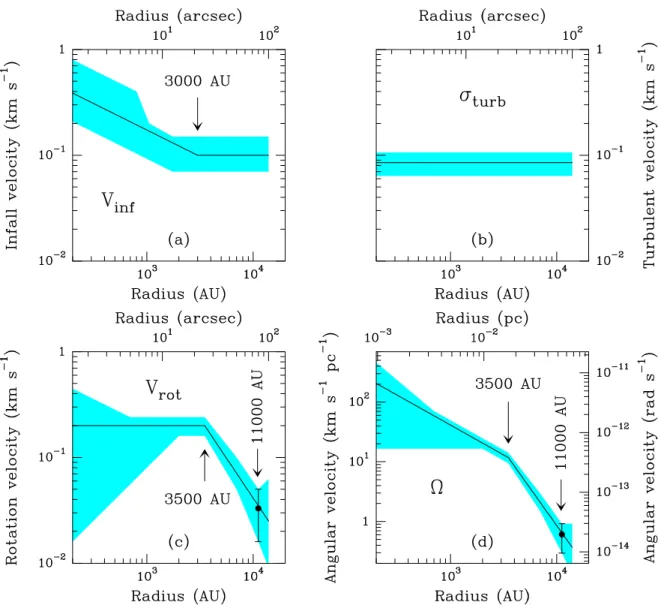
938 A. Belloche et al.: Velocity structure of the IRAM 04191 protostar
Fig. 12. Infall a), turbulence b), and rotation c) velocity fi elds inferred in the IRAM 04191 envelope based on our 1D (Sect. 4) and 2D (Sect. 5) radiative transfer modeling. The shaded areas show the estimated domains where the models match the CS and C34S observations reasonably
well. In a) and b), the solid lines show the infall velocity and turbulent velocity dispersion in both the 1D and 2D models (cf. Figs. 8 and 14, respectively) as a function of radius from envelope center. In c), the solid line represents the profi le of the azimuthal rotation velocity in the 2D envelope model (cf. Fig. 14) as a function of radius from the outfl ow/rotation axis. The point with error bar at 11 000 AU corresponds to the velocity gradient observed in C18O (cf. Sect. 3.2). Panel d) shows the corresponding angular velocity profi le.
by the width of the CS(2–1) and CS(3–2) dips is obtained for
σturb = 0.085 ±0.02 km s−1 (cf. Fig. 11). This is equivalent
to ∆vFWH M
turb = σturb⇥
p
8 ln2 = 0.20 ±0.05 km s−1and
corre-sponds to only half the thermal broadening of the mean molec-ular particle at 10 K , showing that the IRAM 04191 envelope is “thermally-dominated” (see also Sect. 3.4) as are Taurus dense cores in general (e.g. M yers 1999).
The main conclusions of our 1D exploration of the pa-rameter space are summarized in Figs. 12a and b, where the shaded areas represent the ranges of infall velocities a and tur-bulent velocity dispersion b for which acceptable fi ts are found. Two infall regimes seem to stand out in Fig. 12a: the infall velocity is relatively large (vinf ⇠ 0.2 km s> −1, supersonic) and
implies a mass infall rate of ˙Minf ⇠ 3 ⇥ 10−6 M yr−1 at
r = 1750 AU. (The density and velocity profi les shown in
Figs. 7a and 12a are such that ˙Minf is roughly independent of
radius.) Inside the r ⇠ 11 000 AU region (where non-zero in-ward motions are inferred), the fraction of envelope mass with supersonic (>
⇠0.16−0.2 km s−1) infall motions is estimated to be only ⇠1−10% , depending on the exact value of the sound speed and exact form of the infall velocity profi le (see Fig. 12a).
5. Radiative transfer modeling: Simulations with infall and rotation
5.1. Quasi 2D simulations
1300AU
アウトフロー
(双極分子流)
原始惑星系円盤
回転している分子雲コアの収縮 円盤・バー構造の形成
分子雲コアの重力収縮の数値シミュレーション
松本倫明氏(法政大学) ・3D自己重力流体計算 ・Nested Grid法1/2細かい格子
密度分布
Matsumoto & Hanawa 2003
アウトフローの生成
w
r
M
GM RCF2 = j2 RCF3R
CFj
=
r
2w
R
CF=
j
2GM
=
r
4w
2GM
RCF =25 r 104 AU æ è ç ö ø ÷ 4 w 10-14s-1 æ è ç ö ø ÷ 2 M Msun æ è ç ö ø ÷ -1 AU重力 = 遠心力
角運動量
原始惑星系円盤の形成
星+円盤系の形成
分子雲
原始星
収縮 ガスが 晴れ上がるTタウリ型星
太陽
モデル
モデルを特徴付ける物理量 中心コア; 光度 Lstar 4成分; 中心コア、星周円盤、 エンベロープ、双極分子流 星周円盤 エンベロープ 中心コア 100AUi
2次元軸対称 観測者S
( )
r
= S
1r
1AU
æ
è
ö
ø
-q 星周円盤;面密度分布 エンベロープ;密度分布r
( )
r
=
r
1r
1AU
æ
è
ö
ø
-pbipolar outflow;opening angle θ
原始星
1011 1012 1013 1014 1015 振動数 [Hz] 1028 1030 1032 1034 1036 観測角度を変えたときのSEDの変化 0゜ 30゜ 60゜ 90゜Tタウリ型星の
スペクトル
Beckwith et al. 1990, AJ 99, 924 フラットスペクトルフ
ラックス
振動数
中心星+円盤
高温
高振動数
低温
低振動数
中心星の放射を エンベロープが散乱 加熱されたディスク からの赤外放射 中心星からの放射を直接吸収 するよりも多くの輻射を吸収する エンベロープはディスクからの 赤外放射に対して光学的薄い ハロー:エンベロープの 内側100 AU程度の領域
ディスク・ハロー モデル
基礎方程式
ò
ò
¥ ¥=
0 0n
c
n
c
nabsB
nd
nabsJ
nd
2.輻射平衡:
物質の温度分布を決定
nI
:輻射強度
nB
:プランク関数
abs nc
:吸収係数
sca nc
:散乱係数
ò
W
+
-+
-=
I
B
I
I
d
ds
dI
abs abs sca scan n n n n n n n n
p
c
c
c
c
4
1
1.輻射輸送方程式:
輻射によるエネルギー輸送を記述
吸収
放射
吸収
放射
散乱
T Tauri型星 HL Tau
2D 輻射平衡計算
・2次元 軸対称
・輻射平衡,VEF
密度・温度分布
近赤外散乱光イメージ
観測 (HL Tau)
モデル計算 (i = 60
o)
参考文献
• André, P., Men’shchikov,A., Bontemps,S. et al., 2010: From filamentary clouds to prestellar cores to the stellar IMF : Initial highlights from the Herschel Gould Belt Survey, Astronomy and Astrophysics,518 : p. L102.
• André, P. et al. 2002: Molecular line study of the very young protostar IRAM 04191 in Taurus: infall, rotation, and outflow, Astronomy and Astrophysics, v.393, p.927-947
• BO REIPURTH, DAVID JEWITT, AND KLAUS KEIL, (Lori Allen, S.Thomas Megeath, Robert Gutermuth, Philip C. Myers, Scott Wolk, Fred C. Adams , James Muzerolle, Erick Young, Judith L. Pipher) 2007: Protostars and Planets V(The
Structure and Evolution of Young Stellar Clusters), The University of Arizona Press pp683 (pp361)
• Beckwith, Steven V. W et al. 1990: A survey for circumstellar disks around young stellar objects, Astronomical Journal, vol. 99, p. 924-945
• Baba Junichi et al. 2009: The Origin of Large Peculiar Motions of Star-Forming Regions and Spiral Structures of Our Galaxy, The Astrophysical Journal, vol. 706, no. 1, pp. 471-481
参考文献
• Fiebig, D. et al. 1989: Strong magnetic fields in interstellar H2O maser clumps, Astronomy and Astrophysics, vol. 214, no. 1-2, April 1989, p. 333-338.
• Goodman, A. et al. 1993: Dense cores in dark clouds. VIII - Velocity gradientsAstrophysical Journal, vol. 406, p. 528-547.
• Inutsuka, Shu-Ichiro; Miyama, Shoken M. 1992: Self-similar solutions and the stability of collapsing isothermal filamentsAstrophysical Journal, vol. 388, p. 392-399.
• Kikuchi, Nobuhiro; Nakamoto, Taishi; Ogochi, Koji 2002: Disk-Halo Model for Flat-Spectrum T Tauri Stars, Publications of the Astronomical Society of Japan, Vol.54, No.4, pp.589-597
• Kemper, F, Vriend, W. J, Tielens, A. G. G. M 2004: The Absence of Crystalline Silicates in the Diffuse Interstellar Medium, The Astrophysical Journal, Volume 609, Issue 2, pp. 826-837
• Charles J. Lada & Elizabeth A. Lada 2003: Embedded Clusters in Molecular Clouds , Annual Reviews of Astronomy and Astrophysics, Vol. 41, pg. 57.
• Larson, R. B. 1969: Numerical calculations of the dynamics of collapsing proto-star Monthly Notices of the Royal Astronomical Society, Vol. 145, p.271
参考文献
• F. J. Molster, et al. 2001: IRAS 09425−6040: A carbon star surrounded by highly crystalline silicate dust, Astronomy&Astrophysics, 366, pp.923-929
• 松田准一 ,圦本尚義 2008: 宇宙・惑星化学 (地球化学講座2), 培風館 pp.291 • Masunaga, Hirohiko; Miyama, Shoken M.; Inutsuka, Shu-Ichiro1998: A Radiation
Hydrodynamic Model for Protostellar Collapse. I. The First Collapse , Astrophysical Journal v.495, p.346
• S . Matsuura et al. 2011: DETECTION OF THE COSMIC FAR-INFRARED BACKGROUND IN AKARI DEEP FIELD SOUTH The Astrophysical Journal, 737:2 (19pp)
• Mathewson, D. S.; Ford, V. L. 1970: Polarization observations of 1800 stars, Mem. R. Astron. Soc., 74, 139
• Mathis, J. S, Rumpl, W, Nordsieck, K. H, 1977: The size distribution of interstellar grains, Astrophysical Journal, Part 1, vol. 217, p. 425-433.
参考文献
• Tomoaki Matsumoto; and Tomoyuki Hanawa 2003: FRAGMENTATION OF A MOLECULAR CLOUD CORE VERSUS FRAGMENTATION OF THE
MASSIVE PROTOPLANETARY DISK IN THE MAIN ACCRETION PHASE The Astrophysical Journal, 595:913–934
• Tomoaki Matsumoto and Kohji Tomisaka 2004: Directions of Outflows, Disks,
Magnetic Fields, and Rotationof Young Stellar Objects in Collapsing Molecular
Cloud Cores, The Astrophysical Journal, 616:266-282
• Takeshi Nakazato,Taishi Nakamoto ,and Masayuki Umemura 2003: A
Spectrophotometric Method to Determine the InclinationofClassIObjects, The
参考文献
• Sakamoto, Seiichi; Hayashi, Masahiko; Hasegawa, Tetsuo; Handa, Toshihiro; Oka, Tomoharu 1994: A large area CO (J = 2 goes to 1) mapping of the giant molecular clouds in Orion, The Astrophysical Journal, vol. 425, no. 2, pp. 641-652
• Toru Tsuribe andShu-ichiro Inutsuka 1999: Criteria for Fragmentation of Rotating
Isothermal Clouds Revisited, The Astrophysical Journal, 523:L155-L158
• Troland, T. H. & Heiles, C. 1986: Interstellar magnetic field strengths and gas
densities Observational and theoretical perspectives, Astrophysical Journal, vol. 301, Feb. 1, 1986, pp. 339-345
• Zhi-Yun LiandFumitaka Nakamura 2004: Magnetically RegulatedStar Formation