総 説 東女医大誌 89(4): 73-82, 2019.8
性差医療
(4)循環器疾患における性差
東京女子医科大学循環器内科 サ ト ウ カ ヨ コ佐藤加代子
(受理 2019 年 7 月 1 日) Gender Medicine(4) Gender Differences in Cardiovascular Disease
Kayoko Sato
Department of Cardiology, Tokyo Women s Medical University, Tokyo, Japan
Differences in cardiovascular disease are found between the genders. In women, it is known that estrogen has both indirect and direct protective effects on the cardiovascular system. This includes a decrease in low-density lipoprotein cholesterol (LDL-C), an increase in high-low-density lipoprotein cholesterol (HDL-C), the vasodilata-tion response by endothelial Nitric Oxide Synthase (eNOS) synthase, and prostacyclin synthesis.
Many cases of coronary spastic angina and acute coronary syndrome (ACS) have been observed during the menstrual and the late luteal phases of the menstrual cycle, corresponding with low levels of estrogen. After menopause, the risk of atherosclerosis and associated conditions such as; dyslipidemia, hypertension, obesity, dia-betes, T cell activation, and adhesion molecules, increase. Consequently, the risk of a cardiovascular event also in-creases. In addition, regarding the pathological mechanism underlying ACS, erosion is observed most promi-nently during pre-menopause, whereas plaque rupture is observed in post-menopause.
Furthermore, microvascular angina is often found in menopausal women displaying various symptoms, thus a diagnosis may be difficult. We recognize a decrease in vascular endothelial function and the coronary flow re-serve and a high level of lactic acid in the coronary sinus as diagnostic criteria. Regarding problems associated with the“super-aging”society, there are many elderly female patients with HFpEF (heart failure with preserved ejection fraction) who have diastolic dysfunction. Also well-known are cases of atherosclerosis and osteoporosis progressed by common risk factors, and recently, vascular bone disease.
There are characteristics in women for microvascular angina and heart failure, as well as ischemic heart dis-ease, due to atherosclerosis caused by the sex hormone environment in later life stages. Considering gender-specific medicine in the prevention and treatment of cardiovascular disease is important for healthy aging of women.
Key Words: gender-specific medicine, estrogen, T cell, atherosclerosis, microvascular angina
:佐藤加代子 〒162―8666 東京都新宿区河田町 8―1 東京女子医科大学循環器内科 Email: [email protected]
doi: 10.24488/jtwmu.89.4_73
Copyright Ⓒ 2019 Society of Tokyo Women s Medical University. This is an open access article distributed under the terms of Creative Commons Attribution License (CC BY), which permits unrestricted use, distribution, and reproduction in any medium, provided the original source is properly credited.
はじめに
循環器疾患は発症率や病態,社会的背景を含む臨
床像,またライフステージにより性差を認める.そ
の重要性を考慮した性差医学(gender-specific
medi-cine)が 1980 年代後半から米国 NIH(National
Insti-tute of Health)を中心に始まり,2004 年に米国心臓
病協会(American Heart Association:AHA)より
「女性のための心血管疾患予防ガイドライン」
1)が発
表された.わが国においても 1990 年代後半より性差
医学の重要性が認識されて,2010 年に日本循環器学
会から「循環器領域における性差医療に関するガイ
ドライン」
2)が発表され,世界一平均寿命の長い日本
女性における心血管疾患の性差研究の重要性が認識
された.
女性ホルモンであるエストロゲンには,心血管に
対する様々な間接的保護作用と直接的保護作用があ
ることが知られている.閉経によりホルモン環境が
激変すると,脂質異常症,高血圧症,肥満,糖尿病
などの動脈硬化リスクが増加し,それを基盤に心血
管イベントリスクが上昇する.また,最近では骨粗
鬆症と動脈硬化や血管石灰化の関連である骨・血管
相関(vascular bone disease)が明らかとなり,この
点においてもエトロゲン欠乏による骨吸収亢進が二
次的動脈硬化進展をもたらすことが示唆される.本
稿では,エストロゲンの心血管に対する作用と閉経
前・更年期・高齢女性における動脈硬化への影響
や,性差の認められる代表的な虚血性疾患について
概説する.
1.エストロゲンの心血管に対する作用
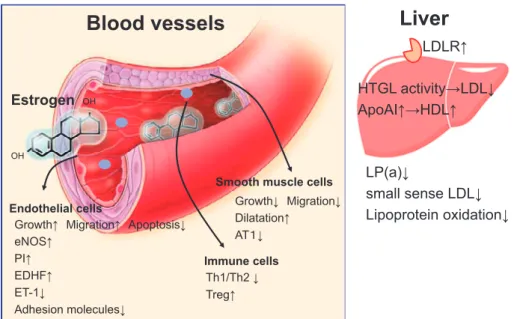
エストロゲンには様々な心血管系に対する間接的
保護作用と直接的保護作用があることが知られてい
る(Figure 1)
3). エストロゲンの間接的保護作用は,
肝臓,小腸,末梢組織に作用し脂質代謝に影響を及
ぼ す.肝 臓 や 末 梢 組 織 の low-density lipoprotein
(LDL)受容体数および活性を増加させ,肝性トリグ
リ セ リ ド リ パ ー ゼ(hepatic triglyceride lipase:
HTGL)の活性を抑制することで血中 LDL コレステ
ロールを低下させる.また,肝臓,小腸における
high-density lipoprotein cholesterol(HDL-C)の主要構成
蛋白である apolipoprotein fraction A-I(アポ AI)の
合成も促し,血中 HDL-C 増加をもたらす.さらに,
リポ蛋白(a)
(Lipoprotein(a))や small dense LDL
を減少させる効果もある.
エストロゲンは,血管平滑筋細胞や血管内皮細胞,
心臓に発現するエストロゲンレセプター
α(estro-gen receptor
α:ERα)やエストロゲンレセプター β
(estrogen receptor
β:ERβ)に結合し直接的保護作
用を発揮する
4).血管内皮細胞では,内皮依存性血管
拡 張 反 応 で あ る 血 流 依 存 性 血 管 拡 張 反
応(flow-mediated diameter:FMD),内 皮 型 NO 合 成 酵 素
(endothelial NO synthase:eNOS)活性,プロスタサ
イクリン(prostacyclin:PI)産生,内皮由来過分極
因子(endothelium-derived hyperpolarizing factor:
EDHF)産生をそれぞれ増加させる.一方,エンドセ
リン-1(endothelin-1:ET-1)産生や内皮細胞のアポ
トーシス,接着分子発現を抑制する.また骨髄から
の内皮前駆細胞(endothelial progenitor cell:EPC)
の増加も促す
5).血管平滑筋細胞に対する直接作用と
しては血管拡張作用を示し,また血管障害後の血管
平滑筋細胞の遊走や増殖を抑え新生内膜肥厚を抑制
する
3)6).最近ではエストロゲンが血管収縮,血管肥
厚,動脈硬化促進,心筋肥大,心筋収縮力の増大作
用のあるアンジオテンシン II の受容体である AT1
受容体の血管平滑筋細胞における発現を抑制するこ
とが明らかとなった
7)8).これら内因性エストロゲン
による心血管保護作用により閉経前女性は心血管疾
患の発症が少ないと考えられている.
2.性周期および更年期以降におけるエストロゲ
ンの心血管に対する影響
閉経前女性の性周期にはエストロゲンの低い月経
期,エストロゲンの高い卵胞期,排卵期,エストロ
ゲンが低下しプロゲステロンの増加する黄体期とあ
り,この内因性女性ホルモンの月経周期による変動
が心血管に影響を及ぼす.若年女性では,FMD が性
周期によるエストロゲン変化に伴い変動することが
知られている
9).これは ER を介する eNOS リン酸化
または Akt/PKB を介する作用と考えられている.
実際,閉経前女性の冠攣縮性狭心症や急性冠症候群
(acute coronary syndrome:ACS)の発症,運動負荷
による ST 変化はエストロゲン分泌の低い黄体末期
から月経期に多く(Table 1)
10)∼12),閉経後 15 年で急
激に冠動脈疾患罹患率は増加して 75 歳では男女同
等となる(Figure 2)
13).また,男女とも動脈硬化進
展に伴い ERα および ERβ の血管壁の発現は低下
し
14)15),ER 遺伝子プロモーター領域の DNA
methyl-ation や ER 遺伝子のユビキチン化が ER 不活性化
をもたらすと考えられている
16).一方,女性で ERβ
Figure 1 The protective direct and indirect effects of estrogen.
eNOS, endothelial NO synthase; PI, prostacyclin; EDHF, endothelium-derived hyperpolar-izing factor, ET-1, endothelin-1; Treg, regulatory T cell.
OH
OH
Estrogen
Endothelial cells
Smooth muscle cells
GrowthĹ MigrationĹ ApoptosisĻ eNOSĹ PIĹ EDHFĹ ET-1Ļ Adhesion moleculesĻ GrowthĻ MigrationĻ DilatationĹ AT䠍Ļ
Blood vessels
Liver
/3 D Ļ
small sense LD/Ļ
Lipoprotein oxidationĻ
HTGL activityĺLD/Ļ
ApoAIĹĺHDLĹ
LDLRĹ
Immune cells Th1/Th2Ļ TregĹTable 1 Physiological circulatory function and diseases in the menstrual cycle.
Menstrual phase Follicular phase Luteal phase Physiological circulatory function Diastolic blood pressure ↓ Systolic blood pressure ↓
Diastolic blood pressure ↓
HR ↓ HR ↓ RPP ↑ Schneider Index ↑ FMD ↑ FMD ↑ QT ↑ QT ↓ Early depolarization ↑ Disease Supraventricular tachycardia ↑ Vasospastic angina ↓
Idiopathic ventricular tachycardia ↑ Effort angina pectoris ↓ Vasospastic angina ↑
Effort angina pectoris ↑
Acute coronary syndrome (ACS) ↑ Menstrual asthma ↑
Catamenial pneumothorax ↑ RPP, rate-pressure product; FMD, flow-mediated dilatation.
変や閉経後の進行した動 脈 硬 化 病 変 で 増 加 を 認
め
17),エストロゲンの ERα 依存的な抗動脈硬化作用
が ER
β を介するシグナルにより制御されている可
能性も示唆された.さらに,女性で ERβ 遺伝子多型
が高血圧や心血管リスクと関連するとの報告や
18)19),
男性では ERα 遺伝子多型が心血管イベントリスク
と相関を認め
20),17β―エストラジオール溶出性ステ
ントが再狭窄予防に有効(EASTER trial)と報告さ
れた
21).ERβ と ERα を介するシグナルが独立して心
血管機能を調節している可能性もあるが詳細は解明
されていない.
女性は閉経すると血中エストロゲンレベルは急激
に低下し,約 2 年で男性の血中レベルよりやや低下
する.男性および閉経後の女性の内因性エストロゲ
ンは副腎性男性ホルモンであるデヒドロエピアンド
ロステロン(dehydroepiandrosterone:DHEA)より
アロマターゼにより変換され生成される(Figure
3).男女とも DHEA は思春期以降,加齢とともに減
少する aging marker であり,NO を介して抗動脈硬
化作用を発揮すると考えられている
22).このように
男女とも内因性エストロゲンが心血管保護作用を持
つと考えられる.
Figure 2 Incidence of cardiovascular disease and estrogen levels. Modified from refer-ence 13). Men Women
Estrogen
Incidence of
cardiovascular
disease
60
50
40
30
20
10
0
29῍34 35῍39 40῍44 45῍49 50῍54 55῍59 60῍64 65῍69 70῍74 75῍79Age
Estrogen levels
50
ίpg/mlὸ ί1000 / yearὸFigure 3 Pathways of steroid hormones. Cholesterol
Pregnenolone
17Į-Hydroxypregnenolone
Progesterone
17Į-Hydroxyprogesterone
Dehydroepiandrosterone (DHEA) Androstenedione
Dehydroepiandrosterone-sulfate (DHEAS) Testosterone
17ȕ-Estradiol(E2) Estrone(E1) Estriol(E3)
Adrenal Cortex
sulfotransferase sulfataseLiver
Gonad
aromatase aromatase3.エストロゲンの動脈硬化進展に関わる炎症細
胞への作用
自己免疫性疾患における性差は広く知られている
が,血管の慢性炎症である動脈硬化に対しても性ホ
ルモンは深く関与している.動脈硬化の進展には
CD4
+helper T cell(Th)のうち炎症性サイトカイン
を産生する IFNγ
+Th1 や IL17
+Th17 は促進的に,
CD4
+CD25
+制御性 T 細胞(Treg)は抑制的に働くと
考えられている
23).エストロゲンは TNFα,INFγ
などの炎症性サイトカイン,アディポカイン,接着
分子,eNOS,ET-1,酸化ストレスなどの血管炎症を
抑制するとともに
24),T 細胞の Th1/Th2 バランスに
も影響を及ぼすことが知られている.低エストロゲ
ン状態で Th1 優位に,高エストロゲン/プロゲステ
ロン状態では Th2 優位に分化する.また,エストロ
ゲンは Treg を増加させることも知られる
25).一方,
DHEA は Th1,Th2 ともに抑制する.自己免疫性疾
患では Th1 や Th17 優位の関節リウマチは妊娠で
寛解し,Th2 優位の SLE は妊娠で増悪する
26).我々
の更年期女性における検討では,活性化した接着分
子 P-selectin glycoprotein ligand-1(PSGL-1)陽性の
CD4
+T 細胞がエストラジオール/ER を介する刺激
で血管内皮細胞障害を誘導し
27)(Figure 4),女性の
閉経以降に急速に進展する動脈硬化の一つの機序と
Figure 4 Activated PSGL-1+CD4+ T cells induced endothelial cell apoptosis in perimeno-pausal women.
Estrogen
o H o s o o o H H Endothelial cellSmooth muscle cell ERD CD4 T cell
Apoptosis
ActivationAtherosclerosis
CD69 PSGL-1 ERE PAdhesion
Endothelial damage
考えられた.
4.女性における動脈硬化病変と虚血性心疾患の
特徴
1)急性冠症候群発症の病理学的機序
冠動脈の動脈硬化性変化は,5∼10 歳の幼少期よ
り脂肪線状として始まり,20 歳ごろには隆起性線維
脂質性プラークとなり,中年期には様々な動脈硬化
病変を認めるようになる.急性冠症候群(ACS)発
症の病理学的機序は,冠動脈プラークの不安定化か
らプラーク破綻(plaque rupture)やプラークびらん
(plaque erosion)が起こるためと考えられている
(Figure 5).不安定プラークの特徴は薄い線維性被
膜に被われた大きな脂質コア(lipid core)とマクロ
ファージ・T 細胞・好中球などの炎症細胞集積や血
管新生,血管内皮細胞や血管平滑筋細胞のアポトー
シスなどの特徴を認める(Figure 6)
28)29).プラークを
不安定化する因子としては「血管内皮細胞の機能障
害や傷害」,
「炎症性細胞のプラーク内集積と活性
化」,
「局所血栓形成能の亢進」が上げられる
30).剖検
例の急性心筋梗塞の責 任 冠 動 脈 病 変 は 60% に プ
ラーク破綻,40% にプラークびらんであるが,閉経
前女性における ACS の病理学的原因はプラークび
らんが多く
31)32),血管内皮細胞のアポトーシスなどが
血管傷害に重要と考えられる
27)33).
2)動脈硬化リスク因子と虚血性心疾患の性差
日本人女性は平均 50 歳で閉経するが,その前後 5
年(45∼55 歳)の更年期からエストロゲンが低下し,
脂質異常症,高血圧,糖尿病,肥満などのリスク因
子が増加し血管機能の低下を生じる.動脈硬化リス
ク因子の種類は男女で同じであるが,リスク因子ご
との発症率や心血管イベントに対する危険率には性
差が認められている.脂質異常症は,特に LDL―コレ
ステロールが女性は 50 歳代以降で男性よりむしろ
高くなる.女性は男性に比較して,低 HDL―コレステ
ロール血症,高トリグリセライド血症の心血管系疾
患への関与が大きい.高血圧症は閉経前の女性では
罹患率が低いが,経口避妊薬服用により高血圧が増
加するので注意が必要である.また,収縮期血圧が
10 mmHg 上昇すると虚血性心疾患罹患・死亡の危
険度は,男性では 15% 増加するが女性では明らかで
はない.糖尿病は,耐糖能障害の段階から虚血性心
疾患のリスクであるが,女性ではその傾向が特に高
い.糖尿病のある女性では,冠動脈疾患発症に対す
る相対危険度は男性の 2 倍,糖尿病のない女性の 4
倍である.さらに,女性は冠動脈疾患死の相対危険
度は男性の 1.5 倍である
34)35).糖尿病のある女性のリ
スクを高めている原因の一つに,糖尿病の女性は男
性に比べて十分な治療を受けておらず,コントロー
ル不十分である傾向がある.
日本人の初回発症心筋梗塞のリスク因子は,男性
では高血圧・喫煙・糖尿病の順であるが,女性では
喫煙・糖尿病・高血圧の順であり
36),女性では糖尿
病の治療が非常に重要である
37).女性の虚血性心疾
患の死亡率は 50 歳代までは男性の 1/3 であるが,高
齢期にはリスク因子の性差,虚血性心疾患の死亡率
ともに差が縮小し,むしろリスク因子保有頻度が高
Figure 5 Pathology of acute coronary syndrome (ACS).
Erosion
30-40%
Plaque rupture
60%
Calcified nodule
10%
Figure 6 Characteristics of unstable plaque. Stable plaque has a thick fibrous cap, less lipid core, less inflamed cells and no thrombus. Whereas, unstable plaque contains a large lipid core with hemorrhage, neoangiogenesis, apoptosis of smooth muscle cells and endothe-lial cells, and many inflamed cells. A thin fibrous cap overlies the lipid core.
Apoptotic SMC Thin fibrous cap
Lumen Inflammatory infiltrate Macrophages T cells (CD4 T cell) NKT cells Dendritic cells Neoangiogenesis Hemorrhage Lipid core Apoptotic EC
Unstable plaque
く高齢で発症すると予後は不良である.また,男性
では心筋梗塞として発症することが多いのに対し,
女性では非典型的症状を主訴とする狭心症として発
症することが多く,発症から受診・治療までの時間
が遅延することも大きな問題である.
3)冠攣縮性狭心症
冠動脈に動脈硬化による狭窄病変がなく,攣縮に
より胸痛や心電図で ST 上昇が生じる冠攣縮性狭心
症(coronary spastic angina)の頻度は,男性に比較
的多い.国内の 1,525 例の冠攣縮研究会のレジスト
リ研究では男性 77%,女性 23% であった.女性にお
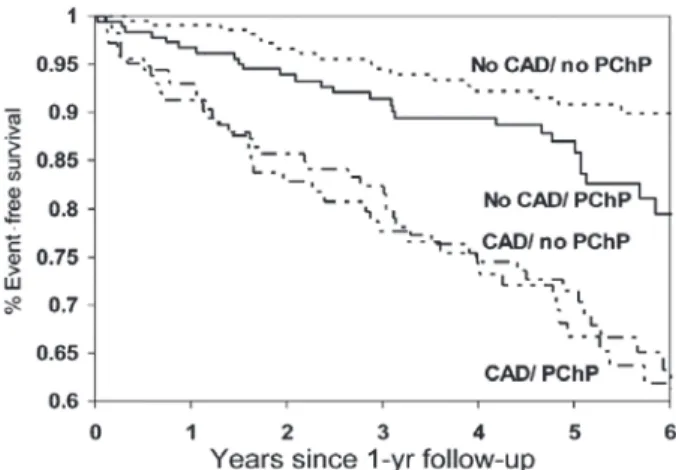
Figure 7 Event-free survival from cardiovascular (CV) events by coronary artery disease (CAD) and persistent chest pain (PChP). CV events were defined as CV death, myocardial infarction, congestive heart failure, or stroke. Modified from reference 40.
いて喫煙の頻度が少ないことも影響している.また,
女性では 75% 以上の器質的狭窄が少なく,冠攣縮誘
発試験では,限局型よりもびまん性の冠攣縮が多い
のも特徴である.閉経前女性の冠攣縮性狭心症の発
作が月経周期内の内因性エストロゲンレベルと密接
に関係し,黄体末期から月経期にかけて増加し,卵
胞期にかけて減少することは前述したとおりであ
る
38).女性の冠攣縮性狭心症にエストロゲン製剤の
投与が有効である場合が報告されている
39).
4)微小血管狭心症
微小循環狭心症(microvascular angina)は,男女
比 1:5 で女性(特に閉経後)に多い疾患である.冠
動脈に有意狭窄が明らかでなく,100
μm 以下の微小
血管における収縮亢進や拡張反応不全による不均一
な血管拡張に伴う凍結現象が起こることにより生じ
ると考えられており
40)41),冠攣縮性狭心症に合併する
こともある.発症年齢は 30 代半ばから 60 代半ば,
特に 40∼50 代の更年期前後の女性に多い.症状は一
般的な狭心症症状に加え,安静時や非典型的な場合,
30 分以上遷延することもあり判断の難しい症例も
多い.微小血管収縮により不定愁訴に近い,消化器
症状,あごの痛み,肩甲骨痛,後頭部痛などの多彩
な症状を呈する.また,症状は精神的ストレス,糖
尿病,脂質異常症,高血圧症,メタボリックシンド
ローム,喫煙などで誘発される.診断は血管内皮機
能である 反 応 性 充 血 指 数(reactive hyperemia
in-dex:RHI)の低下,PET(positron emission
tomogra-phy)による冠血流予備能低下,心臓カテーテル検査
における冠血流予備能低下やペーシング負荷時の冠
静脈洞の乳酸値の高値が有用である.現在のところ
は,確立した治療はなく,狭心症の特効薬である硝
酸剤や発作時のニトロペンの有効率は 50% 以下で,
ジルチアゼムが奏効する例が多い.十分な効果が得
られない場合は,スタチンや ACE 阻害剤等 NO 産
生を増加させ得る薬剤,メタボリック症候群などで
は運動・食事療法,適度な飲酒と禁煙指導,また精
神的サポートが有用である.予後は動脈硬化性の狭
心 症 と 違 い,The Women s Ischemia Syndrome
Evaluation Study(WISE Study)にエントリーされ
た 673 例の平均 5.2 年の検討では,有意狭窄もなく
虚血所見のない患者群は心筋梗塞や脳卒中になるこ
とは少ないが,胸痛の消退しない患者群では心血管
イベント発症率が 2 倍強あり
42),注意深い診断治療
が必要である(Figure 7).
5.超高齢化社会の問題点:心不全,骨・血管相関
とエストロゲン
社会の高齢化率は 65 歳以上の高齢者の割合で表
すが, 2012 年日本の高齢化率は 24.1%(男性 21.2%,
女 性 26.9%)で あ っ た.
「高 齢 社 会」は 高 齢 者 14%
以上と WHO で規定されており,日本は「超高齢化
社会」といえる.超高齢化社会に伴い死因に占める
心不全の割合は増加しており,女性の心不全患者の
平均年齢は男性より高い.心不全の基礎心疾患危険
因子は,男性は虚血性心疾患,女性は高血圧,糖尿
病,肥満が多い.女性の心不全は左心収縮能が EF
(ejection fraction)≧50% と保たれており拡張不全
が主な病態である HFpEF(heart failure with
pre-served ejection fraction)が多く,予後は良い.男性
は左室拡大,EF<40% の左室収縮能低下を呈する
HFrEF(heart failure with reduced ejection
frac-Figure 8 The common risk factors in vascular bone disease. Bone Artery Osteoporosis Bone fracture Atherosclerosis Cardiovascular event Risk factor Aging䞉Menopause Estrogen Ļ Hypertension Dyslipidemia IGT䞉Diabetes Chronic renal disease (CKD)
Obesity Smoking ExerciseĻ Salt䞉Alcohol Ca䞉Vit D䞉Vit KĻ
ADLĻ
Death
tion)が主であることが多い.女性の心不全の特徴で
ある HFpEF には心筋蛋白遺伝子の発現や細胞内
Ca イオンの変動等に対するエストロゲンの影響が
心筋のリモデリングへ関連していることが示唆され
ている
43)44).
高齢者では動脈硬化が進展し血管石灰化や骨粗鬆
症が多く認められる.骨粗鬆症に対してエストロゲ
ンは破骨細胞の ERα を介して Fas リガンドの発現
を促進し,アポトーシスを誘導して破骨細胞寿命を
短縮させる
45).卵巣摘除や閉経後の女性では,エスト
ロゲン低下により骨吸収の亢進,骨形成の低下によ
る骨量の減少が進行する.高齢女性では,動脈硬化
と骨粗鬆症は共通の要因により進展するため,骨・
血管相関(vascular bone disease)が強いことが指摘
されているが
46)(Figure 8),まだ解明に至っていな
いことも多い.
おわりに
現在,わが国における循環器疾患の男女比は,出
生時には 15% ほど男性が多いが,50 歳の閉経期に
はほぼ同数,高齢者では女性が増加し 80 歳では女性
が男性の 2 倍となる.また,女性はライフステージ
での性ホルモン環境により,動脈硬化進展による虚
血性心疾患のみならず,微小血管狭心症や心不全に
特 徴 を 認 め る.女 性 の ウ ェ ル エ イ ジ ン
グ(well-aging)には,gender-specific medicine を考慮した心
血管疾患の予防と治療が今後ますます重要となる.
開示すべき利益相反状態はない. 文 献1)Mosca L, Appel LJ, Benjamin EJ et al: Evidence-based guidelines for cardiovascular disease preven-tion in women. Circulapreven-tion 104: 672―693, 2004 2) 忠和,天野惠子,上野光一ほか:Guidelines for
Gender-Specific Cardiovascular Disease(JCS2010). JCS 74:1085,2010
3)Mendelsohn ME, Karas RH : The protective ef-fects of estrogen on the cardiovascular system. N Engl J Med 340: 1801―1811, 1999
4)Meyer MR, Barton M : ERalpha, ERbeta, and gpER: novel aspects of oestrogen receptor signal-ling in atherosclerosis. Cardiovasc Res 83: 605―610, 2009
5)Hamada H, Kim MK, Iwakura A et al: Estrogen receptors alpha and beta mediate contribution of bone marrow-derived endothelial progenitor cells to functional recovery after myocardial infarction. Circulation 114: 2261―2270, 2006
6)Orshal JM, Khalil RA: Gender, sex hormones, and vascular tone. Am J Physiol Regul Integr Comp Physiol 286: R233―R249, 2004
7)Nickenig G, Bäumer AT, Grohè C et al: Estrogen modulates AT1 receptor gene expression in vitro and in vivo. Circulation 97: 2197―2201, 1998
8)Liu HW, Iwai M, Takeda-Matsubara Y et al: Ef-fect of estrogen and AT 1 receptor blocker on neointima formation. Hypertension 40: 451―457; dis-cussion 448-450, 2002
9)Hashimoto M, Akishita M, Eto M et al: Modula-tion of endothelium-dependent flow-mediated dila-tation of the brachial artery by sex and menstrual cycle. Circulation 92: 3431―3435, 1995
Men-strual cyclic variation of myocardial ischemia in premenopausal women with variant angina. Ann Intern Med 135: 977―981, 2001
11)Lloyd GW, Patel NR, McGing E et al: Does angina vary with the menstrual cycle in women with pre-menopausal coronary artery disease ? Heart 84 : 189―192, 2000
12)Hamelin BA, Méthot J, Arsenault M et al: Influ-ence of the menstrual cycle on the timing of acute coronary events in premenopausal women. Am J Med 114: 599―602, 2003
13)Kannel WB, Hjortland MC, McNamara PM et al: Menopause and risk of cardiovascular disease: the Framingham study. Ann Intern Med 85 (4): 447 ― 452, 1976
14)Losordo DW, Kearney M, Kim EA et al: Variable expression of the estrogen receptor in normal and atherosclerotic coronary arteries of premenopausal women. Circulation 89: 1501―1510, 1994
15)Nakamura Y, Suzuki T, Miki Y et al: Estrogen re-ceptors in atherosclerotic human aorta: inhibition of human vascular smooth muscle cell proliferation by estrogens. Mol Cell Endocrinol 219: 17―26, 2004 16)Kim J, Kim JY, Song KS et al: Epigenetic changes
in estrogen receptor beta gene in atherosclerotic cardiovascular tissues and in-vitro vascular senes-cence. Biochim Biophys Acta 1772: 72―80, 2007 17)Christian RC, Liu PY, Harrington S et al: Intimal
estrogen receptor (ER) beta, but not ERalpha ex-pression, is correlated with coronary calcification and atherosclerosis in pre- and postmenopausal women. J Clin Endocrinol Metab 91 : 2713 ― 2720, 2006
18)Rexrode KM, Ridker PM, Hegener HH et al: Polymorphisms and haplotypes of the estrogen receptor-beta gene (ESR2) and cardiovascular dis-ease in men and women. Clin Chem 53: 1749―1756, 2007
19)Ogawa S, Emi M, Shiraki M et al: Association of estrogen receptor beta (ESR2) gene polymorphism with blood pressure. J Hum Genet 45: 327―330, 2000 20)Sudhir K, Chou TM, Chatterjee K et al:
Prema-ture coronary artery disease associated with a dis-ruptive mutation in the estrogen receptor gene in a man. Circulation 96: 3774―3777, 1997
21)Abizaid A, Albertal M, Costa MA et al: First hu-man experience with the 17-beta-estradiol-eluting stent : the Estrogen And Stents To Eliminate Restenosis (EASTER) trial. J Am Coll Cardiol 43 : 1118―1121, 2004
22)Hayashi T, Esaki T, Muto E et al: Dehydroepian-drosterone retards atherosclerosis formation through its conversion to estrogen: the possible role of nitric oxide. Arterioscler Thromb Vasc Biol 20: 782―792, 2000
23)Sato K: Helper T cell diversity and plasticity. Circ J: official journal of the Japanese Circulation Society
78: 2843―2844, 2014
24)Chakrabarti S, Lekontseva O, Davidge ST: Estro-gen is a modulator of vascular inflammation. IUBMB Life 60: 376―382, 2008
25)Polanczyk MJ, Carson BD, Subramanian S et al: Cutting edge: estrogen drives expansion of the CD4 +CD25+regulatory T cell compartment. J Immunol
173: 2227―2230, 2004
26)Lang TJ: Estrogen as an immunomodulator. Clin Immunol 113: 224―230, 2004
27)Gomita K, Sato K, Yoshida M et al: PSGL-1-expressing CD 4 T cells induce endothelial cell apoptosis in perimenopausal women. J Atheroscler Thromb 19: 227―236, 2012
28)Sato K, Niessner A, Kopecky SL et al: TRAIL-expressing T cells induce apoptosis of vascular smooth muscle cells in the atherosclerotic plaque. J Exp Med 203: 239―250, 2006
29)Sato K, Nuki T, Gomita K et al: Statins reduce en-dothelial cell apoptosis via inhibition of TRAIL ex-pression on activated CD4 T cells in acute coronary syndrome. Atherosclerosis 213: 33―39, 2010 30)van der Wal AC, Becker AE, van der Loos CM et
al: Site of intimal rupture or erosion of thrombosed
coronary atherosclerotic plaques is characterized by an inflammatory process irrespective of the dominant plaque morphology. Circulation 89: 36―44, 1994
31)Virmani R, Kolodgie FD, Burke AP et al: Lessons from sudden coronary death : a comprehensive morphological classification scheme for atheroscle-rotic lesions. Arterioscler Thromb Vasc Biol 20 : 1262―1275, 2000
32)Yahagi K, Davis HR, Arbustini E et al: Sex differ-ences in coronary artery disease: pathological ob-servations. Atherosclerosis 239: 260―267, 2015 33)Burke AP, Farb A, Malcom GT et al: Effect of
risk factors on the mechanism of acute thrombosis and sudden coronary death in women. Circulation
97: 2110―2116, 1998
34)Huxley R, Barzi F, Woodward M: Excess risk of fatal coronary heart disease associated with diabe-tes in men and women: meta-analysis of 37 prospec-tive cohort studies. BMJ 332: 73―78, 2006
35)Lee WL, Cheung AM, Cape D et al: Impact of dia-betes on coronary artery disease in women and men: a meta-analysis of prospective studies. Diabe-tes care 23: 962―968, 2000
36)Kawano H, Soejima H, Kojima S et al: Sex differ-ences of risk factors for acute myocardial infarction in Japanese patients. Circ J 70: 513―517, 2006 37)Madonna R, Balistreri CR, De Rosa S et al:
Im-pact of sex differences and diabetes on coronary atherosclerosis and ischemic heart disease. J Clin Med 8: pii: E98, 2019
38)Kawano H, Motoyama T, Ohgushi M et al: Men-strual cyclic variation of myocardial ischemia in premenopausal women with variant angina. Ann Intern Med 135: 977―981, 2001
39)Kawano H, Motoyama T, Hirai N et al: Estradiol supplementation suppresses hyperventilation-induced attacks in postmenopausal women with variant angina. J Am Coll Cardiol 37: 735―740, 2001 40)Mohri M, Koyanagi M, Egashira K et al: Angina
性差医療 執筆者 所属 内容 掲載号 神尾孝子 乳腺・内分泌外科 (1)乳腺外科領域 89(1) 近藤光子 呼吸器内科 (2)呼吸器領域 89(2) 片井みゆき 総合診療科 (3)代謝内分泌領域 89(3) 佐藤加代子 循環器内科 (4)循環器領域 89(4) 石黒直子 皮膚科 (5)皮膚科領域 89(4) 内田啓子 学生健康管理室/腎臓内科 (6)腎臓領域 89(5) 清水優子 神経内科 (7) 神経内科領域 免疫疾患(妊娠∼産褥) 89(6) Lancet 351: 1165―1169, 1998
41)Cianflone D, Lanza GA, Maseri A: Microvascular angina in patients with normal coronary arteries and with other ischaemic syndromes. Eur Heart J
16 [Suppl I]: 96―103, 1995
42)Johnson BD, Shaw LJ, Pepine CJ et al: Persistent chest pain predicts cardiovascular events in women without obstructive coronary artery dis-ease : results from the NIH-NHLBI-sponsored Women s Ischaemia Syndrome Evaluation (WISE) study. Eur Heart J 27: 1408―1415, 2006
43)Weinberg EO, Thienelt CD, Katz SE et al: Gender differences in molecular remodeling in pressure
overload hypertrophy. J Am Coll Cardiol 34: 264― 273, 1999
44)Douglas PS, Katz SE, Weinberg EO et al: Hy-pertrophic remodeling : gender differences in the early response to left ventricular pressure over-load. J Am Coll Cardiol 32: 1118―1125, 1998
45)Nakamura T, Imai Y, Matsumoto T et al: Estro-gen prevents bone loss via estroEstro-gen receptor alpha and induction of Fas ligand in osteoclasts. Cell 130: 811―823, 2007
46)Sennerby U, Melhus H, Gedeborg R et al: Cardio-vascular diseases and risk of hip fracture. JAMA