Young Boys and Girls Learning English as a Foreign Language:
Teacher-Student Interactions in an English Immersion
Kindergarten in Japan: Part 3
Kathleen Cahill
The materials reported in this article are part of an MA dissertation in TESL/TEFL submitted to the University of Birmingham by the writer. This small case study attempts to examine the role of a Female teacher and the amount and type of attention she pays to her mixed-sex classroom of young Japanese learners in an immersion English kindergarten classroom. Methodologically, Sinclair and Coulthard’s classroom discourse analysis framework, and Farooq’s categories for analyzing gender-based classroom interaction were adopted and modifi ed in order to analyze transcribed classroom data of the teacher-student interactions which were then coded into the designated categories. As the space in this article does not allow the entire dissertation of 265 pages, including transcripts and appendixes, the present report is focused on providing and interpreting the fi ndings of the study as well as discussing its outcomes and possible implications.
5 Results
The purpose of this report was to answer the general question “Will a female teacher’s attention to four and fi ve-year-old boys and girls in an English-immersion kindergarten classroom in Japan diff er based on the sex of the child?" This question can be answered in the affi rmative, however that is not to say that the teacher payed more attention to one gender in all areas. The teacher had a tendency to pay slightly more attention to girls in terms of initiating moves. However, boys tended to receive more feedback and error correction. Other aspects of the classroom interaction revealed further diff erences. This chapter discusses and interprets the fi ndings of this study, starting with the teacher’s initiating moves and then her follow-up moves. Teacher moves are proceeded by fi ndings for student moves and 'other fi ndings'.
5.1 Teacher’s Initiating Moves
The teacher directed a total of 322 academic (AC) and non-academic (NA) initiating moves to students throughout the observed lessons, 199 to boys (Average 28.4), and 123 to girls (Average 30.8).
Overall, the teacher tended to direct more initiating moves to girls. Further details are presented below below, along with reprimands and teacher questions. Data is presented in terms of each category, followed by a section interpreting the fi ndings for teacher’s initiating moves overall.
5.1.1 Academic Moves
In the observed lessons, the teacher directed a total of 260 AC: 156 to boys,104 to girls. Most AC were realized by questions to the class, followed by the nomination of a student. As there were 7 boys and 4 girls, this meant the average boy received 22.3 AC, and the average girl received 26. As illustrated in Figure 5.1 below, one male (Makoto) and one female student (Kano) received disproportionately more AC from the teacher. If those two students are removed from the data, then the average boy received 20 AC and average girl 21. There were also two students, one male (Akira) and one female (Nanami), who were absent for two of the fi ve lessons. If those two students are removed from the data, then the average boy received 23.7 AC and average girl 30.7. Finally, if all of those students (Akira, Kano, Makoto and Nanami) are removed from the data, then the average boy received 20.8 academic initiations, and average girl 25.5. Therefore, no matter how the data is analyzed, girls tend to receive more AC than boys.
Figure 5.1.1: Teacher’s Academic Initiating Moves to Students
5.1.2 Non-Academic Moves
A total of 61 NA were directed to students. Of that number, 42 were directed to boys and 19 to girls. Therefore, the average boy received 6 NA, and average girl 4.8, suggesting that the teacher tends to direct more NA to boys than to girls. Roughly 64% of NA were reprimands, which will be further discussed below.
Figure 5.1.2: Teacher’s Non-Academic Initiating Moves to Students
5.1.2a Teacher Reprimands at I/Ib
The teacher reprimanded students a total of 43 times during fi ve observed lessons. Most were multi-coded with NA, however one girl (Kano) received one reprimand realized by an AC, and one boy (Makoto) received two reprimands realized by bound-initiations. Of the 43 reprimands, boys received 29 (4.1 average), and girls received 14 (3.5 average), suggesting that boys tend to receive more reprimands than girls. Figure 5.1.2b illustrates that the boy, Makoto, received the most (13) reprimands, 31% of all reprimands and over 75% more than the average boy.
Figure 5.1.2a: Teacher Reprimands Student (at I/Ib)
5.1.3 Teacher Questions
The teacher asked a total of 298 questions. As all questions were multi-coded as either open/closed or display/referential, the totals and averages for questions are the same in sections 5.1.3a and 5.1.3b, with girls on average being asked or nominated more frequently than boys. A section discussing the fi ndings
for other types of questions is included below.
5.1.3a Open and Closed Questions
Of the 298 questions directed to students, 248 were open questions. Open questions consisted of 94% initial AC moves and 4% bound-initiations with a student after an AC. Closed questions, of which there were 50, consisted of 20% initial NA moves, 36% initial AC moves (half of which were checking moves, see Figure 2.4.1), and 44% bound-initiations (over one-third of which were elicitations after an error). Boys were nominated to answer 183 questions (149 open, 34 closed), with the average boy answering 26.1 questions. Girls were nominated to answer a total of 115 questions (99 open, 16 closed), with the average girl answering roughly 28.9 questions. This suggest that girls were asked, or nominated to answer, more questions than boys. Girls were asked more open questions on average (24.8 to 21.3), however boys received on average, slightly more closed questions (4.9 to 4).
Figure 5.1.3a illustrates that once again, Makoto and Kano are asked far more questions than the other students. However, even if the data were to be calculated without their numbers, or without those of Akira and Nanami who were absent twice, or even the numbers of all four students, girls are asked more questions on average than boys, just as in the case with AC above.
Figure 5.1.3a: Open and Closed Questions Directed to Students
5.1.3b Display and Referential Questions
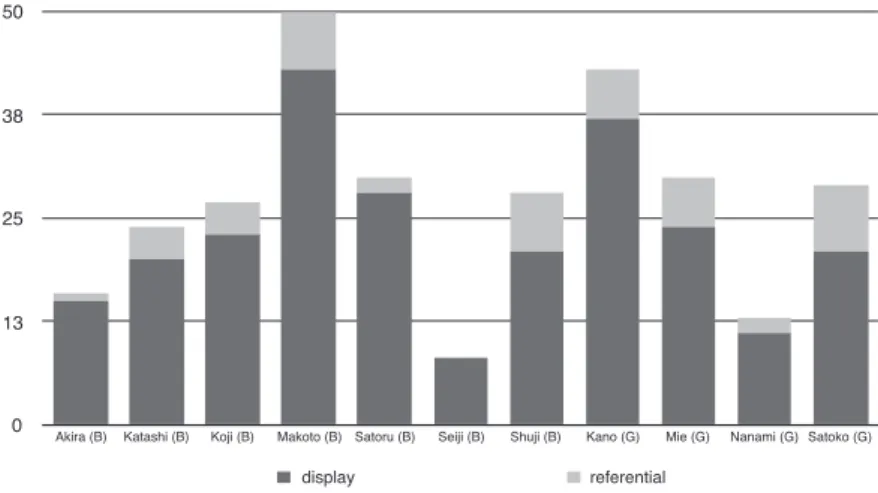
The average girl received only slightly more display questions than the average boy (23.3 girls, 22.6 boys). If Kano and Makoto’s data is removed from the total data, then boys received slightly more: 19.2 boys, 18.7 girls. However, if only Nanami and Akria’s data is removed, or all four above mentioned students’ data is removed, then girls received more display questions on average. Of the 251 display questions asked to students, 89% were AC, 10% were Re-initiations after an AC, and only 1% were NA. Referential questions, on the other, hand look slightly diff erent, illustrated in Figure 5.1.3b below, detailed in Appendix VIII. Boys were asked 25 referential questions, and girls 22. On average, girls were asked more referential questions than boys, 5.5 to 3.4 respectively. 64% of referential questions were AC (about 30% of which were checking moves), 23% were Re-initiations, and 13% were NA.
Figure 5.1.3b: Display and Referential Questions Directed to Students
5.1.3c Other Questions
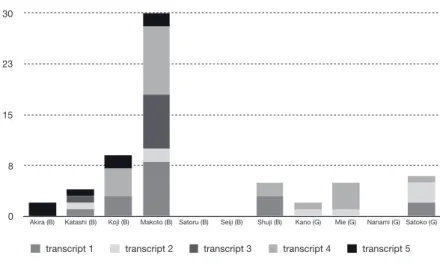
As mentioned in section 4.5.2, additional categories for types of questions include PQ, EE, and CL. The teacher only asked 6 PQ during the fi ve observed lessons. Four were directed to Kano, a girl, and one was directed each to Makoto, a boy, and Nanami, a girl. Therefore, the teacher tended to direct more PQ to girls, but the data sample is too small to say this defi nitively.
The question category of EE is one of six types of corrective feedback identifi ed by Lyster and Ranta (1977, outlined in Lightbown and Spada, 1999:104), (see section 4.5.3). This category will therefore be discussed with negative cognitive and corrective feedback (section 5.2.2b).
CL are somewhat complicated. While the teacher directed 63 CL to students, less than one-third of them were employed after a student response. Roughly 84% of CL were asked after a student’s initiating move. It is suggested that this type of elicitation was employed less as a form of corrective feedback, but more as a way of engaging with students’ contributions, both solicited and unsolicited, to the discourse. As a result, it will not be included in the discussion of corrective feedback below. Of the 63 CL to students, 13
were directed to girls (average girl 3.3) and 50 were directed to boys (average boy 7.1), however, Makoto received 60% of CL directed to boys.
Figure 5.1.3c: Clarifi cation Requests directed to Students
5.1.4 Interpretation of fi ndings for Teacher’s Initiations
Overall, the teacher tended to pay more attention to girls in terms of her initiating moves, most notably with AC and questions. One explanation for this tendency could be that the teacher considers girls to be better language learners than boys, an idea that is not uncommon in SLA research (Larsen-Freeman and Long, 1991; Zeynali, 2012). This was later revealed to be the case in a subsequent interview with the teacher, in which she elaborates that while the girls are not necessarily stronger as a whole, the top two girls (Kano and Satoko) are ‘head and shoulders’ above even the strongest boys.
Closer inspection of the data reveals that if the two students who received the most AC were removed from the data, then the teacher provides fairly equitable attention. Sunderland (2000) found similar results in her study of German language students in the UK. Sunderland’s student participants were aged 11-12, and the student participants of the current study are young children. Nonetheless, similarities can happen across ages, cultures, subjects, and ethnicities.
Boys received more attention with regards to NA and reprimands. Other studies have found this to be the case as well (Farooq, 2011). In her meta-analysis, Kelly (1988, p.29) states that the discrepancy in the amount of attention between girls and boys is most notably marked in behavioral criticism. This will be discussed again with teacher’s feedback in the section below. Again, closer inspection of the data suggests that averaging the results for boys and girls as groups does not tell the whole story. One boy received almost a third of all reprimands; if the data for reprimands were to be averaged among students who received them, excluding Makoto (and Seiji, as he did not receive any reprimands) then girls and boys received equitable treatment in regards to reprimands, and the same thing can be applied to NA.
Concerning teacher’s initiating questions, girls received more overall than boys, but not remarkably so. Girls on average were asked 52%, and boys 48% of initiating questions. As mentioned above, if the data were calculated to exclude certain students, the averages become more balanced. Nonetheless, it is important to consider the diff erences in types of questions asked. Girls tended to receive slightly more open, display, and referential questions, and boys slightly more closed questions. Open questions “leave open the nature and length of the expected response” (Chaudron, 1988, p. 127), and therefore create better opportunities for students to test hypotheses about the language than closed questions. The same can be said for referential questions, which are likely to “promote more meaningful communication between teacher and learner” (ibid, p.127), compared to display questions.
With regards to CL, it seems the teacher employed them to further engage and negotiate meaning with students. She undeniably engaged with utterances by Makoto substantially more than other students. This led the teacher to engage in particularly long exchanges with Makoto. Without his data, boys and girls received equitable attention for CL.
This leads me to suggest that in this particular classroom, because girls are directed more AC moves, including open and referential questions, they are therefore, as an answer to the implications question of this study (see section 2.4), provided more speaking (thus learning) opportunities by the teacher’s attention in the form of her initiating moves. However, girls as a whole do not have an advantage over boys as a whole. Rather, it seems as though Kano and Makoto as individuals are provided more opportunities, as the teacher tends to initiate more interactions with them, compared to other students. This will be further discussed regarding teacher feedback and student initiations in the sections below.
5.2 Teacher’s Follow-Up Moves
Findings for teacher follow-up moves will be discussed fi rst regarding aff ective feedback, including praises and criticisms. This will be followed by cognitive feedback, including types of error correction.
5.2.1 Aff ective Feedback
5.2.1a Positive Aff ective Feedback and Praise/Encouragement
In the observed lessons, there were 117 instances where the teacher provided students with positive aff ective feedback (+AF) Only 9 of those instances were provided after a student initiation (discussed below). As can be seen in Figure 5.2.1a below, almost all of the +AF was multi-coded as also being praise or encouragement (PE). The 4 times where a +AF was not a PE were where the teacher said “thank you” or some sort of variant. On average, boys received 10.7, and girls 10.5 instances of +AF. With regards to PE, on average male and female students received virtually the same (boys 10.28, girls 10.25).
Figure 5.2.1a: Positive Aff ective Feedback and Praise/Encouragement
5.2.1b Neutral Aff ective Feedback
Neutral aff ective feedback rarely occurred in the discourse. Only 8 instances were counted throughout the recorded lessons. Half of those instances were marked by the teacher saying “keep thinking” after a student replied “I don’t know” or was silent after being nominated to respond to a question.
5.2.1c Negative Aff ective Feedback, Behavioral/Academic Criticisms and Rejects
A total of 42 instances of negative aff ective feedback (-AF) were observed in the recorded lessons. Of those instances, 31% were also coded as academic criticisms (CR), 43% were coded as behavioral criticisms (CB), and 38% were rejections. As mentioned in section 4.3.3 above, CB and CR are multi-coded, therefore the percentages will not equal 100%. Likewise, fi gure 5.2.1c, below, shows more than 42 instances due to multi-coding. As illustrated below, Makoto had by far the highest number of instances of -AF, 23. The student with the second highest number of instances, a girl, only received 6. With the averages divided among students who received such feedback (5 boys, 3 girls), the ratio for boys and girls is 3:2 respectively. When divided among the receiving students, the ratio for CB is 5.5 for boys to 3 for girls. With regards to CR, averages for receiving students are at 2.75 to 1.5 respectively. Finally, rejections were also calculated among students who received them, with 2 boys receiving an average of 6, and 3 girls an average of 1.3.
Figure 5.2.1c: Negative Aff ective Feedback
5.2.2 Cognitive Feedback and Error Correction 5.2.2a Positive Cognitive Feedback
In the observed lessons, 240 instances of positive cognitive feedback (+CF) were analyzed, 153 to boys and 87 to girls. In exactly 50% of those instances the teacher repeated a student response verbatim (RV), as illustrated in Figure 5.2.2a. Instances where she did not RV were marked in many cases by her accepting a response by saying “yeah”, “uh-huh”, “sure”, “okay”, etc. It should also be noted that 54 instances (23%) of +CF were provided after a student initiation. On average, boys and girls received the same amount of +CF (21.9 and 21.8 respectively), although girls’ responses were repeated slightly more often (10.4-boys, 11.6-girls).
5.2.2b Negative Cognitive Feedback and Error Correction
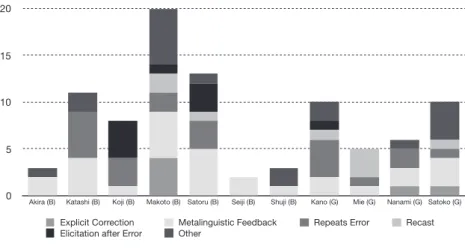
Figure 5.5.2b below provides a visual representation of the types of negative cognitive feedback (-CF), including corrective feedback. These totals also include instances where the teacher elicited a question after an error (EE), as mentioned above (section 5.1.3c). Of the 91 total instances of -CF, 60 were provided to boys and 31 to girls, with an average ratio of 8.6 to 7.8, or 52% and 48% respectively. With regards to corrective feedback, the teacher most frequently used metalinguistic feedback as well as repeating an error with a questioning intonation. Overall, boys and girls received fairly equitable corrective feedback, with a ratio of 6.9 to 6, respectively. However, when data for each type of error correction is looked at for the number of students who received the treatment, boys tended to receive more, particularly with EC (80%), ML (73%), and ER (73%), discussed further in the section below. Instances of -CF that did not included corrective feedback (see the category ‘other’ in fi gure 5.2.2b) were mostly marked by the teacher saying “no” accompanied by “you’re close”, “try again”, and “keep going”, or by saying “I don’t know/think/ see…”.
Figure 5.2.2b: Negative Cognitive and Corrective Feedback
5.2.3 Interpretation of Teacher’s Feedback
Overall, the teacher tended to pay more attention to boys in terms of her follow up moves. She gave equal attention to girls and boys with regards to +AF and +CF, which is good because this kind of feedback encourages and motivates students to speak more. However, boys received more attention in terms of -AF, 65% of both CB and CR. This is likely because of the teacher’s responses to boys’, particularly Makoto’s disruptive behavior, particularly with regards to speaking out of turn (further discussed below). In a later interview with the teacher, she stated that she sees some of her boys as being more talkative and more easily distracted than most of the girls. These opinions are in line with those of primary teachers surveyed
in Altani’s (1995) study on teachers’ beliefs (see chapter 2).
As for corrective feedback, boys and girls were treated very diff erently in terms of the individual types of correction. Boys who received certain types of corrective feedback tended to receive more than their fair share. According to Lightbown and Spada (1999, p.103-106), ML and EE are the more successful types of corrective feedback, because they are more likely to result in uptake, a learner response giving the correct form immediately after treatment. Boys received 73% of each of these types of feedback. The most likely reason for providing a greater proportion of -CF in the form of error treatment to boys could be that the teacher considered them to be weaker learners than girls, “since feedback is likely to be given to those who are less able and consequently deserve most to get it” (Farooq, 2011). Again, it was discussed in a subsequent interview with the teacher that this was the case; she did consider the boys to be weaker as a group than the girls as a group in terms of speaking and fl uency.
5.3 Student Moves
Student initiating and responding moves will be discussed below. Both initiating and responding moves will be discussed with regards to how they were coded as either solicited or unsolicited, as well as academic or non-academic. An interpretation for the fi ndings of student moves will be discussed along with ‘other fi ndings’ in section 5.2 below.
5.3.1 Student Initiating Moves
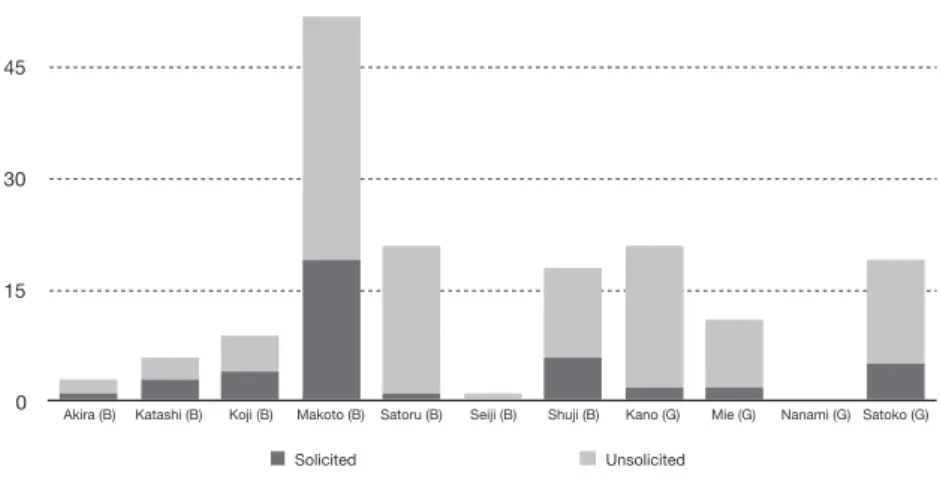
Many times throughout the recorded lessons, students would initiate their own contributions to the discourse. In some cases, they would raise their hands and wait to be nominated, however most of the time they would self-nominate and speak unsolicited, as illustrated in Figure 5.3.1 below. A total of 161 moves were initiated by students, 110 by boys and 51 by girls. Total initiations made by the students consisted of 85% academic and 15% non-academic moves. As can be seen below, Makoto initiated substantially more moves than any other student, making 32% of all student initiations and half of the non-academic initiations. On average, boys contributed 15.7 initiations, and girls 12.8. However, if Makoto’s initiations are removed from the data, then boys only contributed on average 9.7 initiations to the discourse.
Figure 5.3.1: Student Initiating Moves
5.3.2 Student Responding Moves
Students responded to the teacher’s academic and non-academic initiations, as well as clarifi cation requests, elicitations after errors, and other moves at Ib. Of the total 393 student responses, 254 were provided by boys and 139 were provided by girls. Less than 10% were non-academic responses, almost all of which were to non-academic initiations by the teacher. On average boys responded 36.4 times and girls responded 34.75 times, roughly equal to each other. However, once again Makoto has a substantially higher number of responses than the other students, and without his data boys responded an average of 27.8 times throughout the lessons.
5.3.3 Student Word Count
Of the 1,400 words spoken by students, boys spoke 925 (average boy: 132) and girls spoke 475 (average girl: 119). However, Makoto spoke roughly 42% of the total words spoken by boys, and without his contributions boys spoke on average 89 words throughout the observed lessons. Table 5.3.3 below, also shows the average number of words spoken per turn for both girls and boys.
Table 5.3.3: Total Turns Taken and Words Spoken
5.4 Other Findings
5.4.1 Teachers Treatment of Students’ Unsolicited Moves
After a closer inspection of students’ unsolicited moves at both I and R, it was found that the teacher generally treated them in one of three ways: by responding to, ignoring or rejecting the student’s move. Responses to unsolicited moves came in the form of cognitive or aff ective feedback, clarifi cation requests, or informs if the unsolicited move was an elicitation. Table 5.4.1 below shows the number of unsolicited moves for each student, as well as how those moves were treated.
Table 5.4.1: Teacher’s Treatment of Students’ Unsolicited
5.4.2 Student Bids
As previously discussed in section 4.1, data on student bids was collected and analyzed. Table 5.4.2 below shows the total number of times each student bid throughout the 5 observed lessons. Boys bid a total of 464 times, with the average boy bidding 66.3 times; girls bid a total of 270 times, with the average girl bidding 67.5 times. This means that girls and boys bid at roughly equal frequency. The table also shows the number of times that a teacher called on students when bidding was taking place (as opposed to when the teacher went around the room and called on each student in turn). Boys were called on a total of 156 times, meaning boys on average were called on 22.3 times. Girls were called on a total of 87 times, with the average girl being called on 21.7 times, almost the same amount as boys on average. Boys were only 2% more likely to be called on than girls.
Table 5.4.2: Student Bids and Number of Times Called on
5.5 Interpretation of Student Moves and other fi ndings
Although the results show that the tendency was for the teacher to direct more initiating moves to girls, this is contradicted in the results for students’ solicited responses, with boys averaging 32.7, and girls 31.5. While the results are overall fairly equitable, boys have slightly more, and this is because of the inclusion of CL. As mentioned previously, Makoto was directed substantially more CL than any other student, therefore if his data is removed, boys average 28.3 solicited responses, which corresponds better with the data for teacher initiations overall.
With regards to students’ solicited initiations, boys were nominated more frequently (66%) than girls (34%). As the data for student bids suggests, girls and boys both bid and were called on equally. Therefore it can be said that while boys were nominated to initiate an interaction more frequently, this is counterbalanced by the fact that the teacher nominated girls more frequently to respond to her initiations. Once again, a possible explanation for this could be that the teacher saw the girls as stronger students, thus she nominated them to respond, and boys as weaker, and therefore allowed them to initiate by asking questions or perhaps to test hypotheses with their utterances.
Regarding unsolicited moves by the students, the teacher treated boys and girls diff erently. On average, girls made 10.5 unsolicited initiations, and boys made 10.9. As for unsolicited responses, girls averaged 3.3 and boys 3.6. As students made on average the same amount of unsolicited moves overall (14.4 by boys, 13.8 by girls), the teacher tended to respond more frequently to those by female students, and more frequently ignored and rejected those by males. In fact,18% of the teacher’s responses to boys’ unsolicited moves were in the form of
engage with girls when they made unsolicited contributions to the discourse than boys. There are a few possible explanations for this tendency. One possibility is that in some cases when the teacher did respond to a boy’s unsolicited move, it turned into a long exchange and this took time out of the lesson. Yet another possible reason could be that many of the boys’ unsolicited contributions were interruptions of another student’s turn and even solicited contributions were nonsensical and irrelevant to the discussion, therefore perhaps the teacher considered contributions by the boys as somewhat disruptive. This is not unusual as mentioned in chapter 2, it is common for teachers to believe that boys are more disruptive than girls (Alanti, 1995).
6. Conclusion
6.1 Outcomes of the study
This study aimed to examine the role of one female teacher’s attention in an EFL classroom of mixed-sex Japanese kindergarten students, which consequently highlights the provision of language learning opportunities for male and female students. As as small-scale case study, 5 classroom discussions of various lengths, totaling roughly 75 minutes, headed by the teacher to her female and male learners (aged 4 and 5) were explored. Methodologically, Sinclair and Coulthard’s classroom discourse analysis framework was adopted and modifi ed in order to analyze transcribed classroom data of the teacher-student interactions. Once in the framework, the discourse was again coded using Farooq’s categories for analyzing gender-based classroom interaction, in order see if the teacher payed more attention to boys or girls with regards to (i) her initiating moves to the boys and girls, (ii) her feedback to students’ utterances and behavior, and (iii) initiating and responding moves by the students. Initiating moves were seen as academic or non-academic, and further examined regarding teacher questions (open or closed, display or referential, etc.). Follow-up moves were classifi ed as either aff ective or cognitive feedback in the forms of praise and criticisms, and error correction.
As discussed in the preceding sections, overall fi ndings suggest that the teacher treated her male and female students somewhat diff erently, but in a variety of ways, sometimes, but not often, in agreement with prevailing fi ndings from foreign and non-foreign language classrooms (see chapter 2). Girls were seen as more academic and well-behaved based on the higher frequency of academic initiations, including more communicative questions, and the lower frequency of reprimands and behavioral criticisms. Contrarily, boys were seen as being disruptive (Altani, 1995), particularly in the case of one student, and in need of error correction based on the frequency of negative aff ective and cognitive feedback, including error correction.
6.2 Possible implications for the fi ndings
unsolicited utterances by girls than with boys. She also tended to discipline boys’ behavior, administer corrective feedback to boys, and ignore or reject unsolicited contributions by boys more frequently than with girls. This section responds to the implications question “Will the teacher’s attention to 4 and 5-year-old boys and girls in an English-immersion kindergarten in Japan provide equal learning opportunities for boys and girls?”. The question, unfortunately, cannot be answered with a simple yes or no.
As the teacher initiated more academic moves, including referential and open questions, with girls, it is possible that she consequentially provided them with more speaking, thus learning opportunities. This is because, as stated before, such questions are more communicative and thus create greater learner productivity (Nunan, 1989).
However, most prominent is the fact that almost all types of interactions happened substantially more with one boy than any other student in the class. The teacher payed more attention to that boy in terms of questions, feedback of all types, and engaging in long exchanges with him. She did this by using clarifi cation requests as a way of engaging with his contributions and negotiating the meaning of his utterances which provided the student with much more practice in responding, and therefore in producing longer responses. This one student was responsible for aff ecting the averages for attention payed to boys. A similar phenomenon occurred in Sunderland’s (1996-unpublished, cited in Sunderland, 2004) study of a German EFL class. Had this boy not been included in the study, the teacher’s attention would have likely appeared more equally divided. In both studies, variations seemed to occur less between gender groups and more so within them. This is also highlighted in the lack of all types of interactions with another male student, Seiji, who received the least attention of all the other learners in this class.
It is important for teachers to be aware of this type of behavior and make sincere eff orts to provide equal attention to not just girls and boys as groups, but to all students individually. As mentioned in chapter 2, teachers are generally unaware of the fact that they pay attention to some students more than others (Spender, 1982; Kelly, 1988; Hassaskhah and Zamir, 2013). Yepez (1994) points out the importance of training language teachers so that they can be more aware of this problem, and Stern (1992, p.145) makes some suggestions for ways of providing more equitable treatment to students with diff erent (perhaps gender based) learning styles, including
“a) imposing a ‘wait time’ of 30 seconds to encourage impulsive students (often boys) to refl ect before responding
b) encouraging refl ective students (often females) to be more spontaneous, for example through small-group activities and question games which require rapid answers”
6.3 Limitations of the current study and suggestions for further research
One of the key weaknesses of this study, and probably one that many researchers feel about their work, is that the fi ndings are based on only a mere 75 minutes of classroom time, and therefore the perceived tendencies and overall generalizations made based on the fi ndings are limited and rather tentative. Perhaps the teacher treated her students with more or less equity at other times throughout the year, as very young students tend to change in many ways even in a short period of time.
Another shortcoming, which may have aff ected the data, was that the teacher’s words directed to individual students could not be measured. As there was only one video recorder placed at the front of the class facing the students, in order to collect data on student bids, only the back of the teacher was seen throughout the lessons. Perhaps had there been another camera facing the teacher, data on the teacher’s gaze could have been collected which would have been helpful in more clearly deciphering who she was talking to, whether it be an individual student, or the class as a whole.
Other questions that were raised during the research process but that were unable to be investigated due to limitations of time and space include questions about the teacher’s wait-time (how long she waited for students to respond to her elicitations; whether she waited longer for boys or girls, and possible explanations for why) as well as the teacher’s treatment of students who spoke in the mother tongue (as with unsolicited moves, did she respond to, ignore, or reject utterances in Japanese by the students?). The intention is to examine the the teacher’s attention in relation to these questions in future studies.
Lastly, in working on the research reported in this study, I suggest that further investigations be carried out in similar contexts to this one. To my knowledge, there are no studies of this kind focusing on Japanese learners at the kindergarten level. With the recent implementation of enhanced English programs in Elementary Schools, Japan is likely to see an increase in new, perhaps untrained and inexperienced, foreign teachers throughout the country. This is likely to mean that kindergartens will become more competitive in providing early education, including language studies, as well as day care. It is important that research be done as these developments occur, so that fi ndings can be translated in to professional ELT practices.
Bibliography
Altani, C. 1995. ‘Primary school teacher’s explanation of boys’ disruptiveness in the classroom: a gender-specifi c aspect of the hidden curriculum’. In Mills, S. (Ed.) Language and Gender: Interdisciplinary
Perspectives. 149-159. London: Longman.
Chaudron, C. 1988. Second Langauge Classrooms: Research on teaching and learning. Cambridge: Cambridge University Press.
Farooq, M. U. 2011. ‘Examining Gender Diff erences in Teacher-Student Interactions Based on the Sinclair-Coulthard Model: Outcomes of the Study’. NUAS. The Journal of Liberal Arts. 7: 17-42.
Hassaskha, J. and Zamir, S. R. 2013. ‘Gendered Teacher-Student Interactions in English Langauge Classrooms: A Case of Iranian College Context’ SAGE Open. 3:1-11.
Kelly, A. 1988. ‘Gender diff erences in teacher-pupil interactions: a meta-analytic review’. Research in
Education. 39:1-23.
Larsen-Freeman, D., and Long, M. 1991. An Introduction to Second Language Acquisition Research. London: Longman.
Lightbown, P. and Spada, N. 1999. How Languages are Learned. (2nd edition). Oxford: Oxford University Press.
Nunan, D. 1989. Understanding Language Classrooms: A guide for teacher-initiated action. Hertfordshire: Prentice Hall International.
Spender, D. 1982. Invisible Women: The schooling scandal. London: Writers and Readers Publishing. Stern, H. H. 1992. Issues and Options in Langauge Teaching. Oxford: Oxford University Press.
Sunderland, J. 2000. ‘New Understandings of Gender and Language Classroom Research: texts, teacher talk, and student talk’. Language Teaching Research. 4(2): 149-173.
Sunderland, J. 2004. Gendered Discourses. New York: Palgrave Macmillan.
Yepez, M.E. 1994. ‘An Observation of Gender-Specifi c Teacher Behavior in the ESL Classroom’. Sex
Roles. 30, 1(2): 121-133
Zeynali, S. 2012. ‘Exploring the Gender Eff ect on EFL Learners’ Learning Strategies’. Theory and