第 128 号 2013 年 9 月
Abstract
The majority of studies on depression among women living in s helters have investigated the relationship between depression and the reason for living in a shelter, such as intimate partner violence and rape. Prior studies were limited to examining lower socioeconomic status (SES), lower parental SES in childhood and lower interpersonal trust as factors potentially associated with depression. However, a paucity of literature exists on possible associations between depression and other shelter-related factors, such as the length of residence. In addition, the majority of prior studies were conducted in high income countries, primarily in the United States; few studies have been conducted in low-income countries, such as Cambodia, where the incidence of rape and abuse among young women has been increasing. This study aimed to investigate factors associated with prevalence of depression among young women living in shelters in Cambodia. The study participants included 31 young women living in two shelters run by two local non-governmental organizations in Phnom Penn, Cambodia. In-person, structured interviews were conducted in February 2011. T-tests and one-way analyses of variance were used to examine differences in the means of depression scores for each independent variable. Categorical regression analysis was used to identify statistically significant factors that affect the prevalence of depression. The length of residence in a shelter and lower parental SES in childhood were associated with increased prevalence of depression at the 1% level. The length of residence in a shelter and lower parental SES in childhood were associated with prevalence of depression among the sheltered women in Cambodia.
Keywords: depression, shelter, women, Cambodia, SES
Factors Associated with Depression among
Young Women Living in Shelters in Cambodia:
Socio-Demographic Characteristics,
Socioeconomic Status, Life in a Shelter,
Worries after Leaving a Shelter
and Interpersonal Trust
INTRODUCTION
Empirical evidence has demonstrated a high prevalence of depression among female residents of domestic violence and homeless shelters (West et al., 1990; Gleason, 1993; Bean & Möller, 2002). The majority of studies on depression conducted in women's shelters have investigated the relationship between depression and the reason for living in a shelter, such as intimate partner violence and rape, and have found that abused women in shelters are more likely to have depression (Wenzel et al., 2006; Sato-DiLorenzo & Sharps, 2007; Weaver et al., 2007). For instance, a study of 224 women living in homeless shelters or low-income housing in the United States (US) showed that women who experienced victimization by physical and/or sexual violence were statistically significantly more likely to have depression, compared to non-victimized women (Wenzel et al., 2006).
However, a paucity of literature exists on possible associations between depression and other shelter-related factors, such as length of residence in a shelter. Prior studies have shown that the length of residence in a shelter was associated with lower likelihood of depression (Deighan, 1994; Orava et al., 1996). One prior study showed that depression among 30 women at a domestic violence shelter in the US was statistically significantly reduced after one week at the shelter (Deighan, 1994).
Prior studies on factors associated with depression risk among women living in shelters have been limited with respect to available data but have been able to examine socioeconomic status (SES) and interpersonal trust for possible associations with depression. A growing body of empirical evidence has demonstrated that lower SES (Andrade et al., 2003; Lorant et al., 2003; Inaba et al., 2005; Yoshii, 2007), lower SES in childhood (Gilman et al., 2002; Gilman et al., 2003; McLaughlin et al., 2010) and lower interpersonal trust (Kouvonen et al., 2008; Starr & Davila, 2008; Kim et al., 2012) are associated with increased depression risk in the general population. One prior study showed that family income, a proxy for SES, was statistically significantly associated with the likelihood of major depressive episodes in the general populations of the US, Canada and the Netherlands (Andrade et al., 2003). Another study examined 1,132 adult offspring of mothers enrolled in the Providence, Rhode Island cohort of the National Collaborative Perinatal Project between 1959 and 1966, and showed that women of lower SES in childhood had a nearly twofold increased risk of major depression, compared to women in the highest childhood SES category (Gilman et al., 2002). With respect to a possible association between interpersonal trust and depression risk, a longitudinal study of 18,856 South Koreans conducted from 2006 to 2008 found that low interpersonal trust appeared to be an independent risk factor for new-onset and long-term depression (Kim et al., 2012).
While some studies have reported associations between lower SES in interviews, lower SES in childhood, lower interpersonal trust, and increased depression risk, these relationships are still under debate. For example, family income was not associated with risk of major depressive episodes among a Japanese and Mexican sample (Andrade et al., 2003), and life-course research conducted in New Zealand found that children from
socioeconomically disadvantaged families were not at elevated risk of adult depression (Melchior et al., 2007). A study in the US found that individual trust in neighbors was not associated with major depression when the study population was restricted to a non-depressed sample at baseline (Fujiwara & Kawachi, 2008).
With respect to depression studies conducted among women living in shelters, the majority of studies have been conducted in high income countries, primarily in the US. Few studies have been conducted in low-income countries, such as Cambodia, where the incidence of rape and abuse among girls and young women has been increasing (Amnesty International, 2010; ECPAT Cambodia, 2010). Qualitative reports on Cambodian victims of rape have revealed difficulties in coping with stigma and fear, leading to depressive symptoms (Amnesty International, 2010). In order to protect and rehabilitate girls and young women who are at risk or have been victims of sexual and/or physical abuse or labor exploitation, non-governmental organizations (NGOs) have provided services, such as counseling, in shelters.
The objective of the current study was to examine a variety of factors for possible association with increased prevalence of depression among young women residing in Cambodian shelters, who were at risk of or were victims of sexual and/or physical abuse or labor exploitation. Five hypotheses were considered: (1) Abused women would be more likely than non-abused women to have depression. (2) The length of residence in the shelter would be associated with lower prevalence of depression. (3) Prevalence of depressive symptoms would be higher in women of lower SES. (4) Prevalence of depressive symptoms would be higher in women with lower parental SES in childhood. (5) Prevalence of depressive symptoms would be higher in individuals with lower levels of interpersonal trust. Because the participants are provided shelter services for a limited time, other questions related to shelter life, NGO support, education, concerns about the future after leaving the shelter and socio-demographic characteristics were also investigated for possible associations with depression. Overall, this study aimed to identify ways to provide mental health support to young women residing in shelters in Cambodia.
METHODS
Participants and ethics
Research request was made to five local NGOs in Phnom Penn, Cambodia through e-mailing or meeting local staff from December 2010 to February 2011. This research was conducted in two shelters run by two local NGOs in Phnom Penn, during 21–22 and 25–26 February 2011. All 31 young women residing in both shelters were interviewed in person. An outline of the research, including the purpose, the wording of questions and protocol for protection of privacy of the participants was submitted to the director of the NGO before the interview. At the beginning of the interview, the objectives of the research and privacy protection protocol were explained to the participants.
Style of research
This research employed a cross-sectional study design. In-person, structured interviews, of approximately 40 minutes per participant, were conducted through an interpreter, in the shelter. Approximately one week prior to the interview date, the questionnaires were checked by an NGO director or staff person to ensure that no inappropriate questions would be posed to a participant. Two professionals with experience conducting interviews with sexually or physically exploited Cambodian women served as the interpreters.
Assessment of depression
Depression scores were measured using the Depression Self-Rating Scale for Children (DSRS), developed by Birleson (1981). The DSRS is an 18-item questionnaire in which the participant is asked to rate his or her own situation during the last week on a 3-point scale (most, sometimes or never). Responses are scored in the direction of disturbance 0, 1 or 2. The sum of the scores across all 18 items is the depression score. The DSRS was chosen because of its short length and relative ease of understanding (Myers & Winters, 2002). The DSRS was designed for children between the ages of 7–13 years. However, the DSRS was shown to be reliable and valid among adolescents as well (Ivarsson & Gillberg, 1997). The internal reliability coefficient in this study (Cronbach's alpha) was 0.663.
The primary independent variables were the socio-demographic characteristics described below, SES characteristics including SES at the time of the interview and parental SES in childhood, life in the shelter, worries about the future after leaving the shelter and interpersonal trust. Socio-demographic characteristics included age at the time of the interview (in years), years of schooling, home province, marital status (1: married, 2: never married, 3: previously married), having children (1: yes, 2: no) and the reason for the stay in a shelter. The variable on the reason for staying in a shelter had five categories (1: poverty, 2: orphan, 3: sex worker, 4: abused, 5: rape), which were reclassified into two levels for the analysis (1 and 2: non-abused; 3, 4 and 5: abused). At one shelter, the participants were asked to provide the reason that they were staying in a shelter during the interview. At the other shelter, the NGO staff was asked to answer this question on behalf of the participant.
The SES at the time of the interview was assessed through the question, ‘Do you have money?' This question had three answer choices (1: a lot, 2: a little, 3: none). Parental SES in childhood was based on access to food using two questions. The first question was, ‘When you lived with your family, could you have a full meal?' This question had three answer choices (1: most of the time, 2: sometimes, 3: no). The second question was, ‘When you lived with your family, could you have meal three times a day?' This question had two answer choices (1: most of the time, 2: no). Although a number of studies conducted in industrial countries have used parental occupation to measure parental SES in childhood (Gilman et al., 2002; Gilman et al., 2003; Melchior et al., 2007), the measure is not suitable in low-income countries such as Cambodia, in which most of the labor force (80%) is employed in the agriculture sector and most agricultural workers are self-employed or unpaid family members working on a household farm (FAO, 2010). Since many people
throughout the developing world remain vulnerable to food insecurity (FAO, 2009), access to food was recorded in order to assess parental SES in childhood.
A set of variables related to shelter life was examined for possible association with depression among women living in Cambodian shelters; these variables included the participant's length of residence in shelter, whether she had taken support provided by the NGO, whether the participant was attending either a public school or a school out of the shelter (1: yes, 2: no), whether the participant felt satisfied with life in the shelter (1: yes, 2: no) and whether the participant had more requests to the NGO (1: yes, 2: no). Taking support provided by the NGO was based on whether the participant took support in any of the following areas (1: yes, 2: no): vocational training, a literacy class, a life skills class, a creative program, medical services, individual counseling and legal services.
The questions about worries about the future after leaving the shelter assessed the level of worry related to finding a job, having money on which to live, finding a place to live, relationships with family and physical health; each of these concerns was assessed with four response levels (1: very worried, 2: a little worried, 3: not worried, 4: not worried at all). The score was categorized into three levels (1: very worried, 2: a little worried, 3 and 4: not worried) for the analysis.
Four items regarding interpersonal trust were recorded. One question asked, ‘Do you have someone you like?' For this question, the participants had three answer choices (1: many, 2: a few, 3: no). Two additional questions asked, ‘Do you have someone you can talk to about the worries for the future after leaving shelter?' and ‘If you have someone you can talk to about the worries, whom can you talk about? Family member? Friends at school? Friends in shelter? Relatives? Staff of the NGO?' Participants had two answer choices for these questions (1: yes, 2: no). The final question asked, ‘Do you want to meet your family?' For this question, the participants could select from three answer choices (1: very much, 2: a little, 3: no).
Statistical methods
After calculating basic descriptive statistics, a t-test was used to examine differences between the means of the depression scores, for each of the independent variables. A one-way analysis of variance (ANOVA) was used to examine differences in the means of the depression scores between the groups of the independent variables. Then, a categorical regression analysis was used to identify what factors were associated with the prevalence of depression. In the categorical regression analysis, variables that had statistically significant differences in the means of depression scores in the t-test and one-way ANOVA were used as independent variables. SPSS 16.0 was used for the analysis of the data.
RESULTS
Socio-demographic characteristics
The socio-demographic characteristics of the participants, except home province, marital status and having children, are presented in Table 1. The mean of age at the time of
the interview was 16.48 years (standard deviation (SD)=2.308), with an overall range of 12 to 21 years. Age at the time of the interview was categorized as 12–15 years old (38.7%), 16–18 years old (38.7%) and 19–21 years old (22.6%). The mean years of schooling was 7.48 years (SD=3.355), and years of schooling was categorized as less than 6 years (19.4%), 6–9 years (48.4%) and more than 10 years (32.3%). Home provinces included Koh Kong (25.8%), Kampong Thom (12.9%), Kampong Speu (9.7%), Kandal (9.7%), Kompong Cham (9.7%), Kampong Chhang (6.5%), Kampot (6.5%), Prey Veng (6.5%), Pursat (6.5%), Phonm Penh (3.2%) and Preah Vihear (3.2%). The distribution of home province shows that participants were not only from Phonm Penh, where the shelters were located, but also from different parts of Cambodia. Regarding marital status and having children, all participants were single with no children. Approximately one-third (38.7%) of the participants came to a shelter for reasons not related to abuse, such as poverty or orphanhood. The other two-thirds of the participants (61.3%) came to a shelter for reasons related to abuse, including having been a sex worker and/or a rape victim.
SES: SES at the time of the interview and parental SES in childhood
Slightly more than half of the participants (54.8%) had no money at the time of the interview, while another approximately half (45.2%) had a little money (Table 2). No one had a lot of money. Nearly less than half of the participants (45.2%) could have a full meal most of the time when they lived with their family, while approximately one-third of the participants (35.5%) could not have a full meal, and about one-sixth of the participants (16.1%) could sometimes have a full meal. About two-third of the participants (64.5%) could not have three meals a day when they lived with their family, while another one-third of the participants (32.3%) could have three meals a day most of the time.
Table 1 Socio-demographic characteristics and depression (n= 31)
Variable n % Mean SD Mean of
depression scores SD p valuea Age 12–15 16–18 19–21 12 12 7 38.7 38.7 22.6 16.48 2.308 9.58 14.83 11.71 3.972 3.157 3.251 ** Years of schooling >6 years 6–9 years <10 years 6 15 10 19.4 48.4 32.3 7.48 3.355 9.50 13.27 11.90 4.324 4.480 2.767 n.s.
Reason for shelter stay Non-abused Abused 12 19 38.7 61.3 12.17 12.05 3.762 4.403 n.s. n.s.=not significant, **p<0.01
aOne-way ANOVAs were used to assess differences in the means of the depression scores between the
three groups of age and years of schooling. A t-test was conducted on the means of the depression scores across levels of reason for shelter stay.
Life in the shelter
The mean of length of residence in a shelter was nearly 3 years (2.897 years, SD= 2.350) (Table 3). Approximately one-third of the participants (38.7%) stayed in the shelter for more than 4 years, while the remainder had lengths of residence in a shelter of 1–4 years (25.8%), 3 months to 1 year (19.4%) and less than 3 months (16.1%). Regarding taking support from an NGO, all participants took vocational training, such as weaving and cooking. Other types of support that participants received included medical services (93.5%); life skill classes, such as HIV prevention and human rights (87.1%); individual counseling (71.0%); literacy classes (45.2%); creative programs, such as music, art and dance (45.2%); and legal services (19.4%). Types of support that participants did not receive included legal services (80.6%), creative programs (54.8%), literacy classes (51.6%), individual counseling (29.0%), life skills class (12.9%) and medical services (6.5%). The majority of the participants (83.9%) went to school, either to a public school or a school out of the shelter;
Table 2 SES and depression (n=31)
Variable n % Mean of
depression scores
SD p valuea
<SES at the time of the interview> Amount of money I have A lot
A little None 0 14 17 0.0 45.2 54.8 - 10.36 13.53 - 4.012 3.693 *
<Parental SES in childhood>
Full meal with family Most of the time Sometimes No Missing value 14 5 11 1 45.2 16.1 35.5 3.2 10.07 14.00 13.64 - 3.772 3.082 4.202 - *
Three meals a day with family Most of the time No Missing value 10 20 1 32.3 64.5 3.2 10.06 12.75 - 4.858 3.683 - n.s. *p<0.05 a
T-tests were conducted to assess differences in the means of depression scores for SES at the time of the interview (amount of money I have) and parental SES in childhood (three meals a day with family). A one-way ANOVA was conducted to assess differences in the means of depression scores between the three groups of another measure of parental SES in childhood (full meal with family).
Table 3 Life in the shelter and depression (n=31)
Variable n % Mean SD Mean of
depression scores
SD p value
(one-way ANOVA) Length of residence in the shelter
<3 months 3 months to 1 year 1–4 years >4 years 5 6 8 12 16.1 19.4 25.8 38.7 2.897 2.350 16.00 8.83 10.75 13.00 3.742 3.545 4.833 2.296 * *p<0.05
the remainder of the participants did not go to school (16.1%). Most participants (93.5%) reported being satisfied with life in a shelter, and only 6.5% reported that they were not satisfied with life in a shelter. However, nearly 70% (71.0%) of the participants had more requests to an NGO; 29.0% did not have any additional requests.
Worries about the future after leaving the shelter
With respect to worries about the future after leaving the shelter, most participants worried very much about having enough money on which to live (90.3%) and finding a job (87.1%) (Table 4). Only 9.7% of the participants were only a little worried about having enough money on which to live, and 9.7% of the participants were only a little worried about finding a job. The remainder of the participants (3.2%) reported that they were not worried about finding a job. Regarding worries about finding a place to live, approximately two-thirds of the participants (61.3%) reported being worried very much, while about one-third (32.3%) reported being worried a little, and the remainder (6.5%) reported being not worried about finding a place to live. Nearly half of the participants (45.2%) reported being a little worried about relationships with family, while less than one-third of the participants (29.0%) worried very much about relationships with family, and 25.8% of the participants reported that they were not worried about relationships with family. Regarding worries about their own physical health, approximately half of the participants (51.6%) worried a little, while about one-fourth (25.8%) worried very much, and the
remainder (22.6%) reported that they were not worried.
Variable n % Mean of
depression scores
SD p value (t-test) Taking support from the NGO
Vocational training
Literacy class
Life skills class
Creative program Medical services Individual counseling Legal services Yes No Yes No Missing value Yes No Yes No Yes No Yes No Yes No 31 0 14 16 1 27 4 14 17 29 2 22 9 6 25 100.0 0.0 45.2 51.6 3.2 87.1 12.9 45.2 54.8 93.5 6.5 71.0 29.0 19.4 80.6 12.10 - 10.93 13.19 - 12.19 11.50 12.64 11.65 11.90 15.00 12.45 11.22 13.67 11.72 4.102 - 4.615 3.544 - 4.133 4.435 2.951 4.898 4.135 2.828 4.240 3.833 4.457 4.016 - n.s. n.s. n.s. n.s. n.s. n.s.
Going to school Yes
No 26 5 83.9 16.1 11.62 14.60 4.070 3.647 n.s.
Satisfaction with shelter life Yes No 29 2 93.5 6.5 12.00 13.50 4.123 4.950 n.s.
Having more requests to the NGO Yes No 22 9 71.0 29.0 12.27 11.67 4.188 4.093 n.s.
Interpersonal trust
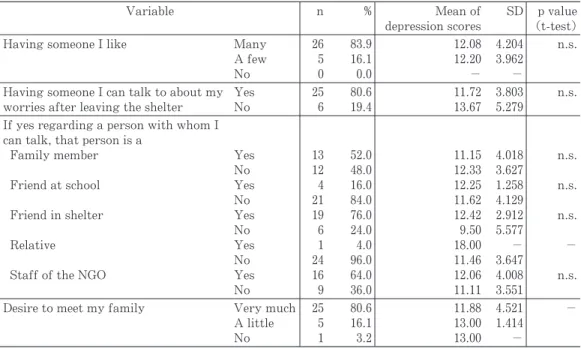
The majority (83.9%) of the participants reported that they had many people that they liked, and the remainder (16.1%) had only a few people that they liked (Table 5). The majority (80.6%) of the participants reported that they had someone with whom they could talk about their worries surrounding the future after leaving the shelter, and the remainder (19.4%) of the participants reported that they did not have anyone with whom they could talk about such worries. Among the participants who reported that they did have someone with whom to talk about worries surrounding the future after leaving the shelter, most participants reported that they could talk to friends in the shelter (76.0%) and the staff of the NGO (64.0%). Nearly half of the participants could talk to a family member about these worries (52.0%), while a small proportion of the participants could talk to friends at school (16.0%) and relatives (4.0%) about these worries. The person with whom participants reported they could not talk about these worries included relatives (96.0%), friends at school (84.0%), a family member (48.0%), the staff of the NGO (36.0%) and friends in the shelter (24.0%). The majority (80.6%) of the participants wanted to meet their family very much, while 16.1% of the participants wanted to meet their family only a little, and a small percent (3.2%) of the participants did not want to meet their family. The data on interpersonal trust showed that participants had a relatively high level of interpersonal trust and that they trusted people associated with the shelter, such as friends at the shelter or the staff of the NGO.
Table 4
Worries about the future after leaving the shelter and depression (n=31)
Variable n % Mean of
depression scores
SD p valuea
Finding a job Very worried A little worried Not worried 27 3 1 87.1 9.7 3.2 12.59 7.67 12.00 3.816 5.508 - -
Money to live Very worried A little worried Not worried 28 3 0 90.3 9.7 0.0 12.32 10.00 - 4.010 5.292 - n.s.
Finding a place to live Very worried A little worried Not worried 19 10 2 61.3 32.3 6.5 12.63 11.70 9.00 3.919 4.111 7.071 n.s.
Relationship with family Very worried A little worried Not worried 9 14 8 29.0 45.2 25.8 13.33 12.00 10.88 4.950 3.742 3.796 n.s.
Physical health Very worried A little worried Not worried 8 16 7 25.8 51.6 22.6 13.00 11.75 11.86 1.309 5.053 4.100 n.s. a
A t-test was used to assess differences in the means of depression scores for the variable money to live. A one-way ANOVA was used to assess differences in the means of depression scores across the three groups of finding a place to live, relationship with family and physical health.
Differences in the means of the depression scores for each independent variable
With respect to socio-demographic characteristics and depression (Table 1), the results from the one-way ANOVA showed a statistically significant difference in the means of the depression scores between the three groups of age at the time of the interview at the 1% level ((F (2, 28)=6.904, p=0.004)). Comparisons of age at the time of the interview by the Tukey HSD showed that there was a statistically significant difference between the means of the depression scores between the 12–15 year group and the 16–18 year group at the 1% level. The depression scores were significantly higher in the 16–18 year group compared to the 12–15 year group at the 1% level. There were no statistically significant differences between the means of the depression scores across years of schooling or reason for shelter stay.
Upon investigation of SES and depression (Table 2), the results of the t-test assessing differences in the means of the depression scores across categories of amount of money I have demonstrated that there was a statistically significant difference at the 5% level (t (29) =2.289, p=0.030). The results of the ANOVA assessing differences in the means of the depression scores across the three groups of full meal with family showed a statistically significant difference at the 5% level (F (2, 27)=3.430, p=0.047). Comparisons of full meal with family by the Tukey HSD showed a statistically significant difference between no and most of the time at the 10% level. The depression scores were statistically significantly higher in the no category compared to the most of the time category at the 10% level. The results of t test showed no statistically significant difference in the means of the depression scores for each category of three meals a day with family.
Table 5 Interpersonal trust and depression (n=31)
Variable n % Mean of
depression scores
SD p value (t-test)
Having someone I like Many
A few No 26 5 0 83.9 16.1 0.0 12.08 12.20 - 4.204 3.962 - n.s.
Having someone I can talk to about my worries after leaving the shelter
Yes No 25 6 80.6 19.4 11.72 13.67 3.803 5.279 n.s.
If yes regarding a person with whom I can talk, that person is a
Family member
Friend at school
Friend in shelter
Relative
Staff of the NGO
Yes No Yes No Yes No Yes No Yes No 13 12 4 21 19 6 1 24 16 9 52.0 48.0 16.0 84.0 76.0 24.0 4.0 96.0 64.0 36.0 11.15 12.33 12.25 11.62 12.42 9.50 18.00 11.46 12.06 11.11 4.018 3.627 1.258 4.129 2.912 5.577 - 3.647 4.008 3.551 n.s. n.s. n.s. - n.s.
Desire to meet my family Very much A little No 25 5 1 80.6 16.1 3.2 11.88 13.00 13.00 4.521 1.414 - -
The results of the ANOVA regarding the a possible association between factors related to life in the shelter and depression (Table 3) showed statistically significant differences in the means of the depression scores across the four groups of length of residence in the shelter at the 5% level ((F (3, 27)=4.347, p=0.013)). Comparisons using the Tukey HSD showed a statistically significant difference between participants in the less than 3 months category and those in the 3 months to 1 year category at the 5% level. The depression scores were statistically significantly higher among participants in the less than 3 months category compared to participants in the 3 months to 1 year category at the 5% level. No other statistically significant differences in the means of the depression scores were apparent upon application of the t-test to the other variables related to life in the shelter, including taking support from the NGO, going to school, satisfaction with shelter life and having more requests to the NGO.
With respect to a possible association between worries about the future after leaving the shelter and depression (Table 4), no statistically significant differences were found by application of the t-test to the variable money to live. No statistically significant differences were apparent upon application of the ANOVA to the variables finding a place to live, relationship with family and physical health.
Regarding interpersonal trust and depression (Table 5), no statistically significant differences in the depression score means were apparent in the results of the t-test, for either of the variables having someone I like or having someone I can talk to about my worries after leaving the shelter. Among participants who reported that they did have someone with whom they could talk about worries of the future, the t-test revealed no statistically significant differences in the means of the depression scores across the categories of the type of person with whom they could talk.
To summarize the outcome of the t-tests and one-way ANOVAs, four variables were identified to be statistically significantly differences in the means of the depression scores: age, SES at the time of the interview (amount of money I have), parental SES in childhood (full meal with family) and length of residence in shelter. Graph 1 presents the means of
the depression scores and SDs for four variables.
Variables related to depression
Table 6 shows the outcome of the categorical regression analysis in assessing possible factors that affect the prevalence of depression. The coefficient of determination, adjusted for the degrees of freedom (adjusted R2), was 0.501. The regression equation was
statistically significant at the 0.1% level. The highest absolute standardized coefficient (ß) was found upon analysis of length of residence in shelter. The second highest standardized coefficient was found upon analysis of full meal with family. Length of residence in shelter and full meal with family were statistically significantly associated with depression at the 0.1% level. The results of the categorical regression analysis showed that length of residence in shelter and parental SES in childhood (full meal with family) were statistically significantly associated with depression scores. However, age at the time of the interview and SES at the time of the interview (amount of money I have) were not statistically
Table 6
Relational independent variables associated with depression (Categorical regression analysis) (n=30)
ß SD df F p value
Age
SES at the time of the interview (amount of money I have) Parental SES in childhood (full meal with family) Length of residence in the shelter
-0.178 0.215 0.448 -0.631 0.144 0.158 0.164 0.133 1 1 3 2 1.535 1.843 7.472 22.510 0.228 0.188 0.001 0.000 df=degrees of freedom Table 7
Pearson correlation coefficients of qualified independent variables identified in the categorical regression analysis (n=30)
Age SES at the time of the interview Parental SES in childhood Length of residence in the shelter Age
SES at the time of the interview (amount of money I have)
Parental SES in childhood (full meal with family)
Length of residence in the shelter
1.000 -0.116 0.283 0.037 1.000 0.486 0.137 ** 1.000 0.149 1.000 **p<0.01 Graph 1
significantly associated with depression.
Possible co-linearity between the variables found to be associated with depression in the categorical regression analysis was assessed by calculating Pearson correlation coefficients. The highest absolute correlation coefficient was 0.486, indicating a modest correlation between SES at the time of the interview (amount of money I have) and parental SES in childhood (full meal with family; Table 7), and thus, the presence of significant co-linearity was unlikely. Therefore, a categorical regression analysis of these data is appropriate for evaluating possible associations between these variables and de pression using a standardized coefficient (ß).
DISCUSSION
This study showed that length of residence in a shelter and lower parental SES in childhood were associated with prevalence of depression. Hypotheses 2 and 4 were supported in the present study: (2) The length of residence in the shelter was related to lower depression. (4) Prevalence of depressive symptoms was higher in women with lower parental SES in childhood. However, hypotheses 1, 3 and 5 were not supported by results of the current study: (1) Abused women were not more likely than non-abused women to have depression. (3) Prevalence of depressive symptoms was not higher in women of lower SES. (5) Prevalence of depressive symptoms was not higher in individuals with lower levels of interpersonal trust. In addition, socio-demographic characteristics, life in the shelter, except for length of residence in the shelter and worries about the future after leaving the shelter did not appear to be associated with prevalence of depression in the categorical regression analysis.
The categorical regression analysis revealed that length of residence in the shelter was the variable most strongly associated depression scores. There was an inverse association between length of residence and depression scores. As the comparisons showed, depression symptoms were reduced after living in a shelter for 3 months to 1 year. This result suggests that involvement in the first three months is vital for young women in shelters in Cambodia. The shelter plays an important role as a safe accommodation that alleviates depression among sheltered young women for the first year of residence. The results from this study support prior research in this area (Deighan, 1994; Orava et al., 1996). However, one finding should be considered. As Graph 1 shows, the means of the depression scores increased among participants who stayed at the shelter for 1 to 4 years, and the mean increased further among those who stayed at the shelter more than 4 years. This finding suggests that longer shelter stays did not help to alleviate depression symptoms among the young women in Cambodia.
Parental SES in childhood was also associated with the prevalence of depression among the young women at shelters. The means of the depression scores were higher among participants who reported no full meals with family compared to those with access to full meals most of the time. Lower parental SES in childhood was associated with increased prevalence of depression among the young women at shelters. These results are consistent
with prior research conducted in the general population, who had not been victims or had not been at risk of sexual and/or physical abuse or labor exploitation, showing an association between lower parental SES on lifetime risk of depression (Gilman et al., 2002; Gilman et al., 2003; McLaughlin et al., 2010); however, the current results are inconsistent with life course research conducted in New Zealand, which found that children from socioeconomically disadvantaged families were not at elevated risk of adult depression (Melchior et al., 2007).
Gilman et al. (2003) explained that the long-term association between childhood SES and depression likely is due to the influence of SES on psychological processes that increase the vulnerability to depression. Since low childhood SES directly affects psychological well-being (McLeod & Shanahan, 1993), it might interrupt vital aspects of psychological development, leading to increasing adult vulnerability to depression (Gilman et al., 2003). Gilman et al. (2002) suggested that children's vulnerability to depression throughout the life course might be increased because children in disadvantaged situations may obtain less control over their environments (i.e., learned helplessness) and may develop difficulties in forming close relationships.
Although supported by evidence from prior studies conducted in the general population, hypotheses 3 and 5 were not supported in this study. SES at the time of the interview (amount of money I have) was not associated with depression. The results support a study by Andrade et al. (2003), conducted among a Japanese and Mexican sample; however, the current results are inconsistent with several other studies, including Lorant et al. (2003), Inaba et al. (2005) and Yoshii (2007). Participants in the current study had secure access to food while living in the shelter, thus the variable amount of money I have might be less likely to be associated with depression.
With respect to the association between interpersonal trust and depression, the results of the current study support prior work by Fujiwara & Kawachi (2008); however, these results are inconsistent with previous studies including Kouvonen et al. (2008) in Finland, Starr & Davila (2008) in the US and Kim et al. (2012) in South Korea. The inconsistency among the results of these studies might result from the differential influence of difference cultural backgrounds on interpersonal trust.
Limitations
This study had several methodological limitations. The small sample size precluded analyses of data to some extent. Effort is needed to collect more data.
CONCLUSIONS
This study aimed to investigate factors associated with an increased prevalence of depression among young women who were victims of or were at risk of sexual and/or physical abuse or labor exploitation in shelters in Cambodia. The results of the current study provided support for two out of five hypotheses. The length of residence in the shelter and lower parental SES in childhood were associated with depression. The association
between the length of residence in the shelter and depression scores revealed that a shelter can play an important role as safe accommodation, alleviating depression among sheltered young women for the first year of residence. This study also demonstrated that SES differences in childhood may be particularly important in determining later risk of depression, a finding that is consistent with substantial literature conducted in the general population suggesting that lower parental SES in childhood is associated with a higher lifetime risk of depression. These results have important implications for efforts to understand the factors that lead to increased depression risk among young women in shelters in Cambodia.
ACKNOWLEDGMENTS
First and foremost, I would like to thank to Masanori Takeshita for his invaluable advice and suggestions. I wish to express my sincere thanks to Emi Hirasawa, Shingo Saberi, Kasumi Nakagawa and Mizuho Oura for precious advice. Finally, I am very grateful to directors and staff of NGOs who kindly agreed to conduct the interviews as well as lovely girls in shelters who made contribution as participants.
REFERENCES
Amnesty International. (2010). Breaking the Silence, Sexual Violence in Cambodia. London: Amnesty International Publications.
Andrade, L., Caraveo-Anduaga, J. J., Berglund, P., Bijl, R.V., De Graaf, R., Vollebergh, W., ...Wittchen, H. U. (2003). The epidemiology of major depressive episodes: results from the International Consortium of Psychiatric Epidemiology (ICPE) surveys. International Journal of Methods in Psychiatric Research, 12(1): 3–21.
Bean, J., & Möller, A. T. (2002). Posttraumatic stress and depressive symptomatology in a sample of battered women from South Africa. Psychological Reports, 90(3 Pt 1), 750–752.
Birleson, P. (1981). The validity of depressive disorder in childhood and the development of a self-rating scale: a research report. Journal of Child Psychology and Psychiatry, 22(1): 73–88. Deighan, E. D. M. (1994). A comparative study of abused women at a domestic violence shelter with
abused and non-abused women in the community (Doctoral dissertation). Available from ProQuest Dissertations and Theses database. (UMI No. 9504095).
ECPAT Cambodia. (2010). NGO Joint Statistics Database Report on Sexual Trafficking, Exploitation and Rape in Cambodia 2010. http://www.ecpatcambodia.org/documents/database_ report/Database_Report_2010.pdf Dates of access 29.02.12.
FAO. (2009). Food Security and Agricultural Mitigation in Developing Countries: Options for Capturing Synergies. http://www.fao.org/docrep/012/i1318e/i1318e00.pdf Dates of access 29.02.12. FAO. (2010). National Gender Profile of Agricultural Households, 2010: Report based on the 2008
Cambodia Socio-Economic Survey. http://www.fao.org/docrep/012/k8498e/k8498e00.pdf Dates of access 29.02.12.
Fujiwara, T., & Kawachi, I. (2008). A prospective study of individual-level social capital and major depression in the United States. Journal of Epidemiology and Community Health, 62(7): 627–633.
Gilman, S. E., Kawachi, I., Fitzmaurice, G. M., & Buka, S. L. (2002). Socioeconomic status in childhood and the lifetime risk of major depression. International Journal of Epidemiology, 31: 359–367.
Gilman, S. E., Kawachi, I., Fitzmaurice, G. M., & Buka, S. L. (2003). Socio-economic status, family disruption and residential stability in childhood: relation to onset, recurrence and remission of major depression. Psychological Medicine, 33(8): 1341–1355.
Gleason, W. J. (1993). Mental disorders in battered women: an empirical study. Violence and Victims, 8(1): 53–68.
Inaba, A., Thoits, A. P., Ueno, K., Gove, R. W., Evenson, J. R., & Sloan, M. (2005). Depression in the United States and Japan: gender, marital status, and SES patterns. Social Science & Medicine, 61 (11): 2280–2292.
Ivarsson, T., & Gillberg, C. (1997). Depressive symptoms in Swedish adolescents: normative data using the Birleson Depression Self-Rating Scale (DSRS). Journal of Affective Disorders, 42(1): 59–68.
Kim, S., Chung, Y., Perry, M. J., Kawachi, I., & Subramanian, S. V. (2012). Association between interpersonal trust, reciprocity, and depression in South Korea: a prospective analysis. PLoS ONE, 7(1): 1–8.
Kouvonen, A., Oksanen, T., Vahtera, J., Stafford, M., Wilkinson, R. Schneider, J., ... Kivimäki, M. (2008). Low workplace social capital as a predictor of depression: the Finnish public sector study.
American Journal of Epidemiology, 167(10): 1143–1151.
Lorant, V., Deliège1, D., Eaton, W., Robert, A., Philippot, P., & Ansseau, M. (2003). Socioeconomic inequalities in depression: a meta-analysis. American Journal of Epidemiology, 157(2): 98–112. McLaughlin, A. K., Kubzansky, D. L., Dunn, C. E., Waldinger, R., Vaillant, G., & Koenen, C. K.
(2010). Childhood social environment, emotional reactivity to stress, and mood and anxiety disorders across the life course. Depress Anxiety, 27(12): 1087–1094.
McLeod, J. D., & Shanahan, M. J. (1993). Poverty, parenting, and children's mental health. American Sociological Review, 58: 351–366.
Melchior, M., Moffitt, E. T., Milne, J. B., Poulton, R., & Avshalom, C. (2007). Why do children from socioeconomically disadvantaged families suffer from poor health when they reach adulthood? A life-course study. American Journal of Epidemiology, 166(8): 966–974.
Myers, K., & Winters, N. C. (2002). Ten-year review of rating scales. II: scales for internalizing disorders. Journal of the American Academy of Child and Adolescent Psychiatry, 41(6): 634–659. Orava, T. A., McLeod, P. J., & Sharpe, D. (1996). Perceptions of Control, Depressive
Symptomatology, and Self-Esteem of Women in Transition from Abusive Relationships. Journal of Family Violence, 11(2): 167–186.
Sato-DiLorenzo, A., & Sharps, P. W. (2007). Dangerous intimate partner relationships and women's mental health and health behaviors. Issues in Mental Health Nursing, 28(8): 837–848.
Starr, L. R., & Davila, J. (2008). Differentiating interpersonal correlates of depressive symptoms and social anxiety in adolescence: implications for models of comorbidity. Journal of Clinical Child & Adolescent Psychology, 37(2): 337–349.
Yoshii, K. (2007). Self-rated health and depression. In K. Kondo (ed.), Exploring "Inequalities in Health": A large-scale social epidemiological survey for care prevention in Japan (in Japanese) (pp. 9–20). Tokyo: Igakusyoin.
Weaver, T. L., Allen, J. A., Hopper, E., Maglione, M. L., McLaughlin, D., McCullough, M. A., Jackson, M. K., & Brewer T. (2007). Mediators of suicidal ideation within a sheltered sample of
raped and battered women. Health Care for Women International, 28(5): 478–489.
Wenzel, S. L., Hambarsoomian, K., D'Amico, E. J., Ellison, M., & Tucker, J. S. (2006). Victimization and health among indigent young women in the transition to adulthood: a portrait of need. Journal of Adolescent Health, 38(5): 536–543.
West, C. G., Fernandez, A., Hillard, J. R., Schoof, M., & Parks, J. (1990). Psychiatric disorders of abused women at a shelter. Psychiatric quarterly, 61(4): 295–301.