Acceleration of Hericium erinaceum mycelial growth in
submerged culture using yogurt whey as an alternative
nitrogen source
Chikako Asada, Ryosuke Okumura, Chizuru Sasaki, Yoshitoshi Nakamura*
Department of Life System, Institute of Technology and Science, The University of Tokushima, Tokushima, Japan Email: *[email protected]
Received 3 August 2012; revised 11 September 2012; accepted 19 October 2012
ABSTRACT
The effects of various carbon sources and their initial concentrations on mycelia production by Hericium
erinaceum were investigated by determining the dry
cell weight (DCW) and β-glucan content of mycelia in submerged culture. Glucose and xylose were superior carbon sources for promoting mycelial growth re-sulting in mycelial concentrations of 3.99 g/L and 4.01 g/L, respectively; glucose was the best carbon source in terms of productivity (0.44 g/L/day). Experiments were also performed using yogurt whey as an alter-native nitrogen source for submerged cultivation of H.
erinaceum mycelia, and DCW and β-glucan content
were compared with those with chemical nutrient medium. When whey was used as a nitrogen source, DCW and total amount of β-glucan were 2.3- and 2.8-fold higher, respectively, than that with chemical nutrient medium. Thus, whey appears to be an alter-native nitrogen source for promoting H. erinaceum mycelial growth.
Keywords: Hericium erinaceum; Mycelia; Submerged Culture; Yogurt Whey
1. INTRODUCTION
Basidiomycetes are classified as fungi, and their edible fruiting bodies are known as mushrooms. In recent years, various biological and pharmacological activities of cer-tain types of mushrooms have been revealed; for exam-ple, lentinan from Lentinus edodes and sonifilan from Schizophyllum commune are well known as anti-tumor polysaccharides [1,2]. Yamabushitake, or Hericium eri-naceum, is an edible mushroom that belongs to the Aphyllophorales order and Hydnaceae (Hericiaceae) class. Members of the Hericium genus are widely dis-tributed throughout Japan and China. Compounds iso-lated from H. erinaceum show interesting biological ac-
tivities, including cytotoxic effects against HeLa cells, promotion of the synthesis of nerve growth factor (NGF), and inhibition of pollen germination [3]. Cultivation of basidiomycetes is complicated because the fruiting bod-ies require finely-tuned conditions of light intensity, temperature, and humidity, and are more complex than the fungal mycelia. Therefore, a rapid and efficient method for producing compounds from fungal mycelia is desired. On the other hand, whey is a by-product of the yogurt or cheese-making process and contains pro-teins, vitamins, minerals, and some sources of carbon. A large portion of whey is discarded as industrial garbage arising from food production, but because of the possi-bility of environmental pollution due to high levels of BOD, effective utilization of whey is anticipated [4-6]. Some researchers have reported that cheese whey can be used as an alternative carbon and/or nitrogen source [7-10]. However, few have studied the utilization of yogurt whey as an alternative substrate. Therefore, we focused on yogurt whey as an unutilized industrial bio- mass.
In this study, the optimal carbon source to obtain a large amount of H. erinaceum mycelia was investigated. Furthermore, we used yogurt whey as an alternative ni-trogen source for submerged cultivation of H. erinaceum mycelia, and compared the mycelial yield and β-glucan content with those with chemical nutrient medium.
2. MATERAIALS AND METHODS
2.1. Microorganism and Seed Culture
Fungal mycelia of Hericium erinaceum was used in this study and cultured on Potato Dextrose Agar (Wako Pure Chemical Industries, Ltd.) plates at 25˚C.
2.2. Culture Media and Cultivation
To pre-culture the fungus, pieces of mycelia were inocu-lated into 200 mL Erlenmeyer flasks containing 50 mL of medium consisting of the following ingredients buffered
with 0.4 M phthalic acid (pH 5.0): glucose 30 g/L, poly-peptone 6.3 g/L, yeast extract 0.2 g/L, KH2PO4 1.0 g/L,
MgSO4·7H2O 0.5 g/L (basal medium). All nutrients were
purchased from Wako Pure Chemicals. The flasks were incubated in a rotary shaker (TAITEC, Bio-Shaker BR- 300LF) at 25˚C, 100 rpm for 7 days.
The main culture was carried out in 300 mL Erlen-meyer flasks containing 60 mL of basal medium. The pre-culture was homogenized with a polytron homoge-nizer (Model PT-MR 2100, Kinematica AG, Switzerland) for 20 s at 15000 rpm. Two percent (v/v) of the homoge-nized pre-cultures were inoculated into the main culture media. The flasks were then incubated at 25˚C, 100 rpm. Different carbon sources (galactose, glucose, mannose, arabinose, xylose, lactose, maltose, and soluble starch) and initial glucose concentrations (10, 20, 30, 40, 50 g/L) were tested.
The possible use of yogurt whey as an alternative ni-trogen source was also examined. The yogurt whey was separated from commercially available yogurt by centri-fuging a sample for 30 min at 3000 rpm using a small centrifuge (H-110A, KOKUSAN Ltd.). The separated supernatant as a sample of yogurt whey in this study was sterilized by filtering it through a 0.20-μm membrane filter (Nalge Nunc International, USA) and then subse-quently used as mycelial growth medium. The effects of whey concentration [100%, 75%, 50%, 25% (v/v)] on mycelial growth were investigated. Cultivation in basal medium supplemented with 20 g/L glucose was used as a positive control (P.C.), and cultivation without polypep-tone and yeast extract as nitrogen sources was used as a negative control (N.C.).
2.3. Analytical Methods
After cultivation, mycelia were filtered from culture me
dium through ADVANTEC no. 131 filter paper. The fil-tered mycelial pellet was washed with 300 mL distilled water and air dried for 2 days at 35˚C. Subsequently, it was stored in a vacuum desiccator with silica gel at room temperature. The dry cell weight (DCW) was then de-termined. Glucose concentration was determined by the mutarotase GOD method (Glucose C-Test; Wako Pure Chemicals, Osaka, Japan), the soluble starch concentra-tion by the phenol-sulfuric acid method, and the concen-trations of the other carbon sources were determined by HPLC (Shimadzu RID-10A, Shimadzu Co. Ltd., Kyoto, Japan) with an Aminex HPX-87H column (300 mm × 7.8 mm) (Bio-rad, Richmond, CA). Analysis of the amino acid composition of whey was also performed using HPLC (JLC-500/V, JEOL Ltd.). The solvent used in all mobile phases was sodium citrate buffer (H-01-H-04) supplied by JEOL Ltd. The Ninhydrin Coloring Solution Kit-II for JEOL (Wako) was used for the reaction agent. The β-glucan content was assayed using the Mushroom and Yeast β-glucan Assay Kit (Megazyme International Ireland Ltd., Bray Business Park, Bray, Co. Wicklow, Ireland). All experiments were carried out in triplicate and individual assays were performed at least twice.
3. RESULTS AND DISCUSSION
3.1. Investigation of the Effect of Carbon Source on Fungal Growth
Carbohydrates are important nutrients for microbial growth. To determine the optimal carbon sources for H. erinaceum mycelia growth in submerged culture, 8 dif-ferent carbon sources were individually assessed at con-centrations of 20 g/L by replacing glucose in the above-mentioned basal medium; the results are shown in Fig-ure 1. Galactose, arabinose, lactose, and soluble starch
Figure 1. Effect of carbon sources on H. erinaceum mycelial growth incubated in basal
medium supplemented with 20 g/L of each carbon source: (A) galactose, (B) glucose, (C) mannose, (D) arabinose, (E) xylose, (F) lactose, (G) maltose, (H) soluble starch.
were not completely consumed in 30 days (data not shown). On the other hand, when glucose, xylose, and mannose were used, complete consumption was ob-served in 9, 20, and 14 days, respectively. The second highest DCW, 3.99 g/L, and the highest productivity, 0.44 g/L/day, were obtained in glucose medium. Xylose yielded better mycelial growth, 4.01 g/L, than glucose. However, because it took more days to consume all of the carbon, its productivity, 0.20 g/L/day, was less than that of glucose. Different carbon sources may result in different catabolite repression of mycelial metabolism, especially if the different carbon sources contain poly-saccharides with different carbohydrate compositions [11]. Based on these results, further study of mycelial growth under different initial concentrations of carbon was performed in glucose medium.
The effects of 5 different initial glucose concentrations on H. erinaceum mycelial growth in submerged culture were investigated, and the results are shown in Figure 2. An initial glucose concentration of 40 g/L gave the high-est DCW, but the highhigh-est productivity was obtained at an initial glucose concentration of 20 g/L. Beyond the initial glucose concentration of 20 g/L, little increase in DCW was observed. Furthermore, the higher the initial glucose concentration, the longer it took to consume all of the glucose, and as a result the productivity was dramatically decreased. This implied that dissolved oxygen, which is critical to mycelial growth, was significantly decreased. Furthermore, the production of organic acids and secon-dary metabolites, such as enzymes that may inhibit my-celial growth due to end product inhibition may have occurred [1]. In particular, bacteriolysis may have oc-curred at an initial glucose concentration of 50 g/L be-cause DCW of glucose at 50 g/L (3.61 g/L) was lower than that of glucose at 20 g/L (3.99 g/L). As a result, it was decided that the best carbon source was glucose, and that the initial glucose concentration should be 20 g/L to obtain a large amount of mycelia in a relatively short incubation time.
3.2. Utilization of Whey as an Alternative Nitrogen Source
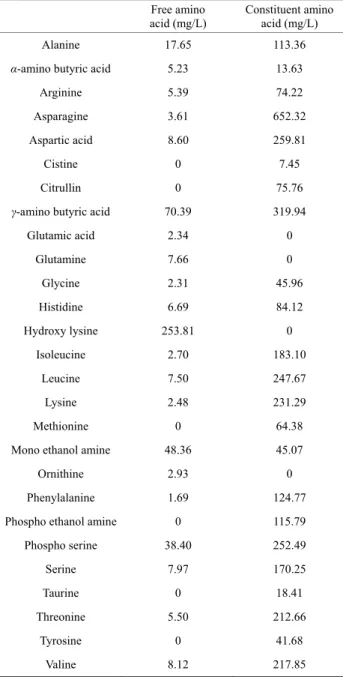
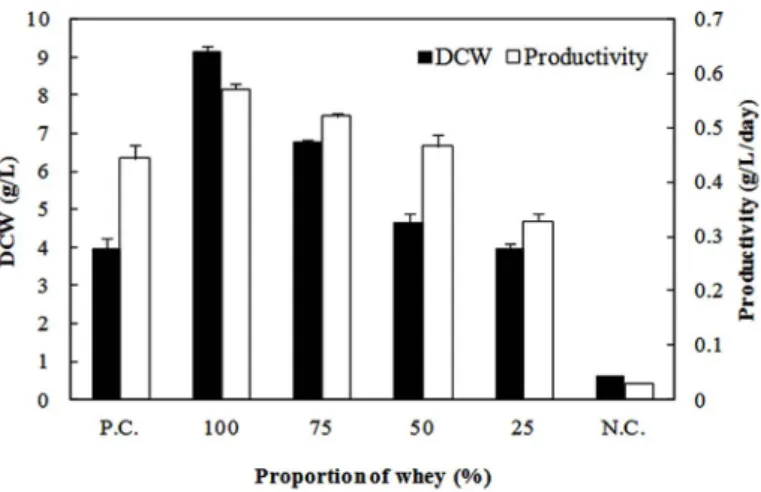
The whey used in this study contained 1 g/L glucose, 40 g/L lactose, 10 g/L galactose, 3.5 g/L proteins, and 1.2 g/L lactic acid; the pH of the whey was 4.2. The protein content was calculated from the concentrations of the constituent amino acids as shown in Table 1. Figure 3 shows the effect of the proportion of whey in medium on H. erinaceum mycelial growth in yogurt whey medium. In this experiment, the glucose concentration in the me-dium was adjusted to 20 g/L by addition of glucose be-cause this glucose concentration gave the highest myce-lial productivity as shown in Figure 2. Glucose was completely consumed in all of the cultures containing
Figure 2. Effect of initial glucose concentration on H.
erina-ceum mycelial growth in basal medium.
Table 1. Concentration of amino acids in the whey used in this
study.
Free amino
acid (mg/L) Constituent amino acid (mg/L)
Alanine 17.65 113.36
α-amino butyric acid 5.23 13.63
Arginine 5.39 74.22 Asparagine 3.61 652.32
Aspartic acid 8.60 259.81
Cistine 0 7.45 Citrullin 0 75.76
γ-amino butyric acid 70.39 319.94
Glutamic acid 2.34 0 Glutamine 7.66 0 Glycine 2.31 45.96 Histidine 6.69 84.12 Hydroxy lysine 253.81 0 Isoleucine 2.70 183.10 Leucine 7.50 247.67 Lysine 2.48 231.29 Methionine 0 64.38
Mono ethanol amine 48.36 45.07
Ornithine 2.93 0
Phenylalanine 1.69 124.77
Phospho ethanol amine 0 115.79
Phospho serine 38.40 252.49 Serine 7.97 170.25 Taurine 0 18.41 Threonine 5.50 212.66 Tyrosine 0 41.68 Valine 8.12 217.85
Figure 3. Effect of the proportion of whey in medium on H. erinaceum
myce-lial growth in yogurt whey medium. P.C. (positive control) refers to basal me-dium, N.C. (negative control) refers to basal medium without polypeptone and yeast extract.
Table 2. Effect of the proportion of whey in the medium on the β-glucan content of H. erinaceum mycelia. P.C. (positive control)
refers to basal medium supplemented with 20 g/L glucose, N.C. (negative control) refers to basal medium supplemented with 20 g/L glucose without polypeptone and yeast extract.
Proportion of whey (%) Culture time (day) β-glucan content (%) Total amount of β-glucan (g/L)
P.C. 9 15.1 ± 0.1 0.602 ± 0.03 100 16 18.7 ± 0.3 1.706 ± 0.03 75 13 19.0 ± 0.4 1.285 ± 0.01 50 10 19.4 ± 0.0 0.905 ± 0.04 25 12 24.2 ± 0.0 0.955 ± 0.04 N.C. 20 n.d. n.d.
whey (data not shown). Whey rate of 50% (v/v) was the earliest of four conditions, otherwise high whey rate made culture day longer as shown in Table 2. A high lactic acid concentration may inhibit mycelial growth. However, it was obvious that a high proportion of whey had a positive effect on mycelial yield because all the media that contained whey showed greater mycelial growth. The highest DCW was obtained with 100% whey medium, where it was about 2.3-fold higher than that in basal medium (P.C.). In fact, it has previously been reported that mycelial biomass cultivated using casein peptone was greater than that obtained by poly-peptone cultivation [12]. The β-glucan content of the mycelia cultivated in whey medium increased as the proportion of whey in the media decreased (Table 2). This trend is similar to the results found from the inves-tigations on nitrogen concentration: The highest β-glucan content was obtained at the lowest nitrogen concentration. However, the absolute amount of β-glucan was increased when whey was used as an alternative nitrogen source. The highest absolute amount of β-glucan was obtained in 100% whey medium, and was 2.8-fold higher than that in basal medium (P.C.). The protein content was lesser in
whey medium than in polypeptone medium, but never-theless, greater mycelial growth was observed in whey. It appears that other nutrients in whey, such as a lipid or trace elements such as vitamins, are more effective at promoting mycelial growth.
4. CONCLUSION
The highest H. erinaceum mycelial DCW and productiv-ity (3.99 g/L and 0.44 g/L/day, respectively) were ob-tained with an initial glucose concentration of 20 g/L at pH 5, 25˚C. Whey could be used as an alternative nitro-gen source, as DCW was 2.3-fold greater in whey me-dium compared with that in chemical nutrient meme-dium, and the absolute amount of β-glucan was 2.8-fold greater. These results indicate that yogurt whey can stimulate H. erinaceum mycelial growth. However, further detail studies are required to identify the effective components of yogurt whey.
REFERENCES
(2006) Development of optimal culture method of Spa- rassis crispa mycelia and a new extraction method of antineoplastic constituent. Biochemical Engineering Jour- nal, 30, 109-113. doi:10.1016/j.bej.2006.02.004
[2] Malinowska, E., Krzyczkowski, W., Łapienis, G. and Her- old, F. (2009) Improved simultaneous production of my-celial biomass and polysaccharides by submerged cul- ture of Hericium erinaceum: Optimization using a central composite rotatable design (CCRD). Journal of Industrial Microbiology & Biotechnology, 36, 1513-1527.
doi:10.1007/s10295-009-0640-x
[3] Mizuno, T., Wasa, T., Ito, H., Suzuki, C. and Ukai, N. (1992) Antitumor-active polysaccharides isolated from the fruiting body of Hericium erinaceum, an edible and medicinal mushroom called yamabushitake or houtou. Bioscience Biotechnology Biochemistry, 56, 347-348.
doi:10.1271/bbb.56.347
[4] Ben-Hassan, R.M. and Ghaly, A.E. (1994) Continuous propagation of Kluyveromyces fragilis in cheese whey for pollution potential reduction. Applied Biochemistry and Biotechnology, 47, 89-105. doi:10.1007/BF02788678
[5] Mawson, A.J. (1994) Bioconversions for whey utilization and waste abatement. Bioresource Technology, 47, 195- 203. doi:10.1016/0960-8524(94)90180-5
[6] Fournier, D., Schwitzguebel, J.P. and Peringer, P. (1993) Effect of different heterogeneous inocula in acidogenic fermentation of whey permeate. Biotechnology Letters,
15, 627-632. doi:10.1007/BF00138553
[7] Crisiani-Urbina, E., Netzahuatl-Muñoz, A.R., Manriquez- Rojas, F.J., Juárez-Ramírez, C., Ruiz-Ordaz, N. and Ga-
líndez-Mayer, J. (2000) Batch and fed-batch cultures for the treatment of whey with mixed yeast cultures. Process Biochemistry, 35, 649-657.
doi:10.1016/S0032-9592(99)00116-8
[8] Kassa, A., Brownbridge, M., Parker, B.L., Skinner, M., Gouli, V., Gouli, S., Guo, M., Lee, F. and Hata, T. (2008) Whey for mass production of Beauveria bassiana and Metarhizium anisopliae. Mycological Research, 112, 583- 591. doi:10.1016/j.mycres.2007.12.004
[9] Lee, H., Song, M. and Hwang, S. (2003) Optimizing bio- conversion of deproteinated cheese whey to mycelia of Ganoderma lucidum. Process Biochemistry, 38, 1685- 1693. doi:10.1016/S0032-9592(02)00259-5
[10] Lee, H., Song, M., Yu, Y. and Hwang, S. (2003) Produc-tion of Ganoderma lucidum mycelia using cheese whey as an alternative substrate: response surface analysis and biokinetics. Biochemical Engineering Journal, 15, 93-99.
doi:10.1016/S1369-703X(02)00211-5
[11] Kim, S.W., Hwang, H.J., Xu, C.P., Sung, J.M., Choi, J. W. and Yun, J.W. (2003) Optimization of submerged culture process for the production of mycelial biomass and exo-polysaccharides by Cordyceps militaris C738. Journal of Applied Microbiology, 94, 120-126.
doi:10.1046/j.1365-2672.2003.01754.x
[12] Kim, H.O., Lim, J.M., Joo, J.H., Kim, S.W., Hwang, H.J., Choi, J.W. and Yun, J.W. (2005) Optimization of sub-merged culture condition for the production of mycelial biomass and exopolysaccharides by Agrocybe cylin- dracea. Bioresource Technology, 96, 1175-1182.