Toward Practical Application
of Program Refactoring
A Dissertation Submitted to
The Graduate School of Information Science and Technology of Osaka University
for the degree of
Doctor of Philosophy in
Information Science and Technology
by
Yoshio Kataoka
January 16, 2006Abstract
Program refactoring — transforming a program to improve readability, structure, performance, abstraction, maintainability, or other characteristics — is not applied in practice as much as might be desired. Although there are various possible reasons why program refactoring is not so popular, one deterrent is the cost of detecting can-didates for refactoring and of choosing the appropriate refactoring transformation. Another problem is that there are few quantitative evaluations of its impact to the software maintainability. It is sometimes difficult to judge whether the refactoring in question should be applied or not without knowing the effect accurately.
This series of researches mainly focuses on how to support program refactoring to encourage practical applications of the technique. The first half of this thesis demonstrates the feasibility of automatically finding places in the program that are candidates for specific refactorings. The approach uses program invariants: when particular invariants hold at a program point, a specific refactoring is applicable. Since most programs lack explicit invariants, an invariant detection tool called Daikon is used to infer the required invariants. We developed an invariant pattern matcher for several common refactorings and applied it to an existing Java code base. Numer-ous refactorings were detected, and one of the developers of the code base assessed their efficacy.
The latter half proposes a quantitative evaluation guideline to measure the main-tainability enhancement effect of program refactoring. We focused on the module coupling metrics and the module cohesion metrics to evaluate the refactoring effect. Comparing the metrics before and after the refactoring, we could evaluate the degree of maintainability enhancement. As for coupling metrics, we carried out an exper-iment and found our method was really effective to quantify the refactoring effect and helped us to choose appropriate refactorings.
List of Major Publications
1. Yoshio Kataoka, Shinji Kusumoto and Katsuro Inoue, “Supporting Refactoring Using Invariant,” IPSJ Transaction, Vol.46, No.5, pp.1211–1221, May 2005. 2. Yoshio Kataoka, Shinji Kusumoto and Katsuro Inoue, “A Quantitative
Evalu-ation of Refactoring Effect,” Transactions on InformEvalu-ation and Systems (Sub-mitted).
3. Yoshio Kataoka, Takeo Imai, Hiroki Andou and Tetsuji Fukaya, “A Quantita-tive Evaluation of Maintainability Enhancement by Refactoring,” Proceedings of International Conference on Software Maintenance, pp.576–585, Montreal, Canada, October 2002.
4. Takeo Imai, Yoshio Kataoka and Tetsuji Fukaya, “Evaluating Software Mainte-nance Cost Using Functional Redundancy Metrics,” Proceedings of 26th Inter-national Computer Software and Applications Conference, pp.299–306, Oxford, England, August 2002
5. Yoshio Kataoka, Michael D. Ernst, William G. Griswold and David Notkin, “Automated Support for Program Refactoring using Invariants,” Proceedings of International Conference on Software Maintenance, pp.736–743, Florence, Italy, November 2001
6. Yoshio Kataoka, Masayuki Hirayama, Jiro Okayasu and Tetsuji Fukaya, “An Approach to Reverse Quality Assurance with Data-Oriented Program Analy-sis,” Proceedings of Asia Pacific Software Engineering Conference 1995, pp.324– 332, Brisbane, Australia, December 1995
Acknowledgements
During the course of this work, I have been fortunate to have received assistance from many individuals. I would especially like to thank my supervisor Professor Katsuro Inoue and Professor Shinji Kusumoto for their sustainable supervision. I could not have come this far without their support and encouragement for this work.
I am also very grateful to Professor Tohru Kikuno who is the member of my thesis review committee for his invaluable comments and helpful advices.
I also would like to thank Professor Koji Torii for his initiation to this research field and his supervision during my undergraduate years and master course. My perspective had been broaden by his advices and encouragements from time to time. I also would like to thank Professor David Notkin for his supervision during my undergraduate years and my visiting University of Washington. My original motivation of research in this field was his word, “make software engineering true engineering.”
I also would like to thank Professor Mike Ernst for his continuous advice and collaboration during my visiting University of Washington. He always give me very productive and insightful advices on my research.
I would also like to thank Ms. Yoshimi Katagiri for her administrative support during my attending a Ph.D. course. I would also like to appreciate all the member of Inoue laboratory at Osaka University for their support of my research.
I would like to appreciate Dr. Masami Akamine, Dr. Shun Egusa and Dr. Naoshi Uchihira for their understanding and support for my attending a Ph.D. course.
I would like to thank to Research Planning Office members, System Engineering Laboratory members and Software Engineering Center members of Toshiba Corpo-ration for their support of my research.
Last but not least, I would like to thank to my family for every support and encouragement. Nobuko, she has been literally supporting me for everything. And
Yusuke, he has always been cheering me up. There’s no proper word to express my gratitude to them.
Contents
1 Introduction 1
1.1 Research Background . . . 1
1.2 Program Refactoring . . . 2
1.3 Refactoring Process Model . . . 4
1.4 Major Activities in Refactoring Process . . . 6
1.4.1 Planning — Identification of Refactoring Candidates . . . 6
1.4.2 Improvement — Execution of Refactoring . . . 7
1.4.3 Evaluation — Validation of Refactoring . . . 8
1.5 Research Objective . . . 8
2 Program Refactoring 11 2.1 Defining Refactoring . . . 11
2.2 Motivations for Refactoring . . . 12
2.3 Refactoring Catalog . . . 13
2.3.1 Composing Methods . . . 14
2.3.2 Moving Features Between Objects . . . 15
2.3.3 Organizing Data . . . 16
2.3.4 Simplifying Conditional Expressions . . . 17
2.3.5 Making Method Calls Simpler . . . 18
2.3.7 Big Refactorings . . . 21
3 Supporting Refactoring Using Invariants 23 3.1 Introduction . . . 23
3.2 Related Work . . . 24
3.3 Invariant Discovery . . . 26
3.4 Finding Refactoring Candidates . . . 29
3.5 Candidate Refactorings Discoverable from Invariants . . . 31
3.5.1 Remove Parameter . . . 31
3.5.2 Eliminate Return Value . . . 33
3.5.3 Separate Query from Modifier . . . 34
3.5.4 Encapsulate Downcast . . . 36
3.5.5 Replace Temp with Query . . . 37
3.6 Analysis of Nebulous . . . 40
3.7 Static and Dynamic Approaches . . . 45
3.8 Conclusion . . . 47
4 A Quantitative Evaluation of Refactoring Effect 51 4.1 Introduction . . . 51
4.2 Supporting Refactoring Process . . . 53
4.3 Refactoring Effect Evaluation . . . 54
4.3.1 Definition of Refactoring Effect . . . 54
4.3.2 Refactorings enhancing module couplings . . . 55
4.3.3 Refactorings enhancing module cohesions . . . 57
4.3.4 Refactoring Effect from Cohesiveness Viewpoint . . . 60
4.4 Quantitative Coupling Evaluation . . . 64
4.4.2 Combining Three Couplings . . . 66
4.5 Experiment and Result . . . 67
4.5.1 Example of Quantification . . . 67
4.5.2 Experiment . . . 70
4.5.3 Consideration . . . 72
4.6 Expansion and Related Works . . . 75
4.7 Conclusion . . . 76
5 Summary 79 5.1 Toward Practical Application of Refactoring . . . 79
List of Figures
1.1 Refactoring Process . . . 4
3.1 An overview of dynamic invariant inference as implemented by the Daikon tool . . . 27
4.1 Quantitative Cohesion . . . 59
4.2 Example of “Separate Query from Modifier . . . 63
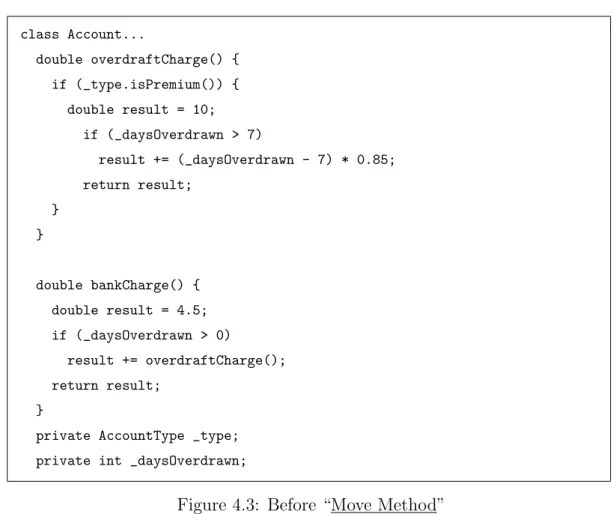
4.3 Before “Move Method” . . . 68
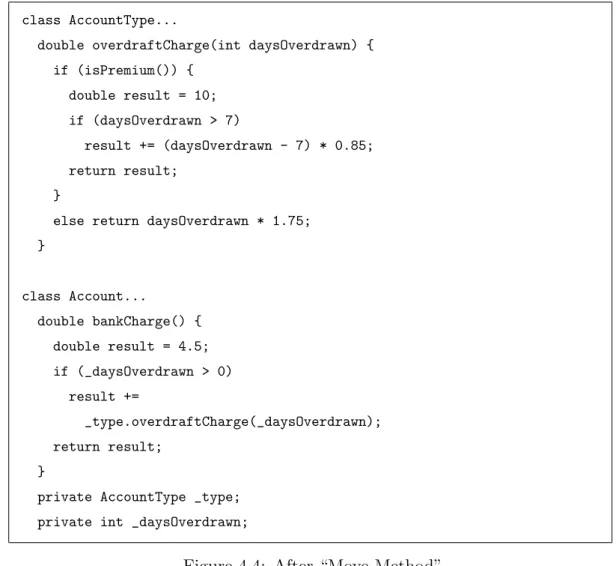
4.4 After “Move Method” . . . 69
4.5 Example of Good Refactoring . . . 73
4.6 Example of Not-So-Good Refactoring . . . 74
List of Tables
1.1 Status quo of refactoring process support . . . 9
4.1 Contributing factors . . . 56
4.2 Refactoring Experiment Result . . . 72
Chapter 1
Introduction
1.1
Research Background
Nowadays softwares are getting more and more important for various systems and devices around us. At the same time, required functionalities and performance are also getting higher and higher. In other words, it is getting more and more important to develop higher-quality software as quick as possible. Naturally speaking, develop-ing all those softwares from scratch is not a realistic idea at all. We do have some reasonable method to develop software systems without writing a lot of new pieces of code.
Generally speaking, however, it is rather hard to utilize existing software codes. Most of the case those source codes are not supposed to be used for different sys-tems other than the original target system. As for rather reusable source codes, there could always be an “unpredictable” need of customize because anticipating any possible applications at the development stage is impossible. For instance, an application software installed in a cell phone system would interact not only with those softwares in the cell phone but also a number of software components and/or hardware devices over the network. It is obviously impossible to presume those
ev-ery potential interaction opponents at the development stage. Therefore customizing existing softwares is inevitable today’s software system development.
In conventional way of software development, especially in enterprise software development sites, nothing more important than implementing required functionality as quickly as possible. In other words, so called non-functional requirements such as maintainability, portability, etc. are less cared or even ignored intentionally due to delivery constraint. Such softwares often require enormous amount of time to acquire necessary information, or even have developer extract wrong information to customize. Moreover, if the modularization is not done properly, there might be an unexpected side effect to other modules/functionalities which cannot be traced very easily.
There is another problem. Customizing an existing software induces a potential deterioration problem. Although softwares are free from aged-deterioration, quali-ties of software can be deteriorated by various modification including adding a new functionality, fixing a bug and other maintenance activities. Among a number of qualities, non-functional qualities like maintainability and portability are often im-paired because most modifications are based on functional quality requirements. As a result, such deterioration often makes software customization rather hard.
1.2
Program Refactoring
Program refactoring is a technique in which a software engineer applies well-defined source-level transformations with the goal of improving the code’s structure and thus reducing subsequent costs of software evolution. Initially developed in the early 1990s [32, 18, 31, 21], refactoring is increasingly a part of mainstream software de-velopment practices [16]. As just one example, one of the basic tenets of Extreme Programming [4] is to refactor on a continual basis, as a fundamental part of the
software development process.
Program refactoring is a technique to improve readability, structure, performance, abstraction, maintainability, or other characteristics by transforming a program. Program refactoring can be used to diagnose the quality and improve customiz-ability of the target software. Highly motivated and skillful software developers actually apply this technique in practice. And, of course, Fowler’s work organiz-ing the program refactororganiz-ing catalog encourages many software developers to apply program refactoring to their software development processes.
On the other hand, program refactoring is not a very simple technique to apply. Firstly, it is often very difficult to identify which part of the program should be refac-tored without understanding basic notion of software quality. Secondly, softwares in practice are so large in scale that developers have to spend decent amount of time to inspect the whole target software. In addition, it is hardly possible to secure that there is no slipped-out. And finally, program refactoring potentially introduces a new bug in the source code because it does require a source code modification.
In fact, refactoring is not applied in practice as frequently as might be beneficial. There are a number of reasons for this, including managerial (such as, “we need to add features to ship the product, and refactoring doesn’t directly contribute to that”) and technical (such as, “refactoring might break a subtle property of the system, which is too dangerous”). There are a number of tools to help overcome some of these problems: most of these automate the process of safely applying a refactoring that an engineer has determined is appropriate (see Section 3.2).
The main objective of this thesis is to overcome those potential problems re-garding program refactoring and make program refactoring more and more practical technique. In this thesis, two major topics will be discussed. One is how to identify which part of the program to be refactored. The other one is how to evaluate the effectiveness of the program refactoring.
1.3
Refactoring Process Model
We analyzed the program refactoring process and found we need at least the following three phases to perform appropriate refactorings.
1. Identification of refactoring candidates 2. Application of refactoring
3. Validation of refactoring effect
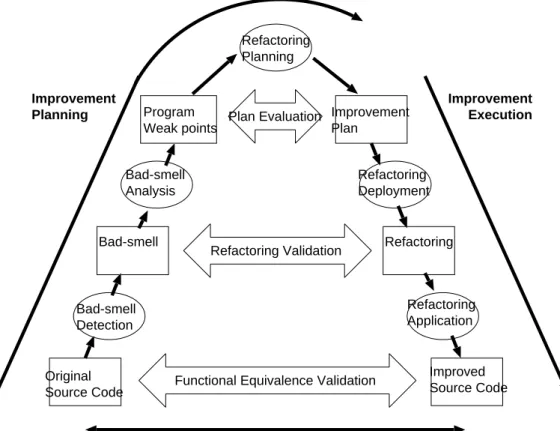
Fig. 1.1 shows the diagram of the refactoring process.
Original Source Code Bad-smell Program Weak points Improvement Plan Refactoring Improved Source Code Bad-smell Detection Bad-smell Analysis Refactoring Planning Plan Evaluation Refactoring Validation
Functional Equivalence Validation
Refactoring Deployment Refactoring Application Improvement Planning Improvement Validation Improvement Execution
There are two axes in the diagram. The horizontal axis stands for the process timeline and the vertical axis stands for the degree of abstraction of the product (or roles in charge). Refactoring process always begins from the source code level analysis. Verification and validation of refactorings have to be evaluated at the source code level. This level is also referred as developer level. Developers need to confirm that the observable behavior is the same before and after the refactoring by testing and other means(functional equivalence validation).
The next level is referred as analyst level. At this level analysts verify the refactor-ing against “bad-smell” detected by the source code analysis(refactorrefactor-ing validation). The uppermost level is referred as manager level. The manager has to strate-gically decide which refactoring should be carried out and which should not(plan
evaluation). Actually there is a strict trade off between the cost to apply the
refac-torings and the effect derived from the refactoring. From practical point of view, it is very important to emphasize that the strategic decision made at this level would greatly effect the tactical approaches of refactoring application at the lower levels. A manager should organize the possible improvement alternatives submitted by an-alysts to establish the refactoring plan. Otherwise the total quality improvement activity will lead nowhere near the desirable result.
As introduced earlier, the refactoring process consists of the following three sub-processes.
1. Identification of refactoring candidates
This subprocess appears as the bottom–left to top–middle flow in Fig. 1.1. Starting with the identification of program points to be refactored, it includes organization of refactorings and selection of refactorings to be applied.
2. Application of refactoring
This subprocess appears as the top–middle to bottom–right flow in Fig. 1.1. It includes the ordering of each refactoring according to the priority in terms
of cost–effect trade–off by the analyst and the actual code modification by the developer.
3. Validation of refactoring effect
This subprocess corresponds to the arrows connecting the identification flow and the application flow in Fig. 1.1. At the developer level, mainly the func-tional equivalence before and after the refactoring should be verified. At the analyst level, the intended effect should be validated. At the manager level, the cost–effect trade–off should be substantiated.
1.4
Major Activities in Refactoring Process
1.4.1
Planning — Identification of Refactoring Candidates
Extract Bad-smells (developer level)First of all, developers should identify the causes that deteriorate readability and/or maintainability of their own source code. “Bad-smell” is a program property or characteristic that implies one or more (potential) problems in the source code[16]. There are various smells from simple ones like “Large Class” and “Long Method” to fairly complicated ones like “Parallel Inheritance Hierarchies” and “Inappropriate Intimacy.”
Identify Bad-smells’ causes (analyst level)
Next thing to be done is to identify the causes of bad-smells. This might be trivial for some simple bad-smells like “Large Class.” In some cases, however, it requires some deeper analysis of the target code to identify what causes a certain bad-smell after all. The cause does not necessarily exist anywhere near the smell itself. It is
often observed that introducing just one new method solves several bad-smells at once.
Design quality improvement plan (manager level)
As mentioned above, the cost required to eliminate single bad-smell is different from one another. One bad-smell will be eliminated by just introducing a new private method while other bad-smell will require a number of modifications here and there. Designing appropriate improvement plan often requires fairly high level decision mak-ing concernmak-ing with cost and delivery.
1.4.2
Improvement — Execution of Refactoring
Select optimal refactoring set (analyst level)
Once the improvement plan is established, next thing to be done is to identify an optimal set of refactoring since some of them may conflict each other. Based on the target source code analysis, analyst should find an optimal set of refactoring and parcel out the refactorings to the developers properly.
Modify source code (developer level)
Each developer applies the apportioned refactorings to her/his own code. Althogh the refactoring set is supposed to be consistent by analyst, each developer should be careful not to violate each other.
1.4.3
Evaluation — Validation of Refactoring
Validate improvement plan (manager level)Manager should validate that designed improvement plan correctly grasp the targeted weak points.
Validate refactoring candidates (analyst level)
Analyst should validate that derived refactorings correctly mend the targeted bad-smells.
Validate functional equivalence (developer level)
Developer should validate that their program does not change its observable behavior after the refactoring.
1.5
Research Objective
The main objective of this series of researches is how to support the refactoring process effectively so that program development projects can adopt the process easily and enhance the maintainability of the target software. Although there are several distinguished research results for some activities of the process, it is still far from being the comprehensive support of the refactoring process we stated above.
For instance, there are some fundamental studies on the refactoring application phase including Griswold and Notkin’s work[21]. Table 1.1 summarizes the current status of the refactoring process support.
Among these research areas, Chapter 3 introduces a tool to support engineers in refactoring software: automatically finding candidate refactorings. The recom-mended manual method of identifying beneficial refactorings is to observe design
Table 1.1: Status quo of refactoring process support
Subprocess Activity Support
Planning bad–smell detection partly bad–smell analysis partly refactoring planning partly
Validation plan evaluation no
refactoring validation no functional equivalence validation no Execution refactoring deployment no
refactoring application partly
shortcomings manifested during development and maintenance [17]. Unfortunately, design problems may be overlooked or ignored by a programmer, particularly under deadline pressures and the intellectual demands of implementing correct changes.
The technology introduced in Chapter 3 for identifying refactoring candidates uses program invariants: a particular pattern of invariants at a program point in-dicates the applicability of a specific refactoring. This use of program invariants is complementary to other approaches such as human examination or pattern-matching over the source code.
Chapter 4 introduces a quantitative evaluation guideline to measure the main-tainability enhancement effect of program refactoring. This research focused on the module coupling metrics and the module cohesion metrics to evaluate the refactoring effect. Comparing the metrics before and after the refactoring, we could evaluate the degree of maintainability enhancement.
Chapter 2
Program Refactoring
This chapter introduces the basic idea of program refactoring with several examples which are actually referred and used in this series of researches more precisely.
2.1
Defining Refactoring
Fowler defines refactoring as follows [16].
Refactor(verb): to restructure software by applying a series of refactorings without
changing its observable behavior.
Refactoring(noun): a change made to the internal structure of software to make
it easier to understand and cheaper to modify without changing its observable behavior.
Fowler clarifies these definitions in two points. First, the purpose of refactoring is to make the software easier to understand and modify. Although there are a num-ber of possible changes one can make in software that make little or no change in the observable behavior, only changes made to make the software easier to under-stand are refactorings. Fowler contrasts refactoring with performance optimization.
That is, neither refactoring nor performance optimization changes the behavior of a component; it only changes the internal structure. The major and very important difference is that performance optimization often makes code harder to understand while refactoring does make code easier to understand.
Second, refactoring does not change the observable behavior of the software. Fowler emphasizes this point like this; any user, whether an end user or another programmer, cannot tell that things have changed. Fowler also introduces Kent Beck’s metaphor of two hats to support this point. A developer cannot add function and refactor at the same time. She or he have to wear one hat at a time, either “adding function” hat or “refactoring” hat. As the development progresses, the developer should swap the hats frequently. Unless such an obvious change of state of mind, neither adding function nor refactoring will take effect.
2.2
Motivations for Refactoring
Fowler introduces several motivations for refactoring. First, refactoring will improve the design of software. As mentioned earlier, the design of the program may be deteriorated as people change code — changes to realize short-term goals or changes made without a full comprehension of the design of the code. Refactoring helps reor-ganizing the code and its design so that non-functional qualities like maintainability and portability are improved and enhanced.
Second, refactoring will make software easier to understand. This notion implies two different meanings. One perspective is very straightforward from the definition. Since refactoring is supposed “to make it(program) easier to understand,” the re-sulted program after refactoring will become easier to understand. As for the other perspective, Fowler introduces the following story[16].
me understand unfamiliar code. When I look at unfamiliar code, I have to try to understand what it does. I look at a couple of lines and say to myself, oh yes, that’s what this bit of code is doing. With refactoring I don’t stop at the mental note. I actually change the code to better reflect my understanding, and then I test that understanding by rerunning the code to see if it still works.
Third, refactoring will help find bugs. As seen in the previous quoted story, refactoring itself is a process to understand what the code does. That does not necessarily means that one can only understand what the code actually does but also what the code should do, which means one has spotted a bug.
And finally, refactoring will help program faster. All the earlier points come down to this conclusion. One of the reason why refactoring is not so popular is that most of developers feel that refactoring is an extra work other than their required develop-ment task. In fact, however, appropriate refactoring will actually save maintenance effort greatly, since refactoring stops the design of the system from deterioration.
2.3
Refactoring Catalog
The original Fowler’s refactoring catalog in [16] contains 72 refactorings classified into seven large categories. After the publication of the text book, a number of additional refactoring techniques have been proposed. There also several information update those in the original text book. Today total 93 refactorings have been defined. Those refactorings can be referred athttp://www.refactoring.com/catalog.
Since each refactoring name is fairly self-descriptive, here only shows the list of refactorings for each category save those refactorings actually used in this research.
2.3.1
Composing Methods
Refactorings belonging to this category basically intend to package code properly. Most refactorings in this category are useful when one found large methods.
There are two refactorings that are dealt in this thesis: “Extract Method” and “Replace Temp with Query.”
Extract Method
“Extract Method” is intended for “a code fragment that can be grouped together.” [16, p. 110] The refactoring turns the fragment into a method whose name explains the purpose of the method. The rationale is that if there is a very large method that does require some comment to understand its purpose, turning a fragment of code into its own method will increase the understandability of the method. Fowler also emphasize the importance of selecting an appropriate short name for the extracted method.
Replace Temp with Query
“Replace Temp with Query” is intended for “a temporary variable that holds the value of an expression” [16, p. 120]. The refactoring extracts the expression into a method and replaces uses of the temporary by method calls. The rationale is that the expression may be used in multiple places and that eliminating temporary variables can enable other refactorings. In essence, this is the user-level inverse of a compiler’s application of the common subexpression elimination optimization.
The other refactorings belonging to this category are the followings.
• Inline Method • Inline Temp
• Introduce Explaining Variable • Split Temporary Variable
• Remove Assignments to Parameter • Replace Method with Method Object • Substitute Algorithm
2.3.2
Moving Features Between Objects
It is often rather difficult to place a certain functionality and data into an appropriate class/object for the first time. Refactorings belonging this category help developers to maintain their objects well-organized throughout the development phase.
“Extract Class” is dealt in this thesis as an example. Extract Class
“Extract Class” is intended for “one class doing work that should be done by two.” [16, p. 149] This refactoring create a new class and move the relevant fields and method from the old class into the new class. A large class with a lot of data and methods is very difficult to understand and reuse. Another potential problem is that such a class will increase inter-class coupling complexity. The rationale is that by separating such a large class into two (or more), you will get two (or more) handy classes which are easier to understand. In addition, that separation will decrease coupling complexity among classes.
The other refactorings belonging to this category are the followings.
• Move Field • Inline Class • Hide Delegate
• Remove Middle Man • Introduce Foreign Method • Introduce Local Extension
2.3.3
Organizing Data
Refactorings belonging to this category let developers gradually used to the basic object-oriented programming paradigm. Typical examples may be “Replace Data Value with Object” and “Replace Array with Object.” “Replace Data Value with Object” let developer turn dumb data into a sophisticated object with appropriate methods. When there is an array acting as a data structure, “Replace Array with Object” will help turning the array into an appropriate object.
Although this thesis does not deal with any of them, there are following refactor-ings in this category.
• Self Encapsulate Field
• Replace Data Value with Object • Change Value to Reference • Change Reference to Value • Replace Array with Object • Duplicate Observed Data
• Change Unidirectional Association to Bidirectional • Change Bidirectional Association to Unidirectional • Replace Magic Number with Symbolic Constant • Encapsulate Field
• Encapsulate Collection
• Replace Record with Data Class • Replace Type Code with Class • Replace Type Code with Subclasses • Replace Type Code with State/Strategy • Replace Subclass with Fields
2.3.4
Simplifying Conditional Expressions
Refactorings belonging to this category might be familiar to many developers. Ac-tually they are all conventional programming technique before the appearance of object-oriented paradigm save a few refactorings like “Replace Conditional with Polymorphism” and “Introduce Null Object.” The basic idea is to simplify the con-ditional expressions so that one can understand the logic easily and clearly.
Although this thesis does not deal with any of them, there are following refactor-ings in this category.
• Decompose Conditional
• Consolidate Duplicate Conditional Fragments • Remove Control Flag
• Replace Nested Conditional with Guard Clauses • Replace Conditional with Polymorphism
• Introduce Null Object • Introduce Assertion
2.3.5
Making Method Calls Simpler
Refactorings belonging in this category basically make interface more straightfor-ward. Actually there are variety of refactoring techniques from a very trivial but reasonable one like “Rename Method” to highly sophisticated and rather difficult one like “Separate Query from Modifier.”
There are three refactorings that are dealt in this thesis: “Remove Parameter,” “Separate Query from Modifier” and “Encapsulate Downcast.”
Remove Parameter
“Remove Parameter” is intended to apply when “a parameter [is] no longer used by the method body” [16, p. 277]. A parameter can also be removed when its value is constant or can be computed from other available information. The refactoring eliminates the parameter from the declaration and all calls. The rationale is that extraneous parameters are confusing and burdensome to users of the code.
Separate Query from Modifier
“Separate Query from Modifier” is intended for “a method that returns a value but also changes the state of an object” [16, p. 279]. The refactoring converts a single
routine into two separate routines, one of which returns the query result and the other of which performs the modification. The rationale is to give each routine a single clearly defined purpose, to permit clients to perform just the query or just the modification, and to create side-effect-free procedures whose calls may be freely inserted or removed.
Encapsulate Downcast
“Encapsulate Downcast” is intended for “a method that returns an object that needs to be downcasted by its callers” [16, p. 308]. The refactoring changes the return type and moves the downcast inside the method. The rationale is to reduce the static number of downcasts and to simplify implementation and understanding for clients. It can also permit type checks to be performed statically (at compile-time) rather than dynamically (at run-time), which has the dual benefits of early error detection and of improved performance.
The other refactorings belonging to this category are the followings.
• Rename Method • Add Parameter • Parameterize Method
• Replace Parameter with Explicit Methods • Preserve Whole Object
• Replace Parameter with Method • Introduce Parameter Object • Remove Setting Method
• Hide Method
• Replace Constructor with Factory Method • Replace Error Code with Exception
• Replace Exception with Test
2.3.6
Dealing with Generalization
Refactorings belonging to this category often change the class hierarchy. In that sense, these refactorings are very difficult to apply. These refactorings will, however, greatly improve the non-functional qualities such as maintainability, understandabil-ity and portabilunderstandabil-ity once appropriately applied.
Although this thesis does not deal with any of them, there are following refactor-ings in this category.
• Pull Up Field • Pull Up Method
• Pull Up Constructor Body • Push Down Method
• Push Down Field • Extract Subclass • Extract Superclass • Extract Interface • Collapse Hierarchy
• Form Template Method
• Replace Inheritance with Delegation • Replace Delegation with Inheritance
2.3.7
Big Refactorings
Refactorings belonging to this category are different from those introduced in pre-ceding sections. These are more like refactoring strategies than mere refactoring techniques. As for deeper discussion about this category will be found in [16], which is beyond the scope of this thesis.
• Tease Apart Inheritance
• Convert Procedural Design to Object • Separate Domain from Presentation • Extract Hierarchy
Chapter 3
Supporting Refactoring Using
Invariants
3.1
Introduction
Our research shows the feasibility of another kind of tool to support engineers in refac-toring software: automatically finding candidate refacrefac-torings. The recommended manual method of identifying beneficial refactorings is to observe design shortcom-ings manifested during development and maintenance [17]. Unfortunately, design problems may be overlooked or ignored by a programmer, particularly under dead-line pressures and the intellectual demands of implementing correct changes.
Our technology for identifying refactoring candidates uses program invariants: a particular pattern of invariants at a program point indicates the applicability of a specific refactoring. This use of program invariants is complementary to other approaches such as human examination or pattern-matching over the source code.
Furthermore, the invariants of the refactored (modified) program indicate which properties were maintained and which were changed, which helps to check that the refactoring was applied properly.
To broaden the applicability of our approach beyond programs for which engi-neers have written invariants explicitly, we automatically infer the invariants used to find candidate refactorings. In particular, we use the Daikon tool for dynamically discovering program invariants [12, 13].
In the following we discuss prior work in refactoring (Section 3.2), Daikon’s ap-proach to detecting invariants (Section 3.3), our apap-proach to finding refactoring candidates (Sections 3.4 and 3.5), and a case study of its use (Section 3.6). We close with a comparison of dynamic and static refactoring detection (Section 3.7) and a discussion of contributions and future work (Section 3.8).
3.2
Related Work
Refactoring Tools. Refactoring is ideally suited to automation: engineers want to apply refactorings, but applying them manually is error-prone (as are all manual software modifications). This research focuses on identifying candidates for refactor-ing and, to a lesser degree, on checkrefactor-ing that manually applied refactorrefactor-ings preserve meaning. In contrast, nearly all the related work focuses instead on automatically applying refactorings once an engineer has identified a candidate. These two styles of automation dovetail quite naturally.
Opdyke [32, 31] and Griswold [18, 21] defined early tools to apply refactorings and ensure that the meaning of the program was left unchanged by the refactoring.1
A number of more recent tools also support refactoring: the Smalltalk Refactoring Browser [33], which automatically performs a set of refactorings taken primarily from
1Precisely defining what it means to leave the meaning of the program unchanged is important
and challenging. For example, the functional properties may be kept stable, but performance prop-erties may change — indeed, that might be one of the motivating reasons to apply the refactoring. The details of this issue are beyond the scope of this paper; they are addressed by Griswold [18] and Roberts [34].
Opdyke’s original work; the IntelliJ Renamer tool (www.intellij.com), which supports renaming of packages, variables, etc. and moving of packages and classes for Java; and the Xref-Speller (www.xref-tech.com/speller/), which extends the Emacs editor to support a set of refactorings for C and for Java.
Roberts [34] discusses analyses to support refactoring, especially those defined by Opdyke. Roberts observes that few of Opdyke’s refactorings are applied on their own, so he defines the postconditions that hold after a refactoring is applied. This def-inition allows precise reasoning of postcondition–precondition dependencies among refactorings, which in turn allows compositions of refactorings to be defined. Further-more, Roberts discusses dynamic refactoring in which the program, while running, checks for certain properties, applies appropriate refactorings, and then can retract those refactorings if the required conditions are later violated. Although Roberts’s effort has similarities to our result — it aids in refactoring by exploiting program pred-icates obtained by dynamic analysis — it, like the tools mentioned above, focuses on the application of refactorings, while we focus on locating where refactorings might apply.
Moore’s Guru tool [30, 29] automates two specific and somewhat more global refactorings. It employs a graph-based inheritance hierarchy inference algorithm that can automatically restructure an object-oriented hierarchy for programs written in Self [36]. Using a similar algorithm, Guru can also automatically extract shared expressions from methods.
Bowdidge’s Star Diagram [7, 8] hierarchically classifies references to chosen vari-ables or data structures, and provides a tree-based graphical visualization to highlight redundant patterns of usage, facilitating an appropriate object-oriented redesign. The visualization has been used both as the front-end to an automated refactoring tool and a refactoring planner [20]. The tool does not recommend specific refac-torings, and the tool user must identify the variables or data structures that are
candidates for refactoring.
Finding Duplication in Software. Other related work identifies potential dupli-cation in software systems. Baker [2], for example, locates instances of duplidupli-cation or near-duplication in a software system by checking for sections of code that are textually identical except for a systematic substitution of one set of variable names and constants for another. Further processing locates longer sections of code that are the same except for other small modifications. Experimental results showed the approach to be effective and fast. There are at least two distinctions between Baker’s approach and ours. First, Baker’s approach identifies the similarities but does not suggest specific refactorings. Second, it identifies only refactoring candidates involv-ing redundancy, but many refactorinvolv-ings apply to code patterns that appear only once or to code patterns that differ.
Kontogiannis et. al. [28] describe three analysis techniques — source code met-rics, dynamic programming, and statistical matching — for finding patterns in code. Experimental results have been promising on moderately-sized systems such as sev-eral Unix shells. These techniques — and similar ones such as plan recognizers — are aimed at supporting general program understanding, reverse engineering, and ar-chitectural (and design) recovery activities. Although our work has a high-level relationship to efforts like these, our work is distinct due to our use of invariants and our focus on refactoring.
3.3
Invariant Discovery
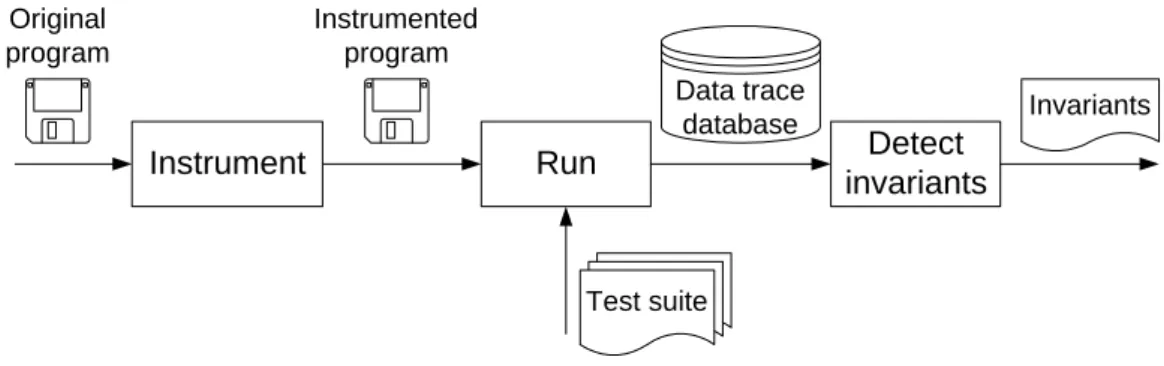
Dynamic invariant detection [13] discovers likely invariants from program executions by instrumenting the target program to trace the variables of interest, running the in-strumented program over a test suite, and inferring invariants over the inin-strumented values (Figure 3.1). The inference step tests a set of possible invariants against the
Invariants Instrumented program Original program Test suite Run Instrument Data trace database Detect invariants
Figure 3.1: An overview of dynamic invariant inference as implemented by the Daikon tool
values captured from the instrumented variables; those invariants that are tested to a sufficient degree without falsification are reported to the programmer. As with other dynamic approaches such as testing and profiling, the accuracy of the inferred invari-ants depends in part on the quality and completeness of the test cases. The Daikon invariant detector is language independent, currently supporting instrumenters for C, Java, and Lisp.
Daikon detects invariants at specific program points such as loop heads and pro-cedure entries and exits; each program point is treated independently. The invariant detector is provided with a variable trace that contains, for each execution of a program point, the values of all variables in scope at that point. Each of a set of possible invariants is tested against various combinations of one, two, or three traced variables.
For variables x, y, and z, and computed constants a, b, and c, some examples are: equality with a constant (x = a) or a small set of constants (x ∈ {a, b, c}), lying in a range (a ≤ x ≤ b), non-zero, modulus (x ≡ a (mod b)), linear relationships like z = ax + by + c, ordering (x ≤ y), a range of functions (x = fn(y)), and invariant com-binations (x + y ≡ a (mod b)). Also sought are invariants over a sequence variable such as minimum and maximum sequence values, lexicographical ordering, element
ordering, invariants holding for all elements in the sequence, or membership (x ∈ y). Given two sequences, some example invariants are elementwise linear relationship, lexicographic comparison, and subsequence relationship.
In addition to local invariants such as node = node.child.parent (for all nodes), Daikon detects global invariants over pointer-directed data structures, such asmytree is sorted by ≤. Finally, Daikon can detect conditional invariants that are not univer-sally true, such asif p 6= NULL then ∗p > xandp.value > limit or p.left ∈ mytree. Pointer-based invariants are obtained by linearizing graph-like data structures. Conditional invariants result from splitting data into parts based on the condition and comparing the resulting invariants; if the invariants in the two halves differ, they are composed into a conditional invariant [15].
For each variable or tuple of variables, each potential invariant is tested. Each potential unary invariant is checked for all variables, each potential binary invariant is checked over all pairs of variables, and so forth. A potential invariant is checked by examining each sample (i.e., tuple of values for the variables being tested) in turn. As soon as a sample not satisfying the invariant is encountered, that invariant is known not to hold and is not checked for any subsequent samples. Because false invariants tend to be falsified quickly, the cost of computing invariants tends to be proportional to the number of invariants discovered. All the invariants are inexpensive to test and do not require full-fledged theorem-proving.
To enable reporting of invariants regarding components, properties of aggregates, and other values not stored in program variables, Daikon represents such entities as additional derived variables available for inference. For instance, if array a and integer lasti are both in scope, then properties over a[lasti] may be of interest, even though it is not a variable and may not even appear in the program text. Derived variables are treated just like other variables by the invariant detector, permitting it to infer invariants that are not hardcoded into its list. For instance, if size(A) is
derived from sequence A, then the system can report the invariant i < size(A) without hardcoding a less-than comparison check for the case of a scalar and the length of a sequence. For performance reasons, derived variables are introduced only when known to be sensible. For instance, for sequence A, the derived variable size(A) is introduced and invariants are computed over it before A[i] is introduced, to ensure that i is in the range of A.
An invariant is reported only if there is adequate evidence of its plausibility. In particular, if there are an inadequate number of samples of a particular variable, patterns observed over it may be mere coincidence. Consequently, for each detected invariant, Daikon computes the probability that such a property would appear by chance in a random input. The property is reported only if its probability is smaller than a user-defined confidence parameter [14].
The Daikon invariant detector is available for download fromhttp://pag.csail. mit.edu/daikon.
3.4
Finding Refactoring Candidates
The goal of this work is to aid the engineer in finding some of the nearly two dozen “bad smells in code” [16, Chap. 3] that motivate refactorings. Human judgment is still required to determine whether a candidate refactoring should be applied: the engineer would apply the refactoring — either manually or using a tool such as those discussed in Section 3.2 — if it was judged to be of value.
Identifying refactoring candidates generally requires a semantic analysis of a pro-gram. (In some cases, such as “Large Class” [16, p. 78], a weaker analysis may identify some candidates.) Our approach is to use program invariants to automati-cally identify candidate refactorings. A particular pattern of invariants identifies a candidate refactoring and where to apply it.
We selected candidate refactorings from among those in Fowler et al. [16] and manually determined the invariants that indicate their applicability.
As an example, the “Remove Parameter” refactoring can be applied if a param-eter is not needed. This can arise, for example, when a paramparam-eter can be computed from other parameters: a method is a candidate if an invariant over the parame-ters indicates that one parameter is a function of the others. As one example, this approach allowed us to find a situation in a substantial program in which a poten-tially rectangular icon was always square: the height and width parameters were always equal. Automatic detection of this property allowed the engineer to then decide whether or not to apply the refactoring, depending on whether there was still a desire to keep the original flexibility. (Even if the engineer chose not to apply the refactoring, the relationship between the parameters could be retained, perhaps as a comment or annotation, to provide additional documentation about the program; this annotation could be mechanically checked from time to time to identify if and when the potential flexibility was being utilized.)
There are three major steps to perform refactoring. 1. Identifying possible refactoring
2. Applying refactoring 3. Verifying refactoring
As for 2, several useful preceding researches exist [18][21][33][30][36][29]. They often include 3 as a part. For instance, Refactoring Browser [34]
1. checks the possibility of a certain refactoring such as “Inline Temporary,” “Re-move Parameter from Method,” and so on,
2. applies the refactoring to the code, and
Our approach works regardless of how the invariants are created. If the invariants are explicit in the code, then we can analyze those invariants to determine candidate refactorings. In the common case where there are few or no explicit invariants, we dynamically detect program invariants, as described in Section 3.3. (Section 3.7 compares dynamic and static analysis for identifying candidate refactorings.)
3.5
Candidate Refactorings
Discoverable from Invariants
This section describes the refactorings (largely from Fowler et al. [16]) that our tool detects, and specifies the invariants that indicate their applicability. Section 3.6 presents a case study over Nebulous [22], including quantitative and qualitative re-sults. We use some examples from this case study to clarify the refactorings discussed here.
3.5.1
Remove Parameter
“Remove Parameter” is intended to apply when “a parameter [is] no longer used by the method body” [16, p. 277]. A parameter can also be removed when its value is constant or can be computed from other available information. The refactoring eliminates the parameter from the declaration and all calls. The rationale is that extraneous parameters are confusing and burdensome to users of the code.
“Remove Parameter” is applicable when either of the following preconditions (in-variants at a procedure entry) holds:
• p =constant
where p is a parameter, f is a computable function, and a, b, . . . are either parameters or other variables in scope at the procedure entry.
In Nebulous one parameter to the Aspect constructor was constant: isAutomaticAspect = true .
In another case of a constant parameter, method SetFirstItemFlag turned out to have only a single call, and that call passed a literal as the corresponding argument. The example mentioned in the previous section — when the width and height parameters for a rectangular icon were always equal — illustrates the power of using invariants to find this refactoring. In general, determining equality of two parameters requires nontrivial program analysis.
we found several examples such as the following.
We found the following invariant related with the parameter flag of the method SetFirstItemFlag.
flag = true
This invariant implies that flag is useless parameter in this case and can be eliminated from the parameter list.
public void SetFirstItemFlag( boolean flag ) {
mFirstItem = flag; }
The name implies that the parameter is useless. In fact, there is only one usage of this method.
public boolean InsertHistoryItem( int fileID, int lineNum ) {
...
if( -1 == mCurrentIndex )
item.SetFirstItemFlag( true ); ...
}
Therefore the parameter flag can be removed.
3.5.2
Eliminate Return Value
“Eliminate Return Value” is intended for methods that return a trivial value or a value that callers ignore; a value is trivial if it is constant or is computable from other available values. Although this refactoring is not mentioned by Fowler [16], its rationale and mechanics are similar to those of Remove Parameter (Section 3.5.1).
“Eliminate Return Value” is applicable if either of the following postconditions (invariants at a procedure exit) holds:
• return =constant
• return = f(a, b, . . .)
where return stands for the procedure result, f is a computable function, and a, b, . . . are in scope at the call site.
In Nebulous, method makeObjectObey in class CollisionCountCommand had the postcondition
return = true
and in fact, this routine can never return false.
In the Nebulous source code, we found the following example.
{
if( inObject instanceof nFlatLandPanel ) { nFlatLandPanel panel = ( ( nFlatLandPanel )inObject ); mCollisionCount += panel.GetNumCollisions(); } return true; }
This method does return a value that is obviously useless because it is always “true.”
3.5.3
Separate Query from Modifier
“Separate Query from Modifier” is intended for “a method that returns a value but also changes the state of an object” [16, p. 279]. The refactoring converts a single routine into two separate routines, one of which returns the query result and the other of which performs the modification. The rationale is to give each routine a single clearly defined purpose, to permit clients to perform just the query or just the modification, and to create side-effect-free procedures whose calls may be freely inserted or removed. Another common problem, at least in some of the Nebulous code, is that the procedure name or documentation may not make the side effects clear.
“Separate Query from Modifier” is applicable when two conditions hold at the procedure exit:
• the postconditions do not contain return =constant, even though the procedure returns a value, and
• for some variable a in scope at procedure entry (for instance, a formal
param-eter), the postconditions imply a 6= orig(a)
If the return value is constant, the “Eliminate Return Value” refactoring (Section 3.5.2) will be recommended. Postconditions can imply a = orig(a) by, for example, contain-ing a =func(a), where func is not the identity function.
Nebulous’ CursorHistory.GetNextItem method, which returns an object of CursorHistoryItem, includes the following postcondition:
this.mCurrentIndex = orig(this.mCurrentIndex) + 1 .
This method returns an item in the list and also increments an index into the list. We found the following invariants related with the method in question GetNextItem().
CursorHistory.GetNextItem()LCursorHistoryItem;:::EXIT85 this.mCurrentIndex > orig(this.mCurrentIndex)
The first line shows that GetNextItem() returns non-trivial value, or a
CursorHistoryItem class value to its callers. The following two lines show that the inner status of this class, or the member mCurrentIndex is modified.
In Nebulous, we found a couple of examples, including the following:
public CursorHistoryItem GetNextItem() {
CursorHistoryItem item = null;
if( mCurrentIndex < mHistoryItems.size() - 1 ) {
mCurrentIndex++;
item = ( CursorHistoryItem )
}
return item; }
This method returns an item in the list and increments the index at the same time. There are two major problems with this implementation. First, the name of the method does not necessarily imply it does, suggesting that it returns the next item in the list and nothing else. In fact, the inner status of the list is changed by invoking this method. Second there might be redundancy when we need a method that performs either getting next item in the list or incrementing the index.
Rather it is preferable that we provide those two method, or “query part” and “modify part” separately.
3.5.4
Encapsulate Downcast
“Encapsulate Downcast” is intended for “a method that returns an object that needs to be downcasted by its callers” [16, p. 308]. The refactoring changes the return type and moves the downcast inside the method. The rationale is to reduce the static number of downcasts and to simplify implementation and understanding for clients. It can also permit type checks to be performed statically (at compile-time) rather than dynamically (at run-time), which has the dual benefits of early error detection and of improved performance.
“Encapsulate Downcast” is applicable when the following postcondition holds:
• LUB(return.class) 6=declaredtype(return)
where LUB is the least-upper-bound operator and declaredtype(return) is the declared return type of the procedure. Our current implementation approximates this test with the conjunction of the following two conditions:
1. return.class =constant, and 2. return.class 6=declaredtype(return)
One example appears in method ShowAspect of class AspectTraverseComboBox:
elements of this.comboBoxItems have class AspectTraverseListItem
Although this.comboBoxItems is declared as a Vector (containing Objects), its contents are always AspectTraverseListItem objects. These elements can be en-capsulated in a more specific container, making the intention clearer.
In the Nebulous source code, we found[[statically?]] the following in the body of ShowAspect:
public void ShowAspect( String pat ) { HiddenItem h =
( HiddenItem )hiddenItems.get( pat ); ...
}
hiddenItems is a Vector object that holds HiddenItem class objects. It seemed that hiddenItems holds HiddenItem class object only. Nevertheless hiddenItems is declared as a general Vector object and therefore hiddenItems.get() is required to be downcast by its caller.
There were a couple of other program points that have the same structure seen here.
3.5.5
Replace Temp with Query
“Replace Temp with Query” is intended for “a temporary variable that holds the value of an expression” [16, p. 120]. The refactoring extracts the expression into a method and replaces uses of the temporary by method calls. The rationale is that the
expression may be used in multiple places and that eliminating temporary variables can enable other refactorings. In essence, this is the user-level inverse of a compiler’s application of the common subexpression elimination optimization.
“Replace Temp with Query” is applicable to a temporary variable if neither the temporary variable nor the value of the expression that initialized it is changed during the temporary variable’s lifespan. This is guaranteed by the conjunction of the following two postconditions:
• temp = orig(temp), and
• a = orig(a), b = orig(b), . . . for all variables a, b, . . . in the (side-effect-free)
initializer for temp
Section 3.6 does not report any results for “Replace Temp with Query”, because Daikon does not currently report invariants over the initial values of temporary vari-ables. Extending Daikon to do so is relatively straightforward, but time-consuming. (Another problem is the need to check values (of a, b, . . . above) at each use of the temporary; checking only at the procedure exit would not preclude one of those val-ues being changed, then changed back. A static analysis or programmer examination could also suffice for this check.)
As a proof of concept of detecting “Replace Temp with Query”, we introduced wrapper functions into Nebulous that make temporary variables into parameters, thus making them visible to Daikon. Using the Daikon output for the modified program, our refactoring pattern-matcher was able to detect candidates for
“Replace Temp with Query”. Consequently, we are confident that this refactoring can be detected automatically when we improve Daikon as described above. As an example, method getIndex contained invariant
numAspects = orig(numAspects) = size(this.aspects)
In the Nebulous source code, we found several examples including the following.
public Aspect itineraryLine( String pat, String path,
int lineNumber, boolean adding ) { int index = getIndex( pat );
Aspect aspect = null; if( index >= 0 ) {
aspect = ( Aspect )aspects.elementAt( index ); ...
} ... }
It may be, however, getting more difficult to realize that which value index holds if the method implementation is so long that we cannot see the definition and the usage in one screen.
An important precondition to applying this refactoring is to confirm that neither pat nor the return value of getIndex itself is changed throughout the lifespan of the temporary variable index.
This refactoring requires invariant information related with a local variable which current Daikon cannot handle. To demonstrate the availability of dynamic invariants, however, we introduced a dummy wrapping method which enables Daikon to handle such a local variable in question.
For instance, we made the following change to a method in question.
private int getIndex(String aspectPattern) { int numAspects = aspects.size();
return getIndexReal(aspectPattern, numAspects); }
// private int getIndex( String aspectPattern )
private int getIndexReal(String aspectPattern, int numAspects) { int indexFoundAt = -1; // numAspects = aspects.size(); ... } }
This modification allows Daikon to detect variable numAspects related invari-ants. As a result, we found the following Daikon output as a dynamic invariant for getIndexReal() method.
numAspects = orig(numAspects) = size(this.aspects)
This implies that the temporary variable numAspects in the original getIndex() method is never changed during the method scope. Therefore every appearance of numAspects in the original getIndex() method can be replaced with aspect.size() query method to enhance the readability.
3.6
Analysis of Nebulous
To demonstrate the feasibility of our invariant pattern matching method and to gather informal empirical data about its effectiveness, we applied our technique to Nebulous, a component of Aspect Browser [22]. Nebulous is a software tool that employs simple pattern matching and the geographic map metaphor both to visualize how the code of a program feature or property crosscuts the file hierarchy of the
program, and to manage changes to that code. Nebulous is written in Java, and consists of 78 files and a similar number of classes, amounting to about 7000 lines of non-comment, non-blank source code. Over its three year history, it has had three different primary developers under the guidance of one of the co-authors.
We applied our approach as follows:
1. We wrote Perl scripts to identify the patterns of invariants that indicate that particular refactorings may apply (Section 3.5).
2. We used Daikon to extract invariants from a typical Nebulous execution. The test runs of Nebulous exercised a variety of features over two inputs — a student assignment from an MIT class and the source code of Nebulous itself.
3. We ran the Perl scripts over the extracted invariants to identify candidate refactorings from among those described in Section 3.5.
4. The current programmer on the Nebulous project evaluated the usefulness of the recommendations. This evaluation occurred in the presence of one of the co-authors so that qualitative issues could be observed.
The Nebulous programmer classified the recommendations into: yes, the rec-ommendation is good; no, the recrec-ommendation is not good at all; or maybe, the refactoring might be a good idea, or another refactoring might be better.
Name yes maybe no total
Remove Parameter 6 4 5 15
Eliminate Return Value 1 2 4 7
Separate Query from Modifier 0 2 0 2
Encapsulate Downcast 1 1 0 2
Total 8 9 9 26
Remove Parameter Most of the yes’s in this category are due to the same literal or object being passed in from all call sites. For a single object being passed in, the
restructuring is tricky, since the object’s data must still reach the method. Since the object is a singleton, the incoming object’s class could be refactored to make it a static class, thus making the data readily accessible via static methods. Most of the no’s and maybe’s in “Remove Parameter” were detected as candidates because in each instance a flag of the same value was passed in on every call, and this flag controls a case statement that is driving a method dispatch. Thus, although the programmer deemed it incorrect or inappropriate to perform “Remove Parameter,” he did decide that “Replace Parameter with Explicit Methods” [16, p. 285] would be appropriate, which would push the switching logic outside the method using the flag. Extending the tool’s pattern matching to recognize flags — by detecting the passing of a limited range of values to a method — could yield the appropriate recommendation.
Eliminate Return Value The yes here is for a function that always returns true. The four no’s are due to the fact that the usage scenario failed to exercise a couple of Nebulous’ more obscure features. (This weakness is due to our use of a dynamic method for discovering invariants: the reported invariants were false and would be eliminated through the use of a richer test suite or a sufficiently powerful static technique.) The two maybe’s are functionally correct, but their value is dubious. For example, the createAspect method of class AspectBrowser need not return its value, but the programmer judged it convenient for additional processing after the aspect was created.
Separate Query from Modification The two maybe’s for this refactoring are a matter of programming style. The programmer likes a style of iterator (for example) that uses a modify-and-return approach, which inherently combines the query and the modification. It should be straightforward to customize the invariant pattern matcher to account for programmer preferences, for instance disabling patterns that make recommendations that contradict the programmer’s preferred style.
Encapsulate Downcast Both recommendations made by the tool are correct. However, in one case ten casts on a vector appear in the code, in the other just two appear. In the latter case the programmer marked this as a maybe since the amount of casting was limited, thus mitigating the benefits of creating a new class to encapsulate the casting.
Overall, the programmer felt that the use of the tool was quite valuable. The tool’s recommendations, although not large in number, revealed fundamental archi-tectural features — the programmer would say flaws — of Nebulous. In particular, although the tool did not detect every use of flags in the system to control method dispatch, the programmer used his knowledge of the system to extrapolate from these few cases to the architectural generalization. Also, although a number of the recommended refactorings were not of interest to the programmer, he quickly picked out the gems, wasting little time on the uninteresting recommendations. Moreover, even the no’s provided insight about Nebulous, in particular revealing the excessive use of flags.
Several recommended refactorings, although correct, possessed subtleties that would complicate their application, perhaps enough to discourage their application. One example is “Remove Parameter,” which in some cases would necessitate con-verting a singleton object into a static class. In another case, the recommendation, although technically not meaning-preserving, convinced the programmer that the exceptional, falsifying case should be eliminated to simplify the program. Thus, the process was not an exercise in refactoring alone, but also in functional redesign.
Based on these results, the programmer plans to eliminate the prevailing archi-tectural flaw, systematically refactoring the code to largely eliminate the use of flags and to convert key singleton objects into static classes.
Coincidentally, the programmer had recently used a simple clone-detection tool based on text-based pattern matching [19] to ferret out copy-pasted code. The