A Transaction Cost Approach Revised toward the
General Theory of Foreign Market Entry
Strategies
journal or
publication title
International review of business
number
13
page range
1-27
year
2013-03
1. Introduction
Before the latter half of 1980’s, an internalization approach and a transaction cost approach applied to the theory of the multinational enterprise (Hereafter, described as MNE) were meaningful as they could help explain why MNEs come to grow based on a sort of general theory. But thereafter these approaches have become losing the explanative power since international strategic alliances were employed by MNEs in order to enter the target market in which MNE can retain their strength.
For this phenomenon, internalization behavior of MNEs tended to lose rationality. Due to it, internalization and transaction cost theories were unbelievably fallen in the bottom, as long as they address the growth of MNEs.
On the other hand, to be noticed, Dunning, J. H. & Rugman, A. have remained their assertions that an internalization approach has been going on the first level without having a doubt of explaining when and why MNEs enter their target markets even if strategic alliances are chosen, although the resource-based view has been combined with a transaction
of Foreign Market Entry Strategies
Takeshi FUJISAWA*
Abstract
This article aims to explore the validity of a transaction cost approach as a theoretical background in explaining when and why multinational enterprises choose an optimal foreign market entry strategy over time. The author shows Rugman’s general theory of the multinational enterprise can be enforced to revise in terms of introducing information costs and communication costs as the significance of transaction costs has been gradually weakened due to the changes of technology, product market and competition. That is why an integrative approach should be here employed as Casson suggests. A transaction cost approach, however, may be thought still now effective, as long as this approach can be in part revised. Such a perspective can be supported by examining the foreign market entry choice optimal for software developers.
Keywords: foreign market entry strategies, transaction cost, information cost, communication cost, software developers
cost approach in their recent works.
In this article the possible validity of their assertions are reviewed for MNE facing with an alternative option of strategic alliances in terms of filling up the failure of Rugman’s earliest traditional model of MNEs’ foreign market entry strategies (1981). At the same time, we should review Rugman’s model in which each one optimal entry mode per MNEs’ growth stage is assumed. Then we focus on modifying the Rugman’s traditional model to propose MNEs can simultaneously develop the same foreign market with two types of entry modes at the given time. In the second, we examine OEM can be effectively chosen to take advantage of utilizing managerial resources of both business partners (a leader and a follower) without neglecting some sort of transaction costs.
Thirdly information costs and communication costs are built in the selection of foreign market entry modes, in which their relationships with transaction costs are discussed. Fourthly let us apply the revised transaction cost approach to the entry modes selection for software developers. Finally the possibility of integrating the resource-based view and the concept of architecture with transaction cost approach can be proposed.
2. Modeling plural foreign market entry modes in a given country
Figure 1 shows the sequential market entry model depending on the dissipation costs of knowledge in which MNEs can internalize or externalize alongside with the value of their knowledge over time, when summing up the Rugman’s theory of the MNE.
Apparently we may think this model dynamic. To be more accurate, however, three stages model is seen in Figure 1. Rugman emphasizes the big role of dissipation costs of knowledge when leasing a parent’s technology to a local independent company. Due to its costs, each MNE has to select setting up a wholly-owned subsidiary (internalization) in terms of foreign direct investment in the earlier stage after exporting from a parent company becomes no best entry mode in an imperfect target market country imposing tariff on the parent company. Each MNE prefers foreign direct investment to licensing considering high dissipation costs accompanied with licensing in the earlier stage where the knowledge value of a parent company is relatively high.
According to the transaction cost theory, only one optimal entry mode is assumed to be decided as long as entering the same foreign market in the given time. In effect, however, we shouldn’t neglect the possible coexistence of two types of market entry modes at the same time or phase even if a licensing agreement appears to be earlier than Rugman’s proposition. Therefore foreign direct investment is realized while exporting goods from a parent company to the same target country where its subsidiary is located. Or a licensing agreement is concluded with a local partner (licensee) as a parent company has determined releasing its technology under it, at the same time when its subsidiary operates a local
production factory.
Then we show the latter case among the simultaneous behavior of plural entry strategies by MNEs. By using plural entry modes in the same host country, MNEs should gain more profits than selecting only a local production in the subsidiary. In terms of enacting a licensing agreement at the same time as a local production in the subsidiary, MNEs may fear dissipation costs of knowledge. But if MNEs select plural entry modes such as an operation in the subsidiary and licensing to a local company, they seem to get higher profits than a single activity of wholly-owned subsidiary’s foreign production in the host country. The ground is explained by the following equation.
Taking advantage of the highly valued technology developed by MNEs simultaneously in their local subsidiaries and an independent local firm is justified as long as the net profit is higher in this case than a single foreign business such as either only a local production in the subsidiary or licensing to an independent manufacturer. Here one MNE is termed as A, and a local independent licensee is denoted as B. In the first assumption that A chooses a licensing while continuing the subsidiary’s local production, A can get a higher rate of its licensing fee from B compared with the net sales profit rate gained by A’s subsidiary from its local production. But only this condition isn’t enough to postulate a simultaneous entry behavior of A. Here we have to consider A’s total licensing revenue divided into two parts
Figure 1. Conversion of the Optimal Market Entry Mode by Three Stages in Rugman’s Theory (1981)
Source) Fujisawa drew this figure summing up the theoretical essence proposed by Rugman(.1981).
not only accruing from B but also from A’s subsidiary, as a A’s subsidiary should also have been paying a licensing fee to its parent company since it started the local production owing to taking advantage of A’s parent’s technology which could be transferred under a licensing agreement even if the bonding relationship between like a parent and a child has been kept. As a matter of course, the licensing fee paid by A’s subsidiary is less than one done by B, as A’s subsidiary is internalized by its parent and its subsidiary must compete with local independent companies like B at the price level.
That is why we can propose the below formula in modeling the simultaneous foreign market entry modes satisfying the maximum net profit for A in a given country.
! A’s subsidiary’s net sales profit rate!" A’s net profit rate in terms of a licensing fee gained from its subsidiary## A’s net profit rate in terms of a licensing fee gained from B.
Here such a licensing fee is denoted by a certain percent of the total sales revenue accruing from production activities using A’s parent’s technology. In this formula we postulate A’s parent company owns 100% of the total issued equities of its subsidiary since setting up it abroad. Therefore all of the net sales profit recorded in A’s subsidiary can be consolidated with A’s parent company’s net sales profit. In addition to this formula, these three kinds of profits’ levels should change their values over time. It can be expected that in the growth phase of a product life cycle in a host country, ""!"# may be established and in its mature stage, ""#"! may be realized, as a technological value seems to decline sharply over time rather than its brand value. In this way we can explain the simultaneous market entry modes adopted by one MNE in terms of an intra-firm’s international division of labor and inter-forms’ international division of labor seen at the same time in a given market country. In the real business world in the latter stage of international product life cycle, MNE may retain brand power longer than technological value as the technological value is easily dispersed into licensees, even if licensors try to keep a certain level of technological value in terms of technological improvement. Contrasted with technology, brand power doesn’t tend to suffer from the dissipation risk.
The above formula brings the maximum net profit in the type of MNEs employing both internalization and externalization of international production. In particular this formula is supported by MNEs which emphasize the role of technological value in their foreign operations and collect the former research and development costs at the earlier stage of international product life cycle. Perhaps the cost performance in such a MNE is likely to be higher than the MNE focusing on its intra-companies’ transactions, that is, internalization. The internalization theory supported by Rugman shown in his earlier research can be revised in order to take plural foreign market entry modes into consideration and such a phenomenon is explained in this section.
Figure 2. Determinants for Decision-making on Internalization and Externalization of Managerial Resources
Source) Fujisawa drew this figure after collecting information on each company’s R&D, production, sales and brand policies.
3. Basic Analytical Axis for Internalization and Externalization
Still now the transaction cost theory tends to mainly discuss the place or location of using managerial resource, whereas how to develop the resources and what way should be taken in accumulating the resource developed by MNEs have been relatively neglected in discussion. What types of managerial resources should be developed inside MNE or bought with a licensing-in agreement has to be treated by the MNE theorists, because developing managerial resources within the firm has nowadays been decided by a MNE depending on its competitive position and capabilities in addition to the technological environment. In figure 2 we can see each company’s positioning from the perspective taking the location of using managerial resources in the horizontal axis and the main actor of developing them in the vertical axis.
Moreover Figure 3 shows what type of technology is more desirable in-house development. Figure 3 depicts the new technology whose value is sharply diminished over time isn’t adequate to develop in-house, whereas the opposite type is desirable for developing in-house.
For example, Toshiba Co. licensed out its compressor technology to a Chinese manufacturer and allowed the company to sell refrigerators with Toshiba brand which were
Figure 3. In-house development type of a technology
Source) Fujisawa drew this figure.
produced by it using Toshiba’s technology before starting Toshiba’s local production of refrigerators in its subsidiary in China. In this case Toshiba preferred externalization to internalization in the first step and gradually move from externalization to internalization.
Such a strategy can’t be evaluated by an internalization approach. Toshiba has challenged toward externalization of technology and brand using right in order to hedge a commercial risk and get any stable profit by such an externalization. Since 2000 Toshiba has strongly pushed in-house technological development and discerning its brand selling after evaluating its marketing capability for each product. When Toshiba judges its marketing power as relatively weak, it sells its technology to an outsider without developing a new product. In this way the dichotomy of brand strategies such as superior and inferior branding for home appliances has been introduced and the similar strategy will be in fashion among MNEs whose homes are developed countries.
On the other hand, Matsushita Electric and Industry Co. merged its several group companies into itself and taking advantages of this consolidated group system, it has increased its making ratio of electric parts and materials which are integrated into assembly lines for final products and sell the total products with its own brand name, Panasonic. That is why Matsushita Electric and Industry Co. is located at left upside in Figure 2. In particular Matsushita’s group profit ratio is high than two rival Japanese makers shown in Fig. 2, because in-house production ratio of core parts utilized for digital home appliances are extremely highest in Japan which means vertical production process is strongly integrated inside Matsushita group. Owing to this group production system, quality improvement of the parts is prospered and new parts are developed under in-group cooperation, which can increase its sales profit ratio.
Sony tends to lack core parts by in-house production as shown by about 85% ones outsourced, which weakens Sony’s international competitiveness for PC and digital audio visual products. Then Sony challenges toward raising in-house production ratio of core parts.
Philips may be inferior to the three Japanese electric makers like Matsushita in its technology. But Philips has developed continuously and accumulated basic core technologies. Owing to this kind of technological advantage, Philips has successfully retained its original strong brand power for its total technological level.
That is why Philips can discriminatingly adopt OEM (original equipment manufacturing) procurement and original brand selling owing to strong sales network worldwide established. This leads to keeping the totally stable competitive positions of Philips.
4. The Rule for Allocating Managerial Resources by OEM with Selling Each
Own Brand
Company A is defined as a leader MNE and B as a follower MNE. In the first phase, Company A retains a technological advantage and sells its technology to B, Company B manufactures a sort of finished products utilizing this licensed technology in order to supply A with the products under an OEM agreement for A’s own brand, while some manufactured products are sold with B’s brand. Company A has already divested from producing these items of products. An initial condition for A is that A has not only a technological advantage but also a brand one. Here necessary variables for analyzing both MNEs’ behavior are defined as follows.
B’s total supplying volume of finished products manufactured by B; QB A’s selling price of its own brand; PA
B’s selling price of its own brand; PB
B’s selling price of manufactured products for A; PC B’s total average production and supplying costs; CB
B’s ratio of selling its own brand to B’s total quantity of manufactured products; x(0"x"1)
Under a licensing agreement A can receive an assured licensing fee from B. The rate of this licensing fee is measured by a certain ratio of B’s total sales volume when producing the products inclusive A’s technology. The rate of this licensing fee’ is denoted as y and y is found like 0"y"1. Since starting B’s manufacturing the related products, it’s postulated A has no touch with supplying parts and materials for A’s production.
Among the above variables, a few initial conditions are found. As A’s brand can be sold at a higher price than B’s brand, PA!PB is assured. In addition to it, as B has to incur sales promotion costs when selling its manufactured products with B’s brand, B is enforced to set
its own brand price higher than the selling price of B’s products for A. Then PB&PC is assumed. Moreover B has to get some adding values from its manufacturing so as to keep producing. So PC&CBis naturally found.
Thus the initial conditions are made sure as follows. PA&PB&PC&CB, Therefore, PA"PB&2PC !!!!
Here the transportation, tariff and insurance costs are neglected when A imports all manufactured products from B for simplification of discussion. Rather several variables are added to the above variables.
Annual A’s total profit; RA A’s revenue of licensing fee; LA
A’s sales profit with its own added brand value; BA B’s total profit; RB
Here RA$LA"BA.
LA$PBQBxy"PCQB (1#x) y !!!!" BA$(PA#PC) QB (1#x) !!!#
RB$(PB#CB) QBx"(PC#CB) QB (1#x) !!!$
Then the A’s residual technological development cost is denoted as TA and its total R&D cost related this technology is TO.
Each sales year for A since a new product was introduced by A in the market is defined as I, and the years since A released its own technology is shown by k. The equation is set as follows.
!!!%
In the first A’s decision-making to involve selling its technology to B depends on the condition satisfying RA$LA"BA&RB, as long as TA&0 is continued. The reason why if LA"BA%RB, A has to leave TA at the time of licensing out and find the total future revenue gained by A may be lower than that of B. In this case A may notice that A would have never had a motive for its technological development. If TA&0 is assumed by A but as a result of licensing out, LA"BA%RB is realized, A can’t perform to collect the total cost for its technological development and sunk cost will be arisen. This sunk cost is seen a kind of transaction costs.
Therefore as far as A’s rational behavior is assured, the following formula is established.
!!!&
shown as the below.
!!!!
In the next phase, at the time period of TA$0, A’s technological value is diminishing while B’s brand is going up. That is why PB$PC may be established as a price negotiation term. Consequently B’s brand value tends to equivalent with the market price evaluated by actual traders. Therefore PB$PC can be substituted into equation!, the new equation " is derived.
!!!"
Finally, at TA%0, B can strengthen its brand power and B’s brand selling price becomes equal to the world standard price, which can be denoted as PA$PB$PC. Thus the negotiation concerning the existing technology becomes against A. Taking advantage of such a reversal on the licensing fee, B becomes stronger than A in deciding the fee shown by #.
!!!#
In addition to such an analysis, so as to solve the optimal condition for A in licensing out, one stable equilibrium about the rate of A’s technological licensing fee should be derived from totally differentiating equation " under y´$0 as follows.
!!!$
As X is constrained to be non-negative and (1"PC) &PB is clearly kept, !!!%
As PA"PB&PA"CB is established, A’s stable time period concerning A’s negotiating power over its licensing fee is defined as below.
!!!&
In such a condition that A’s sales added value is higher than B’s manufacturing added value, A becomes more advantageous over B in negotiating its licensing fee.
But in the case of (PA#PC) $ (PB#PC), A becomes to never expect the agreement beneficial to A. That is, when A’s sales profit ratio with A’s brand is below B’s sales profit
Figure 4. Conceptual Framework for the Determinants of FDI
ratio with B’s brand value which is made clear by PC&CB, A is forced to reduce its status for negotiating the licensing fee.
In conclusion, A should start its licensing out from the time period satisfying the condition of PC% PA#CB
2 and determine to expire its licensing agreement at the time coincident with!PA#PC"$!PB#PC".
5. A conceptual Framework and Theoretical Integration
Here we employ a simple framework depicted in Figure 4 in which information cost and communication cost are built in influencing factors of FDI (foreign direct investment) as well as transaction cost when considering the determinants of Japanese makers’ FDI.
The theoretical background is also essentially required. Whether a wholly-owned or joint venture type of FDI has been preferred by Japanese parents should be clarified comparing with other entry modes such as licensing and exporting plants. All of manufacturers should have strong firm specific advantages in entering each foreign market by setting up their wholly-owned subsidiaries equal to internalization. Before entering foreign countries most of manufacturers might hold any strategic intent mainly divided into globalization or localization, as such a strategic motive may influence on the performance of each subsidiary.
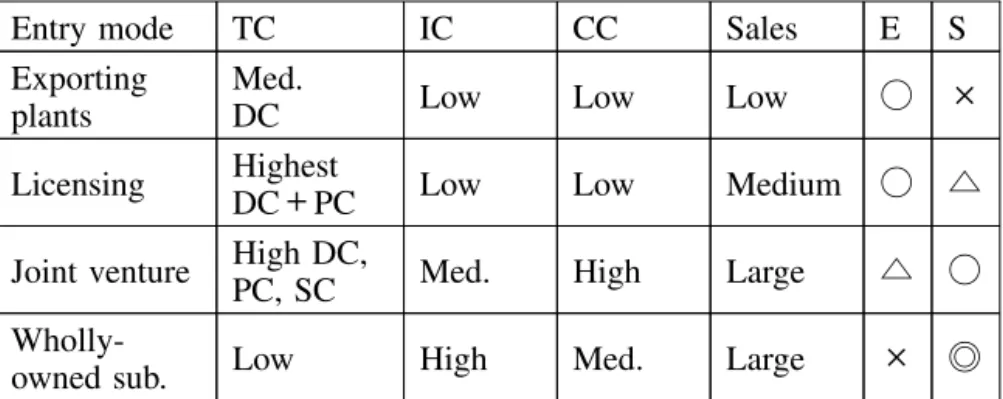
Table 1. Transaction Cost(TC) and other costs by types of entry modes; relative sizes in each cost
Entry mode TC IC CC Sales E S
Exporting plants
Med.
DC Low Low Low # "
Licensing Highest
DC!PC Low Low Medium # %
Joint venture High DC,
PC, SC Med. High Large % #
Wholly-owned sub. Low High Med. Large " $
Note; IC=Information cost, CC=Communication cost, E=Easiness for Entry among firms, S=Specific asset needed in entering markets
Source; Takeshi Fujisawa’s consideration referring to theory proposed by Rugman and Casson
Table 1 illustrates that manufacturers must hold specific assets in entering foreign countries so as to compete with their rival makers not only in a host country but also in the world market, as long as it tries to raise its market share there. In order to sharply raise its market share, a local production in a wholly-owned subsidiary becomes a promising entry mode. Setting up a wholly-owned subsidiary makes sure to be the fastest way for attaining such a goal. Since this entry mode strongly commits corporate resources to link with many markets. Consequently once such a project fails in, this MNE has to take the highest risk and feels it hard to recover from a crucial damage. To make a wholly-owned subsidiary stronger, a parent must develop the strongest asset specificity in technologies or knowledge enough for its subsidiary to be transferred to learn well. From a long perspective, its subsidiaries can be expected toward developing an original design of technology and business model.
This entry mode has a merit in that it can erase transaction costs (TC) by the following reasons. A manufacturer’s parent can transfer its technology and knowledge to its subsidiary without caring about market inefficiencies illustrated by unstably evaluated value of a new technology due to the lack of technology market mechanism and asymmetry information as well as unduly moral hazard by a licensee where a new type of technology may be sold to the third party by this licensee ignoring the licensing agreement concluded between a license holder and technology buyer. So as to prevent from opportunistic behavior of a licensee, its licensor must always watch and audit his behavior. Therefore the licensor often
becomes to face with policing costs (PC), although it might not be able to perfectly control its licensee to act freely with moral hazard, even if it has been continuing paying such costs since the licensing agreement was established.
As a matter of fact, a licensing at the early stage of its product life cycle like a new product introduction phase, that is, such an early licensing is too risky for a licensor as it enforces the licensor to pay the highest dissipation cost (DC) of a technology and knowledge as licensee will soon catch up with the licensor after selling big volume of the products whose technology is derived from the licensor who may lose its product market share while the licensee can emulate the licensed technology which enables the licensee to develop its own technology in the near future so called catching up process with an original licensor.
Before setting up a wholly-owned subsidiary, a manufacturer has to research where is best for locating its subsidiary and when to start its operation, market research and feasibility study are required for this MNE. That is why the MNE must pay high information costs (IC) from the feasibility study. After it starts operation in its subsidiary, this MNE has to incur high IC cost so that the parent controls and coordinates many subsidiaries when integrating the role of each subsidiary into its global strategy. How to integrate a variety of subsidiaries into the corporate level of global strategy depends on much information available to the parent. As a result of information processing, this MNE can work together with its local subsidiaries. Communication costs (CC) become more important after a local production and R&D start between a parent and its wholly-owned subsidiaries. The managers of local subsidiaries also regard the mutual communication most important with each other in extending some transactions within the firm beyond national borders and parent’s mandate. In this way, CC will be augmented.
A joint venture, however, demands both partners to pay maximum CC for conducting an optimal decision-making. If one’s goals become divergent from another partner’s ones, both managers must often keep in touch with each other, and many times attend a congress or meeting in addition to an ordinary discussion. The decision-making in a joint venture tends to be delayed (particularly in a equality ownership type of joint venture) and such a slow style of decision-making and delayed or postponed project worsen both partners’ business performances due to the late response to the changing environment. To solve this problem, sharing information shouldn’t be neglected. That is why a joint venture must incur relatively high IC instead of saving the highest CC. Even if CC and IC can be covered by MNE, another big problem happens to a joint venture partner.
Sunk costs (SC) may be caused by opportunistic behavior of one side of the partner when another partner has invested huge resources and cash into its own plant whose type is limited to a specific usage for production. If one partner comes to reject selling the product
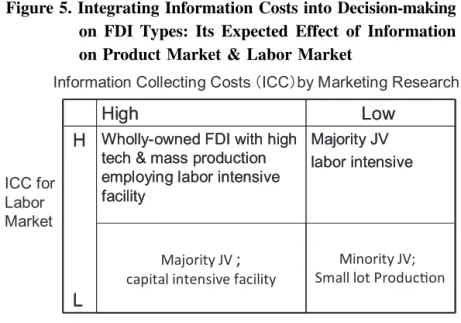
Figure 5. Integrating Information Costs into Decision-making on FDI Types: Its Expected Effect of Information on Product Market & Labor Market
made in this joint venture, another partner, that is, a real plant owner can’t compensate such a facility investment cost as another type of product can’t be fertilized or assembled in its joint venture’s plant. Such a partner is enforced to give up covering SC, while an opportunistic partner doesn’t have will to pay for SC. Partnership tends to be easily collapsed as soon as the production and sales regulation specified in the joint venture agreement can’t be observed by one partner who has never touched with the facility investment.
TC is therefore comprised of three cost factors; ! DC, " PC, # SC. Obviously at the same time, TC has some relations with IC and CC.
Then proceed to build theoretical models. At first focusing on the role of information collecting costs (ICC) used to research a product market and a labor market for each type of entry mode, a theoretical framework can be built as shown in Figure 5. This scheme is lent itself to explain what type of entry mode is best for a manufacturer depending on the requirement levels of ICC allotted for a product market (PM) and labor market (LM)..
Figure 5 illustrates foreign direct investment (FDI) may be classified into a wholly-owned, majority joint venture (JV) and a minority JV. What type of FDI is preferred is determined by the production (process) method of whether abundant labor should be employed etc. For example, a minority JV is suitable to small lot of production as one partner can’t have much interest on business performance compared with running majority JV. More interested in majority JV, we notice the manufacturer who is eager to research a
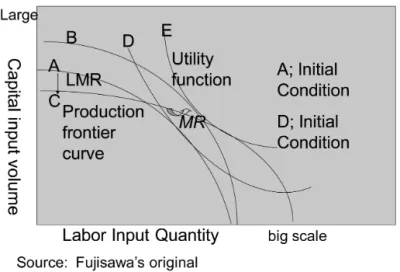
Figure 6. Dynamic Change after Marketing Research
labor market and save some product market research costs tends to adopt a labor intensive production method, whereas a manager of a majority JV partner who emphasizes the role of marketing research on its own product rather than collecting information on a labor market, a capital intensive facility seems to be utilized. A wholly-owned FDI prefers a high-tech and mass production employing a labor intensive facility.
Take the dynamism after marketing research (MR) on a specific product into consideration as seen in Figure 6. Figure 6 depicts expanding product market as a result of a manufacturer’s marketing effort induces to move a utility function of the product to be right upward as curve E shifts from the original curve D. Corresponding to the shift of a utility function curve, production frontier curve A or C goes up to the right so as to touch utility function curve E at the point G. When a manufacturer has prompted labor market research (LMR), the company has come to utilize production frontier curve C shifted from curve A.
If the manufacturer has been spending cash on MR, its production frontier curve might have a tendency for converging on the frontier curve B to meet a touching point G. Consequently there is a co-relationship between MR costs for a specific product and LMR costs and this relationship gives an effect on the production method in a manner that even if an originally labor intensive production method was selected, the heavy MR on a product would induce the production method to be more capital-intensive.
Finally build the hypothesized relationships among three cost factors by market entry modes in terms of relative cost sizes by such entry types in each business.
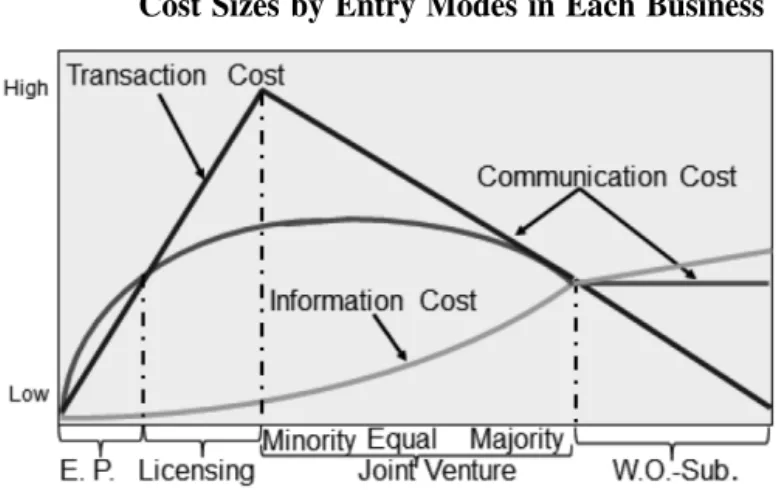
Figure 7. The Hypothesized Relationships among three Cost Factors by Entry Modes: The Relative Cost Sizes by Entry Modes in Each Business
In figure 7 exporting plants (E.P.) shares a position of a starter for becoming MNE. This figure aims to follow changing cost factors over time, that is, focus on the relative size of costs alongside the time horizon. Then explain the changing costs.
For exporting plants, there is a general relationship such as CC"TC"IC. CC incurs entailing technological instructions for a plant importer.
For Licensing, TC"CC"IC is easily established, for DC of a technology is highest on average than any other entry modes proposed by Rugman, as externalizing the firm’s asset specificity and thus the licensee may appear as its competitor in the world market.
In the case of JV three hypothesized relationships are explored without considering internalization models proposed by Rugman etc. Rather linking with the decision-making speed for JV partner’s managers and their relationships with local partners and headquarters.
For a minority JV, TC"CC"IC.
An equally-owned JV is expected to establish TC!CC"IC. CC is highest among all entry modes, as it takes long time and largest frequency in business decisions between the partners concerned who have the same decision-making rights.
A majority JV has a different aspect. The higher equity ownership ratio in JV ensures the parent company to appropriate its own asset specificity, contributing to reduce TC.
Another face of a majority JV in TC is thought to be more interesting.
According to Casson’s theory (2000), IC has TC related field to some extent. Namely, to recognize an inseparable sphere from TC in IC is to be emphasized. What overlapping field with TC can be seen in IC? A TC-unrelated factor of IC is to search for skillful labors and
extension to a new market. On the other hand SC accruing from JV partner’s opportunistic behavior are often seen in its own facility invested by the majority owner parent company. as such a parent tends to mainly invest into its subsidiary’s plant. This factor is counted as IC related with TC.
We should discern TC-related IC from TC-unrelated IC (pure IC). In the case of a wholly-owned subsidiary, IC!CC!TC is plausibly applicable to many MNE. Over the years having passed since a wholly-owned subsidiary was established, it may come to be positioned in a series of world mandate strategy type by its headquarters. By this IC will continue augmenting in order to develop the world market and look for new transaction partners like in supply chain management.
6. Theoretical Approach to the Foreign Market Entry Behavior of Software
Developers
Here we aim to build the analytical framework for explaining how to internationalize in terms of focusing on what foreign market entry strategies in software developers (thereafter this term is denoted as SD) are inclined to be sequentially selected. In the first phase comparing with how to select foreign market entry strategies for manufacturers, the foreign market entry behaviors of SD are explored taking their industry characteristics unique to them into consideration.
In this observation whether the sequential development of foreign market entry strategies tends to depend on the transaction cost approach is reviewed. In addition to it, the analytical framework for explaining empirical evidence is also presented.
First we describe the characteristics of SD among service industry firms and consider what main motives for internationalization of SD are.
In general it is thought SD belong to the typical knowledge-intensive industry. According to the empirical research covered by Contractor and et. all, their global developments are naturally limited as their industry has a characteristic of knowledge-intensive industry. Their host countries are also confined as long as it is more desirable that they have such industry characteristic.
In this meaning the worldwide involvement of SD may be enforced to face with the upper limit, opposed to the situation that hotels, restaurants hypermarkets and department stores have evolved in globalization of their businesses with their chains development. That is, the industry characteristics constraint the location of SD in the world.
Therefore SD should consider the determinants in selecting foreign market entry modes without ignoring the limit of their globalization degree and the uniqueness of SD to become international actors related with industry characteristics and business models. There should be ten factors influencing on SD’s internationalization levels.
1. Ineffective scale economies
2. Service embodied in a specific person which can’t be separated from an individual whose capability and human relationship are specific.
3. Continuous transaction which becomes intangible asset and influences on selecting market entry modes.
4. Asset specificity emphasized in market entry modes more than scale advantage (capital intensity)
5. Relatively easier integration of brand image 6. Smaller development costs as an absolute value.
7. Accounting contractual costs related with a contractor (previous cost) and policing costs happened to audit whether the contractor has behaved in keeping with the contractual conditions which give an impact on the business performance of its consigner.
8. Language abilities vital for the success of business
9. Access to main customers including contractors or embedding them 10. Outsourcing versus Developing (Internal developing)
Here we expect many SD may begin with developing soft products in entering a foreign market and then tend to shift to outsourcing over time from the below reasons.
In the first stage of internationalization, many SD may feel it hard to look for and find out foreign customers. Then they want to get jobs of developing software from their domestic major SD or foreign famous SD. By these works they can start exporting software according to the specific manual and order contents given by the consigners. Taking these initial conditions into consideration, SD had better invest enough cash into their internal development.
In the second stage of internationalization, most of SD must get conscious to perform the above 10 factors as much as they can to the degree of their facing with more foreign customers at the same time. Among these asset specificity and capital intensity seem to become most powerful independent variables in determining internalization or externalization of SD. That is why we should review the possibility of applying the traditional transaction cost approach to the internationalization of SD.
Originally the traditional transaction cost theory has focused on explaining the foreign market entry behaviors of oligopolistic manufacturers. The firm specific factors such as size, rich international experience, the number of holding technologies protected by patents for a certain time period, huge investments into R&D can provide such oligopolistic manufacturers with choosing many opportunities for internalization. In particular product technologies leading to global de-facto standard can ease to develop the global market.
many service industry firms except for an operation soft and application soft provided by Microsoft etc. Due to the low development cost per soft project relative to the new products of high technology makers, SD mustn’t be involved in competing scale extension. The firm specific advantage of SD can’t be measured by the development cost.
But the emulation often happens to soft products and they are relatively easier to be emulated and copied by their competitors and customers etc, even if the products are so new. Therefore the dissipation risk should be substantially discounted in counting the value of soft products.
Because of these particular reasons discussing the internationalization process of SD doesn’t seem to be adequate as far as introducing the traditional transaction cost approach is concerning.
Then let’s the more refined transaction cost theory posited by Krishna, M.E. & Rao, C.P. (1993) introduce in the next and review the applicability of their theory to the expected internationalization process of SD, that is, to make sure the prophecy of its more refined transaction cost theory.
According to Krishna, M.E. & Rao, C.P. , there are three points to be focused on such as ! the trade off between control(profits of integrating businesses) and resource commitment costs in the transaction cost approach," the relationship between asset specificity and entry mode choice,# the relationship between capital intensity and entry mode choice.
By integrating such three relationships into reconsideration, the observed relationship between capital intensity and desire for shared-control modes can be in particular formulated.
Namely the estimated model includes all the main effects, including asset specificity and moderators and the hypothesized interaction effects. Preliminary analysis led the authors to believe that the relationship between capital intensity and entry mode choice is not liner over the range of values considered in the analysis.
As capital intensity increases from “low” to “moderate” levels, the propensity to employ shared-control modes increases, as expected shown in Figure 8. As it increases from “moderate” to “high” levels, the propensity to share control diminishes, contrary to expectations (Figure 8). The reasons why firms avoid shared-control modes at high levels of capital intensity aren’t always clear; perhaps they feel compelled to protect their rather heavy investments by integration. Notwithstanding its origin, this nonlinearity necessitated the inclusion in the model of two quadratic terms, [capital intensity]2 and asset specificity ! [capital intensity]2.
Figure 8. The Observed Relationship between Capital Intensity and Propensity to Employ Shared-Control Modes
Figure 9. The Observed Relationship between Asset Specificity and Propensity to Employ Shared-Control
Figure 10. The Assumed Sequences of International Market Entry Modes: The Cases of Software Developers
To understand the relationship further, note the estimated probability of employing shared -control modes at low and high levels of asset specificity as it is illustrated by Figure 9. As a firm’s asset specificity moves to “very high” levels, the slope of a line can be depicted to slow down, whereas low-specificity firms prefer shared-control modes (joint venture) to full control ones (wholly-owned subsidiary).
What on earth are SD likely to follow the above two lines? In order to examine this, add their industrial characteristics to the theoretical model’s figures. SD are compelled to know some constraints before penetrating the world market for their software due to different languages and unfamiliar cultural context, which make a bad effect on exporting software and acquiring orders to develop software, though many SD may reach business chances to some foreign countries throughout internal development. But except for some country markets advantageous to SD, most of them seem to suffer from developing new markets. That is why SD are inclined to conclude joint development agreement for a new software and rely on consortium or try to search for a new software developer trusted by the SD.
Therefore the internationalization process or sequences of entry modes changed by SD should be obviously explored by a theoretical approach.
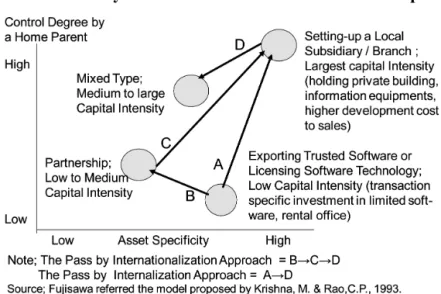
In figure 10 the expected sequential development of market entry modes chosen by SD is illustrated introducing asset specificity and internal control degrees connecting capital intensity. This figure might be revised version of original figures sketched by Krishna, M.E. & Rao, C.P.
If SD are likely to prefer internalization approach, they move on the lines from A to D. On the other hand, SD start with B throughout C, finally turn to D, their option comes to follow such an internationalization approach as served by Root, F (1982).
The selection process for SD are mainly likely to follow the internationalization approach since several explanative factors support strongly the route B!C!D.
Generally the internationalization of SD begin with a trusted developer type exporter serving their consigners with software or exporting a technology for developing software their customers have been wanting. In both entry modes, SD have to satisfy the specification requested by their customers and such specification resembles so strong tacit knowledge that asset specificity can be highly required for the SD. As long as the SD involve with exporting products and/ or technologies, their capital intensity is low because a rental office is usually their main business place. According to the model of Krishna, M.E. & Rao, C.P., shared-control modes aren’t fitted to this first stage. At the same time SD can’t exert strong control over such earlier international operations.
Over time SD come to accumulate many kinds of knowledge about many foreign markets and how to develop software while their company name and brand power have been well known by the potential customers and competitors in the world. Then SD are inclined to choose developing and producing and selling software with their original brand in their own channel and sometimes in the outside channels. These internal complete operation methods necessitate huge investments in developing software at the main inland and overseas business units as well as extending sales networks abroad. As a matter of fact, the fee for purchasing PC and training cost for fostering many excellent engineers become increasing. Consequently these SD realize the maximization of capital intensity in this phase. As the SD make an effort to develop software inside them, asset specificity in their software is extremely high. In this meaning, taking advantage of added value chain makes the SD choose a sole investment, that is, setting up wholly owned subsidiaries or branches or project offices in target market countries and the nations whose software skill is abundant. There the SD can get sole projects and original software development.
After SD worldwide have gained so many customers that they can’t internally develop software offered by main and important customers abroad, they are enforced to take an option of outsourcing for some software so as to keep the delivery date of software customer have required. Subsequently the mixture of internal development and outsourcing, that is ordering the external software houses to develop software in accordance with customers’ needs after the SD themselves have accepted some orders from their customers. In line with enlarging this mixture type, the role of consigners in finding out external software houses is becoming increasing. The development and production volume of software outside the SD is raised up and its share is becoming higher and higher, while the
SD receive sales profit from their trusted developers. The SD naturally weaken capital intensity ratio and asset specificity. The SD might think that establishing new joint ventures with the present trusted developers or competitors is most desirable for maintaining worldwide customers.
Here one problem should be pointed out in order to conclude which approach is more persuasive for observing the internationalization sequences of SD. If partnership stage has been stepped by SD before setting up a local subsidiary or branch or office, the internationalization approach is true for the internationalization process of SD. When SD hasn’t been through the partnership phase, the internalization approach comes to have a more strongly explanative power; namely, starting from a trusted developer (consignee) and then moving directly to setting up a foreign subsidiary, branch or office.
Reviewing the actual application of the internalization versus internationalization approach, it might be concluded that SD are likely to prefer an internationalization approach to internalization one as shown by the following four stages.
The first stage; a trusted software developer or a licensor
The second stage; making a partnership agreement or entering into a consortium arrangement, transaction with affiliated companies
The third stage; establishing a subsidiary, branch, office and project office
The fourth stage; the mixture of internal development and outsourcing from the perspective of a consigner
The theoretical model developed by Krishna, M.E. & Rao, C.P. is rather useful for exploring the decision-making rules of SD to internationalize their software businesses, in particular, it is highly believed that low capital intensity doesn’t support shared-control modes.
7. Decision-making Model for SD’s Foreign Market Entry Modes
Many independent and dependent variables available to solving the problem of what entry mode is best for SD in various situations are shown and specify the all variables based on each definition.
R1: import sales volume of software developed by other companies
R2: total revenue by licensing out internally developed software technology to other companies
R3: total revenue by selling internally developed software with its original brand I1: total cost of importing externally developed software
M1: sales promotion expenses for software imported
M3: sales promotion expenses for internally developed software with its original brand M4: sales promotion expenses of software depending on the development ratio of consignees
P1: net profit by importing and selling externally developed software
P2: net profit by licensing out internally developed software technology to other companies P3: net profit by selling internally developed software with its original brand
P4: total net mixed profit of by selling internally developed software with its original brand and selling its software served for another brand
O1: opportunity costs incurred due to missing the sales of internally developed software O2: opportunity costs incurred due to licensing out internally developed software technology
to other companies
D1: expenses required for developing an internal existing software, some of which will be contributing to developing the next generation software (it is postulated that its depreciation has already expired)
D2: existing software development costs incurred before licensing out internally developed software technology
D3: newly additional costs for developing the next generation software
r2: technological dissipation costs accompanied with licensing out an internally developed software technology (0$r2$1)
What degree of share the existing software development expense is expected to account for in contributing to save the development cost for the next generation software assuming that the existing software technology can create the next one is defined as α (0$α$1).
Then, O1#R3"(D3"D1α)"M3 !!!!
In order not to incur O1, the vital condition is to establish as below. R3$D3"D1α !!!"
The constraint " relates to mean that huge investment costs should bear in order to succeed in the new generation software and the synergy effect between the new generation one and the existing one can’t be greatly brought out, thus that is why the technological continuity is trivial, which results in not bearing O1.
As P1 has co-relationship with O1, thus the below equation can come true. P1#R1"I1"M1"O1 !!!#
!!!$
The above left item in the right equation shows the sales net profit of imported software over years (n) since the stage its related opportunity has never been accounted. Its right item describes the opportunity cost due to not developing software inside the SD and selling it.
!!!!
Generally when the opportunity cost is larger than the development cost, the internal development should be selected.
On the other hand, how SD estimate the profit accrued from licensing out the software internally developed over years (n) should be considered. If the technology licensed out can contribute to develop other software, technological dissipation risk will happen. As a result of such risk (r2) is taken into consideration, the net profit by licensing out internally developed software technology to other companies is defined as equation".
P2#R2"D2"O2 !!!"
The net profit accruing from licensing out internally developed software technology over years (n) may bring technological dissipation cost (r2). When the technological dissipation cost (r2) is higher, it reduces the net sales profit of its technological license out. Therefore equation# can be shown.
!!!#
In the third, the net profit accrued from selling internally developed software with its own brand is described by equation$. It should be noted that the business types of selling such software are mainly divided into sales with its original brand and via trusted development. Here the development degree of trusted development accounted for total order volume from customers is denoted asβ (0$β$1).
The higher this degree is, the lesser naturally its sales expense is, because the consigner sells software marking its own brand and thus pays for market development activities with its own cash.
Instead of it, its sales profit ratio becomes reduced compared with selling original brand as its consignee must give up gaining some of sales profit due to its consigner (buyer)’s holding the goodwill of selling software. Consequently the ratio of the consignee’s giving up sales profit to its consigner accompanied with this trusted development for consigner’s brand is defined asγ (0$γ$1). In this way considering the business model of the consignee in exporting its software for its consignor, sales promotion expenses of software depending on the development ratio of consignees is denoted as M4 and then define as M4 #M3 (1"β).
Assuming that total sales revenue is the same in both own brand selling and OEM (original equipment manufacturing), and R&D cost is required in both types, the sales net
Table 2. Cost Requirements & Expected Revenues by Foreign Market Entry Modes
Determinants of Costs & Revenues Entry Modes Internal Development Cost Internal Sales Cost Dissipation Cost of Technology Opportunity Cost Cost of Switching Customers Expected Revenue Import Sales of Externally
Developed Software Zero Small Zero Small Zero Small Licensing Out of Internally
Developed Software Technology Big Zero Big Big Small Medium Selling Internally Developed
Software with Its Other Brand Big Small Small Medium Medium Big Selling Internally Developed
Software with Its Own Brand Big Big Zero Zero Big Big Source; Fujisawa’s original by applying the transaction cost theory to this framework.
profit derived from the mixed type is derived from the equation!.
!!!! From this equation, P4 can show a bigger value when satisfying R3γ"M3#0, forβ$0. Therefore as long as satisfying R3γ"M3#0, that is, γ# M3
R3 , it is more desirable for a consignee to raise the ratio of an OEM supply of software developed by it in order to gain a more sales net profit. Such a condition that M3 becomes greatly bigger than R3γ is best required for a consignee so long as the larger βis, forβ$0.
In Table 2, what factors become to have a great impact on choosing what types of foreign market entry modes can be distinguished among import sales of internally developed software with its own brand depending on cost requirements and expected revenues etc.
8. Summary and Conclusion
This article challenges renewing the transaction cost approach proposed by Rugman (1980, 1981). The Rugman’s traditional approach can be modified by introducing the simultaneous market entry behavior in a certain time period where both a wholly-owned subsidiary and a licensing to a local independent firm are realized in terms of taking a licensing fee paid by a subsidiary to a parent company into consideration in the model.
As the second factor we particularly focus on the development of managerial resources which is given in the above Rugman’s traditional theory. Whether MNEs have to develop their managerial resources depends on not only each product division’s strategic position but also its diminishing ratio over time rather than their using types. This thinking is beyond the
Rugman’s idea that an earlier licensing out is risky as the dissipation risk of a technology becomes higher by this choice. Here it is postulated that even a new technology can be sold to an independent firm if its value is sharply diminished over its age.
In the next we propose the equation model which treats the brand values and technological values for a leader MNE and a follower MNE under assuming both brand values are correlated with the licensing fee revenue gained by a leader MNE as its technology’s age becomes older. Focusing on an OEM, each brand value is analyzed over time. Externalizing a specific technology may be prosper in that the brand value of a leader MNE is kept enough to sell the procured products with an OEM agreement at a higher price than its follower manufacturing and selling the products for its leader. This model describes what time period is best for selling a technology and divesting from selling the procured products with its own brand for a leader MNE, which is unique as the Rugman’s traditional model may ignore the relationship between the sales price difference influenced by both types’ of brand values and the changing licensing fee affected by ages of new technology.
To build a joint venture model is necessary for its further research in order to take an insight into the allocation of managerial resources by a leader MNE and a follower MNE, where a quasi-internalization (an ownership type) and a quasi-externalization (a contractual type) is mixed. Such hybrid types of strategic alliances are explored by Oxley (1999), which should be explored first.
Some propositions derived from TC and IC and CC underlie the background for explaining what entry mode should be chosen among exporting plants, licensing, minority joint venture, majority joint venture and wholly-owned subsidiary. A few significant conclusions can be derived from applying such an integrative approach to the above entry modes over time. All Four turning points can be made clear in such ways as 1) from exporting plants to licensing, 2) from licensing to minority joint venture, 3) from minority joint venture to equal or majority joint venture, 4) from equal or majority joint venture to wholly-owned subsidiary. These turning points depend on the weights of three variables shared by each entry mode. In addition to this, a product market research and labor market research can contribute for MNE to decide on what method of production should be introduced in its subsidiary’s factory considering the factor endowment in a local country.
Information costs and communication costs may be helpful to discern the sequences of foreign market entry modes and their types selected by Japanese manufacturers for their home society belongs to collectivism. Due to the lack of firm-specific data, however, we haven’t fully reached the comprehensive analysis of market entry sequences based on asset specificity which is a peculiar to a transaction cost approach.
In the last analysis, O2 ( = opportunity costs incurred due to licensing out internally developed software technology to other companies) and r2( = technological dissipation costs
accompanied with licensing out internally developed software technology) are taken into consideration so as to examine the impact of these two costs on the selection of foreign market entry modes for software developers (SD). These two costs essentially pertain to a sort of transaction costs. We suggest that whether SD prefer selling internally developed software with its own brand to selling or supplying it under other brand is determined by both less O2 and r2 which are close to zero, given the expected revenue of the latter mode is almost as same as the one of the former where huge cost of switching customers incurs.
This article should challenge for the robust design of more comprehensive research which can be tailored to the recent phenomena. In order to attain this goal and overcome such a crucial task, we need to integrate a resource-based view as well as the product and process architecture concept as significant determinants with the existing transaction cost approach for carefully exploring an optimal foreign market entry mode adequate to each situation where MNEs have confronted until now. In particularly an OEM supply can be powerfully validated in theory and practice by applying this more integrative framework to conversion from a wholly-owned subsidiary to an OEM contract.
Main References
Campbell, A.J. & Verbeke, A., (1994), “The globalization of service multinational”, Long Range Planning, Vol.27, No.2, pp.95-102.
Capar, N. & Kotabe, M., (2003), “The relationship between international diversification and performance in service firms”, Journal of International Business Studies, Vol.34, No.4., pp.345-355.
Casson, M. (2000) Economics of International Business: A New Research Agenda.
Contractor, F.J., Kundu, S.K. & Hsu, C., (2003), “The three- stage theory of international expansion: the link between multinationality and performance in the service sector”, Journal of International Business Studies, Vol.34, No.5, pp.5-18.
Dunning, J. H. (1988) “The Eclectic Paradigm of International Production: A Reassessment and Some Possible Extensions,” Journal of International Busines Studies, Vol.19 (1989), Transnational Corporations and Growth of Services, Some Conceptual and Theoretical Issues, United Nations, New York.
Fujisawa T, (2006), “Rebuilding MNE theory from the perspective of modified transaction cost theory”, Kwansei Gakuin University Social Sciences Review, Vol.10., February, pp.215-224.
Krishna, M.E. & Rao, C.P., (1993), “Service firms’ international entry-mode choice: A modified transaction-cost analysis approach”, Journal of Marketing, Vol.57, July, pp.19-38.
Oxley. J.E. (1999) Governance of International Strategic Alliances, Harwood Academic Publishers. Rugman, A. (1980), “A New Theory of the Multinational Enterprise; Internationalization versus Internalization,”
Columbia Journal of World Business, Vol. XV, No.1. (1981),; Inside the Multinationals, Croom Helm Ltd.