HUMAN RESOURCE TRAINING AND DEVELOPMENT CONGRUENCE WITH CORPORATE STRATEGIES: AN ANALYSIS OF FIJIAN
ORGANIZATIONS.
LICE NAITANUI TALEMAIVATUIRI JULY 2011
THESIS SUPERVISOR
DAMON DRUMMOND, PhD. (Keio)
GRADUATE SCHOOL OF MANAGEMENT RITSUMEIKAN ASIA PACIFIC UNIVERSITY
BEPPU, OITA, JAPAN
A THESIS SUBMITTED TO THE GRADUATE SCHOOL OF MANAGEMENT IN PARTIAL FULFILLEMENT OF THE REQUIREMENTS FOR THE
Executive Summary
This research examined how training programs are dependent upon business strategies
in Fiji. The study was set out to answer the following research questions: (1)
Determine what are the influences for organizations to have employee training and development programs?, (2) Identify what are the types of business strategies dominated by the organization in reference to the Miles and Snow’s typology (1984)?, and (3) What are the firm’s strategic methods in training and development practices?
The current paper was adapted from a previous study conducted in Spain by Valle,
Martin, Romero and Dolan (2000). The dimensions being reviewed were defender,
prospector, analyzer and reactor and their relationship to types of training programs.
This paper focused mainly on two hypotheses: (1) Organizational performance is
contingent upon HR training and development practices; and (2) The strategic orientation of training is linked with the organizations’ business strategy. The study used quantitative data collected from thirty-six companies, and re-confirmed for Fiji
that the organizations‘ strategic methods in implementing training practices is to link
training programs with business strategy. The research findings from this study
therefore supported the hypotheses where it concurred with the general theory that
organizational performance is achieved from linking HR training with the business
strategy. For instance; prospector and analyzer strategy firms which adopt training
Acknowledgement
There are some people who were instrumental and also influential in the preparation of
this research and deserve special appreciation and thanks. First and foremost, this
research was conceptualized by Damon Drummond (PhD. Keio), my thesis supervisor,
with whom I owe the greatest acknowledgement for his faith in my ability and his
guidance during the duration of my research. His depth of knowledge on the area of
human resource management has been invaluable.
In addition, I would also like to thank the following people for their contributions in the
compilation of this research paper:
Fernando Martin Alcazar – one of the researchers from the Spanish study CEO‘s and HR managers of the thirty-six companies in Fiji under study Aseri Talemaivatuwiri - proof reading the research article
Declaration of Originality
This thesis, to my understanding, contains no material formerly published by another
individual, apart from where due reference has been made and the authors contributions
properly acknowledged. I certify that all the writing and work effort carried out on
this paper are originally my own and the materials gathered are under open sources
apart from those materials stated in the text.
ABBREVIATIONS
SHRTD – strategic human resource training and development
SHRM – strategic human resource management
HR – human resources
HRM – human resource management
HRD – human resource development
CEO – Chief Executive Officer
SPSS – Statistical Package for the Social Sciences
Table of Contents
1. INTRODUCTION ··· 1
1.1 Background ··· 3
1.1.1 A human-capital-enhancing HR system ··· 3
1.1.2 Role of Business Strategy and HR Practices ··· 6
1.2 Structure of Dissertation ··· 9
1.3 Summarizing the aim and objectives of the research ··· 10
2. LITERATURE REVIEW ··· 12
2.1 What is strategic HR training and development and why?··· 12
2.2 Integrating HR configuration and Business Strategy ··· 16
2.3 Summing up of Literature Review ··· 22
3. RESEARCH METHODS ··· 24
3.1 The Sample ··· 25
3.2 Procedure ··· 25
3.3 Measures··· 26
3.3.1 Business Strategies ··· 26
3.3.2 HR training and development configuration ··· 27
3.4 Summing up of Research Analysis ··· 28
4. DATA ANALYSIS AND DISCUSSION ··· 30
4.1 Analysis of Human-capital-enhancing HR systems ··· 30
4.1.1 What does this mean? ··· 36
4.2 The strategic orientation of training ··· 37
4.2.1 What does this mean? ··· 44
4.3 Work processes and business strategy ··· 46
5. COMPARISON OF THEORY AND RESULTS ··· 52
5.2 Summary of Actual Research Findings ··· 55
5.3 Evaluation of Theories and Actual Research Findings ··· 56
6. CONCLUSION ··· 58
6.1. First hypothesis: A human-capital-enhancing HR system will be positively linked with organizational performance. ··· 59
6.2 Second hypothesis: the strategic orientation of training is related to the business strategy formulated by the firm. ··· 60
6.3 Recommendations ··· 61
6.4 Limitations and Future Research ··· 62
Bibliography ··· 64
Appendices A: Training Needs Analysis Form ··· 69
Appendices B - Questionnaire ··· 78
Appendices C - SPSS Analysis Results for Hypothesis 1 ··· 97
1
1. INTRODUCTION
The aim of this research is to examine the degree to which training program is dependent on business strategy for firms in Fiji. This dependent of training program on business strategy is a calculated approach to manage workers. Strategic human resource management (SHRM) therefore is a tactical approach to administer the employees of an institute and is intended to assist businesses best meet the needs of their human resources while supporting company goals (Wei, 2006). Consequently, the latest perception of HRM to SHRM highlights the incorporation of human resource practices with business strategy (Othman, 2009). The basic idea according to Wright & Snell (1991) is an organization is going to perform well with a group of top HRM procedures and through a suitable fit involving an organization‘s corporate strategy and HRM practices. This idea of "fit" that is being discussed here relates to the tight association of HRM strategies and corporate strategies for the success of the organization. Researchers point out that HRM practices enable to sway the behaviors of workers, thus the HRM policies have to be systematically connected with the business strategies (Schuler & Jackson, 1987; Delery & Doty, 1996).
By merging the human resource management function in the midst of corporate strategy, SHRM displays a flexible agreement and consumption of HR to attain the companies‘ purpose, and as a result assists organizations get a competitive advantage (Wei, 2006). In their research, Schuller and Jackson (1987) exhibited the character of the relationship; yet, there are inadequate experimental investigations of the association or correlation in the literature. Strategic human resource training and development (SHRTD), in contrast, a subset of SHRM has assisted with the needs of organizations to provide workers with advanced skills and is critical to improving organization productivity and international competitiveness (Kandula, 2006, 28).
To be on par with the evolving human resource necessities, training is vital to guarantee the ability and skill of the workforce is at the essential stage. But how does the company settle on the greatest means of providing training and whether to depend on inside experience or outside expert knowledge? Each strategy offers
2
advantages and disadvantages. Either way, studies have shown that employer investment in the area of training or development are possible causes of competitive advantage and has the highest prospective to contribute constructively to organizational performance (Edgar and Geare, 2005; Kandula, 2006; Huselid, Jackson and Schuler, 1997). Furthermore, Torrraco and Swanson (1995), in their study found that enhancing employee knowledge and skill in the course of human resource development adds to the possibility that business objectives will be accomplished.
This study explores an issue of interest to many organizations in Fiji. The contemporary organization deals with numerous strategic employment alternatives, counting the choice of whether to acquire the talents from outside sources or develop the skills within by offering a range of training and HR development programs. The current study is the Fijian revalidation of Valle, Romero & Dolan‘s (2000) research done in Spain and it aims to look at training and developing human resources within the organization and to determine if there is a connection linking SHRTD efforts, business strategy and organizational performance. In particular, the study‘s main objective is to look into the firm‘s method of implementing strategic training practices and examines the degree to which the human resource training and development is contingent on business strategy. In doing so, this study will set out to respond to the succeeding research questions:
1. Determine what are the influences for organizations to have employee training and development programs?
2. Identify what are the types of business strategy dominated by the organization in reference to the Miles and Snow‘s typology (1984)?
3. What are the firm‘s strategic methods in training and development practices?
Basically, the research focuses mainly on training which is the most important practice in the HRM function because it plays a significant role in developing the capabilities and knowledge of workers and the business all together (Valle, Martin, Romero, & Dolan, 2000). In the next sub-topic, I will be discussing the theoretical issues
3
concerning the areas of human resource management practices and also look in to the field of business strategies of the organizations.
1.1 Background
1.1.1 A human-capital-enhancing HR system
Human resources symbolize for the most part, an important form of capital in most industries and in particular professional service firms, because expert advice as the major output is produced and conveyed by employees (Kor & Leblebici, 2005). The ability, competence, and experience of the workers are all included as the key providers to a business‘s collection of possessions and proficiency. The contingency theory (Miles and Snow, 1984; Schuler and Jackson, 1987), states that these human capitals with the HRM strategies ought to be joined with explicit business strategies if they are to boost overall performance. Basically, this is SHRM which stresses evolving the company‘s ability to react to the external setting by the proper use of HR with an extensive variety of abilities that are well-matched among business strategy. Employers therefore spend massive sums of money in the training and development of their workforce because it has the greatest potential to contribute beneficially to organizational performance and endorsed as a crucial strategic force in the accomplishment of competitive advantage (Edgar and Geare, 2005). According to a recent issue of Training Magazine, U.S organizations‘ total training expenditures in 2010—including payroll and spending on external products and services— edged up $600 million to $52.8 billion. Although HR managers dispute that training is vital for developing a productive labor force, little is known about how firms make choices regarding the types of training programs to be implemented and allocating the budgets for such programs. It is not so simple to tie training to realization of corporate objectives and presenting logical outcomes. This is where SHRTD comes in.
Miles & Snow (1984) mentioned that the congruence or ‗fit‘ involving human resource practice and the firms‘ strategy has been highlighted in queries linked to SHRM. So many theoretical demonstrations emphasize the services of valuable human resource systems plus the devise of a scheme similar with the business strategy are essential in
4
accomplishment of organizational strategies which contributes to organizational performance (Lengnick-Hall & Lengnick-Hall, 1988). Therefore, human resource practices can influence business performance which will be its competitive advantage (Barney, 1991; Wright & McMahan, 1992). Several researchers have confirmed human capital might be the crucial basis of continual competitive advantage (Youndt, Snell, & Lepak, 1996). Companies aspiring to do well in the current worldwide commerce surroundings ought to create fitting human resource investments to attain and assemble people who acquire superior talents and abilities than their competitors. They need to properly develop their human capital.
This human capital development theory offers reason for accepting preferences companies put together in organizing the employees in an organization. The core of human capital development theory is that employees have great importance for company where the workforce creates positive productivity, resulting in organizations making decisions about investing in them, the people because they are being viewed as a form of capital (Lepak & Snell, 1999). So the costs related to HRM strategies like training of the workforce, is considered as investments in one of the businesses significant resources which is its employees (Wright, McMahan & McWilliams, 1994). This theory has also been used to get some insights regarding the decisions firms make concerning their operations like recruitment of employees. The recruitment of human capital can either be external; which is hiring from outside the organization or internal; where the organization itself develops their pool of human capital already working in the company by providing and offering training programs for them (Wright, Dunford, and Snell, 2001). This study is based on the second factor which is training and developing the workforce already working for the company.
It is interesting to note in earlier periods, that training used to focus mostly on enhancing technical skills. Dessler (2008) highlighted in his book that the focus of training nowadays have altered dramatically. The spotlight is no more on conventional training objectives but instead the training officers discuss with executives and facilitate them to discover strategic objectives of the firm and the skills
5
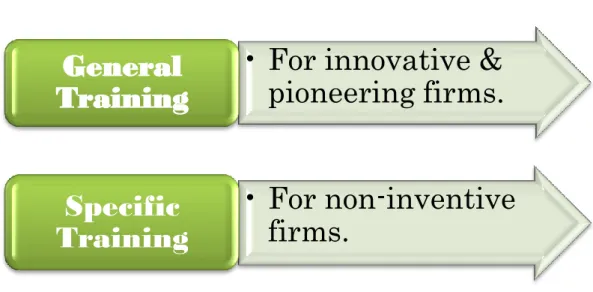
required to accomplish them. All the stakeholders‘ concerned then mutually help each other recognize if the employees have the talents and expertise, and training needs are discussed if the workers do not possess such knowledge or skills. This statement simply means that training programs implemented by organizations have to make sense with regards to the company‘s strategic goals. The training effort should be aligned with the company‘s expectation from each employee in contributing towards the realization of the organization‘s main objectives. More importantly, Loewenstein and Spletzer (1999) clearly document the specificity and generality of company providing training where they emphasize both specific training and general training. In addition, Snell and Dean (1992) found positive relationship among general training which is broad training and the use of advanced manufacturing technology or innovation and specific training with non-innovative firms (Figure 1.1).
Figure 1.1: Types of Training
Adapted from Snell and Dean, 1992
Going back to the identification of training needs discussed earlier, an example of a training needs analysis form in one of the companies in Fiji that employees and their supervisors need to fill out before training is conducted is given on the appendices section (appendices A). The form asks such questions as the skills and knowledge employees need to gain to allow them to do their jobs better as well as the general
• For innovative &
pioneering firms.
General
Training
• For non-inventive
firms.
Specific
Training
6
areas in which training is required for different departments and the objectives to be achieved by the training. Therefore, it is vital that both employee and supervisor fill out the form because it enables the company and the different departments to provide the relevant training that will improve the skills and knowledge of people which will allow them to do their jobs effectively.
1.1.2 Role of Business Strategy and HR Practices
The next analysis is centered on how the administration of HR and strategy literature usually emphasize that human resource management strategies must be coherent with organizational strategy (Fombrun, Tichy, Devanna, 1984; Miles & Snow, 1978). Yet, observed research in corroboration of hypothetical connection is inadequate (Sanz-Valle, Sabater-Sanchez, Aragon-Sanchez, 1999). The Miles and Snow typology used in this present research, nonetheless has been useful in many explorations and investigations linked with organizational business strategy. Shortell & Zajac (1990) already established validity and reliability of the accepted typology by the use of both the business records along with questionnaires answered by senior management teams. Miles and Snow (1978) categorized business entities according to their strategies which are defenders, analyzers, prospectors, and reactors.
Defender Organizations: In this business-type strategy firm, the focus is on a slight merchandise choice and an intended market and functions best in a stable environment. The companies equip their efforts on stability, and efficiency receives top priority. Because their environment changes slowly and focuses on doing the best in its current market, defender firm is able to bank on long term planning. Usually, defender organizations are not in to the development of innovative products as well as markets.
Prospector Organizations: In comparison to defender strategy firms, prospector organizations are more or less outwardly oriented. The firms in this category prosper in changing business surroundings where there is a lot of unpredictability, and they thrive by continuously probing the market in pursuit for new prospects and opportunities. In addition, the firms always strive to bring about innovation and
7
originality to their products, services and markets. Furthermore, they frequently support creativity over efficiency of operations.
Analyzer Organizations: The analyzer organizations have the distinctiveness of both prospector organizations and defender organizations. Analyzer firms are familiar with their interior environments and also exterior environments and try to be both competent which is a defender firms‘ feature and inventive which is the characteristic of a prospector firm. They strive to create a balance and stability amid the agility and creativity of prospectors‘ principles with the competency of defenders‘ philosophy. More emphasis still is on creativity.
Reactor Organizations: The firms do not have a constant strategy or structure and are unprepared for changes they encounter in their business setting. Firms in this category seldom make long-term plans, as they see the surroundings as shifting too rapidly for them. Since organizations under the reactor strategy do not have consistent tactics or procedures of any kind, firms that fall within the reactor category were not included in this present research.
Figure 1.2: Miles & Snow Business Strategy Typology
Adapted from Miles & Snow Typology, 1984
Defender
Prospector
8
So for employee training to be effective and organizational performance to be realized, it is vital that the strategic course of training has to be contingent upon business strategy of the organization. Evidence from some previous researches (e.g., Delery and Doty, 1996; Huselid, 1995; Youndt et al., 1996) have concluded that strategy regulates the HR practice-performance connection. The Miles and Snow's (1984) strategic typology is utilized in this research mainly for rationales expressed by Delery et al. (1996); specifically, the theory is somewhat a powerful indicator of effectiveness. Miles and Snows‘ strategic typology clearly affirmed the theory has inferences for employees and most researches that were done based on SHRM literature have frequently used this typology. For instance, prospector business strategy continuously takes advantage of new products or services and at the same time exploits other market opportunities. Lumpkin and Dess (1996) expressed that prospector strategy are always into innovativeness, where firms are continuously engaged with and sustaining of novel ideas and original processes which possibly might be the outcome of new products.
Flexibility and creativity; as opposed to efficiency becomes the top operational priority for innovators, and employee participation and contribution in the production processes and the procedures involved in the invention stages become significant (Miles and Snow, 1978). Thus for flexible systems which is a prospector firm, it is considered essential for employees to have or be educated in multiple skills, enabling them to carry out the different and variety of tasks when required. By providing a more formal and extensively diverse training program, prospector organizations may benefit by diversifying the skills of their employees which enhances their reaction to any new market opportunities (Richard and Johnson, 2001).
In contrast to prospector strategy firm, a defender firm manufactures a narrow set of products or service aimed at a very small and limited market sector. The organizations gear their efforts towards stability and the goal is to create an established and steady environment. In such organizations, efficiency receives priority and work process is usually repetitive and predictable. Diversity and creativity is less likely to be
9
pleasing and practiced by a firm with a defender business strategy. Milliken and Martins (1996) point out clearly that plain proof exists where diversifying the skills of employees is likely to slow down the groups‘ course of action and group consistency which can interfere with efficiency and organizational performance. All in all, the assumption and proof advocate that a prospector firm will gain more from diversity orientation whereas defenders require a more slick and streamlined operation. Analyzer business strategy, in contrast, carries the features of both a prospector strategy and a defender business strategy with most emphasis on prospector strategy.
In sum, the above literature suggests there are different strategic orientations bearing on a company‘s procedure towards training, and they ought to be consistent with the corporate or business strategy of the company which is dependent to some extent on the nature of the work process involved.
1.2 Structure of Dissertation
The paper is made up of different chapters so that it can address all the essential parts of a research. The first chapter explains the hypothetical matters and background supporting HR training and development along with business strategy. It also clarifies the reasons for opting for the current research and the aim and objectives for carrying out the study. The aims of conducting the research are justified in the course of the selected literature review through the researcher‘s perception.
The second chapter summarizes the literature review in strategic human resource training and development and organizational strategy to show the variety of data that was accessible to researchers who in the past have studied the topic. The chapter provided several insights on theories previous researchers have done on the selected issue. After analyzing the previous literatures, a series of hypothesis was able to be proposed concerning the correlation involving training, business strategies, and business performance.
10
The third chapter explores the research methods and procedures utilized. This chapter explains the proposed research designs that were used and the objectives of the design that was executed. Following a brief section featuring the methodological analysis of this study, the subject of training and development as well as enterprise corporate objectives was explored in a fifty (50) case-study company in Fiji.
For chapter four, the outcomes and results of questionnaires are provided. The questions were analyzed, combined with graphical analysis and calculations which was then followed by critical discussion. These results are discussed with regards to the hypotheses formulated for the purpose of this research. Furthermore, the researcher will be able to conclude whether it is a positive hypothesis or a null hypothesis.
In the fifth chapter, results of the analysis of the research that was created since conducting the study are compared and contrasted with the theories put together by prior researchers of HRM practices. These previous researchers‘ theories are discussed and summarized from the review of literature section. In particular, the results of the current research will be compared with a similar study that was formerly conducted in Spain by Valle, Romero, Martin and Dolan (2000).
In chapter six which is the final chapter, conclusions about the study is presented and the researcher makes some suggestions about the improvements that can be achieved by organizations in Fiji. The researcher also provides the appropriate theoretical elements, which might enlighten management about achieving organizational performance. Finally, some recommendations in terms of strategic training are provided for the organizations in addition to recommendations for further research.
1.3 Summarizing the aim and objectives of the research
In summation, the reason for choosing this research is founded on the current situation which explores an issue of interest to many organizations not only in Fiji but
11
throughout the world. Huge investments in human capital might be the potential basis of competitive advantage as well as positively associated with organizational performance. If organizations are to gain any real benefits from these massive investments, then the appropriate training programs implemented should be associated amid suitable business strategies so that workers maximize their capabilities.
For the following chapter, the literature review of SHRTD with business strategy will be summarized to show the kinds of data which has been accessible to researchers who in the past have studied similar topic. In addition, the next chapter is going to provide more than a few insights on theories earlier researchers have done on the chosen subject. And following the analysis of prior literatures, hypotheses of the present study will be proposed which will be the most important outline and fundamental guideline for conducting the study.
12
2. LITERATURE REVIEW
In the previous chapter, the aims with the objectives of doing this research were explained and the background of topic under study was also highlighted. In this chapter, I am going to discuss about similar studies already carried out and published where researchers have established a range of hypothetical frameworks that have been executed successfully in the investigation of training programs with business strategies and organizational performance. Firstly, I will go through some literatures on strategic human training and development where authors have shared some light in to implementing successful training programs and the reason for implementing such programs. Next, I will look into business strategies implemented by Miles and Snow (1978) and how they are integrated with the training programs. Then, I will be formulating hypothesis for the current study based on the analysis done on similar research previously conducted and published.
2.1 What is strategic HR training and development and why?
The first question that needs to be addressed is why organizations implement training programs? According to Krishnaveni and Sripirabaa (2008), they affirmed that many organizations spend so much of their financial resources for training of their human capital so that the company can accomplish the highest performance and result. They further declared that a well-trained human resource will carry out their job more efficiently and effectively as compared to untrained ones and would therefore reduce the likelihood of making mistakes. So the next question is how can organizations be very sure that training programs will and can bring about maximum performance by the organization? The answer to the question is by putting into action SHRM practices. The term ―strategic human resource management‖ is generally utilized among HR experts to indicate observations that HRM actions and practices should facilitate towards company effectiveness. Schuler and Jackson (1987) in their research highlighted the relationship between HR practices, the requirements of company, and business effectiveness is the central part of strategic HRM. The authors further declared the two fundamental notions of SHRM are firstly; effective HRM insists on an excellent perceptive as well as incorporation with a business strategic objectives,
13
and secondly; effective HRM points to enhanced business performance. This strategic incorporation is essential to offer similarity among business strategy and HR strategy with the aim that human resource reinforces the achievement of the objectives of organizations. For SHRM thinking, the underlying principle is by incorporating HRM among corporate strategy, instead of human resource strategies, workers will be managed rather efficiently, company performance will develop and hence organization will follow (Schuler, 1992).
The introduction of the strategic contingencies perspective in HRM study could be discovered with earlier works that tried to link the subject of strategic management and HRM (Schuler et al., 1987). The initial works in the area of HRM asked the issue if the efficacy of precise human resource practices may be contingent upon the strategic targets of the company which implemented the practice (Miles & Snow 1984, Schuler et al., 1987). The incorporation of HRM in actual fact pushes everybody in the business to take accountability for human resource management practices, and not only the HRM department. This definitely guarantees HRM is given an additional vital point in choices that are made at the strategic level, along with the reminder to decision makers that investing in human resource is an essential organizational policy. This generated the beginning of interest in to the area of researching more about employee training and development.
Human resource development (HRD), one of the many human resource practices has fulfilled the needs of businesses to grant workers with advanced proficiency but also with employers‘ skilled and productive human resource. Torraco and Swanson (1995) mentioned in their study that as a reason fundamental to organizational accomplishment, worker know-how itself has been extended through effective human resource development programs. What they mean is the expansion of the work place proficiency through HRD has been crucial to most favorable organization‘s performance and serves a strategic role by guaranteeing the capability and the potential of workers to meet the firm‘s current performance demand and emergent business strategies. In addition, Edgar and Geare‘s (2005) research established that
14
employee‘s perception on training and development is becoming an increasing significant subject and employers even invest profoundly in this area because they believe it has the maximum possibility to have a say towards the achievement of organizational and business performance. Huselid (1995) and Arthur (1994) mutually in their studies described associations involving human resource and thriving organizational performance and that training and development specifically has been put forward as a fundamental strategic energy in the achievement of competitive advantage and positive organizational outcomes.
As reported by Delery and Doty (1996), in contingency predictions, the connection between the utilization of explicit human resource practices with organizational performance is said to be dependent on a firm's strategy. The firm should execute HR practices like for instance; training and development of human capital to facilitate the workforce behaviors that are in line with the business strategy. Training, as described by Valle et al. (2000) is considered an imperative function in the expansion of working competencies in human resources. Companies therefore will be persistent in looking for training programs that will facilitate in the attainment of goals and objectives that can lead to higher performance (Krieger, Mclinden, and Casper 2004). They noted that a trained employee will make an effort to put additional knowledge in their line of work and strive to improve the entire performance of the organization. This configuration of strategy and HR practices initially proposed by Miles and Snow (1984) permits the business to attain superior organizational performance (Delery et al., 1996). An organization who does a greater work in aligning strategic training and development with business strategy might accomplish superior organizational productivity and maximum outcome and performance.
Ann Bartel (1994) in her research examined statistics on the productivity of 155 American manufacturing firms in the years 1983 and 1986. Bartel calculated productivity through the companies‘ sales for each member of staff. In addition, she had information regarding the percentage of the labor force that was getting proper training during their working careers. Unfortunately, she could not establish any
15
connection linking the implementation of recognized training plans with productivity from only 1986 figures. Nevertheless, the existence of statistics for the year 1983 and 1986 enabled Bartel to come across the outcome with executing training programs. The analysis illustrated that company with lesser productivity in 1983 were most probably to have used training programs between 1983 and 1986. What it means is training was the ideal strategy for companies wanting to elevate their productivity.
Furthermore, Bartel established that the productivity of organizations executing training programs increased by 18% during 1983 until 1986. There were two main lessons gathered from this research which were firstly, training is the favored approach for dealing with a position whenever productivity was inferior as compared to the competitors, and secondly, this strategy has proven to be successful and effective. It is apparent that training enhanced productivity in Bartel‘s research as compared to any other strategy considered. Delery and Doty (1996) also confirmed Bartel‘s findings in that the correlation between the uses of explicit employment practices fitted with the business strategy can bring about organizational productivity and performance.
As a result of positive responses for employee development, organizations spend a lot of their financial resources on training expenses. Yet Katz (1998) highlighted that despite organizations spending billions of dollars on training costs, effective employee learning is not always maximized. Lingham, Richley and Rezania (2006) therefore proposed that for learning to be maximized, the business has to create an exclusive evaluation system for a training program where he puts forward a four-phase approach which are firstly; design of training program; secondly, launch and evaluating the initial program; thirdly, response from participants, and administration of evaluation measures; and finally, continuing training and evaluation. Evaluation of training programs is thus significant for all enterprises and organizations so that real benefits can be gained from those huge investments done by employers.
So the subject matter that needs to be raised here is why organizations want their human capital to be strategically trained and developed? The answer to this question
16
is that HR through strategic training can improve efficiency of the firms‘ operation which will contribute towards business performance in terms of productivity and revenue growth (Huselid, 1995). Dessler (2008) in his book mentioned that an effective HRM practice is able to enhance performance by the use of technology, effective HR practices and by establishing high-performance work systems. Human capital is viewed as both labor and a business function. It has usually been considered as expenditure to be reduced as well as a possible cause of competitive advantage. Hardly ever has HR assessment been seen as a foundation of value creation because labor overheads are always one of the sole major operating costs in numerous firms (Becker & Gerhart, 1996). Dessler however, believes that in the end, the gains created from HR practices outweigh the cost in that well-trained employees perform better than untrained ones. The trained employees, as a result of upgrading their skills, can improve their own individual performance and also the overall performance of the company. This leads the researcher to formulate the first hypothesis:
Hypothesis 1: A human-capital-enhancing human resource system
will be positively linked with organizational performance.
2.2 Integrating HR configuration and Business Strategy
The Miles and Snow's strategic typology is used in most SHRM studies generally for the intentions expressed by Delery and Doty (1996) in which the theory is somewhat a powerful forecaster of effectiveness evident in organizations. Miles and Snow's (1978 & 1984) strategic typology classifies four strategic types: the defender, the analyzer, the prospector, and the reactor (Delery et al., 1996). The defender has a constricted and steady product and market area and hardly ever makes key modifications in its technology or composition. They emphasize more on finding well-organized ways of their production processes and procedures and will try their utmost best to defend their market share against competitors. Prospectors, on the other hand, are portrayed by their continuous hunt for innovative products and markets. They frequently try out with latest product lines and endeavor to new marketplace
17
whenever possible. These organizations are very innovative and the initiators of change in the markets. As such, prospectors are more anxious with penetrating new prospects and will likely not be as efficient as defenders. For analyzers, they have characteristics of both defenders and prospectors and typically function mutually in secure product domains as well as innovative changing product domains.
The strategic differences among the prospector, analyzer, and defender propose that organizations following these alternative strategies must put into practice different employment systems (Delery et al., 1996). Since defender‘s focal point is on efficiency in existing products and markets, rather than innovation or creativity, effective employment practices ought to highlight a long-term loyalty to the firm. It is imperative for the organization to value the knowledge and skills of its labor force. The unique abilities and understanding can be improved through proper training, where the training program tries to educate on learning specific abilities and knowledge attempting for specialization. After training, organizations should then follow and implement appropriate performance assessment and evaluation systems to facilitate human development as compared to temporary outcomes (Delery et al., 1996). These practices, according to Delery and Doty (1996) should generate surroundings which promote long-term dedication to the company and decreases the expenses connected to the substitution of employees, and the knowledge and skills already gained and possessed. The skills and knowledge gained from these training programs will boost the confidence of these employees to do their tasks assertively as they know exactly what is to be done and most importantly, the expectation of the firm on them. Yet, Valle et al. (2000) conclusion from their study illustrates that defender strategy firms appear to adopt an undefined context training strategy with the explanation given by the researchers that with time, defender firms tend to move towards prospector strategy in future hence might change training orientation as well.
In contrast, prospectors are continuously innovating and shifting. Prospectors emphasize on constantly searching into products and markets, where they conventionally have insignificant or no experience at all. Consequently, they will not
18
be able to look inside their current organizations for the necessary skills and will have to hire from the outside to acquire the talent that will keep performance high (Delery et al., 1996). There will be emphasis only on short-term commitment because the organization will be in constant search for innovating processes and procedures of production that will keep evolving within the organization. Since the organization is continuously experimenting new products or service and new marketplace, it will probably progress rapidly to other novel markets if it emerges that there is limited chance for earnings in that region. Therefore, the business will most likely reward employees that are very creative and inventive in their line of work. Valle et al. (2000) again in their research concluded that both prospectors and analyzers adopt a more mechanistic training model where emphasis is on specific skills training.
And this is further substantiated by a few researchers who still query the relation projected amid corporate strategy and HRM policies. Even researchers who agree that business strategy and HRM policies ought to be fitting still have dissimilar outlooks on the kind of policies that is supposed to be in place in order to sustain the diverse organizational strategies. For instance; firms that are inventive and pursue a prospector strategy have got to try their best to employ HR from external sources and markets to boost flexibility and enhance creativity to and for the company (Miles & Snow, 1987; Shortell & Zajac, 1990). These views do agree with the study conducted by Delery et al., (1996) which I have already explained in the previous paragraph.
On the contrary, other authors dispute that organizations which pursue a prospector strategy do not necessarily need to hire experts from outside the organization (Schuler & Jackson, 1987). They require employees within the organization with sufficient job security to be at ease in making mistakes and taking risks because they will learn from committing those errors. As a result, vacant positions in the company should be taken care of by in-house promotions of the established workforce with fresh staff employed at beginning and starting point of employment (Schuler et al. 1987). Firms therefore should provide diversity training programs that will and can bring out the different and multiple skills, abilities and creativity within the employees thus making
19
them more innovative, creative and inventive. So this leads the researcher to formulate the second hypothesis for the current research:
Hypothesis 2: the strategic orientation of training is linked to the
business strategy formulated by the organization.
Added to this hypothesis are the following sub-hypotheses:
H. 2.1 Companies with defenders business strategy will be likely to adopt a mechanical model of training attempting for specialization
H. 2.2 Companies with prospector business strategy will be likely to adopt an organic model of training attempting for diversity
H. 2.3 Companies with an analyzer strategy will be likely to adopt a mixed model of training (mechanistic-organic).
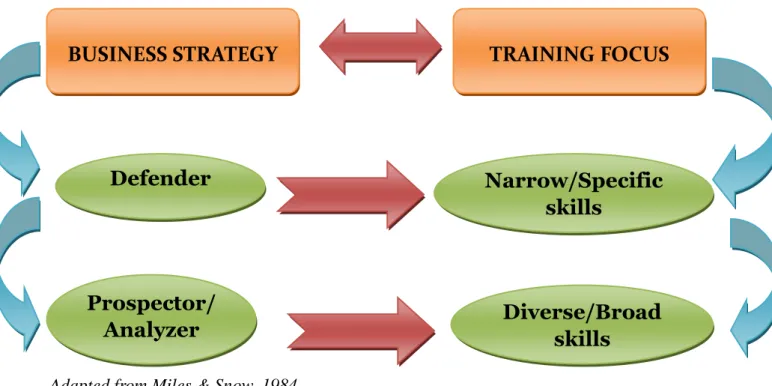
Based on the second hypothesis, figure 2.1 explains how business strategy determines the training focus relevant for the employees. For each alternative strategy, a corresponding training program is given. The training program implemented by the organization to its employees will be coherent with the firm‘s business strategy. For flexible systems it is crucial for employees to have multiple skills that will enable them to perform extensive and diverse work which a wide variety of contingencies may call for; hence job standardization under such flexible system is quite difficult (Valle, Martin, Romero, & Dolan, 2000). A prospector business strategy constitutes a flexible system whereas a defender strategy is more focused-oriented with specific products and stable markets. So the training program that should be instigated in a defender strategy business ought to be specific in nature and focus generally on providing narrow and explicit abilities.
20
Finally, for analyzer strategy businesses, the training focus will be both on imparting specific and narrow skills and also general and multi-skills since its characteristics constitute both the defender and the prospector strategy. Overall, the analyzer firm‘s main training focus is on conveying multiple skills to its employees which is the over-emphasizing of the prospector strategy rather than defender strategy. Due to the continuous changes in the industry‘s surroundings, analyzer strategy firms‘ center of attention is more on innovation and the constant search for new market opportunities rather than concentrating on narrow product line and stable market environment.
Figure 2.1 was adapted from the previous study conducted by Miles and Snow on organizational strategy, structure, and process and the designing of strategic human resource systems. The key word used which is being strategic simply means that organizations should implement calculated HRM practices in support of the accomplishment of business goals and objectives. Simply put, training programs implemented by the companies should be connected with the business strategy.
Figure 2.1: Linking Training Program with Business Strategy
Adapted from Miles & Snow, 1984
BUSINESS STRATEGY
TRAINING FOCUS
Defender
Prospector/
Analyzer
Diverse/Broad
skills
Narrow/Specific
skills
21
Earlier studies suggested some HRM practices through fitting business strategies were correlated to lower worker turnover with high productivity (Arthus,1994) and superior economic performance (Huselid, 1995). Delery and Doty (1996); and Youndt, et al. (1996) have established corporate strategy along with HRM system relations were an imperative aspect in business firms‘ effectiveness. In addition, the author affirms that aligning HR systems together with the organizational strategy can improve business performance; thus they assert that HR conformations together with suitable business strategies have an affirmative outcome on the performance of the organization. For organizational performance to be achieved, it is vital that HR system, and in this case, training program be aligned with the business strategy for maximum benefit.
On the contrary, Becker and Gerhart (1996) not only looked at the impact of HRM on performance but also asked a very important question of whether there is a downside to ‗fit‘. They mentioned that researchers are so captivated by the benefits of the configuration of HR practices, that we should take note of the possible shortcoming of this so-call alignment. Having a tightly coupled system may break down in unforeseen ways which will be hard to come out from, and possibly will not be extremely flexible to amend. Orton & Weick (1990) also agreed with Becker and Gerhart‘s findings. They both suggested that over time, human capital can develop homogenously to some extent since humans are inclined to employ other people just like them. This standardized practice might fit perfectly with a given set of possibilities faced by an organization but any modification in those contingencies may result in a homogeneous business having complexity in adjusting since it lacks diversity in competencies (Becker et al., 1996). In addition, Ragburam and Arvey (1994) noted HR managers must take into account a number of extra factors that can facilitate the effectiveness of training. These factors according to Baldwin and Ford (1988) can range from generating an accommodating environment for transfer of training and a compensation system that is motivating (Balkin & Gomez-Mejia, 1990).
On the other hand, I strongly believe that if the organization has strategically planned their training, then they will not face any difficulties with regards to their HR. This
22
conviction is the result of a few studies previously conducted and supported that has already been mentioned in the analysis of the review of literature (Schuler & Jackson, 1987; Schuler, 1992; Miles & Snow, 1984; Torraco & Swanson, 1995; Edgar & Geare, 2005; Huselid, 1995; Valle, Romero & Dolan, 2000; Delery & Doty, 1996; Arthur, 1994). This means that the training programs implemented should be coherent with its business strategy if the training is to become effective. For instance; if it is a defender organization where the focus is only on few stable products and services, then training programs should concentrate more on educating specialized skills. But if the organizations‘ system is more of innovation, training programs should then focus on diversifying employee skills. Organizations can always adapt their training programs to suit the changes within the organizations‘ systems and procedures.
2.3 Summing up of Literature Review
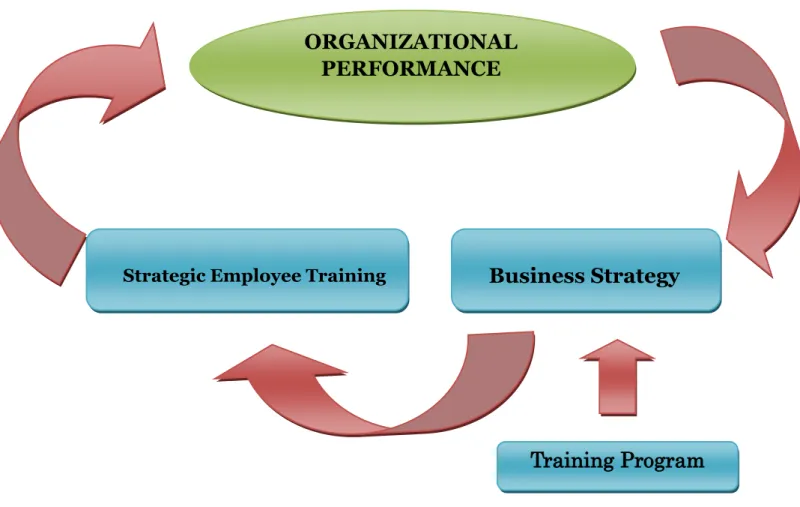
From the evaluation of the literature, I was able to formulate two hypotheses which is the foundation of this study. They are, firstly; organizational performance is contingent upon human resource training and development practices; and secondly; the strategic orientation of training is linked with the corporate strategy formulated by the organization. The problem that has to be tackled with regards to training tactics is how to guarantee the employees are accurately developed to their utmost potential to be aligned with the aims and objectives of the firm. If organizations are able to manage successfully the most important HRM practices of training and development, they ought to retain qualified employees along with the workforce that are motivated to perform and thus able to bring about company efficiency and effectiveness. All things considered, the conceptual framework and the hypotheses generated from the study can be graphically shown as:
23
Figure 2.2: Conceptual Framework
Adapted from Miles & Snow Typology, 1984 & Snell and Dean, 1992
In the next chapter, I will be explaining the research methods and procedures utilized in carrying out the study. The proposed research designs initiated and the objectives of the design implemented will also be explained.
ORGANIZATIONAL
PERFORMANCE
Business Strategy
Strategic Employee Training
24
3. RESEARCH METHODS
In this chapter, I am going to explain the proposed research designs that were implemented in support of the basis of this research and the aims of the design executed. Amaratunga, Baldry, Sarshar, and Newton (2002) pointed out an essential element for defining research is the satisfaction of some conditions. There has to be a systematic examination of a definite problem, logical techniques need to be utilized, sufficient evidence to be collected, conclusions to be drawn without any kind of bias and the researcher should be capable of exhibiting the sensibleness of conclusions whilst the collective results of research yields principles that possibly be used later on.
In research, two essentially diverse and opposing schools of thought have been the base of the philosophers of science and methodologists‘ debate. Firstly, logical positivism employs quantitative as well as experimental method to check hypothetical-deductive generalization (Amaratunga et al., 2002). The major proposition of the stated approach is it requires the formulation of hypothesis with confirmation of the stated theories. Positivism approach looks for underlying clarifications and usually decreases the total to simplest probable fundamentals to assist analysis. Secondly, phenomenological inquiry utilizes qualitative as well as naturalistic approaches to comprehend as a whole human experience in context-specific surroundings (Amaratunga et al., 2002). Since this study has formulated some hypotheses, it then follows the positivism (logical) approach or the quantitative research design to be more specific. The logical approach is designed for the constructing of testable hypothesis and assumption that are general across setting and has to be justified and verified.
This study is framed initially in secondary sources on research already carried in other countries relating to the topic. Because of the limited studies and research conducted on SHRTD in Fiji, I then relied on primary data collected. So in addition to the secondary sources, the positivist method was adopted so that the research questions can be answered successfully. In the current research, questionnaires have been utilized for its completion because it is commonly used by researchers.
25
3.1 The Sample
The total population for the intention of the research is made up of 50 companies located in two major business cities in Fiji with more than 50 employees. Because of the current political upheaval situation in Fiji, I was unable to get the updated list from the relevant authority regarding names of businesses presently operating in the country. So the sampling method utilized in terms of selecting the 50 organizations was through having a personal contact person on any managerial position that I know who works in the company. In addition, the basis for selecting the 50 organizations from the two cities in Fiji is due to the grounds that majority of the companies located in those two cities have been in operation quite successfully for a number of years. This means that they have in their possessions a dynamic workforce either from carrying out some degree of formal training or hiring directly from external sources. Either way, I was confident that training programs were evident in those companies.
Two sets of questionnaires were prepared and sent to the 50 companies; one to the CEO and the other to the HR manager or executives responsible for HR department. The survey questionnaires returned from only 40 companies, where 36 usable responses were evaluated for the study, yielding an overall response rate of 72%. A few follow-up attempts were made to some of the non-responding companies to boost response rate. Of the responding organizations, some engaged in banking and finance, manufacturing, communication and media, government agencies, and the hotel industry. Because the study was more focused on the business strategies implemented by the organizations and how it is linked with the training programs, the sampling method was not focusing on any particular business unit, industry or sector.
3.2 Procedure
Validated questionnaire from the similar study previously conducted in Spain by Valle, Romero and Dolan (2000) was utilized in the current study. The researchers of the study conducted in Spain were really helpful by responding to my email and attaching
26
the questionnaires as well. After receiving the questionnaires, I then asked a colleague to translate the questionnaires from Spanish to English. The two different sets of questionnaires to the HR manager and the CEO were personally delivered with return date of one week being suggested. After a few follow-up attempts to the non-responding companies followed by personal visits, the response rate improved which was then followed by an email thanking the respondents who had taken time to answer the survey questionnaires.
Upon investigation of the questionnaires, I came to the conclusion that four of the questionnaires that were returned do not have any formal training programs provided for employees in the company so the questionnaire was uncompleted. The completed ones were firstly analyzed for the purpose of making sure that all relevant sections in the survey were answered in the approved manner. The data gathered from those questionnaires were then entered in to a computer program SPSS, now called PASW for further analysis.
3.3 Measures
The quantitative approach adopted the survey method using questionnaires that employed a five point Likert Scale and simple multiple choice questions to establish the factors for strategic orientation of training in the firm, the description of the work process and the impact of training on worker performance. The companies selected for the survey were requested to rate each factor on a scale of 1 to 5. In addition, companies were also requested to rate each factor on a scale of 1 to 5 the reasons why they implement training programs in their organizations. Each questionnaire was structured into various sections with various objectives.
3.3.1 Business Strategies
The objective of the questionnaire addressed to top management was to make out the type of business strategy exercised by the organization in position to the Miles and
27
Snow‘s typology (1984). The identification of the business strategy was important because the study was trying to ascertain if there is significant linkage involving the orientations of training programs implemented by the organization with its business strategy being put into practice. The questionnaire for the CEO contains the description of the four different types of organizations which is according to the Miles and Snow typology and how they react to changes in the business surroundings. Respondents were requested to select the descriptions given that exactly match their company. However, they were informed that if none of the description given exactly mirrors their firm, then they were required to decide on any one of the descriptions with similarities or resemblance to theirs. Additionally, they were also informed that none of the described strategies is, per se, ―good‖ or ―bad‖ so they were encouraged to decide on the truthful business strategy that they really follow.
3.3.2 HR training and development configuration
The questionnaire targeted at the HR manager was designed to provide information on the different types of training program present in the company, description of the work processes involved and impacts of such training towards the performance of the worker. The different types of training programs include training for specific skills; training for broad skills; and training for both specific and broad skills. And the descriptions of the work processes include repetitive versus creative work; work centered on short-term versus long-term results; cooperation versus autonomy work; and work with risk-taking decisions versus no risk-taking work. The work process is connected to the business strategy. For example; defender strategy, since emphasis is on narrow production selection, the work process is usually repetitive and autonomous in nature, centered on long-term planning with no risk-taking involved. Prospectors on the other hand have creative and cooperation work process with emphasis on short-term planning and a lot of risk-taking required. This is important because the study is trying to establish the relationship among the orientations of training programs and the business strategy formulated by the companies. Furthermore, it is trying to determine the rationale behind the organization having SHRTD programs and the reasons for wanting to have their HR strategically trained and developed.
28
The dependent variables in the current research concerning the first hypothesis which is regarding the purpose of having SHRTD programs consist of three indicators; organizational performance, technological change and networking. The three indicators was measured on a 5-point Likert scale varying from 1 (strongly disagree) to 5 (strongly agree). In order to identify the likely intention for having strategic employee training in an organization, factorial analysis was carried out. The factor analysis resulted in a single factor which accounted for 59.4% of the variance explained. And the independent variable is the training and development program provided by the organization. Moreover, Chi-square analysis, Cramer‘s V analysis and regression were utilized to evaluate the relative impact of every single variable and to what degree the linking of business strategy have on the implementation of the training programs and the underlying principle of having such strategic connection.
In sum, in order to gather realistic and reasonable information from the selected companies, the choice of questionnaire as a means of collecting data was employed because it allows anonymity and gives chance to people who answer the question to be more honest and to express their opinion more freely without fear of being reprimanded. Compared to an interview approach, which can be time-consuming and costly, questionnaire survey is relatively quick in terms of collecting information and the answers can be collected in a standardized manner, thus questionnaires are more objective, as compared to an interview. Moreover, not having enough published studies conducted in Fiji relating to the area of SHRM practices of any kind in the organizations was also a reason for the use of questionnaire.
3.4 Summing up of Research Analysis
In this chapter, I explained the proposed research designs that were implemented for the justification of the research and also the aims of the design that were implemented. Generally, it followed a logical approach because testable hypotheses were formulated; data collated and analyzed for the purpose of verifying the hypotheses.
29
The current study was framed originally in secondary sources. However, because of the limited research conducted on SHRM in Fiji, I have to rely on primary data which was made possible by the use of the validated questionnaires from the previous study in Spain done by Valle, Romero and Dolan in the year 2000.
So in the next chapter, I will be examining the outcomes of the questionnaire surveys where the questions will be analyzed combined with graphical analysis and critical discussions to follow. The results of the study will be discussed with regards to the hypotheses formulated and to discover if the hypotheses put together were supported after analyzing and evaluating the raw data collated from the surveyed companies.
30
4. DATA ANALYSIS AND DISCUSSION
In the previous chapter, the research methods utilized in the current study was explored. Additionally, the proposed research designs implemented and the objectives of the design used were also justified. In this chapter, a more detailed analysis of the questionnaires will be performed followed by a comprehensive discussion of the data through the utilization of appropriate graphical analysis. These discussions will be on the basis of the hypotheses formulated for the purpose of this research work.
4.1 Analysis of Human-capital-enhancing HR systems
The data for the first hypothesis, a human-capital-enhancing HR system will be positively linked with organizational performance, was first analyzed using the factor analysis. The purpose of factor analysis was to clarify correlations amongst various outcomes as the result of one or more underlying explanations, or factors (Field, 2005). In this case, factor analysis was employed in order to identify a possible reason why organizations wish for their human capital to be strategically trained. The possible dependent variables which are the self-reported subjective measures were organizational performance, technological change and networking. The measurement of business performance in terms of financial operational criteria would have been more reliable (Venkatraman & Ramanujam, 1986). Anyways, the factor analysis resulted in one single factor which accounted for 59.4% of the variance explained.
31
Table 1:
This single factor of organizational performance was the underlying principle why companies want their human capital to be strategically trained (Table 1). The factorial analysis revealed one major factor, which is organizational performance (59.4%), as the motive why organizations want to implement strategic training programs. Although the second factor, technological change accounted for 35.1% of total variance explained, the result of cross-tabulation analysis told a different story (Table 2). Only 44% (16/36 x 100) of the company‘s surveyed stated technological change is the reason for having strategic training as compared to 56% (20/36 x 100) who voted for organizational performance as the underlying principle.
Total Variance Explained
Component
Initial Eigenvalues
Extraction Sums of Squared Loadings
Total % of Variance Cumulative % Total % of Variance 1 1.783 59.425 59.425 1.783 59.425 2 1.055 35.151 94.575 1.055 35.151 3 .163 5.425 100.000
Extraction Method: Principal Component Analysis.
Total Variance Explained
Component Extraction Sums of Squared
Loadings Rotation Sums of Squared Loadings Cumulative % Total % of Variance Cumulative % 1 59.425 1.781 59.355 59.355 2 94.575 1.057 35.221 94.575 3