Journal of Environmental Biotechnology Vol. 9, No. 2, 131–134, 2009
Original paper (short paper)
Polyvinyl alcohol (PVA), a water soluble polymer pre-pared by the hydrolysis of polyvinyl acetate, is widely used in industrial applications, such as adhesives and sizing agent in textiles10). PVA is produced in greater quantities than any other water-soluble synthetic polymer. The world production of PVA is about 650,000 tons per year. PVA is well-known biodegradable polymer but not easily degraded in the envi-ronment. Therefore, the large amount of used and discarded PVA has become a signifi cant waste problem. In previous study, several microorganisms, which can degrade aliphatic polyesters like as poly (hydroxyalkanoate) and poly (ε-caprolactone), are reported2,10,13). In case of PVA, some microorganisms, such as Pseudomonas O-312),
Pseudomo-nas vesicularis PD7), Alcaligenes faecalis5), Bacillus
mega-terium6), and Sphingopyxis sp. PVA314), have been reported as PVA-degrading bacteria. Furthermore, several reports on PVA degradation have dealt with symbiont and the diffi culty of isolating PVA-degrading microorganisms has been pointed out in earlier reports1,3,8,11). One reason may be the diffi culty of isolating a single strain by conventional plate culture methods. This vagueness led us to seek a technique for isolation of individual PVA-degrading microorganisms.
The little information available regarding microbial deg-radation of PVA, despite the large amounts consumed, has made study of its degradation necessary. In the paper, we present the study on the degradation behavior of PVA by an acclimated PVA-degrading microorganism, and responsible
heterogeneous microbial culture involved. Degradation patterns of PVA by the isolated strains are also discussed.
Activated sludge samples were obtained from the waste-water treatment plant. For isolation of PVA-degrading bac-teria form the activated sludge, PVA minimal medium, which contained KH2PO4 (0.4 g/l), K2HPO4 (3.2 g/l), (NH4)2SO4 (1 g/l), MgSO4 (1 g/l), NaCl (0.1 g/l), FeSO4 (10 mg/l), yeast extract (0.05 g/l), and the various concen-tration of PVA (Wako Pure Chemicals, Osaka; degree of polymerization degree: 500), was used. Activated sludge was inoculated into the 0.6% PVA medium and incubated at 30°C with shaking. The concentration of residual PVA was measured by the previously described method with slight modifi cation1). Briefl y, the culture supernatant was diluted to 0.3 ml with distilled water, and then 0.45 ml of 4% boric acid and 90 μl of I2-KI solution were added. Then, the mixture was diluted to a volume of 1.5 ml with distilled water and analyzed at 660 nm to estimate PVA concentra-tion. Cell growth was measured the optical density at 600 nm (OD600). After 6 days of incubation, increasing of cell growth and degradation of PVA were appeared, and almost of all PVA was degraded after 10 days (Fig. 1). To isolate PVA-degrading bacteria, bacterial cells in the culture were collected by centrifugation, resuspended in the distilled water, and spread on the LB agar plates9). After a week of incubation, several colonies were formed. Formed colonies were picked up and grown in the LB liquid medium. Grown
Symbiotic Degradation of Polyvinyl Alcohol by Novosphingobium sp.
and Xanthobacter fl avus.
D
AR
ONG1, 3, K
AORUU
SUI1, T
OMOHIROM
OROHOSHI1*, N
ORIHIROK
ATO2, M
EI-H
UAZ
HOU3,
and T
SUKASAI
KEDA11Department of Material and Environmental Chemistry, Graduate School of Engineering, Utsunomiya University,
7–1–2 Yoto, Utsunomiya, Tochigi 321–8585, Japan
2Department of Advanced Interdisciplinary Sciences, Graduate School of Engineering, Utsunomiya University,
7–1–2 Yoto, Utsunomiya, Tochigi 321–8585, Japan
3College of Environmental Science and Engineering, Dong Hua University, Shanghai 201620, China
* TEL: +81–28–689–6176 FAX: +81–28–689–6176 * E-mail: [email protected] (Received; 18 August, 2009/Accepted; 26 August, 2009)
Polyvinyl alcohol (PVA) must be removed from the waste water before discharge. In this study, we isolated some bacteria from the activated sludge. One of them, Novosphingobium sp. strain P7, could degrade PVA in the minimal medium supplied
with methionine. We also isolated Xanthobacter fl avus strain B2, which did not have PVA-degrading activity. Co-culture of
strain P7 and B2 could degrade PVA without supplying the methionine. It seems likely that strain B2 supplied methionine for the growth of strain P7, which led to the degradation of PVA.
RONGet al. 132
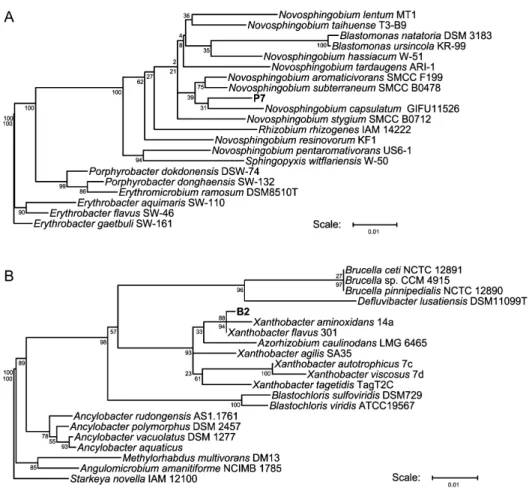
cells were collected, washed twice with distilled water, and transferred to the 1.2% PVA medium. After a week of incu-bation, the concentration of the residual PVA was estimated. One of these isolates, designed strain P7, slightly degraded PVA (Fig. 2A). To identify the bacterial species, almost 16S rRNA gene was amplifi ed by PCR using previously described primers, 63f (5’-CAGGCCTAACACATGCAAGTC-3’) and 1387r (5’-GGGCGGTGTGTACAAGGC-3’)4). Sequencing was performed using BigDye Terminator ver. 3.1 and ABI Prism 3100 Genetic Analyzer (Applied Biosystems, Foster City, CA). 16S rRNA sequence of strain P7 was compared with those from the other type strains using the Ribosomal Database Project (http://rdp.cme.msu.edu/index.jsp1). As the results, the 16S rRNA gene sequence of strain P7 showed high similarity to that of Novosphingobium capsu-latum GIFU11526 (Fig. 3A). Cells of strain P7 were
yellow-pigmented and rod-shaped bacteria (data not shown). These features supported that strain P7 was a member of genus
Novosphingobium (Sphingomonas). The nucleotide sequence
of the 16S rRNA gene from the strain P7 has been deposited in DDBJ/EMBL/GenBank databases under accession no. AB512109.
Although strain P7 showed obvious PVA-degrading activity, growth and PVA degradation of strain P7 in PVA medium were limited compared with that of activated sludge (Fig. 2A). It was considerable that strain P7 received some growth factors or coenzymes for degradation of PVA from the other bacteria. To identify the co-factor for PVA degra-dation by strain P7, the modifi ed PVA medium (M-PVA medium), which did not contain yeast extract but trace metals, was used. First, strain P7 was inoculated into the M-PVA medium containing 0.1% glucose as a sole carbon source. However, cell growth was not observed after a week of incubation (data not shown). This feature showed that strain P7 requires the growth factor, which was not present in the M-PVA medium. Therefore, we added various nutrients to the M-PVA medium. When the 0.8% M-PVA medium was supplied with 0.1% peptone, PVA was degraded com-pletely by strain P7 after a week of incubation (Fig. 2B). Thus, each of twenty kinds of amino acids, which were main components of peptone, was added to the M-PVA medium at the fi nal concentration of 0.01%. One of twenty amino acids, only addition of methionine induced the growth and PVA degradation of strain P7 (Fig. 2B). Strain P7 could also grow in the M-PVA medium containing 0.1% glucose and 0.01% methionine (data not shown). These results showed that methionine worked as the growth factor for strain P7. Large number of PVA-degrading bacteria required exogenous pyrroloquinoline quinone (PQQ) as a coenzyme for PVA-degrading enzyme. However, strain P7 did not require supply of PQQ externally. It was assumed that strain P7 produced PQQ by itself or had PQQ-independent enzymes for PVA degradation.
Strain P7 did not grow and degrade PVA in the M-PVA medium, but did in the activated sludge. It was assumed
Fig. 2. Degradation of PVA in the PVA minimal medium by strain P7 and activated sludge.
(A) Strain P7 or activated sludge was inoculated into the 1.2% PVA medium. (B) Strain P7 was inoculated into 0.8% M-PVA medium with or without 0.1% peptone (Pep) and 0.01% methionine (Met). Bacterial cultures were incubated with shaking at 30°C and residual PVA concentration was measured after a week of incubation by the method described in context.
Fig. 1. PVA concentration and bacterial growth in the PVA medium. The microorganisms from activated sludge were inoculated into 0.6% PVA medium and incubated with shaking at 30°C. Residual PVA concentration (closed squares) and cell growth (open squares) were measured by the method described in context.
133
Symbiotic degradation of PVA
that the putative symbiotic bacteria might support growth of strain P7 and degradation of PVA by strain P7. To iden-tify the symbiotic bacteria from the activated sludge, PVA-degrading activated sludge were diluted and spread on LB agar plates. After forming colonies, eight isolates and strain P7 were grown in the LB medium. Bacterial cells were collected from 1 ml cultures by centrifugation, and washed and resuspended with distilled water. The cell suspensions of strain P7 and each isolates were co-inoculated into 1.2% M-PVA medium. After a week of incubation, only co-culture of strain P7 with one isolate named strain B2 could degrade PVA was almost completely (Fig. 4). Interest-ingly, strain B2 could not degrade PVA by itself with or without the amino acids (data not shown). To identify the bacterial strain of B2, 16S rRNA sequence of strain B2 was compared with those from the other type strains. As the results, the 16S rRNA gene sequence of strain B2 showed high similarity to that of Xanthobacter fl avus 301
(Fig. 3B). The nucleotide sequence of the 16S rRNA gene from the strain B2 has been deposited in DDBJ/EMBL/ GenBank databases under accession no. AB512110. Strain P7 requires the supply of methionine, but did not either PQQ or the other exogenous co-factors. Thus, it was assumed that PVA was degraded by these two strains, in which strain B2 produced a growth factor and strain P7 utilized this
growth factor for PVA degradation. Previously reported PVA-degrading Sphingomonas sp., which related to strain P7,
was also required PQQ and supplied PQQ with surrounding symbiotic bacteria1). Our study demonstrated the new type symbiotic degradation of PVA by strain P7 and B2.
Fig. 3. Neighbor-joining trees of the 16S rRNA gene sequences.
PVA-degrading strain P7 (A) and its symbiotic strain B2 (B) were isolated from activated sludge. Bacterial isolates in this study were shown by bold style. The scale bar represented 0.01 substitutions per nucleotide position. Bootstrap values (from 100 replicates) were in-dicated at the nodes.
Fig. 4. Degradation of PVA in pure and mixed cultures of strain P7 and B2.
Bacterial strains were inoculated into 1.2% M-PVA medium and incubated with shaking at 30°C. After a week of incuba-tion, residual PVA concentration was measured by the method described in context.
RONGet al. 134
Acknowledgements
We thank Dr. Masayoshi Kojima (Fuji Film Co., Ltd.) for providing us with activated sludge sample and technical as-sistance.
References
1) Kim, B.C., C.K. Sohn, S.K. Lim, J.W. Lee, and W. Park. 2003. Degradation of polyvinyl alcohol by Sphingomonas sp. SA3
and its symbiote. J. Ind. Microbiol. Biotechnol. 30: 70-74. 2) Kim, D.Y., and Y. H. Rhee. 2003. Biodegradation of microbial
and synthetic polyesters by fungi. Appl. Microbiol. Biotechnol., 61: 300–308.
3) Lee, J.A. and M.N. Kim. 2003. Isolation of new and potent poly (vinyl alcohol)-degrading strains and their degradation activity. Polym. Degrad. Stab. 81: 303-308.
4) Marchesi, J.R., T. Sato, A.J. Weightman, T.A. Martin, J.C. Fry, S.J. Hiom, D. Dymock, and W.G. Wade. 1998. Design and evaluation of useful bacterium-specifi c PCR primers that amplify genes coding for bacterial 16S rRNA. Appl. Environ. Microbiol. 64: 795-799.
5) Matsumura, S., N. Tomizawa, A. Toki, K. Nishikawa, and K. Toshima. 1994. Eff ect of molecular-weight and stereoregularity on degradation of poly (vinyl alcohol) by Alcaligenes faecalis.
Biotechnol. Lett. 16: 1205-1210.
6) Mori, T., M. Sakimoto, T. Kagi, and T. Sakai. 1996. Isolation and characterization of a strain of Bacillus megaterium that
degrades poly (vinyl alcohol). Biosci. Biotechnol. Biochem. 60:
330-332.
7) Sakai, K., M. Fukuba, Y. Hasui, K. Moriyoshi, T. Ohmoto, T. Fujita, and T. Ohe. 1998. Purifi cation and characterization of an esterase involved in poly (vinyl alcohol) degradation by
Pseudomonas vesicularis PD. Biosci. Biotechnol. Biochem.
62: 2000-2007.
8) Sakazawa, C., M. Shimao, Y. Taniguchi, and N. Kato. 1981. Symbiotic utilization of polyvinyl alcohol by mixed cultures. Appl. Environ. Microbiol. 41: 261-267.
9) Sambrook, J., E.F. Fritsch, and T. Maniatis. 1989. Molecular cloning: a laboratory manual, 2nd ed. Cold Spring Harbor Laboratory Press, NY.
10) Shimao, M. 2001. Biodegradation of plastics. Curr. Opin. Bio-technol. 12: 242–247.
11) Shimao, M., K. Ninomiya, O. Kuno, N. Kato, and C. Sakazawa. 1986. Existence of novel enzyme, pyrroloquinoline quinone-dependent polyvinyl alcohol dehydrogenase, in a bacterial symbiont, Pseudomonas sp. strain VM15C. Appl. Environ.
Microbiol. 51: 268-275.
12) Suzuki, T., Y. Ichihara, M. Yamada, and K. Tonomura. 1973. Some characteristics of Pseudomonas O-3 which utilizes
polyvinyl alcohol. Agric. Biol. Chem. 37: 747-756.
13) Tokiwa,Y and P. Calabia. 2007. Biodegradability and Biodeg-radation of polyesters. J. Polym. Environ. 15: 259-267. 14) Yamatsu, A, R. Matsumi, H. Atomi, and T. Imanaka. 2006.
Isolation and characterization of a novel poly (vinyl alcohol)-degrading bacterium, Sphingopyxis sp. PVA3. Appl.