Effects of Eicosapentaenoic Acid on Growth and
Fatty Acid Composition of the Prawn, Penaeus
japonicus
著者
KANAZAWA Akio, TESHIMA Shin-ichi, ENDO Minoru,
KAYAMA Mitsu
journal or
publication title
鹿児島大学水産学部紀要=Memoirs of Faculty of
Fisheries Kagoshima University
volume
27
number
1
page range
35-40
別言語のタイトル
クルマエビにおけるエイコサペンタエン酸の成長お
よび脂肪酸組成に及ぼす影響
URL
http://hdl.handle.net/10232/13109
Vol. 27, No. 1, pp. 35—40 (1978)
Effects of Eicosapentaenoic Acid on Growth
and Fatty Acid Composition of the Prawn,
Penaeus japonicus
Akio Kanazawa*1, Shin-ichi Teshima*1, Minora Endo*1
and Mitsu Kayama*2
Abstract
In the present study, the effects of eicosapentaenoic acid (20: 5<»3) on growth and fatty acid composition of the prawn, Penaeus japonicus, were investigated and compar ed with those of linoleic (18: 2<y6), linolenic (18: 3o>3), and docosahexaenoic (22: 6o)3) acids. Six groups of the prawns were maintained on the diets containing lipids as mentioned bellow: 1, 5 % oleic acid (18: ley9) alone; 2, ±% 18: \g>9 + \96 18: 2 o>6; 3, 4 96 18: lo9+l# 18: 3o>3; 4, 4 % 18: lo)9+1^20: 5<y3; 5,4^ 18: 1g>9+1^ 22: 6ca3; 6, lipid free.
The highest weight gain and survival rate were attained in the group of prawns fed the diet containing 4^ 18: lo>9 + l ^ 20: 5o>3. The prawns receiving the diets with 18: 2o)6 or 18: 3o)3 revealed lower weight gains and survival rates than those receiving 20: 5o)3 or 22: 6o>3. The supplementation of either 1% 20: 5o) 3 or 22: 6o)3 to the diet containing 4 % 18: lo)9 resulted in the increase of the proportion of o)3 fatty acids such as 20: 5o)3 and 22: 6o)3 in the body of prawns. These data suggest that 20: 5o)3 and/or 22: 6o)3 possess higher activity as essential fatty acids in the prawn, P. japonicus, than 18: 2o>6 and 18: 3o)3.
Linoleic acid (18: 2a>6) is an important essential fatty acid (EFA) for mam mals, and it is converted in vivo to arachidonic acid (20: 4o>6) exerting more high EFA activity. However, recent investigations on the nutritional studies of lipids have shown that fatty acids of the linolenic family (ca3) are more impor tant for fish1"50 and Crustaceans4~8) than those of the linoleic family (o>6). Also Watanabe et alP have reported that the carp, Cyprinus carpio, requires both
18: 2 o)6 and linolenic acid (18: 3o>3). Recent studies on EFA in aquatic animals were reviewed by Takeuchi10), Yone12), and Teshima12>, and it has been suggest ed that EFA requirements of aquatic animals probably vary with species.
Previously, we have shown that growth of prawn, Penaeus japonicus, was im proved by the supplementation of 18: 3o>3 to the diets containing oleic acid (18
: lo>9) as a sole lipid source" and other lipids150 such as pollack residual oil
** Faculty of Fisheries, University of Kagoshima, Kagoshima, Japan.
36 Mem. Fac. Fish., Kagoshima Univ. Vol. 27, No. 1 (1978)
(PRO) and short-necked clam lipids. In the case of the prawn, P. japonicus, a high weight gain is generally attained when PRO and short-necked clam lipids, containing o>3 highly unsaturated fatty acids (HUFA), were used as a lipid source. Therefore, we suspect that the o>3 series of HUFA such as eicosapen taenoic acid (20: 5a)3) and docosahexaenoic acid (22: 6o>3) probably possess higher activity as EFA in the prawn rather than 18: 3o>3 and 18: 2co6, because the prawn, P. japonicus, converts 18: 3o>3 to 20: 5a>3 and 22: 6a>3.
The purpose of the present study is to examine the effects of dietary 20: 5o>3 on growth and fatty acid composition of the prawn, P. japonicus.
Materials and Methods
Prawn and feeding methods The prawn, P. japonicus, was obtained from the Fisheries Research Laboratory, Faculty of Fisheries, Kagoshima University, and maintained on a commercial diet for prawn (Ebian, Kyowahakko Co., Japan) un til use. Twenty prawns, weighing 0.5g in average body weight, were placed in each tank (30 liters) and fed the diets (see Table 1) for 65 days by the sim ilar feeding method to that described previously14>.
Diets The basal diet (diet No. 6, lipid free) was the same as reported pre viously" and composed of the following ingredients: casein (milk casein, lipid and vitamin free) 50. 0 g, glucose 5. 5 g, starch 4. 0 g, glucosamine hydrochloride 0. 8 g, sucrose 10. 0 g, sodium citrate 0. 3 g, sodium succinate 0. 3 g, minerals 8. 6 g, vitamins 2. 7g, cholesterol 0. 5g, cellulose powder 9. 3g, agar 3. Og, and distilled water 130-135 ml. The test diets (diets No. 1 to No. 5) were prepared by adding 5 % levels of lipids to the basal diet as shown in Table 1.
Fatty acids used The 18: 2co6 and 18: 3a>3 were obtained from Sigma Chemi cal Co. and their purities were about 98-99^ by gas-liquid chromatography
(GLC) on 10^ DEGS. The 20: 5o>3 and 22: 6o>3 were prepared from the squid
Table 1. Effects of dietary lipids on growth, survival, and lipid content of the prawn, P. japonicus Diet No. Dietary lipid Feeding Number period of prawns (days) used
Survival Weight Lipid rate gain content
(96) (96) (96)*1 Neutral lipid (96)*' Polar lipid (96)*" 1 5^18: lo>9 65 20 65 43. 6 1.13 28.3 71.7 2 4^18: la>9+ 1#18: 2 o>6 65 20 70 82.1 1.37 27.5 72.5 3 4^18: la>9+ l#18: 3 o>3 65 20 80 97. 4 1. 44 28.7 71.3 4 4^18: 1©9+ 15&20: 5 co3 65 20 90 141 1.32 25.3 74.7 5 4^18: 1©9+ 1^22: 6 cw3 65 20 85 130 1.42 25.5 74.5 6 Lipid free 65 20 70 39.8 1.16 29.1 70.9
After feeding trials, lipids were extracted from the whole body of prawns. Lipid content was expressed as % of fresh weight.
liver oil according to the method of Teshima et al.1B\ After saponification of squid liver oil, the fatty acids so obtained were methylated with Z% (w/v) HCl-methanol and then chromatographed on 5 % (w/w) AgNOs-silicic acid with hexane, hexane-ether, and hexane-ether-acetic acid. Since the 20: 5o>3 and 22: 6o)3 fractions so obtained contained small amounts of unknown polar subs tance (s) as impurities, they were respectively purified by using column chromato graphy on Kieselgel 60 with petroleum ether-ether (95: 5,v/v). The resultant 20
: 5 o)3 and 22: 6o)3 methylesters had the 95-96^ purities by GLC. As to 20: 5 o)3 methylester, the purity was further checked by nuclear magnetic resonance spectrometry (chemical shifts are given in d ) ; 0.95-1.10 (3H, triplet, methyl CH3-CH2-CH=CH-), 1.65-1.85 (2H, quartet, methylene CH3-CH2-CH=), 2.0-2.5 (6H complex signals, methylene =CH-CH2-CH2-CH2-COOCH3), 2.86 (8H, methylene =CH -CH2-CH=), 3.68 (3H, singlet, methyl CH3-0-CO-), and 5.50 (10H, methin -CH= CH-). The hydrolysis of 20: 5o)3 and 22: 6o)3 methylesters with 10^ KOH in methanol gave 20: 5o)3 and 22: 6o)3, respectively.
Fatty acid composition After the feeding trials, lipids were extracted with chloroform-methanol-water (2: 2: 1, v/v)16) from the whole body of prawns and separated into neutral and polar lipid fractions by thin-layer chromatography (TLC) on Kieselgel G with ether-benzene-ethanol-acetic acid (40: 50: 2: 0.2, v/v)8). The fatty acid composition of each lipid fraction was determined by GLC on 10^ DEGS (3mx4mm i. d., column temperature 190°C)17).
Results and Discussion
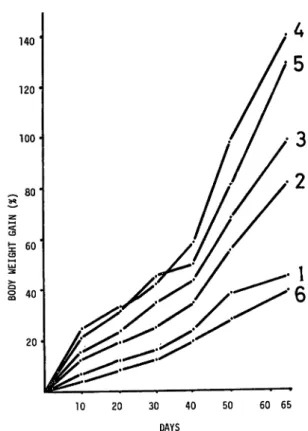
In the present study, the effects of 20: 5o>3 on growth and fatty acid compo sition of the prawn, P. japonicus, were investigated and the results were com pared with those of 18: 2o)6, 18: 3o>3, and 22: 6o>3. The weight gain was low in the groups of prawns maintained on the diets free from co6 and o>3 fatty acids (diets No. 1 and No. 6) (Fig. 1). The addition of \% 18: 2o)6 (diet No. 2) or
\% 18: 3 o)3 (diet No. 3) to A96 18: lo) 9 improved the weight gain and survival
rate of prawns as observed in the previous studies". However, the highest weight gain and survival rate were attained when the diet contained 4 % 18: lo)9-f-l^ 20: 5o)3 (diet No. 4) as a lipid source, and the diet No. 5 containing
±% 18: 1 co9-\-l96 22: 6o)3 followed to this. The results of feeding trials suggest that the o)3 HUFA such as 20: 5o)3 and 22: 6o)3 are more important as EFA for the prawn, P. japonicus, rather than 18: 2o)6 and 18: 3o)3.
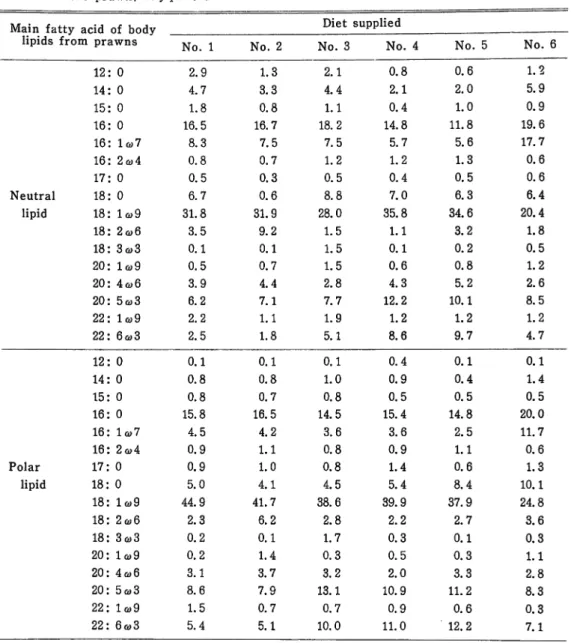
The difference in the dietary lipids resulted in the variation of lipid content and fatty acid composition of prawn, P. japonicus, as shown in Tables 1 and 2. The lipid content (% of fresh weight) was higher in the groups of prawns fed the diets containing 0)6 and 0)3 fatty acids (diets No. 2, 3, 4, and 5), than in those fed the diets containing 18: lo)9 and free from lipids. Also, the propor tion of polar lipids to total lipids seemed to be high in the prawns received 20:
38 Mem. Fac. Fish., Kagoshima Univ. Vol. 27, No. 1 (1978)
60 65
Fig. 1. Growth of the prawns fed the diets containing several fatty acids
The diets (1 to 6) contained the following fatty acids as lipid sources: 1, 5^18: 1g>9; 2, 4^18: 1g>9+1^18: 2o>6; 3, 4^18: lo>9+l $18: 3o>3; 4, 4^18: lo>9+1^20: 5<»3; 5. 4^18: 1^9+1^22: 6o>3; 6, lipid free.
5 0)3 or 22: 6o)3. Table 2 shows the percentage composition of fatty acids in
the polar and neutral lipids from the whole body of prawns after the feeding
trials. The supplementation of ©3 fatty acids such as 18: 3o>3 (diet No. 3), 20:
5 o)3 (diet No. 4), and 22: 6o)3 (diet No. 5) resulted in the marked increase in
the proportions of 20: 5o) 3 and 22: 6o)3 in the polar lipids.
As to the neutral
lipids, the supplementation of 20: 5o>3 and 22: 6o)3 also brought about the ele
vation of proportions of 20: 5o>3 and 22: 6o>3, whereas that of 18: 3o)3 increase
only the proportion of 22: 6o)3. Except for the increase in the proportion of
18: 2 o)6, the supplementation of 18: 2o)6 (diet No. 2) did not cause noticeable
variation in the fatty acid composition of both neutral and polar lipids.
In our previous studies, the prawn, P. japonicus, has been shown to be inca
pable of synthesizing 18: 2o)6, 18: 3o)3, and HUFA such as 20: 5o>3 and 22: 6o)3
from acetic acid-14C18) and palmitic acid (16: 0)-14C19>, but capable of converting
Table 2. Effects of dietary lipids on the fatty acid composition (96) of body lipids in the prawn, P. japonicus
Main fatty acid of body from prawns
Diet supplied lipids
No. 1 No. 2 No. 3 No. <i No. 5 No. 6
12: 0 2.9 1.3 2.1 0.8 0.6 1.2 14: 0 4.7 3.3 4.4 2.1 2.0 5.9 15: 0 1.8 0.8 1.1 0.4 1.0 0.9 16: 0 16.5 16.7 18.2 14.8 11.8 19.6 16: 1©7 8.3 7.5 7.5 5.7 5.6 17.7 16: 2g>4 0.8 0.7 1.2 1.2 1.3 0.6 17: 0 0.5 0.3 0.5 0.4 0.5 0.6 Neutral 18: 0 6.7 0.6 8.8 7.0 6.3 6.4 lipid 18: 1©9 31.8 31.9 28.0 35.8 34.6 20.4 18: 2g>6 3.5 9.2 1.5 1.1 3.2 1.8 18: 3a>3 0.1 0.1 1.5 0.1 0.2 0.5 20: l©9 0.5 0.7 1.5 0.6 0.8 1.2 20: 4o)6 3.9 4.4 2.8 4.3 5.2 2.6 20: 5o>3 6.2 7.1 7.7 12.2 10.1 8.5 22: lo)9 2.2 1.1 1.9 1.2 1.2 1.2 22: 6 ct>3 2.5 1.8 5.1 8.6 9.7 4.7 12: 0 0.1 0.1 0.1 0.4 0.1 0.1 14: 0 0.8 0.8 1.0 0.9 0.4 1.4 15: 0 0.8 0.7 0.8 0.5 0.5 0.5 16: 0 15.8 16.5 14.5 15.4 14.8 20.0 16: la>7 4.5 4.2 3.6 3.6 2.5 11.7 16: 2o>4 0.9 1.1 0.8 0.9 1.1 0.6 Polar 17: 0 0.9 1.0 0.8 1.4 0.6 1.3 lipid 18: 0 5.0 4.1 4.5 5.4 8.4 10.1 18: lo>9 44.9 41.7 38.6 39.9 37.9 24.8 18: 2o>6 2.3 6.2 2.8 2.2 2.7 3.6 18: 3o>3 0.2 0.1 1.7 0.3 0.1 0.3 20: l©9 0.2 1.4 0.3 0.5 0.3 1.1 20: 4&)6 3.1 3.7 3.2 2.0 3.3 2.8 20: 5o>3 8.6 7.9 13.1 10.9 11.2 8.3 22: lo)9 1.5 0.7 0.7 0.9 0.6 0.3 22: 6 o>3 5.4 5.1 10.0 11.0 12.2 7.1
have suggested that crustaceans such as the prawn, P. japonicus, probably re quires EFA for their normal growth. In fact, the feeding trials have shown that the addition of 18: 2 a)6 and/or 18: 3a)3 to the diets improved the weight gain of prawn, P. japonicus7-u). Shebart and Mies5> also have reported the growth-promoting effect of 18: 3o)3 for Penaeus aztecus. The results of the present study showed that the weight gain and survival rate of the prawns receiving either 18: 2 a)6 or 18: 3 a)3 were inferior to those of the prawns receiving 20: 5
40 Mem. Fac. Fish., Kagoshima Univ. Vol. 27, No. 1 (1978)
co3 or 22: 6<o3. Therefore, it is likely that 20: 5a)3 and 22: 6co3 play an impor tant role as EFA in the prawn, P. japonicus, more than 18: 2a)6 and 18: 3o)3.
Acknowledgements
The authors wish to thank Kyowa Hakko Kogyo Co., Ltd. and Riken Vitamin Oil Co., Ltd., for supplying commercial diet of prawn and squid liver oil, respec tively. We are also grateful to the Fisheries Research Laboratory, Faculty of Fisheries, Kagoshima University, for supplying the prawns.
References 1) Watanabe, T. (1975): Kagaku to Seibutsu, 13, 289-291.
2) Fujii, M., H. Nakayama, and Y. Yone (1976) : Rep. Fish. Res. Lab., Kyushu Univ., 3, 65-86.
3) Cowey, C. B. and J. R. Sargent (1977): Comp. Biochem. Physiol, 57 B, 269-274.
4) Sick, L. V. and J. W. Andrews (1973) : Proc. World Maricult. Soc. 4th Annual Workshop., 263-276.
5) Shewbart, K. L. and W. L. Mies (1973) : Proc. World Maricult. Soc. 4th Annual Workshop., 277-287.
6) New, M. B. (1976) : Aquaculture, 9, 101-144.
7) Kanazawa, A., S. Tokiwa, M. Kayama, and M. Hirata (1977) : Bull. Japan. Soc. Sci.
Fish., 43, 1111-1114.
8) Kanazawa, A., S. Teshima, and S. Tokiwa (1977): Bull. Japan. Soc. Sci. Fish., 43, 849-856.
9) Watanabe, T., T. Takeuchi, and C. Ogino (1975) : Bull. Japan. Soc. Sci. Fish., 41, 263-269.
10) Takeuchi, T. (1978): in "Yogyo to Shiryo-Shishitsu" (ed. by Japan Soc. Set. Fish.), Sui-sangaku Series No. 22, Koseisha Koseikaku, Japan, pp. 23-42.
11) Yone, Y. (1978): in "Yogyo to Shiryo-Shishitsu" (ed. by Japan Soc. Sci. Fish.), Suisan-gaku Series No. 22, Koseisha Koseikaku, Japan, pp. 43-59.
12) Teshima, S. (1978): in aYogyo to Shiryo-Shishitsu" (ed. by Japan Soc. Sci. Fish.), Sui-sangaku Series No. 22, Koseisha Koseikaku, Japan, pp. 60-77.
13) Kanazawa, A., S. Teshima, S. Tokiwa, and H. J. Ceccaldi: Oceanologica Acta, in
press.
14) Kanazawa, A., M. Shimaya, M. Kawasaki, and K. Kashiwada (1970): Bull Japan.
Soc. Sci. Fish., 36, 949-954.
15) Teshima, S., A. Kanazawa, and S. Tokiwa (1978): Bull Japan. Soc. Sci, Fish., 44, 927.
16) Bligh, E. G. and W. J. Dyer (1959) : Can. J. Biochem. Physiol, 37, 911-917.
17) Teshima, S., A. Kanazawa, and H. Okamoto (1976) : Mem. Fac. Fish., Kagoshima Univ., 25, 41-46.
18) Kanazawa, A. and S. Teshima (1977) : Mem. Fac. Fish., Kagoshima Univ., 26, 49-53. 19) Kanazawa, A., S. Teshima, and S. Tokiwa (1977): Spring Meeting of Japan. Soc. Sci.