EXISTENCE AND STABILITY OF A TRAVELING WAVE SOLUTION ON A
3-COMPONENT
REACTION-DIFFUSION
MODEL IN COMBUSTION
KOTA IKEDA ANDMASAYASU MIMURA
1. INTRODUCTION
It is shown in [8] that thin solid, for an example, paper, cellulose dialysis bags and polyethylene sheets, buming against oxidizing wind develops finger-like patterns or fingering patterns. The oxidizing $gtL\backslash$ is
supplied in a uniformlaminar flow, opposite to the directions of the front propagation and they control the flowvelocityof
oxygen,
denotedby $V$.
When$V$isdecreased belowacritical value, thesmoothfront developsa structurewhich marks the onsetofinstability. As $V$ isdecrea.sed further, the peaks
are
separated bycusp-like minima and a fingering pattern is formed. In addition, thin solid is stretched out straight onto the bottom plate and they also control the adjustable vertical gap, denoted by aparameter $h$, between top and
bottom plates. We remark here that fingering patterns occur for small $h$, which implies that such patterns
appearin the absence ofnatural convection. Similar phenomena have been also observed in
a
micro-gravity experiment in space (see [5]).To investigate these phenomena, a reaction-diffusion model (RD) $w:\backslash propcx\backslash ed$ in [2]. We carried out
numerical simulations, reproducing similar results to the experiment described above. If the effect of the flow (denoted by $\lambda$ in (RD)) is strong, aflame front is smooth. Decreasing$\lambda$ raises the destabilization of the smooth flame front. Eventually, fingering pattern
occurs
in small $\lambda>0$.
Our model (RD) is represented as follows:
$(RD)$ $\{\begin{array}{l}\frac{\partial u}{\partial t}=Le\Delta u+\lambda’\frac{\partial u}{\partial x}+\gamma k(u)vw-au,\frac{\partial v}{\partial t}=-k(u)vtlJ,\frac{\partial_{tl\prime}}{\partial t}=\Delta_{8l\prime}+\lambda\frac{\partial_{ll)}}{\partial x}-k(u)vw,\end{array}$ $(x,y)\in(-\infty, \infty)\cross\zeta l,$$t>0$,
where the constants $Le$, called Lewis number, $\gamma$ and $a$
are
positive constants,$\lambda$ and $\lambda’$
are
nonnegativeconstants, $\zeta l\subset \mathbb{R}^{\iota}$ is a bounded domain, and $\Delta=\partial^{2}’\partial x^{2}+\sum_{i=1}^{l}\partial^{2}’\partial r/^{2}|$ is Laplacian
as
usual. Thenonlinear term $k$ is defined by
$k(u)=\{\begin{array}{ll}A \exp(-B/(tl-\theta)), u>\theta,0, 0\leq u\leq\theta\end{array}$
for some constants $A,$$B>0$ and $\theta\geq 0$. This function $k$ and $\theta$ are called Arrhenius kinetics and ignition temperature incombustion. Note that we considered a general setting for the nonlinear function $k$ in [2] and
[3].
We suppose that
$\lim u(x,y, t)=0$, $\lim_{xarrow\infty}\tau n(x,y,t)=tl_{r}’>0$, $\lim_{xarrow-\infty}w(x,y,t)=\tau n_{l}\geq 0$ $|x|arrow\infty$
for any $y\in\zeta l$ and$t>0$, where $\tau n_{r}$ and $\tau n_{\iota}$
are
$C0IL\backslash tant\backslash$ and $tlJ_{r}>tl$)$1$.
We also$f^{\backslash },tlppo_{\iota}\backslash \backslash e$ that $u$ and$w$ satisfy $\frac{\partial u}{\partial\nu}(x,y,t)=0$, $\frac{\partial_{ll)}}{\partial\nu}(x,y,t)=0$for $x\in(-\infty, \infty),$ $y\in\partial\zeta]$ and $t>0$, where $\nu$ is the unit exterior normal vector
on
$\partial\ddagger l$.
We suppose that initial fiunctions satisfyand
(1.1) $tl_{0}’(+\infty, y)=?l)_{\mathcal{T}}$, $?l10(-\infty, y)=?I_{\text{ノ}l}’$
.
In numericalsimulations, asmooth flame front
is
observed in (RD) if$\lambda$ is sufficiently large, which implies that (RD) $h_{tk}s$ a stable travelingwave
solution independent of y-variable. Our first aim in thispaper
is toconstruct a
stable travelingwave
solution in thecase
that $\lambda$ islarge. The secondaim
will be described afterthe
statement
ofTheorem 3.
Now
we
describe main results and how to prove the existence and stability ofa
travelingwave solution
of (RD). We formally take the limit of$\lambdaarrow\infty$ in (RD) so that $\partial\tau v’\partial x=0$ holds. Then, from the boundary
condition of $w$,
we
obtain $\tau v\equiv w_{r}$ and (RD) is reduced to(1.2) $\{\begin{array}{l}\frac{\partial u}{\partial t}=Le\Delta u+\lambda’\frac{\partial u}{\partial x_{\text{ノ}}}+\gamma k(\uparrow 4)vtl_{r}^{1-au},,(x, y)\in(-\infty, \infty)\cross\zeta l, t>0\frac{\partial v}{\partial t}=-k(u)v\tau v_{r}\end{array}$
with the boundary condition
$\lim_{|x|arrow\infty}u(x,y, t)=0$, $y\in\Omega,$$t>0$,
$\frac{\partial u}{\partial\nu}(x,y, t)=0$, $x\in(-\infty, \infty),$$y\in\partial\Omega,$$t>0$
.
Hence a solution of (RD) approaches that of (1.2). Theorem 1. Let $(u^{\lambda\lambda\lambda}v, \tau r))$ be a solution
of
$(RD)$ with an initialfunction
$(u_{0}^{\lambda}, v_{0}^{\lambda}, uJ_{0}^{\lambda})$ dependingon
$\lambda$ and $(u,v)$ be a solutionof
(1.2) ivith an initialfunction
$(u_{0}, v_{0})$.
Suppose that $(u_{0}^{\lambda}, v_{0}^{\lambda})$ and $(u_{0}, v_{0})$ belongto $D(L_{u}^{\alpha})\cross C^{\kappa}((-\infty, \infty)\cross\zeta l)$ and satisfy
(1.3) $\Vert u_{0}^{\lambda}-u_{0}\Vert_{\alpha}arrow 0$, $||v_{0}^{\lambda}-v_{0}\Vert_{L^{\infty}((-\infty,\infty)x\Omega)}arrow 0$
as
$\lambdaarrow\infty$.
Here $L_{u}^{\alpha}$ is afractional
powerof
$L_{u}\equiv-Le\Delta-\lambda’\partial’\partial x+a$ with the domain$D(L_{u}^{\alpha})$ endowed
by $\Vert\cdot\Vert_{\alpha}\equiv\Vert\cdot\Vert_{Lp((-\infty,\infty)x\Omega)}+\Vert L_{u}^{\alpha}\cdot\Vert_{L^{p}((-\infty,\infty)x\Omega)}$
for
1 $2<\alpha<1$ and $n+1<p<\infty$ (see [6]), and$C^{\kappa}((-oo\infty)\cross\Omega)$ i$ a Holder space with the exponent $0<\kappa<1$
.
In addition,assume
$w_{0}^{\lambda}-\eta\in D(L_{z}^{\alpha})$,where a monotonically increasing
function
$\eta\in C^{2}(-\infty, \infty)$ satisfy$\eta(x)=\{\begin{array}{l}7l\prime_{r}, x\geq 1,w_{1}, x\leq 0,\end{array}$
and $L_{z}^{\alpha}$ is a
fractional
powerof
$L_{z}\equiv-\Delta-\lambda\partial’\partial x$. Then,for
any $\delta,T>0$ and$R\in$ $(-$oo $\infty)$,$\sup_{0<t<T}(\Vert u^{\lambda}(t)-u(t)\Vert_{\alpha}+\Vert v^{\lambda}(t)-v(t)\Vert_{L^{\infty}((-\infty,\infty)x\Omega)})arrow 0$,
(1.4)
$\sup_{\delta<t<T}||\tau v^{\lambda}(t)-?lJ_{r}\Vert_{L^{\infty}((R,\infty)x\Omega)}arrow 0$
as $\lambdaarrow\infty$
.
From this result, a traveling
wave
solution of (RD) may approach that of (1.2). In order to achieveour
goal,
we
introduce anew
parameter $\epsilon>0$ and construct a solution of(1.5) $\{\begin{array}{l}-\epsilon cu’=\epsilon^{2}u’’+\epsilon\lambda’u’+\gamma k(u)vtl)r-au,-\alpha\prime’=-k(u)vtlfr\end{array}$
with boundary conditions
(1.6) $u(\pm\infty)=0$, $v(+\infty)=v_{r}$,
where $c$ is called
wave
speed of a travelingwave
solution. We derived (1.5) from (1.2) by putting $Learrow\epsilon$,$\gammaarrow\gamma\epsilon$, and $aarrow a\epsilon$
.
Although this problem is easierthan (1.8) and (1.9) below, it is stilldifficult to verifythe existence of a traveling wave solution without any technical $li_{\wedge}\backslash Stlmptionn$ for parameters. Ifwe
use
thesmal parameter $\epsilon$,
we can
apply perturbation theory toour problem and construct atraveling wave solution.By this method
we
alsosee
how the travelingwave
solution obtained in the following theorem behaves $1k’i$Theorem 2 ([3]). $S\uparrow\nu$ppose that th
$e\tau e\uparrow.s\underline{v}$ such that
for
any$\underline{\uparrow)}<?1$, it holds that$\int_{0}^{u_{1}(\underline{v})_{(\gamma k(u)\underline{v}\uparrow l)_{f}}}-au)du=0$,
where $u_{1}(v)$ denotes the maximum
of
the threezeroes
of
$\gamma k(u)v\tau v_{r}-au$.
Then, thereare
positiveconstants
$\overline{v}$ and $\lambda’(v_{r})$ such thatif
$\underline{v}<v_{r}<\overline{v},$ $0\leq\lambda’<\lambda’(v_{r})$, and $\epsilon>0$ is sufficiently small, the system (1.5) with(1.6) has
a
solution, denoted by $(u, v, c)$.
In addition, the associated eigenvalue problem(1.7) $\{\begin{array}{l}\epsilon\mu\phi=\epsilon^{2}\phi’’+\epsilon(c+\lambda’)\phi’+\gamma k’(u)v\tau n_{r}\phi+\gamma k(u)u)r\psi-a\phi,\mu\psi=r\psi’-k’(u)v\tau v_{r}\phi-k(u)\psi\end{array}$
has a unique solution $(\phi, \psi, ’ 4)=(\uparrow\iota’, \uparrow)’,$$0)$ in $H_{\kappa}^{2}(\mathbb{R})\cross H_{\kappa}^{1}(\mathbb{R})\cross\Lambda_{\delta}$
for
small$\kappa>0,$ $u$)$hereH_{\kappa}^{1}(\mathbb{R})$ and $H_{\kappa}^{2}(\mathbb{R})$are weighted Sobolev spaces, and $\Lambda_{\delta}$ is a closed subset in $\mathbb{C}$
for
small $\delta>0$defined
later. The two smallpammeters $\kappa$ and
5 are
supposed to be independentof
$\epsilon$.
$F\}_{4}rthemore$ the algebmic multiplicityof
$\mu=0$ is 1 in (1.7).A traveling
wave
solution is (Iinearly) stable ifthe eigenvalue problemdoes not havean
eigenvalue $\mu\in\Lambda_{\delta}$except for $\mu=0$, and the algebraic multiplicity of $\mu=0$ is 1. Note that $(u’, v’)$ is a solution of (1.7) for $\mu=0$
.
Since $k(O)=0$ and $k’(O)=0$, the $e_{\grave{\backslash }\grave{2}\grave{\cdot}!}\backslash entia1$spectra come to the imaginary axis if we consider the above problem in a usual Lebesgue space or continuous function‘s space (see Section 5 in [1]). In order to avoid the essential spectra of (1.10), it is necessary to introduce weighted functional spaces. We definea
functional space $L_{\kappa}^{2}(\mathbb{R})$ by
$L_{\kappa}^{2}( \mathbb{R})=\{\varphi\in L_{loc}^{1}(\mathbb{R})|\Vert\varphi\Vert_{L_{\kappa}^{2}}\equiv(\int_{-\infty}^{\infty}|\varphi(z)|^{2}e^{2\kappa z}dz)^{1\prime 2}<\infty\}$
.
Sobolev spaces $H_{\kappa}^{1}(\mathbb{R})$ and $H_{\kappa}^{2}(\mathbb{R})$ with the weight fumction $e^{\kappa z}$
are
defined $1i_{\wedge}^{s}lL_{\kappa}^{2}(\mathbb{R})$ analogously. Ifwe
&$\backslash$
sume
that the eigenfumction belongs to the weighted space, the eigenvalue problem (1.10) does not have essential spectra in $\mu\in\Lambda_{\delta}$ fora
small $\delta>0$ Hence it is sufficient to consider only spectra with a finitemultiplicity (namely, eigenvalues), where $\Lambda_{\delta}$ is defined by
$\Lambda_{\delta}=\{\mu\in \mathbb{C}|{\rm Re}\mu\geq-\delta\}$
and ${\rm Re}\mu$ is the real part of 4. Although we only consider the linear stability in this paper, it may imply the
usual stability.
From Theorems 1 and 2, we
can
easily obtain a stable traveling waveso
lution in (RD)as a
perturbed solution of (1.5) and (1.6). However, we cannot obtain a traveling wave solution in (RD) byonly Theorems 1 and 2 because Theorem 1 determines the behavior of solutions in (RD) and (1.2) in local time. We have to give a rigorous proofin order to establish the existence of a traveling wave solution in (RD).We follow the argument above and use thesmall parameter $\epsilon$
.
Our problem is given by(1.8) $\{\begin{array}{l}-\epsilon cu’=\epsilon^{2}u’’+\epsilon\lambda’u’+\gamma k(u)v\uparrow l)-au,-cv’=-k(u)vtl),-\alpha JJ’=w’’+\lambda w’-k(u)vw,\end{array}$
and boundary conditions
(1.9) $u(\pm\infty)=0$, $v(+\infty)=v_{r}>0$, $\tau rj$($+$oo) $=Tl)r$ ’
where the spatial coordinate $z$ is given by
$z=x-ct$
.
Theorem 3. Under the same conditions as in Theorem 2,
if
$\lambda$ is sufficiently large, there is a travelingwave
solution, denoted by $(u, v, \tau lj, c)$of
(1.8) and (1.9). In addition, the associated eigenvalue problemhas a unique solution $(\phi, \psi, \eta, ]I)=(u’, t’, 1l_{\text{ノ^{}\prime}}^{l}, 0)$ in $H_{\kappa}^{2}(\mathbb{R})\cross H_{\kappa}^{1}(\mathbb{R})\cross C_{\kappa}(\mathbb{R})\cross\Lambda_{\delta}$, where $C_{\kappa}(\mathbb{R})$ is
defined
by$C_{\kappa}(\mathbb{R})=\{\eta\in C(\mathbb{R})|_{-\infty<z<\infty}L\backslash ;\iota 1p|\eta(z)|e^{\kappa z}<\infty\}$.
Furthermore the
algebmic
multiplicityof
$\mu=0$ is 1.So far we have been investigating a traveling wave solution which represents flame uniformly burning against oxidizing wind. By numerical calculation
we
observe another type ofsolutions in (RD), “reflection of travelingwave
solutions” (see Figure I, [4]). Our second aim in thispaper
is to $coi_{L}sider$ thereflection
phenomena
in
(RD).Actiially, reflection
cannot beseen
in the $ci_{k}se$ that $\lambda i_{\iota}s$ large.In
the abovewe
onlyconsider a traveling wave solution under the condition that $\lambda$ is sufficiently large, which cannot be applied to reflection phenomena. Then we constriict a soliition of (1.8) with $\lambda$ fixed again.
$\sim\cdot\cdot r\cdots\cdot\cdot**\cdot\cdot$
$t=100$ $t=400$
FIGURE 1. Reflection of a traveling
wave
soliition. In this figure, three lines (one solid line and two dotted lines) represent the functions $T,$ $P$, and $W$, respectively. This numericalcalculation
was
done in a finite interval. The travelingwave
solution initially goes to right (the left figure). After it hits the boundary, a different travelingwave
solution arises (the right figiire).Theorem 4. Fix$\lambda$
.
Under thesame
$c,ondihons$ asin $Theore_{d}m2$, there is a travelingwave solution
of
(1.8)and (1.9).
We also consider other traveling
wave
solution in (RD) in the opposite direction of the previous travelingwave
solution andstudy(1.11) $\{\begin{array}{l}\epsilon(,u’=\epsilon^{2}u’’+\epsilon\lambda’u’+\gamma k(u)vw-au,rv’=-k(u)v\uparrow l),Ctl’\prime=tlJ’’+\lambda w’-k(u)vw,\end{array}$
and boundary conditions
(1.12) $u(\pm\infty)=0$, $v(-\infty)=v_{r}$, $\tau v(+\infty)=rn_{r}$
.
Theorem 5. Fix$\lambda inde,pendent$
of
$\epsilon$.
Under the same conditions as in Theorem 2, there is a travelingwave
solutionof
(1.8) and (1.9).Here weremark arelated $res\iota ilt$on the existence ofa travelingwave solution of (1.5). $Thi_{f}$; is the work of
Roques [7]. In this work, the author proved the exititence ofatraveling
wave
solutionin a combustionmodel withan
ignition temperatiire (i.e. $\theta>0$ in the definition of $k(u)$) without using any singiilar perturbation theory. This result implies that (1.5) $hi_{k}s$ only two travelingwave
solutions with differentwave
speeds.However, this work does not contain the
case
where $k(u)$ is not of ignition type, namely, $k(u)>0$for $u>0$.
In addition, the stability of those traveling wave solutions is unclear although it may be believed that a traveling
wave
solution with a faster wave speed is stable and a travelingwave
solution with aslowerwave
speed is unstable in general. On the other hand, we prove the existence of a traveling wave solution even in
the
case
of$\theta=0$. Furthermore, we also show the stability of that traveling wave solution by using a singularperturbation theory.
This paper is organized $ti\backslash \backslash$ follows. In what follows
we
only givean.
outline of the proof for Theorems 4 and 5. In the proof we apply singular perturbation theory. We formally $co$nstruct solutions, called outer and inner solutions.2. CONSTRUCTION
OF A TRAVELING WAVE SOLUTION IN $($1.8
$)$ AND $($1.11
$)$In this section
we
construct
a
formal
solutionof
(1.8)and
(1.11).We
$f;etzarrow-z$and rewrite
$(1\cdot.8)$into
(2.1) $\{\begin{array}{l}\epsilon c,u’=\epsilon^{2}u’’-\epsilon\lambda’u’+\gamma k(u)vtlj-au,cv’=-k(u)vw,(^{\backslash }?l^{\prime=w-\lambda_{tlj}’-k(u)v?l1},\end{array}$
andboundary conditions
(2.2) $u(\pm\infty)=0$, $v(-\infty)=v_{r}$, $tlj$($-$oo) $=t1J_{f}$
.
We first construct outer and inner solutions of this problem. We divide $(-\infty, \infty)$ into three parts
$I_{1}=(-\infty, 0)$, $I_{2}=(0, \tau)$, $I_{3}=(\tau, \infty)$
.
The width of the second interval is a parameter denoted by $\tau$, which is determined later.
From
the secondand third equations of (2.1), we have
$tl)”-((\backslash +\lambda)w’=k(u)vw=-cv’$
.
Byintegrating $(-\infty, z)$, it holds that
$tl)’-(c+\lambda)(?lJ-tl)r)=-c(v-v_{r})$
.
We treat this equation instead of the third equation of (2.1). Finally,
we
consideron
each intervals(2.3) $\{\begin{array}{ll}\epsilon^{2}u^{(1)’’}-\epsilon(c+\lambda’)u^{(1)’}+\gamma k(u^{(1)})v^{(1)}w^{\langle 1)}-au^{(1)}=0, z\in I_{1},cv^{(1)’}+k(u^{(1)})v^{(1)_{tl)}(1)}=0, z\in I_{1},1l)\langle 1)’-(r, +\lambda)(\tau v^{\langle 1)}-?l\prime_{r})=-c(v^{(1)}-v_{r}), z\in I_{1},\end{array}$
(2.4) $\{\begin{array}{ll}\epsilon^{2}u^{(2)’’}-\epsilon(c+\lambda’)u^{\langle 2)’}+\gamma k(u^{\langle 2)})v^{(2)_{Tl)}\langle 2)}-au^{(2)}=0, z\in I_{2},r,v^{\langle 2)’}+k(u^{(2)})v^{(2)}\uparrow l\text{ノ} (2) =0, z\in I_{2},t11(2)’-(c+\lambda)(\tau^{(2)}ll-\tau\downarrow\prime_{r})=-c(v^{(2)}-v_{r}), z\in I_{2},\end{array}$
and
(2.5) $\{\begin{array}{ll}\epsilon^{2}u^{(3)’’}-\epsilon(c+\lambda’)u^{(3)’}+\gamma k(u^{(3)})v^{(3)_{kI)}(3)}-au^{(3)}=0, z\in I_{3},(\gamma J\langle a)’+k(u^{\langle 3)})v^{\langle 3)_{tl)}\langle 3)}=0, z\in I_{3},\tau\ell^{\langle 3)’(3)}J-(c+\lambda)(1l’-?Ijr)=-c(v^{(3)}-v_{f}), z\in I_{3}.\end{array}$
Also,
we
construct aformal solution of (1.11) by dividing $(-\infty, \infty)$ into three parts$I_{1}=(-\infty, 0)$, $I_{2}=(0, \tau)$, $I_{3}=(\tau, \infty)$
.
Since our traveling
wave
solution is expected to be bounded, the function $\tau n$ mustconverge
to a constant,proceeds, $1l_{l}$ must be nonnegative and less than $\tau/;_{\tau}$. By the same argument as above, we replace the third
equation of(1.11) into a first-order differential equation and consider on each intervals
(2.6) $\{\begin{array}{ll}\epsilon^{2}u^{(1)’’}+\epsilon(\lambda’-c)u^{(1)’}+\gamma k(u^{(1)})v^{(1)}w^{(1)}-au^{(1)}=0, z\in I_{1},(w^{(1)’}+k(u^{(1)})v^{(1)}w^{(1)}=0, z\in I_{1},\end{array}$
(2.7) $\{\begin{array}{ll}\epsilon^{2}u^{(2)’’}+\epsilon(\lambda’-c)u^{\langle 2)’}+\gamma k(u^{(2)})v^{(2)}w^{(2)}-au^{(2)}=0, z\in I_{2},r,v^{(2)’}+k(u^{(2)})v^{(2)_{1lj}(2)}=0, z\in I_{2},\end{array}$ $u^{\langle 1)’}’+(\lambda-c)(w^{(1)}-u)\iota)=-c(v^{(1)}-v_{r})$, $z\in I_{1}$,
$\tau^{(2)’(2)}lj+(\lambda-r,)(\uparrow 1\mathfrak{i}-\tau vl)=-c(v^{(2)}-v_{r})$,
$z\in I_{2}$,
and
(2.8) $\{\begin{array}{ll}\epsilon^{2}u^{\langle 3)’’}-\epsilon(\lambda’-r)u^{(3)’}+\gamma k(u^{(3)})v^{(3)}w^{(3)}-au^{\langle 3)}=0, z\in I_{3},(,v^{(3)}’-k(u^{(3)})v^{(3)}w^{(3)}=0, z\in I_{3},t^{(3)’(3)}lj+(\lambda-c)(\uparrow l)-w_{l})=-c(v^{(3)}-v_{r}), z\in I_{3}.\end{array}$
The nonnegative constant $w_{l}$ will be determined later.
2.1. The lowest order approximation of (2.1). We first construct outersolutions. By putting $\epsilon=0$in
(2.3), we formally get
$\{\begin{array}{ll}\gamma k(U_{0}^{(1)})V_{0}^{\langle 1)}W_{0}^{\langle 1)}-aU_{0}^{(1)}=0, z\in(-\infty, 0),(,V_{0}^{(1)’}+K(U_{0}^{(1)})V_{0}^{(1)}W_{0}^{(1)}=0, z\in(-\infty, 0),W_{0}^{(1)’}-(c+\lambda)(W_{0}^{(1)}-\tau v_{r})=-c(V_{0}^{(1)}-v_{r}), z\in(-\infty, 0),V_{0}^{(1)}(-\infty)=v_{r}, W_{0}^{(1)}(-\infty)=ujr.\end{array}$
From the first and second equations it holds that $U_{0}^{(1)}(z)=0$ and $V_{0}^{(1)}(z)=v_{r}$
.
Then $W_{0}^{(1)}(z)$ is given by$W_{0}^{(1)}(z)=w_{r}-Ae^{(c+\lambda)z}$
for a constant $A$ determined later.
Next, by putting $\epsilon=0$ in (2.4),
we
formally get$\{\begin{array}{ll}\gamma k(U_{0}^{(2)})V_{0}^{(2)}W_{0}^{(2)}-aU_{0}^{(2)}=0, z\in(0, \tau),cV_{0}^{(2)’}+k(U_{0}^{(2)})V_{0}^{(2)}W_{0}^{(2)}=0, z\in(0, \tau),W_{0}^{(2)’}-(c+\lambda)(W_{0}^{(2)}-w_{r})=-c(V_{0}^{(2)}-v_{r}), z\in(0, \tau),V_{0}^{(2)}(0)=V_{0}^{(1)}(0), W_{0}^{(2)}(0)=W_{0}^{(1)}(0).\end{array}$
Let $p=h_{+}(q)$ be
a
unique positive solution of$\gamma k(p)q-aq=0$.
Then the first equationcan
be solved withrespect to $U_{0}^{(2)}$ such
rus
$U_{0}^{(2)}(z)=h_{+}(V_{0}^{(2)}(z)W_{0}^{(2)}(z))$.
Substitutingit into the second equation,
we
have$\{\begin{array}{ll}cV_{0}^{(2)’}=-k(h_{+}(V_{0}^{(2)}W_{0}^{(2)}))V_{0}^{\langle 2)}W_{0}^{(2)}, z\in(O, \tau),W_{0}^{(2)’}-(c+\lambda)(W_{0}^{(2)}-w_{r})=-c(V_{0}^{\langle 2)}-v_{r}), z\in(0, \tau),V_{0}^{(2)}(0)=v_{r}, W_{0}^{(2)}(0)=tl\prime_{r}-A. \end{array}$
It is easy to see the
existence
of the solution of this problem by standard theory for ordinary differential equations.By putting $\epsilon=0$ in (2.5), we formally get
$\{\begin{array}{ll}\gamma k(U_{0}^{(.})V_{0}^{(.i)}W_{0}^{(:}-aU_{0}^{(.)}=0, z\in(\tau, \infty),cV_{0}^{(3)’}+k(U_{0}^{(3)})V_{0}^{(3)}W_{0}^{(3)}=0, z\in(\tau, \infty),W_{0}^{\langle 3)}’-(c+\lambda)(W^{(3)}0-u)r)=-c(V_{0}^{(3)}-v_{f}), z\in(\tau, \infty),V_{0}^{(3)}(\tau)=V_{0}^{(2)}(\tau), |W_{0}^{(3)}(+\infty)|<\cdot\infty.\end{array}$
Traveling wave solutions
are
supposed tobe
bounded. We supposed that $W_{0}^{(3)}$ satisfies the boundarycondition at $\infty$
.
Then, by the similar argument above,we
have $U_{0}^{(3)}(z)\equiv 0,$ $V_{0}^{(3)}(z)\equiv V_{0}^{(2)}(\tau)$, and $W_{0}^{(3)}(z)\equiv\tau v_{r}+c(V_{0}^{(2)}(\tau)-v_{r})/(c+\lambda)$.Next
we
consider the inner solution at $z=0,$$\tau$. At $z=0$,we
introduce the stretched variable $\xi=z’\epsilon$.
Rewrite (2.1) by using $\xi$ and putting $\epsilon=0$
.
Then we formally get$\{\begin{array}{l}\ddot{\phi}_{0}-(c+\lambda’)\phi_{0}+\gamma k(\phi_{0})v_{r}(w_{r}-A)-a\phi_{0}=0, \xi\in(-\infty, \infty),\phi_{0}(-\infty)=0, \phi_{0}(\infty)=U_{0}^{(2)}(0)(=h_{+}(v_{r}(TI)_{T^{-A)))}},\end{array}$
where $($ ‘”
denotes the differentiation with respect to $\xi$
.
There is$\overline{A}$
such that for
any
given $0<A<\overline{A}$,this
problem ha.$s$ a solution $\Phi_{1}(\xi)$ with a
wave
speed uniquely determined, denoted by ($,$ $=(;^{*}(A)$.
The constant$\overline{A}$ is given such
as
thewave
speed c’$(A)$ corresponds to $0$ for $A=\overline{A}$.
Note that $c^{*}(A)$ is continuous withrespect to $A$ and decreii.ses monotonically.
Before we consider the inner solution at $z=\tau$, we first define $\alpha((;)$ and $\Phi_{1}(\xi)$
.
Let $\alpha(c)$ be a positiveconstantsuch as the problem
$\{\begin{array}{l}\ddot{\phi}-(r, +\lambda’)\dot{\phi}+\alpha(c)\gamma k(\phi)-a\phi=0, \xi\in(-\infty, \infty),\phi_{0}(-\infty)=h_{+}(\alpha(c)), \phi_{0}(\infty)=0\end{array}$
$ha.\cdot$; a solution $\Phi_{1}(\zeta)$ for each $0<c,$ $<\overline{(\backslash }$
.
We denote the maximumwave
speed by $\overline{r}$, i.e., $\overline{c}$is such apositive constant $lki$ this problem does not havea
travelingwave
solution for$c>\overline{(;}$.
Now
we
introduce the stretched variable$\xi=(z-\tau)\epsilon$ andobtainan
innersolution at $z=\tau$.
We formally obtain$\{\begin{array}{ll}\ddot{\phi}_{0}-(c+\lambda’)\dot{\phi}_{0}+\gamma k(\phi_{0})V_{0}^{(2)}(\tau)W_{0}^{(2)}(\tau)-a\phi_{0}=0, \xi\in(-\infty, \infty),\phi_{0}(-\infty)=U_{0}^{(2)}(\tau)(=h_{+}(V_{0}^{(2)}(\tau)W_{0}^{(2)}(\tau))),\phi_{0}(\infty)=0.\end{array}$
If $V_{0}^{\langle 2)}(\tau)W_{0}^{(2)}(\tau)$ Is equal to $\alpha(c)$, this problem ha.$s$ a solution $\phi_{0}(\xi)=\Phi_{2}(\zeta)$
.
We have defined allouterand inner solutions. Recall that thewavespeed (,must be$c^{*}(A)$ for the existence
of$\Phi_{1}(\xi)$
.
Then, substituting $c=c^{*}(A)$ into the outer and inner solutions, we formally express our travelingwave solution $(u, v, ?l))a_{\backslash }s$
$(u, v,tl;)\sim\{\begin{array}{ll}(\Phi_{1}(\frac{z}{\epsilon}), v_{r}, W_{0}^{(1)}(z)), z\in I_{1},(U_{0}^{(2)}(z)+(\Phi_{1}(\frac{z}{\epsilon})-U_{0}^{(2)}(0))+(\Phi_{2}(\frac{z-\tau}{\epsilon})-U_{0}^{(2)}(\tau)), V_{0}^{(2)}(z), W_{0}^{(2)}(z)), z\in I_{2},(\Phi_{2}(\frac{z}{\epsilon}), V_{0}^{(2)}(\tau), ?l)_{\Gamma}+\frac{t^{*}(A)(V_{0}^{(2)}(\tau)-v_{r})}{(^{*}(A)+\lambda}), z\in I_{3}.\end{array}$
Unfortunately, the function $rv$ is not continuous at $z=\tau$ in general. In addition, we do not
see
that theredoes exist the function $\Phi_{2}(\xi)$, that is, $V_{0}^{(2)}(\tau)W_{0}^{(2)}(\tau)$correspond to $\alpha(c)$
.
Toestablish these two conditions,we must choose
an
appropriate pair $(A, \tau)$, which is given in the next lemma.Lemma 1. There is a pair$(A^{*}, \tau^{*})$ such that it
satisfies
Proof.
To prove this lemma, we evaluate the behavior of the solution of a differential equation(2.10) $\{$
$c^{*}(A)v’=-k(h+(v\uparrow v))\tau)?I1$, $z>0$ , $w’-(r^{*}(A)+\lambda)(\tau v-w_{r})=-c^{*}(A)(v-v_{r})$, $z>0$, $v(0)=v_{r}$, $w(0)=u)r^{-A}$
in the v-iv phase space. In particular it is important to study the A-dependency ofthe solution.
We introduce
some
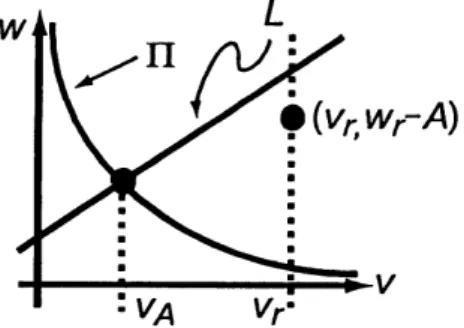
notations here (see Figure 2). We definea
line $L$ and ahyperboliccurve
$\Pi$ by$L=\{(v,w)|(r^{*}(A)+\lambda)(w-w_{r})=c^{*}(A)(v-v_{r})\}$, $\Pi=\{(v, w)|vw=\alpha((,*(A))\}$,
respectively. The line $L$ isthrough $(v_{r}, tlJ_{r})$, while$\Pi$ is below $(v_{r}, ?I_{r}’)$ becauseof$\alpha(c^{*}(A))<v_{r}?lJ_{r}$
.
The slopeof$L$ is positive so that $L$ intersects $\Pi$ at a unique point in $v>0,$$\uparrow l$) $>0$, denoted by $(vA, wwA)$. It is obvious
that $vA<v_{r}$ and $?vA<t1i_{r}$
.
Let $\Gamma$ be asegment defined by$\Gamma=\{(v, \tau v)\in L\cup\Pi|v_{A}<v<v_{r}\}$
.
In what follows, we show that thesolution of (2.10) is through the intersection $(v_{A,A}w)$ for some $A$
.
We note that$v’$ is strictlynegative for positive $v$ and$w$, the initial value of(2.10) is below $(v_{r’ r}tl))$ in the
phasespace. Due to the continuity and monotonicity of$c^{*}(A)$ with respect to $A,$ $(v_{r}u’-A)$ is beneath $L$
and above $\Pi$
.
Hence the flow of (2.10) must hit $\Gamma$ at some$z$ for $0<A<\overline{A}$, denoted by $z^{*}(A)$
.
It iseasy tosee
that $z^{*}(A)$ is uniquely determined. Since the solution of (2.10) continuously dependson theinitial valueand parameters, $z^{*}(A)$ is continuous with respect to$A$
.
We finally prove that there is $A$ such that $(v(z^{*}(A)), ?l,’(z^{*}(A)))=(v_{A}, tI^{1A})$ for
some
$A$.
If $A$ is closeto $0$, the initial value is
near
$(v_{r}, tl_{r})\in L$.
Then $v$ decreases more than$\tau v$ for small
$z>0$
so
that $(v(z^{*}(A)), w(z^{*}(A)))$ must be on $L$ at $z^{*}(A)$.
On the other hand, $c^{*}(A)$ tends to $0$ as $Aarrow\overline{A}$, and thenthe slope of $L$ also tends to $0$
.
Since$?1_{\overline{A}}=\tau rjr$ is larger than $\uparrow\downarrow$)$r^{-\overline{A}}’(v(z^{*}(A)), \tau v(z^{*}(A)))$ must be on $\Pi$ at $z^{*}(A)$
.
From these facts and the continuity of $c^{*}(A)$ and $z^{*}(A)$ with respect to $A$, we can conclude thatthere is $A^{*}$ such that $(v(z^{*}(A^{*})), tI1(z^{*}(A^{*})))$matches $(v\cdot\tau ij)$ by the intermediate value theorem. We
put
$\tau^{*}=z^{*}(A^{*})$
.
$\square$FIGURE 2. The line $L$ and the hyperbolic curve $\Pi$ in the $v-\tau r$) plane. There is a unique
intersection of$L$ and $\Pi$, which corresponds to $(v_{A,R}11))$
.
2.2. The lowest order approximation of (1.11). In thissubsection we obtain outer and inner solutions for (1.11) by taking the limit of$\epsilonarrow 0$
.
When we construct the solutions,we
need the relationship between $\lambda$ and thewave speed$c$
.
In the next lemma, we prove that $\lambda$ must be larger than $c$.
Lemma 2.
If
there is a bounded solutionof
(1.11) and (1.12), thewave
speed$c$ is less than $\lambda$.
Pmof.
By the second equation of (1.11) and $uarrow 0$as
$zarrow\infty,$ $v(+\infty)$ exists and $v(+\infty)<v_{r}$.
From thethird equation of (1.11),
we
have$(\lambda-c)(t1J_{r}-w_{t})=-c(v_{r}-v(+\infty))<0$
.
We first construct outer solutions by the similar argument in the previous section. By putting $\epsilon=0$ in
(2.6), we have
$U_{0}^{(1)}(z)=0$, $V_{0}^{(1)}(z)=v_{r}$, $W_{0}^{(1)}(z)=w_{l}$
.
By putting$\epsilon=0$ in (2.7), we formally get $U_{0}^{(2)}=h_{+}(V_{0}^{(2)}W_{0}^{(2)})$, and $(V_{0}^{(2)}, W_{0}^{(2)})$ is a solution of
$\{\begin{array}{ll}cV_{0}^{(2)’}=-k(h_{+}(V_{0}^{\langle 2)}W_{0}^{(2)}))V_{0}^{(2)}W_{0}^{(2)}, z\in(O,\tau),W_{0}^{(2)’}+(\lambda-r)(W_{0}^{(2)}-w_{1})=c(v_{r}-V_{0}^{(2)}), z\in(0,\tau),V_{0}^{(2)}(0)=v_{r}, W_{0}^{(2)}(0)=u)_{\iota}.\end{array}$
Finally, by putting $\epsilon=0$ in (2.8), we have $U_{0}^{(3)}(z)=0$, $V_{0}^{(3)}(z)=V_{0}^{(2)}(\tau)$,
$W_{0}^{\langle 3)}(z)=(u)_{\iota}- \frac{c}{\lambda-c}’(V_{0}^{(2)}(\tau)-v_{r}))(1-e^{-(\lambda-c)(z-\tau)})-W_{0}^{(2)}(\tau)e^{-\langle\lambda-c)(z-\tau)}$
.
Note that $W_{0}^{(2)}(\tau)=W_{0}^{(3)}(\tau)$ holds. From the boundary condition for the function $\tau\iota$) at
$\infty,$ $W_{0}^{(3)}(+\infty)$ $=?lj\iota-c(V_{0}^{(2)}(\tau)-v_{r})’$($\lambda-(^{\backslash },)$ must be equal to $tI$)
$r$. However it does not hold true in general. We will find
an
appropriate value $7lj\iota$ later.Next we consider the inner solutions at $z=0$ and $z=\tau$
.
At $z=0$, we introduce the stretched variable$\xi=z’\epsilon$
.
Rewrite (1.11) by using $\xi$ and putting$\epsilon=0$.
Then we formally get(2.11) $\{\begin{array}{ll}\ddot{\phi}_{0}+(\lambda’-c)\dot{\phi}_{0}+\gamma k(\phi_{0})v_{r^{tI)}}\iota-a\phi_{0}=0, \xi\in(-\infty, \infty),\phi_{0}(-\infty)=0, \phi_{0}(\infty)=U_{0}^{(2)}(0)(=h_{+}(v_{r}?lj_{\iota))}.\end{array}$
This problem $h$}$k^{\backslash }i$ a solution $\Phi_{1}(\xi)$ with a wave speed $c=c^{*}(rv_{1})$ uniquely determined for each $\tau v_{l}>8l\rangle_{*}$, where $w_{*}$ is given such $t\mathfrak{B}$ c’$(w.)=0$
.
Sinceour
interest is in travelingwave
solutions witha
positivewave
speed,we
naturallyassume
this condition. In addition we should consider the upper boumd for $?l$)$lbeca\iota i_{f^{\backslash },e}$$c^{*}(w\iota)$ must be smaller than $\lambda$ from Lemma 2. Hence we suppose that $tl’\iota$ satisfies $w_{*}<w\iota<\tau n^{*}$, where $?l)^{*}$ are defined as follows. The constant
$TI$)‘ is supposed to be $tl$)$r$ in the case of $\lambda>c’$$(\tau n_{r})$, while in the
case
of $\lambda\leq c^{*}(2l)r)$, it is defined such $tk^{\backslash }tc^{*}(?l)^{*})=\lambda$.
The wave speed $c^{*}(\tau n_{l})$ is continuous and incre&setmonotonically so that $\tau n_{*},$$\tau v^{*}$ are uniquely determined.
At $z=\tau$, we introduce the stretched variable $\xi=(z-\tau)\epsilon$ and formally get
$\{\begin{array}{ll}\ddot{\phi}_{0}+(\lambda’-c)\dot{\phi}_{0}+\gamma k(\phi_{0})V_{0}^{(2)}(\tau)W_{0}^{(2)}(\tau)-a\phi_{0}=0, \xi\in(-\infty, \infty),\phi_{0}(-\infty)=U_{0}^{\langle 2)}(\tau)(=h_{+}(V_{0}^{\langle 2)}(\tau)W_{0}^{\langle 2)}(\tau))) \phi_{0}(\infty)=0.\end{array}$
If $V_{0}^{(2)}(\tau)W_{0}^{(2)}(\tau)$ is equal to $\alpha(c^{*}(kl)\iota))$ for $tl_{l}$, this problem has a solution denoted by $\Phi_{2}(\xi)$, where $\alpha wi_{k^{\backslash }}$;
defined in the previous section.
We have already defined all outer and inner solutions of (1.11). Recall that the
wave
speed $c$ must be $c^{*}(\tau v\iota)$ for the existence of $\Phi_{1}(\xi)$.
Then, substituting $(, =c^{*}(?l)\iota)$ into the outer and inner solutions,we
formally express
our
traveling wave soliition $(u,v, w)\iota\iota\backslash$;$(u,v,w)\sim\{\begin{array}{ll}(\Phi_{1}(\frac{z}{\epsilon}), v_{r}, \tau v_{1}), z\in I_{1},(U_{0}^{(2)}(z)+(\Phi_{1}(\frac{z}{\epsilon})-U_{0}^{(2)}(0))+(\Phi_{2}(\frac{z-\tau}{\epsilon})-U_{0}^{\langle 2)}(\tau)), V_{0}^{(2)}(z), W_{0}^{(2)}(z)), z\in I_{2},(\Phi_{2}(\frac{z}{\epsilon}), V_{0}^{\langle 2)}(\tau), W_{0}^{(3)}(z)), z\inI_{3}.\end{array}$
The function $?l$) does not satisfy the boundary condition at $z=+\infty$ in general $tk9$ described previously. In
addition, we do not
see
that there does exist the function $\Phi_{2}(\xi)$, that is, $V_{0}^{(2)}(\tau)W_{0}^{(2)}(\tau)$ corresponds to$\alpha(c^{*}(klil))$
.
To establish these two conditions, we must choosean
appropriate pair $(w_{l}, \tau)$, which is given inLemma 3. There is apair $(Tl^{\tau^{*}},, \mathcal{T}^{*})$ such that it
satisfie
$s$(2.12) $\{$
$? 1)\iota-\frac{c_{\vee}^{*}(7lil)}{\lambda-c^{*},(\tau v_{l})}(V_{0}^{(2)}(\tau)-?)r)=tl;_{r}$,
$V_{0}^{(2)}(\tau)W_{0}^{\langle 2)}(\tau)=\alpha(c^{*}(\uparrow l1\iota))$
.
Proof.
We
first introduce several notations. Let $(v,\tau v)$ bea
solution of(2.13) $\{\begin{array}{ll}c^{*}(w_{t})v’=-k(h_{+}(vtl’))v\uparrow l1, z>0,?l)’+(\lambda-r^{*}(?If_{\iota))(?v-kl1l)=-c^{*}(?l)}\iota)(v-v_{r}), z>0,v(0)=v_{r}, w(0)=w_{l}.\end{array}$
Define two lines $L_{1},$ $L_{2}$ and a hyperbolic
curve
$\Pi$ by$L_{1}=\{(v, w)|(\lambda-c^{*}(w_{l}))(tl’-\tau r_{l})=-c^{*}(\tau v_{l})(v-v_{r})\}$, $L_{2}= \{(v,\uparrow l))|v=v_{r}-\frac{\lambda-c^{*}(\tau r_{\text{ノ^{}\prime}l})}{r_{d}^{*}(w\iota)} ($ で砺 $-?ll\iota)\}$,
$\Pi=\{(v, \uparrow lj)|v\uparrow lJ=\alpha(r^{*}(\uparrow lj_{l}))\}$
.
Since the slope of $L_{1}$ is negative, $L_{1}$ intersects $\Pi$ at two points. Let $P_{L_{1}.\Pi}$ be one of the
intersections
whose component of$v$ in the v-w plane is less than another point. We denote a unique intersection of$L_{2}$
and $H$ by $P_{L_{2},\Pi}$
.
The point $P_{L_{1},L_{2}}$ denotes the intersection of $L_{1}$ and $L_{2}$. We also set $P_{3}=(v_{r}, \tau n_{l})$ and $P_{4}=(v_{r}, \alpha(c^{*}(w_{l}))\prime v_{r})$, which are on $L_{1}$ and $\Pi$, respectively. By these notations, we define a set $\Gamma$, whichconsists ofsegments of$L_{1},$ $L_{2}$ and $\Pi$, by
$\Gamma=\{(v,\uparrow n)|(v,w)\in L_{2}$ between $P_{1,2}$ and $P_{2}\}\cup$
{
$(v,w)|(v,w)\in$fi between $P_{2}$ and $P_{4}$}.
On the line $L_{1},$ $w’\equiv 0$ and $v’<0$
so
that the solution $(v, w)$ of (2.13) must be $\Gamma$ atsome
$z$
.
Let $z^{*}(w_{l})$ bethe first point of$z$ where $(v, w)$ is on$\Gamma$
.
It is obvious that$z^{*}(w_{l})$ depends on $\tau v_{l}$ continuously.
Actually, the line $L_{2}$ is not included in $v>0$ for
$w_{l}$ close to $w_{*}$ because of $c^{*}(w_{*})=0$
.
Since $(\lambda-$$C^{*}(w\iota))(1lJ_{r^{-w_{t})c^{*}(w_{t})}}$
’
decreases monotonically with respect to $w_{\iota}$, there is umiquely $\tilde{w}_{s}$ such that$\frac{\lambda-c^{*},(?\tilde{l})_{*})}{r^{*},(\tilde{w}_{*})}(11i_{r^{-?\tilde{l})_{*})}}=0$
.
Clearly, $w_{*}<\tau\tilde{v}_{*}$ holds
so
that we only consider $?\tilde{l}J_{*}<?lj_{l}<?1i^{*}$ in the following.We see by the
same
argument as in the proof of Lemma 1 that $(v, w)$ hits $P_{L_{2},\Pi}$ for some $w_{t}$, whichcompletes the proof of the lemma. If $w_{l}$ is
near
$t\tilde{1}J_{*}$, the $tI,$’-componentof $P_{L_{2},\Pi}$ is large. Then, $(v,w)$ ison
$\Pi$for $z=z^{*}(w_{l})$
.
On theotherhand, in thecai$e$of$\tau n\iota=w^{*}$, the initial value $(v_{r}, \tau rj^{*})$ lies on $L_{2}$, which impliesthat $(v, w)$ is on $L_{2}$ for $\uparrow lJ\iota$
near
$w^{*}$ at $z=z^{*}(\uparrow l1\iota)$.
Due to the continuity of$z^{*}(w_{l})$ with respect to $w_{l}$, thereis $?l)l^{*}$ such that $(v(z^{*}(w_{l}^{*})), \tau n(z^{*}(\uparrow l)^{*}l)))$ is equal to $P_{L_{2},\Pi}$
.
$\square$ACKNOWLEDGEMENT
This work $Wik\backslash$ supported in part by the Japan Society ofPromotion ofScience. Special thanks
go
toDr. H. Izuhara for many stimulating discussions.
REFERENCES
[1$|$ D. Henry. Geometrictheoryofsemilinearparabolic equations,
volume840ofLecture NotesinMathematics.Springer-Verlag,
Berlin, 1981.
[2] K. Ikeda and M. Mimura. Mathematicaltreatmentof a model for smoldering combustion. Hiroshima Math. J., $3S(3):349-$ 361, 2008.
[3] K. Ikeda and M. h4imura. Existenceand stability ofatravelingwavesolutionon a3-componentreaction-diffusionmodelin
combustion. inpreparation.
[4] H. Izuharaand M. Mimura. Private communication.
[5] S. Olson, H. Baum, andT. Kashiwagi. Finger-like smoldering over thin cellulosic sheets in microgravity. The Combustion Institute, pages 2525-2533, 1998.
[6] A. Pazy. Semigroupsoflinearoperatorsandapplications topartialdifferentialequations,volume44of AppliedMathematical
Sciences. Springer-Verlag, NewYork, 1983.
[7] L. RAques. Study of thepremixed flame model with heat losses. The existence of two solutions. European J. Appl. Malh., $16(6):741-765$, 2005.
[8] O. Zik, Z. Olami, and E. Moses. Fingering
(K. Ikeda) Mbl.ll $i_{NSTiTtJTE}$ FOR ADVANCED STUDY ok. LIA?.!4bhlATlcAL ScibNcEs, hIbi ii UN$1Vbli_{\wedge}\backslash \backslash 1TY,$ $1- 1- 1$ HlGA
$\backslash \backslash$
HlbllTA. TA lAK U, KAWASAKI, KANAGAWA $214- 8^{r_{J}}71,$ J APA$N$
E-mailaddress: ikeda91sc.meij i.ac.jp
(M. Mimura) DEPARrMENT $ob^{\backslash }MAT$}{$bbIATl(’\eta$
’
INSTITUTE $b^{\backslash }O\}\iota$ MATHEMATICAL SCIENCUS SCHOOL OF SCIENCE AND$TbC^{\backslash },$
}i-NOLOGY Mg]Ji UNivmsiTY, KAWASAKI $214-8^{r_{J}}71$, JAPAN