Traveling
Fronts
for
Higher
Order
Autocatalytic
Reaction-Diffusion
Systems
Yuzo Hosono
*Department of
Information and
Communication Sciences
Kyoto
Sangyo University
Kyoto 603,
Japan
京都産業大学工学部 細野 雄三
Abstract
This article investigates the existence oftraveling fronts and their
propagation speeds for the two component higher order autocatalytic
reaction-diffusion systems withany diffusion coefficients. Our
elemen-taryanalysis ofthe vector fieldsin the phase space gives theestimate of
the minimal propagation speeds interms of the order of autocatalysis
and the diffusion coefficients.
Key Words: traveling fronts, propagation speed, autocatalytic reaction,
phase space
AMS $\mathrm{C}\mathrm{l}\mathrm{a}\mathrm{s}\mathrm{s}\mathrm{i}\mathrm{f}\mathrm{i}\mathrm{c}\mathrm{a}\mathrm{t}\mathrm{i}\mathrm{o}\mathrm{n}:35\mathrm{K}57,34\mathrm{C}37$
1
Introduction
Autocatalytic reaction-diffusion systems including the Brusselator [?], the
Field-Noyes model [6] and the Gray-Scott model [?], have stimulated
an
extensive amount of theoretical studies on
waves
and patterns produced bychemical reactions (see for example, [12]).
One
ofthe$\mathrm{b}\mathrm{a}s$icelements
respon-sible for chemical pattern formation is travelling
waves
which describe thedevelopment ofchemical processes. The series of the papers by Needham at
$\mathrm{a}1.([2]-[5], [13]-[17])$ studied extensively the traveling
waves
in autocatalyticreactions.$\cdot$. Focant and Gallay [7] and Hosono
and Kawahara [11] also
dis-cussed the traveling
waves
for the mixed order autocatalytic two componentsystemsandtheir minimal propagationspeeds. The similar typeof traveling
’This workwasin part supported byGrant-in-AidforScientific Research No.14540143
waves
appears inthecombustion problemand the speed ofcombustion waveswere discussed by the several authors ([8], [22] and the references therein).
This paper concerns traveling fronts and their speeds for the higher order
autocatalytic reaction-diffusion system of the form:
$\{$
$u_{t}=d_{1}u_{xx}-k_{1}uv^{m}$,
$v_{t}=d_{2}v_{xx}+k_{2}uv^{m}$, (1)
where $u$ and $v$
are
concentrations of the reactant and the autocatalystre-spectively, $d_{1}$ and $d_{2}$
are
diffusion coefficients, and $k_{1}$ and $k_{2}$ are anypositiveconstants. Without loss of generarlity,
we
may suppose $k_{1}=k_{2}=1$.
Then, travelingfront solutionsfor (1)
are
definedas
follows. Thenonneg-ativebounded functions of theform $(u(p, t),$$v(x,t))=(U(z), V(z))$ with $z=$
x–ct
are
said to be traveling front solutions for (1) when they satisfy theequations
$\{$
$d_{1}U’’+cU’-UV^{m}=0$,
$d_{2}V’’+cV’+UV^{m}=0$, (2) with the boundary conditions
$P_{-}\equiv(U(-\infty), V(-\infty))=(\alpha, 1)$, $P_{+}\equiv(U(+\infty), V(+\infty))=(1,0)$
.
(3)Here ’
denotes $\frac{d}{dz}$ and
a
is an unknown nonnegative constant to bedeter-mined.
By applyingthe comparison argument, Takase and Sleeman [21] already
proved that there exists the minimalwave speed $c^{*}$ suchthat traveling front
solutionsfor (1) exist foreach $c\geq c^{*}$
.
Thepurpose of this paper isto discusstheproperties ofthe minimal
wave
speed $c^{*}$, especially the dependenceof$c^{*}$on the parameters $m,$$d_{1}$ and $d_{2}$
.
The method of the proof employed here isthe shooting argument which looks for the connection orbits of (2) and (3)
in the $3-\dim$ phase space. Throughout this paper, we always
assume
that$m>1$ without notice.
In the next section,
we
present the preliminary results required for thelaterdiscussions. Insection3,
we
investigate the existence of travelingfrontsfor (1) and their minimal propagation speeds when $0<d_{1}<d_{2}$
.
In section4,
we
study thesame
problem when $d_{1}>d_{2}>0$.
2
The preliminary results
In this
se
ction, we begin by stating the properties of the traveling frontsolutions for (1), that is, the solutions of (2) and (3).
Proposition 1 ([3])
Assume
that there exists a travelingfront
solution(i)
$0<U<1$
,$0<V<1$ .
(ii) $0<U’<+\infty$, $-\infty<V’<0$
.
(iii) $U+V-1\{$
$>0$,
for
$d_{1}<d_{2}$,$=0$,
for
$d_{1}=d_{2}$,$<0$,
for
$d_{1}>d_{2}$.
(iv) $\lim_{zarrow-\infty}(U(z), V(z)=(\mathrm{O}, 1)$, that is $\alpha=1$
.
For the equal diffusion
case:
$d_{1}=d_{2}=1$,we
already had the followingtheorem.
Theorem 2 ([20])
Assume
that $d_{1}=d_{2}=1$.
Then, there existssome
pos-itive $c_{1}^{*}$ such that only
for
each $c\geq c_{1}^{*},$ (1) has a unique monotone travelingfront
solution. Furthermore, the minimal speed $c_{1}^{*}$satisfies
that$\frac{2}{m(m+1)}\leq c_{1}^{*2}\leq\frac{2}{(m-1)m}$
.
(4)For the extreme
case:
$d_{1}=0$, we mayassume
$d_{2}=1$ without loss ofgenerality, and know the following result.
Theorem 3 ([10])
Assume
that $d_{1}=0,$$d_{2}=1$.
Then, there exists $c_{0}^{*}$such that only
for
each $c\geq c_{0\mathrm{z}}^{*}(1)$ has a unique travelingfront
solution. Furthermore, the minimal speed $c_{0}^{*}$satisfies
$\frac{1}{m}<c_{0}^{*2}\leq\frac{1}{m-1}$
.
(5)For another extreme
case:
$d_{2}=0$,we
mayassume
$d_{2}=1$ without lossof generality, and easily have the following result.
Theorem 4 Assume that $d_{2}=0,$$d_{2}=1$
.
Then, there exists a uniquetraveling
front
solutionfor
(1)for
eachpositive $c$.
In the next two sections,
on
the basis of these results,we
discuss thegeneral
case
that the both diffusion coefficientsare
notzero.
3
The
case
$0<d_{1}<d_{2}$For the
case
that $0<d_{1}<d_{2}$, the system (2)can
be writtenas
$\{$
$dU”+cU’-UV^{m}=0$,
$V”+cV’+UV^{m}=0$, (6)
by the change of the independent variable $z$ and the parameter $c$, where $d=\neq_{2}^{d}$
.
The boundary conditionsare
specified by (3) with $\alpha=0$.
Adding the above two equations and integrating the resulting equation,
we have therelation $dU’+V‘+c(U+V-1)=0$ withthe aid of the boundary
condition (3). Let
$X=U+V-1$
. Proposition 1assures
that $X$ ispositivewhen $0<d<1$
.
Then (6) is reduced to the first order systemThe boundary conditions
are
(X$(-\infty),$$V(-\infty),$ $W(-\infty)$) $=(0,1,0)$,
(8) (X$(+\infty),$$V(+\infty),$ $W(+\infty)$) $=(0,0,0)$
.
Introducing the new dependent variables by
$q=V$, $p= \frac{1}{q}q’$, (9)
we can
write (7)as
$\{p’’==qc’ p(p+c)-(1-q+X)q^{m-1}q=pX’=\frac{c}{d}X-(\frac{1}{d}-1)pq,$
,
(10)
where the singularity $(0,0,0)$ of (7) into two critical points $P_{0}=(0,0,0)$
and $P_{c}=(0,0, -c)$ in (10). Thus, (10) has three critical points $P_{0}=$
$(0,0,0),$$P_{c}=(0,0, -c)$ and $P_{1}=(0,1,0)$
.
The property of these criticalpoints
are
as follows. $P_{1}=(0,1,0)$ has the l-dim unstable manifold whichwe
denote by$\mathcal{U}_{d}$ and the $2-\dim$ stable manifold. $P_{0}=(0,0,0)$ isa
topolog-ically stable
node.
$P_{c}=(0,0, -c)$ has the $2-\dim$ stable manifold and thel-dim unstable manifold.
Now
our
problemis findingan
orbit of(10) connecting$P_{1}=(0,1,0)$ with $P_{0}=(0,0,0)$or
with $P_{c}=(0,0, -c)$, which lies entirely in $\Omega^{+}=\{(X, q,p)$ :$X>0,0<q<1,p<0\}$
.
In order to discuss this problem,we
need thefurther information for the
case
of $d=0$.
The change of the variables (9)rewrite (6) with $d=0$ as
$\{$
$q’=pq$
$p’=-cp(p+c)-(1-q- \frac{pq}{c})q^{m-1}$, (11)
which has three critical points $(0,0),$ $(1,0)$ and $(0, -c)$
.
The proof ofThe-orem
3assures
that there existsa
unique orbit of (11) connecting $(1, 0)$ toFig. 1: The position of the front $x(t)$ of $u(x(t), t)= \frac{1}{2}(0\leq t\leq 1000)$ for $d=$
O(pp50),0.2(pp502), 0.4(pp504), 0.6(pp506),0.8(pp508),$1.0(\mathrm{p}\mathrm{p}51),m=5$.
$p=\psi_{c}(q)<0$ for
$0<q<1$
, and it satisfies that $\psi_{c}(1)=0$ for $c\geq \mathrm{c}_{0}^{*}$,$\psi_{c_{0}^{*}(m)}(0)=c_{0}^{*}$, and $\psi_{c}(0)=0$ for $c>c_{0}^{*}$
.
Letus
define the $\mathrm{r}\mathrm{e}\mathrm{g}\mathrm{i}\mathrm{o}\mathrm{n}\Omega_{1}^{+}$ by$\{(X, q,p) : 0<X<-\frac{1}{\mathrm{c}}\psi_{c}(q)q, 0<q<1, \psi_{c}(q)<p<0\}$
.
By examiningthe vector field of (10) and the behavior of$\mathcal{U}_{d}$, we
see
Lemma 5 Assume that $0<d<1$
.
Then,for
each $c\geq c_{0}^{*}$, there exists an orbitof
(10) which connects $P_{1}$ with $P_{0}$.This lemmaenables
us
to apply the Wazewski Theoremandwecan
provethe following lemma.
Lemma 6 Assume that
$0<d<1$
.
Then, there existssome
positiveconstant$c_{d}^{*}$ such that,
for
$c=c_{d\prime}^{*}(10)$ has a unique orbit connecting $P_{1}$ with$P_{c}$
.
We have the monotone dependency of connection orbits of (10) with
respect to theparameters $c$and $d$
.
In the following propositions, weassume
that $0<d$,$d’\leq 1$.
Proposition 7 Let $d$ be
fixed.
Assume thatfor
some
$c_{1}>0$, there existsa
connection orbitof
(10) lying in $\Omega^{+}$.
Then,for
each $c\geq c_{1}$, there existsa
Proposition 8 Let $c$ be
fixed
positive. Assume thatfor
some $d’$, thereexists a connection orbit
of
(10) lying in $\Omega^{+}$. Then,for
each $d\geq d’$, thereexists a connection orbit
of
(10) lying in $\Omega^{+}$.
Lemma 6 and Proposition 7 assure the existence ofa connection orbit of
(10) onlyfor each$c\geq c_{d}^{*}$, that is, $c_{d}^{*}$ is the minimal
wave
speed. Furthermore,Proposition 8 asserts that $c_{d}^{*}\leq c_{d}^{*}$, if $d\geq d’$
.
Combining these results, weobtain the following theorem.
Theorem 9
Assume
that$0<d<1$, Then, there existssome
$c_{d}^{*}$, such thata traveling
front
solutionfor
(1) exists uniquely onlyfor
each $c\geq c_{d}^{*}.$ hr-thermore, the minimal speed$c_{d}^{*}$ is strictly monotone decreasing with respectto $d$, and it
satisfies
that $c_{1}^{*}<c_{d}^{*}<\mathrm{c}_{0}^{*}$.
Fig. 1 shows the numerical resultof the propagationspeeds ofthe
travel-ing fronts obtained by solving the evolutional system (1) with the appropri-ate initial data of the st$e\mathrm{p}$ function type. This result illustratesnumerically the last assertion of Theorem 9.
4
The
case
$d_{1}>d_{2}>0$For the
case
that $d_{1}>d_{2}>0$, the system (2)can
be writtenas
$\{$
$U”+cU’-UV^{m}=0$,
$DV”+cV’+UV^{m}=0$, (12)
by the change of the independent variable $z$ and the parameter $c$, where
$D= \frac{1}{d}=\frac{d}{d}21<1$
.
Put
$X=U+V-1$
. Proposition 1 againassures
that $X$ is negativewhen
$0<D<1$
.
Then (12) is reduced to the first order systemThe boundary conditions
are
(8). Let $D=\epsilon^{2}$, and replace$c,$ $\frac{z}{\epsilon}$ and $\epsilon W$ by
$\epsilon c,$$z$ and $W$ respectively. Then (13) is written as
$\{$
$X’=-c\epsilon^{2}X+(1-\epsilon^{2})W$,
$V’=W$,
$W’=-cW-(1-V+X)V^{m}$
.
Fig. 2: The graph of$c_{D}^{*}(m)(D=0.2)$ for $(1 \leq m\leq 12)$
$\mathrm{s}\mathrm{y}\mathrm{s}\mathrm{t}\mathrm{e}\mathrm{m}\mathrm{w}\mathrm{h}\mathrm{i}\mathrm{c}\mathrm{h}\mathrm{i}\mathrm{s}\mathrm{t}\mathrm{h}\mathrm{e}\mathrm{s}\mathrm{a}\mathrm{m}\mathrm{e}\mathrm{a}\mathrm{s}(10)\mathrm{w}\mathrm{i}\mathrm{t}\mathrm{h}\epsilon^{2}=\frac{1(}{d}\mathrm{A}\mathrm{p}\mathrm{p}\mathrm{l}\mathrm{y}\mathrm{i}\mathrm{n}\mathrm{g}\mathrm{t}\mathrm{h}\mathrm{e}\mathrm{c}\mathrm{h}\mathrm{a}\mathrm{n}\mathrm{g}\mathrm{e}\mathrm{o}\mathrm{f}\mathrm{t}\mathrm{h}\mathrm{e}\mathrm{v}\mathrm{a}\mathrm{r}\mathrm{i}\mathrm{a}\mathrm{b}1\mathrm{e}\mathrm{s}(9)\mathrm{t}\mathrm{o}1.4)$
,
we
arrive at the following$\{p’’==qp’(p+c)-(1-q+X)q^{m-1}q=pX’=c\epsilon^{2}X+(1-\epsilon^{2})pq,$
.
(15) Now
our
problemis finding anorbit of (10) connecting$P_{1}=(0,1,0)$ with $P_{0}=(0,0,0)$ or with $P_{c}=(0,0, -c)$, which lies entirely in $\Omega^{-}=\{(X, q,p)$ :$X<0,0<q<1,p<0\}$
.
Repeatingthe similar arguments in the section 3,we can
prove the following theorem.Theorem 10 Assume that
$0<D<1$
.
Then, there exists some $c_{D}^{*}$, suchthat a traveling
front
solutionfor
(1) existsfor
each $c\geq c_{D}^{*}$.
Furthermore, the minimal speed $c_{D}^{*}$satisfies
that $c_{D}^{*}<\sqrt{D}c_{1}^{*}=\sqrt{\frac{mm-12D}{}}$.FIg.2 shows that the minimal
wave
speed $c_{D}^{*}$is monotonedecreasingwithrespect to the parameter $m$
.
This is obtained numerically by the shootingmethod which follows the unstable manifold of the critical point $P_{1}$ of (15).
5
Concluding remarks
Wehavediscussedthe propagation speeds of thechemical reaction fronts and
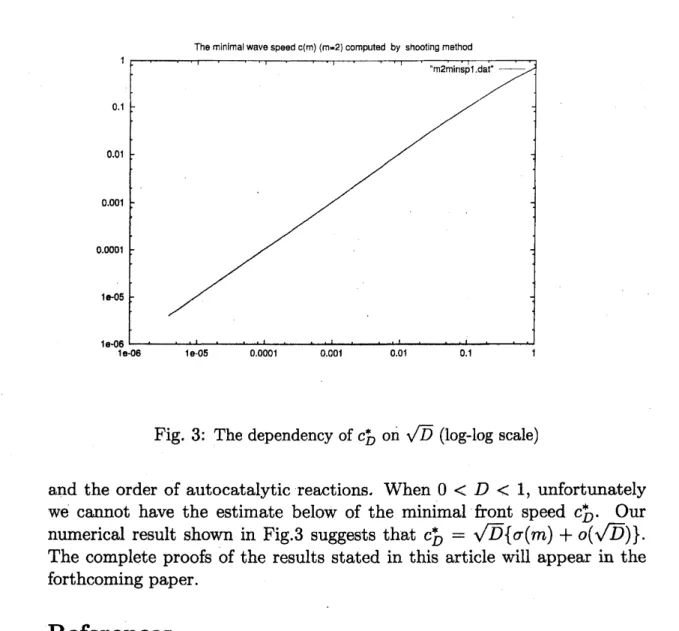
Fig. 3: The dependency of$c_{D}^{*}$ on $\sqrt{D}$ (log-log scale)
and the order of autocatalytic reactions. When
$0<D<1$
, unfortunatelywe cannot have the estimate below of the minimal hont speed $c_{D}^{*}$
.
Ournumerical result shown in Fig.3 suggests that $c_{D}^{*}=\sqrt{D}\{\sigma(m)+o(\sqrt{D})\}$.
The complete proofs of the results stated in this article will appear in the
forthcoming paper.
References
[1] J. Billingham, Phase plane analysis of one-dimensional reaction
diffu-sion
waves
with degenerate reaction terms, Dynamics and Stability ofSystems, 15 (2000), 23-33.
[2] J. Billingham and D. J. Needham, A noteon the properties of a family
of travelling-wave solutions arising in cubic autocatalysis, Dynamics
and Stability of Systems, 6 (1991), 33-49.
[3] J. Billingham and D. J. Needham, The development oftravelling
waves
in quadratic and cubic autocatalysis with unequal diffusion rates. I.
Permanent form travelling waves, Phil. Trans. R. Soc. Lond. A, 334
(1991), 1-24.
[4] J. Billingham and D. J. Needham, The development oftravelling
waves
in quadratic and cubic autocatalysis with unequal diffusion rates. II.
An initial-value problem with an immobilized of nearly immobilized
[5] J. Billingham and D. J. Needham, The development of travelling
waves
in quadratic and cubicautocatalysis with unequaldiffusion rates.III. Large time development in quadratic autocatalysis, Quart. Appl.
Math., L (1992), 343-372.
[6] R. J. Field and M. Burger (Eds.), Ovcillations and traveling waves in
chemical systems, Wiley, New York, 1985.
[7] S. Focant and Th.Gallay, Existence and stability ofpropagation fronts
for
an
autocatalytic reaction-diffusion system, Physica D, 120 (1998),346-368.
[8] V. Gionvangigli, Nonadiabatic plane laminar flames and their singular
limits. SIAM J. Math. Anal., 21 (1990), 1305-1325.
[9] P. Gray, T. H. Merkin, D.J. Needham and S. K. Scott, Thedevelopment
of travelling
waves
in a simple isothermal chemical system. III. Cubicand mixed autocatalysis. Proc. R. Soc. Lond. A, 430 (1990), 509-524.
‘[10] Y. Hosono, Phase plane analysis of travelling
waves
for higher orderautocatalytic reaction-diffusion systems, preprint.
[11] Y. Hosono and H. Kawahara, The minimal propagation speed of
trav-elling wavesfor autocatalytic reaction-diffusion equations, Japan J.
In-dustrial and Applied Math., 18 (2001), 445-458.
[12] R. Kapral and K.
Showalter
(Eds.),Chemical Waves
and Patterns,Kluwer Academic Publishers, Dordrecht, 1995.
[13] J. H. Merkin and D. J. Needham, Propagating reaction diffusion
waves
in
a
simple isothermal quadratic autocatalytic chemical system, J.En-gng.
Math. 23 (1989),343-356.
[14] J. H. Merkin and D. J. Needham, The development oftravelling
waves
in
a
simpleisotherma!
chemical system II. Cubic autocatalysis withquadratic and linear decay, Proc. R. Soc. Lond. $\mathrm{A},$ $430$ (1990),
315-345.
[15] J. H. Merkin and D. J. Needham, The development of travelling
waves
in a simple isothermal chemical system IV. Quadratic autocatalysis
with quadratic decay, Proc. R. Soc. Lond. A 434 (1991), 531-554.
[16] J. H. Merkin and D. J. NeedhamReaction-Diffusion
waves
inanisother-mal chemical system with general orders of autocatalysis and spatial
dimension, Z. angew. Mech. Phys., 44 (1993),
707-721.
[17] J. H. Merkin, D. J. Needham and S. K. Scott, The development of
travelling
waves
in a simple isothermal chemical system III. Cubic and[18] M. J. Metcalf, J. H. Merkin and S. K. Scott, Oscillating wave fronts
in isothermal chemical systems with arbitrary powers of autocatalysis,
Proc. R. Soc. Lond. $\mathrm{B},$ $447$ (1994), 155-174.
[19] D. J. Needham and J. H. Merkin, The development oftravelling
waves
in a simple isothermal chemical system with general orders of
auto-catalysis and decay, Phil. ?kans. R. Soc. Lond. $\mathrm{A},$ $387$ (1991),
261-274
[20] A. dePabloand J. L. Vazquez, Travellingwave
behaviour for aPorous-Fisher equation, Euro. J. Applied Mathematics, 9 (1998), 285-304.
[21] H. Takase and B. D. Sleeman, Travelling-wave solutions to monostable
reaction-diffusionsystems of mixed monotone type, Proc. R. Soc. Lond. $\mathrm{A}$, 455(1999), 1561-1598.
[22] A. I. Volpert,. Vitaly A. Volpert and Vladimir A. Volpert, Travelling