Near
model
completeness
of
generic
structures
Koichiro Ikeda
$*$Faculty
of
Business
Administration,
Hosei
University
A theory $T$ is said to be nearly model complete, ifevery formulais
equiv-alent in $T$ to
a
Boolean combination of $\Sigma_{1}$-formulas. This notion is agener-alization ofmodel completeness. It is known that
Fact Hrushovski’s strongly minimal structure is nearly model complete. On the other hand, Baldwin and Shelah [4] proved the following:
Theorem Shelah-Spencer’s random graph is nearly model complete. The proof is a little complicated. Pourmahdian [7] gave a new proof for this theorem, by adding countable predicates to the language. Both of
Hrushovski’s strongly minimal structure and Shelah-Spencer’srandom graph
are
well-known examples ofgeneric structures.In this short note,
we
give amore
direct proof fora
theorem of Baldwin and Shelah, and moreover generalize both of the above fact and theorem:Theorem Let $M$ be a generic structure. If Th(M) is ultra-homogeneous
over
finite closed sets, then it isnearly
model complete.1
Generic
structures
It is assumed that the reader isfamiliar with the basics of generic structures. In particular, this paper
was
influenced by papers of Baldwin-Shi [3] and Wagner [8].Let $L$ be a language which consists
of finite relations with irreflexivity and symmetricity. Let $A,$$B,$$C$, be $L$-structures or (hyper-)graphs. A
pred-imension $\delta(A)$ of a finite structure $A$ is defined as follows:
$\delta(A)=|A|-\sum_{R\in L}\alpha_{R}|R^{A}|,$
where $\alpha_{R}\in(0,1] for$ each $R\in L. We$ denote $\delta(B/A)=\delta(BUA)-\delta(A)$
.
For finite $A\subset B,$ $A$ is said to be closed in $B$ $(in$ symbol, $A\leq B)$, if
$\delta(X/A)\geq 0$ for any $X\subset B-A$. When $A,$ $B$ are not necessarily finite,
$A\leq B$ is defined by $A\cap X\leq X$ for any finite $X\subset B.$
For $A\subset B$, there is a smallest set $C\leq B$
containing $A$. Such a $C$ is
denoted by $c1_{B}(A)$.
Let $K^{*}$ be the class
of finite$L$-structures$A$ with $\delta(A’)\geq 0$for all $A’\subset A.$
Definition 1.1 Let $K\subset K^{*}$ Then
a countable
$L$-structure
$M$ is saidto
be$(K, \leq)$-generic, if it satisfies the following:
1. $A\in K$ for any finite $A\subset M$;
2. $M$ is rich, i.e., if$A\leq B\in K$ and $A\leq M$, then there is
a
$B’(\cong_{A}B)$with $B’\leq M$;
3. $M$ has
finite
$clo\mathcal{S}ures$, i.e., $c1_{M}(A)$ is finite for any finite $A\subset M.$Clearly
a
genericstructure $M$ has finiteclosures, butany
model of Th(M)does not always have finite closures.
Definition 1.2 Let $M$ be ageneric structure. Then we say that Th (M) has
finite
closures, if any model has finite closures.By the back-and-forth method, if$M,$ $N$ are $(K_{\}}\leq)$-generic then $M\cong N.$ Also,
we can see
thata
generic structure $M$ is ultra-homogeneousover
finite
closed sets, i.e., if$A,$ $B$ are finite with $A\cong B$ and $A,$$B\leq M$, then $tp(A)=$
$tp(B)$.
Definition 1.3 Let $M$ be a generic structure. Then we say that Th(M) is
ultra-homogeneous over
finite
$clo\mathcal{S}ed$ sets, if any mbdel isultra-homogeneous
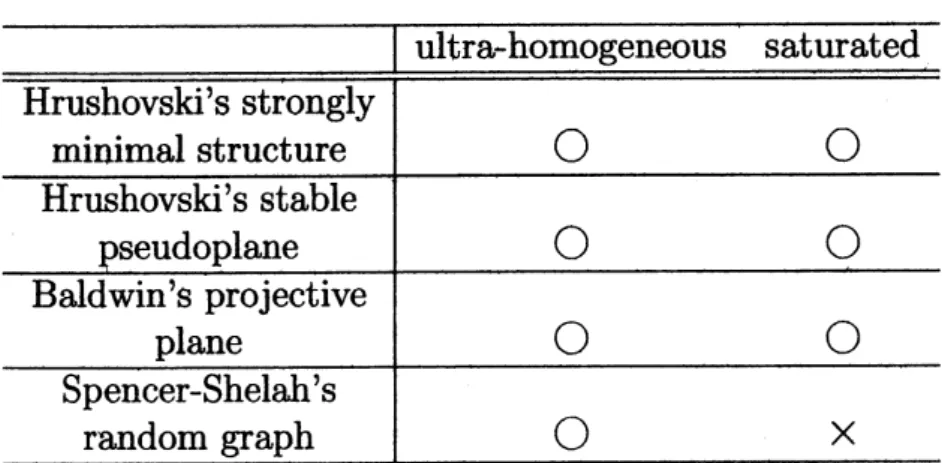
Table 1: Examples of generic structures
Note 1.4 It is easily checked that $M$ is saturated if and only if Th (M) has
finite closures and is ultra-homogeneous
over
finite closed sets.The following
are
well-known examples of generic structures.Example 1.5 1. (Hrushovski [5]) A
new
strongly minimal structure 2. (Hrushovski [6]) An $\omega$-categorical stable pseudoplane3. (Baldwin [1]) An $\aleph_{1}$-categorical projective plane
4. (Baldwin-Shelah [4]) Spencer-Shelah’s random graph
For examples ofgenericstructures,almost alltheories
are
ultra-homogeneousover
finite closed sets: Each of 1,2 and3
is saturated, and hence, by Note 1.4,the theory is $ultra_{r}$homogeneous
over
finite closed sets. 4 is not saturated,because the theory does not have finite closures, however it
can
beseen
that the theory is $ultra_{r}$homogeneous over finite closed set. (See Table 1)2
Nearly
model complete theories
Definition 2.1 Let $T$ be a theory.
1. $T$ is said to be model complete, if whenever $M,$ $N\models T$ and $M\subset N,$
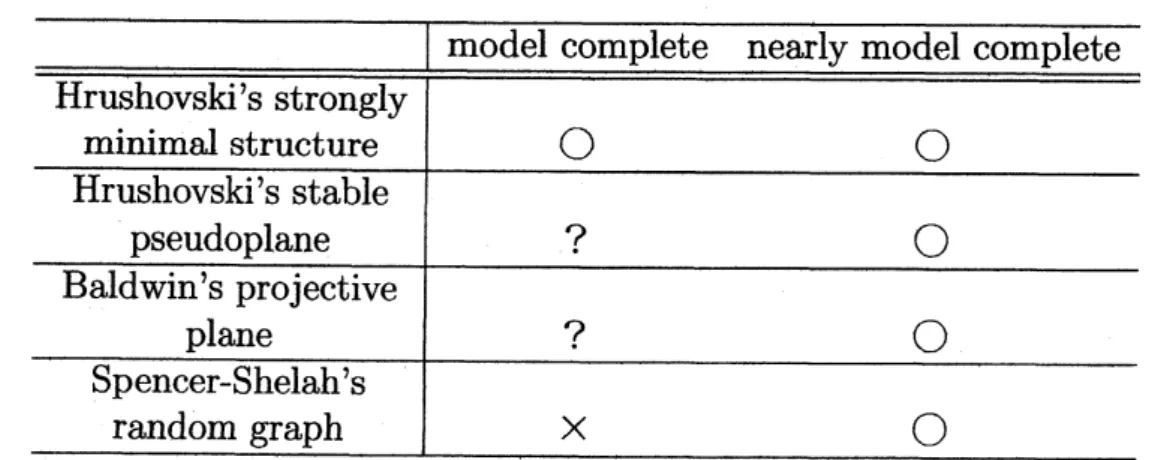
Table
2: Examples of genericstructures
2. It is known that $T$ is model complete if and only if every formula
is equivalent in $T$ to some $\Sigma_{1}$-formula.
3. $T$ is said to be nearly model complete, if every formula
is equivalent in
$T$ to a Boolean combination of $\Sigma_{1}$-formulas.
For model completeness, it is known that 1 of Example 1.5 is model
complete ([2]) but 4 of Example 1.5 is not model complete ([4]). However, it is not known whether 2 and 3 of Example 1.5 is model complete or not.
On the otherhand, for near model completeness, it is proved that 1 and 4 of Example 1.5
are
nearly model complete. (See Table 2)Fact 2.2 Hrushovski’sstrongly minimal structure isnearlymodel complete.
Theorem 2.3 (Baldwin-Shelah [4], Pourmahdian [7]) Shelah-Spencer’s
random graph is nearly model complete.
Baldwin and Shelah prove that the theory of a semi-generic structure is nearly model complete. As a corollary, it is obtained that Shelah-Spencer’s
random graph is nearly model complete. After that, Pourmahdian gives
a new
proof for this theorem. In both proofs, the notion ofa
semi-genericstructure is usedto get
near
model completeness ofShelah-Spencer’s randomgraph. Then
we
want to givea more
direct proof fora
theorem ofBaldwin
Theorem 2.4 Let $M$ be
a
generic structure. If Th(M) is ultra-homogeneousover
finite closed sets, then it is nearly model complete.Proof. Let $M\mathcal{M}$ be a big model. We write $c1(A)=c1_{\mathcal{M}}(A)$
.
For $n\in\omega,$$B\leq_{n}C$ is defined by $\delta(X/B)\geq 0$ for any $X\subset C-B$ with $|X|\leq n$
.
Wewrite
$c1^{n}(A)=\cap\{B:A\subset B\leq_{n}\mathcal{M}\}.$
Note that $d(A)=\bigcup_{n}c1^{n}(A)$, and
moreover
that if $A$ is finite thenso
is$c1^{n}(A)$
.
Take any finite $A\subset \mathcal{M}$
.
It is enough to show that there is some set $\Sigma$ ofa Boolean combination of $\Sigma_{1}$-formulas with $\Sigma\vdash tp(A)$
.
Let $B=c1(A)$. Foreach $n\in\omega$, let $B_{n}=c1^{n}(A)$
.
Note that each $B_{n}$ is finite and $B= \bigcup_{n}B_{n}.$Let $\Sigma(X)$ be
$\{(\exists Y_{n})(XY_{n}\cong AB_{n}):n\in\omega\}$
$\cup\{\neg(\exists Y_{n})(\exists Z)(XY_{n}Z\cong AB_{n}C) : B_{n}\subset C\in K, B_{n}\not\leq {}_{n}C, n\in\omega\}.$
Since $A\models\Sigma,$ $\Sigma$ is consistent. Take any $A’\models\Sigma$. Then, for each $n$, there
is
a
$B_{n}’\subset \mathcal{M}$ with $A’B_{n}’\cong AB_{n}$.
By compactness,we
can assume
that $B_{n}’B_{n+1}’\cong B_{n}B_{n+1}$ for any $n\in\omega$.
Let $B’= \bigcup_{n}B_{n}’$.
Clearly $B’\cong B.$Since $A’\models\Sigma$, we have $B_{n}’\leq_{n}\mathcal{M}$ for each $n$, and hence $B’\leq \mathcal{M}$
.
Byultra-homogeneity, we have $tp(B’)=tp(B)$
.
Hence we have $tp(A’)=tp(A)$.References
[1] John T. Baldwin, An almost strongly minimal non-Desarguesian
pro-jective plane, Trans. Am. Math. Soc. 342, 695-711 (1994)
[2] Kitty L. Holland, Modelcompleteness ofthe
new
stronglyminimal sets, The Journal of Symbolic Logic 64 (1999)946-962
[3] John T. Baldwin and Niandong Shi, Stable generic structures, Annals
of Pure and Applied Logic 79 (1996) 1-35
[4] John T. Baldwin and Saharon Shelah, Randomness and semigenericity.
Trans. Am. Math. Soc. 349 (1997) 1359-1376
[5] E. Hrushovski, A newstrongly
minimal
set, Annals of Pure and Applied Logic 62 (1993) 147-166[6] E. Hrushovski, A stable $\aleph_{0}$-categorical pseudoplane, preprint,
1988
[7] Massoud Pourmahdian, Simple generic structures, Annals of Pure and Applied Logic 121 (2003)
[8] F. Wagner, Relational structures and dimensions, In Automorphisms