Numerical Cylindrical Algebraic Decomposition
with
Certification
via Symbolic
Reconstruction
穴井 宏和
HIROKAZU ANAI
(
株
) 富士通研究所
/(
独
)
科学技術振興機構
FUJITSU
LABORATORIES
LTD / CREST, JST *横山
和弘
KAZUHIRO YOKOYAMA
立教大学
/(
独
)
科学技術振興機構
RIKKYO UNIVERSITY /CREST, JST \dagger
Abstract
Recentlyreal quantifier elimination (QE) has been widely used as an effective toolfor solving real algebraic constraints (in particular parametric and non-convex cases) arising in many engineering and industrial problems In fact there are several successful applications of quantifierelimination to practi-calindustrial problems. It is, however, still strongly required todeveloppractically efficient realizations of quantifier elimination. In thispaper we propose a new scheme for efficient cylindrical a\‘igebraic de-composition (CAD) algorithm, which is the most fundamental part of quantifier elimination, based on symbolic-numeric computation.
1
Introduction
Cylindrical algebraicdecomposition(CAD) is a general-purpose symbolicmethodaimingfor quantifier elimination (QE) which is a powerful tool to resolvenon-convex and parametric optimizationproblem $\mathrm{s}$
exactly. However, QE based on
CAD
is not practicalon
real computers, since CAD usually consists of manyof purely symbolic computations and has bad computational complexityin nature.Against the inherent computationalcomplexityof QEbased on aCAD algorithm, severalresearchers
have focused on QE algorithms specialized to particular types of input formulas,
see
[Wei88, LW93, Wei97 Hon93, GV98]. Thisdirectionis quiteprom ising in practicesincenumber ofimportantproblem $\mathrm{s}$in engineering have been successfully reduced to the particular input torm ulas and resolved by using
thespecialized QE algorithms. For theconcreteapplications of the scheme,
see
[Wei96, SW97, DSW98, GV96, AHOO,$\mathrm{A}\mathrm{Y}\mathrm{S}\mathrm{H}04_{\mathrm{J}}^{]}$.However, there still remain manysignificant problems in engineeringthat can not berecast as such
particular formulas. Therefore,it isstrongly desired todevelopanefficient algorithm to realize CAD. One
’anai(Djpfujitsucom
effective way for efficient CAD construction is achievedby utilizing numericalcomputation and derived numerical information onalgebraicnumbers
as
faras
possible without violatingcorrectnessofthe resultsinstead of symbolictreatment. So far there
are
several related workstointroduce numericalcomputation into CAD construction [$\mathrm{H}\mathrm{o}\mathrm{n}93\mathrm{b}$, Rat02, AP03]: for example, RatschanproposedacombinationofCAD
and interval arithmetic [Rat02], and Anal
&
Parrilo presented improved CAD by using the inform ation ofa numerical feasiblepoint particularly forconvex
optimization [APG3].Inthispaperwe propose a
new
scheme for an efficient realizationofCADbasedon
symbolic-numeric computation [AY04] , wherenumericalcomputation is used particularlyinhandling algebraicnumbersin the lifting phase ofCADconstruction and we apply “symbolic reconstruction” witha sm
aller number ofsymbolic computations only to the unreliable numerical results to validate them. Our symbolic
recon-struction procedure in the lifting phase is based
on
a dynamic evaluation (DE) technique [Duv94], andcombinedwith successive representationsofalgebraicextensions.
2
Numeric
Computation
with
Symbolic
Reconstruction
Computational difficultyof thelifting phaseofCAD
comes
from.
Computationover
Algebraic Extension: For exact computation,we
have to constructtow-ers of algebraic extension fields successively
over
the rational number field Q. This requires heavy computationssuchas
algebraicfactorization, GCD of polynomials..
CombinatorialExplosion:CAD
decomposesthe wholespace
$\mathbb{R}^{n}$intonumerous
sub-algebraicsets.The computational flow ofthe decomposition
can
be illustrated bya computational tree. However, in $\mathrm{Q}\mathrm{E}$,manysuchsub algebraicsetsare
unnecessary, and manysubtree should bediscarded.Toresolvethesedifficulties
we
considerusing floatingpointsnumberinCAD construction. In contrast to symbolic construction of CAD, replacing every symbolic computation (except projection phase inCAD construction) with its approximate numerical computation,
we can
compute an numerical CAD(i.e. approximate CAD) quite efficientlydue toavoidanceofcomputation
over
algebraic extension.2.1
Using
numerical
computation
in
CAD
Usingnumerical computationin handling algebraicnumbers greatly improvesthe efficiency of CAD
construction because
we can
avoidsymboliccomputationsover algebraic extensionfields and also pruneunnecessary branches of a CAD tree by numerical values of algebraic numbers,while this
causes
uncer-tainty of the computed results depending
on
accuracy ofnumericalcomputation. Hencewe proposetouse
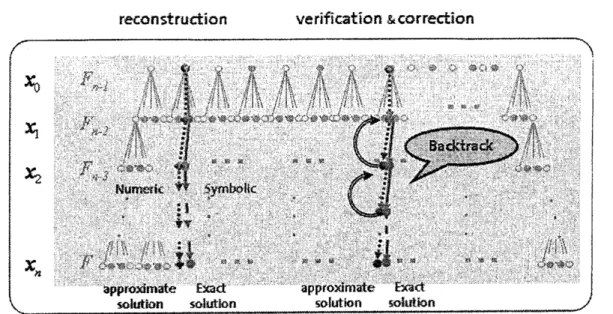
numericalcomputationwithmachineryforvalidatingnumerically computedresultsby reconstructing them exactlywith asmaller number ofsymbolic computations. Some possible computationalflow ofour
schem $\mathrm{e}$inthe lifting phaseisillustrated inFig.1. Thedotted
arrows
and solidarrows
in Fig.l stand for numericalcomputationandsymbolic reconstruction, respectively.Actually computations
over
algebraic extension fieldsare
required in the lifting phase ofCAD to computerespectiveisolatinginterval of algebraicnumbersover
successiveextensionfields. Then whatwe
need todo is “sign determination” ofmany algebraic numbers, i.e., to determine exactlywhether they
reconstruction
$\mathrm{v}\mathrm{e}\mathrm{r}\hat{|}\mathrm{f}\hat{\iota}\mathrm{c}\mathrm{a}\mathrm{t}:’ \mathrm{o}\mathrm{n}\mathrm{a}\mathrm{c}\mathrm{o}\mathrm{r}\mathrm{r}\mathrm{e}\mathrm{c}\mathrm{E}\hat{;}0’$:
Figure1:
CAD
construction- numerical computation with symbolicreconstructiondone byonlynumericalcomputation. Wecheck againthe sign exactly by symbolic computation only for
unreliable numerical results (We callthis symbolic reconstruction,) This isthe ground why
our
method would improve theefficiencyofCAD construction.2.2
Efficient
symbolic
reconstruction
by
using
a
numerical CAD
Moreover we improve the reconstruction procedure by employing a dynamic evaluation technique integrated with successiverepresentationsof algebraicextensions as follows: Algebraic extension is
ex-pressedbya residueclassring$Q[X]/A\mathit{4}$,where$X$isa setofvariables and$M$isa maximal idealin$Q[X]$.
Usually, computation of maximal ideals tends to be very hard. Instead of $\mathbb{Q}[X]/.\Lambda 4$,
we
utilize “lazyrepresentation” $\mathbb{Q}[X]/J$, where$J$is notnecessary maximalbut easily computable. $\mathbb{Q}[X]/J$maynotbe
a
domain, i.e., it couldhavezero
divisors. In the computationover
$\mathbb{Q}[X]/J$, ifagivenalgebraic numberdoes not correspond to azero-divisor,then it is not equalto 0 and we check its sign by usinga certain
numerical method. Ifwemet
some zero
divisors$ab=0$, the wecan
split the ideal Ias follows:$J$$=$ $(J +\langle a\rangle)\cap(J +\langle b\rangle)$.
This decomposition is achieved by $\mathrm{g}\mathrm{c}\mathrm{d}$computation for univariatecase, i.e. simple algebraicextension,
and Grobner basis computation for multivariate
case.
Thus, by using lazy representation successively for towersofextensions,where defining polynomials for algebraicnumbers are used as generators of theideal $J$,
we
do not requireany algebraicfactorization anda
primitiveelement computationfora
simpleextension which
are
often difficult especially in thecase
oftall towers of extensions. Furthermore the most crucial point is thatwe
can
easily chooseone
necessary branch $J$$+\langle a\rangle$ in the decomposition byvirtueofnumericalinformation ofalgebraicnumbers and hence
can prune
unnecessary branches for the3
Concluding
Remarks
Wepresenta newscheme forrealizingefficient CAD based
on
symbolic-numeric computation. Inorder toexa
mine its effectiveness, implementation ofour schem $\mathrm{e}$into SyNRAC, which isa
maple package forsolving real algebraicconstraintsdevelopedat FUJITSULABORATORIESLTD [YA04],isongoing. We
rem
ark that this work also providesoneof prom ising directions for validated numerics for optimization problems.Acknowledgements :This work has been partially supported by CREST, JST (Japan Science and TechnologyAgency).
References
[AHOO] H.Anai andS. Hara. Fixed-structure robustcontrollersynthesisbasedonsigndefinite condi-tion byaspecialquantifier elimination. In Proceedings
of
American ControlConference
2000, pages 1312-1316, 2000.[AP03] H. Anai and P. A. Parrilo. Convex quantifier elimination for semidefinte programming. In Proceedings
of
the 6th International Workshopon
Computer Algebra inScientific
Computing2003. To appear, 2003.
[AY04I H. Anai and K. Yokoyama. Numerical cylindrical algebraic decompositionwith certificated reconstruction. InProceedings
of
11th GAMM-$IMACS$InternationalSymposiumon
Scientific
Computing, ComputerArithmetic, and Validated Numerics (Fukuoka, Japan), page 31, 2004.
[AYSH04] H. Anai, H.Yanami, K.Sakabe, andS. Hara. Fixed-structurerobustcontrollersynthesisbased
onsymbolic-numeric computation: design algorithms with
a
CACSDtoolbox(invited paper). In Proceedingsof
$CCA/ISIC/CACSD$2004
(Taipei, Taiwan), pages1540-1545 2004.[DSW98] A. Dolzmann, T. Sturm, and V. Weispfenning. Real quantifier elimination in practice. In B. H. Matzat, G.-M. Greuel, and G. Hiss, editors, Algorithmic Algebra and Number Theory,
pages 221-247. Springer, Berlin, 1998.
[Duv94] D. DuvaL Algebraic numbers: anexampleof dynamic evaluation. Journal
of
Symbolic Com-putattion, 18:429-445, 1994.[GV96] L. Gonzalez-Vega. Applying quantifier elimination to the Birkhoff interpolation problem. Journal
of
Symbolic Computation, 1996. To appear,[GV98] L. Gonzalez-Vega. A combinatorial algorithm solving
some
quantifier elimination problems. In$\mathrm{B}.\mathrm{F}$. Caviness and $\mathrm{J}.\mathrm{R}$. Johnson, editors, QuantifierElimination and Cylindrical AlgebraicDecomposition, Texts and Monographs in Symbolic Computation, pages 365-375. Springer, Wien, NewYork, 1998.
[Hon93] H. Hong. Quantifier elimination for formulas constrainedby quadratic equations. In Manuel
Bronstein,editor, Proceedings
of
theInternationalSymposiumonSymbolicand Algebraic Com-putation (ISSAC 93), pages264-274, Kiev, Ukraine, July 1993. ACM, ACM Press.$[\mathrm{H}\mathrm{o}\mathrm{n}93\mathrm{b}]$ H.Hong. Efficient method foranalyzing topologyofplane real algebraic
curves.
In Proceedings[LW93] R. Loos and V. Weispfenning. Applying linear quantifier elim ination. The $Comp’\prime xter$ Journal,
36(5):450-462, 1993. Special issueon computational quantifier elimination.
[Rat02] S. Ratschan. Approximate quantified constraint solving by cylindrical box decomposition.
Reliable Computing, 8(1)$:21-42$, 2002.
[SW97] T.Sturmand V. Weispfenning. Rounding and blending ofsolidsbyarealeliminationmethod. In Achim Sydow,editor, Proceedings
of
the 15th IMACS World Congresson
Scientific
Com-putation, Modeling, and AppliedMathematics (IMACS 97), volume 2, pages 727-732, Berlin, August 1997. IM ACS, Wissenschaft
&
Technik Verlag.[Wei88] V. Weispfenning. The complexityoflinear problem $\mathrm{s}$ in fields. Joumat
of
SymbolicComputa-tion, 5(1-2):3-27, February-April 1988.
[Wei96] V. Weispfenning. Applying quantifier elim ination to problems insimulation andoptimization.
TechnicalReport MIP-9607,FMI, UniversitatPassau, D-94030Passau, Germany, April 1996.
To appearinthe JournalofSymbolic Computation.
[Wei97] V.Weispfenning. Quantifierelim ination for real algebra–thequadraticcase andbeyond. Ap-plicable Algebrain Enginee$\mathit{7}\mathrm{z}ng$ Communication and Computing, $8(2):85-101$, February 1997,
[YA04] H. Yanami and H.Anai. Development of$\mathrm{S}\mathrm{y}\mathrm{N}$RAC- formuladescriptionand newfunctions. In
Proceedings