Dynamics
of
entire
functions with
two
singular
values
Shu
nsuke MOROSAWA
Department
of
Mathematics and Information
Science,
Faculty
of
Science,
Kochi
University
and
Masahiko
TANIGUCHI
Graduate School of
Science, Kyoto University
1
Introduction
Form the structural viewpoint, the simplest entire function is a quadratic
polynomial. It has two critical points. One is the point at infinity and is
always asuperattracting fixed point. Hence the behavior of the finite critical
point decides the dynamics onthe complex plain. In this sense, dynamics of
cubic polynomialis decided by twofinite critical points. The family of cubic
polynomials has been investigated by several authors (e.g. [2], [3] and [4]).
In this note, we treat three simplest kinds of entire functions having only
two singular values. They are structurally finite entire functions, which are
definedby Taniguchi in [9].
Definition
1. Cubic (monk centered) polynomials
$P_{a,b}(z)=z^{3}-3a^{2}z+b$.
The critical points are$\pm a$, and the singular (critical) values are$b\mp 2a^{3}$.
We denote by $\mathrm{P}\mathrm{o}1\mathrm{y}_{3}$ the family consisting ofall cubic polynomials.
2. Simply decorated exponential functions
$E_{a,b}(z)=a(z+b)e^{z}$ $(a\neq 0)$.
The single critical point is $-b-1$, and the singular values are 0 and
$-a\exp(-b-1)$. Wedenote by$\mathrm{D}\exp_{1}$ thefamily consistingof allsimply
3.
Complexerror
functions$C_{a,b}(z)=a \int_{0}^{z}e^{-t^{2}}dt+b$ $(a\neq 0)$.
The singular values
are
$\pm aA+b$ with $A^{2}=\pi/4$. We denote by Cerfthe family consisting of all complex error functions.
Definition We denote by
S2
the union of the families $\mathrm{P}\mathrm{o}1\mathrm{y}_{3}$, $\mathrm{D}\exp_{1}$ andCerf.
The second family has been investigated by Morosawa ([5] and [6]) and
others. But the third family
seems
to have been paid almost no attentions.Recently, Morosawa and Taniguchi obtain
some
results on complex errorfunctions (see, [10], [7] and [11]).
2
Classification
of
hyperbolic
Fatou
compo-nents
Let $f$ be a Speiser function, i.e.
a
function having only a finite number ofsingular values, and $\langle$ be an asymptotic value of $f$ in the Fatou set $F(f)$ of
$f$. Then there exists an asymptotic path for
4
in $F(f)$. The Fatoucompo-nent containing such
a
path is called a prelusive component of $f$ for $\langle$.
TheFatou component containing a critical point $c$ of$f$ is also called a prelusive
componentfor the criticalvalue $f(c)$.
Note that a singular value may have several prelusive components for it.
The following Proposition is well-known.
Proposition 1 The immediate basin
for
an attracting cyclic contains atleast
one
prelusive component.We say that aSpeiser function $f$ is hyperbolicif the orbit of every singular
value of $f$ belongs to basins of attracting periodic points. In the
case
ofhyperbolic entire functions in $S_{2_{7}}$ there
are
four kinds of dynamics (cf. [4],[8]$)$
.
Definition We say that a hyperbolic function
f
$\in \mathcal{X}$, where $\mathcal{X}=\mathrm{P}\mathrm{o}1\mathrm{y}_{3}$,$\mathrm{D}\exp_{1}$ or Cerf is
1.
of
adjacent type if there exists a prelusive component $U$ for both ofsingular values and there exists the smallest positive integer $p$ such
that
$f^{p}(U)\subseteq U$,
2.
of
bitransitive type ifthere exist different prelusive components $U_{1}$ and $U_{2}$ and the smallest positive integers $p$ and $q$such that$f^{\mathrm{p}}(U_{1})\subset U_{2}$, $f^{q}(U_{2})\subseteq U_{1}$,
and
we
denote the set of all such $f$ with fixed $p$ and $q$ by $B_{p+q}=$$B_{p+q}(\mathcal{X})$,
3.
of
captured type if there exist two prelusive components $U_{1}$ and $U_{2}$ andthe smallest non-negative integers $p$, $q$, and $t$ such that $U_{1}$ is disjoint
from $\bigcup_{k=0}^{\infty}f^{k}(U_{2})$, $t\geq 1$ with
$f^{t}(U_{1})\cap(_{k=0}^{\infty}\cup f^{k}(U_{2}))\neq\emptyset$
and, $p\geq 0$ and $p+q\geq 1$ with
$f^{t+p}(U_{1})\subset U_{2}$, $f^{p+q}(U_{2})\subseteq U_{2}$,
and we denote the set of all such $f$ with fixed $p$,$q$,$t$ by $C(t)p+q=$
$C_{(t)p+q}(\mathcal{X})$, and
4.
of
disjoint type ifthere exist two prelusive components $U_{1}$ and $U_{2}$ andthe smallest positive integers $p$ and $q$ such that
$f^{p}(U_{1})\subset U_{1}$, $f^{q}(U_{2})\subset U_{2}$,
and
$k=0k=0\cup f^{k}(U_{1})\cap\cup f^{k}(U_{2})=\emptyset\infty\infty$,
and
we
denote that the set of all such $f$ with fixed$p$ and $q$ by $D_{p,q}=$$D_{p,q}(\mathcal{X})$.
Bergweiler [1] pointed out the following.
Theorem 2
if
aforward
invariant Fatou component Uof
a
Speiserfunction
f
contains all the singular valuesof
f, then U is completely invariantCorollary 1 The set $C_{(1)0+1}=C_{(1)0+1}(\mathcal{X})$, where $\mathcal{X}=\mathrm{P}\mathrm{o}1\mathrm{y}_{3\mathrm{r}}$ $\mathrm{D}\exp_{1}$ or
Cerf, is empty.
Next
we
show a criterion for ahyperbolic function being ofcapture type.Theorem 3 Let $f$ be a hyperbolic
function
belonging to $\mathrm{P}\mathrm{o}1\mathrm{y}_{3}$ or Dexpj,Assume
$f$ has a superattractingfixed
point $\zeta_{1}$. Let $\zeta_{2}$ be another singularvalue.
if
there existssome
$N>0$ satisfying $f^{N}(\zeta_{2})=\zeta_{1;}$ then$f$ isof
capture3
Examples
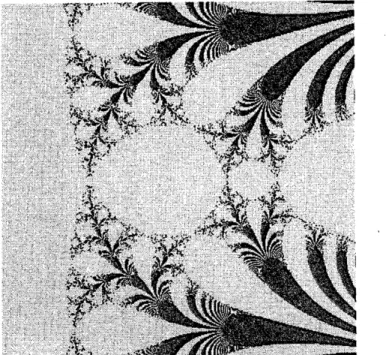
Example 1 Let$E_{-1,-1}(z)=-(z-1)e^{z}$
.
Then $E_{-1,-1}$ is hyperbolic and belongs to $C_{\langle 1)0+2}$
.
Verification.
The function has a critical point 0 and a singular value 0.Since $f(0)=1$ and $f(1)=0_{1}$ it has a superattracting cycle with period two.
Hence it is hyperbolic. By using a graphical analysis, we can find a fixed
point $x\in$ $(0, 1)$ and it is easy to
see
that it is repelling. Hence there exists apoint in $(-\infty, 0)$ which is mapped
on
$x$. Since the Fatou set of $E_{-1,-1}(z)$ issymmetric with respect to the real axis, the prelusive component for 0 does
not contain 0.
Figure 1: The Julia set of $E_{-1,-1}$. The range shown is $|\Re z|<2.4$ and
$|_{S}^{\alpha}z|<2.4$.
Example 2 Assume $a$ and $b$ satisfy
ab $=$ $-b-1$ $be^{b+1}$ $=$ -1.
Then $E_{a}$,$b$ is hyperbolic and belongs to $C_{(2)0+1}$
.
In this case, the prelusivecomponent
for
the asymptotic value is captured by the prelusive componentVerification.
The first equation implies $-b-1$ is a superattracting fixedpoint. Thesecond implies $E_{a,b}(0)=-b-1$. Prom Theorem 3, we obtain the
claim.
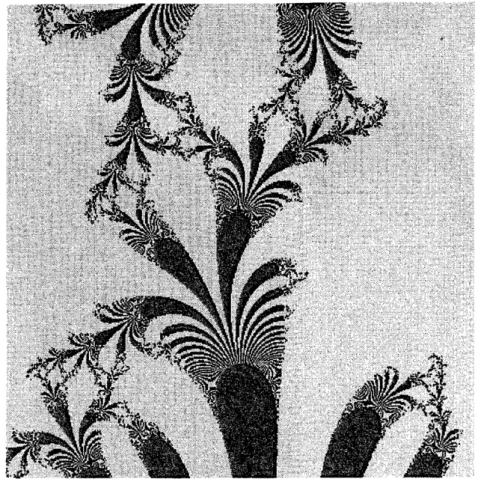
Figure 2: The Julia set of $E_{a,b}$, where $a=-0.952639\cdots+$i0.114414$\ldots$ and
$b=-3.08884\cdots+$i7.46149$\ldots$ which satisfy the equation$1\mathrm{S}$ in Example 2. It
has asuperattracting fixed point 2.08884$\ldots-$i7.46149$\ldots$ . The range shown
is $-7<\Re z<3$ and $-8<sz\triangleright<2$.
Example 3 Assume a and b satisfy
$a$ $=$ $\frac{1}{1+2b}$
$\frac{1}{1+2b}-2b\exp(\frac{3}{2}+b)$ $=$
0.
Then $E_{a}$,$b$ is hyperbolic and belongs to $C_{(2)0+1}$. In this case, the prelusive
component
for
the critical value is captured by the prelusive componentfor
the asymptotic value.
Verification.
The first equation implies 1/2 is anattracting fixed point. TheFigure 3; The Julia set of $E_{a,b}$, where $a=$
-0.0605096
– and $b=$-5.51185 $\ldots$ which satisfythe equations in Example 3. It has
an
attractingfixed point 1/2. The range shown is $-2<\Re z<6$ and $|\Leftrightarrow sz|<3$.
Example 4 Let
$C_{a,b}(z)=a \int_{0}^{z}e^{-w^{2}}dw+b$,
with $a=1.41055+\mathrm{i}1$,23448 and $b=-0.121077-$ 20.8811. Then it belongs to $C_{(2)0+1}$.
References
[1] W. Bergweiler, oral communications.
[2] B. Branner, The parameter space
for
cubic polynomials, ChaoticDy-namics and Fractals, Academic Press, (1996),
169-179.
[3] B. Branner and J. Hubbard, The iteration
of
cubic polynomials, Part I:Acta Math. 160, (1988),
143-206.
Part ILActaMath. 169,(1992),229-325.
[4] J. Milnor, Remarks
on
iterated cubic maps, Experimental Math. $1_{7}$Figure 4: The Julia set of$C_{a,b}$. Ithas an attractingfixed point
0.8910492
\cdots-i0.0372985\cdots. Its asymptotic values are $a_{1}=1.12899$\cdots --i0.2129294$\cdots$
and $a_{2}=-1.371144$\cdots -i1.975129\cdots . The immediate basin is the prelusive
component for $a_{1}$ and $C_{a,b}^{2}(a_{2})$ is contained in it. The range shown is $-2.3<$
$\Re z<1.7$ and $-2.4<\triangleright sz$ $<1.6$.
[5] S. Morosawa, Note on the iteration
of
$f_{\ell\iota}(z)=z\exp(z+\mu)$, Sci. Bui.Josai. Univ., Special Issue 4(1998), 11-16.
[6] S. Morosawa, Local connectedness
of
Julia setsfor
transcendentalen-tirc functions, Proceedings of the International Conference
on
Nonlin-ear
Analysis and Convex Analysis (eds. W. Takahashi and T. Tanaka),World Scientific, November 1999,
266- 273.
[7] S. Morosawa, Fatou components whose boundaries have a
common
[8] M. Rees, Components
of
degree two hyperbolic rational maps, Invent.Math. 100, (1990),
357-382.
[9] M. Taniguchi, Maskit surgery
of
entire functions, RIMS Kokyuroku1220, (2001),
7-16.
[10] M. Taniguchi, Synthetic
defor
mation spacesof
an
entire function,Con-temporary Math,, 303, (2002),
107-136.
[11] M. Taniguchi, Geometric compactification