An introduction
to
stochastic
processes
associated
with
resistance
forms
and their
scaling
limits
D. A.Croydon
*February
3,
2017Abstract
Weintroduce andsummariseresults from therecent paperScalinglimits of stochasticprocesses
associated withresistanceforms
[5],
and alsoapplicationsfromTime‐changesofstochasticprocessesassociated with resistance forms
[9],
whichwaswrittenjointlywithT.Kumagai(Kyoto University)
andB. M.Hambly
(University
ofOxford).
1
Introduction
Theconnectionsbetween
electricity
andprobability
aredeep,
and haveprovided
manytools for under‐standing
the behaviour of stochasticprocesses. In thisnote,wedescribea newresultinthis direction from[5],
which statesthatifasequenceofspacesequipped
with so‐called resistance metrics andmeasuresconvergewithrespecttothe
Gromov‐Hausdorff‐vague topology,
then the associated stochasticprocessesalso converge.
(In
thenon‐compactcase,theproof
in[5]
alsorequires anon‐explosion
condition.)
All the relevant concepts will be introduced morecarefully below,
with the statement of the main resultappearingasTheorem 4.1.
This result
generalises previous
workontrees,fractals,
andvariousmodels of randomgraphs
(apart
fromthebackground
in[5],
seealso[2,
14Moreover,
it isusefulinthestudy
oftime‐changed
processes,including
Liouville Brownianmotion, the Bouchaudtrapmodel and the random conductancemodel,
onsuchspaces
[9].
Some of theseexamples
will be sketchedinSection 5. Ifurtherconjecture
that the resultwill be
applicable
tothe random walkontheincipientinfinite clusterof criticalbondpercolation
onthehigh‐dimensional
integerlattice(see
Section5.2).
2
Random
walks
ongraphs
and
electrical networks
Before
introducing
the definition ofa resistance metric and associated stochasticprocesson ageneral
space,it is
helpful
torecall themoreelementary
definition of effectiveresistanceand thecorresponding
randomwalkon a
graph.
Thisisthepurposeof thepresentsection.Westartwith the definition ofarandom walkon a
weighted graph.
Inparticular,
letG=(V, E)
beafinite,
connectedgraph, equipped
with(strictly
positive,symmetric)
edge
conductances(c(x, y))_{\{x,y\}\in E}.
Let $\mu$beafinitemeasureon Vof
full‐support.
We then define the associated random walkX tobe thecontinuous timeMarkov chain withgenerator\triangle,asdefined
by:
( $\Delta$ f)(x):=\displaystyle \frac{1}{ $\mu$(\{x\})}\sum_{y:y\sim x}c(x, y)(f(y)-f(x))
, *where thesumisoververticesyconnectedtox
by
anedge
inE, i.e. thisistheprocessthatjumpsfromx to ywithrate
c(x, y)/ $\mu$(\{x\})
. Notethatthe transitionprobabilitiesof thejumpchainof X aregivenby
P(x, y)=\displaystyle \frac{c(x,y)}{c(x)},
where
c(x)
:=\displaystyle \sum_{y:y\sim x}c(x, y)
, andso arecompletely
determinedby
the conductances. Themeasure $\mu$determines the
time‐scaling
of the process. Common choices areto take$\mu$(\{x\}) :=c(x)
, whichistheso‐called constant
speed
random walk(CSRW),
or$\mu$(\{x\}):=1
,whichis the the variablespeed
randomwalk
(VSRW).
As illustratedby
theexample presented
inSection5.4,the lattertwo processescanhavequitedifferent behaviourifthe conductancesare
inhomogeneous.
Suppose
now we view G as an electrical network withedges assigned
conductancesaccording
to(c(x, y))_{\{x,y\}\in E}
. If vertices in the network are heldaccording
to thepotential
f(x)
, then the total
electricalenergy
dissipated
inthenetwork isgiven
by
\mathcal{E}(f, f)
,where\mathcal{E} isthequadratic
formonVgiven
by
\displaystyle \mathcal{E}(f, g):=\frac{1}{2}\sum_{x,y:x\sim y}c(x, y)(f(x)-f(y))(g(x)-g(y))
.Moreover, regardless
of theparticular
choice of $\mu$,\mathcal{E}isaDirichletform
onL^{2}(V, $\mu$)
, andcanbewrittenas
\displaystyle \mathcal{E}(f, g)=-\sum_{x\in V}( $\Delta$ f)(x)g(x) $\mu$(\{x\})
.Using
the classicalcorrespondence
between Dirichlet forms and reversible Markov processes, itfollowsthat there is aone‐to‐one
correspondence
between the electricalenergy \mathcal{E}(viewed
as aDirichlet formon
L^{2}(V, $\mu$))
and the random walk X.(For
the definition ofaDirichletform,
andbackground
ontheconnectionsbetween such
objects
and Markovprocesses,see[10].)
Suppose
nowthatwewishedtoreplace
ournetworkby
asingle
resistorbetweentwoverticesxandy.The resistanceweshouldassignto thisresistortoensurethat thesameamountofcurrentflows fromx
toywhen
voltages
areapplied
tothemasdidintheoriginal
networkisgiven by
theeffective
resistance,whichcanbe
computed by setting
R(x, y)^{-1}=\displaystyle \inf\{\mathcal{E}(f, f):f(x)=1, f(y)=0\}
for
x\neq y
, andR(x, x)=
O.Although
it is not immediate from thedefinition,
it ispossible
tocheckthat RisametriconV, e.g.
[16],
and characterises theedge
conductancesuniquely,
e.g.[13].
The latterobservationis important, because it means
that,
given an effective resistanceR on agraph,
one canreconstructthe
corresponding
electricalenergyoperator\mathcal{E}.Thus,
ifoneisalsogiven
a measure $\mu$,thenby viewing
\mathcal{E} as aDirichlet formonL^{2}(V, $\mu$)
asinthepreviousparagraph
wealsorecovertherandomwalkX.
In summary,wehave the
following correspondences:
Random walkX, \leftrightarrow Dirichlet form8 \leftrightarrow Effectiveresistance R
generator $\Delta$ on
L^{2}(V, $\mu$)
andmeasure $\mu$.3
Resistance
metrics
and forms
Building
on the discussion of theprevious section, it isnowstraightforward
to introducearesistance metric on ageneral
space. Afterpresenting thedefinition,
we thenexplain
thetheory developed by
Kigami
inthecontextofanalysis
onlow‐dimensional fractals that linksresistancemetrics and stochasticprocesses
(see [14, 15]
fordetails).
Definition3.1
([14,
Definition2.3.2]).
Let F beaset. Afunction
R:F\times F\rightarrow \mathbb{R}is aresistance metricif, for
everyfinite
V\subseteq F, one canfind
aweighted
(
i.e.equipped
withconductances)
graph
withvertex setAssomefirst
examples
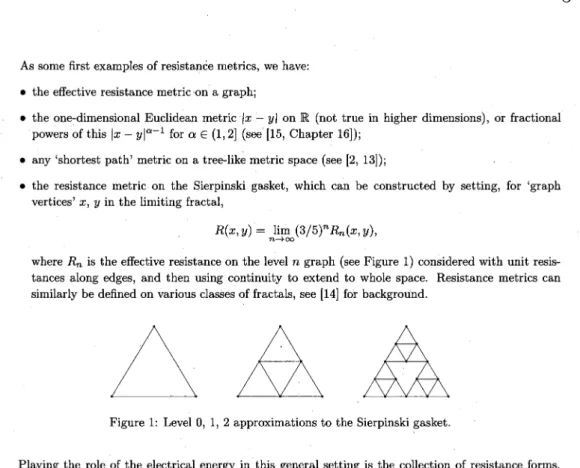
ofresistancemetrics,wehave:\bullet the effectiveresistance metricon a
graph;
\bullet the one‐dimensional Euclidean metric
|x-y|
on\mathbb{R}(not
trueinhigher
dimensions),
or fractionalpowersof this
|x-y|^{ $\alpha$-1}
for$\alpha$\in(1,2] (see [15,
Chapter
160 any(shortest
path
metricon atree‐likemetricspace(see [2,
13\bullet the resistance metric on the
Sierpinski gasket,
which can be constructedby
setting, forgraph
vertices x, yinthe
limiting fractal,
R(x, y)=\displaystyle \lim_{n\rightarrow\infty}(3/5)^{n}R_{m}(x, y)
,whereR_{m} isthe effectiveresistanceonthe leveln
graph
(see
Figure
1)
considered withunit resis‐tances
along edges,
and thenusing continuity
toextend towholespace. Resistance metrics cansimilarly
be definedonvariousclasses offractals,
see[14]
forbackground.
Figure
1: Level0, 1,2approximationstotheSierpinski gasket.
Playing
the role of the electricalenergy inthisgeneral setting
isthe collection ofresistanceforms. Wenow statethe definition of suchobjects.
Whilst this is quitetechnical andwewill not discuss the role of thevariousconditionsindetailhere, importantly
itgives
aroute to connecttheresistance metricwith astochasticprocess.
Definition 3.2
([14,
Definition2.3.1]).
Let F be a set. Apair(\mathcal{E}, \mathcal{F})
is a resistanceform
on Xif
itsatisfies
thefollowzng
conditions:RF1 \mathcal{F} is alinear
subspace of
the collectionoffunctions
\{f:F\rightarrow \mathbb{R}\}
containing constants, and\mathcal{E} isanon‐negative symmetric
quadratic form
on\mathcal{F} such that\mathcal{E}(f, f)=0
if
andonly if f
is constanton F.RF2 Let\sim be the
equivalence
relation on\mathcal{F}defined by saying f\sim g if
andonly if f-g
is constanton F. Then(\mathcal{F}/\sim, \mathcal{E})
is aHilbertspace.RF3
If
x\neq y
, then there exists anf\in \mathcal{F}
such thatf(x)\neq f(y)
.RF4 Forany x,
y\in F,
\displaystyle \sup\{\frac{|f(x)-f(y)|^{2}}{\mathcal{E}(f,f)}:f\in \mathcal{F}, \mathcal{E}(f, f)>0\}<\infty.
RF5If
\overline{f}:=(f\wedge 1)\vee 0
, thenf\in \mathcal{F}
and\mathcal{E}(\overline{f},\overline{f})\leq \mathcal{E}(f, f)
for
anyf\in \mathcal{F}.
The
following
theoremconnectsthenotionsofaresistance metricandaresistanceform,
andyields
the stochasticprocessthat will be ofinterest inthe remainder of the article. Inparticular,
itexplains
how the
correspondences
stated at the end of theprevioussectionextendto themoregeneral
presentsetting. For
simplicity
of the statement,we restrictto thecompactcase. Itisalsopossible
to extend the resulttolocally
compactspaces,though
thisrequiresa morecarefultreatmentof the domain of the Dirichlet form.Theorem 3.3
([14,
Theorems2.3.4,2.3.6], [15,
Corollary
6.4 andTheorem9.4]). (a)
Let F be aset.There is a one toone $\omega$
wespondence
between resistance metrics and resistanceforms
on F. This ischaracterised
by
the relation:R(x, y)^{-1}=\displaystyle \inf\{\mathcal{E}(f, f):f(x)=1, f(y)=0\}
(3.1)
for x\neq y
, andR(x, x)=0.
(b)
Suppose
(F, R)
iscompactresistance metricspace, and $\mu$ is afinite
Borelmeasureon Foffull
support. Then thecorresponding
resistanceform
(\mathcal{E}, \mathcal{F})
is aregular
Dirichletform
onL^{2}(F, $\mu$)
, andsonaturally
associated withaHuntprocess
((X_{t})_{t\geq 0}, (P_{x})_{x\in F})
.Asafirst
example
oftheconnectionbetweenaresistance metricandastochasticproCess(beyond
theexample
of random walksongraphs already
discussed),
considerF=[0
,1],
R=Euclidean,
and $\mu$beafinite Borelmeasureoffullsupporton
[0
,1]
. Define\displaystyle \mathcal{E}(f, g)=\int_{0}^{1}f'(x)g'(x)dx, \forall f, g\in \mathcal{F},
where \mathcal{F}=
{f\in C([0,1])
:f
isabsolutely
continuous andf'\in L^{2} (dx)}.
Then(\mathcal{E}, \mathcal{F})
isthe resistanceform associated with
([0,1], R)
.Moreover,
(\mathcal{E}, \mathcal{F})
isaregular
Dirichlet formonL^{2}( $\mu$)
.
Integrating by
parts
yields
\displaystyle \mathcal{E}(f, g)=-\int_{0}^{1}(\triangle f)(x)g(x) $\mu$(dx) , \forall f\in \mathcal{D}(\triangle) , g\in \mathcal{F},
where
Af
=\displaystyle \frac{d}{d $\mu$}
‐df,
and\mathcal{D}(\triangle)
contains thosef
such that:f'
existsanddf'
isabsolutely
continuous withrespectto $\mu$,
$\Delta$ f\in L^{2}( $\mu$)
,andf'(0)=f'(1)=0
. Fromthis,
we seethat if$\mu$(dx)=dx
, then the Markov
process
naturally
associated with $\Delta$ isreflected Brownian motion on[0
,1]
.(For
moregeneral
$\mu$, therelevant process is
simply
atime‐change
ofBrownianmotionaccording
toRevuz measure $\mu$.)
Taking
R(x, y)=|x-y|^{ $\alpha$-1}
for$\alpha$\in(1,2],
we canalso obtain $\alpha$‐stableprocessesinthis way(see [15,
Chapter
16
4
Scaling
limit
result
In thissection,wewillpresenta
simplified
versionof the result establishedin[5],
theaim ofwhichwastoestablish
scaling
limits of stochasticprocesseg
associatedwith resistanceforms. In the fullresult,
\mathrm{a}non‐explosion
conditionwasprovided
to extend from thecaseofcompactspacesthatweconsider here.Moreover,
the resultwas alsoadapted
torandomspaces, andincorporated spatial
\mathrm{e},mbeddings.
In[9]
\mathrm{a} similar resultwasproved
undermorerestrictive\mathrm{v}\mathrm{o}}\mathrm{u}\mathrm{m}\mathrm{e}growth
conditions,whichwereapplied
tofurther deduceaconvergencestatementregarding
the localtimesof theprocesses inquestion.Tointroduce the result
precisely,
letusfix the framework. Inparticular,
wewrite\mathbb{F}_{c}
for the collection ofquadruples
of the form(F, R, $\mu$, $\rho$)
, where: F isanon‐empty set; RisaresistancemetriconF suchthat
(F, R)
iscompact; $\mu$ isalocally
finite Borelregular
measureof fullsupport on(F, R)
; and p isa markedpointin F. Werecall thatsaying
asequenceof suchspaces converges inthe(marked)
Gromov‐Hausdorff‐Prohorov
topology
tosomeelement of\mathrm{F}_{c}if all thespacescanbeisometrically
embeddedintoa commonmetricspace
(M, d_{M})
insuch awaythat: the embedded sets convergewith respect to theHausdorff
distance,
the embeddedmeasuresconvergeweakly,
and the embedded markedpointsconverge.The
following
result establishesthat,
ifsuch convergence occurs, then we also obtain convergence ofstochasticprocesses.
Theorem4.1
(cf. [5,
Theorem1.2]).
Suppose
that thesequence(F_{n}, R_{\triangleleft n}, $\mu$_{n}, $\rho$_{n})_{n\geq 1}
in\mathrm{F}_{c}satisfies
(F_{n}, R_{m},$\mu$_{n}, $\rho$_{n})\rightarrow(F, R, $\mu,\ \rho$)
(4.1)
inthe(marked)
Gromov‐Hausdorff‐Prohorov topology for
some(F, R, $\mu$, $\rho$)\in \mathbb{F}_{c}
. Itis thenpossible
toisometrically
embed(F_{n}, R_{m})_{ $\gamma \iota$\geq 1}
and(F, R)
intoa common metric space(M, d_{M})
insuch awaythatweakly
asprobability
measures onD(\mathbb{R}_{+}, M) (that
is, the spaceof cadlag
processes on Mequipped
with the usual SkorohodJ_{1}‐topology),
where((X_{t}^{n})_{t\geq 0}, (P_{x}^{n})_{x\in F_{n}})
isthe Markovprocesscorresponding
to(F_{n}, R_{n}, $\mu$_{n}, $\rho$_{n})
and((X_{t})_{t\geq 0}(P_{x})_{x\in F})
is the Markovprocesscorresponding
to(F, R, $\mu$, $\rho$)
.Ofcourse,
given
thecorrespondence
betweenmeasuredresistance metricspaces and stochasticpro‐cesses,as describedinSection3, one
might intuitively
expectthat Gromov‐Hausdorff‐Prohorovconver‐gencewill
give
us all the informationweneedto obtainprocess convergence. To turn thisexpectation intoaproof
we usethe factthat,
for aprocessassociated with aresistancemetric,wehaveanexplicit
formula foritsresolvent kernel.(This
starting pointwasinfluencedby
theoneusedasthe basis of thecorresponding
argumentfortrees in[2].)
Inparticular,
for(F, R, $\mu$, $\rho$)\in \mathrm{F}_{\mathrm{c}}
,letG_{x}f(y)=E_{y}\displaystyle \int_{0}^{$\sigma$_{x}}f(X_{s})ds
be the resolvent ofX killed on
hitting
x wherewe have written $\sigma$_{x} for thehitting
time ofx.(NB.
Processesassociated withresistanceforms hitpoints;the aboveexpressioniswell‐defined and
finite.)
We then have thatG_{x}f(y)=\displaystyle \int_{F}g_{x}(y, z)f(z) $\mu$(dz)
where the resolvent kernel isgiven
by
g_{x}(y, z)=\displaystyle \frac{R(xy)+R(xz)-R(yz)}{2}.
(See [15,
Theorem4.3].)
In viewof thisexpression,themetricmeasureconvergence at(4.1)
readily
givesconvergenceof resolvents.
Relatively
standard argumentssubsequently yield semigroup
convergence,whichinturn
gives
convergenceof finite dimensional distributions.Togetfromconvergenceof finite dimensional distributionstoconvergence in
D(\mathbb{R}_{+}, M)
, it remainstocheck
tightness
of theprocesses. Forthis,
weagain
appeal
toanexplicit
expressionforaresolventintermsof resistance. In
particular,
wehave foranyclosedsetA thatg_{A}(yz)=\displaystyle \frac{R(y,A)+R(z,A)-R_{A}(y,z)}{2},
whereg_{A} is theresolvent kernel for theprocessX killedon
hitting
thesetA andR_{A}(y, z)
istheresistancefromy tozwhen theset Ais \mathrm{s}\mathrm{h}\mathrm{o}\mathrm{r}\mathrm{t}\mathrm{e}\mathrm{d},i.e. in
defining
the resistancebetween yandzsimilarly
to(3.1),
weconsider
only
functions thatareconstantonA.(Again,
see[15,
Theorem4.3].)
Fromthis,
andusingthatX admits local times
(L_{t}(x))_{x\in F,t\geq 0}
(see
[9
Lemma2.4])
thatsatisfy
E_{y}L_{ $\sigma$ A}(z)=g_{A}(y, z)
where$\sigma$ Aisthe
hitting
timeof A one canestablishviaMarkovsinequality
ageneral
exittime estimateof theform:
\displaystyle \sup_{x\in F}P_{x}(\sup_{s\leq t}R(xX_{s})\geq $\epsilon$)\leq\frac{32N(F, $\epsilon$/4)}{ $\epsilon$}( $\delta$+\frac{t}{\inf_{x\in F} $\mu$(B_{R}(x $\delta$))})
where
B_{R}(x $\delta$) :=\{y\in F : R(x, y)< $\delta$\}
, andN(F, $\epsilon$)
is the minimalsize ofan $\epsilon$ coverof F(see [5
Lemma
4.3]).
Theexactform of thisexpression
is notespecially
important.Rather,
thecrucialfactoristhe
straightforward dependence
onsimply
metric‐measurequantities. Asaconsequence,wefind thatif(4.1)
holds,
then\displaystyle \lim_{t\rightarrow 0}\lim\sup_{xn\rightarrow\infty}\sup_{\in F_{n}}P_{x}^{n}(\sup_{\mathrm{s}\leq t}R_{m}(x, X_{s}^{n})\geq $\epsilon$)=0.
Tightness
of thesequenceX^{n} is thenastandardapplication
ofAldoustightness
criterion[12
Theorem 16.10and16.11].
5
Applications
To
complete
thisoverview,
we present severalexamples
to which the resistance metric frameworkis5.1 Trees
Considerasequenceof
graph
trees(T_{n})_{n\geq 1}
,whereT_{n}hasvertex setV(T_{n})
,shortestpath graph
distanceR_{n}
(noting
that this isaresistancemetric),
counting
measureonthe vertices$\mu$_{n}(placing
mass one oneach
vertex),
androot$\rho$_{n}.Suppose
that forsomenullsequences(a_{n})_{n\geq 1}, (b_{n})_{n\geq 1}
(V(Tn), a_{n}R_{m}, b_{ $\tau \iota$}$\mu$_{n}, $\rho$_{n})\rightarrow(TR, $\mu \rho$)
for somelimit in
\mathrm{F}_{c}
.(NB.
Under the assumptionsstated,
(TR)
is aso‐called realtree,
which isanaturalmetric space
analogue
ofagraph
tree.)
It then holds that(X_{ta_{ $\tau \iota$}b_{n}}^{T_{n}})_{t\geq 0}\rightarrow(X_{t}^{T})_{ $\iota$\geq 0},
whereX^{T_{ $\tau \iota$}} is the random walk associated with
(V(Tn), R_{m}$\mu$_{n}$\rho$_{n})
.(Here
andintheexamples below,
for the statementwesupposethestate spacesare
suitably isometrically
embeddedintoa commonmetricspace.)
Inparticular,
distributionalversions of theresult hold for:Critical Galton‐Watsontreeswith finitevarianceconditionedonsize,
a_{n}=n^{1/2}b_{n}=n
. Versionsof the result for infinitevarianceGalton‐Watsontreesalso
hold,
see[7].
The
(non‐lattice)
branching
randomwalk,
where theunderlying
tree isacritical Galton‐Watson treewithexponential
tails for theoffspring distribution,
and thestepshaveacentred,
continuous distribution with fourth orderpolynomial
taildecay
[6].
\mathrm{e} \mathrm{A}‐coalescentmeasuretrees
[
2 Section7.5].
The uniformspanningtreein two
dimensions,
a_{n}=n^{5/4}b_{n}=n^{2} (this
wasproved subsequentially
in[3],
andthefullconvergencefollows from[11]).
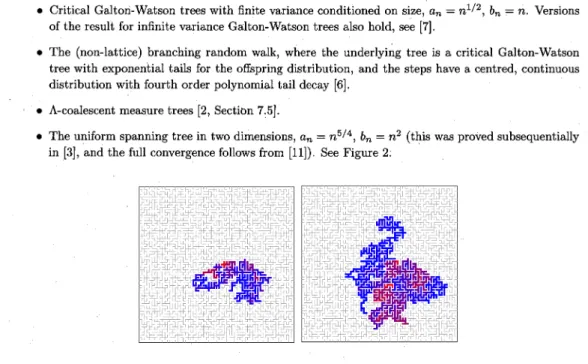
SeeFigure
2;‐c
:.\vdash--\cdot ‐
Figure
2: Therangeofarealisation of thesimple
random walkonuniformspanningtreeon a 60\times 60box
(with
wiredboundary
conditions),
shown after 5,000and50,000 steps. Frommost to least crossededges,
colours blend from redtoblue. Picture: Sunil Chhita.5.2
Conjecture
for criticalpercolation
One model for whichan
appealing
conjecturecanbe made istheincipientinfinite cluster of bond per‐colation on
\mathbb{Z}^{d}
inhigh dimensions,
that is, when d>6. Inparticular,
it isexpected
thatthis modelsatisfies thesame
scaling
propertiesasbranching
randomwalk,and thusonemight anticipate
that ifIICistheincipient infinite cluster
(see [17]
for aconstruction),
R_{\mathrm{I}\mathrm{I}\mathrm{C}} isthe resistancemetric.onthis(when
individualedges
haveunitresistance)
and$\mu$_{\mathrm{I}\mathrm{I}\mathrm{C}} isthecountingmeasure onIIC,then the rescaledsequencesatisfiesa
locally
compact,distributionalversionof(4.1),
with limitbeing
(an
unboundedversionof)
thecontinuumrandomtree,andsothe associated random walksconvergetoBrownianmotiononthe latter
space, cf. theconjectureof
[6].
See also therecent work of[4]
regarding
the latticebranching
randomwalk.
5.3
Critical random
graph
One critical
percolation
model thatcanalready
be tackled with Theorem 4.1 isthat onthecomplete
graph.
Inparticular,
letG(n1/n)
be theErdós‐Rényi
randomgraph
atcriticality,
whichisobtainedby
runningbond
percolation
withedge
retentionprobability
1/n
onthecomplete graph
withnvertices. Forthe
largest
connectedcomponentC_{1}^{n}
ofG(n1/n)
itcanbe checkedthat(C_{1}^{n}, n^{-1/3}R_{m}, n^{-2/3}$\mu$_{n}p_{n})\rightarrow(FR $\mu \rho$)
where the
limiting
spacecanbe describedexplicitly,
cf.[1].
Hence,
asoriginally proved
in[8],
(X_{tn}^{n})_{t\geq 0}\rightarrow(X_{t})_{t\geq 0}.
5.4
Heavy‐tailed
random conductancemodel
onfractals
Finally,
consider theSierpinski gasket graphs
shown inFigure
1.Suppose
thatweequiptheedges
ofthese
graphs
withrandom,
i.i.\mathrm{d}.edge
conductances thatsatisfy
P(c(x,y)\geq u)=u^{- $\alpha$}
forsome
$\alpha$\in(0,1)
. Onecanthen check thatresistancehomogenises,
inthesensethat, almost‐surely,
(V_{n}(3/5)^{n}R_{n})\rightarrow(F, R)
,inthe Gromov‐Hausdorff
topology,
where: V_{n}isthevertex setof the nth levelgraph,
R_{m}isthe effectiveresistanceassociated with the random
conductances,
F istheSierpinski gasket,
and(up
toadeterministicconstant)
R is the effectiveresistanceontheSierpinski gasket
introducedabove,
see[9].
Recall from Section 2 that theVSRW associated with
(V_{n}R_{m})
which has transition rates$\lambda$_{xy}=
c(x, y)
istheprocesscorresponding
to(V_{n}R_{m}$\mu$_{n})
where$\mu$_{n}(\{x\})=1
. Since3^{-n}$\mu$_{n}\rightarrow $\mu$
, where $\mu$ is(\ln 3/\ln 2)
‐dimensional Hausdorffmeasure onSierpinski gasket,
itfollows thatp the VSRW X^{n} convergestothe standard Brownian motiononthe
gasket,
X say:(X_{t5^{\mathfrak{n}}}^{n})_{t\geq 0}\rightarrow(X_{t})_{t\geq 0}.
On the other
hand,
the associated CSRW has transition rates$\lambda$_{xy}=c(xy)/c(x)
wherec(x):=
\displaystyle \sum_{y:y\sim x}c(x, y)
. Thiscorresponds
to the space(V_{n}R_{m}, \mathrm{v}_{n})
where$\nu$_{n}(\{x\})=c(x)
:Similarly
to the convergenceofi.i.\mathrm{d}.sumsto $\alpha$‐stablesubordinators,
itfurther holds that$\nu$_{n}:=3^{-n/ $\alpha$}\displaystyle \sum_{x\in V_{f}}c(x)$\delta$_{x}\rightarrow $\nu$=\sum_{i}v_{i}$\delta$_{x_{i}},
in
distribution,
where\{(v_{i}, x_{i})\}
isaPoissonpoint processon(0, \infty)\times F
withintensity
cv^{-1- $\alpha$}dv $\mu$(dx)
(for
some deterministic constant c).
Hence the \mathrm{C}\mathrm{S}\mathrm{R}\mathrm{W}Y^{n}say,(and
indeeditsjump chain, which issimply
the discretetimesimple
random walkamongstthesameconductances)
converges:(Y_{t(5/3)^{n}3^{n/ $\alpha$}}^{n})_{t\geq 0}\rightarrow(Y_{t})_{t\geq 0},
where the
limiting
process\mathrm{Y}isthe so‐calledFontes‐Isopi‐Newman
(FIN)
diffusiononthelimiting fractal,
which is the
time‐change
of the Brownian motionXaccording
to Revuz measure \mathrm{v}. Theprocess Yspends
positivetimeat atomsof $\nu$ which demonstrates thepersistenceof thetrapping
onedges
ofhigh
conductance of the CSRWinthe limit
(a
phenomenon
which the result of thepreviousparagraph
showsReferences
[1]
L.Addario‐Berry,
N.Broutin,
and C.Goldschmidt,
The continuumlimitof
critical randomgraphs,
Probab.
Theory
Related Fields 152(2012)
no. 3-4367-406.[2]
S.Athreya,
W. \mathrm{L}"\""{o}" \mathrm{h}\mathrm{r} andA.Winter,
Invarianceprinciple for
variablespeed
random walks on trees, Ann.Probab.,
toappear.[3]
M.T.Barlow,
D.A.Croydon,
andT.Kumagai, Subsequential scaling
limitsof simple
random walk onthe two‐dimensionaluniform
spanning tree,45(2017)
no. 1,4‐55.[4]
G. BenArous,
M.Cabezas,
andA.Fribergh,
Scaling
limitfor
theant inasimple labyrinth, preprint
availableatarXiv: 1609.03977.[5]
D.A.Croydon, Scaling
limitsof
stochasticprocessesassociatedwithresistanceforms
preprintavail‐ ableat arXiv: 1609.05666.[6]
—,Hausdorff
measureof
arcs and Brownian motion onBrownianspatial
trees,Ann. Probab.37
(2009)
no. 3 946−978.[7]
— Scaling
limits.for simple
random walksonrandom orderedgraph
trees,Adv.inAppl.
Probab.42
(2010)
no.2 528−558.[8]
—Scaling
limitfor
the randomwalkonthelargest
connectedcomponentof
thecritical randomgraph,
PubLRes. Inst. Math. Sci.48(2012)
no. 2 279−338.[9]
D. A.Croydon,
B. M.Hambly,
and T.Kumagai, Time‐changes of
stochasticprocesses associatedwithresistance
forms,
preprint availableatarXiv:1609.02120.[10]
M.Fukushima,
Y.Oshima,
andM.Takeda,
Dinichletforms
and symmetricMarkovprocesses, ex‐ tendeded.,
deGruyter
StudiesinMathematics,
vol. 19, Walter deGruyter
&Co.,
Berlin,2011.[11]
N..Holden and X.Sun,
SLE as amating
of
trees in Eudidean geometry, preprint available atarXiv: 1610.05272.
[12]
O.Kallenberg,
Foundationsof
modernprobability,
seconded., Probability
anditsApplications
(New
York),
Springer Verlag,
NewYork,
2002.[13]
J.Kigami,
Harmonic calculusonlimitsof
networks anditsapplication
todendrites,
J. Funct. Anal.128
(1995)
no. 1 48−86.[14]
—Analysis
onfractals, Cambridge
Thacts inMathematics,
vol.143, Cambridge University
Press, Cambridge,
2001.[15]
—, Resistanceforms,
quasisymmetricmaps andheat kernelestimates,Mem.Amer. Math. Soc.216