sentences in Seoul Korean: a preliminary
study
Akira U
T SUGI(Graduate School, University of Tsukuba)
key words: Seoul Korean, prosody, intonation, phrasing, K-ToBI1
Introduction
In the joint research I conducted with K. Mimatsu (Mimatsu and Utsugi 2002; hereafter M&U), the fundamental structure of Seoul Korean prosody is exam-ined. The data examined in M&U was only a part of what has actually been recorded. Although the rest of the collected data has been recorded as a pre-liminary survey, it will provide good material for the study of Seoul Korean prosody. Thus, in this paper, I describe these data1.
The next subsection overviews previous studies on Seoul Korean prosody, focusing on Jun (1993) and subsequent studies2.
1.1 Previous studies
One of the most influential studies on Seoul Korean prosody is a work by S.-A. Jun (Jun 1993). In this work, she introduces a framework of Intonational Phonology into the area of Seoul Korean prosody and establishes a model for the prosody. In her model, Seoul Korean prosody consists of two levels of phrase, the Accentual Phrase (AP) and the Intonational Phrase (IP). The AP is a phrase determined by tones3. When a phrase consists of two syllables or fewer, it has LH tones. When it consists of four syllables or more, it has LHLH tones. The IP is a phrase that consists of several APs and ends in a boundary 1I would like to thank Prof. Kunihiro Mimatsu for permitting me to use the data originally
recorded for joint research.
2For studies before Jun (1993), see M&U.
3What is more, AP is a domain for the lenis obstruents voicing in her model. According to her
model, the lenis obstruents are voiced inside an AP and are voiceless at the initial position of an AP.
tone.
This model has been applied to a prosodic labeling convention called K-ToBI (Korean K-ToBI), which shares the essential framework with other K-ToBI (Tones and Break Indices) systems such as the original ToBI developed for En-glish prosody (Silverman et al. 1992) and J ToBI for Japanese prosody (Ven-ditti 1995). K-ToBI has been revised a few times, and the latest version (Ver-sion 3.1) was presented in 2000 (Jun 2000). In the K-ToBI system, tones are labeled in the similar way to Jun (1993) in the phonetic tone tier. For example, LHLH tones of an AP in Jun (1993) are labeled L +H L+ Ha in K-ToBI4.
Although K-ToBI has the same basic idea as Jun’s original model, it has a number of differences from the original model, which reflects findings after Jun (1993). For example, while the original model identifies only one type of tone at the AP boundary, such as H, K-ToBI distinguishes two tones, Ha and La. In addition, while Jun (1993) states that the H tone at the AP-medial position appears on the second syllable of the AP, K-ToBI identifies the +H tone that can sometimes appear on the third syllable instead of in the normal position of the second syllable.
Jun (1993)’s model is examined by M&U, which investigates the pitch and duration of declarative sentences in Seoul Korean. As for pitch, the data ob-tained from the experiments agree with Jun’s model, in which the Accentual Phrase has two tonal peaks. M&U call these two peaks the “phrase-medial peak (kuchuu peak)” and the “phrase-final peak (kumatsu peak)”5. As for du-ration, however, it is revealed that Jun’s model cannot explain the rhythmic patterning of Seoul Korean, which suggests that another model is needed for the rhythm.
1.2 Purpose
This paper describes the full data originally recorded for M&U. The description especially concerns intonation and phrasing. In addition, I point out certain findings and problems of previous studies, based on this description.
4In the K-ToBI system, Ha means a H tone at the AP boundary. The tones that appear in the IP
boundary are labeled as tones with “%,” H% and L%.
5These peaks correspond to “+H” and “Ha” in K-ToBI, respectively. However, while the labels
in K-ToBI represent tones, M&U’s terms represent peaks in the F0 contours at the phonetic level. In this paper, I use the terms “phrase-medial peak” and “phrase-final peak” in referring to the peaks in the contours and use of “+H” and “Ha” when I refer to the corresponding tones in the K-ToBI system.
2
Method
The data analyzed in this paper are the same as those in M&U. Therefore, the method described in this section is nearly equivalent to that described in M&U. However, there are two exceptions. First, the speech materials consist of 30 sentences in this paper, while there are 10 sentences in M&U. This difference is due to M&U analyzing only the part of the full material. Second, the analyzing procedures are different since the material is newly analyzed for this paper. 2.1 Material
The material in this survey consists of 30 sentences, which are shown in Ap-pendix A6. Sentences No. 1 to 10 correspond to those in M&U.
In the selection of material, three points are considered. First, /s/, /h/, aspi-rated obstruents and tense obstruents are avoided in the most material since it is well known that they radically raise F0 (e.g. Jun 1996, Nagato 2003), which is not the focus of this study. Second, sentences with open syllables are preferred. This biased selection is intended especially for M&U, in which the influence of syllable structure assumed by Lee (1973) is controlled7. Third, sentences that end with the so-called hay-form8are selected in the most of the material. This selection relates to segmentation. Since one of the purposes of M&U was to investigate rhythm, including segments in which segmentation is difficult, such as glides, is avoided. Thus, the hay-form, which has no glide, was appropriate for M&U rather than the hayyo-form, the more polite form, which has a glide 2.2 Subjects
The subjects in this study are the following 2 native speakers of Seoul Korean. Their majors are neither linguistics nor phonetics.
HJG, born in 1973, male PIG, born in 1971, female
6Korean is transliterated in the Yale system of romanization (Martin et al. 1967) in this paper.
Phonetic representations are transcribed in the broad transcription of IPA with square brackets. In the phonetic transcription, [*] represents tense obstruents. [O], [W], [C], [tC], and [dý] in this
paper correspond to what is sometimes transcribed by other researchers as[@] or [2], [1], [S], [Ù],
[Ã], respectively. As for lenis obstruents, transcription is somewhat inconsistent since they have
voiceless and voiced allophones, and the distribution of these allophones is sometimes inconsistent (see Footnote 3). In Appendix A, they are transcribed as voiceless sounds at the word-initial position, and as voiced sounds at the word-medial position, which sometimes disagree with the actual allophones since they vary by subject and by token. Except for Appendix A, they are transcribed with the representative actual allophones in each case.
7Lee (1973) states that the placement of stress, which he assumes in Seoul Korean, is predicted
by the syllable structure of the first syllable.
2.3 Recording procedures
Recordings were made on digital audio tape (DAT), using a DAT-corder (Sony TCD D-7) and a dynamic microphone (AKG D112), in a recording booth in the Phonetics Laboratory of the University of Tsukuba. The recordings were sampled at 48,000 Hz.
A set of cards from which to read the material was made as follows. First, each sentence of the material was printed in Hangul (Korean characters) on three cards; thus, a total of 90 cards (30 sentences× 3) were printed. Then, these cards were randomized. After this, 10 dummy cards were added to the 90 cards, 5 cards at the top and 5 cards at the bottom. The dummy cards were included to avoid the instable state of speech intensity. Thus, the full set of cards consisted of 100 cards: 90 cards and 10 dummy cards.
Before the recordings, the subjects were requested to practice reading the cards. They were instructed to read the cards at a natural speech rate, without pauses within a sentence, with declarative intonation. No explanation about the purpose of the recordings or the material was provided. Therefore, our purpose was unknown. In addition, no special interpretations for sentence meanings, and no context, were specified.
The recordings were made 8 times per set of cards. Thus, 24 tokens were obtained per sentence. This considerable number of tokens was planned since inter-speaker and intra-speaker variation was expected. To reduce the load for the subjects, the recordings were made over two days.
2.4 Editing and analyzing procedures
The data digitized at 48,000 Hz were downsampled to 16,000 Hz and saved as wave files, using PRAAT (Version 4.1.20), the free software produced by P. Boersma and D. Weenink (University of Amsterdam). The files were then analyzed using PRAAT.
Among the 24 tokens per sentence, only 10 tokens were analyzed. These 10 tokens included the second token to the sixth token in the recordings made on the first day, and the first token to the fifth token in the recording made on the second day. The first token in the recordings of the first day was excluded because it was pronounced with a higher intensity than the other tokens9.
The data were analyzed as follows. First, they were segmented, referring to wide-band spectrograms and intensity contours. After this, F0 was esti-9For PIG’s data, the first token of the second day was also excluded for the same reason. Thus,
for her data, the second token to the sixth token was analyzed in the recording made on the second day.
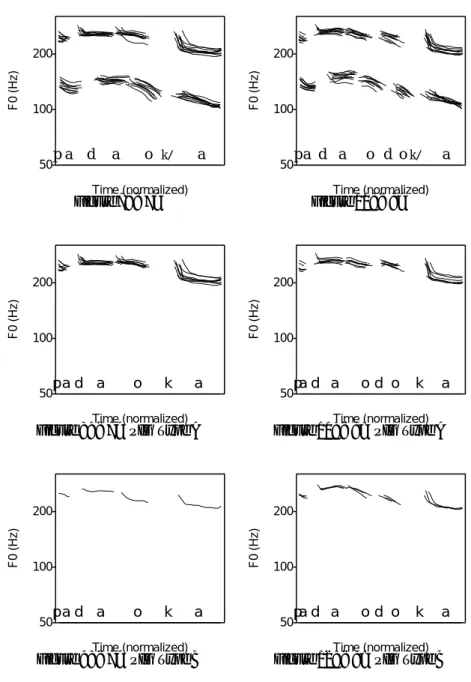
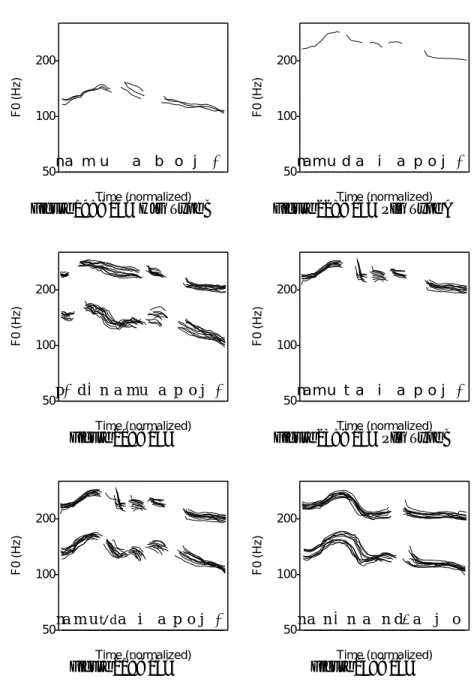
mated only to vowels and nasals10, which was segmented as described above. This estimation was made using the autocorrelation method based on Boersma (1993). Then, F0 contours were drawn as shown in Appendix B. As seen in these figures, each figure includes the contour of every token of the same sen-tence. The F0 (the vertical axis) is shown in the logarithmic scale, and the time (the horizontal scale) was normalized.
3
Results
Appendix B shows the F0 contours of the data. Of the two groups of contours in a figure, the lower contours show HJG’s data, and the upper contours show PIG’s data. As for<18>, <19>, <20>, <21>, <24>, <25>, <26>, and <27>, only the second phonological phrase is shown since this part is the focus of this paper.
As can be seen from these figures, the F0 contours of Seoul Korean have a few peaks in a sentence. Among these peaks, the discussion in 4.1 concerns phrase-medial peaks, and that in 4.2 concerns phrase-final peaks. In addition to these peaks, it can be seen that there is global downtrend of contours. In addition, the sentence-final predicates show a gradual falling without peaks when they are short.
In<13>, <17>, and <20> in HJG’s data and <7>, <8>, and <15>
in PIG’s data, two different types of contour are distinguished, which I call Type A and Type B. For these sentences, each type is also shown separately in Appendix B.
Appendix C shows the tones and phrasings of the data. The tones annotated here correspond to those in the phonetic tone tier of K-ToBI. When a tone is unclear or optional, it is parenthesized.
The phrasing in Appendix C shows the AP phrasing in Jun’s model. If more than one interpretation is possible, I show every possible interpretation rather than deciding on one interpretation since it will be more useful for descriptive purposes. When there are two different types as noted above, the annotations are shown separately. IPs are not shown in this table since IP boundaries in-side the sentence are hardly seen in the data probably because they are short sentences with simple syntactic structures with instructions not to pause. How-ever, despite these instructions, there are a few cases in which there are pauses, which results in perceiving an IP boundary. This case is noted in Appendix C.
10Exceptionally, for the sentence-initial nasals and the nasals after a pause, F0 was not estimated
4
Discussion
This section points out certain findings and problems of previous studies, based on the data described in the last section.
4.1 Phrase-medial peaks
As noted in the introduction, it has been pointed out that a phrase-medial peak normally appears on the second syllable of an AP when the AP has 4 or more syllables. This feature is also identified in the current data. For example, peaks appear on the second syllable of[nOmunado] in <6>, and of [tCOgoRiRWl] in <26>.
This feature is not influenced by the morphological structure. A phrase-medial peak appears on the second syllable of an AP even when the second syllable is located in a suffix. For instance, kanulako ([kanWRago]) in <24>, which consists of a stem ka and a suffix nulako, has a peak on the second syllable [nW] even though it is a part of the suffix. Similarly, kasinulako ([kaCinWRago]) in <25> has a peak on [Ci] and muleytaka ([muRedaga]) has a peak on[Re]. These results suggest that phrase-medial peaks are not specified at the lexical level.
Similar results are also seen in tal.ilako ([taRiRago]) of <19> and pok.ilako ([pogiRago]) of <21>. Interestingly, these phonological words have the same pitch pattern as those of<18> (talilako) and <21> (pokilako), respectively, even though their morphological organization is different. Since other phonetic features seem also to be identical between each sentence of the pairs, their phonetic representations may be completely identical.
4.2 Ha and La at the AP boundary
In<8> of PIG’s data, we can find two types of contour, in which one (Type
A) can be interpreted as two APs, and the other (Type B) can be interpreted as one AP, namely, dephrasing. Interestingly, when I listened to all of the tokens of this sentence in PIG’s data, I heard the intermediate pattern between the two types. This intermediate type can also be identified from the figure. In the 4th syllable[do] of PIG’s contours in Figure 10, while a few contours have a lower pitch and a few contours have a higher pitch, some contours have a middle pitch. This continuousness challenges Jun’s, and probably most of the Intonational Phonologist’s, premise that the levels of phrase boundary are discrete.
However, there is another interpretation of the phrasing of the sentence in question, which I support here. The two types of contour can be interpreted as having the same phrasing, namely two APs. With this interpretation, the
first AP of Type B has a La tone instead of a Ha tone at the boundary. This interpretation of phrasing is supported by the fact that the initial consonant of the second AP in the type B is voiceless.
Although this interpretation avoids the continuousness of the phrase bound-ary, it cannot avoid the continual nature of this sentence itself. I believe this continuous nature is attributed to the continuousness between Ha and La. 4.3 Compounds
The data shown in the results include a number of compounds, which manifest interesting behavior. Table 1 shows the number of APs in compounds.
Table 1: The number of APs in compounds. When there are two phrasing possibilities, both possibilities are shown.
the number of APs
Sentence Word HJG PIG <12> moca-keli 1 or 2 2 <14> petu-namu 2 1 <15> namu-tali 2 1 or 2 <27> min-cekoli 2 1
As Table 1 shows, some compounds clearly have an AP boundary inside. These phrasings are noteworthy since an AP normally consists of one or more words, not morphemes11.
However, there is another interpretation in which compounds with an AP boundary inside are not actually compounds but phrases. This interpretation is possible since the genitive particle is sometimes omitted in consecutive nouns in Korean. For example, namutali in<15> can be regarded as the phrase,
namu tali, in which the genitive particle after namu is omitted12. Whether
consecutive nouns such as namutali are compounds or phrases is in question. The same question is also involved with wuli cip in <29>, which is pro-nounced as one AP. This consecution is normally regarded as a phrase in Ko-rean orthography13. However, it can be interpreted as a compound.
11An AP boundary at the morpheme boundary of a compound is also found in Japanese
(Kubo-zono 1993: 19ff.).
12For<12>, <14> and <17>, however, this interpretation may be problematic since Korean
does not have keli (<12>), petu (<14>) and min (<17>) as independent words.
13In Korean orthography, a space is inserted between the nouns of a phrase, while no space is
4.4 Negative adverb an
Sentences<16> and <17> are potentially homonymous sentences. While the predicate of the former sentence is the verb, anca.yo (sit down), without an adverb, that of the latter sentence consists of the negative adverb, an, and the verb, ca.yo (sleep).
Interestingly, HJG distinguishes these two sentences in a few tokens, while those in most of HJG’s data and all of PIG’s data are identical. In the tokens in which<17> is distinguished from <16>, an AP boundary is inserted immedi-ately after the negative adverb. However, this exceptional pronunciation might be unnatural, resulting from the intentional differentiation of the two sentences under unusual laboratory conditions even though I, who is a non-native speaker of Korean, have difficulty to judge whether the sentence in question is really unusual or not. Further investigation is needed.
4.5 Variability of pitch
In the figures shown in Appendix B, it can be seen that some parts are quite constant while others are variable. For example, in HJG’s<5>, the peak height of[nOmuna] is more variable than that of [nOmu]. This variability may be due to factors that vary the range of pitch, which include downtrend such as dec-lination and downstep, and other factors such as emphasis. Even though these factors seem to be important in Seoul Korean prosody, few studies have been conducted. Further research is necessary.
5
Conclusion
In this preliminary study, I have described the data on Seoul Korean prosody, with special reference to intonation and phrasing. In addition, several findings and issues are discussed. The findings are summarized as follows.
• A phrase-medial peak appears in the second syllable of an AP, as stated in previous studies. Its location is not concerned with the morphological structure.
• It is likely that the relation between Ha and La at the AP boundary is continuous rather than discrete.
In addition, I raise some issues on Seoul Korean prosody based on the data, which concern compounds, the negative adverb, an, and the variable nature of pitch. My future study will examine these issues.
References
Boersma, Paul. 1993. Accurate short-term analysis of the fundamental fre-quency and the harmonics-to-noise ratio of a sampled sound. Pro-ceedings of the Institute of Phonetic Sciences 17. 97-110. University of Amsterdam.
Jun, Sun-Ah. 1993. The phonetics and phonology of Seoul Korean prosody. Ph.D. dissertation, Ohio State University.
—. 1996. Influence of microprosody on macroprosody: a case of phrase initial strengthening. UCLA Working Papers in Phonetics 92. 97-116. —. 2000. K-ToBI (Korean ToBI) labelling conventions (Version 3.1). Ms.
UCLA.
Kubozono, Haruo. 1993. The Organization of Japanese Prosody. Tokyo: Kuroshio.
Lee, Hyun-Bok. 1973. Hyentayhankwukeuy accent (A phonetic study of the accent in Korean). Munlitayhakpo (Journal of College of Humanities) 19. 113-128. Seoul National University.
Martin, Samuel E., Yang-Ha Lee, and Sung-Un Chang. 1967. A Korean-English Dictionary. New Haven: Yale University Press.
Mimatsu, Kunihiro and Akira Utsugi. 2002. Choosengo souruhoogenno purosodi-ino kihonkoozooni tsuite (On the fundamental structure of Seoul Ko-rean prosody). Chosen Gakuho (Journal of the Academic Association of Koreanology in Japan) 184. 35-70.
Nagato, Youichi. 2003. Choosengo souruhoogenno onsetsutoosiinto meeshino onchookee (Onset and tone pattern of nouns in the Seoul dialect of Korean). Onsee Kenkyuu (Journal of the Phonetic Society of Japan) 7. 114-128.
Silverman, Kim, Mary E. Beckman, John Pitrelli, Mari Ostendorf, Colin Wight-man, Patti Price, Janet Pierrehumbert, and Julia Hirschberg. 1992. ToBI: a standard for labeling English prosody. Proceedings of the Second International Conference on Spoken Language Processing 2. 867-870. Banff.
Venditti, Jennifer. 1995. Japanese ToBI labeling guidelines. Ms. Ohio State University.
Appendix
A
Material
The following illustrates the material used in the recordings. For each sentence, the broad transcriptions of IPA, transliterations (the Yale system of romaniza-tion) with glosses and translations are shown. Abbreviations used for glosses are as follows. NOM: nominative case particle, ACC: accusative case parti-cle, DIR: directional partiparti-cle, TOP: topic partiparti-cle, QT: quotative partiparti-cle, SH: subject honorific suffix, DC: declarative sentence-type suffix, PAST: past tense suffix, POL: polite speech level suffix (so-called hayyo-form), INT: intimate speech level suffix (so-called hay-form).
A <1> [nabiga naRa]
napi-ka butterfly-NOM
nal-a. fly-INT “A butterfly flies.”
<2> [nabiga naRaga]
napi-ka butterfly-NOM
nalaka. fly away (INT)
. “A butterfly flies away.”
<3> [nabiga naRadañO]
napi-ka butterfly-NOM
nalatany-e. fly around-INT “A butterfly flies around.”
B <4> [nOdo nOmu nOgWROwO] ne-to you-also nemu too nekulew-e. generous-INT “You, also, are too generous.”
<5> [nOdo nOmuna nOgWROwO] ne-to you-also nemuna too nekulew-e. generous-INT “You, also, are too generous.”
<6> [nOdo nOmunado nOgWROwO] ne-to you-also nemunato too nekulew-e. generous-INT “You, also, are too generous.”
pata-lo sea-DIR
ka. go (INT) “I go to the sea.”
<8> [padaRodo ka]
pata-lo-to sea-DIR-also
ka. go (INT) “I also go to the sea.”
<9> [padaRotCadýu ka] pata-lo sea-DIR cacwu often ka. go (INT) “I often go to the sea.”
<10> [padaRodotCadýu ka] pata-lo-to sea-DIR-also cacwu often ka. go (INT) “I also often go to the sea.”
D <11> [modýaga modýaRa]
moca-ka hat-NOM
mocala.
insufficient (INT) “Hats are not enough.”
<12> [modýagORiga modýaRa]
mocakeli-ka hat stand-NOM
mocala.
insufficient (INT) “Hat stands are not enough.”
E <13> [namuga pojO]
namu-ka tree-NOM
po.y-e. be seen-INT “We can see a tree.”
<14> [pOdWnamuga pojO]
petunamu-ka willow-NOM
po.y-e. be seen-INT “We can see a willow.”
<15> [namudaRiga pojO]
namutali-ka
wooden bridge-NOM po.y-e. be seen-INT “We can see a wooden bridge.”
na-nun I-TOP
anc-ayo. sit down-POL “I sit down.”
<17> [nanWn antCajo] na-nun I-TOP an not ca-yo. sleep-POL “I don’t sleep.”
G <18> [igOsWn taRiRago he] ikes-un this-TOP tali-la-ko bridge-be-QT ha-y. say-INT “We call this ‘tali (bridge)’.”
<19> [igOsWn taRiRago he] ikes-un this-TOP tal-ila-ko moon-be-QT ha-y. say-INT “We call this ‘tal (moon)’.”
H <20> [igOsWn pogiRago he] ikes-un this-TOP poki-la-ko example-be-QT ha-y. say-INT “We call this ‘poki (example)’.”
<21> [igOsWn pogiRago he] ikes-un this-TOP pok-ila-ko happiness-be-QT ha-y. say-INT “We call this ‘pok (happiness)’.”
I <22> [tCibedo kiRWmi modýaRa] cip-ey-to house-at-also kilum-i oil-NOM mocala. insufficient (INT) “Oil is not enough also in the house.”
J <23> [padado mWRi modýaRa] pata-to sea-also mul-i water-NOM mocala. insufficient (INT) “Water is not enough also in the sea.”
K <24> [isaRWl kanWRago pap*as*O]
isa-lul move-ACC ka-nulako go-as a result of papp-ass-e. busy-PAST-INT “I was busy moving out.”
isa-lul move-ACC ka-si-nulako go-SH-as a result of pappu-sy-ess-ta-y. busy-SH-PAST-DC-INT “(I heard that someone was) busy moving out.”
L <26> [nanWntCOgoRiRWltCoaHe] na-nun I-TOP cekoli-lul cekoli-ACC coaha-y. like-INT “I like cekoli (Korean jackets).”
<27> [nanWn mintCOgoRiRWltCoaHe]
na-nun I-TOP mincekoli-lul mincekoli-ACC coaha-y. like-INT
“I like mincekoli (simple Korean jackets).”
M <28> [muRedaga sogWmWl t hajo] mul-eytaka water-into sokum-ul salt-ACC tha-yo. put-POL “I put salt in the water.”
N <29> [pobenWn uRitCibeOps*O] popay-nun treasure-TOP wuli our cip-ey house-at eps-e. not exist-INT “There is no treasure in our house.”
<30> [uRi abOdýinWn mOCis*O] wuli our apeci-nun father-TOP mesiss-e. handsome-INT “My father is handsome.”
B
F0 contours
The following shows the F0 contours14. F0 (vertical axis) is shown in a log-arithmic scale, and time (horizontal axis) is normalized. In each figure, the lower contours show HJG’s data, and the upper contours show PIG’s data. As
for<18>, <19>, <20>, <21>, <24>, <25>, <26>, and <27>, only the
second phonological phrase is shown since this part is the focus of this paper.
14Larger-sized figures are available from the author’s web site.
100 200 50 F0 (Hz) Time (normalized) n a b i g a n a R a Figure 1:<1> 100 200 50 F0 (Hz) Time (normalized) n a b i g a n a R a g a Figure 2:<2> 100 200 50 F0 (Hz) Time (normalized) n a b ig a n a R a d a ¯ ç Figure 3:<3> 100 200 50 F0 (Hz) Time (normalized) nç d o n ç mu n ç gµR ç w ç Figure 4:<4> 100 200 50 F0 (Hz) Time (normalized) nç d on çmun a n ç gµR çw ç Figure 5:<5> 100 200 50 F0 (Hz) Time (normalized) nç d o nçmun a d on ç gµRçwç Figure 6:<6>
100 200 50 F0 (Hz) Time (normalized) p a d a R o k/g a Figure 7:<7> 100 200 50 F0 (Hz) Time (normalized) pa d a R o k a
Figure 8:<7> PIG Type A
100 200 50 F0 (Hz) Time (normalized) pa d a R o k a
Figure 9:<7> PIG Type B
100 200 50 F0 (Hz) Time (normalized) p a d a R o d ok/g a Figure 10:<8> 100 200 50 F0 (Hz) Time (normalized) pa d a R o d o k a
Figure 11:<8> PIG Type A
100 200 50 F0 (Hz) Time (normalized) pa d a R o d o k a
100 200 50 F0 (Hz) Time (normalized) pa d a R o t˛ a d¸u g a Figure 13:<9> 100 200 50 F0 (Hz) Time (normalized) pa d aR o d o t˛ a d¸u g a Figure 14:<10> 100 200 50 F0 (Hz) Time (normalized) mo d¸ a g a m o d¸ a R a Figure 15:<11> 100 200 50 F0 (Hz) Time (normalized)
mod¸a g çR i g a m od¸a R a
Figure 16:<12> 100 200 50 F0 (Hz) Time (normalized) n a m ug a p/b o j ç Figure 17:<13> 100 200 50 F0 (Hz) Time (normalized) na m ug a p o j ç Figure 18:<13> HJG Type A
100 200 50 F0 (Hz) Time (normalized) na m ug a b o j ç Figure 19:<13> HJG Type B 100 200 50 F0 (Hz) Time (normalized) pç d µn a mug a p o j ç Figure 20:<14> 100 200 50 F0 (Hz) Time (normalized) na m ut/daR i g a p o j ç Figure 21:<15> 100 200 50 F0 (Hz) Time (normalized) nam u d aRiga p o j ç
Figure 22:<15> PIG Type A
100 200 50 F0 (Hz) Time (normalized) nam u t aRiga p o j ç
Figure 23:<15> PIG Type B
100 200 50 F0 (Hz) Time (normalized) n a nµn a n d¸ a j o Figure 24:<16>
100 200 50 F0 (Hz) Time (normalized) na nµn a n d¸ a j o Figure 25:<17> 100 200 50 F0 (Hz) Time (normalized) na nµn a n t˛a j o Figure 26:<17> HJG Type A 100 200 50 F0 (Hz) Time (normalized) na nµn a n d¸ a j o Figure 27:<17> HJG Type B 100 200 50 F0 (Hz) Time (normalized) t a R i R a g o Figure 28:<18> 100 200 50 F0 (Hz) Time (normalized) t a R i R a g o Figure 29:<19> 100 200 50 F0 (Hz) Time (normalized) p o g i R a g o Figure 30:<20>
100 200 50 F0 (Hz) Time (normalized) po g i R a g o Figure 31:<20> HJG Type A 100 200 50 F0 (Hz) Time (normalized) po g i R a g o Figure 32:<20> HJG Type B 100 200 50 F0 (Hz) Time (normalized) p o g i R a g o Figure 33:<21> 100 200 50 F0 (Hz) Time (normalized)
t˛ib e d o k iRµm i m od¸aR a
Figure 34:<22> 100 200 50 F0 (Hz) Time (normalized) pa d a d o muR i mod¸aR a Figure 35:<23> 100 200 50 F0 (Hz) Time (normalized) k a n µ R a g o Figure 36:<24>
100 200 50 F0 (Hz) Time (normalized) k a ˛ i n µ R a g o Figure 37:<25> 100 200 50 F0 (Hz) Time (normalized) t˛ ç g o R i R µ l Figure 38:<26> 100 200 50 F0 (Hz) Time (normalized) m i nt˛/d¸ç g o R i Rµl Figure 39:<27> 100 200 50 F0 (Hz) Time (normalized) muR e d a g a s ogµmµl tha j o Figure 40:<28> 100 200 50 F0 (Hz) Time (normalized) po b e nµn u R i d¸ibe ç p s* ç Figure 41:<29> 100 200 50 F0 (Hz) Time (normalized) uR i a b çd¸inµnmç ˛ i s* ç Figure 42:<30>
C
Phrasing and tones
The following shows the tones and phrasings of the data. The tones annotated here correspond to those in the phonetic tone tier of K-ToBI. When a tone is unclear or optional, it is parenthesized. The phrasing corresponds to the AP phrasing in Jun (1993)’s model. If more than one interpretation is possible, I show every possible interpretation. When there are two different types as noted in the section 3, the annatations are shown separately.
Subject Type Phrasing and Tones # of Tokens
<1> HJG {na L biga Ha } {na L Ra L% } 10 or{na L biga +H naRa L% } PIG {na L bi +H ga Ha } {na L Ra L% } 10 <2> HJG {na L biga Ha } {na L Raga L% } 10 or{na L biga +H naRaga L% } PIG {na L bi +H ga Ha } {na L Raga L% } 10 <3> HJG {na L biga Ha } {na L Ra (+H) dañO L% } 10 PIG {na L bi +H ga Ha } {na L Ra +H dañO L% } 10 <4> HJG {nO L do Ha } {nO L mu Ha } {nO L gW +H ROwO L% } 10 or{nO L do +H nO L+ mu Ha } {nO L gW +H ROwO L% } PIG {nO L do Ha } {nO L mu Ha } {nO L gW +H ROwO L% } 10 <5> HJG {nO L do Ha } {nO L muna Ha } {nO L gW +H ROwO L% } 10 PIG {nO L do Ha } {nO L muna Ha } {nO L gW +H ROwO L% } 10 <6> HJG {nO L do Ha } {nO L mu +H na L+ do Ha } {nO L gW +H ROwO L% } 10
PIG {nO L do Ha } {nO L mu +H na L+ do Ha } {nO L gW +H ROwO L% } 10 <7> HJG {pa L da +H Roga L% } 10
PIG Type A {pa
L da +H Ro Ha } {ka L L% } 9 Type B {pa L da +H Ro La } {ka L L% } 1 or{pa L da +H Ro ka L% } <8> HJG {pa L da +H Rodo La } {ga L L% } 10 or{pa L da +H Rodoga L% }
PIG Type A {pa
L da +H Ro L+ do Ha } {ka L L% } 7 Type B {pa L da +H Ro L+ do La } {ka L L% } 3 or{pa L da +H Rodo ka L% } <9> HJG {pa L daRo Ha } {tCa L dýu (+H) ga L% } 10 or{pa L daRo Ha } {tCa L dýu Ha } {ga L L% } PIG {pa L da +H Ro Ha } {tCa L dýu Ha } {ga L L% } 10 or{pa L da +H Ro Ha } {tCa L dýu +H ga L% } <10> HJG {pa L da +H Ro (L+) do Ha } {tCa L dýu (+H) ga L% } 10 or{pa L da +H Ro (L+) do Ha } {tCa L dýu Ha } {ga L% } PIG {pa L da +H Rodo Ha } {tCa L dýu Ha } {ga L L% } 10 {pa L da +H Rodo Ha } {tCa L dýu +H ga L% }
<11> HJG {mo L dýaga Ha } {mo L dýaRa L% } 10 or{mo L dýaga +H modýaRa L% } PIG {mo L dýa +H ga Ha } {mo L dýa (+H) Ra L% } 10 <12> HJG {mo L dýa +H gORi L+ ga Ha } {mo L dýaRa L% } 10 or{mo L dýa Ha } {gO L Riga Ha } {mo L dýaRa L% } or{mo L dýa Ha } {gO L Riga +H modýaRa L% } PIG {mo L dýa Ha } {gO L Riga Ha } {mo L dýa (+H) Ra L% } 10 <13> HJG Type A {na L muga Ha } {po L jO L% } 7 or{na L muga +H pojO L% } Type B {na L mu +H ga bojO L% } 3 {na L mu +H ga La } {bo L jO L% } PIG {na L mu +H ga Ha } {po L jO L% } 10 <14> HJG {pO L dW Ha } {na L muga Ha } {po L jO L% } 10 or{pO L dW Ha } {na L muga +H pojO L% } PIG {pO L dW +H namu L+ ga Ha } {po L jO L% } 10 <15> HJG {na L mu Ha } {da L Riga Ha } {po L jO L% } 10 or{na L mu Ha } {da L Riga +H pojO L% }
PIG Type A {na
L mu +H daRiga La } {po L jO L% } 1
Type B {na L mu Ha } {ta L Riga Ha } {po L jO L% } 9 or{na L mu Ha } {ta L Riga +H pojO L% } <16> HJG {na L nWn Ha } {an L+H dýajo L% } 10 PIG {na L nWn Ha } {an L dýa (+H) jo L% } 10 <17> HJG Type A {na L nWn Ha } {an L+Ha } {tCa L jo L% } 3 or{na L nWn Ha } {an L+H tCajo L% }
There is a pause before[an], at which an IP boundary possibly exists. Type B {na L nWn Ha } {an L+H dýajo L% } 7 PIG {na L nWn Ha } {an L dýa (+H) jo L% } 10 <18> HJG {i L gOsWn Ha } {ta L Ri +H RagoHe L% } 10 or{i L gOsWn Ha } {ta L Ri +H Rago La } {He L L% } PIG {i L gO (+H) sWn Ha } {ta L Ri +H RagoHe L% } 10 or{i L gO (+H) sWn Ha } {ta L Ri +H Rago La } {He L L% } <19> HJG {i L gOsWn Ha } {ta L Ri +H RagoHe L% } 10 or{i L gOsWn Ha } {ta L Ri +H Rago La } {He L L% } PIG {i L gO (+H) sWn Ha } {ta L Ri +H RagoHe L% } 10 or{i L gO (+H) sWn Ha } {ta L Ri +H Rago La } {He L L% } <20> HJG Type A {i L gOsWn Ha } {po L gi +H Ra L+ go Ha } {He L L% } 4 Type B {i L gOsWn Ha } {po L gi +H RagoHe L% } 6
or{i L gOsWn Ha } {po L gi +H Rago La } {He L L% } PIG {i L gO (+H) sWn Ha } {po L gi +H RagoHe L% } 10 or{i L gO (+H) sWn Ha } {po L gi +H Rago La } {He L L% } <21> HJG {i L gOsWn Ha } {po L gi +H RagoHe L% } 10 or{i L gOsWn Ha } {po L gi +H Rago La } {He L L% } PIG {i L gO (+H) sWn Ha } {po L gi +H RagoHe L% } 10 or{i L gO (+H) sWn Ha } {po L gi +H Rago La } {He L L% } <22> HJG {tCi L bedo Ha } {ki L RWmi Ha } {mo L dýaRa L% } 10 or{tCi L bedo Ha } {ki L RWmi +H modýaRa L% } 10 PIG {tCi L be +H do Ha } {ki L RW (+H) mi Ha } {mo L dýa (+H) Ra L% } 10 <23> HJG {pa L dado H% } {mu L Ri Ha } {mo L dýaRa L% } 10 or{pa L dado H% } {mu L Ri +H modýaRa L% } 10
There is a pause and/or final lengthening after [padado], at which an IP boundary clearly exists.
PIG {pa L da +H do Ha } {mu L Ri Ha } {mo L dýa (+H) Ra L% } 10 <24> HJG {i L saRWl Ha } {ka L nW +H Ra L+ go Ha } {pa L p*a (+H) s*O L% } 10 PIG {i L sa +H RWl Ha } {ka L nW +H Ra (L+) go Ha } {pa L p*a (+H) s*O L% } 10 <25> HJG {i L saRWl Ha } {ka L Ci +H nWRa L+ go Ha } {pa L p*W +H COt*e L% } 10 PIG {i L sa +H RWl Ha } {ka L Ci +H nWRa L+ go Ha } {pa L p*W +H COt*e L% } 10 <26> HJG {na L nWn Ha } {tCO L go +H Ri L+ RWl Ha } {tCo L a (+H) He L% } 10
PIG {na L nWn Ha } {tCO L go +H Ri (L+) RWl Ha } {tCo L a (+H) He L% } 10 <27> HJG {na L nWn Ha } {min L Ha } {tCO L go +H Ri L+ RWl Ha } {tCo L a (+H) He L% } 10
In a few tokens, a pause is identified after[nanWn],
at which an IP boundary possibly exists.
PIG {na L nWn Ha } {min L dýO +H goRi (L+) RWl Ha } {tCo L a (+H) He L% } 10 <28> HJG {mu L Re +H da L+ ga Ha } {so H gWmWl Ha } {tha H jo L% } 10 or{mu L Re +H da L+ ga Ha } {so H gWmWl +H thajo L% } PIG {mu L Re +H da L+ ga Ha } {so H gWmWl Ha } {tha (H) jo L% } 10 or{mu L Re +H da L+ ga Ha } {so H gWmWl +H thajo L% } <29> HJG {po L benWn Ha } {u L Ri (+H) dýi (L+) be Ha } {Op L s*O L% } 10
In one token, a pause is identified after[pobenWn],
at which an IP boundary possibly exists.
PIG {po L be +H nWn Ha } {u L Ri +H dýi (L+) be Ha } {Op L s*O L% } 10 <30> HJG {u L Ri Ha } {a L bO (+H) dýi L+ nWn Ha } {mO L Ci (+H) s*O L% } 10 PIG {u L Ri Ha } {a L bO +H dýinWn Ha } {mO L Ci +H s*O L% } 10