Abstract
This article argues the case for teaching note-taking techniques to under-achieving Japanese university students. It outlines the reasons why the author believes note-taking should be taught; the process followed in introducing the initial coordinated program to encourage note-taking at Kyoei University; and the outcomes of those efforts. The survey results and other investigations reveal that there are possibly two factors influencing reluctant note-takers' behaviour. These are firstly, a lack of reinforcement concerning students' note-taking can lead to the practice not becoming habitual in under-achieving students, and secondly, that the absence of a university wide policy on note-taking and the resulting inconsistency has led some students to believe note-taking was an extra and unfair requirement.
Keywords: note-taking, classroom management, study skills
Introduction
The problem of unacceptably low examination scores for a number of first year stu-dents taking English conversation, a compulsory requirement, at Kyoei University was in need of correction. The teachers concerned agreed to look into the situation to see what the possible causes were and what corrective actions could be taken. In addition to a twice-yearly student satisfaction survey which asks students to rate texts, teaching methodology, curriculum content etc, students enrolled in lower-level English conversation classes were also casually interviewed and asked a range of questions. Notes were taken and student re-sponses were then collated.
On the whole, students had positive feelings for the subject and the way that it was taught. Generally speaking, most students were also satisfied with the curriculum, though those in lower level classes thought that the material was still too demanding. The material and teaching methodology were modified for these students and the level of student
satis-University Students
- The Process and Problems Encountered -
faction has subsequently risen. Unfortunately, examination results across all levels did not show much improvement.
We also looked at our goals, level of achievement expected and our examination methods and agreed that they were reasonable. It was then that we turned our attention to student behaviour. Those teachers involved voiced their concerns over the study habits of the majority of students. Amongst the issues raised were:
・Many students did not bring notebooks or paper with them to class.
・Many students wrote notes in the margins of their textbooks and as the space ran out so did their notes.
・Notes prepared by teachers were either tucked into the back of their textbook or placed in a plastic file box, or in many cases unceremoniously stuffed into their bags.
・Most students did not organize their notes. The organization of notes/handouts by students ranged from: inserting them into clear plastic pouches within one file ac-cording to subject; placing them in a file as and when they received them with no regard to subject or topic and, as mentioned above, randomly inserted into their bags.
The above practices were also observed in other classrooms.
Through casual conversations with the students a common pattern began to emerge. Most students informed us that they had not received any specific note-taking instruction while in high school. They either copied from the blackboard or their textbook whatever they were instructed to copy. Little or no analysis of the material taught was required. Thus from the above we deduced that perhaps part of the problem regarding low re-tention and recall of material taught may be down to the fact that they were unaware of the importance of note-taking or the various ways to structure the information they write down.
There also seemed to be a perception gap between what we expected from all the dents in terms of note-taking and what some students believed was acceptable. Some stu-dents took notes but the majority did not. We felt that those stustu-dents that did not take notes should be encouraged to do so, while those that did take notes could benefit from improv-ing their note takimprov-ing techniques. This in turn also led to a discussion on note-takimprov-ing. Among the points raised were:
・Do we have the time to teach note-taking? ・Is note-taking as valuable as we believe?
・Are some methods specifically more suited to certain learner types? ・Some methods may not be suitable for other disciplines.
Do we have the time to teach note-taking?
The first year English Conversation curriculum discussed in this paper had been in place for three years. There were fifteen weeks per semester, one lesson per week. Of the fifteen lessons, thirteen were for teaching the required curriculum content, the first lesson was used as an introduction to the course and the last for final revision and questions con-cerning the examination. It has been our experience that all thirteen weeks allotted to teaching the curriculum content were necessary. This was because the lower level students needed all the available time to cover the course content and the higher achieving students tended to use any extra available time to study the course content in greater depth. This left us with no option other than to consider using the first lesson and possibly a little of the second to introduce note-taking techniques. Initially, this is what we tried, but it soon became apparent that this would not be enough. From the second semester of 2004 we be-gan to allot roughly 20 minutes of the first seven lessons to note-taking instruction.
Is note-taking as valuable as we believe?
Note-taking facilitates two functions: encoding and storage. The encoding function is the process of writing notes, which are then not reviewed. It involves recognizing impor-tant points and recording them in some way-usually by writing them down or typing into a laptop computer. This facilitates learning even when the notes are not subsequently re-viewed. It is suggested by Einstein et al (1985) that this could occur due to the increased attention being paid to the lecture's content and the mental process required when record-ing the information succinctly. Further, Aiken et al.(1975) find that lecture information re-corded in students' notes had a recall probability rate of 47% , while information omitted in their notes only had a 17% probability rate of recall.
The storage function suggests reviewing notes generally enhances retention and leads to a deeper understanding of the material being studied. This is supported by Fisher and Harris (1973: 325), when, in the conclusion of their study, they note that, “in a typical
col-lege lecture setting, the taking of notes of good quality and the subsequent review of these notes are associated with more efficient recall.”
Whether these be the students own notes or handouts provided by the lecturer there is little difference between the two (Thomas, 1978) -review enhances retention.
While both functions are of importance this paper will concern itself only with the encoding function. It has been suggested that the process of note-taking assists students in developing external connections between the information provided during a lecture and knowledge already acquired. The encoding benefit of taking notes has a generative effect. That is, the connecting of new information with existing knowledge (Peper & Mayer 1978, 1986, as cited in Kiewra 1989). Also Peper & Mayer (1978, ibid) posit that although note-taking does not have a significant effect on near transfer tasks (the recall of simple facts) it does help students with far transfer tasks (the use of information or a process in one context and applying that knowledge to help solve a different problem in another context). There are many such far transfer tasks in language learning. For example, when a language learner uses a new phrase or sentence structure learnt in one context and applies this new knowledge in new a context to achieve a similar or different, but nonetheless desirable, outcome.
Kiewra (1989) also cites several studies that suggest note-taking will, more often than not, aid recall, whereas not taking notes will, in all likelihood, lead to very little being re-called as time progresses. Thus, there would seem to be enough evidence to suggest that the process of note-taking is of value in most learning situations.
Effective note-taking methods
There is evidence, certainly in terms of storage, that teacher-provided notes lead stu-dents to learn more. However, as Kiewra (1985 c, d) points out, this is probably due to the fact that provided notes are far more complete than a student's own notes and much better structured and organized. Teaching staff, however, cannot be expected to provide handouts for every lesson and topic. Apart from time issues, the content of many lessons or lectures is fluid. While the core principles may remain the same the supporting details and data may change. Also this emphasis on passive learning leaves some students with nothing to do other than listen, which can often lead to inattention and boredom. Therefore, it was felt the students, and I'm sure much to their chagrin, would have to bear more responsibili-ty for their learning. Further, all of the information that we provide in handouts may not be
of interest or relevance to every student. Students may wish to focus on what they feel is of importance and either brush over or ignore the rest. It follows that by encouraging stu-dents to improve their note-taking behaviour we not only increase the likely recall of in-formation, but we provide them with an opportunity to connect new knowledge with prior knowledge in a more personal way.
We also took into consideration learner styles: styles within a group (Wright 1987: 117-118), individual student learning styles (Willing 1987, as cited in Skehan 1998: 247-250) and individual differences in the way students respond to the same stimuli-Multiple intelligences. MI theory (Gardener, 1983) suggests that different people's brains are better at some things than they are at others and that we do not have a single intelligence, but a range of intelligences. He lists seven intelligences which are possessed by all of us, but in each individual one or more of these is better developed. Consequently this leads us to recognize that some teaching methods, learning tasks and note-taking methods might not be appropriate for all students. Furthermore, various note-taking methods ideally should be taught and the individual student be allowed to choose one he or she is comfortable with.
Implementation
Over the course of two semesters two language teachers endeavored to improve stu-dents note-taking skills by demonstrating and stressing the importance of note-taking. During the first lesson of each semester it was made clear to students that note-taking ma-terials were a requirement and not an option. Several note-taking techniques were taught: the Cornell Method, Outlining, Charting and Mind Maps, the latter are also sometimes known as Spider-grams. Over the subsequent weeks just under 20% of class time was used for teaching note-taking techniques. A similar program to the one used by Robin et al.(1977) of modeling, practice, shaping, fading and feedback was implemented. In addi-tion, for the lowest level classes all noteworthy material continued to be either written on the blackboard or projected via OHP on to a screen and prompts given reminding students that this material needed to be recorded. Id est, there was no fading.
Student participation
At first participation was patchy. Some students would pick up on the cue to take notes and immediately began writing while others would have to be prodded into action by the teacher making a personal request for them to take notes. Regrettably there would also be a small core of students in many classes who had neglected to bring any note-taking materials with them at all. For the first couple of offences they were given a warning and provided with some paper and occasionally pencils too. On the third and any subsequent offences they would be deducted half an attendance mark (university rules and guidelines stipulate that students attend a certain number of lectures/lessons of each subject per se-mester or they will be ineligible to take the final examination in subjects where they have not met attendance requirements).
Over the course of one semester the note-taking habits of the majority of students would improve. Those students who took notes from the very beginning continued to do so throughout the semester and the amount of information they recorded increased in quantity and quality. The group that had initially been slow to take down information un-less prompted had, by about week seven, begun to search for their notebooks or had actu-ally begun to write either a moment before or shortly after the prompt to take notes. On in-spection one could definitely see an improvement in the quantity of information they recorded, but they were continuing to miss key elements of the lesson.
Finally, in the lower-level sets there would remain a small number of students who would consistently require personal appeals in order for them to begin taking notes. Inter-estingly enough, while some of these students' notes were lacking in quantity and quality, inspection of their notebooks revealed that on average their notes were no less as complete as the average student's notes.
Categories of note-taker
The evidence suggested that there were three groups of note-takers in each class: the self-activator group that instinctively knew when and what kind of information to record; the group that had responded to instruction and over a period of time had integrated note-taking into their study habits and finally, the group that seemed unmotivated and reluctant to take-notes unless directly asked to do so. This left the teachers concerned with an in-triguing question: What is the reason for the difference between the latter two groups? On
the one hand, we had a group of students who, over time, learned to take notes without prompting and on the other, a group that consistently failed to take notes without being ca-joled into doing so. Were these students rebelling for some reason or succumbing to peer pressure, or were they just disinterested in the subject? There was also the possibility that they were simply bone-idle.
The data from that year's student satisfaction survey showed that most students had some interest in the subject. Unfortunately, the problem with this information was that we had no way of knowing which students (as defined by their note-taking habits) were inter-ested in the subject and which students were not.
Interviews were conducted in an effort to see whether there was any one factor or a number of factors that led to poor study habits. The self-activators were not interviewed, as they were not perceived as part of the note-taking problem. The remaining students, however, were surveyed and later interviewed.
Survey of students' preferred subjects and study techniques
The survey asked a total 50 male and female School of International Business Man-agement first year students to rank two lists in order of preference. Those surveyed had all performed below average on a GTELP level 3 English proficiency test administered at the beginning of the academic year and were consequently all members of the lower level English Conversation classes. All those surveyed had either taken or were, at the time of the survey, taking the compulsory subjects mentioned hereafter. The first list, (fig 1a) was of compulsory subjects, and the second, (fig 1b) was a list of study techniques. Both lists were written in Japanese for ease of understanding. Those surveyed were asked to rank by writing number 1 next to an item that they most liked, a 2 for second most liked etc. There were no spoiled or invalid replies.
Figure 1a shows that English conversation ranked 3rd out of the 7 compulsory class-es: slightly above the median. Thus there is little reason to believe that an intense dislike or disinterest in the subject was the sole reason for their low motivation and poor study habits.
Figure 1b conveys the surveyed students preferred study techniques by rank. Note-taking ranked 4th out of 9, again just above the median. Considering the reluctance of many in this group this was unexpected. One would have expected note-taking to be ranked lower on the table. At first glance the data suggests that lower level students prefer
study methods that require the least effort and that those surveyed may simply be prone to idleness. However, this may not actually be the case as there is no data for the higher achieving students with which to compare. It may be the case that both groups prefer tech-niques that require little effort.
Interviews
The survey group was later interviewed in an effort to gather any information that could lead us to understanding their reluctance to take notes. A list of acceptable questions was compiled and agreed upon as a guideline by the interviewers. The interviewers also avoided closed-ended, dichotomous, questions as these may lead to low validity. This was because sometimes, questions such as “Do you like English?” can lead students to hide their true feelings by giving an answer that either they feel you would like to hear or an answer that shows them in a more favourable light. Thus through the indirect root of a seemingly casual chat with each student we probed and looked for answers or evidence. Initially the categories of possible causes were: Youthful rebellion, Peer pressure; Disinter-est and Other. However, due to the difficulties in identifying youthful rebellion we dis-carded this category.
Interview data
The data from the follow-up interviews confirmed the initial survey results regarding the level of interest in English conversation and the ranking of note-taking as a study tech-nique. Peer pressure showed itself to be a contributory factor, but this should not be viewed in a negative light as peer pressure within a group is an intrinsic part of youth cul-ture, male or female, and can, with skill, be manipulated for positive effect. What we did find that was of great interest was in the category, Other. A total of 3 interviewees ex-pressed resentment at the requirement to take notes in our classes. They informed us that in other subjects they had not been required to take notes nor was there any pressure to do so.
This information was investigated and confirmed. A random sample of students were asked whether other teaching staff were as insistent as the English conversation teachers were concerning the taking of notes and the answers confirmed that, with one or two ex-ceptions, they were not. Thus, the problem could be redefined. Perhaps the issues of low motivation and interest in the subject were only part of the problem and that consistency, conformity and reinforcement were the core issues.
The possibility that these issues were a major factor regarding the reluctance of stu-dents to take notes was followed up. By observing student behaviour in other classes enough evidence was collected to confirm that this was the case. Very few students were
observed taking notes and little or no evidence of lecturers insisting or encouraging the taking of notes was found. Thus it would seem the students had a valid point concerning irregular note-taking requirements between subjects.
Confirmation survey
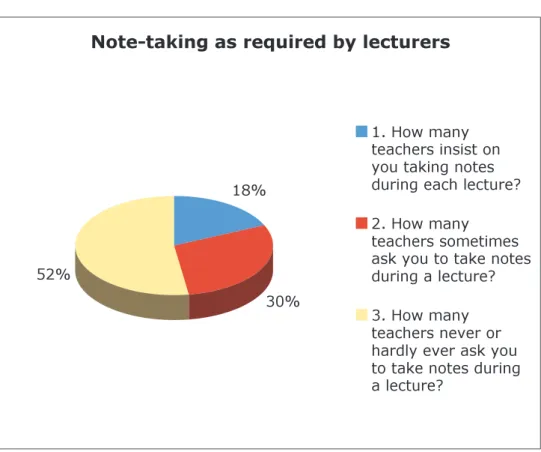
Another simple survey was taken in which students were asked the following three questions. Above the three questions on the survey sheet an instruction reminds students only to write the number of lecturers and not the names of those lecturers.
1. How many teachers insist on you taking notes during each lecture? 2. How many teachers sometimes ask you to take notes during a lecture?
3. How many teachers never or hardly ever ask you to take notes during a lec-ture?
Total number of participants 26.
The data shows that 52% of lecturers rarely or never ask students to take notes and that 30% of lecturers sometimes require notes be taken. This also seems to confirm that one of the fundamental reasons why some students were reluctant to take notes was, that it was simply not required. Thus it did not become a habitual part of their classroom behav-iour. Further, it was confirmed that there was no systematic or uniform policy regarding note-taking in the university.
Toward a common policy on note-taking
On the basis of the evidence accrued it was decided to bring this problem to the atten-tion of the Foundaatten-tion Course Committee ( 基礎ゼミ委員会 ). The Foundaatten-tion Course is a seminar style course for first year students aimed at teaching presentation skills, debat-ing, academic writing etc, as well as giving students an opportunity to discuss other per-sonal or social issues in a familiar and friendly atmosphere.
The issue of students being academically unprepared and the need for a basic uniform policy on note-taking was presented as a problem-solution package to the Committee. Af-ter the initial discussions the committee decided to publish a pamphlet entitled ‘Study Skills’ as a guide for students and in addition to those mentioned above, note-taking was included as one of the skills to be covered during all Foundation Course seminars. The original concise note-taking guide (Bufton and Lloyd, 2003) was translated and used as the initial example for the 2005 academic year. However, this has since been revised for the 2006 academic year.
Discussion
Regarding the improvement in note-taking skills across the range of students who un-derwent the note-taking training program the results are encouraging. For the majority of students there was a measurable improvement in terms of the quantity and quality of their notes. The self-activator group showed continual improvements both in quantity, and more importantly, in the quality of their notes. While the group that had initially been slow to take down information unless prompted showed a marked improvement in the quantity of information they recorded together with a slight improvement in the quality. They were continuing to miss key elements in lessons but not as many as they had at the beginning of the program. Indeed, with more encouragement and reinforcement these students too
would quite possible show continued improvements in their note-taking skills.
The final group of students, those that would not begin to take notes without constant coercion are the ones we became most interested in. Initially we thought that they were simply disinterested, but the data showed that that was not always the case. Many of those who did not take notes had responded positively in their ranking of English conversation when compared with other compulsory subjects. What was evident was the students' per-ception of being treated differently. When interviewed they had agreed that note-taking was something that they felt was necessary, to some degree at least, but the fact that the re-quirement to take notes was not consistent had in some way led to a feeling of unfairness. There is of course the possibility that they were using this as an excuse for not taking notes. This, however, cannot be clarified without a trained psychologist to judge between the two. Furthermore, which of the two possibilities is not the main issue here. What is at issue is the lack of reinforcement and conformity regarding note-taking as a factor influ-encing reluctant note-takers behaviour and how that behaviour can be modified.
In conclusion, the findings of this study indicate that repetitive reinforcement of note-taking is required until the action of note-taking notes becomes habitual and that a uniform policy regarding note-taking is required throughout the university. Thus it was with these two points in mind, and the overall success of the program described above, that a consistent standard note-taking program was recommended as necessary through out the university.
References
Aiken, E. G., Thomas, G. S., and Shennum, W. A.(1975). Memory for a lecture: Effects of notes, lecture rate, and information density. J. Educat. Psychol. 67: 439-444
Einstein, G. O., Morris, J., and Smith, S.(1985). Note-taking, individual differences, and memory for lecture information. J. Educat. Psycol. 77: 522-532.
Fisher, J. L., and Harris, M. B.(1973). Effect of Note Taking and Review on Recall. J. Ed-ucat. Psychol. 65: 321-325
Gardener, H 1983 Frames of the Mind: The Theory of Multiple Intelligences Basic Books Kiewra, K. A.(1985a). Investigating note-taking and review: A depth of processing
alterna-tive. J. Educat. Res 20: 23-32
Kiewra, K. A.(1985c). Students' note-taking behaviors and the efficacy of providing in-structor's notes for review.Contemp. Educat. Pschol. 23: 39-56
Kiewra, K. A.(1985d). Learning from a lecture. Hum. Learn. 4: 73-77
Kiewra, K. A.(1989). A review of note-taking: The encoding-storage paradigm and be-yond. J. Educat. Psychol. Vol 1: No 2 147-172
Locke, E. A.(1977). An empirical study of lecture notetaking among college students. J. Educat. Res 77: 93-99
Robin, A., Fox, R. M., Martello, J., and Archable, C.(1977). Teaching Note-Taking Skills to Under-Achieving College Students. J. Educat. Res 71: 81-85
Skehan, P (1998). A Cognitive Approach to Language Learning OUP
Thomas, G. S.(1978). Use of Students' Notes and Lecture Summaries as Study Guides for Recall. J. Educat. Res. 71: 316-319
Willing, K (1987). Learning Styles in Adult Migrant Education Adult Migrant Education Programme: Adelaide
Wright, T (1987). Roles of Teachers and Learners OUP
G-TELP TM General Test of English Language Proficiency 4 Koujimachi 3-chome Chiyo-da-ku, Tokyo 102-0083 JAPAN