Ⅰ. Introduction
On March 11th, 2011, a magnitude 9.0 Tohoku earthquake hit on a large-scale, highly impacting the North region of the Japanese mainland. It caused tremendous after effects such as building collapse, the tsunami, and liquefaction phenomenon. The damage mainly occurred in Miyagi, Iwate and Fukushima, and expanded to Kanto. Furthermore, because of the Accident at the Tokyo Nuclear power plant in Fukushima, the residents were forced to evacuate to the outside of hazard areas. The damaged situations were emphasized in many parts of the world through news, with disastrous images of tourist destina-tions being broadly spread. This situation that the most crucial priority for Tourism’s “safety” is under threat has resulted in a dramatic reduction of the number of tourists to Japan. Tour-ism is not immune to natural disasters, terrorTour-ism, and political situation. Accordingly, there is a great need to review tourism management. However, whereas previous research on tourism crisis management has been done many times, research on mar-keting for image reconstruction after a disaster is insufficient. Recovery of the tourism image caused by harmful rumours and image collapse is very important especially in the case of the great Tohoku earthquake. For that reason, it is essential for further tourism development to make provision for inevitable
emergency through the content of recovery marketing. This paper is about disaster crisis management which focuses on recovery marketing as a part of crisis communication in the recovery of tourism destination image. This research aims to clarify the main role of recovery marketing in a particular cri-sis, which is “The Great East Japan Earthquake” that took place in 2011. The research examines the operations of the Japanese tourism agencies and the Destination Marketing Organisations (DMO) by means of two methodologies: interview research and secondary research. Damage to the destination image was not restricted to the area directly affected by the disastrous Tohoku earthquake but extended to tourism destinations which were further away. Therefore, the scope of research indicates the inclusion of the tourism destination image of the whole of Japan. It uncovers insights into the reality of the catastrophe of disasters, and also the tools or steps of recovery marketing in comparison with the change in tourist numbers. As a result, this final project assumes that the use of recovery marketing can lessen the negative image of tourism destinations. Hence, it can be a significant step for the quicker regeneration of the tourism industry.
研究論文
Regenerating destination image and tourist arrivals using Recovery Marketing:
The 2011 Tohoku Earthquake
藤田 友里佳 Yurika Fujita
和歌山大学大学院観光学研究科
Key Words:Recovery Marketing, Crisis Management, Destination Image, Earthquake Abstract:
When a disaster occurs, the number of foreign tourists significantly decreases. Tourism and service industries are particularly vulnerable to the impact of disaster and crises. Therefore, it is imperative for further tourism development to prepare for an inevitable emergency. This research adopts The Great East of Japan Earthquake that has received tremendous influence from both natural and secondary disaster as a case study and investigates the role and usage of crisis management and Japanese efforts for tourism restoration in Tohoku area. It clarifies the flow of destination, image ruination, and marketing approach and its effect throughout a year after the occurrence, by collating the recovery transition efforts and the recovery transition of inbound tourist numbers, focusing on recovery marketing among crisis management. Finally, it discusses the importance and high possibility of the future need for further development of Recovery Marketing.
Ⅱ. Literature review
1. Disaster and crisis management
Faulkner (2001) states that the actual causes of crisis and disaster are obscure, and it is difficult to distinguish between the causes of man-made and natural disasters. In regard to infection disasters such as SARS, malaria and AIDS, some au-thors consider the factor of epidemic disaster which combines natural with artificial elements. Pike (2008) argues disaster is unpredictable, a negative event itself which has little or no con-trol; on the other hand, crisis relates to the duration throughout from the commencement of the event or occurrence until re-covery. It means that a crisis shows a wider time scale of oc-currence which includes the management for recovery process. Thence, it could be suggested that the post-earthquake manage-ment for tourism recovery is more relevant to be designated as crisis management; whereas the devastating event itself should be classed as a disaster.
Sahin, Ulubeyli and Kazaza (2015) mention that crisis man-agement is to prevent the possibility of harmful effects, and to minimize the loss, to apply the preparatory activities for the recovery. It could be explained as one of the process or management systems against emergency. Also, the process in-cludes preparation efforts for rapid recovery. Sharpley (2012) elucidates crisis management model often cannot be embed-ded in the logical format especially for unpredictable crisis or disasters. Especially in the situation of crisis management in the tourism field, it becomes more complex to apply the man-agement process since each stake holder in tourism is inter-connected more closely and intricately. Consequently, it is nec-essary to apply different approaches depending on the specific circumstances such as cultures and geographical situation. 2. Destination vulnerability in the tourism industry
The world is seemingly becoming more disaster and crisis prone with many aspects becoming more vulnerable (Faulkner, 2001). The tourism and service industries are particularly vul-nerable to the impact of disaster and crises. In accordance with Beck (2006), the level of risk which causes serious disaster and crisis such as Hurricane Katrina in America and the SARS epi-demic in south-east Asia gain the power as to advance of glo-balization. It seems that the more that the world proceeds to-wards globalization, the higher the possible occurrence of crisis and disaster becomes. In terms of the industrial development in globalization, the service business is highly susceptible to both man-made and nature- based disasters (Lee and Harrald, 1999). Also, the globalized world is highly inter-dependent and inter-connected each other; therefore, even small-scaled cri-ses or disasters can lead to even more crisis by adding further
risk through influence and expansion (Ritchie, 2004). Hence, even though globalization creates comfort and security and strengthens the social network, actually, the world is still also vulnerable and subject to disaster and crisis. This vulnerability can also apply to the tourism industry because tourism industry is an aggregation of individual business such as hotels, trans-portation, restaurant and attractions as well as shops. These businesses cover a wide range of activities and they are highly inter-related; so, once disaster affects even one sector of them, it is easy to destroy a wide range of tourism sectors. Further-more, the tourist is afraid of unpredictable risk factors such as terrorism, health concerns, natural disasters and crime affecting the trip. Their first priority when choosing a destination is often the destination’s security and safety (Tasci and Boylu, 2009) so that, not only the tourism destination but also the tourists’ motivation for tourism are also susceptible and sensitive to de-structive events.
The tourism industry has developed according to technologi-cal advancement as well as globalization. However, because every aspect of society and the economy is inter-dependent, the negative impact affects consumer behaviour, especially with regard to security and safety as the first priority for tour-ists, tourists react quite sensitively and try to avoid destinations with risk. Even if the initial event is small, the impact of a de-structive event gains negative power by mutual influence and the increasing effect is difficult to prevent from multiplying with countermeasures.
3. Destination image and tourist’s decision making Tourism has a close relationship to tourism destination im-age. Destination image is defined as the conception of tourism destination which influences decision making, satisfaction and anticipation of tourists (Chon, 1990; Bigne, Sanchez and San-chez, 2001). Referring to Wang and Hsu (2010), the destination image connects to the tourist’s perceptions such as impression, expectation, emotion and opinion more profoundly than coun-try image. Destination image tends to work on the affective im-pression which may operate on the tourist’s inducement toward destination. For that reason, the negative images often cause the decline in tourist numbers because the event harms the safety and security of tourists (Tasci and Boylu, 2009). Desti-nation image can transform the effect diversely depending on the positive or negative image. Fundamentally, two contrasting impressions; objective and subjective images, can affect the composition of the destination image (Wong and Yeh, 2009). These works indicate that subjective image positively affects human behaviour more than objective image in the situation of decision-making process because, a tourist mostly makes a
de-cision with their pleasure and interest in mind. Wang and Hsu (2010) state that the destination image includes cognitive and affective knowledge; in addition, they imply that the destina-tion image can be regarded as third knowledge which embraces both of them at the same time. Normally, the affective image also operates at the point of decision-making (Gartner, 1993; Wang and Hsu, 2010). Therefore, a tourist makes a decision on destination with their emotion, impression, expectation and ideal which relates to the affection, so these feelings can exer-cise an important influence on the tourist’s decision- making process.
However, global mass media tends to implant negative imag-es of crisis in the minds of tourists because they try to forward chaotic information to kindle audience interests. This negative information, especially media coverage insinuating death or devastating results is often unforgettable and easily implants the image of fear and threat, so that the tourist numbers plum-met rapidly (Prideaux et al, 2008; Ritchie, 2009). Because the tourist creates a destination image with collective information through tourism marketing and mass media as well as word-of-mouth, the unfavourable information is prone to destroy-ing the image (Walters and Clulow, 2010). Further, Young and Montgomery (1998) express that disaster is prejudicial to tourism destination marketing and the disaster information oc-casionally tend to be magnified and distorted, so that it creates a massively ruinous influence. It means that not only facts and correct knowledge mould the destination image; but also that exaggeration and fallible information establish destination im-age as one of the formative elements, and then it influences the number of visitors. Even though the ruination of the destina-tion image does not happen at the exact same time as disaster occurrence, negative information begins subsequently. Accord-ingly, Destination image is also highly vulnerable to damage from the disastrous event and has a direct connection to the tourist’s decision- making process as well as to tourist satisfac-tion. Although the tourist tends to be subject to the destination image both positively and negatively, negative images affect the decision-making process more suddenly. Thence, it is im-perative to convert images through tourism marketing, mass media and promotion as one of the crisis management tools after the crisis for the recovery of tourism.
4 . Crisis communication as a recovery marketing tool in crisis management
It seems that destination marketing is interpreted as one of the significant recovery issues in crisis management especially after September 11th: the synchronized terrorist attack, 2001 (Beirman, 2003). Also, as part of crisis management after
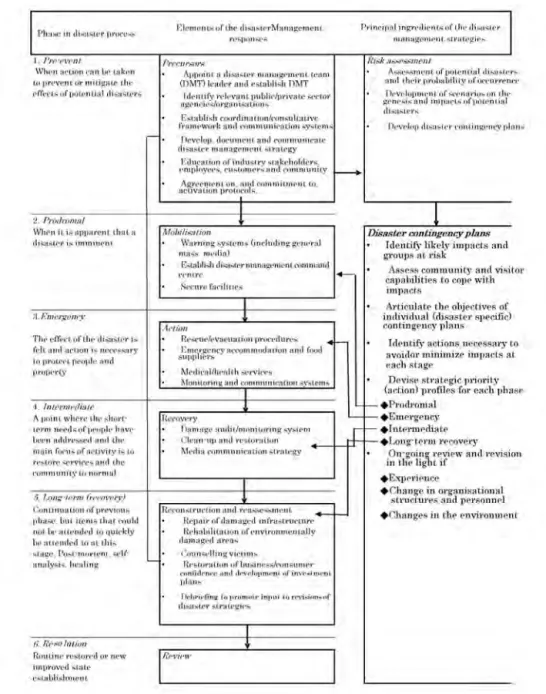
the crisis, it is effective to control the information and to add risk assessment and damage investigation (Ashcroft, 1997; Beirman, 2003; Glaesser, 2006; Ritchie, 2009). The authors underline the necessity of a quick response and provision of accurate information in crisis communication. Whereas this uncontrollable information may exaggerate the flow and con-sequence of the negative event through distortion and over-statement, accurate information can avoid further risk (Ritchie, 2009). Communication strategy comprises discrimination and supervision between these two kinds of information and these provisions operate throughout crisis and crisis management and often are launched in the middle-crisis or post-crisis for re-covery (Ashcroft, 1997; Ritchie, 2009). In order to specify the crisis communication role in crisis management, this strategy review shows the Faulkner’s tourism crisis management frame-work (see figure 1) which demonstrates the holistic approach for crisis and crisis management. This framework suggests the way to manage and limit the negative influence through the ap-propriate comprehension of the crisis and natural disaster, and event flow. Faulkner (2001) specifies the stages of crisis, each phase of actions and strategic approach to eliminate further continuous impact on the presumption that each has different time pressures, circumstances and event magnitudes. It shows, the communication system spreads in all phases of the disaster process and management elements, apart from the phase of re-construction and reassessment; besides, Faulkner (2001) states that communication strategy can work relevantly in tourism crisis management for situations sharing the information with tourists, destination community and internal workers of tour-ism agency. Communication strategy is somewhat practical in lessening the further complexity in the crisis and promoting the comprehension of the situation. Hysted and Keller (2008) also propose that communication development and planning should be integrated and transform the mode of communication throughout the crisis due to the transition of the situation.
To be precise, crisis communication comprises the internal (employee) and the external (media, tourist, travel and trade) constitution (Yang and Montogomery, 2008). Their studies tell us the crisis management procedures for destination recovery through convention and visitor bureaux and specify the two different communication strategies and communication frame-works. It appears that the element of communication with the tourist belongs to an external constitution which impacts on the ruination of destination image as a tourism marketing tool (Yong and Montogomery, 2008). With the premise that crisis communication is one of the recovery marketing plans, Coombs (1999) and Berry (1999) emphasize the significance
of consistent, rapidly transmitted messages for development and the necessity of honest and open messages. In brief, the transmission of correct and the open information can avoid fur-ther disorder and misunderstanding, and promote the recovery marketing more efficiently.
For the most relevant method for destination recovery, des-tination recovery marketing plays an obligatory role in crisis communication since marketing is a negotiation process to link the business market with the supply-side and the demand-side, and lubricate their transactions (Pike, 2004). It can connect the potential tourist (demand side) and the tourist destination or organisation (supply-side) through the promotion and adver-tisement of destination. Also, recovery marketing enables to restore and redevelop a tourism destination to recapture tour-ist numbers and the re-enhancement of the destination market
(Armstrong and Ritchie, 2007). Although the concept still pro-vides basic marketing theory - that is the connection between supplier and consumer, recovery marketing stresses tourism restoration rather than further development of sales. Hence, crisis management includes recovery marketing as the key for destination recovery, and as a part of crisis communication. In that situation, DMO works on not only in normal tourism marketing but also in recovery marketing post crisis. However, each crisis perception demands trained skills for quick deci-sion-making and action to take place, so that the DMO workers need to gain skills before a crisis happens. Similarly DMOs require to prepare marketing plans in advance for a possible crisis occurrence (Rittchainnwat, 2006).
Accordingly, recovery marketing is somewhat relevant with regard to the basic aim; however, the actual implementation is
complex and there are many difficulties to practicing effective actions. However, there are a lots of possibility of making ef-forts for tourism recovery and destination regeneration. Figure 2 demonstrates the composition which the literature review shows. As shown, the image converter is mainly composed of DMOs which especially focus on communication outside of the organisation via media and tourists. The main role of the DMO is to be transparent and forward accurate, up-to-date in-formation to the tourists.
Figure
2
: Recovery marketing approach and flow of destina-tion image ruinadestina-tionSource: Chon, 1990; Sonmez, Apostolopoulos and Tarlow, 1999; Bigne, Sanchez and Sanchez, 2001; Beirman, 2003; Faulkner, 2001; Pike, 2004; Prideaux et al, 2008; Ritchie, 2009; Pike, 2008; Yang and Montogomery, 2008; Lee, 2008; Wang and Hsu, 2010
Ⅲ. Research Investigation
This study reveals a substantial effect through the strategic approach of Japanese recovery marketing for recapture of the number of foreign tourists. Therefore, it is necessary to re-search both the level of awareness and the companies’ efforts throughout a year after the outbreak of earthquake because this research field is relatively new. In addition, since the impact of the earthquake in inbound tourism was intended to cover the whole of Japan not only the Tohoku, it is important to conduct surveys of the major travel companies throughout Japan. As a final goal, this research aims to organize recovery trend of for-eign tourist numbers, and investigate the possibility of “com-munication and reporting” in recovery marketing.
Ⅳ. Methodology
In this paper, two different methods can be used to gain
dif-ferent views of recovery marketing: (1) General interview guide approach of people who are working in the marketing segment of the Japanese tourism enterprise, (2) Secondary research of statistics from the Japan National Tourism Organ-isation (JNTO) and journals. Through these research methods, this paper’s objective is to reveal the systematical framework of Japan’s recovery marketing. It collates the main activities done by tourism companies and the statistics of number of tourist arrival published by JNTO, to verify the gradual influence of marketing through the clarification of relevance between the effort contents and the transition of the number of tourists from oversea. Interviews are conducted by e-mail and phone from July 2012 to August 2012 along the questions of the table 1, and 10 companies and municipality relation to tourism as well as destination marketing are chosen as research targets. Even-tually, responses from 6 out of 10 companies and municipali-ties were collected.
Table
1
: Questions for interviewQ1.About the content of recovery marketing
What do you think the main aim or view of tourism marketing? What do you think the main aim or view of recover marketing after earthquake 3.11?
Q2. About your company’s actions for recovery marketing 2-1. When did you start recovery marketing after earthquake? 2-2. In which way did you practice the recovery marketing?
(For example: video promotion, HP, Media coverage etc.) 2-3. How did you operate the PR activity according to the time
frame?
2-4. Which part of destination did you advertise particularly? Q3. About the preparation of recovery marketing for
unpredictable disaster
3-1. Have you ever had the training or workshop for recovery marketing before? Yes/ No
3-2. If you tick yes, what kind of training did you have? (Examples: the way of quick correspondence, ethical consideration, mutual cooperation with other organizations, etc.)
Ⅴ. Natural disaster: the research and case study context At 14:46 at local time on March 11th 2011, the magnitude 9.0 Tohoku earthquake caused large-scaled impacts in the North region of the Japanese mainland (see Appendix 1). The event was the greatest earthquake recorded Japanese in history, and the scale can be compared to the Sumatra-Andaman earthquake in 2004 (Hisdal and Lorraine, 2011). The Tohoku earthquake had huge tremors of over magnitude 6.0 not only in the Tohoku area but it also reached the whole of Kanto area, the range of damage in the Kanto area included such diverse problems as liquefaction on reclaimed land and large scale of power failure (Takewaki, et.al, 2011). The quake brought about Tsunamis, and the height attained was around 9 meters; resulted in land
flooding as far as 6 kilometres inland. Particularly badly af-fected were Iwate prefecture as well as Fukushima prefecture (Japan Meteorological Agency, 2011). As a result of this dev-astating Tohoku earthquake, the number of the deceased and missing amounted to about 1900; so, it is clear that this event included secondary disasters such as submergence through land subsidence and it impacted on the whole Japanese economy. Even after the initial Tohoku earthquake, tremors over mag-nitude 4.0 kept occurring in the disaster area on a long-term basis, so that there are tremendous difficulties for recovery to take place (Japan Meteorological Agency, 2011). For example, the tremor becomes the obstacle at the time for rescue because there is a high possibility that the quake will cause the further collapse of buildings. Furthermore, the nuclear accident hap-pened at the same time as the occurrence of tsunamis. Although TEPCO (Tokyo Electric Power Co.) built the seawall which is higher than the standard level of conceivable tsunami in order to guard the nuclear station from the anticipated tsunami disas-ter; the tsunami in Tohoku earthquake overwhelmed it easily, so that the nuclear station was fully flooded (Fukazawa,S. and Fukazawa,N, 2011). Consequently, the nuclear re-actor stopped working and started to contaminate the seawater.
Moreover, the risk of reputation also damage rose as each event happened. The influence of the nuclear accident was massive and the impact extended into many areas of everyday life, affecting many kinds of grocery, soil, sea water and drink-ing water in the Tohoku area (Fukazawa,S. and Fukazawa,N, 2011). Every product from Tohoku was subjected to a tempo-rary export ban, and as for journeys to Japan, every country an-nounced the recommendation of self-imposed control for travel to the affected area (Ministry of Land, Infrastructure, Transport and Tourism, 2011). Due to the desire to avoid even more confusion and not to jeopardize the tourist by unpredictable risk, the acceptance of visitors was hardly possible whilst an assessment of the situation was the first priority and the Japa-nese government and the self-defence forces wrestled with the protection of victims, food support, the removal of tremendous amounts of debris and the need for the determination of coun-termeasures against further impact as well as risk assessments. As a result of this, the number of foreign tourists plummeted sharply, and the number was documented at minus 70 per cent of growth rate over a period of three month post-earthquake compared to the preceding year (JNTO, 2011: JNTO, 2012). From the number, it appears that the impact of a disaster con-nects directly to the tourism industry; rather, it is not too much to say that the tourism industry must meet the impact head-on.
Ⅵ. Result
6 out of the 10 companies approached completed the inter-view process, either by e-mail or by telephone, and they are shown in table 2.
Table
2
: Collective result of recovery marketing tools Company (Detail) Methods for destination PRCompany A
(Tourism organisation which i s d i r e c t ly c o o p e r at e w it h Japanese Ministr y of Land, Infrastructure, Transportation and Tourism sector)
・ Transmission of up-to minute i n f o r m a t i o n v i a S N S , H P , ne ws p a p e r, v id e o m a s s a ge a n d YouTube
・ Constitution of 24 hours tourist information centre
・ M e d i a a n d t o u r i s m a g e n c y invitations
・ PR of bargain tours
・ The project and operation of press tours
Company B
( T he m a rket i ng se c t or of J a p a n e s e t o u r i s m a g e n c y which invites not only tourists b u t a l s o c o n v e n t i o n a n d international meeting, etc.)
・ Bargain package tour th rough c ol l a b o r a t io n w i t h a i r l i n e a n d tourism agencies
・ Information transmission through SNS
・ Notification of tourism information and package tour via online travel websites
Company C
(Tourism bureau in Kansai area which is deal in the area tour)
・ Infor mation transition on own website
・ Blog entry to discuss the questions of whether to cancel or visit ・ Press tour
・ Magazine and newspapers
Company D
(Tourism agency which offers a collection of private tours specialized Japanese cultural aspects for foreign visitors)
・ Information transmissions via social media homepages
Company E
(Official tourism bureau in Kanto erea)
・ Utilization of blogs especially in cooperation with celebrities ・ PR in the international exhibitions ・ Development of further attraction
Company F
(A non-prof it organisation which aims to promote tourism and education of eco-tourism)
・ Operation of volunteer tour ・ To hold a cou nter measu re for
tourism recovery
・ Submission of a proposal book for tourism recovery
Each company and municipality has been given words with a summary of the companies’ main achievements detail as well as their efforts in recovery marketing. Every company and mu-nicipality underlines the importance of making detailed reports for customers as a first priority, and the medium tool for trans-mission is diverse and varied. Media tools such as an official homepages, SNS, blogs, magazines and newspapers are widely utilized as main resources already. Company A which directly co-operates with the Japanese government has set up a 24-hour tourist information centre to transmit the information more quickly to tourists. Because they are aware that tourists become more anxious in the situation where they cannot get
informa-tion, they have set up a system so that tourists can be aware of the present situation anytime, anywhere. Company A also films the interviews with local people, foreign tourists and foreign residents; then they upload these interview videos to their own HP or to YouTube in order to make the local information more accessible. Besides, as both Company A and Company C have done, they make newspaper features or articles about the Japa-nese earthquake, or TV documentary programmes with the co-operation of overseas media. With respect to Newspaper and programmes, the information is more positive than normal in-formation via news; rather, the inin-formation can give the recov-ery impression by means of image notification which focuses on destination recovery.
In addition, 5 out of 6 agencies launch unusual countermea-sures against damaged images by such measure as press tours, information transmission by famous celebrities and holding conferences as well as international meetings for mutual un-derstanding of tourism recovery. Foreign tourism agencies and foreign journalists were the main targets of press tours and conferences. They toured not only unaffected areas of Japan but also visited the damaged areas with the intention of proving that the country was safe to visit. They intended to give prompt truthful information. These official invitations were mainly is-sued by Company A which co-operated with the Government directly; however, private companies also have the advantage
of being able to use appeals by celebrities and holding confer-ences. The comments made by famous singers and actors are uploaded onto the HP and YouTube in order to get more atten-tion from foreigners. They have a great influence and because of their celebrity status is an effective way of spreading in-formation to influence the public’s perception of the situation. From this point of view, the most important step for recovery marketing is how quickly they can send reliable information to tourists; to be open is also mandatory. Although the commu-nication tools are varied, it appears that there was a shared de-termination to succeed in the common objective of destination recovery.
On the other hand, there is similarity in the timing of the start of commercial promotions. Figure 3 demonstrates prevailing recovery marketing flow post-earthquake with a flow graph of tourist numbers. Fundamentally, officials and tourism agencies concentrate on information transmission in March shortly after the quake; this focus continued until around the end of April. Although there were two stages of movement: the exclusion of excessive restriction stage and the tourism promotion stage for marketing in April, promotion of package tours sales restored in May .
Private companies could not progress the marketing move-ment without official information and the removal of restric-tions. Thus, the change in emphasis in recovery marketing in
the first few months after the quake necessarily became more similar between these 6 companies. It may be divided into three important stages: (1) information transmission from offi-cials, (2) amendment negotiation of travel restriction into Japan and (3) commercial promotion of tourism. Furthermore, the promotions differ to the timing and context depending on the target destination; for instance, the promotion toward Europe went back to normal promotion around three months earlier than Asia; on the other hand, Asian neighbour countries needed more time for the restoration of reputation. That is because neighbour countries had more information about the crisis than Europe, so that a high awareness of danger toward Japan re-mained deeply rooted on people’s minds. It can clearly verify that the tourists regard the safety and security as the first prior-ity; also that the excessive news highly damaged the image or Japan as a tourism destination. The success of these operations led to the start of the recovery in tourist numbers from the end of April.
Concerning the companies understanding of recovery market-ing and cooperative structure, 4 out of 6 companies answered that they have never had the training in advance; and they do not seem to recognize the specialized techniques. Only Compa-ny A and CompaCompa-ny B replied that they have ever had seminars and training in risk management, proper context of informa-tion, timing as well as targeting between administration and the tourism industry. Company A also acknowledged the use of recovery marketing, and they organized the training and semi-nars directly under the Ministry of Land, Infrastructure, Trans-portation and Tourism (MLIT). Hence, even though both Com-pany A and ComCom-pany B are aware of know the way to manage recovery marketing as they both attended the same seminar, they are in opposite positions. It is clear that not all companies possess the same understanding of recovery marketing or risk management; moreover, it appears that there is no standardized operational process. In other words, management of the flow of recovery marketing is composed with common-sense of aware-ness toward tourist under the administrative direction as proper result.
Ⅶ . Discussion
From these examinations, it appears the recovery marketing after the Tohoku earthquake took place within companies with-out recovery market training as well as within these who had received training. Figure 4 demonstrates the flow of recovery marketing after image ruination as well as showing a decrease of tourist numbers post-earthquake. Figure 4 links to Figure 1 which is shown in literature review, and is composed based
on the result from the interview and secondary research. Im-mediately after the crisis, every organisation such as the Gov-ernment, tourism agencies and the DMOs launched intensive information transmission. They sent credible and transparent information to confirm the safety of Japanese tourism; rather than positive information or appealing information. Similarly, tourist’s behaviour also changes due to anxiety when a crisis or disasters takes place, so that they tend to seek accuracy and speed with information. The information does not specialise on information as a tourism destination but the present situation of crisis and the safety. After information transmission, organisa-tions resume normal marketing. Even though there is no specif-ic strategy for a time frame to shift the marketing content, the timing of strategy conversion varies due to the level of image ruination. The level of the damage on the destination image changes depending on the quantity and content of the informa-tion. This is evidenced through the research that the change in emphasis from information transmission to normal marketing varied between Asia and Europe. For example, in the situation of the recovery marketing on the Tohoku earthquake, neigh-bouring countries received more information than European countries; therefore, the resumption of normal marketing for Asian countries was delayed for three months longer than for Europe. It implies that a reduction of anxiety and the resolution of safety issues can be the indication to resume normal meth-ods of tourism promotion. Besides, the information for the re-storing of confidence is not for the further development of tour-ism industries, but for the encouragement for the resumption of normal marketing. For this reason, it could be mentioned that the speed of return to normal marketing is related to the level of damage suffered by the destination image. However, it could also be emphasised that the use of transparency and accurate information can accelerate the recovery of destination image. Thus, while the level of damage to destination image varied with the amount and content of the information, the quicker and more accurately information was transmitted, the sooner the normal marketing could re-commence. That is to say, the quicker and the more accurate the information that the DMOs and the tourism agencies forward, the quicker tourism numbers can recover.
Figure
4
: Recovery marketing flow post-Tohoku earthquake in the case of JapanIn terms of tourism promotion, each Company and municipal-ity resumes a similar flow in normal tourism marketing such as participation of international tourism convention and to sell special offers of package tours; however, the price of package tours plummeted significantly. The unit of price of tourism, lei-sure and package tour dropped 35.7% sharply, and the amount of expenditure during the tour decreased 8.6% at the same time (Nanbi and Takashige, 2011).
There are basically three different positions of organisations: the official tourism agency, the private tourism agency and the DMO. As a whole, these three kinds of organisations send intelligence which is based on governmental publication, the private sectors and the DMOs send the announcement after disclosure from official tourism agency. Thus, even though the officials and the government publish the information, the organisations still interpret the transmission of information as the common role for recovery marketing. Also, as the most important element for recovery marketing, the quick response after crisis promotes the regeneration of the destination image by means of disclosure. However, it could be observed that the flow of information transmission occurs since organisations held same aim which was to restore confidence in the safety of the nuclear power plant and the surrounding areas.
With regards to the common understanding of recovery mar-keting, actually, it is still developing. As to the present situation of recovery marketing in Japan, recovery marketing was not yet been acknowledged as the one of the official tourism manage-ment and there are not enough case studies in Japan referring to Company A; however, when SARS broke out, the government as well as tourism industry have stated to recognize the impor-tance of recovery marketing gradually. There have been very few seminars specifically about recovery marketing and recov-ery marketing is still developing even in Japan which is famous as an earthquake-prone country. Tourism agencies and DMOs tend to deal with recovery marketing as an extension of risk
management; however, their management do not, so there is a difference in the basic approaches. There are a limited number of case studies in Japan to refer to. Although only a small num-ber of organisations have undertaken training or participated in seminars, they use the external constitution in crisis com-munication which is referred by Yang and Montogomery (2008) relevantly. Therefore, the resumption of commercial marketing took place with the support of foreign journalists and tourism agencies. It could be suggested that the purpose of disclosure is to restore confidence in the safety of Japan as a destination. Nevertheless, it is clear that there are common operations, us-ing tools with similar steps to recovery marketus-ing. These com-panies tend to use quicker and more effective communication tools in their recovery marketing. Figure 5 shows the tourist utilization rate of information source and composes them with main recovery marketing tools after Tohoku earthquake (JNTO, 2011: 2012). As it demonstrates, the utilization rate of book-lets decreases year after year; whereas the rate of SNS which can send the information relatively quickly increases in 2012. Looking at the utilization rate in 2011, tourists tended to utilize official HP and direct conversation with their acquaintance to obtain correct and credible information. The word-of-mouth from acquaintance category in this graph indicates friends or relatives that live in Japan or have ever been to Japan post-earthquake. It shows that what tourists really need and which tool tourists use. Tourists obviously need correct and up-to-minute information. Thus, the information source which has general tourism information with low-speed such as booklet slightly decreased the utilization rates after the outbreak of a crisis. On the other hand, the net-based tool: official HP showed increased on use numbers in 2011. It is because basi-cally the tourists prefer to use net-based tool due to the qual-ity, that the tourists can gain the many information quickly. However, the rate of SNS, which is also one of the net-based tool deceased in 2011 and raised the rate in 2012. It could be considered the lack of accuracy as a cause. There was a great deal of unreliable information at the time of outbreak, so that people tended to avoid the SNS tool. As a result, it is clear that the tourists seek the accuracy of the information in addition to the speed.
Figure 5: Information source of foreign visitor before their visitation
Source JNTO, 2011: JNTO, 2012
In this recovery marketing, organisations do not try to convert the image of Japanese image but to restore the image whilst keeping mind and not hiding the factor that a crisis has taken place. Because of the groundwork, the number of foreign visi-tors recovered in one year. In addition, the continuation of normal marketing; promotion started in a short period; for ex-ample, Asia and Europe started regular promotions in 6 months and three months respectively. On the other hand, the eco-nomic impact in inbound tourism has not fully recovered, and economic income in inbound tourism has fallen below 20% at June 2012 compared to previous year (JNTO, 2012). A lot of tourism agencies tend to avoid selling Tohoku area tour be-cause the Government has not published a declaration of safety yet. From this point of view, it seems that there are still plenty of issues to be resolved before the completion of perfect image restoration. However, the definite thing is that controlled infor-mation post-earthquake can mitigate the tourists’ confusion and anxiety, and form the basis for the continuation of normal des-tination promotion at the same time. Thus, the recovery of the perception of a safe destination open information the transmis-sion positively influence on tourist decitransmis-sion-making process.
Ⅷ . Conclusion
The recovery marketing after crisis plays a significant role for tourism recovery post-crisis. This research uncovers the strat-egy and the intrinsic role of Japanese recovery marketing after “The Great East Japan Earthquake”. It mainly examines the Japanese DMOs and the tourism agencies with the interview research carried out by e-mail and telephone, and secondary research through the JNTO’s statistics. The research aimed to clarify their common understanding of recovery marketing and the purposes and the marketing tools for recapture of the tourist numbers. As the result, it clarifies that Japanese tourism agen-cies and the DMOs promote the use of transparency, by means of up-to-date and accurate information which is published by the Government and official organisations. This is because they believe that the restoration of safety confidence is an essential step for the recovery of Japanese tourism. Also, the main role
of recovery marketing is not the conversion of destination im-age and the development of the tourism industry. Recovery marketing is a strategic tool, which is based on the ideology of regeneration, for the retrieval of safety trust and the continua-tion of commercial tourism promocontinua-tion.
From the result of the operation of the recovery marketing, it also demonstrates the characteristics of the Japanese recovery marketing. Fundamentally, the role of the recovery market-ing aims to recover the destination image from the negative impression. In other words, it does not aim to convert the destination but to develop the destination image positively. Furthermore, it also plays the role as foundation building for the resumption of normal marketing. In essence, the purpose of recovery marketing is not for making profit or for the devel-opment of the tourism industry, but for the restoration of the tourism industry to its previous position. However, it is clear that recovery marketing can advance the tourism regeneration effectively. With regard to the case of the Tohoku earthquake, the recovery marketing in the first two months after crisis pro-moted the recovery of the tourist numbers. It was because they could restore the credibility of Japan’s safety through the im-mediate operation of recovery marketing. Therefore, it could be said that the recovery marketing is an imperative tool for inbound tourism regeneration. At the end, this research reveals the achievement process of recovery marketing which has not been well studied in the prior studies, and there are potential to contribute to the model building. However, only 6 companies had to target in this study, and the research remained in the fo-cus on the recovery marketing after the earthquake. As the fu-ture research, there is still the need for further development of recovery marketing not only in the situation of post-earthquake but also a variety of cases that require a recovery marketing such as terrorism and transition of political situation.
Reference:
Armstrong, E. K.; Ritchie, B. W., 2007. The heart recovery marketing campaign: destination recovery after a major bushfire in Australia’s national capital. Journal of Travel & Tourism Marketing, 23(2/4), pp. 175-189.
Ashcroft, L.S., 1997. Crisis Management- public relations. Journal of
Managerial Psychology, 12(5), pp.325-332.
Bigne, J.E, Sanchez, M.I., Sanchez, J., 2001. Tourism image, evaluation variables and after purchase behaviour: inter-relationship. Tourism
Management, 22(6), pp.607-616.
Beck, U., 2006. Living in the world risk society. Economy and Society, 35(3), pp. 329-345.
Beirman, D., 2003. Restoring tourism destination in crisis a strategic
marketing approach. Oxon: CABI Publishing.
81(4), pp.4-9.
Chon, K., 1990. The role of destination image in tourism: A review and discussion. Tourism Review, 45(2), pp. 2-9.
Coombs, T., 1999. Ongoing crisis communication: Planning, managing
and responding. Thousand Oakes, CA: Sage.
Faulkner, B., 2001. Toward a framework for tourism disaster management.
Tourism Management, 22(2), pp.135-147.
Fukazawa, S. and Fukazawa, N., 2011. A Study about Nuclear Accident
at Tokyo Electric Power Co., Ltd’s Fukushima No. 1 Power Plant.
[pdf] Available at:< http://www.jiu.ac.jp/books/bulletin/2011/graduate/ fukasawa.pdf > [accessed 30 July 2012].
Gartner, C.W., 1993. Image formation process. Journal of Travel &
Tourism Marketing, 2(2-3), pp. 191-216.
Glaesser, D., 2006. Crisis management in the tourism industry. Oxford: Elsevier.
Hisdal, D. and Tighe, M. L., 2011. Two devastating Tsunamis in less than a decade. In: Geospatial Media and Communications,10th
annual Asian conference & Exhibition on Geospatial Information, Technology &
Applications. Jakarta, Indonesia, 17-19 October 2011. [pdf] Available
at:< http://www.asiageospatialforum.org/2011/proceeding/pps/ David%20Hisdal_AGF.pdf > [Accessed 30 July 2012].
Hysted, P.W. and Keller, P.C., 2008. Toward a destination tourism disaster management framework: Long-term lessons form a forest fire disaster.
Tourism Management, 29(1), pp.151-162.
Japan Meteorological Agency, 2011. The 2011 off the pacific coast of Tohoku earthquake, observed tsunami. [online] Available at:< http://
www.seisvol.kishou.go.jp/eq/2011_03_11_tohoku/index.html > [Accessed 28 July 2012].
Japan Meteorological Agency, 2011. The number of times of aftershock
post-Tohoku earthquake between March 2011 and August 2012. [online]
Available at:< http://www.seisvol.kishou.go.jp/eq/2011_03_11_tohoku/ aftershock/ > [accessed 3 August 2012].
Japan National Tourism Organization, 2011. Visitor arrivals and Japanese
overseas travellers: estimated record of May 2011, and provisional figure
of March 2011. [pdf] Tokyo: Japan National Tourism Organization.
Available at:http://www.jnto.go.jp/jpn/downloads/110616_monthly.pdf [Accessed 2 August 2012].
Japan National Tourism Organization, 2012. Visitors arrivals and
Japanese overseas travellers: estimated record of June 2012, [pdf]
[pdf] Available at:< http://www.jnto.go.jp/jpn/news/data_info_listing/ pdf/120720_monthly.pdf> [Accessed 5 August 2012].
Lee,Y. and Harrald, J.R., 1999. Critical issue for business area impact analysis in business crisis management: analytical capability. Disaster
Prevention and Management. 8(3)pp.184-189.
Ministry of Land, Infrastructure, Transport and Tourism, 2011. The advice
for travel to Japan in various countries. [pdf] Available at:< http://www.
mext.go.jp/b_menu/shingi/chousa/kaihatu/016/shiryo/__icsFiles/afieldfi le/2011/07/01/1307977_4_1.pdf > [accessed 29 July 2012].
Ministry of Land, Infrastructure, Transportation and Tourism, 2011. The
operations for recovery marketing. [pdf] Available at:< http://www.mlit.
go.jp/common/000170293.pdf > [accessed 28 July 2012].
Nanbi, K. and Takashige, H.,2011. Tohoku earthquake, rising yen rate-reduction of objective number of foreign visitor. Asahi
newspaper,[online] 24 November, Available at:< http://www.asahi.com/
business/topics/economy/TKY201111240212.html > [Accessed 30 July 2012].
Sahin, S., Ulubeyli, S. and Kazaza, A., 2015. Innovative Crisis Management in Construction: Approaches and the Process. Social and
Behavioral Sciences. 195, pp. 2298 – 2305.
Prideaux, B., Alexandra, C. and Faye, F., 2008. Post Crisis Recovery: The Case of After Cyclone Larry. Journal of Travel & Tourism Marketing, 23(2), pp. 163-174.
Pike, D., 2004. Destination marketing organisations. Oxford: Elsevier. Pike, S., 2008. Destination marketing an integrated marketing
communication approach. Oxford: Elsevier.
Ritchie, B.W., 2004. Chaos, crisis and disaster: a strategic approach to crisis management in the tourism industry. Tourism management, 25(6), pp. 669-683.
Ritchie, B.W., 2009. Crisis and disaster management for tourism. Bristol:Channel View Publication.
Takewaki, I., Murakami, S., Fujita, K., Yoshitomi, S. and Tsuji, M., 2011. The 2011 off the Pacific coast of Tohoku earthquake and response of high-rise buildings under long-period ground motions. Soil Dynamics
and Earthquake Engineering, 31(11), pp.1511-1528.
Tasci, A.D.A. and Boylu, Y., 2009. Cultural comparison of tourists’ safety perception in relation to trip satisfaction. International Journal of
Tourism Research. 12(2), pp. 179-192.
Walters, G. and Clulow, V., 2010. The tourism market’s response to the 2009 black Saturday bushfires: the case of Gippsland. Journal of Travel
& Tourism Marketing, 27(8), pp.844-857.
Wang, C. and Hsu, M.K., 2010. The relationships of destination image, satisfaction, and behavioural interventions: an integrated model. Journal
& Travel & Tourism Marketing, 27(8), pp.829-843.
Wong, J. and Yeh, C., 2009 Tourist hesitation in destination decision making. Annals of Tourism Research, 36(1), pp6-23
Young, W.B. and Montgomery, R.J., 1998. Crisis management and its impact on destination marketing. Journal of Convention & Exhibition
Management, 1(1), pp.3-18.