ASimple Design
of
Chaotic Binary
Sequences
with
Prescribed
Auto-Correlation
Properties
Based
on
Piecewise
Linear
Onto Maps
Akio
TSUNEDA
Department ofElectrical and Computer Engineering,
Kumamoto University, Japan
2-39-1 Kurokami, Kumamoto 860-8555, Japan
Tel: +81-96-342-3853, Fax: +81-96-342-3630
E-mail : t suneda@eecs.kumamoto-u.ac.jp
Abstract: This paper describes simple design methods of chaotic binary sequences with
prescribed aut0-correlation properties including higher-0rder statistics. We employ
one-dimensionalpiecewiselinearontomaps and simplethreshold functionsforgenerating such
sequences. Some examples of such designs are also given. Furthermore, bounds on such
statistics are discussed and compared to the result for general binary random variables.
1Introduction
Simpledeterministicsystemscan exhibit very complex and randombehaviorcalled chaos.
Such phenomena are very interestingin both oftheoretical and engineeringpoint of view.
One of the most useful applications of chaos is arandom number generator which is
re-quired in several engineering applications such as Monte Carlo simulations, spread
spec-trum communications, and cryptosystems. In many kinds of pseudorandom numbers,
binary sequences are most useful in such digital communicationsystems. The best known
class of binary sequences is the s0-called linear feedback shift register (LFSR) sequences
such as $\mathrm{M}$-sequences, Gold sequences, and
Kasami sequences [1].
As quite different methods from LFSRsequences, there have been several attempts to
use chaotic sequences which are generated by one-dimensional nonlinear maps. Though
achaotic sequence itself is real-valued, it can be easily transformed into binary sequences
by appropriate threshold functions. In applications of such chaotic sequences, theoretical
evaluation and design of statistical properties of such sequences are very important
be-causethere are many kinds ofchaotic sequences with various properties which depend on
their deterministicsystems.
Design ofmany chaotic sequences of $i.i.d$. (independent and identically distributed)
binary random variables from asingle chaotic real-valued sequence generated by aclass of
one-dimensional maps has been established [2]. Ageneralized version of such design has
also been given [3]. Sequences of i.i.d. binary random variables are very useful as random
numbers. However non-i.i.d. sequences, which have some correlations dependent on the
chaotic maps and quantizationfunctions, are also useful in someapplications. Actually, it
has been shown that sequences with exponentially vanishingaut0-correlations have better
performance in asynchronous $\mathrm{D}\mathrm{S}/\mathrm{C}\mathrm{D}\mathrm{M}\mathrm{A}$ systems than i.i.d. sequences $[4],[5]$. Thus, it is
very important to design chaotic sequences with prescribed statistical properties
数理解析研究所講究録 1240 巻 2001 年 192-203
Design of chaotic real-valued orbits with prescribed statistical properties have b$\mathrm{e}\mathrm{e}\mathrm{n}$
discussed in [6]. Also, design of dynamical systems which generates an arbitrarily
pre-scribed tree sourceby using piecewiselinear maps has beengiven [7]. We also remarkthat
Kalman already gave aprocedure for embedding aMarkov chain into chaotic dynamics
of piecewise linear maps $[8],[9]$.
In this paper, we present simple design methods to obtain chaotic binary sequences
with prescribed aut0-correlation properties, including higher-0rder statistics, based on
piecewise linear onto maps with auniform invariant measure [10]-[12]. We also use a
simple threshold function for generating chaotic binary sequences from
areal-valued
one.2One-Dimensional
Maps
and
Chaotic
Binary
Sequences
One-dimensional
nonlinear difference equation$x_{n+1}=\tau(x_{n})$, $x_{n}\in I=[d, e]$, $n=0,1,2$,$\cdots$ , (1)
can produce achaotic sequence $\{x_{n}\}_{n=0}^{\infty}$, where $x_{n}=\tau^{n}(x_{0})$. The ensemble-average
defined by
$\langle G\rangle=\int_{I}G(x)f^{*}(x)dx$ (2)
is very useful in evaluating statistics of $\{G(\tau^{n}(x))\}_{n=0}^{\infty}$ under the assumption that $\tau(\cdot)$
is mixing on I with respect to an absolutely continuous invariant measure, denoted by
$\mathrm{g}\mathrm{i}(\mathrm{x})dx$. In this paper, we employ piecewise monotonic onto maps with
$N_{\tau}$ subintervals.
We now define the Perron-Frobenius (PF) operator $P_{\tau}$ of the map $\tau$ with an interval
$I=[d, e]$ by
$P_{\tau}G(x)= \frac{d}{dx}\int_{\tau^{-1}([d,x])}G(y)dy$ (3)
which can be rewritten as
$P_{\tau}G(x)= \sum_{i=1}^{N_{\mathcal{T}}}|g_{i}’(x)|G(g_{i}(x))$ (4)
for piecewise monotonic onto maps, where $g_{i}(x)$ is the $i$-th preimage ofthe map $\tau(\cdot)[13]$.
This operator is very useful in evaluating the correlation functions because it has the
following important property:
$\int_{I}G(x)P_{\tau}\{H(x)\}dx=\int_{I}G(\tau(x))H(x)dx$. (5)
Areal-valued chaotic sequence generated by such amap is easily
transformed
into abinary sequence by athreshold function defined by
$\Theta_{t}(x)=\{$ 0 $(x<t)$ (6)
1 $(x\geq t)$.
We will discuss statistical properties of abinary sequence $\{\Theta_{t}(\tau^{n}(x))\}_{n=0}^{\infty}$ generated by
the threshold function
3
Chaotic Binary
Sequences
with
Prescribed
AutO-Correlation
Properties
3.1
$2\mathrm{n}\mathrm{d}$-Order
AutO-Correlation
Firstly, we define the $2\mathrm{n}\mathrm{d}$-order
aut0-correlation function ofasequence $\{G(\tau^{n}(x))\}_{n=0}^{\infty}$ by
$\rho(\ell;G)=\int_{I}(G(x)-\langle G\rangle)(G(\tau^{\ell}(x))-\langle G\rangle)f^{*}(x)dx$. (7)
For an i.i.d. binary sequence $\{B(\tau^{n}(x))\}_{n=0}^{\infty}$ as given in [2], we have
$\rho(\ell;B)=(\langle B\rangle-\langle B\rangle^{2})\delta(\ell)$, (8)
where $8(0)=1$ and $\delta(\ell)=0$ for $\ell>1$.
Now, we consider piecewise linear (PL) onto maps whose mapping function $\tau_{i}(\cdot)$ in
each subinterval $I_{i}(i=1,2, \cdots, N_{\tau})$ is given by
$\tau_{i}(x)=a_{i}x+b_{i}$, $|a_{i}|>1$, $\tau_{i}$ : $I_{i}arrow I$ (onto). (9)
Without any loss of generality, we
assume
$I=[0,1]$.
For such maps, the invariant densityfunction $f^{*}(x)$ is constant such that $\int_{I}f^{*}(x)dx=1$, that is, $f^{*}(x)=1$. We
call eq.(9) the
onto condition through this paper. Thus, we can obtain the following lemma.
Lemma 1: For the piecewise linear onto maps given by (9), we can get
$P_{\tau} \{(\Theta_{t}(x)-\langle\Theta_{t}\rangle)f^{*}(x)\}=\frac{1}{a_{r}}(\Theta_{\tau(t)}(x)-\langle\Theta_{\tau(t)}\rangle)f^{*}(x)$ (10)
where $t\in I_{r}$.
By using the above lemma, we can obtain the following theorem.
Theorem 1: Let $c$ be afixed point of the map satisfying
$\tau(c)=c$. If we employ the
threshold $c(\in I_{r})$, we have
$\rho(\ell;\Theta_{c})=\frac{\rho(0,\Theta_{c})}{a_{r}^{\ell}}.=\frac{\langle\Theta_{c}\rangle-\langle\Theta_{c}\rangle^{2}}{a_{r}^{\ell}}$. (11)
It should be noted that eq.(ll) is independent of the mapping functions $\tau_{i}(\cdot)(i\neq r)$.
Thus, we can control the aut0-correlation property of the chaotic binary sequence by $c$
and $a_{r}$, where we can use arbitrary values of
$a_{r}$ whose absolute value is greater than 1.
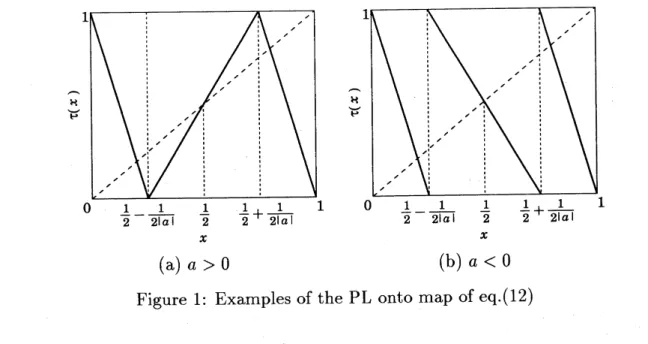
Example 1: Define apiecewise linear onto map with $I=[0,1]$ by
$\tau(x)=\{$
$\frac{2|a|}{ax-1-|a}1\frac{a-11^{x+}}{2}$
$(0 \leq x<\frac{1}{2}-\frac{1}{2|a|})$
$( \frac{1}{2}-\frac{1}{2|a|}\leq x<\frac{1}{2}+\frac{1}{2|a|})$
$\frac{2|a|}{1-|a|}(x-1)$ $( \frac{1}{2}+\frac{1}{2|a|}\leq x\leq 1)$
$|a|>1$
.
(12)Examples of the above map are shown in Fig.1. According to Theorem 2, the
aut0-correlation function ofabinary sequence $\{\ominus\frac{1}{2}(\tau^{n}(x))\}_{n=0}^{\infty}$ obtained by the PL onto map
ofeq. (12) is given by
$\rho(\ell;\Theta_{\frac{1}{2}})=\frac{1}{4a^{\ell}}$.
(13)
$x$ $x$
(a) $a>0$ (b) $a<0$
Figure 1: Examples of the PL onto map of eq.(12)
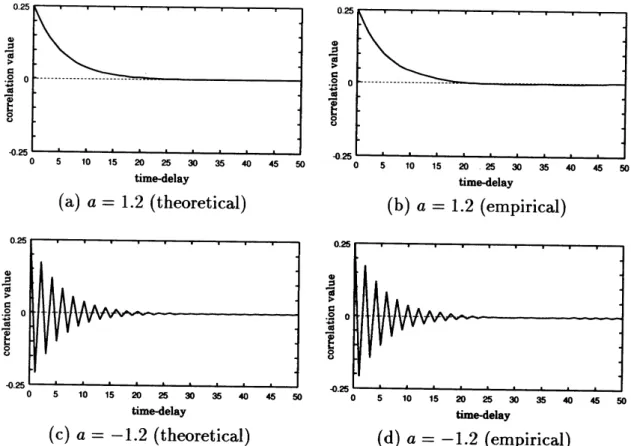
Figure 2shows examples oftheoretical and empirical correlation values of$\{\Theta_{\frac{1}{2}}(\tau^{n}(x))\}_{n=0}^{\infty}$
generatedby PLontomaps of eq.(12), where empiricalvalues are obtained by acomputer.
We can find that the theoretical and empirical values are in good agreement with each
other.
3.2
Run-Probability
When $B(\cdot)$ is abinary ({0,
1}-valued)function,
the probability of$m$ successive l’s in thebinary sequence $\{B(\tau^{n}(x))\}_{n=0}^{\infty}$ is given by
$P_{m}(B)= \int_{I}B(x)B(\tau(x))\cdots B(\tau^{m-1}(x))f^{*}(x)dx$, (14)
which is one of higher-0rder statistics and is also useful for some statistical tests [14].
We call this probability run-probability. Of course, if the sequence is i.i.d., we have
$P_{m}(B)=\langle B\rangle^{m}$.
Here, again, considerthepiecewise linear onto maps givenby (9). We give the following
theorem.
Theorem 3: Let $t$ be avalue such that $t<\tau(t)$,$t<\tau^{2}(t)$,$\cdots$,$t<\tau^{p-1}(t)$ and $t\geq\tau^{p}(t)$.
Then, for the piecewise linear onto maps given by (9), we have
$P_{m}( \Theta_{t})=(\prod_{i=0}^{p-1}\frac{1}{a^{(i)}})P_{m-p}(\Theta_{t})+\sum_{j=1}^{p}(\prod_{i=0}^{j-2}\frac{1}{a^{(i)}})(\langle\Theta_{\tau^{f1}(t)}-\rangle-\frac{\langle\Theta_{\tau^{j}(t)}\rangle}{a^{(j-1)}})P_{m-j}(\Theta_{t})$ (15)
where $a^{(i)}$ is the slope of the mapping function of the subinterval in which $\tau^{i}(t)$ exists.
Proof: Using eq.(10), we can write
$P_{m}( \Theta_{t})=\int_{I}P_{t}(x)f^{*}(x)\}\Theta_{t}(x)\cdot\Theta_{t}(\tau^{m-2}(x))dx=\int_{I}\{\frac{\tau\{\Theta 1}{a^{(0)}}(\Theta_{\tau(t)}(x)-\langle\Theta_{\tau(t)}\rangle)f^{*}(x)\}\Theta_{t}(x)\cdots\Theta_{t}(\tau^{m-2}(x))dx$
timedelay
(a) $a=1.2$ (theoretical) (b) $a=1.2$ (empirical)
(c) $a=-1.2$ (theoretical) (d) $a=-1.2$ (empirical)
Figure 2: ontocorrelation functions of$\{\Theta_{\frac{1}{2}}(\tau^{n}(x))\}_{n=0}^{\infty}$ generated by PL onto maps with
$a=\pm 1.2$.
$= \frac{1}{a^{(0)}}\int_{I}\Theta_{\tau(t)}(x)\Theta_{t}(\tau(x))\cdots\Theta_{t}(\tau^{m-2}(x))f^{*}(x)dx$
$+( \langle\ominus_{t}\rangle-\frac{\langle\Theta_{\tau(t)}\rangle}{a^{(0)}})P_{m-1}(\Theta_{t})$ (16)
and thus by induction we have eq.(15).
Remark: For maps with the EDP, $P_{m}(\ominus_{t})$ as in Theorem 3is obtained by substituting
$a^{(i)}=s((\tau^{i})’(t))N_{\tau}$ into eq.(15).
From Theorem 3, we find that the run-probability of Is in the sequence is also
control-lableto some extent. Note that eq.(15) is independent of slopes of the mappingfunctions
of the subintervals in which $\tau(:t)$ does not exist. We give simple design examples based
on piecewise linear onto maps as follows.
Example 2: For $t\geq\tau(t)$ and $t\in I_{r}$, we have
$P_{m}( \Theta_{t})=(\frac{1-\langle\ominus_{\tau(t)}\rangle}{a_{r}}+\langle\Theta_{t}\rangle)P_{m-1}(\Theta_{t})$ (17)
$=( \frac{1-\langle\Theta_{\tau(t)}\rangle}{a_{r}}+\langle\Theta_{t}\rangle)^{m-1}\cdot\langle\Theta_{t}\rangle$
(18)
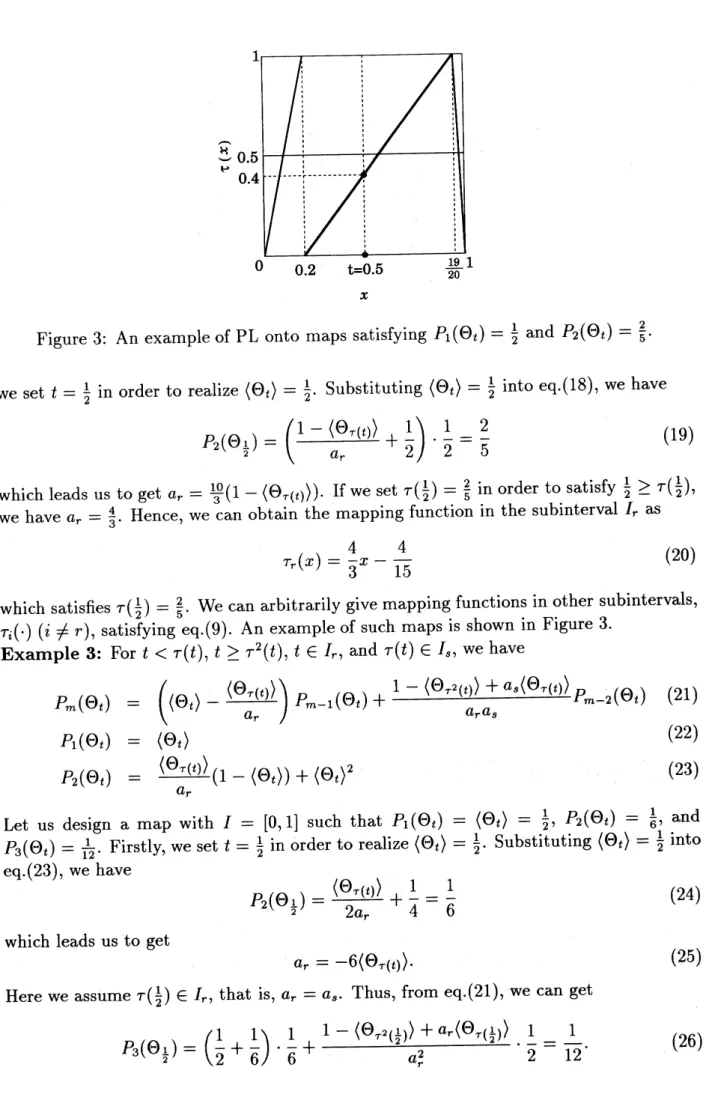
Let us design amap with $I=[0,1]$ such that Pi{Qt) $= \langle\ominus_{t}\rangle=\frac{1}{2}$ and P2(&t) $= \frac{2}{5}$. Firstly
$x$
Figure 3: An example of PL onto maps satisfying $P_{1}( \Theta_{t})=\frac{1}{2}$ and $P_{2}( \Theta t)=\frac{2}{5}$.
we set $t= \frac{1}{2}$ in order to realize $\langle\Theta_{t}\rangle=\frac{1}{2}$
.
Substituting $\langle\Theta_{t}\rangle=\frac{1}{2}$ into eq.(18), we have$P_{2}( \Theta_{\frac{1}{2}})=(\frac{1-\langle\Theta_{\tau(t)}\rangle}{a_{r}}+\frac{1}{2})\cdot\frac{1}{2}=\frac{2}{5}$ (19)
which leads us to get $a_{r}= \frac{10}{3}(1-\langle\Theta_{\tau(t)}\rangle)$. Ifwe set $\tau(\frac{1}{2})=\frac{2}{5}$ in order to satisfy $\frac{1}{2}\geq\tau(\frac{1}{2})$,
we have $a_{r}= \frac{4}{3}$
.
Hence, we can obtain the mapping function in the subinterval$I_{r}$ as
$\tau_{r}(x)=\frac{4}{3}x-\frac{4}{15}$ (20)
’
Example 3: For $t<\tau(t)$, $t\geq\tau^{2}(t)$, $t\in I_{r}$, and $\mathrm{r}(\mathrm{t})\in I_{s}$, we have
$P_{m}( \Theta_{t})=(\langle\Theta_{t}\rangle-\frac{\langle\Theta_{\tau(t)}\rangle}{a_{r}})P_{m-1}(\Theta_{t})+\frac{1-\langle\Theta_{\tau^{2}(t)}\rangle+a_{s}\langle\Theta_{\tau(t)}\rangle}{a_{r}a_{s}}P_{m-2}(\Theta_{t})$ (21) $P_{1}( \Theta_{t})P_{2}(\Theta_{t})==\frac{\langle\Theta_{t}\rangle\langle\Theta_{\tau(t)}\rangle}{a_{r}}(1-\langle\Theta_{t}\rangle)+\langle\Theta_{t}\rangle^{2}$ (22) (23) $\mathrm{L}\mathrm{e}\mathrm{t}\mathrm{u}\mathrm{s}\mathrm{d}\mathrm{e}\mathrm{g}\mathrm{n}\mathrm{a}\mathrm{m}\mathrm{a}\mathrm{p}\mathrm{w}\mathrm{i}\mathrm{t}\mathrm{h}I=[0, 1]\mathrm{s}\mathrm{u}\mathrm{c}\mathrm{h}\mathrm{t}\mathrm{h}\mathrm{a}\mathrm{t}P_{1}(\Theta_{t})=\Theta_{t}\rangle=\frac{1}{2,\mathrm{t}},P_{2}(\Theta_{t})=\frac{1}{6},\mathrm{a}\mathrm{n}\mathrm{d}P_{3}(\Theta_{t})=\frac{\mathrm{s}_{1}\mathrm{i}}{12}.\mathrm{F}\mathrm{i}\mathrm{r}\mathrm{s}\mathrm{t}1\mathrm{y}\mathrm{w}\mathrm{e}\mathrm{s}\mathrm{e}\mathrm{t}t=\frac{1}{2}\mathrm{i}\mathrm{n}\mathrm{o}\mathrm{r}\mathrm{d}\mathrm{e}\mathrm{r}\mathrm{t}\mathrm{o}\mathrm{r}\mathrm{e}\mathrm{a}1\mathrm{i}\mathrm{z}\mathrm{e}\langle\Theta_{t}\rangle=\frac{1\langle}{2}$
.
$\mathrm{S}\mathrm{u}\mathrm{b}\mathrm{s}\mathrm{t}\mathrm{i}\mathrm{u}\mathrm{t}\mathrm{i}\mathrm{n}\mathrm{g}\langle\Theta_{t}\rangle--\frac{1}{2}\mathrm{i}\mathrm{n}\mathrm{t}\mathrm{o}$ eq. (23), we have $P_{2}( \Theta_{\frac{1}{2}})=\frac{\langle\Theta_{\tau(t)}\rangle}{2a_{r}}+\frac{1}{4}=\frac{1}{6}$ (24)which leads us to get
$a_{r}=-6\langle\Theta_{\tau(t)}\rangle$
.
(25)Here we assume $\tau(\frac{1}{2})\in I_{r}$, that is, $a_{r}--a\mathrm{s}.$ Thus, from eq.(21), we can get
$P_{3}( \Theta_{\frac{1}{2}})=(\frac{1}{2}+\frac{1}{6})\cdot\frac{1}{6}+\frac{1-\langle\Theta_{\tau^{2}(\frac{1}{2})}\rangle+a_{r}\langle\Theta_{\tau(\frac{1}{2})}\rangle}{a_{r}^{2}}\cdot\frac{1}{2}=\frac{1}{12}$. (26)
197
$x$
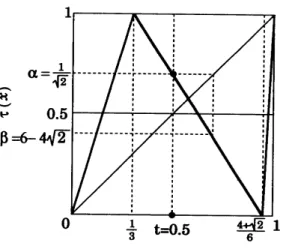
Figure 4: An example of PL onto maps satisfying $P_{1}( \Theta_{t})=\langle\Theta_{t}\rangle=\frac{1}{2}$, $P_{2}( \ominus_{t})=\frac{1}{6}$, and
$P_{3}( \Theta_{t})=\frac{1}{12}$.
Put $\alpha=\tau(\frac{1}{2})$ and $\beta=\tau^{2}(\frac{1}{2})$. Then we have
$\langle\ominus_{\tau(\frac{1}{2})}\rangle$ $=$ $1-\alpha$ (27) $\langle\Theta_{\tau^{2}(\frac{1}{2})}\rangle$ $=$ $1-\beta$ (28)
$\tau_{r}(x)$ $=a_{r}(x- \frac{1}{2})+\alpha$ (29)
$\tau_{\gamma}(\alpha)$ $=\beta$.
(30)
Using eq.(25)-(30), we can get each value of the parameters and obtain the mapping
function in the subinterval $I_{r}$ as
$\tau_{r}(x)=3(\sqrt{2}-2)x+3-\sqrt{2}$. (31)
We can also arbitrarily give mapping functions in other subintervals, $\tau_{i}(\cdot)(i\neq r)$,
satis-fying eq.(9). An example of such maps is shown in Figure 4.
4Discussion
of
Run-Probability
Now consider the simplest case $p=1$ in eq.(15), that is, the case ofeq.(18). Further, we
focus our attention on the case $m=2$
.
Using $\langle\Theta_{t}\rangle=1-t$, we have$P_{2}( \ominus_{t})=(\frac{\tau(t)}{a_{r}}+1-t)(1-t)$. (32)
We consider bounds on the run-probability $P_{2}(\Theta_{t})$ given by eq.(32). There are three
parameters$t$, $\tau(t)$,and$a_{r}$ which determine the value of$P_{2}(\Theta_{t})$
.
However, theseparametersare not completely independent each other since the onto condition eq.(9) and $t\geq \mathrm{r}(\mathrm{t})$
must be satisfied as long as eq.(32) is used. Hence, eq.(32) should have some bounds
which are of our main interest in this section. Thus, we theoretically investigate such
bounds for agiven $P_{1}(\ominus_{t})=\langle\ominus_{t}\rangle$ ($i.e.$, agiven $t$).
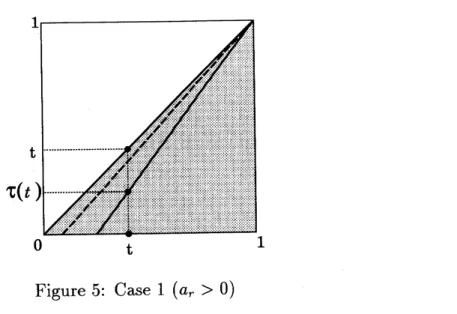
Figure 5: Case 1 $(a_{r}>0)$
To do this, we consider the following cases. Note that each case corresponds to each
of Figures 5-8. In these figures, the coordinate $(t, \mathrm{r}(\mathrm{t})$, which is one of parameters
determining the mappingfunction, must be located in shaded area in order to satisfy the
given conditions.
$\bullet$ Case 1: $a_{r}>0(\mathrm{F}\mathrm{i}\mathrm{g}.5)$
In this case, obviously, the minimum value of $P_{2}(\Theta)$ is $(1 -t)^{2}$ to be obtained for
$\mathrm{o}\mathrm{n}P_{2}(\Theta)\tau(t)=0$
,
condition. As shown in Fig.5, the mapping function $\tau_{r}(x)$ is alinear one with $\tau_{r}(t)=\tau(t)$
and Tr(t) $=1$, whose slope $a_{r}$ is given by
$a_{r}= \frac{1-\tau(t)}{1-t}$. (33)
Thus, the upper bound is $1-t$ to beobtained for $\tau(t)=t$. Note that when $\tau(t)=1$, that
is, $a_{\gamma}=1$, the map is no longer chaotic. Thus, in this case, we have
$P_{1}(\Theta_{t})^{2}\leq P_{2}(\Theta_{t})<P_{1}(\Theta_{t})$. (34)
$\bullet$ Case 2-1: $a_{r}<0$, $t \geq\frac{1}{2}$, and $\tau(t)>1-t(\mathrm{F}\mathrm{i}\mathrm{g}.6)$
In this case, the upper bound on $P_{2}(\Theta)$ is $(1-t)^{2}$ to be obtained for $a_{r}arrow\infty$. Next,
consider the most correlated case. As shown in Fig.6, the mapping function $\tau_{r}(x)$ is a
linear one with $\tau_{r}(t)=\tau(t)$ and $\tau_{r}(1)=0$ for the most correlated case where the absolute
value of the slope of $\tau_{r}(x)$, $|a_{r}|$, is closest to 1while keeping the onto condition. In this
case, we have
$a_{r}=- \frac{\tau(t)}{1-t}$. (35)
Substituting eq.(35) into eq.(32), we can get $P_{2}(\Theta_{t})=0$ which is independent of$\tau(t)$ and
is the minimum value in this case. Hence we have
$0\leq P_{2}(\Theta_{t})<P_{1}(\Theta_{t})^{2}$. (36)
$\bullet$ Case 2-2: $a<0$, $t \geq\frac{1}{2}$, and $\tau(t)\leq 1-t(\mathrm{F}\mathrm{i}\mathrm{g}.7)$
Figure 6: Case 2-1 ($a_{r}<0$, $t \geq\frac{1}{2}$, and $\mathrm{r}(\mathrm{t})>1-t$)
Figure 7: Case 2-2 ($a_{r}<0$, $t \geq\frac{1}{2}$, and $\tau(t)\leq 1-t$)
In this case, the maximumvalue of $P_{2}(\Theta)$ is also $(1-t)^{2}$ to be obtained for $\mathrm{r}(\mathrm{t})=0$
.
Similarly to Case 2-1, consider the most correlated case. As shown in Fig.7, the mapping
function $\tau_{r}(x)$ is alinearone with $\tau_{r}(t)=\tau(t)$ and $\tau_{r}(0)=1$ for the most correlated case
while keeping the onto condition. The slope $a_{r}$ is given by
$a_{r}=- \frac{1-\tau(t)}{t}$
.
(37)In this case, obviously, the lower bound on P2(&t) is 0to be obtained for $\mathrm{r}(\mathrm{t})=1-t$.
Note that when $\mathrm{r}(\mathrm{t})=1-t$, that is, $a_{r}=-1$, the map is no longer chaotic. Therefore,
we have
$0<P_{2}(\ominus_{t})\leq P_{2}(\ominus_{t})^{2}$. (38)
$\bullet$ Case 2-3: $a<0$, $t< \frac{1}{2}$ (Fig.8)
In this case, the maximum value of$P_{2}(\Theta)$ is also $(1-t)^{2}$ to be obtained for $\mathrm{r}(\mathrm{t})=0$
.
Similarly to Case 2-2, consider the most correlated case. As shown in Fig.8, the mapping
function $\tau_{r}(x)$ is alinearone with $\tau_{r}(t)=\tau(t)$ and $\tau_{r}(0)=1$ for themost correlated case
Figure 8: Case 2-3 ($a_{r}<0$ and $t< \frac{1}{2}$)
while keeping the onto condition. In this case, the minimum value of $P_{2}(\Theta_{t})$ is obtained
for $\tau(t)=t$. For such acase, we have
$a_{r}=- \frac{1-t}{t}$. (39)
Substituting eq.(39) and $\tau(t)=t$ into eq.(32), we can get $P_{2}(\Theta_{t})=1-2t$. Hence, we
have
$2P_{1}(\Theta_{t})-1\leq P_{2}(\Theta_{t})\leq P_{2}(\Theta_{t})^{2}$. (40)
From the above four cases, the bounds on $P_{2}(\Theta_{t})$ can be written as
$2P_{1}( \Theta_{t})-1\leq P_{2}(\Theta_{t})<P_{1}(\Theta_{t})0\leq P_{2}(\Theta_{t})<P_{1}(\Theta_{t})\mathrm{f}\mathrm{o}\mathrm{r}P_{1}(\Theta_{t})\leq\frac \mathrm{f}\mathrm{o}\mathrm{r}P_{1}(\Theta_{t})>\frac{211}{2}\}$ (41)
which corresponds to the result forarbitrary binary random variables (see Appendix) [11].
5Conclusion
$\mathrm{W}\mathrm{e}\mathrm{h}\mathrm{a}\mathrm{v}\mathrm{e}\mathrm{g}\mathrm{i}\mathrm{v}\mathrm{e}\mathrm{n}\mathrm{s}\mathrm{i}\mathrm{m}\mathrm{p}\mathrm{l}\mathrm{e}\mathrm{d}\mathrm{e}\mathrm{s}\mathrm{i}\mathrm{g}\mathrm{n}\mathrm{m}\mathrm{e}\mathrm{t}\mathrm{h}\mathrm{o}\mathrm{d}\mathrm{s}\mathrm{o}\mathrm{f}\mathrm{c}\mathrm{h}\mathrm{a}\mathrm{o}\mathrm{t}\mathrm{i}\mathrm{c}\mathrm{b}\mathrm{i}\mathrm{n}\mathrm{a}\mathrm{r}\mathrm{y}\mathrm{c}\mathrm{o}\mathrm{r}\mathrm{r}\mathrm{r}\mathrm{e}\mathrm{l}\mathrm{a}\mathrm{t}\mathrm{i}\mathrm{o}\mathrm{n}\mathrm{p}\mathrm{r}\mathrm{o}\mathrm{p}\mathrm{e}\mathrm{r}\mathrm{t}\mathrm{i}\mathrm{e}\mathrm{s}\mathrm{i}\mathrm{n}\mathrm{c}\mathrm{l}\mathrm{u}\mathrm{d}\mathrm{i}\mathrm{n}\mathrm{g}\mathrm{h}\mathrm{i}\mathrm{g}\mathrm{h}\mathrm{e}\mathrm{r}- \mathrm{o}\mathrm{r}\mathrm{d}\mathrm{e}\mathrm{r}\mathrm{s}\mathrm{t}\mathrm{a}\mathrm{L}\mathrm{i}\mathrm{s}\mathrm{t}\mathrm{i}\mathrm{c}\mathrm{s}$
.
$\mathrm{U}\mathrm{s}\mathrm{i}\mathrm{n}\mathrm{g}\mathrm{a}\mathrm{c}\mathrm{l}\mathrm{a}\mathrm{s}\mathrm{s}\mathrm{o}\mathrm{f}\mathrm{p}\mathrm{i}\mathrm{e}\mathrm{c}\mathrm{e}\mathrm{w}\mathrm{i}\mathrm{s}\mathrm{e}\mathrm{l}\mathrm{i}\mathrm{n}\mathrm{e}\mathrm{a}\mathrm{r}\mathrm{s}\mathrm{e}\mathrm{q}\mathrm{u}\mathrm{e}\mathrm{n}\mathrm{c}\mathrm{e}\mathrm{s}\mathrm{w}\mathrm{i}\mathrm{t}\mathrm{h}\mathrm{p}\mathrm{r}\mathrm{e}\mathrm{s}\mathrm{c}\mathrm{r}\mathrm{i}\mathrm{b}\mathrm{e}\mathrm{d}\mathrm{a}\mathrm{u}\mathrm{t}\mathrm{o}-$
onto maps, we can control the aut0-correlation property with exponential decay and the
run-probability of l’s in achaotic binary sequence. Furthermore, bounds on such
arun-probability have also been discussed.
Appendix
Bounds on
Run-Probability of Length 2for
General
Binary
Ran-dom
Variables
Let $X$ and $\mathrm{Y}$ be binary random variables taking 0 or 1. We denote events $X=1$, $X=0$,
$\mathrm{Y}=1$, and $\mathrm{Y}=0$ by $A$, $\overline{A}$, $B$, and $\overline{B}$, respectively. Moreover, probabilities with respec $\mathrm{t}$
201
to these events are denoted by
$P(A)$ : probability of $A$
$P(A, B)$ : probability of $A$ and $B$
$P(B|A)$ : conditional probability of $B$ assuming $A$
.
Let us
assume
$P(A)=P(B)$. Then, we have $P(A|B)=P(B|A)$ which is easilyobtained from the formula
$P(B|A)= \frac{P(A,B)}{P(A)}=\frac{P(B)P(A|B)}{P(A)}$. (A1)
Furthermore, by using $P(B|A)+P(\overline{B}|A)=1$, we have
$P(\overline{B}|A)=P(A|\overline{B})=P(\overline{A}|B)=P(B|\overline{A})$ (A2)
which gives $P(A,\overline{B})=P(\overline{A}, B)$ because
$P(A,\overline{B})$ $=$ $P(\overline{B}|A)P(A)$ (A3)
$P(\overline{A}, B)$ $=$ $P(\overline{A}|B)P(B)$. (A4)
Now consider bounds on $P(A, B)$ under the assumption that $P(A)=\mathrm{P}(\mathrm{A})$. We also
assume that $P(B|A)=\delta$, where $0\leq\delta<1$
.
Thus, we have$P(A, B)=P(B|A)P(A)=\delta P(A)$ (A5) $P(A,\overline{B})=P(\overline{A}, B)=P(\overline{B}|A)P(A)$
$=(1-\delta)P(A)$ (A6)
$P(\overline{A},\overline{B})=1-(P(A, B)+P(A,\overline{B})+P(\overline{A}, B))$
$=1+\delta P(A)-2P(A)$. (A7)
Since $0\leq P(\overline{A},\overline{B})\leq 1$, we have
$\frac{2P(A)-1}{P(A)}\leq\delta<1$ (A8)
which, in conjunction with (A5), gives
$2P(A)-1\leq P(A, B)<1$. (A9)
However, the probability $P(A, B)$ must satisfy $0\leq P(A, B)\leq 1$. Therefore, we have
$2P(A)-1\leq P(A,B)<P(A)0\leq P(A,B)<P(A)$ $\mathrm{f}\mathrm{o}\mathrm{r}P(A)>\frac \mathrm{f}\mathrm{o}\mathrm{r}P(A)\leq\frac{1}{221}$
.
$\}$ (A1O)
If we set $X=\Theta_{t}(x_{n})$ and $\mathrm{Y}=\ominus_{t}(x_{n+1})$, then $P(A, B)$ implies $P_{2}(\Theta_{t})$ and the two
bounds (41) and (A1O) correspond to each other. This means that chaotic binary
se-quences generated by apiecewise linear onto map and athreshold function can mimic
arbitrary binary random variables with respect to run-probability of length 2.
References
[1] D. V. Sarwate and M. B. Pursley, “Crosscorrelation Properties ofPseudorandom and
Related Sequences,” Proc. IEEE, vo1.68, no.3, pp.593-619,1980.
[2] T. Kohda and A. Tsuneda, “Statistics of Chaotic Binary Sequences”, IEEE Trans.,
Information
Theory, vo1.43, no.1, pp.104-112, 1997.[3] T. Sang, R. Wang, and Y. Yan, “Constructing Chaotic Discrete Sequences forDigital
Communications Based on Correlation Analysis,” IEEE Trans., Signal Processing,
vo1.48, n0.9, pp.2557-2565, 2000.
[4] R. Rovatti and G. Mazzini, “Interference in DS-CDMA Systems with Exponentially
Vanishing Autocorrelations: Chaos-Based Spreading Is Optimal,” Electronics
Let-ters, Vo1.34, N0.20, pp.1911-1913, 1998.
[5] T. Kohda and H. Fujisaki, “Variances of Multiple Access Interference Code Average
against Data Average,” Electronics Letters, Vo1.36, N0.20, pp.1717-1719, 2000.
[6] A. Baranovsky and D. Daems, “Design of
One-Dimensional
Chaotic Maps withPre-scribed Statistical Properties”, Int. J.
Bifurcation
and Chaos, vo1.5, n0.6,pp.1585-1598, 1995.
[7] Y. Oohama, M. Suemitsu and T. Kohda, “Constructionof aNonlinear Map
Generat-ing an Arbitrarily Prescribed Tree Sources”, Proc.
of
1998 International Symposiumon Nonlinear Theory and its Applications, vo1.2, pp.615-618, 1998.
[8] R. E. Kalman, “Nonlinear Aspects of Sampled-Data Control Systems,” Proc. Symp.
Nonlinear Circuit Analysis VI, pp.273-313, 1956.
[9] T. Kohda and H. Fujisaki, “Kalman’s Recognition of Chaotic Dynamics in
Design-ing Markov Information Sources,” IEICE Trans. Fundamentals, VOI.E82-A, N0.9,
pp.1747-1753, 1999.
[10] A. Tsuneda, “Design ofChaotic Binary Sequenceswith Prescribed AutO-Correlation
Properties Based on Piecewise Monotonic Onto Maps”, Proc.
of
1999 InternationalSymposium on Nonlinear Theory and its Applications, vo1.2, pp.605-608, 1999.
[11] A. Tsuneda, “On Run-Probability in Chaotic Binary Sequences Generated by
Piece-wise Linear Onto Maps”, Proc.
of
2000 International Symposium on NonlinearThe-ory and its Applications, vo1.2, pp.385-388, 2000.
[12] A. Tsuneda, “On AutO-Correlation Properties of Chaotic Binary Sequences
Gener-ated by One-Dimensional Maps,” Proc.
of
2000 IEEE InternationalConference
onIndustrial Electronics, Control and Instrumentation, pp.2025-2030, 2000.
[13] A. Lasota and M. C. Mackey, Chaos, Fractals, and Noise, Springer-Verlag, 1994.
[14] T. Kohda, “A New Theoretical Test for Pseudorandom Number Generators Which Is
Based on Perron-Frobenius Operator,” IEICE Trans., Vol.E74, No.6, pp.1430-1436