A Fully Abstract Denotational Model for
Communicating Processes with Label-Passing
Eiichi Horita (
堀田英–), Fer-Jan de Vries
(フェルーヤン ドゥ フリース)NTTCommunication Science Laboratories
2-2, Hikaridai, Seika-Cho, Soraku-Gun, Kyoto619-02,Japan
$\mathrm{E}$-mail: [email protected], [email protected]
Abstract: This paper investigates the full abstractness problem for aCCS-like language, $\mathrm{C}\mathrm{C}\mathrm{S}^{++}$,
withalabel-passingmechanism. (Herelabelsare used asthenamesofcommunication channels through
whichinteractions betweenprocesses take place.) This language is essentially the same as the one
proposed byAstesiano et al.; it is an extension of full CCS of Milner and contains label-passing–
an important feature of$\pi$-calculus of Milner et al.– in addition to the traditionalCCS constructs:
$inp\mathrm{u}\iota_{s}$, ou$tp\mathrm{u}ts$,parallel composition, nondeterministic choice, action restriction, andrecursion. First an operational model$O$, called the weakmaximallinear semantics, is definedin terms ofa
Plotkin-styletransition system; $\mathrm{O}$ serves as a behavioral criterionfor assessing semantic models for$\mathrm{C}\mathrm{C}\mathrm{S}++$
.
Then a denotational model $D$is constructed on the basis ofacomplete partialorder $(\mathrm{c}\mathrm{p}\mathrm{o})$ and it is
shown that $D$ is fffiy abstract with respect to $O$ in the sense that $D$ is the most abstract of those
modelswhichareless abstract than$\mathrm{O}$ and compositional. The full$\mathrm{a}\mathrm{b}_{\mathrm{S}}\mathrm{t}\mathrm{r}\mathrm{a}\mathrm{C}\mathrm{t}\mathrm{n}\mathrm{e}\mathrm{s}8$ result
means
that$D$is the most desirable (or optimal) semantic model$\mathrm{h}\mathrm{o}\mathrm{m}$the practical viewpointembodiedby$O$
.
1
Introduction
$\mathrm{F}\mathrm{u}\mathrm{U}$abstractness
concems
the relationshipbetween twosemantic models, say$D$ and $O$, for a givenlanguage$\mathcal{L}$
.
We saythat the model$D$ isfully abstract with respect tothe model $O$ ifthe followingholdsfor any two programs$s_{0},$ $s_{1}$ in
$\mathcal{L}$
:
$D\mathbb{I}s\mathrm{o}1=D\beta s11$iff$O[C[s\mathrm{o}\mathrm{l}\mathrm{I}=O[C[s_{1}1\mathrm{I}$for allcontexts$C[\cdot]$ofC. (1)
$\mathrm{I}\mathrm{J}_{\mathrm{P}^{\mathrm{i}\mathrm{a}\mathrm{U}}}r\mathrm{C}\mathrm{y}\mathrm{O}\mathrm{i}8$ an operational semanticsdescribing the behavior ofprocesses in termsaPlotkin-style
transition system.
The
full
abstractnessproblemforprogramminglanguageswasfirst raised by Milner [26]. Ingeneral,afully abstract modelfor a givenlanguage with respect to a given operational semantics $O$ is the
most abstract, and hence, the most desirable (or optimal) of those models which are less abstract
than $O$ and compositional. (Here we say a model $D_{1}$ is less abstract than another model $\mathcal{D}_{2}$ iff
every two programs having the same meaning under $D_{1}$ have the same meaning under $D_{2}.$) The
model $D$ can be considered the optimal model in the following
sense:
The operational semantics$O$may be considered to describe the most interesting characteristic of eachprocess; sucha model,
however, need not be compositional (see Sect. 1.2 of [27]). (This fact is also exhibitedinthesetting
ofthis paper; seeExample 1.) Compositionality, in$\mathrm{t}\mathrm{u}\mathrm{m}$, is an essential propertytofit the semantic
model into an axiomatic framework based on equationallogic; it is also necessary for the modular
definitionofprogram meanings(i.e.,in$\mathrm{o}A\mathrm{e}\mathrm{r}$todefinethemeaningofa composite statement in tems
of themeaningsofitscomponents). Thussome extrainformationneedstobe involved toconstruct a
compositionalmodel; it is desirable, however, for the extra information to be minimum so as not to
bring about inessential details. The fully abstract model$D$ meets theserequirements (see Fig. 1 for
an
illustration of the optimality of$D$). $-$ $l$Inthispaper,
we
investigatethefullabstractness problemfor a CCS-like $\mathrm{l}\mathrm{m}\mathrm{g}\mathrm{u}\mathrm{a}\mathrm{g}\tilde{\mathrm{e}},$ $\mathrm{c}\mathrm{C}\mathrm{s}++$,witha label-passing mechanism. (Here labels are used as the
names
ofcommunication
channels throughwhich interactions betweenprocesses take place.) This language is essentiallythe same as the one proposed in[1];it isan extensionof fullCCS [27] andcontains label-passing–an importantfeatureof
$\pi$-calculus $[29]-\mathrm{i}\mathrm{n}$ addition to thetraditional CCS constructs: inputs, outputs, parallel composition,
Figure 1: The hierarchy of semantic models
First anoperational model $\mathrm{O}$, called the weak maximal linear semantics, is
defined interms of a
Plotkin-styletransitionsystem. The model $\mathrm{O}$is linearand maximalin thatthemeaning
$\mathrm{O}[s\mathrm{I}$of each program$s$ isthe set of maximal sequences ofactionstheprogrammay perform, anditis weak in that
the action sequences are obtained byabstracting $\mathrm{h}\mathrm{o}\mathrm{m}$ (finite sequences of) intemal
moves.1
Froma certain practical viewpoint, $\mathrm{O}$ can be considered to represent the most interesting
characteristic of
each (softwareorhardware) system; $\mathrm{O}$ serves as abehavioralcriterion for
assessingsemantic models for$\mathrm{C}\mathrm{C}\mathrm{S}^{++}$
.
Then adenotationalmodel$D$is constructedonthe basis of a complete partial order$(\mathrm{c}\mathrm{p}\mathrm{o})$
anditisshown that$D$isfully abstract with respect to $O$. The full abstractnessresultmeansthat $D$
is the mostdesirable (or optimal) semantic model$\mathrm{h}\mathrm{o}\mathrm{m}$the practical viewpoint embodied by$O$
.
The cpo $\mathrm{P}$ underlying $D$ is called the Smyth powerdomain
of failures.
This domain consists offailure-divergence sets first introduced in [7];$\mathrm{P}$is not only a cpo but also a compete metric space$(cms)$
withanappropriate metric defined as in [3], and this twofold structure of$\mathrm{P}$is conveniently used for
establishingthe full abstractness of$D$ with respect to $\mathrm{O}$, as described in the next subsection. The
model $D$is a natural extension of the improved
failures
model of $[7, 15]$ to the languagewithlabel-passing (see the remark at the end ofSect.1.3); thus the construction of$D$ gives a counterexample
toHennessy’s conjecture that the improvedfailuresmodel is inadequate for modelingcommunicating
processes withvalue-passingwhen the set of passed-values is infinite (see [14,pp.234-235]).
1.1
Outline of the Full Abstractness Proof
There are two frameworks for denotational semantics: the $cpo$
framework
[37] and the $met7\dot{T}c$framework
[3], and each of the two has itsown advantagesand disadvantages (see Remark1 below); thefullabstractnessresult of thispaper is established bycombiningthe respective advantagesof the twoframeworks.Remark 1 (i) The cpo hameworkprovides a basis for a wide rangeofsemantic models including
weak and strong models, but it does not provide much support for establishing equivalence
between adenotational and operational models.
(ii) Themetric framework provides a powerful and uniform method (bymeansofBanach’sfixed-point
theorem) for establishing equivalence between a denotational and operational models (see [23]
forageneral account of this method, andsee [3, 2,8, 18, 20, 34] for$\mathrm{a}\mathrm{p}\mathrm{p}\mathrm{l}\mathrm{i}_{\mathrm{C}}\mathrm{a}\mathrm{t}\mathrm{i}_{0}.\mathrm{n}\mathrm{S}$of the method
tovariouslanguages). Furthermore, a metric model can be$\mathrm{a}\mathrm{u}\mathrm{t}_{\mathrm{o}\mathrm{m}\mathrm{a}}\mathrm{t}\mathrm{i}\mathrm{C}\mathrm{a}\mathrm{l}\mathrm{l}\mathrm{y}$derived,under certain
conditions, from thetransition rules by which operational models are defined (see [17, 19, 35]).
This method, however, is applicable only to strong models.
1
.
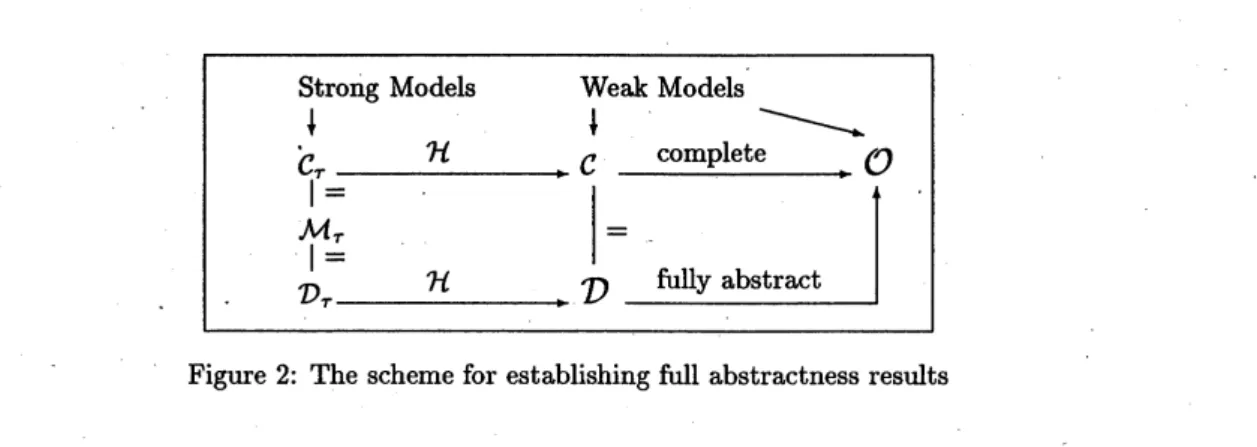
Strong Models $\downarrow$ $\dot{C}_{\tau}$ $\mathcal{H}$ $|=$ $\mathcal{M}_{\tau}|=$ $D_{\tau}$ $\mathcal{H}$
Figure 2: The schemeforestablishingfull abstractness results
By combining the respective advantages of the cpo and metric hameworks for denotational semantics,
weobtain the following general scheme$(\mathrm{i})-(\mathrm{i}\mathrm{i}\mathrm{i})$for establishingfull abstractness results. (The scheme
is illustrated by Fig.2, where the expression$C_{\tau}arrow C\mathcal{H}$
denotes that $\mathcal{H}\mathrm{o}C_{\mathcal{T}}=C.$) This scheme has
been appliedin [18, Sect.6] to a simple language for pure $\mathrm{p}\mathrm{r}\mathrm{o}\mathrm{c}\mathrm{e}\mathrm{S}5\mathrm{e}\mathrm{S}$
.
(By “pure processes” we meanprocesses whichcanonlycommunicate by simultaneously performing synchronization actions; see[14]
forthis terminology.) The full abstractness result reportedin
tthis
paper is $\mathrm{e}\mathrm{s}\mathrm{t}\mathrm{a}\mathrm{b}\mathrm{l}\mathrm{i}8\mathrm{h}\mathrm{e}\mathrm{d}$ by applyingtheschemetoamorecomplexlanguage$\mathrm{C}\mathrm{C}\mathrm{S}^{++}$ withlabel-passing.
(i) Givenalanguage$\mathcal{L}$andanoperational model$O$whichserves as abehavioral
criterionfor$\mathrm{a}\mathrm{s}\mathrm{s}\mathrm{e}\mathrm{s}3\mathrm{i}\mathrm{n}\mathrm{g}$
semanticmodels for$L$, itmay be possible to define a strongoperationalmodel$C_{\tau}$ anda hiding function $\mathcal{H}$ and to show, by an operational analysis ofprogram behaviors, that the model $C$
defined by$C=\mathcal{H}\mathrm{o}C_{\mathcal{T}}$is less abstract than $O$ and complete with respect to$O$ in thesensethat
the congruence induced by $\mathrm{O}$ is finer than the equivalence induced by$C$
.
Thusit is sufficientto construct adenotational model $D$ which is equivalent to $C$, since the equivalence and the
congruence induced by a denotational model coincide with each other. Such a denotational
model$D$may be constructed as follows.
(ii) The metric hamework
can
be conveniently used to construct a $\mathrm{c}\mathrm{m}\mathrm{s}$-based denotational model$\mathcal{M}_{\tau}$ andto establish the equivalence between $\mathcal{M}_{\tau}$ and $C_{\tau}$, when these models are strong (see
Remark1$(\mathrm{i}\mathrm{i}))$
.
(iii) When thesemanticdomain underlying $\mathcal{M}_{\tau}$ is both a cpo anda$\mathrm{c}\mathrm{m}\mathrm{s}$, we can construct a strong
order-theoretic model$D_{\tau}$ which is equivalent to $\mathcal{M}_{\tau}$; furthermore when $\mathcal{H}$ is acontinuous
ho-momorphism from the underlying algebra of$D_{\tau}$ to the weak version of the algebra, we can
also construct a weak order-theoretic model $D$ such that $D=\mathcal{H}\circ D_{\tau}$; thus we can obtain the
equivalence between$C$and$D$,therebyestablishingthe
full
abstractness of$D$with respecttoO.1.2
Comparison with Other
Approachesto Full Abstractness Proofs
To establish the full abstractness of a denotational $D$with respect to a given operationalmodel $O$,
we have to establish detailedconnections betweenT) and O. However, it is in general very difficult
to establish suchconnections directly, because thedenotationalmethod by which$D$is defined is very
different from the operational (or transitional) methodby which$O$ is defined.
Thefollowing approachis taken to overcome this difficulty in this paper as well asin the other
papers (such as [12, 14, 30]) treating the full abstractness problem in the context weak semantic
models for concurrent languages. First, another operational model $C$, called an intermediate model,
is introduced, and it is shown to be equivalent to $D$; then close connections between $C$ and $O$ are
established by operational analysis
of.
programbehaviors, and thereby the desiredconnectionsbetween$D$and $\mathrm{O}$ areobtained.
Thus, the difficulty is reduced to the problem ofestablishing the equivalence between$C$ and$D$
.
$1^{12,14,30}])$: We
establish
theequivalence byconstructingan
strongdenotational
$D_{\tau}$ andoperational
one
$C_{\tau}$ such that$D=\mathcal{H}\mathrm{o}D_{\tau}$ and$C=\mathcal{H}\mathrm{o}C_{\mathcal{T}}$and byshowning
that both$D_{\tau}$ and $C_{\tau}$
are
thefixed-point of the
same
higher-order contraction (whichhas a unique fixed-point byBanach’s
fixed-pointtheorem). In the other papers(suchas[12, 14, 30]),on the other hand, thisequivalenceis
established
bya
detailed
operational analysis oftheintermediate
model$C$, typically byshowing that thepreorderinducedby $C$ is algebraic (see [12, Sect.
4.5]). Roughly, our approachis denotational, whereas the
otherapproaches areoperational.
We believe our approachis more easily applicable to various languages, since there is a general
method,which is
insensitive
tolanguage
constructs under a certaingeneralcondition, to construct theauxiliarymodels$D_{\tau}$ and$C_{\tau}$and to establishtheir equivalence
(see [17, 19]), whereasthe operational
analyses (of$C$) neededin the other approaches
are adhoc and
are
sensitive tolanguage $\mathrm{c}\mathrm{o}\mathrm{n}3\mathrm{t}\mathrm{r}\mathrm{u}\mathrm{c}\mathrm{t}\mathrm{S}$treated. Moreover,suchoperational analyses mayinvolvecrucialerrors, which are difficulttodetect
in theabsence of general methods (seeRemark3 for suchan error found in[30]).
1.3
Connections
with Other
Full
Abstractness Results
A similar full
abstractness
resulthas been establishedbyBergstra, Klop, andOlderog for a languagewithout recursion orintemal
moves
[5]. Moreover, Rutten investigated the semanticsofaconcurrentlanguage for pure processes in the
framework
of$\mathrm{c}\mathrm{m}\mathrm{s}’ \mathrm{s}$, andshowed that the failures model is $\mathrm{f}\mathrm{i}_{1}11\mathrm{y}$
abstractwith respect to a strong linear semantics $O_{\mathrm{L}}[33]$
.
The fullabstractness
of$D$ withrespectto $O$, expressed by (1) above, is an extension of the result
ofBergstra et al. to a language with
recursion, internal moves,weak and
label-passing.
Also it is an extension ofRutten’s resultto thecaseofsemantics (fromstrongsemantics) andtoa languagewith
label-passing.
Theresult reportedinthis paper is an extension of the result of [18, Chap.6], where asinilar full abstractnessresult has been given for aconcurrentlanguage for pure processes. (Sinilar fullabstractness results havealso
been given in[16], but there $\mathrm{a}\mathrm{U}$the models are
constructedina purely operational ffamework.)
In[14], Hemessyand Ing\’ofsd\’ottir proposeda
denotational
model fora minor variantof ffiuCCS,which is slightly simpler than $\mathrm{C}\mathrm{C}\mathrm{S}++\mathrm{b}\mathrm{e}\mathrm{c}\mathrm{a}\mathrm{u}\mathrm{s}\mathrm{e}$
full CCS features value-passing but does not feature
label-passing.
Their modelis closely related to ourmodel$D$,but themachineryusedfor constructingtheir model isquite different fiom that used in thispaper: Thesemanticdomain in [14] is abstractly
constructed, along the lines of [32], as a solution of a system of reflexive domain equations (which
are rathercomplex with apowerdomainconstructor appearing in arecursiveway), while we use the
simplefailures domain definedinelementaryset theory. Andthebehavioral criterionemployedin[14]
isbased onthe concept of testing anddifferent ffomtheoneemployedinthispaper–we usethe weak
linear semanticsasthebehavioral criterion.
The model $D$ is a natural extension of the improved
failures
model of $[7, 15]$ to the languagewith
label-passing,
although weuse
the Smyth order [36] insteadofthereversesetinclusion used in$[7, 15]$, fortheconvenience in relating operational and
denotational
semantics.2
(Note that in$[7, 15]$,the improved failure model is given in a purely
denotational
ffmework, with no comparisons withoperational models.)
2
Language
$\mathrm{C}\mathrm{C}\mathrm{S}++$In this section,we define thelanguage aCCS-like language, $\mathrm{C}\mathrm{C}\mathrm{S}^{++}$, with
a label-passing mechanism.
(Here labels are used as the names of communication channels through which
interactions
betweenprocessestake place.) This language isessentiallythe
same
as the oneproposedin[1];it isan
extensionof fullCCS [27] and contains label-passing–animportantfeature of$\pi$-calculus $[29]-\mathrm{i}\mathrm{n}$addition to
theCCS constructs: inputs, outputs,pamllel composition withvalue-passing, nondeterministicchoice,
action restriction, and recursion.
We define the language in the framework of typed $\lambda$-calculus with
$\mu$-notation as the version of
PCL given in [11]; we take the types $V$ (of values), $B$ (ofBooleans), and$P$ (of process) as ground
$\overline{2\mathrm{T}\mathrm{h}\mathrm{e}}$originalfailuresmodel[6]$\mathrm{a}\mathrm{k}\mathrm{o}$use the
types, and we restrict the compositetypes to$\mathcal{B}^{(1)}=(\mathcal{V}arrow B)$ (thetype ofpredicates or
parameterized
Booleans with
one
parmeter of type $\mathcal{V}$) and $P^{(1)}=(\mathcal{V}arrow B)$ (the type ofparameterized processes
with one parameter oftype$\mathcal{V})^{3}$
.
As a preliminary to the definition of thelanguage$\mathrm{C}\mathrm{C}\mathrm{S}++$, we define severalbasic sets.
Deflnition
1 (1) It is assumedthat acommon
domain V ofvalues md labels is given. (Here labelsserve
as thenames
ofcommunication
channels through which values are passed.) Let $(b\in)$$\mathrm{B}=$
{true,
false}
be thedomain of Booleans.(2) We put$\mathrm{V}!=\{v!|v\in \mathrm{V}\}$ and $\mathrm{V}?=\{v?|v\in \mathrm{V}\}$
.
The set$(c\in)$ Out of output actions isdefined
byOut $=\mathrm{V}!\cross \mathrm{V}=\{(v!,v’)|v,v’\in \mathrm{V}\}$
.
Likewise,we define the set $(c\in)$In ofinput actionsbyIn$=\mathrm{V}?\cross \mathrm{V}=\{(v?,v’)|v, v’\in \mathrm{V}\}$
.
From these, theset $(c\in)\mathrm{C}$ ofcommunication
actionsisdefinedby $\mathrm{C}=\mathrm{O}\mathrm{u}\mathrm{t}\cup \mathrm{I}\mathrm{n}$
.
We define the set $(a\in)\mathrm{C}_{\tau}$ ofactionsby$\mathrm{C}_{\tau}=\mathrm{c}\cup\{\tau\}$.
(3) Let$\mathrm{V}\mathrm{a}\mathrm{r}_{\mathcal{V}}$ be the set ofvariablesof type$V,$ $(X\in)$ Varp the set ofvariablesof type
$\mathcal{P}$, and $(\xi\in)$ $\mathrm{V}\mathrm{a}\mathrm{r}_{P}^{(1})$the set ofvariablesof type$P^{(1)}$
.
Weput$\mathrm{V}\mathrm{a}\mathrm{r}_{p}^{*}=\mathrm{V}\mathrm{a}\mathrm{r}_{P^{\cup}}$Varp,anddefine theset$(Z\in)$ Var of variablesbyVar$=\mathrm{V}\mathrm{a}\mathrm{r}v\cup \mathrm{v}_{\mathrm{a}}\mathrm{r}_{p}^{*}$.
(4) We $\mathrm{a}8\mathrm{s}\mathrm{u}\mathrm{m}\mathrm{e}$ that a set $(E\in)\mathcal{E}$ of values expressions and a set
$(G\in)\mathcal{G}$ ofBoolean $expreS\mathit{8}ions$
are given. Here it is not necessary to specify the syntax for $\mathcal{E}$ and $\mathcal{G}$; we only postulate the $\mathrm{f}\mathrm{o}\mathrm{U}_{0}\mathrm{W}\mathrm{i}\mathrm{n}\mathrm{g}$ conditions
$(\mathrm{i})-(\mathrm{i}\mathrm{i}\mathrm{i})$concerning
$\mathcal{E}$ and $\mathcal{G}$, forconvenience in defining
semantic
modelsin latersections: (i) $\mathrm{V}\mathrm{a}\mathrm{r}_{\mathcal{V}}\subseteq \mathcal{E},$$\mathrm{V}\subseteq \mathcal{E}$, and $\mathrm{B}\subseteq \mathcal{G}$
.
$(\mathrm{i}\mathrm{i})$ For $E_{0},E_{1}\in \mathcal{E},$“$(E0=E1)”\in \mathcal{G}$
.
(iii) For$G_{0},G_{1}\in \mathcal{G},$ “$\neg(G\mathrm{o})$”,“($G_{0}$ A $G_{1}$)$”\in \mathcal{G}$.
Wedefine theset$\mathcal{G}^{(1)}$ ofparameterized Boolean expressionsby
$(H\in)\mathcal{G}^{(1)}=$
{‘‘
$(\lambda x$.
$G)$”$|x\in \mathrm{V}\mathrm{a}\mathrm{r}_{\mathcal{V}}$ A $G\in \mathcal{G}$}
.
$1$Interm ofthe basic sets givenabove,the language $\mathrm{C}\mathrm{C}\mathrm{S}++\mathrm{i}\mathrm{s}$ definedby:
Deflnition
2 (Language$\mathrm{C}\mathrm{C}\mathrm{S}^{++}$)(1) First,wedefinea set $(S\in)\tilde{L}$of terms of type$\mathcal{P}$,simultaneously with the set of terms
$(T\in)\tilde{L}^{(1})$
of type$P^{(1)}$, bythe followingBNF
grammar:
$\{$
$S::=0|_{0}\partial_{C}(s^{\mathrm{u}\mathrm{t}})’(E0E1,\mathrm{n}(E,H,\tau)T,E|_{X|X}^{(|}s_{0}(^{1}\mu S1). |(S_{0}+S1)|S)$
,
$T::=(\lambda X. s)|\xi|(\mu\xi. \tau)$,
where$X$ (resp.$\xi$)ranges over$\mathrm{V}\mathrm{a}\mathrm{r}_{P}$ (resp.
$\mathrm{V}\mathrm{a}\mathrm{r}_{P}^{(1}$$),$) $E$ranges over$\mathcal{E},$$G$ranges
over
$\mathcal{G},$ $H$rangesover
$\mathcal{G}^{(1)}$, and$C$ranges over $\wp(\mathrm{C})$.
Below we give a briefdescription of eachoftheconstructs:
(i) The
constant
$0$ resprests inaction inthesense of CCS.(ii) The constmct out$(E_{0}, E1, S)$
.
represents outputthe value$E_{1}$ throughthechannel
$E_{0;}$thisisa natural extensionof theCCS construct“$\overline{c}E_{1}$
.
$S$” ofCCS withthelabel$c$correspondingto$E_{0}$
.
(iii) The construct in$(E_{0}, (\lambda x. G),\tau)$representsselective inputthroughthechannel$E_{0}$of those
values$\mathrm{S}\mathrm{a}\mathrm{t}\mathrm{i}\mathrm{S}\mathrm{p}_{\mathrm{i}\mathrm{n}\mathrm{g}}$the predicate $(\lambda x.G)$
.
This is an analogue of theLOTOS construct
forvalue-acceptancewith a selectionpredicate (see [10] or [38, Sect.3.5.2]). For a
motivation
for this combinator, seeRemark2(2)below.
$\overline{3\mathrm{W}\mathrm{e}}$caneasilyextend the language soasto include suchprocessesas takeseveralvalues as their$\mathrm{p}\mathrm{a}\mathrm{r}\mathrm{a}\mathrm{m}\mathrm{e}\mathrm{t}\mathrm{e}\mathrm{r}8$, without
anynontrivialchanges of the definition ofsemanticsinlater sections; it is only for simplicity that wetreatonlyprocesses
withzeroorone parameter. However,it$\mathrm{w}\mathrm{i}\mathrm{U}$causeafundamentalchange in the definition of the semantics, ifwe include
(iv) The combinator $||$ represents is parallel composition ofCCS.
(v) The combinator $+\mathrm{r}\mathrm{e}\mathrm{p}\mathrm{r}\mathrm{e}\mathrm{S}\mathrm{e}\mathrm{n}\mathrm{t}_{\mathrm{S}}$ extemal choice (or general choice) of CSP (see Sect. 3.3 of
[15]$)$
.
Thetransition rules for this combinator is slightly different$\mathrm{h}\mathrm{o}\mathrm{m}$those for the choicecombinator ofCCS (see rule (iv) in Definition$9(1)$). Foramotivationfor this combinator,
see Remark2(1) below.
(vi) The construct$\partial_{C}(S)$represents therestrictionof those actions of$S$which arecontainedin
$C$; The transition rule for this constructis slightly different$\mathrm{h}\mathrm{o}\mathrm{m}$ those for the restriction
construct “$S\backslash C$” of CCS (see rule (vii) in Definition$9(1)$). For a motivation for this
construct, see Remark2(3) below.
(vii) Theconstruct if$(B, s_{0}, S_{1})$ is the same as the conditional construct ofCCS.
(viii) The construct $\mathrm{a}\mathrm{p}(\tau, E)$ is the applicationof the parameterized process $T$ to the actual
parameter $E$. We sometimes write $T(E)$ instead of$\mathrm{a}\mathrm{p}(\tau, E)$.
(ix) The $\mu$-notation $(\mu X. S)$ represents a recursively defined process whose bodyis $S$
.
(x) Likewise, the $\mu$-notation $(\mu\xi. T)$ represents a recursively defined parameterized process
whose bodyis$T$
.
We will say that a variable$X\in$ Varpis guarded$\mathrm{i}\dot{\mathrm{n}}$ an expression$S’\in\tilde{L}$,when each occurrence
of$X$ occurs in a subexpression of the form out$(E, E’, S”)$ or in$(E, (\lambda x. G),T)$
.
Likewise wesay that a variable$\xi\in \mathrm{V}\mathrm{a}\mathrm{r}_{P}^{(1)}$ is guarded in an expression$T’\in\overline{\mathcal{L}}^{(1)}$, wheneachoccurrence of
$\xi$
occurs in a subexpression of the form out($E,$$E^{\prime,s’)}’$ orin$(E, (\lambda x. G), T)$
.
Theset $(S\in)L$of statements ofthe language$\mathrm{C}\mathrm{C}\mathrm{S}.++\mathrm{i}\mathrm{s}$
de.fi
$\mathrm{n}_{l}$ed to be theset of
$S\in\tilde{L}\mathrm{s}\mathrm{a}\mathrm{t}\mathrm{i}_{\mathrm{S}}\mathrm{f}\mathrm{y}.\mathrm{i}\mathrm{n}\mathrm{g}$
thefollowing guardedness condition:
Foreachsubexpression$(\mu X. S’)$ (resp. $(\mu\xi$. $T)$)
of
$S$, the variable$X$(2)
(resp.$\xi$) is guardedin$S’$ (resp. in$T$).
Likewisewedefine the set $(T\in)\mathcal{L}^{(1)}$ of parameterizedstatements ofthe language$\mathrm{C}\mathrm{C}\mathrm{S}++\mathrm{t}\mathrm{o}$be
the set of$T\in\overline{L}^{(1)}$ satisfying the above guardedness condition (2).
Let usput$(U\in)\mathcal{L}^{*}=\mathcal{L}\cup \mathcal{L}^{(1)}$.
(2) The constructs “$(\lambda x.\cdots)$”, “$(\mu X. \cdots)$”, and “$(\mu\xi. \cdots)$” have the usualbinding property. For
$U\in \mathcal{L}^{*}$,let $\mathrm{F}\mathrm{V}(U)$be the set of elementsof Var which have afreeoccurrence in $U$
.
For $\mathcal{Y}\subset\wp(\mathrm{V}\mathrm{a}\mathrm{r})$, let us define $\mathcal{L}[\mathcal{Y}]$ and $\mathcal{L}^{(1)}[\mathcal{Y}]$ by $\mathcal{L}[\mathcal{Y}]=\{S\in \mathcal{L}|\mathrm{F}\mathrm{V}(S)\subseteq \mathcal{Y}\}$ and by $\mathcal{L}^{(1)}[\mathcal{Y}]=\{T\in L^{(1)}|\mathrm{F}\mathrm{V}(T)\subseteq \mathcal{Y}\}.$, respectively. Then $L[\emptyset]$ (resp. $\mathcal{L}^{(1)}[\emptyset 1$) is the set of closed
statements (resp. the set of of closed parameterized statements). Let us use $s$ (resp. $t$) as a
variableranging over$\mathcal{L}[\emptyset]$ (resp. $\mathcal{L}^{(1)}[\emptyset]$). Letus put $(u\in)\mathcal{L}^{*}[\emptyset]=\mathcal{L}\cup \mathcal{L}^{(1)}$
.
For $Z\in$ Var,wewrite$\mathcal{L}[Z]$ instead of$\mathcal{L}[\{Z\}]$
.
Further we put $(e\in)\mathcal{E}[\emptyset]=\{E\in \mathcal{E}|\mathrm{F}\mathrm{V}(E)=\emptyset\},$ $(g\in)\mathcal{G}[\emptyset]=\{G\in \mathcal{G}|\mathrm{F}\mathrm{V}(G)=\emptyset\}$, and
$(h\in)\mathcal{G}^{(1)}[\mathrm{o}]=\{H\in \mathcal{G}^{(1)}|\mathrm{F}\mathrm{v}(H)=\emptyset\}.1$
Remark 2 (1) We canadopt thechoice combinator ofCCCinstead of$”+$” (namelywe can remove
$”+$ ” and introduce another binary combinator with the same transition rules as those for the
choice combinator of CCC) and preserve the full abstractness result, by slightly$\mathrm{m}\mathrm{o}\mathrm{d}\mathrm{i}\mathfrak{g}\mathrm{r}\mathrm{i}\mathrm{n}\mathrm{g}$ the
definitionof thesemanticdomain along the lines of$[4, 16]$, [16, Chapter 6];itis only for simplicity
that weadopt the combinator $”+$ ” for external choiceinstead of the $\mathrm{c}\mathrm{h}\mathrm{o}\mathrm{i}_{\mathrm{C}}.\mathrm{e}$combinator ofCCC.
(2) Clearly we obtain richer expressive power by adopting the construct in$(E_{0}, (\lambda x. G),T)$ for
se-lective input instead of a natural extension (whichwould be represented by in$(E_{0},\tau)$ without
the selection predicate) theCCS construct “cx.S” for unselective input. Such richer expressive
rich expressive power, we can establishthe$\mathrm{f}\mathrm{u}\mathrm{u}_{\mathrm{a}}\mathrm{b}\mathrm{s}\mathrm{t}\mathrm{r}\mathrm{a}\mathrm{C}\mathrm{t}\mathrm{n}\mathrm{e}\mathrm{s}8$ofthe denotational model$D$ given
in Sect.5; it is notknown whetherornot the full abstractnesscanbe establishedifwe replace theconstruct in$(E_{0}, (\lambda x. G),T)$ forselectiveinput by the simperconstruct in$(E_{0},\tau)$for
unse-lective input. (Notethat thereis nodifficultyin constructing a denotational modelbyslightly simplifying$D$, foralanguage which hasin$(E_{0},T)$ insteadofin$(E_{0}, (\lambda x. G),T).)$
(3) Therestriction construct$S\backslash C$ofCCS representsthe restrictionof those
$\mathrm{a}\mathrm{c}\mathrm{t}\mathrm{i}\mathrm{o}\mathrm{n}8$of$S$whichare
contained$\mathrm{e}\mathrm{i}\mathrm{t}\mathrm{h}\mathrm{e}\mathrm{r}\cdot \mathrm{i}\mathrm{n}C$ or its complement $\overline{C}\cdot$
, In this sense the restriction construct of CCS is
more
unselective than ourrestriction
construct. Byusingthis type restriction,wecan establishthe full abstractness ofthe denotational modelZ); again it is not knownwhether or not the
$\mathrm{f}\mathrm{u}\mathrm{U}$abstractness canbe established if we replace theconstruct $\partial_{C}(S)$ by the more unselective
restriction construct of CCS. (Note that there is no difficulty in constructing a denotational model byslightly$\mathrm{m}\mathrm{o}\mathrm{d}\mathrm{i}\mathfrak{g}\Gamma \mathrm{i}\mathrm{n}\mathrm{g}\mathcal{D}$, for alanguage which has the CCS construct $S\backslash C$ instead of
$\partial_{C}(S).)$
(4) The grammar given in Definition2 is sufficient to construct a parser of the language, except
for the construct $\partial_{C}(S)$; in order to construct a parser, it is necessary to introduce some
syntax for $\mathrm{s}\mathrm{p}\mathrm{e}\mathrm{C}\mathrm{i}\Phi \mathrm{i}\mathrm{n}\mathrm{g}$ the suffix $C$ in $\partial_{C}(S)$
.
A possible way is to introduce two constructs“$\partial!(E, (\lambda x. B), S)$” and “$\partial?(E, (\lambda x. B), S)$” which correspond to “$\partial_{\{(\beta E\mathrm{Q}!},v$)
$|\ovalbox{\tt\small REJECT}_{B1v/1}x\mathrm{f}=\mathrm{t}\mathrm{r}\mathrm{u}\mathrm{e}$}$(s)$
”
and “$\partial_{\{(\mathfrak{l}^{E}1v)\mathrm{I}[}?,B[v/x]1=\mathrm{t}\mathrm{r}\mathrm{u}\mathrm{e}\}(s)$”, respectively, where [$E\mathrm{J}$ (resp. $[B[v/X]\mathrm{I}$) is the evaluation of the expression
I
$E\mathrm{J}$ (resp. $\mathbb{I}B[v/x]\mathrm{I}$) (see the beginning ofSect. 4 for more explanation oftheevaluationmechanism$[\cdot \mathrm{I})$
.
$1$We
can
characterize$\mathcal{L}^{*}$ as a subsetof theset oftermsgeneratedby amany-sorted signature Fun(giveninDefinition3 below)togetherwith $\lambda$-notationand
$\mu$-notation. Thus, along theusuallines of denotationalsemantics, wecandefine adenotational model bygiving a cpo as an underling domain
and by giving interpretationsof the elements of Fun ascontinuousfunctionsonthecpo (see [11]); in
Sect. 5 we$\mathrm{w}\mathrm{i}\mathrm{U}$definethedenotationalmodel$D$for$\mathrm{C}\mathrm{C}\mathrm{S}^{++}$ in this way.
Definition 3 Let Funbe the set ofconstantsand combinators of$\mathcal{L}$, and for $(i,j, k,l, m)\in\omega^{5}$, let
$\mathrm{K}\mathrm{n}_{(*i^{k}\ell_{m)}}.,,$, bethe set of elements with arity
$\mathcal{V}^{i}\cdot B^{j}\cdot(B(1))^{k}\cdot p\ell\cdot(p1)m$
.
Namely, we define$\mathrm{F}\mathrm{u}\mathrm{n}_{(i,j,k,\ell_{m}},$)asfollows:
(i) Fun$(0,0,0,0,0)=\{$“$0$”$\}$, (ii) $\mathrm{F}\mathrm{u}\mathrm{n}_{(2,0,0,1},0)=\{" \mathrm{o}\mathrm{u}\mathrm{t}" \}$, (iii) $\mathrm{F}\mathrm{u}\mathrm{n}_{()}1,0,1,0,1=\{$“$\mathrm{i}\mathrm{n}$”
$\}$,
(iv) $\mathrm{F}\mathrm{u}\mathrm{n}_{(0},0,0,1,0)=\{"\partial c" |c\in^{\mathrm{c}}\}$, (v) $\mathrm{F}\mathrm{u}\mathrm{n}_{(0)}0,0,0,1,=\{"||", "+" \}$,
(vi)Fun$(0,1,0,2,0)=\{$“$\mathrm{i}\mathrm{f}$”
$\}$, (vii) $\mathrm{F}\mathrm{u}\mathrm{n}_{(1,0},0,0,1)=\{$“$\mathrm{a}\mathrm{p}$
” $\}$,
(viii) $\mathrm{F}\mathrm{u}\mathrm{n}_{(i_{\dot{\theta}},k},\ell_{m)},=\emptyset$ for the other indexes $(i,j, k,l,m)$
.
$1$3
Preliminary
Definitions
In this section wefix basic mathematical notationandintroduce several notions concerningdomains
ofsequences.
Definition4 Let $A$and$B$ be sets.
(1) The setofnatural numbers is denotedby $\omega$, and eachnumber $n\in\omega$ is identifiedwith the set
$\{i\in\omega|0\leq i<n\}$
.
The powersetof$A$ (resp.thecollection of finite subsets of$A$) is denotedby$\wp(A)$ (resp. by$\wp \mathrm{f}\mathrm{i}\mathrm{n}(A)$).
(2) The set of functions from $A$to $B$is denotedby $(Aarrow B)$ orby$B^{A}$. The domain andrangeofa
function$f$ aredenotedby$\mathrm{d}\mathrm{o}\mathrm{m}(f)$ andran$(f)$, respectively. For avariable$x$ and an expression
$E(x)$, the $\lambda$-expression $(\lambda x\in A. E(x))$ is used to denote the function which maps $x\in A$ to
(3) The empty sequence is denoted by $\epsilon$
.
The sequence consisting of$a_{0},$ $\cdots,$$a_{n-1}\in A$ is denoted
$\mathrm{c}$
by $\langle a_{0}, \cdots, a_{\hslash-1}\rangle^{4}$
.
Theset offinite sequences ofelements of$A$ is denotedby$A^{<\mathrm{t}d}$, and$A^{+}=$$A^{<\omega}\backslash \{\epsilon\}$
.
The set offimite or infinite sequences ofelements of$A$ is denoted by $A^{\leq\omega}$.
Each
sequence$w\in A^{\leq\omega}$ is regarded as a
function
whosedomain is a member of$\omega\cup\{\omega\}$.
Thus, thelength of$w$is $\mathrm{d}\mathrm{o}\mathrm{m}(w)$,whichwerefer toas$1\mathrm{g}\mathrm{t}(w)$
.
(Wehave$w=\langle w(i)\rangle|.\in 1\mathrm{g}\mathrm{t}(w)$by definition.)(4) For$w_{1}\in A^{<\omega},$$w_{2}\in A^{\leq\omega}$, let
$w_{1}\cdot w_{2}$ denote the concatenation of$w_{1}$ and$w_{2}$
.
And for$p_{1}\subseteq A^{<\omega}$and$p_{2}\subseteq A^{\leq\omega}$, let
$p_{1}\cdot p_{2}=$
{
$w_{1}\cdot w_{2}|w_{1}\in p_{1}$ A $w_{2}\in p_{2}$}.
For$p\subseteq A\leq\omega$ and $w\in A^{<\omega}$, let $p[w]=\{\tilde{w}\in A^{\leq\omega}|w\cdot\tilde{w}\in p\}$.
The prefix order $\preceq$ and the strict prefix $or\dot{d}er\prec$ are defined asusual: For$w_{1},w_{2}\in A^{\leq\omega},$$w_{1}\preceq w_{2}$iff$w_{1}=w_{2}\uparrow \mathrm{d}\mathrm{o}\mathrm{m}(w_{1})$, and
$w_{1}\prec w_{2}$ iff$w_{1}\preceq w_{2}$ A $w_{1}\neq w_{2}$
.
(5) We definethe set$A\triangleright B$ offinite orinfimitesequencesofelements
of$A$ ending withan elementof
$B$ (when finite) by$A\triangleright B=(A^{<\omega}\cdot B)\cup A^{\omega}$
.
(6) Let$X$bea topological space. The closure of a subset$\mathrm{Y}\subseteq X$ is denotedby$\mathrm{Y}^{\mathrm{c}1}$
.
The collection of
closed subsets of$X$is denotedby $\wp_{\mathrm{c}1}(X)$, andthe the set of nonemptysubsets of$X$ is denoted
by$\wp_{\mathrm{n}}(X)$
.
Hereafter, we usethe conventionthat $\wp\ldots(X)$ denotes the set of$\mathrm{a}\mathrm{U}\mathrm{s}\mathrm{u}\mathrm{b}3\mathrm{e}\mathrm{t}_{\mathrm{S}}$ (of$X$) having the
property (or properties) indicatedbythe suffix$\cdots$
.
Thus, for example, $\wp_{\mathrm{n}\mathrm{c}1(X)}$ denotes the setof$\mathrm{a}\mathrm{U}$
nonempty and closed subsets of X.
1
Deflnition5 Let $A$and $B$disjoint nonempty sets not$\mathrm{c}\mathrm{o}\mathrm{n}\mathrm{t}\mathrm{a}\mathrm{i}\mathrm{n}\mathrm{i}\mathrm{n}\mathrm{g}\perp$
.
We put$B_{\perp}=B\cup\{\perp\}$.
(1) A function strip$(\cdot)$ : $(A\triangleright B_{\perp})arrow A^{\leq\omega}$ is defined as follows: For $q\in(A\triangleright B_{\perp})$, let strip$(q)=$$q\uparrow(1\mathrm{g}\mathrm{t}(q)-1)$ if
$1\mathrm{g}\mathrm{t}(q)<\omega$, and otherwise let strip$(q)=q$
.
The stream $order\subseteq \mathrm{o}\mathrm{n}(A\triangleright B_{\perp})$ isdefinedas follows: For$q_{1},$$q_{2}\in(A\triangleright B_{\perp})$, let $q_{1}\subseteq q_{2}$ if either$q_{1}=q_{2}$ or ($q_{1}\in A^{<\omega}\cdot\{(\perp\rangle\}$ and
$\mathrm{s}\mathrm{t}\mathrm{r}\mathrm{i}_{\mathrm{P}(q_{1})}\preceq \mathrm{s}\mathrm{t}\mathrm{r}\mathrm{i}_{\mathrm{P}}(q2))$
.
For each$n\in\omega$,the n-thprojectionfunction
$(\cdot)^{[n]}$ : $(A\triangleright B_{1})arrow A^{<\omega}\cdot B_{1}$isdefinedas follows: For$q\in(A\triangleright B_{\perp})$, let$q^{[n]}=q\mathrm{i}\mathrm{f}\mathrm{l}\mathrm{g}\mathrm{t}(q)\leq n$, and otherwise let$q^{[n]}=(q\beta_{n})\cdot\langle\perp\rangle$.
And for$p\in\wp(A\triangleright B_{\perp})$, let$p^{[n]}=\{q^{[n]}|q\in p\}$
.
(2) Adistance function$d$on $(A\triangleright B_{\perp})$ is definedin termsof the projectionfunctions as follows: For $q_{1},$$q_{2}\in(A\triangleright B_{\perp})$, let$d(q_{1}, q_{2})= \inf$
{
$(1/2)^{n}|n\in\omega$ A $(q_{1})^{[n}]=(q_{2})^{[n}]$}.
Likewise,adistance function $\tilde{d}$
on$\wp(A\triangleright B_{\perp})$is defined as
follows:5
For$p_{1},p_{2}\in\wp(A\triangleright B_{\perp})$, let$\tilde{d}(p_{1},p_{2})=\inf\{(1/2)^{n}|n\in\omega\wedge(p_{1})^{[n]}=(p_{2})^{1n]}\}$
.
$\iota$Deflnition 6 Let$A$ and $B$ bedisjoint nonempty sets not $\mathrm{c}\mathrm{o}\mathrm{n}\mathrm{t}\mathrm{a}\mathrm{i}\mathrm{n}\mathrm{i}\mathrm{n}\mathrm{g}\perp$, and let $d$and $\tilde{d}$
be defined
as in Definition5.
(1) Abinary$\mathrm{r}\mathrm{e}\mathrm{l}\mathrm{a}\mathrm{t}\mathrm{i}_{0}\mathrm{n}\subseteq_{\mathrm{s}}$, the Smyth order on
$\wp(A\triangleright B_{\perp})$,is definedas follows: For$p_{1},p_{2}\in\wp(A\triangleright B_{\perp})$,
let$p_{1}\subseteq_{\mathrm{s}}p_{2}$if$\forall q_{2}\in p_{2},$ $\exists q_{1}\in p_{1}[q_{1}\subseteq q_{2}]$
.
(2) We will say that$p\in\wp(A\triangleright B_{\perp})$ is
fiat
if$\forall q,$$q’\in p[q\subseteq q’\Rightarrow q=q’ ]$.
We put$\wp_{\mathrm{f}}(A\triangleright B\perp)=$
{
$p\in\wp(A\triangleright B_{\perp})|p$ isflat}.
(3) We define $\wp_{\mathrm{f}\mathrm{c}1}(A\triangleright B_{\perp})$and$\wp_{\mathrm{n}\mathrm{f}\mathrm{c}1}(A\triangleright B_{1})$, according to the convention in $\mathrm{D}\mathrm{e}\mathrm{f}\mathrm{i}\dot{\mathrm{m}}\mathrm{t}\mathrm{i}\mathrm{o}\mathrm{n}4(6)$
.
(4) Let $\wp_{\mathrm{c}\mathrm{o}}(A\triangleright B_{\perp})=$
{
$p\in\wp(A\triangleright B_{\perp})|p$ iscompact},
where the notion of compactness is inducedby themetric $d$. We define $\wp_{\mathrm{f}\mathrm{c}\circ}(A\triangleright B_{\perp}),$ $\wp_{\mathrm{n}\mathrm{f}\mathrm{c}\mathrm{o}}(A\triangleright B_{1})$, and $\wp_{\mathrm{n}\mathrm{f}\mathrm{c}\circ}(A\triangleright B_{\perp})$ as in part(3).
(5) Let$X\in\wp(A\triangleright B_{\perp})$and$q\in X$
.
We willsay that$q$is minimal in$X$when$\neg\exists q’\in X[q’\subseteq q\wedge q’\neq q]$.
Let${\rm Min}(X)=$
{
$q\in X|q$ isminimalin $X$}.
4We do not abuse notation by writing $a_{0}$ torefer to {$a_{0}\rangle$, because it will be confusing when we treat sequences
consistingofsequences in later sections(cf. [15,Sect.1.5]for similar strictnotation).
5Itis easily checked that$\tilde{d}$
coincides with theHausdorffdistance induced by$d$(forthe definition of Hausdorff distance
(6) The limit ofaconvergingsequence $\langle p_{n}\rangle_{n\in\omega}$ in $(\wp_{\mathrm{c}1}(A\triangleright B_{\perp}),\tilde{d})$is denotedby$\lim_{n}p_{n}$
. I
Notation 1 Let $(X,$$\subseteq, \perp)$, $(\mathrm{Y}, \subseteq’, 1’)$be$\mathrm{c}\mathrm{p}\mathrm{o}’ \mathrm{s}$
.
(1) Forachain $\langle_{X_{n}}\rangle_{n\in\omega}$in $X$, the $lub$of$\{x_{n}\}_{n\in\omega}$ in$X$is denotedby$\mathrm{u}x_{n}n$
.
Let$[Xarrow \mathrm{Y}]$ denote the
set ofcontinuousfunctions from$X$ to$Y$.
(2) Let (X,$\subseteq,$$\perp$)be a $\mathrm{c}\mathrm{p}\mathrm{o},$ $m\in\omega$, and $\langle x_{n}\rangle_{n\geq m}\in(\{n\in\omega|n\geq m\}arrow X)$
.
We saythat$\langle x_{n}\rangle_{n\geq m}$ is a chain to mean that $\langle X_{m+n}\rangle n\in\omega$ isa chain; when$\langle x_{n}\rangle_{n\geq m}$isachain,we write
$n\geq m\square p_{n}$to denote
$\mathrm{u}p_{m+n}\mathfrak{n}$
. I
Definition7 For$p\in\wp(\mathrm{C}_{\tau}\triangleright\wp(\mathrm{C})\perp)$ and$w\in(\mathrm{C}_{\mathcal{T}})^{<\omega}$, let$p[w]=\{q\in(\mathrm{C}_{\mathcal{T}}\triangleright\wp(\mathrm{C})\perp)|w\cdot q\in p\}$
.
Weput act$(p)=\{a\in \mathrm{C}_{\tau}|p[\langle a\rangle]\neq\emptyset\}$
.
$1$Deflnition8 Let (X,$d$) and $(\mathrm{Y}, d’)$ bemetric spaces and$\epsilon$ be a nonnegativereal number. We wtite
$(Xarrow^{\mathcal{E}}\mathrm{Y})$to denote the set $\{f\in(Xarrow \mathrm{Y})|\forall x, x’\in x1^{d’}(f(X), f(x’))\leq\epsilon\cdot d(x, x’) ]\}$
.
Inparticular,wewrite $(Xarrow^{1}\mathrm{Y})$ todenote the set of nonexpansive mappings from $X$to Y.
1
4
The Operational Model
$\mathcal{O}$In this section, the operational model $O$ is defined in terms of a transition system in the style of
$\mathrm{P}\mathrm{l}\mathrm{o}\mathrm{t}\mathrm{k}\mathrm{i}\mathrm{n}[- 31]$
.
Todefine thetransitionsystem,weassumethatsome evaluation mechanism $\mathbb{I}\cdot 1$ mapping$e\in \mathcal{E}[\emptyset]$
(resp. $g\in B[\emptyset]$) to $[e]\in \mathrm{V}$ (resp. to $[g\mathrm{I}\in \mathrm{B}$) is given. For $h\equiv(\lambda x.G)\in \mathcal{G}^{(1)}[\emptyset]$, we define the
evaluation [$h\mathrm{I}$ by $[h\mathrm{J}=(\lambda v\in \mathrm{V}.[G[v/x]\mathrm{J})$
.
4.1
$\mathrm{n}_{\mathrm{a}\mathrm{n}}\mathrm{S}\mathrm{i}\mathrm{t}\mathrm{i}_{\mathrm{o}\mathrm{n}}$System
Definition 9 ($\mathrm{b}\mathrm{a}\mathrm{n}\mathrm{s}\mathrm{i}\mathrm{t}\mathrm{i}\mathrm{o}\mathrm{n}$ Relations)
(1) Thetransition$\mathrm{r}\mathrm{e}\mathrm{l}\mathrm{a}\mathrm{t}\mathrm{i}\mathrm{o}\mathrm{n}\mathrm{s}\sim^{a}\subseteq(\mathcal{L}[\emptyset])^{2}(a\in \mathrm{C}_{\tau})$aredefined as thesmallestrelations satisfying the
following rules:
. (i) out
$(e_{0},e_{1}, S)s\underline{(\beta e\mathrm{o}1!,\beta e_{1}\mathrm{I})}$
.
(ii) in$(e, (\lambda_{X}. G),t)rightarrow \mathrm{a}(1^{e1?},v)\mathrm{p}(t,v)$, if
$v \in \mathrm{V}\bigwedge_{S_{1}}[G[arrow s_{1}\tau/vX,]\mathrm{J}=\mathrm{t}\mathrm{r}\mathrm{u}\mathrm{e}$
.
$( \ddot{\mathrm{u}}\mathrm{i})\frac{s_{1}arrow s_{1}’c}{(s_{1}+s_{2})carrow S_{1}\prime}$ $(c\in \mathrm{C})$.
(iv)$\overline{(s_{1}+s_{2})arrow(\tau s_{1^{+}2}’s)}$
.
$(s_{2}+S_{1})\mathrm{c}arrow S_{1}$’ $(s_{2}+S_{1})\mathcal{T}arrow(S_{2}+s’1)$
(v) $\frac{s_{1^{arrow s’}1}a}{(_{\mathit{8}1}||_{S_{2}})aarrow(_{\mathit{8}_{1}}||s_{2})}$
,
$(a \in \mathrm{C}_{\tau})$.
(vi)$\frac{s_{1^{rightarrow}2}(v!,v)\prime s’1’ srightarrow S’2(v?,v’)}{(s_{1}||_{S_{2}})\mathcal{T}arrow(_{S’}1||s_{2})\prime}$ $(v,v’\in \mathrm{v})$
.
$(s_{2}||s_{1})aarrow(S2||S’1)$ $(s_{2}||s1)\tauarrow(s’2||S_{1})$’
(vii) $\frac{\mathit{8}arrow s’a}{\partial_{C}(\mathit{8})aarrow\partial c(S)}$
,
$(a\not\in C)$.
(viii) $\frac{s_{1}arrow(aS)}{\mathrm{i}\mathrm{f}(g,s_{1},s2)aarrow(s)}$, if$\mathbb{I}g\mathrm{J}=\mathrm{t}\mathrm{r}\mathrm{u}\mathrm{e}$
.
$( \mathrm{i}\mathrm{x})’\frac{s_{2}arrow(as)}{\mathrm{i}\mathrm{f}(g,s_{1,2}S)aarrow(s)}$, if$[g\mathrm{I}=\mathrm{f}\mathrm{a}\mathrm{l}\mathrm{s}\mathrm{e}$.
(x) The$\mathrm{f}\mathrm{o}\mathrm{U}\mathrm{o}\mathrm{W}\mathrm{i}\mathrm{n}\mathrm{g}$ rule is called thepre-evaluationrule:$\frac{\mathrm{a}\mathrm{p}(u,[e\mathrm{I})arrow S’a}{\mathrm{a}\mathrm{p}(u,e)aarrow_{\mathit{8}}}$
,
$(e\in \mathcal{E}[\mathrm{o}])$.
$(\mathrm{x}\mathrm{i})$ Thefollowing rule is called the
$\frac{S[v/x]aarrow S’}{\mathrm{a}\mathrm{p}((\lambda x.s),v)aarrow s’}$ $(v\in \mathrm{V})$
.
$(\mathrm{x}\mathrm{i}\mathrm{i})$ The following rule is called the recursion rule:
$\frac{S[(\mu X.s)/X]aarrow S’}{(\mu X.S)aarrow_{\mathit{8}’}}$.
(xiii) The following rule is called the parameterizedrecursionrule:
$\frac{\mathrm{a}\mathrm{p}(T[(\mu\xi.\tau)/\xi],v)aarrow s’}{\mathrm{a}\mathrm{p}((\mu\xi.T),v)aarrow S’}$ $(v\in \mathrm{V})$
.
(2) For$s\in \mathcal{L}[\emptyset]$, we put act$(s)=$ $\{a \in \mathrm{C}_{\tau}|\exists s’\in \mathcal{L}[\emptyset][Sarrow_{S’}a ]\}$.
1
Thetransition system is image-finite inthe followingsense:
Proposition 1 For every $s\in \mathcal{L}[\emptyset]$ and$a\in \mathrm{C}_{\tau}$, the image-set $\{s’\in \mathcal{L}[\emptyset]|s\sim^{a}S’\}$ is
finite. 1
Proof. By inductiononthe structureof$s$using the guardednesscondition (2). $\blacksquare$
For $a\in \mathrm{C}_{\tau}$, letus define the channel of$a$,written chan$(a)$, by
chan$(a)=\{$
$v!$ if$a=(v!, v)’$, $v$? if$a=(v?, v)’$,
$\tau$ otherwise.
(3)
Then, thetransition system is bounded with $re\mathit{8}pect$to channels in the followingsense:
Proposition 2 For every $s\in \mathcal{L}[\emptyset]$, the set$\mathrm{c}\mathrm{h}\mathrm{a}\mathrm{n}[\mathrm{a}\mathrm{c}\mathrm{t}(S)]$
of
channels isfinite. 1
4.2
The Operational Model
$O$In this subsection,wedefine the operational model $\mathrm{O}$in terms of thetransitionrelations$\langle-^{a}|a\in \mathrm{C}_{\tau}\rangle$
.
As a preliminary to thedefinition, weintroducethree othernotionsoftransitions (as in [28]):
Deflnition 10 (1) For$w=(a_{0}, \ldots , a_{n-1})\in(\mathrm{C}_{\mathcal{T}})^{<\omega}$, and $s,$$s’\mathcal{L}[\emptyset]$, we write $s-^{w}s’$ to
mean
thatthereexist $s_{0},$$\ldots,$
$s_{n}\in \mathcal{L}[\emptyset]$ such that
$s\equiv s_{0}arrow a_{0}S1rightarrow a_{1}$.
..
$s_{n-1}arrow a_{n-}1Sn\equiv SJ$.
(2) For$w\in \mathrm{C}^{<\omega}$ and
$s,$$s’\in \mathcal{L}[\emptyset]$,we write$s\Rightarrow^{w}s$’tomeanthat
$\exists\tilde{w}\in(\mathrm{C}_{\mathcal{T}})<\omega$[$Sarrow S’\overline{w}$ A $w=(\tilde{w}\backslash \tau)$ ],
where $(w\backslash \tau)$ denote theresult oferasing$\tau’ \mathrm{s}$in$w$
.
(3) For$w\in(\mathrm{C}_{\tau})^{\omega}$and$s\in \mathcal{L}[\emptyset]$, we write$sarrow w$tomeanthat
$\exists\langle_{S_{n}}\rangle_{n\in\omega}\in(\mathcal{L}[\iota])\omega$[$s0=s$ A $\forall n\in\omega[s_{n}arrow S_{n}w(n)+1$ ]].
1
By using the above definition, theoperational model$O$ isdefined by:
Deflnition 11 (The Operational Model O)
(1) The flattening function${\rm Min}(\cdot)$ on $\wp(\mathrm{C}_{\mathcal{T}}\triangleright\{\delta, \perp\})$ isdefinedas in Definition6(6).
(2) First, we define an auxiliary model $\tilde{O}$ : $\mathcal{L}[\emptyset]arrow\wp(\mathrm{C}_{\tau}\triangleright\{\delta, \perp\})$ as follows: For $s\in \mathcal{L}[\emptyset]$ and $\rho\in(\mathrm{C}_{\tau}\triangleright\{\delta, \perp\})$, weput$\rho\in\overline{O}[s\mathrm{I}$, ifoneof the following three conditions $(\mathrm{i})-(\mathrm{i}\mathrm{i}\mathrm{i})$is satisfied:
Lemma
4.1
Let $\varphi,$$\psi$ be knowledgepropositions
including only disjunction and conjunctionsymbols.
Then
$[\varphi\vee\psi]\div\rho\#=[\varphi]\div\rho[\#_{\mathrm{n}}\psi]\div\rho\#$
[$\varphi$A$\psi$]
$\div\rho^{\#\#}=[\varphi]\div\rho \mathrm{u}[\psi]\div\rho^{\#}$
Each
agent infers
fromprevious message and determines its next action and its next
message
tosend.
We
providea property which guarantees that agents
reasonablyinfer proposition from
some messages.
Definition
4.1 Let
$s\in Q$and let
$\varphi$be
a
knowledgeproposition and
$\Gamma\equiv\psi_{1}\wedge\cdots$ A$\psi_{m}$
be a
conjunctive knowledge propositions.We
say thatagent $i$ knows$\varphi$ fromthe condition set
$\Gamma$ at
$s$
if
and onlyif
$s\delta_{1}$.$\cap[\mathrm{r}]\div\rho^{\#}\subseteq[\varphi]$
As mentioned
in
the previous section, the quotient relationis
thegreatest
relation $\alpha$ satisfing thecom-mutative diagram:
$1^{\Gamma}1k-1/\star\backslash \searrow^{\alpha}$
$QQ\overline{\rho^{l}}$
Lemma
4.2
Let $s\in Q.$Assume
that $i$ knows$\varphi$
from
$\Gamma$
at
$s$.
For every state
$t$such
that $(t, s)\in p$,
if
$t\models K_{i\varphi}$
then
$s\models K_{i}\varphi$.
Proof: Suppose that for every state$t\in Q$ such that$t\subseteq s\rho\#,$$t\subseteq[\varphi]\div\delta_{i}$, that
is
$s\rho^{\#}\subseteq[\varphi]_{k}\div\delta_{i}$As
$\rho$and
$\delta_{i}$are
commutative,$s$ $\subseteq$ $([\varphi]\div\delta_{\dot{\iota}})\div p\#$
$s$ $\subseteq$ $[\varphi]\div\rho^{\mathrm{t}}\delta_{i}$
$s$ $\subseteq$ $[\varphi]\div\delta_{i}\rho^{\#}$
8 $\subseteq$ $([\varphi]\div\rho^{\#})\div\delta_{\dot{\iota}}$
$\mathit{8}\delta_{:}$ $\subseteq$ $[\varphi]\div\rho^{\#}$
From
assumption it
holds that$s\delta_{i}\cap[\varphi]\div\rho^{\#}\subseteq[\psi]$
Then we have
$s\delta_{i}\subseteq[\psi]$.
$\square$Remark 4.1: If the transition relation
$\rho$is
reflexive,then
it holds that
$[\varphi]\div\rho\subseteq[\varphi]$
for any knowledge
proposition $\varphi$
.
$\square$Theorem
4.1
Letthe transition relation$\rho$ be reflexive, and$[\Gamma]\subseteq[\varphi]$ where$\Gamma$ is
a
conjunctive knowledgeproposition and$\varphi$ is
a
knowledge proposition. For any transition$(t, s)\in\rho$,if
$t\models K_{i}\Gamma$ then$s\models K_{\dot{*}}\varphi$
.
Proof:Assume that
$t\subseteq[\Gamma]\div\delta_{i}$for
every$t\subseteq s\rho\#$,that is,
$\star_{p}\Rightarrow \mathrm{X}\mathrm{R}$
As
$p$and
$\delta_{i}$are commutative,
we
have
$s\delta_{ip^{\#}=S}p\delta\# i\subseteq[\Gamma]$
so
that $s\delta_{i}\subseteq[\Gamma]\div p\#$.
From assumption$s\delta_{i}$ $=$ $s\delta_{\dot{l}}\cap[\mathrm{r}]\div p^{\#}$
$\subseteq$ $s\delta_{i}\mathrm{n}[\varphi]\div\rho\#$
$\subseteq$ $s\delta_{\dot{l}}\cap[\varphi]$
therefore
$s\delta_{i}\subseteq[\varphi]$,hence
$s\subseteq[\varphi]\div\delta_{i}$.
$\square$Corolary 4.1 (In the
same condition
of
theorem.) For everytransition
$(t, s)\in\rho$,
if
$t\models K_{i}\varphi$ then $s\models K_{i\varphi}$then
$s\models K_{i}\varphi$.
Proof: By
theorem in
thecase
of$\Gamma\equiv\varphi$.
$\square$Proposition 4.1 Let $p$ be
reflexive.
Forevery
transition $(t, s)\in\rho$,
if
$t\models K_{i}\varphi$ and$t\models K_{i}\psi$ then $i$knows
$\varphi\psi$from
$\varphi$A$\psi$
.
Proof:
Byassumption
we have
$s\rho^{\#}$ $\subseteq$ $[K_{i\varphi}]\cap[K_{i}\psi]$ $=$ $([\varphi]\div\delta_{i})\cap([\psi]\div\delta i)$
$=$ $([\varphi]\mathrm{n}[\psi])\div\delta_{i}$
.
As
$p$ and $\delta_{i}$commutes
$s\delta_{i}$ $\subseteq$ $([\varphi]\Pi 1^{\psi}])\div\rho^{\#}$ $=$ $[\varphi\wedge\psi]\div\rho \mathrm{t}$
$\subseteq$ $[\varphi\vee\psi]\div\rho^{\#}$
$\subseteq$ $[\varphi\vee\psi]$
from
assumption. Hencewe
have $s\delta_{i}\Pi$($[\varphi$A$\psi]\div p$$\#\subseteq[\varphi\vee\psi]$).
$\square$$\not\in\doteqdot \mathrm{X}\mathrm{f}\mathrm{f}\mathrm{l}$
[CM86] K. M. Chandy and J.
Misra.
Howprocesseslearn. Distributed Computing, 1:40-52,
1986.
[FH88]
R. Fagin and J. Y. Halpern. I’m ok if
you’re$\mathrm{o}\mathrm{k}$:
On
the
notion
of
trusting
communication.
Journal
of
Philosophical
Logic,17:329-354,
1988.
[HM89]
J. Y. Halpern and Y. Moses. Modelling knowledge and action in distributed
systems.Distributed
Computing,3:159-177,
1989.
[HM90]
J.
Y. Halpern and Y. Moses.Knowledge
andcommon
knowledge
in a distributed environment.
Journal
of
theAssociation
for
Computing
Machinery, $37(3):549-587$,1990.
[Hoa85] $\mathrm{C}.\mathrm{A}$
.R.
Hoare.Communicating
Sequential$*_{\ovalbox{\tt\small REJECT}\yen \mathrm{X}\mathrm{R}}$
[HZ89]
J.
Y. Halpernand
L. D.Zuck. A little knowledge
goes
a long
way: Simpleknowledge-based
derivation and correctness proofs
fora
familyfor
protocols.Technical
ReportRJ 5857, IBM
Research
Division,1989.
[Kaw90] Y. Kawahara. Pushout-complements and basic concepts of
grammers
in
toposes.Theoretical
Computer Science,
77:267-289,
1990.
[Kaw94] Y. Kawahara.
Relational formalization
of knowledge dynamics. draft,1994.
[KM92] Y. Kawahara and Y.
Mizoguchi. Categorical assertion semantics in topoi.
$AdvanCe\mathit{8}$ inSoflware
and
Technology,4:137-150,
1992.
[LL90] L. Lamport
and
N. Lynch.Distributed computing:
Models andmethods.
Invan
Leeuwen J., editor, Handbookof
theoretical
computer science,pages
1157-1199.
ElsevierScience
Publishers B.V.,1990.
[Mi189] R. Milner.
Communication
and Concurrency. PrenticeHall,1989.
[SS85]
G. Schmidt
and T. Str\"ohlein.Relation
algebras: Concept ofpoints
and represetntability.Dis-crete
Mathematics, 54:83-92,1985.
(1) The
function
($\lambda p\in$P. $\overline{\mathrm{o}\mathrm{u}\mathrm{t}}(v,$$v’,p)$) is a nonexpansive andcontinuousunary operation on$\mathrm{P},$ $i.e.$,
one has ($\lambda p\in$P. $\overline{\mathrm{o}\mathrm{u}\mathrm{t}}(v,$$v’,p)$) $\in(\mathrm{P}arrow^{1}\mathrm{P})\cap[\mathrm{P}arrow \mathrm{P}]$
.
(2) The
function
($\lambda p\in$ P. $\overline{\mathrm{o}\mathrm{u}\mathrm{t}}(v,v’,p)$) is contractive in the sense that$\forall p_{0},p_{1}\in \mathrm{P}[\tilde{d}(\mathrm{o}\mathrm{u}\mathrm{t}(v, vp\mathrm{o})’,, \mathrm{o}\mathrm{u}\mathrm{t}(v, v’,p1))\leq(1/2)\cdot\tilde{d}(p_{0},p1)]$
.
I(6)Deflnition 15 Wedefine$\overline{in}:\mathrm{V}\cross \mathrm{B}^{(1)}\cross \mathrm{P}arrow\wp_{\mathrm{f}\mathrm{c}1(}\mathrm{C}\mathcal{T}\triangleright\wp(\mathrm{C})_{1})$ as follows: For
$v\in \mathrm{V},$ $\eta\in \mathrm{B}^{(1)}$, and $\pi\in \mathrm{P}^{(1})$,
$\overline{\mathrm{i}\mathrm{n}}(v, \eta, \pi)=$
{
$\langle c\rangle|C\in\wp(\mathrm{C})$ A $C\cap(\{v?\}\cross I)=\emptyset$}
$\cup,\cup(\langle(v!, v’)\rangle v\in I^{\cdot}\pi(v’))$
.
(7)where$I=\{v’\in \mathrm{V}|\eta(v’)=\mathrm{t}\mathrm{r}\mathrm{u}\mathrm{e}\}$.
I
As for$\overline{\mathrm{o}\mathrm{u}\mathrm{t}}(v, v’,p)$,we have the following useful property of$\overline{\mathrm{i}\mathrm{n}}(v, \eta, h)$.
Proposition 6 Let$v\mathrm{V}$ and$\eta\in(\mathrm{V}arrow \mathrm{B})$
.
(1) The
function
$(\lambda\pi\in \mathrm{P}^{(1)}.\mathrm{i}\mathrm{n}(v, \eta\sim\sim’\pi))$ is a nonexpansive and continuousfunction from
$\mathrm{P}^{(1)}$ to$\mathrm{P}$,
$i.e.$, one has$(\lambda\pi\in \mathrm{P}^{(1)}.\mathrm{i}\mathrm{n}(v, \eta, \pi))\in(\mathrm{p}(1)_{arrow^{1}}\mathrm{p})\cap[\mathrm{P}^{(1)}arrow \mathrm{P}]$.
(2) The
function
$(\lambda\pi\in \mathrm{P}^{(1)}.\overline{\mathrm{i}\mathrm{n}}(v, \eta, \pi))$is contractive in thesense that
$\forall\pi_{0},$$\pi_{1}\in \mathrm{P}^{(1)}[\tilde{d}(\mathrm{i}^{\sim}\mathrm{n}(v, \eta, \pi 0), \mathrm{i}^{\sim}\mathrm{n}(v, \eta, \pi_{1}))\leq(1/2)\cdot d\sim \mathrm{f}(\pi 0, \pi_{1})]$
.
$1$ (8)
5.3.2 Parallel Composition
The definitions of the semantic operations corresponding to parallel composition, action restriction,
and extemal choice ismore involved than the definitions in Sect. 5.3.1. First weneed a preliminary
definition.
Definition 16 For$p_{0},p_{1}\in \mathrm{P}$, let $\sim||_{\perp}(p0,p1)=\{\langle\perp\rangle\}\cap(p_{0}\cup p_{1})$, and
$\sim||_{\delta}(\mathrm{P}0,p1)=\{\langle C\rangle|C\in\wp(\mathrm{C})\wedge\exists C_{0},$$C_{1}\in\wp(\mathrm{C})[\langle C\mathrm{o}\rangle\in p_{0}\wedge\langle C_{1}\rangle\in p1\wedge$ (9)
$C\subseteq C_{0}\cap C_{1}\wedge\overline{(\mathrm{c}\backslash C\mathrm{o})}\cap(\mathrm{C}\backslash C_{1})=\emptyset.\}$
I
We will define abinary operation $\sim||$ on $\mathrm{P}$ sothat the following
proposition holds:
Proposition 7 For$p0,p_{1}\in \mathrm{P}$, one has
$\overline{||}(_{\mathrm{P}0,p_{1}})=||\perp(\sim p0,p1)\cup\overline{|}\wedge|\delta(p0,p1)\cup\tilde{\mathrm{L}}\wedge(p_{0},p1)\cup\tilde{\perp}(p1\wedge,p0)\cup \mathrm{L}\wedge\sim\sim(p0,p1)\cup \mathrm{L}(p1,p0)\wedge$, (10)
where
$\tilde{\perp}(p0,p1)=$ $\cup$ $(\langle a\rangle\cdot||(p_{0}\sim[\langle a\rangle],p_{1}))$, and (11)
$a\in \mathrm{a}\mathrm{c}\mathrm{t}(p_{0})$
$\sim\sim\lfloor(p0,p_{1})=\cup\{\langle\tau\rangle\cdot||(p0[\langle(v!, v’)\rangle],p_{1}[\langle(v?, v)’\rangle])|$ (12)
$v,$$v’\in \mathrm{V}$ A $(v!, v)’\in \mathrm{a}\mathrm{c}\mathrm{t}(p\mathrm{o})$ A $(v?, v)’\in \mathrm{a}\mathrm{c}\mathrm{t}(p_{1})\}$
. I
Informally, we may
supppose
that $\sim||$is defined by the above proposition, where the$\mathrm{V}\mathrm{a}\mathrm{l}\mathrm{u}\mathrm{e}_{\sim}|\sim|(\mathrm{p}0,p1)$ is
characterized in termsof$||(p_{0}[w_{0}],p_{1}[w_{1}])$with$w_{0},$$w_{1}\in(\mathrm{C}_{\mathcal{T}})^{<\omega}$. Formally, the operation $||$ is defined
astheunique fixed-point ofa higher-ordermapping$\Phi_{||}$ defined by:
Deflnition 17 We define $\Phi_{||}$
:
$(\mathrm{P}^{2}arrow \mathrm{P})arrow(\mathrm{P}^{2}arrow\wp(\mathrm{C}_{\mathcal{T}}\triangleright\wp(\mathrm{C})_{1}))$ as follows: For$F\in(\mathrm{P}^{2}arrow \mathrm{P})$and $(p0,p_{1})\in \mathrm{P}^{2}$, let
$\Phi_{||}(F)(p_{0},p1)\sim$ (13)
$=||\perp(p_{0},p1)\cup||_{\delta}(p\wedge\sim 0,p1)\cup\Phi(\iota F\wedge 0)(p,p1)\cup\Phi_{1^{(F)(}p_{1},p}\wedge 0)\cup\Phi_{\lfloor}(p_{0},p1)\wedge\cup\Phi_{\lfloor}(p1,p\mathrm{o})\wedge$, where
$\Phi_{1}(F)(p0,p_{1})=$
.
$\cup$ $(\langle a\rangle\cdot F(p\mathrm{o}[\langle a\rangle],p_{1}))$, and (14)$\Phi_{\lfloor}(F)(p0,p1)=\cup\{\langle T\rangle\cdot F(p01\langle(v|, v’)\rangle],p1[\langle(v?, v’)\rangle 1)|$
$v,$$v’\in \mathrm{V}$ A $(v|, v’)\in \mathrm{a}\mathrm{c}\mathrm{t}(p_{0})$ A $(v?, v’)\in \mathrm{a}\mathrm{c}\mathrm{t}(p1)\}$
.
$1$(15)
Themapping$\Phi_{||}$ isa monotonic contraction$\mathrm{h}\mathrm{o}\mathrm{m}(\mathrm{P}^{2}arrow \mathrm{P})$toitself, and preserves nonexpansiveness
and(order-theoretical) continuity. (seeSect.5.3.2 of[21]forthe proof of this fact). Weformallydefine
$\sim||$
tobe fix$(\Phi_{1}|)$, the unique flxed-point of$\Phi_{||}$
.
By Corollary 1,wehave$\sim||=\mathrm{f}\mathrm{i}\mathrm{x}(\Phi_{||})=\lim_{n}((\Phi_{||})n(\perp))=\sim$$\mathrm{u}_{n}((\Phi_{1})^{n}|(^{\sim}\perp)),$ $\mathrm{w}\mathrm{h}\mathrm{e}\mathrm{r}\mathrm{e}\perp\sim=(\lambda\vec{p}\in \mathrm{P}^{2}.\{\langle\perp)\})$. Thus$\sim||$is nonexpansive and (order-theoretically)
contin-uous $(\mathrm{i}.\mathrm{e}.,||\sim\in(\mathrm{P}^{2}-^{1}\mathrm{P})\cap[\mathrm{P}^{2}-^{1}\mathrm{P}])$, becausethe limit of nonexpansive functions is nonexpansive
and the lub ofcontinuousfunctions is continuous.
5.3.3 ActionRestriction and External Choice
For every$C\in\wp(\mathrm{C})$, wedefine a $\mathrm{u}\mathrm{n}\mathrm{a}\mathrm{r}\mathrm{y}_{0}\mathrm{p}\mathrm{e}\mathrm{r}\mathrm{a}\mathrm{t}\mathrm{i}\mathrm{o}\mathrm{n}\tilde{\partial}_{C}\in(\mathrm{P}-^{1}P)\cap[\mathrm{P}arrow \mathcal{P}]$corresponding to the
combinator$\partial_{C;}$ the formal definition of$\partial_{C}$ is similar to that of$\sim||$ butmore simple (see Sect. 5.3.3 of
[21] for the defimition).
The binary $\mathrm{o}\mathrm{p}\mathrm{e}\mathrm{r}\mathrm{a}\mathrm{t}\mathrm{i}\mathrm{o}\mathrm{n}+\sim:\in(\mathrm{P}^{2}arrow^{1}\mathcal{P})\cap[\mathrm{P}^{2}arrow \mathcal{P}]$corresponding tothe combinator $‘+$ ’ canbe
defined directly withoutusinga higher-ordermapping (see Sect.5.3.4of [21] for the definition).
5.3.4 Conditionals and FunctionApplication
Thedefinitionsof thesemanticoperations corresponding to theconstruct if$(\cdot, \cdot, \cdot)$forconditionalsand
theconstruct$\mathrm{a}\mathrm{p}(\cdot, \cdot)$ for function applicationare intuitivelynatural.
Deflnition 18 (1) We define$\mathrm{i}\mathrm{f}(b)\sim$ :$\mathrm{B}\cross \mathrm{P}^{2}arrow \mathrm{P}$ as follows: For$b\in \mathrm{B}$ and$p_{0},p_{1}\in \mathrm{P}$, let $\mathrm{i}\mathrm{f}(b,p0,p_{1})=\sim\{$
$p_{0}$ if$b=\mathrm{t}\mathrm{r}\mathrm{u}\mathrm{e}$,
$p_{1}$ if
$b=\mathrm{f}\mathrm{a}\mathrm{l}\mathrm{s}\mathrm{e}$
.
(16)(2) We define$\overline{\mathrm{a}\mathrm{p}\mathrm{l}}:\mathrm{P}(1)\cross \mathrm{V}arrow \mathrm{P}$asfollows: For$\pi\in \mathrm{P}^{(1)}$ and
$v\in \mathrm{V},$ let $\overline{\mathrm{a}\mathrm{p}\mathrm{l}}(\pi,v)=\pi(v)$
. I
5.4
The
Denotational
Model
$D$Onthe basis of the cpo $(\mathrm{P}, \subset_{\mathrm{s}})$, we define the denotational model$D$ in terms of weak versions$\overline{\mathrm{o}\mathrm{p}}$ of
the semantic operations $\overline{\mathrm{o}\mathrm{p}}$ defined in the previous subsection. The weak operations$\overline{\mathrm{o}\mathrm{p}}$ aredefinedas
the compositions oftheoriginal operations $\overline{\mathrm{o}\mathrm{p}}$ and a hiding function$\mathcal{H}$
.
First wedefine$\mathcal{H}$.
5.4.1 The Hiding Function $\mathcal{H}$
The hiding function$\mathcal{H}$ isdefined by:
Definition 19 (1) A function$h:(\mathrm{C}_{\tau}\triangleright\wp(\mathrm{C})_{\perp})arrow(\mathrm{C}_{\tau}\triangleright\wp(\mathrm{C})_{\perp})$is defined as follows: For$q=w\cdot\langle x\rangle$
with $(w, x)\in(\mathrm{C}_{\mathcal{T}})^{<\omega}\cross\wp(\mathrm{C})_{\perp}$,let $h(q)=(w\backslash \tau)\cdot\langle x\rangle$, and for $q\in(\mathrm{C}_{\mathcal{T}})^{\omega}$, let
$h(q)=\{$$(\overline{w}\backslash \tau)\cdot\langle\perp\rangle$ if$\exists\overline{w}[w=\tilde{w}\cdot\langle \mathcal{T}\rangle i\in\omega 1$,
$h(q)=(w\backslash \tau)$ otherwise.
(2) The $\dot{\mathrm{h}}$
ding function $\mathcal{H}$
:
$\wp(\mathrm{C}_{\mathcal{T}}\triangleright\wp(\mathrm{C})_{1})arrow\wp(\mathrm{C}_{\tau}\triangleright\wp(\mathrm{C})_{1})$ is defined as follows: For $p\in$$\wp(\mathrm{C}_{\tau}\triangleright\wp(\mathrm{C})_{\perp})$, let$\mathcal{H}(p)={\rm Min}(h[p])$
.
I
The monotonicity of$\mathcal{H}$immediatelyfollows fiiom thisdefinition:
Proposition 8 The hiding
function
$\mathcal{H}i_{\mathit{8}}$ monotonic with respect$to\subseteq_{\mathrm{S}}$.
$1$Moreover,wehave the following lemma:
Lemma 2 The hiding
function
$\mathcal{H}$ is a continuousfunction from
$\wp \mathrm{f}\mathrm{c}\mathrm{l}(\mathrm{c}\tau\triangleright\wp(\mathrm{C})_{1})$ toitself.
1
This lemma $\mathrm{f}\mathrm{o}\mathrm{U}\mathrm{o}\mathrm{W}\mathrm{s}$ fromthe continuity of$h$ on $\wp(\mathrm{C}_{\tau}\triangleright\wp(\mathrm{C})_{\perp})$ by applying (a localizedversion of)
the lifting method proposed by Meyer and de Vink(seeTheorem4.6of [24]). SeeLemma3 of [21] for
5.4.2 Weak Versions ofSemantic Operations
Deflnition 20 For $(i,j, k,\ell,m)\in\omega^{5}$and$\mathrm{o}\mathrm{p}\in \mathrm{F}\mathrm{u}\mathrm{n}_{(k,\ell,m}$),let $\overline{\mathrm{o}\mathrm{p}}:\mathrm{V}^{i}\cdot \mathrm{B}^{j}\cdot(\mathrm{B}^{(1)})^{k}\cdot \mathrm{p}^{\ell}$
.
$(\mathrm{P}^{(1)})^{m}arrow \mathrm{P}$ be defined as$\mathrm{f}\mathrm{o}\mathrm{u}_{\mathrm{o}\mathrm{W}\mathrm{S}}$: For$varrow\in \mathrm{V}|,$ $b\sim\in \mathrm{B}^{j},\vec{\beta}\in(\mathrm{B}^{(1)})^{k}\vec{p}\in \mathrm{P}^{\ell}$, and$\vec{\pi}\in(\mathrm{P}^{(1)})^{m}$, let
$\overline{\mathrm{o}\mathrm{p}}(\vec{v}\cdot b\cdot\tilde{\beta}\cdot\tilde{p}\sim\cdotarrow\tilde{\pi})=\mathcal{H}(\overline{\mathrm{o}_{\mathrm{P}}}(\vec{v}\cdot b\cdot\vec{\beta}\cdot\vec{p}\cdot\tilde{\pi}))$
.I
5.4.3 Deflnitionof the Denotational Model$D$
Having definedthe semanticoperations$\overline{\mathrm{o}\mathrm{p}},$ $\mathrm{t}\mathrm{b}\mathrm{e}$definition ofthe denotational model$D$
is
straightfor-ward. In order to formulatethe definition,it$\mathrm{i}_{8}$ convenientto introduce the set
Valtofvaluations. Deflnition 21 Let $(\zeta\in)$ Valt be the set of thoseelementsof$(\mathrm{V}\mathrm{a}\mathrm{r}arrow(\mathrm{V}\cup \mathrm{P}^{*}))$ whichpreserve types in the following
sense:
$(Z\in \mathrm{V}\mathrm{a}\mathrm{r}v\Rightarrow\zeta(\ddot{Z})\in \mathrm{V})$A $(Z\in \mathrm{V}\mathrm{a}\mathrm{r}_{\mathcal{P}}\Rightarrow\zeta(Z)\in \mathrm{P})$ A $(Z\in \mathrm{V}\mathrm{a}\mathrm{r}_{\mathcal{P}}^{(1)}\Rightarrow\zeta(Z)\in \mathrm{P}^{(1)})$
.
ElementsofValtare called valuations.We fix a valuation $\overline{\zeta}\in$ Valt in the rest of this paper for notational
convenience in defining denotational$\mathrm{m}\mathrm{o}\mathrm{d}\mathrm{e}1_{8}$
. I
We define the model$D$ as the least fixed-point model based on the domain $\mathrm{P}$ and the semantic $\mathrm{o}\mathrm{p}\mathrm{e}\mathrm{r}\mathrm{a}\mathrm{t}\mathrm{i}\mathrm{o}\mathrm{n}8\overline{\mathrm{o}_{\mathrm{P}}}$
.
Thatis, we define$D$as the uniquefunction$D\in \mathcal{L}^{*}arrow([\mathrm{V}\mathrm{a}\mathrm{l}\mathrm{t}arrow \mathrm{P}]\cup[\mathrm{V}\mathrm{a}\mathrm{l}\mathrm{t}arrow \mathrm{P}^{(1)}])$
$\mathrm{s}\mathrm{a}\mathrm{t}\mathrm{i}\mathrm{s}\theta \mathrm{i}\mathrm{n}\mathrm{g}$ conditions (17)$-(22)$ listedin the next $\mathrm{d}\mathrm{e}\mathrm{f}\mathrm{i}\dot{\mathrm{m}}\mathrm{t}\mathrm{i}_{0}\mathrm{n}$
.
Definition22 The mapping $D:\mathcal{L}^{*}arrow([\mathrm{V}\mathrm{a}\mathrm{l}\mathrm{t}arrow \mathrm{P}]\cup[\mathrm{v}_{\mathrm{a}}1\mathrm{t}arrow \mathrm{P}^{(1)}])$ preserves types in the sense
that
$\forall S\in \mathcal{L}[D\mathbb{I}S\mathrm{I}\in[\mathrm{V}\mathrm{a}\mathrm{l}\mathrm{t}arrow \mathrm{P}]]$A $\forall T\in \mathcal{L}^{(1)}[D[\mathrm{m}\in[\mathrm{V}\mathrm{a}\mathrm{l}\mathrm{t}arrow \mathrm{P}^{(1)}]],$ (17)
and satisfies the$\mathrm{f}\mathrm{o}\mathrm{U}_{0}\mathrm{w}\mathrm{i}\mathrm{n}\mathrm{g}$ conditions:
(i) $\forall Z\in \mathrm{V}\mathrm{a}\mathrm{r},\forall\zeta\in \mathrm{V}\mathrm{a}\mathrm{l}\mathrm{t}[D[Z\mathrm{I}(\zeta)=\zeta(Z)].$ (18)
(ii) $\forall(i,j, k,\ell,m)\in\omega^{5},\forall \mathrm{o}\mathrm{p}\in \mathrm{F}\mathrm{u}\mathrm{n}_{(i,j,k,\ell_{m}},)$, (19) $\forall\vec{E}\in \mathcal{E}^{i},\forall\tilde{G}\in \mathcal{G}^{j},\forall\vec{H}\in(\mathcal{G}^{(1)})^{k},\forall\tilde{S}\in \mathcal{L}^{\ell},\forall\vec{T}\in(\mathcal{L}(1))m,\forall\zeta\in \mathrm{V}\mathrm{a}\mathrm{l}\mathrm{t}[$
$D[\mathrm{o}\mathrm{p}(\tilde{E}\cdot\vec{c}\cdot\vec{H}\cdot\tilde{s}\cdot\vec{\tau})\mathrm{I}(\zeta)=\overline{\mathrm{o}\mathrm{p}}([\tilde{E}\mathrm{I}\cdot[\vec{G}\mathrm{I}\cdot \mathbb{I}^{\vec{H}}\mathrm{I}\cdot D\mathrm{I}^{\vec{s}\mathrm{I}}(\zeta)\cdot D\mathbb{I}\tau](())]$
.
(iii) $\forall x\in \mathrm{V}\mathrm{a}\mathrm{r}_{\mathcal{V}},\forall S\in \mathcal{L},\forall\zeta\in \mathrm{V}\mathrm{a}\mathrm{l}\mathrm{t}[D[(\lambda X. S)\mathrm{I}(\zeta)=$ ($\lambda v\in$ V.$D[S\mathrm{J}(\zeta[v/x])$) $]$
.
(20)(iv) $\forall X\in \mathrm{V}\mathrm{a}\mathrm{r}_{P},\forall S\in L[(\mu X. S)\in \mathcal{L}\Rightarrow$ (21)
$\forall\zeta\in \mathrm{V}\mathrm{a}\mathrm{l}\mathrm{t}$[ ($\lambda p\in$P. $D[0(\zeta[\mathrm{P}/X])$)$\in[\mathrm{P}arrow \mathrm{P}]$
A$D$[$(\mu X$
.
$S)\mathrm{I}(\zeta)=\mathrm{Y}(\lambda p\in$ P.$D[0(\zeta[\mathrm{P}/X]))$ ]].(v) $\forall\xi\in \mathrm{V}\mathrm{a}\mathrm{r}_{p}(1),\forall T\in \mathcal{L}(1)[(\mu\xi.T)\in \mathcal{L}^{(1)}\Rightarrow$
(22)
$\forall\zeta\in \mathrm{V}\mathrm{a}\mathrm{l}\mathrm{t}[(\lambda\pi\in \mathrm{p}(1).D[\mathrm{r}(\zeta[\pi/\xi]))\in[\mathrm{p}(1)arrow \mathrm{P}^{(1)}]$
A$D\mathbb{I}(\mu\xi. \tau)\mathrm{I}(\zeta)=\mathrm{Y}(\lambda\pi\in \mathrm{P}(1).D[\mathrm{r}(\zeta[\pi/\xi]))$ $]]$
.
1
Foreveryclosedstatement$s\in \mathcal{L}[\emptyset]$, the value$D[S\mathrm{J}(()$does not depend on$\zeta$
.
Proposition 9 $\forall s\in \mathcal{L}[\emptyset],\forall\zeta_{0},$$(_{1}\in \mathrm{V}\mathrm{a}\mathrm{l}\mathrm{t}[D[S1(\zeta 0)=D\mathbb{I}s\mathrm{J}(\zeta_{1})]$
.
I
Notation 2 In the rest of thispaper, wesimply write$D[s\mathrm{J}$for$s\in \mathcal{L}[\emptyset]$to denote the value$D\beta s\mathrm{I}(\overline{\zeta})\in$
$\mathrm{P}$; thus thenotation
$D[s\mathrm{J}$denote eitheranelement of$(\mathrm{V}\mathrm{a}\mathrm{l}\mathrm{t}arrow \mathrm{P})$oran elementof$\mathrm{P}$dependingonthe
context. Wewillwrite$D[s\mathrm{J}(\cdot)$ to explicitly denoteanelement of$(\mathrm{v}_{\mathrm{a}}1\mathrm{t}arrow \mathrm{P})$whenitis necessary.
1
The model$D$ is compositional in thesense that for any two statements
$s_{0}$ and $s_{0}$ with thesame meaning in$D,$ $s_{0}$in
an
arbitrary contextcanbe replaced by$s_{1}$withoutchangingthe overallmeaning.Namely,wehavethe followingproposition.
Proposition 10
$\forall X\in \mathrm{v}_{\mathrm{a}}\mathrm{r}p,\forall x\in \mathcal{L}[X],\forall S0,$ $S1\in \mathcal{L}[\emptyset][D[s\mathrm{o}\mathrm{I}=D[s_{1}\mathrm{J}\Rightarrow D[S[s_{0}/X]\mathbb{I}=D[S[s1/x]\mathrm{I}]$
.
(23)Proof. Wecanprove that thefollowingholds forevery $S\in \mathcal{L}[X]$by inductiononthestructureof$S$:
$\forall\zeta\in$Valt,$\forall s\in L[\emptyset][D[S[S/X]\mathrm{I}=D[S\mathrm{J}(\zeta[D[s\mathrm{I}/X])].$ (24)