Optimal
linear codes
over
$GF(5)$
Masaharu Fbkui
(福井 雅晴)The
Graduate School of Mathematics
Meijo
University
and
Tatsuya Maruta
$(\lambda \mathrm{f}\mathrm{f}\mathrm{l} \mathrm{g}-\oplus^{\backslash })$Meijo University, Junior College Division
1
Introduction
Let $GF(q)$ denote the Galois field of$q$ elements and let $V(n, q)$ denote the row vector
space of ordered $\mathrm{n}$-tuples with entries in $GF(q)$. The (Hamming) distance $d(x, y)$ between
two row vectors $x$ and $y$ is definded to be the number of co–ordinate places in which they
differ. The weight$wt(x)$ ofa rowvector $x$ is definded to be the number of
non-zero
entriesof $x$. Note that
$wt(x)=d(_{X}, \mathrm{o})$.
A linear $[n, k]_{q}$-code $C$ is a $k$-dimensional subspace of $V(n, q)$. The row vectors of $C$
are called codewords. The minimum $d\dot{u}$tance of $C$ is the smallest value of the distances
between distinct codewords. A linear $[n, k]_{q}$-code with the minimum distance $d$ is called
linear $[n, k, d]_{q}$-code. We deal with only linear codes, sothat is called simply an $[n, k]_{q}$-code
or an [$n,$$k,$$d\rfloor_{q}$-code. A generator matrix of
an
$[n, k]_{q}$-code $C$ is a $k\cross n$ matrixwhose $k$ rowvectors form a basis of$C$.
Next we explain about the
error
correcting of codewords. Suppose thatsome
noisesinvade to a codeword $c$, transmitted as a message, and that $c$ changed $d$
.
Then thefollowing is well known: $d$ can be corrected to $c$ if at most $\mathrm{L}\frac{d-1}{2}\rfloor$ errors occur, where $\lfloor x\rfloor$
denotes the largest integersmaller than or equal to $x$
.
A good code will have small $n$ (for fast transmission of messages), large $k$ (to enable
transmission ofa wide variety ofmessages) and large $d$ (to correct many errors). Now
we
Problem.
Optimize one of the parameters $n,$$k$ and $d$ for given values of the other two.
In particular, the problem of optimizing $n$, i.e. finding the smallest value of $n$ for which
there exists an $[n, k, d]_{q}$-code for given $k,$ $d$ (we denote the value by $n_{q}(k,$ $d)$), is the most
natural, because later the Griesmer bound provides an important lower bound on$n_{q}(k, d)$.
An [$n_{q}(k, d),$ $k,$$d\rfloor q$-code is called optimal.
Set $g_{q}(k, d)= \sum_{i=0}^{k-1}\mathrm{r}d/q^{i}\rceil$, where $\lceil x\rceil$ denotes the smallest integer larger than or equal to
$x$. The following theorem is well known:
Theorem 1.1. (The Griesmer bound)
$n_{q}(k, d)\geq g_{q}(k, d)$.
Theorem 1.2. (R.Hill [4])
For given $q$ and $k$, the Griesmerbound is attaind if $d\geq(k-2)q^{k-}1+1$.
By Theorem 1.2, for a fixed dimension $k,$ $n_{q}(k, d)$ is equal to $g_{q}(k, d)$ for all sufficiently
large values of$d$
.
So the problem of finding $n_{q}(k, d)$ is a finite one. The values of $n_{q}(k, d)$are already known for the following $k(\leq 4),$ $q$:
(i) $k\leq 2$ for all $q$ and $d$,
(ii) $k=3,$ $q\leq 9$ for all $d$,
(iii) $k=4,$ $q\leq 4$ for all $d$,
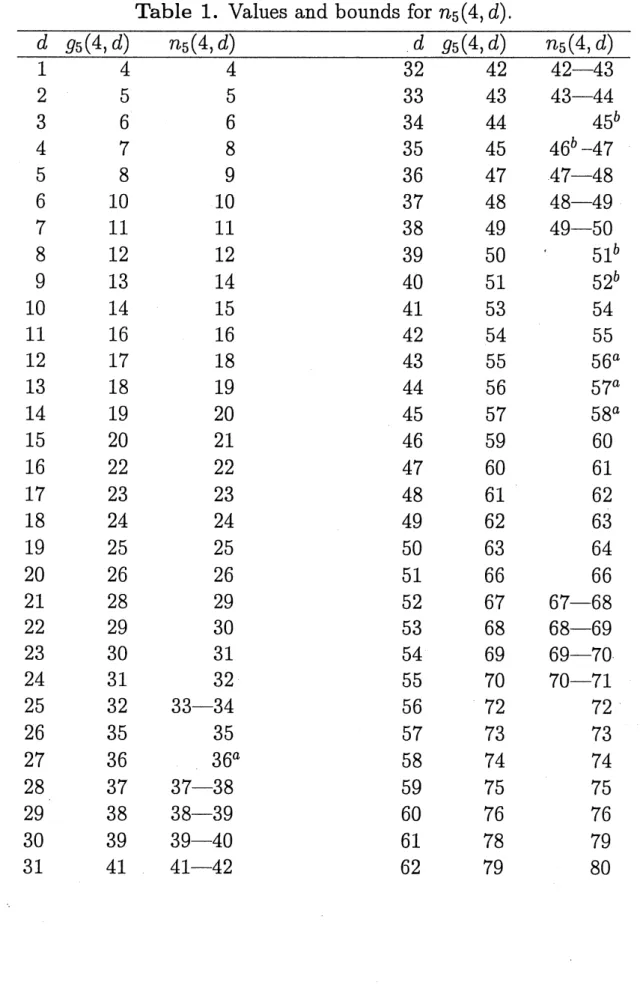
(iv) $k=4,$ $q=5$ for all but 54 values of $d$ ($\mathrm{c}.\mathrm{f}$
.
I.G.Boukliev and $\mathrm{S}.\mathrm{N}$.Kapralov [1]).We resolved eight of these fifty four cases in (iv), and we improved
one
of the remainingones.
Table 1 is arranged to put contents of [1] and updated valuesor
bounds together.Details are in Section 3.
In Section 3 we only consider optimal codes for $q–5$ and $k=4$
.
Note that for $k\leq 2$, $n_{5}(k, d)=g_{5}(k, d)$ for all $d$by Theorem 1.2. For $k=3$, the values of$n_{5}(3, d)$ are as follows($c.\mathrm{f}$. R.Hill [4]):
$n_{5}(3, d)=\{$
$g_{5}(3, d)+1$ for $d=5,9,10,13,14,15$,
$g_{5}(3, d)$ for other values of $d$.
2
Preriminaries
Theorem 2.1. (T.Maruta [7])
For $q\geq 4$ there $d$ose not exist an $[n, 4, n+1-q^{2}]_{q}$-code with $n=\lceil q^{3}-q-\sqrt{q}-21$. Lemma 2.2. ($\mathrm{P}.\mathrm{P}$
.
Greenough and R.Hill [3])(i) $n_{q}(k, d)\leq n_{q}(k, d+1)-1$, (ii) $n_{q}(k, d)\geq n_{q}(k, d-1)+1$.
Definition.
Let $C$ be an $[n, k]_{q}$-code. The dual code of$C$, denoted by $C^{\perp}$, is given by
$C^{\perp}=$
{
$v\in V(n,$$q)|(v,$$c)=0$ for all $c\in C$},
where $(x, y)$ is the inner product as usual.
Theorem 2.3. (The MacWilliams $\mathrm{i}$dentities)
Let $C$ be an $[n, k]_{q}$-code. Let $A_{i}$ and $B_{i}$ denote the number of codewords of weight $i$ in
$C$ and in the dual code $C^{\perp}$ respectively. Then the $A_{i}’ \mathrm{s}$ and $B_{i}’ \mathrm{s}$satisfy
$j= \sum_{0}^{n-\mathrm{r}}A_{j}=q^{k}-t\sum_{j=0}^{t}B_{j}$
for $t=0,1,$$\ldots$ ,$n$. Definition.
Let $G$ be a generator matrix of a linear $[n, k, d]_{q}$-code $C$. Then the residual code of $C$
with respect to a codeword $c$, denoted by${\rm Res}(C, c)$, is the code generatedbythe restriction
of $G$ to the columns where $c$ has a zero entry.
Theorem 2.4. (R.Hill [4])
Suppose$C$is an $[n, k, d]_{q}$-code and suppose $c\in C$has weight $w$ , where$d> \frac{w(q-1)}{q}$. Then
${\rm Res}(C, c)$ is an $[n-w, k-1, d\mathrm{o}]_{q}$-code with $d^{\mathrm{O}} \geq d-w+\lceil\frac{w}{q}\rceil$.
Definition.
A linear code is called projective if no two columns of a generator matrix are linearly
dependent.
Theorem 2.5. (R.Hill [4])
Suppose $d\leq q^{k-1}$ and that $C$ is an $[n, k, d]_{q}$-code which attains the Griesmer bound.
as distinct points of the projective space $PG(k-1, q)$
.
Lemma 2.6. (R.Hill [4])There existsaprojective$[n, k, d]_{q}$-codeif and only if there exists an$n$-set$L$of$PG(k-1, q)$
such that $|L\cap\Pi|\leq n-d$ for any hyperplane II of $PG(k-1, q)$ and that equality hol$d\mathrm{s}$
for some hyperplane.
In Lemlna 2.6, take the$n$ columnsofagenerator matrix as an $n$-set $L$
,
then it is $\mathrm{e}\mathrm{a}s\mathrm{y}$ toverify that this set satisfies the condition in Lelnma
2.6.
Consequently when we considerproblems with respect to a code,
we
may
regard the column vectors of a generator matrixof the code as points ofthe corresponding projectivespace.
Definition.
Foragiven [$n,$$k,$$d\rfloor_{q}$-code$C$, an$i$-line (resp. an$i$-plane) isaline (resp. aplane) containing
exactly$i$points of$C$
.
Denotedby$a_{i}$ thenumber of planes $\Pi_{i}$ of$PG(k-1, q)$ with $|C\cap\Pi_{i}|=$ $i$.Let$C$bean $[n, k, d]_{q}$-codewhich attains theGriesmerbound with$d\leq q^{k-1}$. By Theorem
2.5
$C$is projective. Then, byTheorem2.3
We have the following equalities:$. \sum_{1=0}^{n-}d$ $a:= \frac{q^{k}-1}{q-1}$,
$n- \sum_{i=1}^{d}iai=n\frac{q^{k-1}-1}{q-1}$,
$, \sum_{2i=}^{\iota-d}i(i-1)a_{i}=n(n-1)\frac{q^{k-2}-1}{q-1}$.
At the following two lemmas we set $k=4$, and
we
assume
that any plane $\Pi$ of $PG(3, q)$meets $C$ in at most $m$ points.
Lemma 2.7.
If there is a $t$-line, then wehave $t \leq\frac{1}{q}\{m(q+1)-|C|\}$.
Lemma 2.8.
3Optimal
linear codes
over
$GF(5)$with
$\mathrm{k}=4$In this section, we explain about Table 1 and our new results. Table 1 is the updated
best bounds or values of$n_{5}(4, d)$. For comparison, we also list the values of $g_{5}(4, d)$. For
all $d$not listed, in Table 1, it is already known that theGriesmer bound is attained. In the table, the values labeled $a$ are due to $\mathrm{I}.\mathrm{G}$.Boukliev [2], labeled $b$ are
our
new results, and others are given by $\mathrm{I}.\mathrm{G}$.Boukliev and $\mathrm{S}.\mathrm{N}$.Kapralov [1]. Note that the lower bounds aregiven either by the Griesmer bound (Theorem 1.1) orby proving the nonexistence of
co
desattaining the Griesmer bound and applying Lelnma 2.2. On the other hand, the upper
bounds are given by constructing codes with suitable parameters.
Next we prove
some
ofour
new results.Theorem 3.1.
There exist no codes which have the following
paranieters:
(i) $[44, 4, 34]_{5}$, (ii) $[50, 4, 39]_{5}$, (iii) $[106, 4, 84]5$, (iv) $[110, 4, 87]_{5}$,
(v) $[115, 4, 91]_{5}$.
Proof. (v) follows from Theorem 2.1. We only prove (ii) here, because the proof of (ii) is
comparatively
easy.
The other results are also proved similarly makinguse
of the conceptof projective geometry.
Let $C$ be
a
$[50, 4, 39]_{5}$-code. By Theorem2.5
$C$ is projective. By Theorem2.4
$A_{i}>0$implies $i\in$
{0,39,40,44,45,49,50}.
So, $a_{i}>0$ implies $i\in${11,10,6,5,1,0}.
Now we have thefollowing Lemma: Lemma 3.2.
(i) $|C\cap\Pi|\leq 11$, for any plane $\Pi$ of$PG(3,5)$,
(ii) There are no 4-, 5- and 6-1ine,
(iii) $a_{0}=0$,
(iv) $a_{1}=0$.
Proof. (i): This follows from Lemma 2.6.
(ii): This follows from Lemma
2.7.
(iii): By Lemma 2.8, note that $a_{0}>0$ implies $a_{0}=1$
.
Suppose $a_{0}=1$. Let $L$ be aline containd in the $0$-plane, and consider the six planes containing $L$
.
Then from (i) and$|C|=11\cross 4+6$, we cannot have a 1- and 5–plan$e$. Hence $a_{1}=a_{5}=0$. Then we have the
uniquesolution
(iv): Note that $a_{1}>0$ implies $a_{1}=1$
.
Suppose $a_{1}=1$, then we have the unique solution $a_{1}=1$, $a_{5}=25,$ $a_{6}=1$, $a_{10}=1,$ $a_{11}=128$.Let $\Pi_{5}$ and $\Pi_{10}$ be a 5-plane and the 10–plane respectively, and let $L’$ be the int$e$rsection of$\Pi_{5}$ and $\Pi_{10}$. Set $C’=C\backslash L’$. Consider the six planes containing $L’$. If $L’$ is an i-line, then we have $|C’|=35+i$ for $i=0,1,2,3$, from (ii). But we cannot find the remaining
four planes containing$L’$ from the unique solution. $\square$
By Lemma $3.2(\mathrm{i}\mathrm{i}\mathrm{i}),(\mathrm{i}\mathrm{v}),$ $a_{i}>0$ implies $i\in\{11,10,6,5\}$
.
Then the MacWilliams identitiesyield a contradiction. $\square$
Remark
Note that there exist no $[45, 4, 35]_{5^{-}},$ $[51,4,40]5^{-},$ $[111,4,88]_{5}-$ and $[116, 4, 92]_{5}$-codes by
Lemma 2.2 and Theorem 3.1.
For the unresolved cases of $k=4$ an$dq=5$, we can show that optimal codes with the
following parameters, if they exist, must have th$e$ unique weight distributions indicated:
a $[39, 4, 30]_{5}$-code: $A_{30}=468,$ $A_{35}=156$.
a $[70, 4, 55]_{5}$-code: $A_{55}=512,$ $A_{60}=88$, $A_{65}=24$.
If there exist both codes with above parameters, then we can result $n_{5}(4,28)=37$,
Table
1. Values and bounds for
$n_{5}(4, d)$.
$dg_{5}(4, d)$ $n_{5}(4, d)$ $1$4
4
2
5
5
3
6
6
4
7
8
5
8
9
6
10
10
7
11
11
8
12
12
9
13
14
10
14
15
11
16
16
12
17
18
13
18
19
14
19
20
15
20
21
16
22
22
17
23
23
18
24
24
19
25
25
20
26
26
21
28
29
22
29
30
23
30
31
24
31
32
25
32
33–34
26
35
35
27
36
$36^{a}$ $28$37
37–38
29
38
38–39
30
39
39–40
31
41
41–42
$dg_{5}(4, d)$ $n_{5}(4, d)$ $32$42
42–43
33
43
43–44
34
44
$45^{b}$ $35$45
$46^{b}-47$ $36$47
47–48
37
48
48–49
38
49
49–50
39
50
$51^{b}$ $40$51
$52^{b}$ $41$53
54
42
54
55
43
55
$56^{a}$ $44$56
$57^{a}$ $45$57
$58^{a}$ $46$59
60
47
60
61
48
61
62
49
62
63
50
63
64
51
66
66
52
67
67–68
53
68
68–69
54
69
69–70
55
70
70–71
56
72
72
57
73
73
58
74
74
59
75
75
60
76
76
61
78
79
62
79
80
63
80
81
64
81
82
97
122
122
98
123
123
65
82
83
66
84
85
67
$- 85$86
68
86
$87^{a}$ $69$87
$88^{a}$ $70$88
$89^{a}$ $71$90
91
72
91
92
73
92
93
74
93
94
75
94
95
76
97
97
77
98
98
78
99
99
79
100
100
80
101
101
81
103
103–104
82
104
104–105
83
105
105–106
84
106
$107^{b}$ $85$107
108
86
109
109–110
87
110
$111^{b}$ $88$111
$112^{b}$ $89$112
113
90
113
114
91
115
$116^{b}$ $92$116
$117^{b}$ $93$117
118
94
118
119
95
119
120
96
121
121
146
184
$184-185^{a}$ $147$185
$185-186^{a}$ $148$186
$186-187^{a}$ $149$187
$187-188^{a}$ $150$188
$188-189^{a}$ $151$191
191
152
192
192
153
193
193
154
194
194
155
195
195
156
197
197
157
198
198
158
199
199
159
200
200
160
201
201
161
203
203–204
162
204
204–205
163
205
205–206
164
206
206–207
165
207
207–208
166
209
209–210
167
210
210–211
168
211
211–212
169
212
212–213
170
213
213–214
171
215
215–216
172
216
216–217
173
217
217–218
174
218
218–219
175
219
219–220
References
[1] I.G.Bouklievand S.N.Kapralov: Optimal linearcodesofdimension4 over$F_{5}$, preprint. [2] I.G.Boukliev: private communication.
[3] P.P.Greenough and R.Hill: Optimal linear codes
over
$GF(4)$, Discrete Math. 125,187-199.
[4] R.Hill: Optimal linear codes, in: C.Mitchell ed., Proc. 2nd IMA Conf. on
Cryptogra-phy and Coding, Oxford Univ. Press, Oxford 1992,
75-104.
[5] I.Landgev, T.Maruta and R.Hill: On the nonexistence ofquaternary [51,4,34] codes,
preprint.
[6] F.J.MacWilliams and N.J.A.Sloane: The Theory of Error-Correcting Codes,
North-Holland Mathematical Library Vol.16, Ammsterdam, 1977.
[7] T.Maruta: On the non-existence of linear codes attaining the Griesmer bound, preprint.