The Network of Entrepreneurs in
Bombay in the 1920s
*Natsuko KITANI
**1.Introduction
This paper investigates the network of Bombay entrepreneurs, especially in the 1920s, who were engaged in the cotton industry by analyzing the structures of the Board of Direc-tors in each mill company and by reviewingthe careers of those direcDirec-tors. Bombay was the centre of Indian native capital, and also one of the main places where Indian cotton industry had developed. The Bombay industry grew rapidly, first in spinning, then in weaving, from the 1870s to the First World War ; however, in the 1920s and the 1930s, Bombay entered a prolonged slump and Bombay capitalists mobilized to demand protection from the
Govern-ment of India.1)
The managing agency system was a distinctive, and probably essential, feature of the
modern corporate sector of colonial India.2)
When new companies were formed, old-established, and well-known firms of “managing agents”, undertook the duties of management
on a commission basis.3)
Yet the Managing Agency system faced severe criticism during the
オイコノミカ 第 47 巻 第3・4合併号,2011 年,pp. 43-72
* This paper is based on the presentations at the Annual Conference of the Japanese Association for South Asian Studies in 2005 and at the Chubu Workshop of the Business History Society. I wish to express my gratitude to Prof. Naoto Kagotani (Kyoto University) for valuable advice in giving a pre-sentation in 2005, and to the chairs and audience at the conference and the workshop. My special thanks are also due to Prof. B. R. Tomlinson (SOAS) and Dr. Iain Hutchison for their valuable comments and criticisms. All the faults in this paper are attributed to the author.
** Assistant Professor, Graduate School of Economics, Nagoya City University.
1)Basudev Chatterji (1992) Trade, Tariffs and Empire : Lancashire and British Policy in India 1919-1939, Delhi : Oxford University Press ; Clive Dewey (1978) ‘The End of the Imperialism of Free Trade : The Eclipse of the Lancashire Lobby and the Concession of Fiscal Autonomy to India’, in Clive Dewey and A. G. Hopkins (eds.) The Imperial Impact : Studies in the Economic History of Africa and India, London : Athlone Press ; B. R. Tomlinson (1979) The Political Economy of the Raj : The Econo-mics of Decolonization in India, London : Macmillan.
first half of the twentieth century, not least because of the inadequacy of many Boards of Directors.4)
Company Boards of Directors, in Bombay and elsewhere in India, were widely thought to be largely made up of members of the owner’s family (‘family boards’), or of
executives linked to particular Managing Agents (‘dependent boards’).5)
As Vera Anstey pointed out, “one glaring fault is that the members of the Boards of Directors of the mills, as a rule, fail to take any close interest in their mills, and very few have any technical qualifications for their position. ... Possibly this helps to explain why the trainingof the technical and
supervisingstaff also tends to be deficient.”6)
In the deliberations over reforms to Indian company law in 1913 and 1936, the managing agency system was the subject of much discussion, and the system was put under legal restrictions for the first time by the Indian Companies (Amendement) Act of 1936.
A good deal of work has already been published on the history of business groups and
family networks in colonial India.7)
This paper supplements this by investigating the careers of a number of very prominent individual entrepreneurs who served as directors of several cotton mill companies, and attempts to analyze the inter-connections that were built up by the holdingof such multiple directorships. The paper then presents some conclusions about the effect of these distinctive arrangements on the Bombay cotton industry.
This study is mainly based on material in S. M. Rutnagur, Bombay Industries : the Cotton Mills (Bombay : the Indian Textile Journal Ltd., 1927), which contains a detailed history of the textile industry in Bombay from 1850 to 1926 and a full description and analysis of the constitution, management and financial position of the spinningand weavingfactories in the mid-1920s. This book contains a great deal of raw material, especially on the relationship
2)With regard to the managing agency system, see : Vera Anstey (1952) The Economic Development of India (the Fourth Edition), London : Longmans. ; P. S. Lokanathan (1935) Industrial Organization in India, London : George Allen & Unwin Ltd. ; S. K. Basu (1958) The Managing Agency System : In Prospect and Retrospect, Calcutta : The World Press Private Ltd. ; Maria Misra (1999) Business, Race, and Politics in British India c. 1850-1960, Oxford : Clarendon Press. ; Gijsbert Oonk (2001) ‘Motor or millstone ? The managing agency system in Bombay and Ahmedabad, 1850-1930’ in The Indian Econo-mic and Social History Review, Vol. 38 No. 4, pp. 419-452. ; Ajia Keizai Kenkyu-sho (Institute of Develop-ingEconomies) (1960) Indo no Keiei Dairi Seido [The Managing Agency System in India] Ajia Keizai Kenkyu-sho (Institute of Developing Economies) . ; Kenji Koike (1979) Keiei Dairi Seido Ron [The Arguments of Managing Agency System], Ajia Keizai Kenkyu-sho (Institute of DevelopingEconomies). 3)Anstey, The Economic Development of India, p. 113.
4)Lokanathan, Industrial Organization in India, pp. 331-334.
5)S. M. Rutnagur (1927) Bombay Industries : the Cotton Mills, Bombay : the Indian Textile Journal Ltd., p. 245.
between directors and managing agents, and should be regarded as a quasi-primary source : it has been supplemented by other contemporary publications, such as the reports of the Bombay Millowners’ Association ; the Imperial Gazetteer of India ; and the Dictionary of National Biography (Calcutta : Institute of Historical Studies, 1972-74).
2.The History of Bombay Cotton Industry
Bombay City was the capital of the Bombay Presidency, and the principal seaport of
Western India.8)
The second half of the nineteenth century witnessed a remarkable develop-ment of the trade and industry of the city. Together with a considerable improvedevelop-ment of the means of communication, constant demand from distant markets increased both imports and in exports. The chief exports were raw cotton, grain, seeds, cotton twist and yarn ; the chief imports were cotton goods, metals, and machinery. Bombay also supported all the many industries incidental to the active life of the city, including the trades of dyeing, tanning, and metal-working. The characteristic feature of Bombay manufacture was the rapid growth of the European factory system, that is, mills which were worked by steam and employinga large number of operatives, and were mainly erected by local capital. At the end of the nineteenth century, the total number of factories in the Bombay island rapidly increased, mainly due to the construction and openingof new spinningand weaving-mills. This increase of the industry had taken place in spite of the plague and a decline in the Chinese demand for Bombay’s production.
7)For instance, see the followingstudies : Shoji Ito (1974) (in Japanese) ‘Indo ni Okeru Dai-Zaibatsu no Dôzokuteki Seikaku no Saikento [An Analysis on Communal Features of the Top-management of Indian Zaibatsus]’ in Keizai to Keizaigaku [Journal of the Faculty of Economics], Tokyo Metropolitan University, No. 40, pp. 35-46. ; Shoji Ito (1980) (in Japanese) ‘Indo ni Okeru Zaibatsu no Shutsuji ni Tsuite : 19 seiki ― Dai-Ichiji Taisen [Indian Version of Zaibatsu at the Infant Stage ; From the Nineteenth Century to the First World War]’ in Shakai-Keizaishigaku [Socio-Economic History], Vol. 45, No. 5, pp. 511-536. ; Isamu Hirota (1979) (in Japanese) ‘Tata Zaibatsu Shihon no Dôzokuteki Seikaku [Familialism of the Tata Business Group]’ in Keieishigaku [Japan Business History Review] Vol. 13, No. 2, pp. 78-94. ; Atsufuji Mikami (1993) (in Japanese) Indo Zaibatsu Keiei-shi Kenkyu (The Study of the History of Indian Busi-ness Groups), Dobunkan Co. ; Claude Markovits (2000) The Global World of Indian Merchants 1750-1947 : Traders of Sind from Bukhara to Panama, Cambridge : Cambridge University Press. ; Claude Markovits (2008) Merchants, Traders, Entrepreneurs : Indian Business in the Colonial Era, Basingstoke : Palgrave Macmillan. ; Dwijendra Tripathi (2004) The Oxford History of Indian Business, Oxford : Oxford University Press.
8)As the history of Bombay City, for example, see the following: Mariam Dossal (1991) Imperial Designs and Indian Realities : The Planning of Bombay City, 1845-1875, Bombay : Oxford University Press.
Authors such as Mikami have identified a number of distinctive features in the indus-trialization of India.9)
First, until the beginning of the twentieth century, there had been no field where Indian businessmen engaged in the successful undertakings other than cotton industry. Second, it was not British capital but Indian capital that chiefly established and managed the cotton industry (and later the steel industry also). It has been suggested that this may have been because the British tried not to establish industries in India which would compete with established industries in Britain. So far as the development and management of Indian modern cotton spinningindustry is concerned, Shinichi Yonekawa has identified two important issues for discussion ― the causes of the establishment of modern cotton spinning companies and the features of their management in the period while they were developing. He pays particular attention to the processes by which the managing agency system was
adapted for the Indian spinningindustry.10)
Takayuki Sawada, who concentrates on labour relations, argues that these had become very unstable by the 1920s, and that the Bombay
strike in 1928 represented a major crisis for the industry.11)
He further analyses the develop-ment of Indian textiles in the context of competition both with the British and the Japanese cotton industries, arguing that Bombay was always subordinate to the British cotton industry in Lancashire.
Kenji Koike’s study of managing agency has identified a key characteristic of the system : although the agents were actually the same economic entities as the firms they managed, they
were completely different subjects from these firms in legal contracts.12)
In addition, under this system, managing agents controlled the affiliated companies both through absorbing the profits in advance and through human control in the board of directors. These conclusions are reinforced by a survey of the cotton mill companies of Bombay City in 1925 which found that
more than half the directors had some connection with the managing agents.13)
The enterprise and energy of a few wealthy Parsi merchants and bankers established the early cotton mills in Bombay. The pioneer industrialists were men who had an intimate knowledge of the cotton trade, but were ignorant of the technical conditions of the industry. Their want of technical experience was made up by the importingof skilled technical labour,
9)Mikami, Indo Zaibatsu Keiei-shi Kenkyu, p. 15.
10)Shinichi Yonekawa (1994) Boseki Gyo no Hikaku Keiei-shi Kenkyu [The Study of the Comparative History of Cotton Spinning Industry], Yuhikaku Co., pp. 123-144.
11)Takayuki Sawada (2003) Ajia Mengyo-shi Ron [The Arguments of the History of Asian Cotton Indus-tries], Hassaku Co., pp. 42-66.
12)Koike, Keiei Dairi Seido Ron, pp. 1-49. 13)Rutnagur, Bombay Industries, p. 250.
and the assistance of the agents of British machine-making firms. It was Mr. Cawosji Nanabhoy Daver, an enterprisingParsi merchant, who first established a cotton spinning
factory in Bombay.14)
He struggled on the project with his preliminary enquires and corres-ponded with Messrs. Platt Brothers & Co., Ltd., of Oldham, a prominent manufacturer and exporter of textile machinery. Platt Brothers supported Daver’s idea and offered advice and suggestions with regard to the machinery necessary for spinning Indian cotton. A company was founded under the title of the Bombay Spinningand WeavingCompany, and the pioneer spinningfactory was inaugurated in February 1854. “Thus the enterprisingspirit and fore-sight of a Parsi merchant and the co-operation of British machinery manufacturers laid the
foundation of India’s industrial development and commercial prosperity.”15)
The 1860s saw a break in establishingnew cotton mills. The Civil War in America disrupted the supply of cotton to Lancashire and so created abnormal demand for Indian raw
cotton, which led to fabulous prices for that commodity in British markets.16)
Once the Amer-ican war was over, however, the Bombay spinningindustry expanded rapidly once Indian merchants had been suddenly excluded from the European import trade in raw cotton. In Bombay City alone, fifteen cotton mill companies were founded in the first half of the 1870s, which enabled Bombay to establish its leadingposition in the Indian cotton industry. The 1880s saw a further burst of expansion.
The companies that had been founded in the 1860s were domestic-oriented (the main market was Bombay island), but the firms that were organized in the next decade aimed at the export market for yarn. The export of cotton yarns to the Chinese market underpinned
14)There is the followingaccount : “There is no official record or authentic information regardingany previous undertakingof the kind in any other part of the country. Thus the absence of any data on the subject and the scarcity of labour and other difficulties rendered Mr. Daver’s project exceptionally risky if not unworkable..” Rutnagur, Bombay Industries, p. 9.
15)Rutnagur, Bombay Industries, p. 9. In addition, Lokanathan comments : “The industry owned much to the pioneeringwork of men like J. N. Tata, who went over to England to study the workingof the mills in Lancashire, and to obtain machinery suitable for spinningand weavingin the different climatic conditions of India. The influence of Greaves, Cotton & Co., Ltd., who became managing agents of several cotton mills, and of Bradbury, Brady & Co., who were machinery agents, and who advised the mills in regard to equipment, was also important in the development of the cotton industry.” Lokanathan, Industrial Orga-nization in India, pp. 29-30.
16)“The Lancashire spinners had sympathy with President Lincoln and his cause and preferred Indian cotton to supplies of the raw material from the Southern States. Members of the various communities in Bombay, includingwealthy merchants, bankers, brokers and traders invested their all in cotton exports and thought of no other business or commodity in the frenzy of the huge profits which the white staple of the country brought of them.” Rutnagur, Bombay Industries, p. 13.
the growth of the Bombay spinning companies in the 1870s and 1880s. However, from the middle of the 1890s, exports to China began to fail due to the competition with Japanese yarns,
which meant that Bombay spinningcompanies reached the limit in their development.17)
From the middle of the 1890s onwards, the industry faced severe problems as a result of domestic difficulties ― plague, famine and severe financial depression ― as well as Japanese competition in the China market. This “materially affected the earnings of the spinning factories in Bombay, and it was deemed advisable to utilise the reserves and all available capital for increasingthe resources of existingconcerns by weavingand finishing
machinery.”18)
Thus the period between the 1870s and the 1890s was the crucial formative
period of Bombay spinningfirms.19)
Thereafter the premier position of the Bombay spinning industry gradually declined in India, with Ahmedabad already on the rise in the 1880s.
The outbreak of the First World War in 1914 led to the stoppingof machinery imports from Lancashire to India, which brought a complete cessation in mill building in Bombay. Even after the end of the war, the heavy increase in the cost of land and buildinginhibited the erection of new factories. The inter-war period saw both the start of new firms in new locations and crises of old firms in the cotton mill industry, so the competition within textiles was much keener in this period than before. Bombay now had to compete not only with Japan
but also with new mills that were started in other locations within India.20)
In the three years followingthe end of the First World War, the Indian cotton industry enjoyed prosperity thanks to a short re-stockingboom caused partly by the lack of supply of
cotton textiles from foreign countries such as United Kingdom.21)
However, in 1923, the boom broke and Indian manufacturers faced a prolonged depression. From this time on the indus-try demanded a protective policy from the Government of India and had achieved a partial political victory on this issue by the early 1930s. The depression was serious especially in Bombay where there was weak management during the post-war boom, comparatively high
wages, and frequent labour disputes.22)
Moreover, Bombay now faced severe competition with the interior cotton mills in the domestic market. The up-country cotton mills such as
Ahmeda-17)Yonekawa, Boseki Gyo no Hikaku Keiei-shi Kenkyu, p. 101. 18)Rutnagur, Bombay Industries, p. 21.
19)Yonekawa, Boseki Gyo no Hikaku Keiei-shi Kenkyu, p. 101.
20)Tirthankar Roy (2004) The Economic History of India 1857-1947 Second Edition, New Delhi : Oxford University Press, p. 230.
21)Report of the Indian Tariff Board, 1927, Vol. I : Report, pp. 9-10 ; Takashi Murayama (1961) Sekai Mengyo Hatten-shi [The History of the Development of Cotton Industries in the World], Nihon Boseki Kyokai, pp. 448-449.
bad or Madras cotton mills were located in almost the centre of main cotton growing areas, which was gave them favourable raw material costs. In addition, some of these up-country mills were located also in the centre of areas of high demand, which minimized transport costs.23)
The increased competitive pressures of the 1920s and 1930s resulted in some important
changes of Bombay cotton mills.24)
A number of established mills went out of business during these decades. Those that survived tried to adopt a number of new strategies. They began to weave their own yarn into cloth much more than before, which meant that the substitution of British piece-goods by Indian products accelerated ; in addition, a number of Bombay mills tried to spin and weave finer yarn, to save labour costs. In such circumstances, the capacity for business leadership amongmanagingagencies and boards of directors was put to the test.
3.The Network of Bombay Cotton Entrepreneurs
Koike points out that, after the First World War, Indian family conglomerates had retained the concentration of their control through taking on both the agency contracts and the posts of director, with members of the managing agency occupying more than half of the posts of
director in the affiliated companies.25)
This section will investigate further the networks of connection amongof Bombay cotton entrepreneurs through analysingthe personal organiza-tions of the boards of directors.
[ 1 ] The Directors of Bombay Cotton Mill Companies
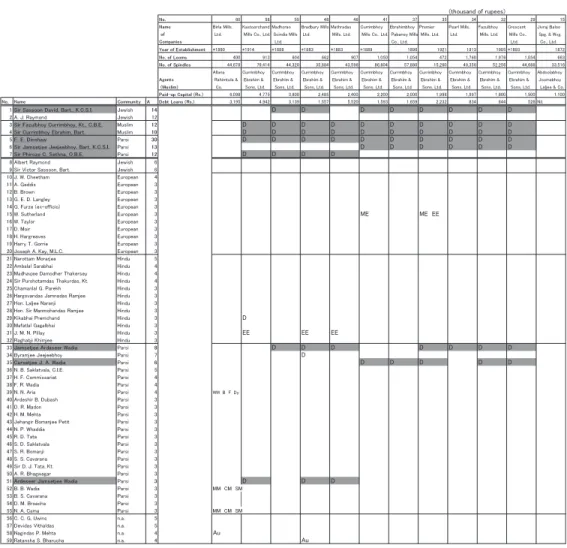
Table 1 to 5 also show how many posts Indian businessmen ― not only managing agents but also the other entrepreneurs or businessmen ― occupied in affiliated companies under each of the European, Jewish, Muslim, Hindu and Parsi agents. Basically, it can be pointed out that the posts of director were almost monopolised by the persons in the same communities as the agents. For instance, it was Europeans who were mainly directors of the companies under
22)Ibid., pp. 457-460 ; M. P. Gandhi (1930) The Indian Cotton Textile Industry : Its Past, Present and Future, Calcutta : The Book Co., pp. 118-119 ; Freda Utley (1931) Lancashire and the Far East, London : George Allen & Unwin Ltd., pp. 380-381.
23)Hirendra Lal Dey (1933) The Indian Tariff Problem in Relation to Industry and Taxation, London : George Allen & Unwin Ltd., pp. 139-140.
24)Roy, The Economic History of India, p. 233. 25)Koike, Keiei Dairi Seido Ron, p. 66.
Table 1 : Directors under European Agency
A : The number of directorship.
Note 1) D=Director ; Au=Auditor ; Se=Secretary ; So=Solicitor ; MM=Mill Manager ; CM=Carding Master ; SM=SpinningMaster ; WM=WeavingMaster ; B=Bleacher ; F=Finisher ; Dy=Dyer ; ME=Mecanical Engineer ; EE=Electrical Engineer
Note 2) Paid-up Capital : in 1924 ; Debt Loans : in 1924. Some companies list liabilities as well as debt loans ; however, these totals have been excluded from this and the followingfour tables.
Note 3) Kohinoor No. 1 started in 1896. Kohinoor No. 2 was started in 1888, as the Union Mills and became Naigaum in 1904, and Kohinoor No. 2 in 1913.
Note 4) Swan Mills was started as Bombay National in 1888, and reconstructed as Swan Mills in 1903. Note 5) Bombay Industrial Mills was started in 1888 as Lord Reay Mills and converted into Bombay
Industrial in 1909.
Note 6) New City of Bombay Manufacturingwas started in 1883 as the City of Bombay and reconstructed in 1905 as the New City of Bombay.
Source:Calculated from : S. M. Rutnagur (1927) , Bombay Industries : The Cotton Mills, Bombay : the Indian Textile Journal Ltd., pp. 75-311.
A : The number of directorship.
Note 1) D=Director ; Au=Auditor ; Se=Secretary ; So=Solicitor ; MM=Mill Manager ; CM=Carding Master ; SM=SpinningMaster ; WM=WeavingMaster ; B=Bleacher ; F=Finisher ; Dy=Dyer ; ME=Mecanical Engineer ; EE=Electrical Engineer
Note 2) E. D. Sassoon United Mills, Ltd., was registered in 1920. It was including the Alexandra, E. D. Sassoon, Jacob Sassoon, Rachel Sassoon, Manchester Mills and E. D. Sassoon Turkey Red Dye Works.
The Alexandra Mill was started in 1868 ; reconstructed in 1872 and converted into the Alexandra in 1880. Jacob Sassoon Mill was started in 1893. E. D. Sassoon Mill was started in 1883. Rachel Sassoon Mill was started as People of India in 1882 and reconstructed and converted into Rachel Sassoon in 1895. The Manchester Mill was started as Prince of Wales in 1874 ; recon-structed into Hongkong in 1890 and into Manchester in 1925.
Note 3) Elphinstone Spg. And Wvg. Mills Co., Ltd., was started in 1897 as Tapidas Mills and converted into Elphinstone Mill in 1902.
Note 4) Apollo Mills, Ltd., was started in 1874 as the Anglo-Indian, Ld. ; converted into the Apollo (Private) in 1893 and formed into Apollo Mills, Ld., in 1920.
Note 5) David No. 1 was started in 1888 and David No. 2 in 1899.
Note 6) Meyer Sassoon Mills, Ltd., was started in 1897 as Naranji Mill and converted into Meyer Sassoon in 1910.
Note 7) Edward Sassoon Mills, Ltd., was started as Tricumdas in 1898 and converted into Edward Sassoon in 1910.
Note 8) Dawn Mills Co., Ltd., was started in 1883 as Lukhmidas and converted into Dawn in 1910. Note 9) Paid-up Capital : in 1924 ; Debt Loan : in 1924.
Table 3 : Directors under Muslim Agency
A : The number of directorship.
Note 1) D=Director ; Au=Auditor ; Se=Secretary ; So=Solicitor ; MM=Mill Manager ; CM=Carding Master ; SM=SpinningMaster ; WM=WeavingMaster ; B=Bleacher ; F=Finisher ; Dy=Dyer ; ME=Mecanical Engineer ; EE=Electrical Engineer
Note 2) Birla Mills, Ltd., included Birla Mills 1 and 2. Birla No. 1 was started in 1896 as the Diamond Mill ; became Rehmani and Ramdas and subsequently Birla 1 in 1917.
Birla No. 2, was started as the Indo-China in 1890 and converted into Birla No. 2 in 1919. Note 3) Kastoorchand was started in 1914. Imperial was started in 1882 and reconstructed in 1915. Note 4) Madhorao Scindhia Mills, Ltd., was started in 1889 as the Sun Mills ; reconstructed as Madhorao
Scindia in 1917.
Note 5) Bradbury Mills, Ltd., was started in 1883 as Ripon Mills and converted into Bradbury in 1914. Note 6) Mathradas Mills, Ltd., was started in 1883 as the Queen Mills ; became KingGeorge Mills in 1913
and was reconstructed into Mathradas Mills in 1917.
Note 7) Currimbhoy Mills Co., Ltd., included Mahomedbhoy Mills. Currimbhoy was started in 1889 and Mahomedbhoy started in 1899.
Note 8) Crescent Mills Co., Ltd., was started in 1893 as Damodar and converted into Crescent in 1905. Note 9) Paid-up Capital : in 1924 ; Debt Loans : in 1924.
Table 4 : Directors under Hindu Agency
A : The number of directorship.
Note 1) D=Director ; Au=Auditor ; Se=Secretary ; So=Solicitor ; MM=Mill Manager ; CM=Carding Master ; SM=SpinningMaster ; WM=WeavingMaster ; B=Bleacher ; F=Finisher ; Dy=Dyer ; ME=Mecanical Engineer ; EE=Electrical Engineer
Note 2) Sir Shapurji Broacha Mills, Ltd., included Connaught and Empress Mills started in 1883 and the New Empress in 1895. The three mills were formed into Sir Shapurji Broacha Mills, Ld., in 1916. Note 3) Kilachand Mills, Ltd., was started in 1889 as Peroo Mahomed, became Coronation in 1902, and was
reformed into Kilachand in 1920.
Note 4) Diamond Spinningand WeavingCo., Ltd., was started in 1892 as Hope Mill, converted into Prospect in 1913, and turned into Diamon in 1919.
Note 5) Madhowji Dharamsi ManufacturingCo., Ltd., was started in 1872 as Jadhowji Mills and converted into Madhowji Dharamsi in 1894.
Note 6) Planet Mills, Ltd., was started in 1888 as the Star Mills ; reconstructed as the Victory Mill in 1904 and rebuilt in 1917 as the Planet after destruction by fire.
Note 7) New Kaiser-I-Hind Spg. & Wvg. Co., Ltd., was started in 1876 as the Nursey Mills and wound up in 1880 ; reconstructed in 1882 as the New Kaiser-I-Hind.
Note 8) Phoenix Mills, Ltd., was started in 1889 as Britannia Mill and reconstructed as Phoenix in 1905. Note 9) Crown Spinningand ManufacturingCo., Ltd., was started as the Dhun Mills in 1884 and
recon-structed into Crown in 1902.
Note 10) Alliance Cotton ManufacturingCo., Ltd., was started in 1857 as Bombay Throstle and converted into the Alliance in 1864.
Note 11) Paid-up Capital : in 1924 ; Debt Loans : in 1924. Source:As Table 1.
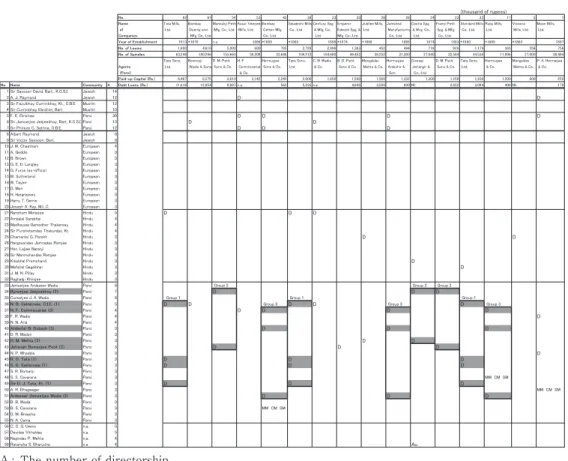
Table 5 : Directors under Parsi Agency
A : The number of directorship.
Note 1) D=Director ; Au=Auditor ; Se=Secretary ; So=Solicitor ; MM=Mill Manager ; CM=Carding Master ; SM=SpinningMaster ; WM=WeavingMaster ; B=Bleacher ; F=Finisher ; Dy=Dyer ; ME=Mecanical Engineer ; EE=Electrical Engineer
Note 2) Bombay Dyeingand ManufacturingCo., Ltd., included the Bombay Dye Works started in 1876, the Textile Mill started in 1896, and the SpringMill started in 1908.
Note 3) Bombay Cotton ManufacturingCo., Ltd., was started in 1885 and reconstructed in 1909.
Note 4) Swadeshi Mills Co., Ltd., was started in 1860 as the Coorla Mills ; became Dharamsey Poonjabhoy in 1865 ; went into liquidaation five times and was closed in 1886.
Restarted as the Swadeshi Mills in 1887, purchased the Bombay United Mills in May 1925 from the Tata Mills, Ld.
Note 5) Emperor Edward Spg. And Mfg. Co., Ltd., was started in 1874 as Mazagon and converted into Emperor Edward in 1903.
Note 6) Jubilee Mills Ltd., was started in 1888 and reconstructed in 1916.
Note 7) Standard Mills Co., Ltd., was started in 1890 as the Balladina Millsand formed into the Standard Mills in 1891.
Note 8) Ruby Mills, Ltd., was started in 1889 as the Sorab Woollen Mills and reconstructed as Ruby Mills in 1917.
Note 9) Victoria Mills, Ltd., was started in 1860 ; wound up in 1898 ; sold in 1905 and reconstructed into Victoria Mills, Ltd., in 1913.
Note 10) Paid-up Capital : in 1924 ; Debt Loans : in 1924. Source:As Table 1.
European agency (see Table 1). The same tendencies appear in Table 2 to 5. This point will support that Koike’s argument that human control was one of the ways of concentration of control by managing agents. European people were divided into two groups. The one group included Andrew Geddis, B. Brown, G. E. D. Langley and G. Furze, who gathered under the agency of James Finlay & Co., Ltd. The other included Joseph A. Kay, Harry T. Gorrie and D. Moir, who gathered under the agency of W. H. Brady & Co., Ltd.
However, these three tables can suggest some other points. First, some people who were a director of more than ten mill companies, such as Sir Sassoon David, F. E. Dinshaw, Sir Jamsetjee Jeejeebhoy, and Sir Phiroze Sethna, tended to engage in the affiliated companies beyond the family or community (Table 1, 2 and 3).
Second, as Table 3 shows, members of the Wadia Family, such as Jamsetjee Ardaseer Wadia, Cursetjee J. A. Wadia and Ardeseer Jamsetjee Wadia, were also directors of companies under the agency of Currimbhoy Ebrahim & Sons, Ltd. In other words, there could be some connection amongthe three groups : Currimbhoy Family ; Wadia Family ; persons who were directors of many companies (Sir Sassoon David, F. E. Dinshaw, Sir Jamsetjee Jeejeebhoy, Sir Phiroze C. Sethna).
Third, we can find three groups of Parsi26)
directors in Table 5 : Group 1, 2 and 3. Groups 1, which was under the agency of Tata Sons, Ltd., included N. B. Saklatvala, S. D. Saklatvala, R. D. Tata and D. J. Tata. Byramjee Jeejeebhoy, H. M. Mehta and Jehangir Bomanjee Petit were included Group 2 under the agency of D. M. Petit Sons, Co. The companies under the agency of Hormusjee Sons, & Co., Hormusjee Ardeshir & Son., and Hormusjee & Co, made up Group 3, which included H. F. Commissariat, Ardeshir B. Dubash and Ardeshir Jamsetjee Wadia.
The companies under Hindu or Parsi agency were established between 1850s and 1910s, compared with the companies under European, Jewish or Muslim agency being established mainly between 1870s and 1920s. Table 6 shows the distribution of mill agencies in 1924-25. We can draw a few conclusions from this Table. The number of Parsi and Hindu agencies was much larger than that of Muslim, Jews and European ones. However, in the amounts of
paid-up capital, the Jewish remarkably showed the largest number. As for the Muslims,27)
the amounts of paid-up capital were almost the same as those of Parsis or Hindus, in spite of the small number of the agencies.
26)The Parsis had exercised a great influence in spite of their small numbers. They had held high rank among the native community through the force of their inherited wealth, their natural genius for trade, their intelligence, and their munificent charities. The Imperial Gazetteer of India, Vol. VIII, Berhampore to Bombay, 1908, Oxford : Clarendon Press, p. 412.
[ 2 ] The Careers of the Directors
This section considers the activities of Bombay entrepreneurs mainly through surveying the careers of the persons who were directors of several companies. Table 7 shows the careers of the persons who were directors of more than ten mill companies. A few tendencies appear in this table.
First, most of them were concerned with bankingor financial undertakings. For example,
Sir Sassoon David was the promoter of the Bank of India,28)
and also a member of the first Board of Directors of the Bank. He had been one of the leadingfinanciers in Bombay, and been associated not only with financial projects but also with industrial and commercial projects. Sir Currimbhoy Ebrahim also served as a director of the Bank of India. Sir Fazul-bhoy CurrimFazul-bhoy was a member of the Local Board of the Imperial Bank of India, and Sir
Table 6 : Distribution of Mill Agencies in 1924-25
Source : Calculated from : Rutnagur, Bombay Industries, p. 55. A=thousand of spindles
B=thousand of looms C=thousand of hands
27)Although a large number of Muslims were engaged in commercial pursuits and a few families had made remarkable money in the China trade, cotton manufacturingdid not attract so many Muslims. Among them, Currimbhoy Ebrahim was the only member of this community in India who started a cotton company of his own. The China trade became the principal interest of Currimbhoy, and for that purpose, he opened offices in HongKongand Shanghai in China, and Kobe in Japan. Tripathi, The Oxford History of Indian Business, p. 124. On the other hand, Claude Markovits considers the limited role of Muslim business elite in colonial industrial development. “The only two Muslim merchant families which attained prominence in industry were the Currimbhoys and Adamjis ... The most decisive factor explainingthe weak position of Muslims in industry is, however, most probably the attitude of the dominant groups of Indian Muslim society towards industry. ... Muslim elites, ... were little affected by the development of a trend of economic nationalism epitomized by the Swadeshi movement, which contributed in no small way to directinga part of the savings of the Hindu middle class towards industry.” Markovits, Merchants, Traders, Entrepreneurs, pp. 116-122.
28)Amonglocal bankingconcerns, the Bank of India was one of the best managed ones. It was established in 1906, and because of the energy and influence of Sir Sassoon David, the conception and floatation of the Bank was successful. See Rutnagur, Bombay Industries, p. 683.
Table 7 : The Careers of Directors (the number of directorship is more than ten) Source : Rutnagur, Bombay Industries , pp. 697-732 ; Claude Markovitz (1985) , Indian Business and Nationalist Politics 1931 -39 , Cambridge : Cambridge University Press, pp. 207-213 ; S. P. Sen (ed.) (1974) Dictionary of National Biography (Vol. IV) , Calcutta : Institute of Historical Research, pp. 137-138. ; Report of the Millowners ’Association ,Bombay ,for the Year 1925 ,pp. 18-55 A : The number of directorship.
Pheroze C. Sethna was Chairman of the Central Bank of India.29)
On the other hand, F. E. Dinshaw, who floated F. E. Dinshaw & Co., a financial company, was one of Bombay’s top financiers. The following can be suggested that the connections with these persons would
have considerably useful in financingthe projects of textile industry.30)
The second tendency was that most of these directors had contributed to the municipal administration of Bombay mainly through the membership of the following institutions : the
Municipal Corporation31)
; the Improvement Trust ; the Port Trust. The Municipal Corpora-tion possessed extensive powers in the ordinary local administraCorpora-tion, and a StandingCommit-tee had dealt with ordinary business. The Improvement Trust (the Bombay City Improve-ment Trust) had been entrusted with the regeneration of the city through the construction of new streets, the destruction of insanitary areas, the construction of sanitary quarters for the labouringclasses, and the development of valuable sites for building. The Port Trust, a small board of thirteen members representingcommercial and other interests, had controlled the administration of the port, and been responsible for executingimprovements to the port.
As already seen, in Table 1, European directors can be divided into two groups on the basis of connection to particular managing agents. For example, Andrew Geddis joined James Finlay & Co., Ltd., Glasgow, in 1902 and came out to their Bombay office in 1907. On the other hand, Joseph A. Kay was Managing Director of W. H. Brady & Co., which were mill agents and machinery importers. They both were active members of the Bombay Millowners’ Association,32)
and were associated with the municipal administration through the
member-29)The Central Bank of India was one of the prominent bankingconcerns amongthe investingpublic and amongfinanciers and company promoters. “Sir Phiroze Sethna who succeeded Sir Phirozshaw as chair-man of the Bank has not only maintained its prestige but has helped towards its further development. As an institution established mainly with Parsi capital and through Parsi enterprise the Central Bank of India has attained the highest position amongIndian bankingconcerns and ranks high in the estimation of financiers and the investingpublic in all parts of the country.” Ibid., p. 686.
30)It had not been so difficult for mill promoters in Bombay to finance their projects duringthe first a few years of the progress of the cotton industry. Even after the yarn trade in China started to decline, this good luck in financing continued. “When the banks advanced money the security generally included the liquid assets such as cotton, yarn and cloth in stock and in process of manufacture, in addition to the personal guarantee of the mill agents, and the mil property as security, in some cases. This arrangement worked fairly well duringperiods of profit but duringtimes of trade depression and financial stringency the mill agents had an anxious time unless they had the intention, which some undoubtedly had, of carryingthe concern into liquidation and becomingthe owners thereof.” Ibid., p. 683.
31)The Municipal Corporation consisted of 72 members ― 36 elected by the ratepayers, 20 by the Chamber of Commerce, the University, and the Justices of the Peace, and 16 appointed by Government. The Imperial Gazetteer of India, Vol. VIII, p. 415.
ship of the Port Trust.
Table 3 shows that members of the Parsi Wadia Family were directors of several com-panies under the agency of Currimbhoy Ebrahim & Sons, Ltd. The Wadia family was
well-known for its role in the early growth of the textile industry.33)
Another family member, Jamsetjee Ardeshir Wadia, was intimately connected with the Bombay mill industry in the 1920s : he had his apprenticeships in a mercantile house in London, was a member of the Municipal Corporation and the Millowners’ Association, and took an active and intelligent part
in the deliberations of these institutions.34)
Table 8 shows the careers of three groups of Parsi businessmen.35)
The members of Group 1, Tata group, graduated from the Elphinstone College, which was instituted in 1835 and was under the management of Government, or from St. Xavier’s College. Both were the important educational institutions in Bombay. In addition, one interestingpoint appears in this table. On the one hand, R. D. Tata of Group 1 contributed decisively to the establishment of the Indo-Japanese trade relationship through the introduction of Indian raw cotton into Japan. On the other hand, H. M. Mehta of Group 2, who started an agency business for machinery and mill accessories, had visited Europe several times and formed important connections with the leadingmanufacturers and exporters in the United Kingdom and the Continent.
It was in 1889 when the first batch of Japanese merchants came to Bombay to buy Indian cotton for Japan, and next year, Japan actually began to import Indian cotton. In the 1890s, Japanese merchants opened the first office in Bombay for shippingcotton to Japan (1895), and a little later, Japan abolished the import duty on cotton and export duty on yarn (1898). In
32)Bombay possessed the Chamber of Commerce, which represented on the Legislative Council, the municipality, the Port Trust, and the Bombay Improvement Trust. The Bombay Millowners’ Association was also a special association for protectingand furtheringthe interests of the cotton industry, the opinion of the association therefore carried great weight on all questions connected with the industry. 33)For example, Mr. Naorosji Nusserwanji Wadia, born in Bombay in 1849, “was one of the best known of citizens connected with the mill industry. He was sent to a school in Liverpool, and after returningin 1866, acted as consulting engineer and textile expert for a large number of the cotton mill in Bombay. He was elected a member of the Bombay Legislative Council and Associate of the Institute of Civil Engineers and Member of the Institute of Mechanical Engineers, London. Mr. Sorabji Nusserwanji Wadia, born in 1850, was one of the most proficient of mill engineers from an early period of the mill industry in Bombay. He was sent to Manchester in 1863 for education and factory trainingalongwith his brother Mr. Naoroji N. Wadia. He was one of the earliest of the local engineers to pass the Bombay Boiler Act examination for mechanical engineers in the First Class, and acted as consulting engineer and erected several of the large mill engines in Bombay.” See Rutnagur, Bombay Industries, p. 730.
34)Ibid., p. 731.
Table 8 : The Careers of Parsi Directors of Group A and B Source : Rutnagur, Bombay Industries ,pp. 697-732 ; Markovitz, Indian Business and Nationalist Politics 1931 -39 ,pp. 207-213 ; A : The number of directorship.
the next decade, Japan started to erect her own mills and exports of Bombay yarn to China began to fall.
Mr. R. D. Tata “was largely interested in Bombay’s cotton and yarn trade with China and
Japan and was in fact the pioneer in introducingIndian cotton amongthe Japanese mills.”36)
When a small deputation of Japanese merchants visited India in 1889 to investigate the possibilities of usingIndian cotton for Japanese mills, Mr. R. D. Tata not only gave them the
necessary information but also undertook to ship the first 32 bales of cotton to Japan.37)
Next year, Mr. Tata himself visited Japan and gave some instructions of how to open and work the hard-pressed cotton.
Before importingcotton from India, Japan had to depend on China for its supply of the raw material. However, after the introduction of Indian cotton, Japanese mill industry showed a marked advance, and then, began to compete with India in the Chinese market both in yarn and cloth that were manufactured from Indian cotton. A little later, Japan came to compete with Indian goods not only in the Chinese market but also in the Indian market itself. “It will therefore be instructive to recall the circumstances under which Japan imported and used her first supply of Indian cotton for manufacturingpurposes. ... Japan not only takes away Indian cotton but spins and weaves it and sells the cloth back in India at a cheaper rate than what the
Indian mills can do.”38)
In any case, it is sure that Mr. R. D. Tata greatly contributed to the
development of the Indo-Japanese trade relationship.39)
On the other hand, some members of Mehta or Petit Families had some connections with Britain or the Continent. As shown in Table 8, H. M. Mehta had visited Europe several times and formed important connections with the leadingmanufacturers and exporters in Great
Britain and the Continent.40)
Amongthe Petit group, Cowasjee Hormusjee Petit, for example, went to Manchester in 1922 and joined the College of Technology. He also specialized in
weavingand worked at various loom sheds in the Lancashire district.41)
36)Rutnagur, Bombay Industries, p. 598.
37)This deputation “had brought the introductions to Messrs. Tata Sons of Bombay from their Hong Kong branches.” Ibid.
38)Ibid.
39)“For his services in the development of the Indo-Japanese trade relationship, the Emperor of Japan was pleased to confer on him the high distinction of the Third Order of the Rising Sun, which was a title somewhat similar to the K. C. I. E. or C. I. E., in India.” Ibid., p. 599.
40)As another case, Pirojsha N. Mehta “went to Manchester and obtained the Certificate in the Faculty of Technology of the Victory University and Honours Diploma of the Municipal College of Technology of that city.” Ibid., p. 714.
[ 3 ] The Network amongthe Directors
Table 9 shows the several groups which seemed to be established among these directors,42)
and Table 10 shows the members of each group. Eight groups can be found in Table 9. Group A mainly includes the people who were interested in bankingand financial industry. These people had many directorships. The connections beyond each community can be found and the leadingpersons in Bombay financial world seem to gather in Group A. Group B mainly includes the people from Jewish community, but Sir Sassoon David belongs to another group. This group has the connection with F. E. Dinshaw, who was one of the best known in Bombay and had been intimately associated with the mill industry as a financier and director (see Table 7).
Group C and F mainly include the people from European community. Group C has the people who were involved in James Finlay & Co., Ltd. Group C has the connection with F. E. Dinshaw and Sir Sassoon David who had been the leadingfinancier in large and important undertakings (see Table 7). Group F seems to have another connection with Bombay finan-cial world such as Sir Jamsetjee Jeejeebhoy. Group D and Group G mainly include the people from Parsi community. In Group D, F. E. Dinshaw and Pheroze C. Sethna were the leading persons. Pheroze C. Sethna had been a prominent member of the mercantile community, and had also identified himself with insurance companies, bankinginstitutions and a large number
41)With regard to the relationship between Lancashire people and Parsi in the mill staffs, “The English-man wanted the job and to do his best and the Parsi wanted to learn and co-operate with him and the relations between the two became friendly and have continued up to the present day [the 1920s].” Rutnagur, Bombay Industries, p. 289. However, after 1895, many “Mill managers became Mill Agents and Machinery Importers while the higher grade of Lancashire men were requisitioned in larger numbers. Indians with Technological Certificates began to find employments in the local factories so that the mill staff of 1925 is almost wholly different from that of 1895.” Ibid., p. 294.
42)The numbers in this table correspond to the number of each company in Table 1 to 5. In abstracting these groups, first, the persons who had more than three directorships were abstracted, and then, the companies in which more than two persons amongthe above had interested were abstracted. In abstractingthe groups in this way and analyzingthe interlock network, the followingstudies were much instructive : Kazuo Wada, Yoichi Kohayagawa and Haruhito Shiomi (February 1992) ‘Interlocking Man-agement in Chûkyô Area Corporations : An Analysis of The National Directory of Corporate Executives (1907 Edition)’ in Nanzan Management Review, Vol. 6 No. 3, pp. 215-248. ; Wada, Yoichi Kohayagawa and Haruhito Shiomi (October 1992) ‘InterlockingManagement in Chûkyô Area Corporations : An Analysis of The National Directory of Corporate Executives (1898 Edition)’ in Nanzan Management Review, Vol. 7 No. 2, pp. 217-254. ; Wada, Yoichi Kohayagawa and Haruhito Shiomi (1993) ‘Interlocking Management in Chûkyô Area Corporations : An Analysis of The National Directory of Corporate Executives (1918 Edi-tion)’ in Nanzan Management Review, Vol. 8 No. 1, pp. 75-125. ;
Table 9 : The Groups amongthe Directors (Part 1) Source : A s Table 1.
of cotton mill companies and other joint stock concerns (see Table 7). Group G shows the Tata group, and this group seems to have had the looser connection with another group through the interlocking network by the directorship. In Group E, the connections beyond each community can be found and F. E. Dinshaw was the leadingperson also in this group. This group also seems to have the connection with an Ahmedabad businessman, Ambalal
Table 10 : The Groups amongthe Directors (Part 2)
Sarabhai. Ambalal Sarabhai was one of Ahmedabad’s most prominent industrialists and was
always very close to Gandhi.43)
Group H mainly includes the people from Hindu community. F. E. Dinshaw had the largest number of directorship among these directors, and he belonged Group A, B, C, D and E which showed different features. In Group B, C, D and E, we can find the people who belonged to Group A together with F. E. Dinshaw. Dinshaw did not belongto Group F, but we can find Sir Jamsetjee Jeejeebhoy who were the member of Group A. In short, it can be stated that one group was established beyond the community (Group A) and that some other groups were composed including the member of Group A as the key member. In addition, F. E. Dinshaw seem to have been the core person of this network beyond the community.
4.The Abolition of Cotton Excise Duty and Bombay Mill Industry
Most of the notables who were engaged in the cotton industry were members of the Millowners’ Association, and some of them also served as Chairman. The Bombay Millowners’ Association was established in February 1875. The Association “became the path-finder for India’s industrialization, [and] was called upon to play on behalf of the Indian cotton mill
industry precisely the same role as the Congress did for the country as a whole.”44)
“Through-out the history of its mill industry, it [Bombay] was not so much its size as its influence on policy-makingwhich gave it its importance. ... Neither the Bombay mill industry nor its Association can claim a unique position for themselves, but the fact that they are primus inter
pares in the industry cannot be doubted.”45)
The Millowners’ Association had taken an active
part in the legislative and other measures connected with the textile industry.46)
When Bombay mill industry faced the danger of Japanese competition in the 1890s, the Association discussed the problem extensively, but opinion was divided ; Sir George Cotton and Sir Dinshaw Wacha, for example, expressed contrary views of the threats and opportuni-ties resultingfrom the first phase of activiopportuni-ties of Japanese merchants in the Bombay markets. Sir George Cotton was born in 1842 and educated in Manchester. After practical training in textile factories he came to India in 1860 as Agent to the East India Cotton Agency Co., and
43)Markovits, Indian Business and Nationalist Politics 1931-39, pp. 211-212.
44)V. B. Kulkarni, “History of the Indian Cotton Textile Industry” in Millowners’ Association Bombay 1875-1975 Centenary Souvenir, Bombay, 1975, p. 18.
45)Ibid., pp. 67-68.
the Mofussil Co., at Julgaum. He started the firm of Greaves Cotton & Co., in 1868 in
partner-ship with Mr. James Greaves,47)
and also projected several mills. He took a very active part in the civic and commercial life of Bombay as member of the Municipal Corporation, the Cham-ber of Commerce, the Millowners’ Association, the V. J. T. Institute and other public
institu-tions and industrial concerns.48)
Sir George Cotton expressed the opinion that “the Bombay mills could successfully compete with China and Japan as Bombay had the raw material on the
spot and an abundance of experienced and cheap labour.”49)
On the other hand, Sir Dinshaw Wacha was born in Bombay in 1844 and educated at the Elphinstone College. He served as an assistant in 1868 in the firm of Brodie and Wilson, public accountants in Bombay. Later, he worked with Mr. Jamsetji Tata as a salaried partner in the agency of the Swadeshi Mills until 1890. He had been a valued and active member of the Millowners’ Association for thirty-eight years and its President for 1917. Sir Dinshaw Wacha pointed out that “the Bombay millowners should look far ahead and not to the immediate future because whatever the conditions of labour and other matters, every national industry was hampered by obstacles in its infancy which time and experience would soon remove and
the same would be the case with the spinningand weavingindustries in China and Japan.”50)
Eventually, Sir Dinshaw Wacha’s opinion and warninghad proved to be true in the situations of the 1920s.
The suspension of the cotton excise duty was an outstandingly important issue for the Indian cotton mill industry in the 1920s. The severity of Japanese competition considerably
strengthened the case for the abolition of the duty.51)
When Sir Basil Blackett, the Finance Member of the Government of India, introduced the Budget in February 1925, the Bombay industry was quite disappointed, because not only was the excise duty not abolished but also the Finance Member did not even make any reference to this question in his speech. Such a treatment of the Indian premier industry by Government elicited strongprotest from mem-bers of the Legislative Assembly, who eventually refused to sanction the grant for running the
47)Mr. James Greaves was “the pioneer of the cotton ginningand pressingindustry in the Bombay Presidency. He came to India in 1866 after experiencingthe factory life in Lancashire, and started business in Broach in partnership with Mr. George Cotton in 1868. [He] was the inventor of the leather roller for cotton gins which suited the Indian staple better than the American Saw Gin. ... Mr. Greaves was also one of the pioneers of the mill industry in Bombay.” Ibid., p. 708.
48)Rutnagur, Bombay Industries, p. 703. 49)Ibid., p. 535.
50)Ibid.
Cotton Excise Department.52)
Soon after the publication of the Budget, the Bombay Millowners’ Association sent a deputation to the Governor of Bombay in March, to Sir Charles Innes, Member for Commerce, in April, and to Sir Basil Blackett, the Finance Member, in early July 1925. Blackett “admitted the injustice of the imposition of the Excise Duty and agreed that the tax was wrong, but in the present state of Government finances he saw no chances at present for the removal of the
Excise Duty.”53)
Eventually, the Association sent a deputation headed by Mr. N. N. Wadia, C. I.
E., to the Viceroy in August 1925,54)
and discussed with the Viceroy the abolition of the cotton excise duty in the context of loomingdepression and severe Japanese competition. Finally,
the Cotton Excise Duty was suspended on 1st
December 1925 and it was made clear that the duty would be abolished at Budget time. With regard to the problems of the duty or the Japanese competition, the Bombay Millowners’ Association played an active role as a lobbying organisation but with many gaps in activity and internal differences of opinion.
5.Concluding Remarks
In the 1920s, many Bombay entrepreneurs served as directors of cotton mill companies ; some were directors of more than ten companies, and collectively they formed networks both within and outside the industry. This section considers some hypotheses about the role and significance of these networks.
First, some directors were on the boards of companies not only in their own communities or business groups but also in different ones. In other words, a kind of the network was being formed in Bombay beyond the communities. The entrepreneurs formingthese extended networks also served as directors of bankingand financial undertakings, such as the Bank of India, the Central Bank of India, or the Imperial Bank of India. Thus it can be concluded that these businessmen had much influence in advancingsome capital. In addition, these people contributed to Bombay municipal administration. Therefore, these people may be regarded as
52)Ibid., p. 42. 53)Ibid., p. 43.
54)This deputation represented both the Bombay Millowners’ Association and the Ahmedabad Millow-ners’ Association, and consisted of the followingmembers : N. N. Wadia, Esq., C. I. E. (Chairman) ; Ratansi D. Morarji, Esq. (Deputy Chairman) ; Sir Cowasji Jehangir, Bart. ; Sir Dinshaw E. Wacha, Kt. ; Munmohandas Ramji, J. P. ; Narotum Morarji Goculdas, Esq. ; Ebrahim G. Currimbhoy, Esq. ; J. A. Kay, Esq., M. L. C. ; A. J. Raymond, Esq. ; Lalji Naranji, Esq., M. L. C. ; Mangaldas G. Parekh, Esq. ; Kasturbhai Lalbhai, Esq., M. L. A.
the ‘coordinators’ in floatingnew companies in Bombay. Their careers increased the level of trust in them, which could then contribute to establishingtrust in the companies on whose boards they sat.
This feature was evident especially in the mill companies under European and Muslim agency. The Muslim Currimbhoy Ebrahim group was a newcomer in the field : therefore, the connections with these notables were essential to establishingits new cotton mill companies
both in raisingmoney and in establishingthe trust in the companies.55)
The nomination of particular directors added another layer of trust for the companies by supplementingthose seen as makingup a ‘family’ or ‘dependent’ board. F. E. Dinshaw, with his 30 directorships across the industry, can be regarded as the core of this network of trust.
Second, as far as the structures of the boards of directors were concerned, the connections between Parsi and European firms (especially the British) had begun to fade in some cases. At the first stage, Bombay cotton industry had co-operated or acquired much know-how in the management or technology, as the example of Daver showed. However, in the 1920s, some groups still had some connection with Britain or Europe as Petit or Mehta groups had, while as the case of Tata, other Parsi merchants started to search for the trade relationships with Japan through introducing Indian cotton into Japanese cotton mills, in spite of the severe competition with them in the Chinese market (and later, also in the Indian domestic market). The Bombay industry cannot simply be regarded as always being subordinate to British cotton industry. In the aspect of paid-up capital, too, the communities other than the Euro-peans had much larger amounts.
In the 1920s, Bombay faced a major political crisis in the campaign to secure the suspen-sion and then the removal of the Cotton Excise Duty in 1925-6. AmongBombay businessmen, many were associated with municipal administration and some were members of the Legisla-tive Assembly. They had a common background as the notables of Bombay. In other words, they can be regarded as a kind of the bridge between the political and business worlds of Bombay. Through their activities Bombay business could influence imperial politics over the problems of competition and protection, through the activities of the Millowners’ Association. However, several conflicts and of interest had longexisted even within the Association, and
55)Gusbert Oonk argues that securingand maintainingtrust was an important part of the activities of successful managing agents : “Trust in integrity of the managing agent and the concern played an important role in the development of the cotton industry in India, ... Loans were issued and deals concluded on the basis of personal connections. This meant that managing agents did everything they could to establish and keep a ‘good name’. Gusbert Oonk, ‘Motor or millstone ?’, p. 441.
these differences would continue duringthe second half of the 1920s and throughout the 1930s.
References
I. Primary Sources A. Official Publications
Report of the Indian Tariff Board (Cotton Textile Industry Enquiry), 1927, Volume I : Report, Bombay : the Government Central Press, 1927. Report of Millowners’ Association, Bombay, for the
Year 1915/for the Year 1925
Issued by the Bombay Millowners’ Association, 1925, The Indian Cotton Excise Duty, Bombay : G. Claridge.
R. L. N. Vijayanagar (ed.) (1979) Millowners’ Asso-ciation Bombay : Centenary Souvenir, 1875-1975, Bombay : R. L. N. Vijayanagar.
B. Dictionaries and Gazetteers
Dictionary of Business Biography, 1984-86, London : Butterworths.
Dictionary of National Biography, 1981, Oxford : Ox-ford University Press.
The Imperial Gazetteer of India : The Indian Empire : Vol. IV Administrative, 1909, Oxford : Clarendon Press.
The Imperial Gazetteer of India, Vol. VIII Berham-pore to Bombay, 1908, Oxford : Clarendon Press. Sen, S. P., (ed.) , 1972-74, Dictionary of National Biography, Calcutta : Institute of Historical Stu-dies.
II. Secondary Sources (Books and Articles) Anstey, Vera (1952) The Economic Development of
India (the Fourth Edition), London : Longmans. Basu, S. K. (1958) The Managing Agency System : In Prospect and Retrospect, Calcutta : The World
Press Private Ltd.
Buchanan, D. H. (1934) The Development of Capita-listic Enterprise in India, New York : Macmillan. Chatterji, Basudev (1992) Trade, Tariffs and Empire : Lancashire and British Policy in India 1919-1939, Delhi : Oxford University Press. Clive Dewey (1978) ‘The End of the Imperialism of
Free Trade : The Eclipse of the Lancashire Lob-by and the Concession of Fiscal Autonomy to India’, in Clive Dewey and A. G. Hopkins (eds.) The Imperial Impact : Studies in the Economic History of Africa and India, London : Athlone Press.
Dey, Hirendra Lal (1933) The Indian Tariff Problem in Relation to Industry and Taxation, London : George Allen & Unwin Ltd.
Dossal, Mariam (1991) Imperial Designs and Indian Realities : The Planning of Bombay City, 1845-1875, Bombay : Oxford University Press. Gandhi, M. P. (1930) The Indian Cotton Textile
In-dustry : Its Past, Present and Future, Calcutta : The Book Co.
Hirota, Isamu (1979) (in Japanese) ‘Tata Zaibatsu Shihon no Dôzokuteki Seikaku [Familialism of the Tata Business Group]’ in Keieishigaku [Japan Business History Review] Vol. 13, No. 2, pp. 78-94.
Ito, Shoji (1974) (in Japanese) ‘Indo ni Okeru Dai-Zaibatsu no Dôzokuteki Seikaku no Saikento [An Analysis on Communal Features of the Top-management of Indian Zaibatsus]’ in Keizai to Keizaigaku [Journal of the Faculty of Econo-mics], Tokyo Metropolitan University, No. 40, pp. 35-46.
Ito, Shoji (1980) (in Japanese) ‘Indo ni Okeru Zaibatsu no Shutsuji ni Tsuite : 19 seiki ― Dai-Ichiji Taisen [Indian Version of Zaibatsu at the Infant Stage ; From the Nineteenth Century to
the First World War]’ in Shakai-Keizaishigaku [Socio-Economic History], Vol. 45, No. 5, pp. 511-536.
Koike, Kenji (1979) (in Japanese) Keiei Dairi Seido Ron [The Arguments of Managing Agency Sys-tem], Ajia Keizai Kenkyu-sho (Institute of De-velopingEconomies).
Leadbeater, S. R. B. (1993) The Politics of Textiles : The Indian Cotton-Mill Industry and the Legacy of Swadeshi 1900-1985, New Delhi : Sage Pub-lications.
Lokanathan, P. S. (1935) Industrial Organization in India, London : George Allen & Unwin Ltd. Markovitz, Claude (1985) Indian Business and
Nationalist Politics 1931-39 : The indigenous capitalist class and the rise of the Congress Party, Cambridge : Cambridge University Press. Markovits, Claude (2000) The Global World of
Indi-an MerchIndi-ants 1750-1947 : Traders of Sind from Bukhara to Panama, Cambridge : Cam-bridge University Press.
Markovits, Claude (2008) Merchants, Traders, En-trepreneurs : Indian Business in the Colonial Era, Basingstoke : Palgrave Macmillan. Mehta, S. D. (1953) The Indian Cotton Textile
Indus-try : An Economic Analysis, Bombay : Textile Association.
Mikami, Atsufumi (1993) (in Japanese) Indo Zaibat-su Keiei-shi Kenkyu [The Study of the History of Indian Business Groups], Dobunkan Co. Misra, Maria (1999) Business, Race, and Politics in
British India c. 1850-1960, Oxford : Clarendon Press.
Murayama, Takashi (1961) (in Japanese) Sekai Mengyo Hatten-shi [The History of the Develop-ment of Cotton Industries in the World], Nihon Boseki Kyokai.
Nishimura, Takao (1966) (in Japanese) Indo Momen Kogyo-shi [The History of Indian Cotton Indus-try], Mirai-sha.
Oonk, Gijsbert (2001) ‘Motor or millstone ? The managing agency system in Bombay and Ahme-dabad, 1850-1930’ in The Indian Economic and Social History Review, Vol. 38 No. 4, pp. 419-452. Ray, Rajat K. (1979) Industrialization in India :
Growth and Conflict in the Private Corporate Sector, 1914-47, Delhi : Oxford University Press.
Roy, Tirthankar (2004) The Economic History of India 1857-1947 Second Edition, New Delhi : Oxford University Press.
Rutnagur, S. M. (1927) Bombay Industries : the Cot-ton Mills, Bombay : the Indian Textile Journal Ltd.
Sawada, Takayuki, 2003, (in Japanese) Ajia Mengyo-shi Ron (The Arguments of the History of Asian Cotton Industry), Hassaku Co.
Thakkar, N. H. (1949) The Indian Cotton Textile Industry during Twentieth Century, With Spe-cial Reference to War periods, Bombay : Vora. Tomlinson, B. R. (1979) The Political Economy of the
Raj : The Economics of Decolonization in India, London : Macmillan.
Tomlinson, B. R. (1987) ‘British Capital and Enter-prise in Late-Colonial India : Institutional Change and Economic Opportunity, 1900-1960’ in Dwijendra Tripathi (ed.) State and Business in India : A Historical Perspective, New Delhi : Manohar.
Tripathi, Dwijendra (2004) The Oxford History of Indian Business, Oxford : Oxford University Press.
Utley, Freda (1931) Lancashire and the Far East, London : George Allen & Unwin Ltd.
Yonekawa, Shinichi (1994) (in Japanese) Boseki Gyo no Hikaku Keiei-shi Kenkyu [The Study of the Comparative History of Cotton Spinning In-dustry], Yuhikaku Co.
Wada, Kazuo, Kohayagawa, Yoichi and Shiomi, Haru-hito (1992) (in Japanese) ‘Meiji 40 Nen Jiten no Chûkyô Zaikai ni Okeru Jyûyaku Kennin : “Nihon Zenkoku Shogaisha Yakuin-roku” (Meiji 40 Nen Ban) no Bunseki [InterlockingManage-ment in Chûkyô Area Corporations : An Analy-sis of The National Directory of Corporate Execu-tives (1907 Edition)]’ in Nanzan Keikei Kenkyû [Nanzan Management Review], Vol. 6 No. 3, pp. 215-248.
Wada, Yoichi Kohayagawa and Haruhito Shiomi (October 1992) (in Japanese) ‘Meiji 31 Nen
Jiten no Chûkyô Zaikai ni Okeru Jyûyaku Ken-nin : “Nihon Zenkoku Shogaisha Yakuin-roku” (Meiji 31 Nen Ban) no Bunseki [Interlocking Management in Chûkyô Area Corporations : An Analysis of The National Directory of Corporate Executives (1898 Edition)]’ in Nanzan Keikei Kenkyû [Nanzan Management Review], Vol. 7 No. 2, pp. 217-254.
Wada, Yoichi Kohayagawa and Haruhito Shiomi
(1993) (in Japanese) ‘Taishô 7 Nen Jiten no Chûkyô Zaikai ni Okeru Jyûyaku Kennin : “Nihon Zenkoku Shogaisha Yakuin-roku” (Taishô 7 Nen Ban) no Bunseki [Interlocking Management in Chûkyô Area Corporations : An Analysis of The National Directory of Corporate Executives (1918 Edition)]’ in Nanzan Keikei Kenkyû [Nanzan Management Review], Vol. 8 No. 1, pp. 75-125.