
近畿大学学術情報リポジトリ
6
0
0
全文
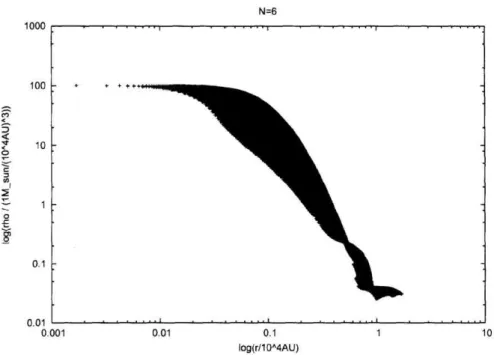
(2) the course of calculation.. 1 M® mass of spheroid. The number N can't be so small. Where the interval of grids changes to half, the numerical error of. in x-y direction and 2500 AU in z-direction. The abscissa is the logarithm of the distance from the center. calculation is induced by the change. If we demand that the error must be smaller than 3%, N> 5 is re-. log /x2 + y2+ z2 andtheordinateis the logarithm. quired. contact. the density is same for various distance r. We can read from this figure that the effect of improvement. Moreover, in order to resolve the shock or the discontinuity in each level, not so small N is. required. In figure 1, we show the initial stage of collapse. M. O C3 y. 0 L 0) O. O. U) N. O L OI O. of density. with axis length of 5000 AU. log p. As the morphology. is not spherical,. from N = 4 to N = 5 is large, but the improvement of. from N = 5 to N = 6 seems to be saturated..
(3) log(r/10^4AU) Figure. 3. Solving. Poisson. 1: Comparison. of the density distribution. for various. N. equation. The gravitygi is given by the Poisson equation:. point at each level is different point. We, therefore, calculate the potential value at finer grids from the a20 = 47-Gp, a one at coarser grid by the bi-linear interpolation forxiaxi mula and make the prolongation formula. From the adjoint condition, we make the restriction formula. 9i— =~(1) axi In the numerical calculation, the boundary condition for the Poisson equation must be imposed at where G is the gravitationalconstantand p is the den- finite distance. In initial, we put a uniform density sity. We can solve this equation by the multi-grid ellipsoid with axis length a1, a2, a3. In this case, the method (Hachbasch, 1985). The multi-gridmethod external potential is given by. is a hybrid iterativemethod. Using restrictionof potential cbto coarser grid systems and prolongation to finer grid system, long wavelength fluctuations are converged to zero, and using the Gauss-Seidel method, short wavelengthfluctuationsare converged to zero. We start to find the potential (/) level 0 by applying the multi-grid methods to the (2N)3 grids system. The density of level i is given by prolongating the density at level i + 1. After finding the solution in the level 0, we fix the boundary value of the potential for level 1, and proceed to the calculation in level 1. We continue this process to level N (Kiguchi, 2000). By the prolongation procedure of the density, the potential is found in each level up to the required accuracy, and we can neglect the effect of the finer level potential to the coarser level potential. The representation point of a cell is there at the center of the cell. This means that the representation. This potential as. is expressed. using the elliptic. integral.
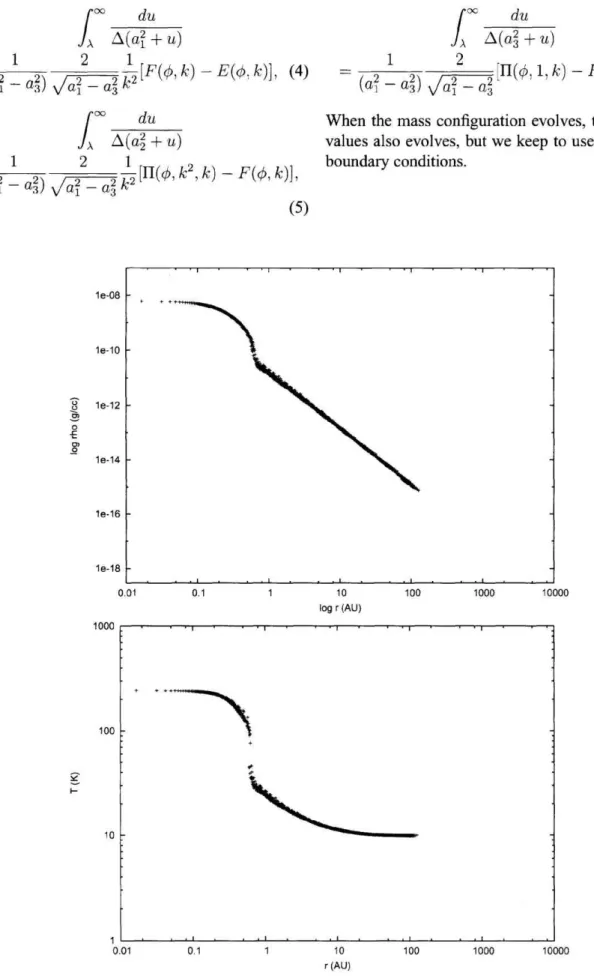
(4) When the mass values. also evolves,. boundary. Figure. 2 : The density. and temperature. distribution. configuration. evolves,. the boundary. but we keep to use this original. conditions.. for spherical. collapse. calculated. by 3-d code.
(5) 4. Hydro-dynamics. The basic equation momentum written as. where. of our problem. and the energy. state variables. is the mass, the whic h is. conservation,. the state Uoand proximate point,. the right cell has the state U1, the ap-. solution. is given as follows:. At left sonic. U are given by. At right sonic point,. for 1 < i < 3 in terms of the density p, the velocity and the internal. v. energy e, and the flux F is given by. At intersection. point,. for 1 < j < 3 in terms of the stress tensor, and the source term S is given by. where. where A is the volume heating rate. In inviscid case, which is our target, Cauchy stress tensor is cik = —p8iiand the thermal conduction flux is qi = 0 . In numerical simulation, we assume that the state valuables have a constant value in a grid cells with the representation point at the cell, and calculate the flux at the cell boundary. Using this approximate solution, the flux at the The accuracy of the time evolution and the width interface surface between these two cells is given by of a spatial cell are closely connected in the difference method for partial differential equations. When the width of a cell has the difference of factor two in neighboring cells, this difference easily leads to numerical instabilities such as spurious run-away to vanishing density in a cell. We tried various method (Toro, 1999) and found that Osher scheme is stable and simple, which is adequate for the nested grid sys- where tem. Osher scheme uses an approximate Riemann sovu lution which assumes there are three waves of contact discontinuity traveling with the velocity v, v c, In extreme case, there are possibilities that cso or csi where c is the sound velocity. When the left cell has becomes negative and Osher scheme fails. In this.
(6) case, all waves enter in the same cell, so that we can use complete upstream difference method. After updating the state using the flux term, we integrate the source term considering the equation as an ordinary differential equation which initial value is the updated. state. This method. corresponds. to the. variation of parameter method in inhomogeneous linear differential equations, i.e., this method is an approximate one in the case of non-linear it is strict in the linear case. In order to make the accuracy. equations,. of calculation. transfer in spherical case. We import the p-p relation from the spherical study and use the basic equation (7) inversely to determine the heating rate A. This p-p relation is as follows (Narita, 2002): At p < Pi = 10-15 g/ cm-3, the gas is in isothermal state,. p=mPHT=10K.Atp > p2= 10-1° gcm-3,the gas is in adiabatic is given. state, At pi < p < p2, the relation. but better. at the surface where neighboring cell width changes, one may think that fine cell should be embedded in the coarse cell and find the state in the fine cell by interpolation, but this method leads the calculation to an instability. The heating radiative problem.. transfer. rate A must be determined calculation,. Fortunately,. from the. but this is a difficult. we have the result of radiative. Using this relation, we can show that the first core with radius of about 1 AU is formed for the spherical collapse. of 1 M® using our three-dimensional. code. as shown in Figure 2.. References [1] Hackbasch,W., 1985,"MultigridMethodsand Applications",Springer-Verlag. [2] Kiguchi,M., 2000, Scienceand Technology,No. 12, 43. [3] Masunaga,H., Inutsuka, S., 2000, Ap. J., vol. 531, 350. [4] Toro,E. F., 1999,"Riemann Solversand NumericalMethodsfor Fluid Dynamics", Springer-Verlag. [5] Narita, S., 2002., Japan AstronomicalSocietyAutumn Assembly,p30..
(7)
図
関連したドキュメント
We study existence of solutions with singular limits for a two-dimensional semilinear elliptic problem with exponential dominated nonlinearity and a quadratic convection non
2 Combining the lemma 5.4 with the main theorem of [SW1], we immediately obtain the following corollary.. Corollary 5.5 Let l > 3 be
In Section 3, we show that the clique- width is unbounded in any superfactorial class of graphs, and in Section 4, we prove that the clique-width is bounded in any hereditary
Keywords: continuous time random walk, Brownian motion, collision time, skew Young tableaux, tandem queue.. AMS 2000 Subject Classification: Primary:
Kilbas; Conditions of the existence of a classical solution of a Cauchy type problem for the diffusion equation with the Riemann-Liouville partial derivative, Differential Equations,
Then it follows immediately from a suitable version of “Hensel’s Lemma” [cf., e.g., the argument of [4], Lemma 2.1] that S may be obtained, as the notation suggests, as the m A
Our method of proof can also be used to recover the rational homotopy of L K(2) S 0 as well as the chromatic splitting conjecture at primes p > 3 [16]; we only need to use the
Classical Sturm oscillation theory states that the number of oscillations of the fundamental solutions of a regular Sturm-Liouville equation at energy E and over a (possibly
