Love and hate : is militarization perceived as
sustainable development for Chittagong Hill
Tracts (CHT)? : a case study on CHT,
Bangladesh
著者
Md. Reazul Haque
権利
Copyrights 日本貿易振興機構(ジェトロ)アジア
経済研究所 / Institute of Developing
Economies, Japan External Trade Organization
(IDE-JETRO) http://www.ide.go.jp
journal or
publication title
IDE Discussion Paper
volume
717
year
2018-05
i
INSTITUTE OF DEVELOPING ECONOMIES
IDE Discussion Papers are preliminary materials circulated to stimulate discussions and critical comments
Abstract:
Background: The existence of Bangladesh Army in Chittagong Hill Tracts (CHT) has often been associated and presented as the panacea and mantra of development for CHT Pahari population1 . The ongoing debate whether the Paharis population of CHT perceives the existence of army as the mantra of development or threat to their existence continues to exist. There have not been many ethnographical studies that empirically examine the perception of the Paharis about this relationship and the changing mode of the dialogues over the decades.
Method: With case studies, observations and focus group discussions I undertook a qualitative study on community perceptions of the Paharis, Bengali settlers, and
1 Lewin in his famous ‘wild race’ (2004[1870]) invented new terminology to designate and identify the CHT people, which is the category used even today. He collectively termed the CHT people as ‘hill-men’ (Pahari in Bengali), which is still used to identify CHT people both by themselves and by the majority Bengalis” (Lewin in Uddin 2010: 286). Throughout the research, I will also use the term Pahari to identify these ethnic communities in CHT.
IDE DISCUSSION PAPER No. 717
Love and Hate
Is Militarization Perceived as Sustainable
Development for Chittagong Hill Tracts
(CHT)?: A Case Study on CHT, Bangladesh
Md. Reazul Haque *
May 2018
ii representatives from Bangladesh Army in CHT districts. I conducted interviews of randomly selected Pahari respondents (n=7), Bengali settlers (n=10), Army representatives (n=4) and Academic, Security Expert and Local political leader (n=3) representing the overall catchment area of CHT. I then carried out direct content analysis to identify themes and triangulate findings across methods and informant groups.
Result: Key themes emerged across from the interviews surrounding: (1) militarization and powerlessness and unheard of Pahari people; (2) lack of collective awareness and consciousness among the Pahari people about their rights; (3) militarization as a strategic requirement for giving security to Bengali settlers; (4) development perceived as ‘impossible and less plausible reality’ for the Pahari people. These themes recurred throughout many participants’ narratives and cases and influenced their perception of militarization and development.
Conclusion: As the perceptions of the Pahari people in CHT, which often results in lack of trust between the Bengali settlers and Pahari people, continues to exist, it will be critical to find convincing, effective and sustainable ways of addressing the ongoing perceptions of the Pahari people.
Key words: Army, Bengalis, Paharis, Sustainable Development, Militarization, Peace Accord, CHT.
* Professor, Department of Development Studies, University of Dhaka, (Bangladesh)
PhD in Women’s Studies, Flinders University (Australia),MA in Development Studies, ISS (the Netherlands), MSS & MPhil in Public Administration, University of Dhaka (Bangladesh) Email: [email protected] / [email protected]
This version is completed during his visit to Institute of Developing Economies (IDE-JETRO) as a Visiting Research Fellow in October 2017- March 2018.
iii The Institute of Developing Economies (IDE) is a semigovernmental, nonpartisan, nonprofit research institute, founded in 1958. The Institute merged with the Japan External Trade Organization (JETRO) on July 1, 1998. The Institute conducts basic and comprehensive studies on economic and related affairs in all developing countries and regions, including Asia, the Middle East, Africa, Latin America, Oceania, and Eastern Europe.
The views expressed in this publication are those of the author(s). Publication does not imply endorsement by the Institute of Developing Economies of any of the views expressed within.
INSTITUTE OF DEVELOPING ECONOMIES (IDE), JETRO 3-2-2, WAKABA,MIHAMA-KU,CHIBA-SHI
CHIBA 261-8545, JAPAN
©2018 by Institute of Developing Economies, JETRO
No part of this publication may be reproduced without the prior permission of the IDE-JETRO.
iv
Dedicated
to
My Sisters Hamida Banu, Thamina Begum & Zohora Begum
&
v
Note of Thanks
The research on Love and Hate – “Is Militarization Perceived as Sustainable Development for Chittagong Hill Tracts (CHT)?: A Case Study on CHT, Bangladesh” was a dream project for me. To make this dream a reality, first of all, I want to acknowledge the monetary support provided by the IDE-JETRO without which the dream would have remained a merely a dream. It is a matter of privilege for me to acknowledge my intense gratitude and indebtedness to my counterpart Dr. Kenmei Tsubota, an honourable research fellow at Institute of Developing Economies, Japan External Trade Organization. I express my warm thanks to him for his cordial contribution in developing the research and make it more informative. His amiable and precious inputs have not only enhanced the quality of this research paper but also opened innovative windows for me for self-assured thinking on this issue. I am particularly grateful for this infinite patience in guidance and giving valuable suggestions to make the research thoughtful. Amidst many responsibilities he always found time to share his knowledge. I am also thankful to Dr. Mayumi Murayama, Director-General, Research Promotion Department of IDE for her endless support. I want to give especial thanks to Dr. Zhe Ren, Dr. Housam Darwishe, Yumiko Ishikawa, Atsuko Hirakata and Dr. Yamagata of International Exchange and Training Department, IDE Advanced School (IDEAS). I want to express my heartfelt gratitude to all of the respondents (Bengalis, Paharis, Army, Human Right Activists, Academic and Security Experts) because without their voluntary participation it would have been impossible to complete this research. Their enthusiastic involvements made this entire study an unforgettable experience for me.
I am thankful to Dr. Amrita Chhachhi, Dr. Dubravka Žarkov and Dr. Thanh Dam Truong of ISS, The Netherlands, Dr. Noore Alam Siddiquee, Dr. Barbara Baird, Dr. Yvonne Corcoran-Nantes, Dr. Heather Brook of the discipline of Women’s Studies of Flinders University, Professor Delem Ch Barman, Professor Sadeka Halim, Professor Gobinda Chakraborty and Professor Nayeem Sultana of Dhaka University for their cordial help. I am thankful to Professor Mizanuddin and Professor Anik Mahmud of Rajshahi University for their inspiration. I want to remember the valuable words of my idol late Professor M. Azaduzzaman (Former Chairman of University Grants Commission of Bangladesh) who is my source of inspiration in every sphere of life.
Although it is not possible to mention all my friends and well-wishers who assisted me at various stages of this research, I want to remember few of them like Kamrul Hasan, Abdul Hamid, Md. Nasim Uddin, Tanmoy Mazumder, AHM Nahid, Md. Niamot Ali, Abdullah Shahnewaz, Kaniz Fatima Lily, Mohammad Shaheenur Alam, Md. Koushik Ahmed, Shahtab Mahmud, Prabir Kumar Sarkar, Ashfaq Ahmed Jack, A. N. M. Mazharul Islam, Usahang Mong Marma Hero and especially to Barrister Jyotirmoy Barua, without him, it would be impossible to come and finish this research. His constant support, encouragement made it possible to submit this research. I will remain grateful to him for rest of my life.
No word can adequately express my debt of gratitude to my mother late Mafuza Begum, and my beloved sisters Hamida Banu, Thamina Begum, and Zohora Begum for generating in me a
vi perennial interest in higher education. Without my sisters, I would not be able to come to this stage and thanks will be so little and too formal in this regards. I am also thankful to my brothers Habib, Amin, Iman and my elder brother Nurul Haque. I could not give enough time to the sweetest young members of my family Rideta, Nodi, Barisha, Sami, Sajid, Ifti, and Omi because of this research.
Above all, I would like to acknowledge Almighty Allah who enabled me to successfully complete and submit this research paper.
vii
Content
Abstract
Note of Thanks Abbreviation
Chapter One: Introduction: Focusing On the Unfocussed 1-11 1.1 Background and Problem Statement
1.2.Justification 1.3. Objectives
1.4. Research Question 1.5. Research Process 1.6. Layout of the Research 1.7. Limitations of the Research
Chapter Two: Underpinning the Concepts & Contexts from Previous Studies 12-24 2.1. Introduction
2.2. Section A: Concepts
2.3. Section B: Review of Literature 2.4. Section C: Theoretical Framework 2.5. Conclusion
Chapter Three: Unveiling Reality: Different Voices, Different Perceptions 25-48 3.1. Introduction
Section A: Perceptions of the Bengalis Section B: Perceptions of the Paharis Section C: Perceptions of the Army Section D: Perceptions of Others 3.5. Conclusion
Chapter Four: Drawing the Curtains: Concluding Remarks 49-54 4.1. Introduction
viii 4.3. Recommendations
4.4. Conclusion
Appendix 55-77
ix
Abbreviation
ALRD Association for Land Reform and Development BAL Bangladesh Awami League
BGB Boarder Guard Bangladesh BNP Bangladesh Nationalist Party
BNSB Bangladesh National Society for Blind
CARE Cooperative for Assistance and Relief Everywhere
CI Congress of India
CHT Chittagong Hill Tract
CHTDB Chittagong Hill Track Development Board
DB Detective Branch
DC District Commissioner
EU European Union
GoB Government of Bangladesh
HQ Head Quarter
HT Hill Tract
HWF Hill Women’s Federation MNDP Mro National Defense Party NGO Non-Governmental Organization NSI National Security Intelligence
PCJSS Parbatya Chattagram Jana Samhati Samiti
SB Shanti Bahini
SB Special Branch
SD Sustainable Development SDGs Sustainable Development Goals
SSA Sammo Adikhar Andolon
UK United Kingdom
ULFA United Liberation Front of Assam
x UNESCO The United Nations Educational, Scientific and Cultural Organization UPDF United People's Democratic Front
1
Chapter One
Introduction: Focusing On the Unfocussed
_____________________________________________________________________________ Chittagong Hill Tracts (CHT) is a very complex issue and as long as Bangladesh lives, this problem will
not be solved. 1
1.1.Background and Problem Statement
In Bangladesh, Chittagong Hill Tracts (CHT) denotes diverse ethnic communities with fractured and suspicious relationships among the Bengalis, civil and military administration. It is significant to mention that CHT borders two neighboring countries of Bangladesh –India and Myanmar and houses eleven ethnic communities2 who are collectively known as Paharis3. Of all the ethnic communities, the Chakma, Marma, Tripura, Tanchangya and Mru are numerically dominant whereas the Bawm, Khumi, Chak, Kheyang, Lusai and Pangkhowa are smaller groups4(Uddin 2010). Researches on Paharis (Ahamed 2003; Ahsan 1995; Bernot 1964; Bessaignet 1958; Brauns and Loffler 1990; Chakma 1986; Dewan 1990; Grierson 1927; Levi-Strauss 1951, 1952; Lewin 1869, 2004[1870]; Schendel 1992; Uddin 2008b) refers that in terms of socio-cultural, political and economic background, the Paharis are different from the mainstream Bengalis. Physical appearance of the Paharis are different from the Bengalis but closely similar to the Southeast Asian people (Babul 2016). In a similar vein, their language, beliefs and rituals are also different from the Bengalis and mostly analogous to the people living in hills at Seven Sisters in India and Upper Myanmar (Uddin 2010). It is evident from different historical works (Hughes 1881; Hutchinson 1909; Lewin 2004[1870]; Phayre 1841; Schendel 1992, Qanungo 1988; Serajuddin 1971, 1984) that the Paharis were the primordial migrants to CHT from Arakan in Myanmar and Tripura in India (Ibid). Based on this socio-cultural and geo-political situation, the above informations unveil the hidden reality necessary to understand the CHT crisis as a whole. Despite the problems, it is also evident that Government of Bangladesh (GoB) considers the Paharis as citizens, part of the culture, and also promotes tourism in CHT (Nasrin 2017).
1Brigadier General (Retd) who joined the then Pakistan army in 1960 and later joined the army of independent
Bangladesh and was engaged in the service of the country till 1993.
2Panday and Jamil in their paper mentioned 13 ethnic communities and these 13 different Pahari communities include
the Chakma, Marma, Pankho, Khumi, Lusai, Murong, Bonojog, Tanchanya, Khyang, Chak, Tripura, Mro, and Ryang (Panday and Jamil 2009).
3 “Lewin in his famous ‘wild race’ (2004[1870]) invented new terminology to designate and identify the CHT people,
which is the category used even today. He collectively termed the CHT people as ‘hill-men’ (Pahari in Bengali), which is still used to identify CHT people both by themselves and by the majority Bengalis” (Lewin in Uddin 2010: 286). Throughout the research, I will also use the term Pahari to identify these ethnic communities in CHT.
4 The Pahari people in Bangladesh constitute about 1.13% of the total population (Yasmin 2014: 121). For details
2 Photo: Pahari Peoples of Bangladesh in Stamps5
In 1776, it was the British who started a military campaign in the Hill Tract (HT). They divided HT from Chittagong as a separate district called the Chittagong Hill Tracts (CHT) and appointed a superintendent. It was 1900 when CHT manual was passed and so CHT was officially considered as an ‘excluded area’ to protect culture and traditions of the Paharis (Ibid). The Government of India Act was passed in 1935 and according to the act, CHT was regarded as a “totally excluded area outside the provinces of Bengal and Assam” (Karim 1998: 306, Ahmed 2014). In1947, the Indian subcontinent was divided into two countries named India and Pakistan. There is evidence that Indian flag was hoisted in different places of Rangamati and Burmese (presently known as Myanmar) flag was raised in Bandarban even after two to three day to the partition (Barua 2001, Mey 1984, Ahmed 2014). Due to the dual loyalties evident in them, the then Pakistan government considered them as anti-Pakistan groups. It was well known that the emergence of India and Pakistan as separate countries was based on religious identity. The CHT Pahari communities by religion are non-Muslims and thus the Chakma elites and other Pahari leaders wanted the CHT to be a part of India (Uddin 2010).6
5https://www.google.co.jp/search?q=indigenous+in+Bangladesh+stamps&rlz=1C1CHBD_enBD765BD765&tbm=is
ch&source=iu&ictx=1&fir=S63_W0K7dgSBSM%253A%252CcSMPo6KoUOiNwM%252C_&usg=__kRAkhx-
btmojHu-gWjIlWxpZhpQ%3D&sa=X&ved=0ahUKEwiO94OJgJnZAhUEhrwKHb6rACoQ9QEIMDAB#imgrc=cE_l4iMAT q75AM (Last viewed on 10th February 2018).
6 Shelley opines thus: “Therefore in 1946, the tribal chiefs formed ‘The Hill Men Association’ and proposed a princely
state status for CHT as per with neighboring Tripura, Koochbihar and Khasia; and with which they also proposed a confederation to be under the administrative control of central government of India. But this move failed and by 16 August, CHT became the part of Pakistan…Sneha Kumar Chakma…had hoisted the Indian flag at Rangamati on August 14. At the same time, the Marma, who claimed descent from the same stock of people as those inhabiting Burma had hoisted the Burmese flag at Bandarban” (Shelley 1992: 29).
3 In 1956, the first Constitution of Pakistan had classified CHT as an ‘Exclusive area’ (Yasmin 2014) and then CHT lost its special status and autonomy under the amendment of the Pakistan Constitution in 1963. Significantly, this amendment removed immigration barriers and gave the Bengalis access to large scale migration7 to CHT region (Panday and Jamil 2009). In addition to that, the Paharis became irate when Pakistan Government built the ‘Kaptai Hydro-Electric Dam’ in 1962. The amplitude of the project area was 218 KM which was 40% of the cultivable land in CHT. This project also created 100,000 development refugees who were mostly the Chakma. That is why the Paharis addressed this dam as a ‘death trap’ and ‘development disaster’(ibid). In a similar way, another development project in CHT, the Chandraghona Paper Mill evicted the Marma villages and again produced dissatisfaction and anger (Choudhury, Islam & Durrat in Chowdhury ed. 2017).
In 1971, when Bangladesh was struggling and fighting for independence from West Pakistan, a number of Chakma and Marma chiefs “advertised their hostility by allowing themselves to be recruited as rajakars- irregulars-on the side of Pakistani military” (Levene 1999: 349; Karim 1998). The Chakma leaders, just after independence, demanded autonomy for CHT and was again granted status of ‘excluded area’ in the new Constitution of Bangladesh (Karim 1998)8. It was on the 23rd
January 1974 when the Parliament passed a bill and declared “Bangladesh as a uni-culture and uni-linguistic nation state” (Ibid: 307)9. In 15th August 1975, father of the nation, Sheikh Mujibur Rahman was brutally killed and soon after that, the army took over the power in Bangladesh. It should be noted that the relation between India and Bangladesh deteriorated post-1975. During the tense, heated situation, the aggrieved the Pahari people, within and outside the country, decided to form Shanti Bahini (SB), the armed wing of Parbatya Chattagram Jana Shanhati Shamiti (PCJSS) to achieve autonomy and ensure the rights of the Pahari people over the region. In 1977, the SB launched an insurgency against Bangladesh (Adnan 2007:2) and significantly, some women joined SB too. The Pahari women not only faced problem due to displacement but also incidences of rape and harassment were not uncommon by security forces. Additionally, it has also created more female headed household as male members had to leave due to military insurgency (Nasrin 2017).
The then army ruler, President Ziaur Rahman followed hegemonic approach and imposed ban on PCJSS and deployed army10 in the conflicted region under counter insurgency program named ‘Operation Dabanol’(Adnan 2008:33). Bangladesh claimed that Indian agents are providing training and arms to fighters of SB in the Indian States of Mizoram and Assam (Adnan 2008: 33; Mohshin 2002: 67; Levene 1999: 350)11. Indian Government denied the accusation and
7 In 1947, Bengalis were 2% of the total population of CHT whereas it became 49% in 2003 (Panday and Jamil 2009). 8 At the time of drafting of the Constitution of Bangladesh, former member of Parliament Manabendra N Larma from
CHT opined “I am a Chakma. A Marma can never be a Chakma, a Chakma can never be a Bengali. I am a citizen of Bangladesh-Bangladeshi. You are also Bangladeshi but your national identity is Bengali ... they (tribals) can never be Bengalis” (Karim 1998: 307; Ahmed 2014).
9 In 2011 the National Parliament enacted the 15th Amendment to the Constitution of Bangladesh denying recognition
of indigenous people as full citizens of this country. Article 6(2) of our Constitution states, "The people of Bangladesh shall be known as Bengalese as a nation and the citizens of Bangladesh shall be known as Bangladeshis “(The Daily Observer, 10th August 2017).
10GoB deployed about 115,000 military personnel in CHT (Chakma 2010 in Ahmed 2014). 11Headquarter of SB was in Tripura State of India (Yasmin 2014:123).
4 counterclaimed that Bangladeshi army was providing training and sanctuary to Assamese and Mizo separatists12.
In 1979, the army government began a project of ‘demographic engineering’ in the CHT and about 100,000 Bengalis from plain land were transferred to the CHT in the formal phase of the project (Chittagong Hill Tracts Commission 1994). GoB presented these migrants with not only cultivable plots and rations but also Khas13 Lands in army protected cluster villages and in the process,
forcefully ousted the Paharis. As a reaction, PCJSS adopted the policy of terrorizing the new migrants and as a result, settlers were put into cluster villages near army camps (Choudhury, Islam & Durrat in Chowdhury ed. 2017). In addition, the GoB had undertaken different economic projects as a part of the counter insurgency program. The army took over the civil administration of CHT and handled most of the development fund that came through CHT Development Board (CHTDB). It supervised civilian activities, infrastructure building and employment generation (Adnan and Dastidar 2011: 77). Thus, three decades of insurgency and counter insurgency adversely affected day-to-day lives and livelihoods of people living in the region. This gave birth to the ‘love and hate’ relationship as the outcome of an almost fractured relationship.
In CHT, there was a continued war between the Bangladeshi military and Paharis for more than 25 years. In 1996, Shiekh Hasina, daughter of the father of the nation, took over the power in Bangladesh. Historically, the two political parties of the adjacent countries, Bangladesh Awami League (BAL) and Congress of India (CI), have good understanding. This factor did produce positive outcomes (Author’s interview, January 2018). For example, when the number of army camps and security forces were increased in CHT by the GoB, India withdrew its support, persuaded the fighters of SB to reach an understanding with the GoB, and thus the signing of the CHT Peace Accord happened in 1997. The then prime minister, Sheikh Hasina Government signed the agreement with the introduction of infinite courage and prudence. By signing the treaty, the leader of Paharis, Jatirindra Bodhipriya Larma (Santu Larma) declared the full allegiance to Bangladesh which was a responsible and wise act. Thousands of rebels gave up their arms in a grand ceremony on 2nd December 199714. But the role of Pahari women during insurgency were
neither nationally rewarded nor received any formal recognition from their own communities (Halim 2003:5 in Nasrin 2017)15. An important fact worth mentioning is that not all the Pahari groups have accepted this treaty. Some remained unhappy and considered the accord as a ‘defeat’ (Ahmed 2014).
12 E.g. ULFA - United Liberation Front of Assam 13 Land owned by GoB
14 “Among other things, the Accord called for dismantling of all temporary military camps, transferring administrative
power to local institutions and the settling of land disputes. The overall purpose of the Accord was to recognize the CHT as a Tribal inhabited region and so maintain a certain level to regional autonomy, different from the governance system operating the rest of the country” (Ahmed 2014: 7). For details see Appendix 1
15 Hill Women’s Federation (HWF) is a representative organization of the Pahari women in the CHT. It was founded
on 8 March 1988 by some female Pahari students of Chittagong University. http://updfcht.com/?page_id=40 (Last viewed on 10th 2018).
5 Photo: Shanto Larma is handing over their arms to PM Shiekh Hasina on 2nd
December 199716
The armed war ended with the agreement between the Jana Sanghati Samity (JSS) and the GoB on the 2nd December 1997. Present Government celebrated 20 years of Peace Accord in 2017 and claims that they have successfully completed all the tasks mentioned in the treaty. In contrast, the Pahari leaders blame the GoB of treachery and express their dissatisfaction not yet satisfied. Recently, in a press briefing, JSS president Santu Larma claimed that they are dashed against the wall. He threatened the GoB of greater movement unless the Peace Accord is fully implemented stressing the greater movement to be the only way left for them. The government is responsible for the ‘untimely situation’ created in CHT.
In order to bring peace to the hilly region, on the 2nd December 1997, the GoB signed the agreement
with the Pahari representatives led by Santu Larma and JSS. 48 of the 72 provisions of the treaty have been implemented, the rest are still unimplemented, according to the claim made by JSS president Santu Larma. His claim, "Twenty years, the two-thirds of the basic issues of the contract have not been implemented", has been rejected by the government. In the press conference, he complained that the GoB did not take any effective initiative to implement the basic provisions of the agreement such as the settlement of the land dispute, the return of Paharis land, rehabilitation, full-fledged regional council, the formation of the elected Hill District Council etc. The regional council has been void. Responding to a question, Santu Larma grumbled, "The intelligence agencies, law-enforcers and armed forces personnel engaged in the Hill Tracts are playing the biased role in favor of the ruling party and also taking anti-indigenous roles." The conditions for the withdrawal of all military installations except six permanent cantonments in the hill area were conditional. According to the estimates of a private organization, only 105 of the 500 temporary army camps have been withdrawn. Santu Larma said, "There are still four hundred camps in the
16 http://www.weeklyholiday.net/Homepage/Pages/UserHome.aspx?ID=2&date=12/02/2011 (Last viewed on 4th
6 mountainous region”. The undeclared army activities are going on in three districts of CHT. There are ongoing military operations, detention, and repression of Pahari people in the name of inspection. They are interfering in the constitutional rights of their freedom of speech and gathering. Under the agreement, there are conditions to transfer 33 activities from the government to the CHT Regional Council and three Zilla Parishads. According to the CHT Citizen Committee, till now the power of 5 to 12 activities has been partially handed over to the local government. Santu Larma also made the same complaint. He said, 'important activities were not handed over. The administration of three hill districts, law and order, police, land and land management, forest and environment, tourism, secondary education was not yet assigned to the Hill District Council. CHT Regional Council law has not been implemented’. ‘Due to the implementation delay of the contract, the demography in the region is changing for the last 20 years’, JSS chief claimed. Santu Larma also complained that the Paharis are becoming the minority in their land. The plot is going to turn Chittagong into a Muslim majority area. On the basis of this situation, Santu Larma announced the continuation of the non-cooperation movement at a press conference to prevent the Paharis "anti-interest activities" (The Daily Somokal, 30th November 2017).
In these circumstances, this research aims to deal with the presence of Bangladesh army in CHT which has often been associated and presented as the mantra of development for CHT Paharis as well as Bengali population. The debate whether the Bengali and Pahari population of CHT perceives the army presence as the mantra of development or threat to their existence continues to exist. There have not been many studies that empirically examine the perception of the Pahari population about this relationship. For the first time, this research has incorporated voices of Bangladesh army officials regarding their activities and reasons of being in CHT for the wellbeing of both the Paharis and Bengalis and overall, for sustainable peace, security and Sustainable Development (SD) of the region.
1.2.Justification
Ruling Bangladesh Awami League (BAL) Government wants to achieve their “VISION 2041” and the dream of ‘Digital Bangladesh’ through Sustainable Development (SD). Uncertainty, mistrust, the fractured and ambiguous perception among different stakeholders in CHT are the blocks which may hinder the achievement of the Sustainable Development Goals (SDGs)17. Like the rest of the nations worldwide, Bangladesh is also working out to adopt SDG focused policies and integrate SDG goals into actions, plans etc. We are enacting SDG oriented laws, policies, projects so on (Abdin, 2017). In a similar vein, Gender is also a significant part of SD and SDGs. Due to three decades of unrest, girls and women are the most vulnerable and disadvantaged in the area. The contributions by these hard-working Pahari women and girls are rarely acknowledged. Moreover, they face gender disparity, inequality and deprivation of human rights, food insecurity and malnutrition, violence against them (Babul 2016). This issue of gender construction and gender relation has rarely been focused on academic work too. If we know the exact problems and
17 Goal 1: No poverty; Goal 3: Good Health and Well-being; Goal 4: Quality Education; Goal 5: Gender Equality;
Goal 6: Clean Water and Sanitation; Goal 9: Industry Innovation and Infrastructure; Goal 10: Reduced Inequality; Goal 11: Sustainable Cities and Communities; Goal 15: Life on Land; Goal16: Peace Justice and Strong Institution
7 solutions to those, the path towards SD for Bangladesh will become smoother. Thus Bangladesh could start its journey towards the achievement of SDGs by 2030 and ensure its optimum result (Abdin, 2017). Additionally, it will also assist stopping the communal unrest in the region. The significance of this study is colossal in the sphere of reducing conflict and rapid SD of the CHT which is one of the most important parts of Bangladesh. Thus this study will contribute in the field of behavioral psychology, peace, conflict and security studies, area studies, gender and development studies.
1.3.Objective
1. To identify the perceptions of both the Paharis and Bengalis regarding militarization at CHT region after 20 years of the peace treaty;
2. To identify the causal relation between the presence of army, modernization and sustainable development of CHT;
3. To identify the perceptions towards the role of formal local administration in ensuring security as well as mediating and solving disputes in CHT;
4. To identify the gender dimension due to insurgency and presence of the army in CHT.
1.4. Research Question 1.4.1. Main Question
Is the presence of army perceived as a step towards SD for CHT region? What is the role of Bangladesh army at CHT region? How the presence of army is being perceived by both Paharis and Bengalis fe/male at CHT?
1.4.2. Sub-Question
i. Is there any gender dimension regarding the presence of the army in CHT? ii. Have Paharis’ organizations (JSS and UPDF) influence over the creation of
prescribed perception?
iii. Is the power play between two rival parties (JSS and UPDF) suppressing the human rights of common Paharis as well as Bengalis?
1.5.Research Process
This research is mainly qualitative in nature. The qualitative approach is chosen for this study based on the justification that the language and expression of the respondents are necessary for gaining insight into their experiences and emotions while generating rich data (Newton, 2010: 2). Methodologically, a qualitative approach is used because the goal of the research is best achieved through qualitative research tools. In addition, qualitative data collection allows gathering
8 profound insights through detailed personal un-structured face to face in-depth interviews which is not possible in the other way around. This research used ‘standardized’ open-ended questionnaire as primary technique for data collection that involved very structured wording of the interview questions while allowing the responses to be open-ended (Turner, III, 2010: 756). The advantage of using standardized open ended interviews is that respondents are allowed to express their experiences and viewpoints as much detail as they want to while it is also likely to have difficulty in coding the collected data (Cresswell, 2007). Both Primary and Secondary data were collected. Details are described below:
1.5.1. Research Area
This research covers three districts of CHT- Khagrachari, Rangamati, and Bandarban in Bangladesh. Three districts cover about 13,184 sq km which is approximately one-tenth of the total area of Bangladesh and 10 percent population of the country18.
Fig: Location of Bangladesh and CHT19
1.5.2. Primary Data
18http://en.banglapedia.org/index.php?title=Chittagong_Hill_Tracts (Last viewed on 6th January 2018)
19 https://www.google.co.jp/search?q=location+of+Bangladesh+chittagong+hill+tracts+map&rlz=1C1CHBD_enBD
765BD765&tbm=isch&tbo=u&source=univ&sa=X&ved=0ahUKEwj8t436-()ZrZAhULlZQKHV1hCHsQsAQINw&biw=1396&bih=690#imgrc=SbphQiEQL8snIM: (Last viewed on 10th
9 For selection of respondents, purposive sampling techniques were followed to ensure the availability of respondents. Purposive techniques involve identifying and selecting individuals or groups of individuals that are especially knowledgeable about or experienced with the phenomenon of interest (Casewell & Clark in Palinkas et al, 2013). The main goal of purposive sampling is to focus on particular characteristics of a population that are of interest which will best enable researcher to answer the research questions20. Among the various purposive sampling
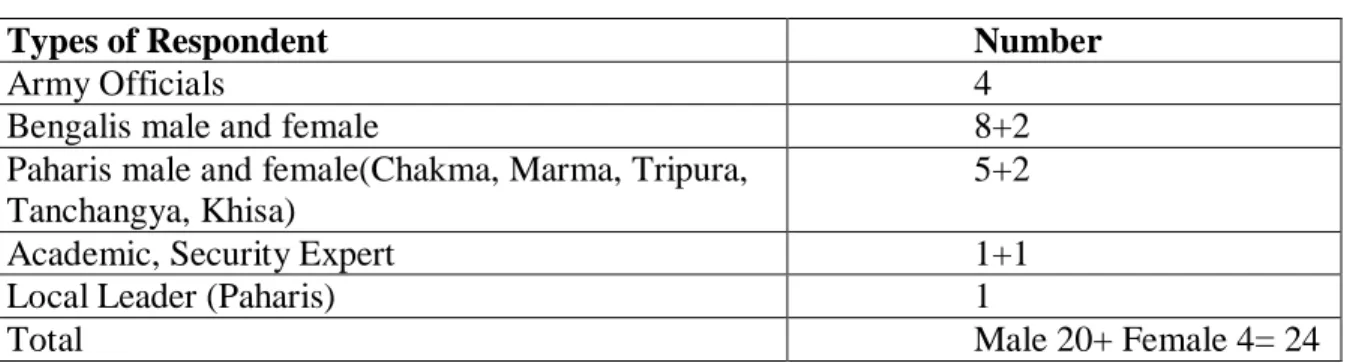
techniques, snowball sampling21 and homogeneous sampling22 are the most emphasized in this study. The following table shows the categories:
Table 1: Sample Frame
Types of Respondent Number
Army Officials 4
Bengalis male and female 8+2
Paharis male and female(Chakma, Marma, Tripura, Tanchangya, Khisa)
5+2
Academic, Security Expert 1+1
Local Leader (Paharis) 1
Total Male 20+ Female 4= 24
1.5.3. Secondary Data
Relevant Articles, Books, Documentary, Internet, Journals, and publications from the concerned organizations helped me to collect information for my research.
1.5.4. Research Process and Ethics
During field work, I did not use any tape recorder rather I used close verbatim method. From my previous experiences as a researcher, I knew that using tape-recorder makes the respondents uncomfortable and suspicious. I strongly maintained the issue of ‘ethics’ during field work. I took permission from the respondents before interviews from them. Before starting the interview with respondents, I disclosed the purpose to them. I ensured them that their information would be used anonymously only for academic research. While conducting an interview, respondents had full right not to answer any question or to withdraw her/him if s/he wanted during the interview process. I did not ask any sensitive or personal questions irrelevant to my research paper. I maintained a field note book where I wrote relevant information during field work. All the respondents are kept anonymous and I used pseudonymous in this research.
20http://dissertation.laerd.com/purposive-sampling.php (Last viewed on date 3rd January 2018).
21 To identify cases of interest from sampling people who know people that generally have similar characteristics who,
in turn know people, also with similar characteristics (Palinkas et al, 2013).
22 To describe a particular subgroup in depth, to reduce variation, simplify analysis and facilitate group interviewing
10
1.5.5. Case Studies, Unstructured Interviews and Focus Group Discussion (FGD)
Case Study: Case study has been one of the most widely used qualitative research method. The case records have been used to construct each case study (Kothari, 1990). For a detailed and good understanding of reality, researchers take out several cases from research field. This helps them to focus on the subject intensively and understand the reality. When a case is taken, then the researcher could also select the data collection and analyzing techniques suitable for the case. Moreover, it is evident from literature that, "A case study enables the researcher to analyze interactions not only as the sum of their parts, but in a realistically whole manner"(Yin, 2003). In addition, case studies are conducted to evaluate individualized client outcomes. Sometimes researchers are puzzled by particular cases - unusual successes, unusual failures or dropouts. Detailed case studies of these unusual cases may generate particularly useful information (Patton, 1990). I collected detailed case studies to portray the situation from different perspectives.
Unstructured Questionnaire: Unstructured Questionnaire provides a qualitative depth by allowing interviewees to talk about the subject in terms of their own frames of reference (May, 2001). Significantly, Open-ended questions are questions that allow someone to give a free-form answer (Farrell, 2016). Similarly, the Unstructured (open ended questionnaire were used) interview was taken from respondents.
Focus Group Discussion (FGD): Mosse's (1994) article sheds light on the complexities of participation and the dynamics of space that elicit true participation. In this research, I used FGD. I was aware that certain public spaces may inhibit participatory discussion. The issue of ‘comfort’ was taken seriously during FGD because group discussions are to be held in an open and comfortable space in which people feel safe to speak freely. To me, it appeared the best to separate opinions by gender as women and men are not two homogenous groups within a community. Discussions with women were held in a space they felt comfortable.
1.5.6. Processing of Data
In order to conduct interview with the Paharis, I took help of local educated interpreters to understand the local dialect. The transcription of qualitative data was made manually. The interviews were conducted in Bengali and so the relevant information was translated into English.
Bandarban District Khagrachari District Rangamati District Bengali Male
and Female Army Officials Paharis Male
Bengali Male Army Officials Paharis Male
and Female Academic Security Expert Leader of Paharis (UPDF/PJSS) Bengali Male and Female
Army Officials Paharis Male
11
1.5.7. Validity & Reliability of Data Collection & Analysis
Validity in research is concerned with the accuracy and truthfulness of scientific findings (Le Comple and Goetz in Brink, 1993). A valid research should demonstrate what actually exists and a valid instrument or measure should actually measure what it is supposed to measure. When planning and conducting the steps of the study, sources of error were handled carefully. Reliability is concerned with the consistency, stability and repeatability of the informant’s accounts as well as the investigators’ ability to collect and record information accurately (Selltiz et al in Brink, 1993). Many of the risks in data collection pertain to the situation, respondents and social context and have already been dealt with concern.
1.5.8. Triangulation of Multiple Data Sources
Secondary information of the research has been collected through triangulation of multiple data sources (Yin 2012:12). It makes data sound and robust the data collection process. Triangulation merges the various sources of the available data collected from various sources. It is useful to keep data alive, interpret information and writing the main findings.
1.6. Layout of the Research
This research constitutes of four chapters. The first chapter describes about the problem statement, justification, objectives, research question and methodology along with ethical issues. The second chapter illustrates the concepts related to the research along with review of selected academic work to find out the gap and thus draws the theoretical framework to connect the context from theoretical perspectives. Chapter three outlines the data analysis from different stakeholders and chapter four deals with finding and recommendations along with conclusion of the research.
1.7. Limitations of the Research
The nature of this research is sensitive in Bangladesh context. Therefore, it was difficult to get respondents for case studies. There were respondents from the Army officials, Bengali and Pahari female who reside there and expressed their fear to be respondents of this research. Duration of this research was only five months and this kind of research needs ethnographic intensive field work which was not possible and that is why participant observation which is an important tool for qualitative research is missing in this research.
12
Chapter Two
Underpinning the Concepts & Contexts from Previous Studies
___________________________________________________________________
2.1. Introduction
CHT for its persisting complex situation is a controversial issue and has been widely debated and contested. The overall human rights questions, both of the arms and non- arms conflict, the rise of nationalism and identity discourse are the major concerns in the region. This chapter examines the magnitudes of the existing military and Bengali settler’s presence in collaboration with the GoB against the ethnic groups and their legal rights. It also engages in the debates on the administrative power exercises by the GoB (as the main concern). Similarly, this chapter reviews some of the recent research work on CHT from the diverse literature of human rights and argument presented by academics, army, Paharis, Bengalis and human right activists. This chapter is divided into three sections where section one considers definitions and terms of major concepts. The second section, also the focal one, is the segment where I critically review academic attempts to address the issue of CHT from human rights perspectives and also identify different perceptions by different actor/stakeholders of the region. In the third section, this chapter offers a theoretical framework.
2.2. Section A: Concepts
Section A deals with the concepts as it is necessary to theorize or conceptualize related key concepts to make the research more admissible. The key concepts of this research are modernization, perception, institution, identity, vulnerability, human security and power and authority.
2.2.1. Modernization
Modernization became a buzzword after the end of the Second World War to rebuild war inflicted Europe and the Third World. The term modernization refers to a development theory that describes the process of modernization itself. A nation needs to follow certain preconditions to transform its traditional society to a modern and advance one (Rostow, 1960). It is the process of transmitting backward societies towards progressive alliances and demands the idea of homogenous development followed by the First World. The Paharis are considered less advanced and residents of traditional society compared to non-Paharis. Because of the ethnocentrism, the Pahari development is not the development which is expected by the superior one. It functions according to its methods which not applicable to coin the term ‘development’.
13
2.2.2. Perception
Simply, perception is the ability and quality to see or become aware of any individual or organization through the senses (Cambridge Advance Learner`s Dictionary, 2008). It is also the way of understanding or interpreting the organic or given meaning of that individual or organization. There is a belief that the presence of army in CHT is more helpful for the Pahari communities. This superficial state dominated narrative has developed over time. Practically the Paharis have different perceptions towards the army and other institutions at CHT. Perception of being in line with both of the stakeholders’ interest is the affectation performed by the state machinery. The army perception on CHT suppresses the Pahari narratives irrespective of their collective resistance.
2.2.3. Institution
Commonly, the institution is the outcome of legal or customary practices (Ibid). It abides by the rules and regulations corrected and rescheduled by its superior authorities. The army as an institution follows particular law and functions according to its limits. Institution involves negotiations and exercises its legitimate power through law and order. Compare to other areas of Bangladesh, CHT has more institutional setup for example Regional Council, Hill District Council, the army and the Chittagong Hill Tracts Development Board (CHTDB). As an institution, the army exercises power in CHT. But the Paharis have low-level of confidence in army and other law enforcement institutions maintained by the GoB. From the peace accord implementation point of view, the army presence is considered negative. The people in CHT overlook their presence and army is considered as block hindering their natural citizenship rights.
2.2.4. Identity
This idea of a collaborative identity presents “an image of how movement activists challenge the dominant cultural order through the process of constructing their individual and collective identities where several third parties take part in the construction process” (Chowdhury 2006: 336). According to Mellucci:
Collective identity [links] personal change with external action, collective action functions as a new medium which illuminates the silent and arbitrary elements of the dominant codes as well as publicizes new alternatives (Mellucci in Haque 2015: 254).
It is clear that the identity politics in Bangladesh is emphasizing only on Bengali ‘identity’ and thus giving ‘positional dominance’ to majority Bengalis of the country over the Paharis in CHT (Yasmin 2014).
2.2.5. Human Security
Human security is not a new idea, but it has had a remarkable revival (Sen, 2002). It has become a central concern to many countries, institutions, social actors, intellectuals and researchers searching for innovative ways and means for tackling the non-military threats to peace and security. The concept of human security was first proposed in the 1994 Human Development Report by United Nations Development Programme (UNDP). Thus, since the publication of the Human Development
14 Report on new dimensions of human security, major efforts have been undertaken to refine the very concept of human security through research and expert meetings to put human security at the core of the political agenda, at both national and regional levels, to respond to the needs and concerns of the most vulnerable populations (Tabyshalieva, 2006). It is important to note that the efficacy of this concept lies in its deviation from classical notions of security that implies military power based on state actors to a more inclusive and multifaceted notion of security based on the individual. According to Amartya Sen (2002), human security can be understood as the protection and preservation of human “survival” and “daily life” (presumably against premature death, avoidable ill-health. the massive handicap of illiteracy etc.) and also the avoidance of various indignities that can shower injury, insult and contempt on our lives (related, for example, to destitution, penury, incarceration, exclusion, or - again - illiteracy or innumeracy). This is expressed in the UNDP report as follows:
For too long, security has been equated with threats to a country’s borders. For too long, nations have sought arms to protect their security. For most people today, a feeling of insecurity arises more from worries about daily life than from the dread of a cataclysmic world event. Job security, income security, health security, environmental security, security from crime, these are the emerging concerns of human security all over the world (HDR, 1994: 3)23.
In order to provide security to both the Bengalis and Paharis in CHT, government has deployed the army over there to control the situation.
2.2.6. Vulnerability
The Vulnerability is the possibility of being affected by the adverse situation. The word has emerged as a central concept for understanding what it is about the condition of people that enables a hazard to become a disaster (Tapsell, et.al, 2010). To Robert Chambers:
The exposure to contingencies and stress is difficulty in coping with them. Vulnerability thus has two sides: an external side of risks, shocks and stress to which an individual or household is subject and an internal side which is defencelessness, meaning a lack of means to cope without damaging loss (Chambers, 1989).
The asset vulnerability framework is based on the work of Caroline O. N. Moser where vulnerability is being defined under some frameworks. According to her, it should be the policy to identify what the poor have (asset), rather than what they do not have to cope up with vulnerability (Moser, 1988:23 in Hoque & Haque 2013). She defines assets of poor in two groups: tangible assets such as labor and human capital and productive assets such as housing as well as intangible assets such as household relations. In her framework, the concept of vulnerability is being linked and schematized under five categories and then she ends in a conclusion that asset management may reduce the household vulnerability. Although the concept of vulnerability is often used as a synonym for poverty, it is not the same. Because poverty measures are generally fixed in time but poverty is
15 essentially a static concept (Ibid). In contrast, vulnerability is more dynamic and better captures change processes as ‘people move in and out of poverty’ (Lipton & Maxwell, 1992:10).
It is true that poor people are usually among the most vulnerable group but not all vulnerable people are poor. It is a distinction which facilitates differentiation among lower-income populations. Again vulnerability does not always mean the disaster to poor rather vulnerability stands for the possibility to fall a victim to disaster. It has been found that hazard by itself is not a disaster unless there are vulnerable populations who do not have the capacity to absorb it and who are unable to cope with it (O’Neil et. al 2010 in Hoque & Haque 2013). In CHT, it is not uncommon that without any prior notice, GoB (e.g army, Bengalis) is grabbing the land of the Paharis and make them vulnerable in the process in terms of assets forced them into a vulnerable situation.
2.2.7. Power and Authority
Max Weber defines power as the ability to have one’s will to be carried out despite the resistance of others (Weber, 1978). Power is exercise through collective consensus and mostly legitimately elected authorities. Authority shapes common characteristics of using power over any sovereign territory and it is the part of establishing hegemonic and relationship with its stakeholders. As an important part and parcel of Bangladesh constitution, the army exercise power as a functional and legitimate authority. Its legal authority is considered just and appropriate by those over whom the power is exercised. The army, as an institute, exercises power over the Paharis because of its legal supremacy. To exercise its power, they use ideological and repressive state apparatuses developed by Luis Althusser (1970). Authority permits to use both of the apparatuses in the country like Bangladesh.
In social sciences, when we talk about ‘power’ and ‘authority’, we start with the classic definition given by famous sociologist Max Weber. According to Weber (1948), power is the “probability that one actor within a social relationship will be in a position to carry out his own will despite resistance, regardless of the basis on which this probability rests” whereas authority is the “probability that a command with a given content will be obeyed by a given group of persons.” The key difference between power and authority is that power is basically linked with the personal features of individuals or groups while authority is linked with social positions and roles. To Weber, power is simply real relation whereas authority is a valid relation of domination and subjection. According to Weber, authority is legitimate power (Weber in John and Coleman 1997: 31-32) and so physical power to the possession of Bangladesh army has both the legal power and authority over the Paharis at CHT.
2.3. Section B: Review of Literature
Section B deals with the review of academic literature on CHT issue to identify the gap existed in the field of research. The literatures are discussed later with the idea of ethnic presence and daily lives of the ethnic groups in the CHT. Moreover, the presented literature focused on the issues available in the mainstream media. Then the researcher went beyond the narratives. To do this, a group of academic articles are considered in the context of CHT.
16 Yasmin initiated her discussion of nationalism in the study titled “The Tyranny of the Majority in Bangladesh: The Case of the Chittagong Hill Tracts” published by the Journal of Nationalism and Ethnic Politics in 2014. In the paper, she developed some consequences of Bangladeshi national ideology claiming that it has created binaries like the majority and minority status by positional political dominance over the decades. Based on the superficial idea of Bangladeshi identity, indigenous groups are treated as aliens in the country. Bangladesh, the country once fought and struggled vigilantly, has now created the situation for the “others”. The author argued that there is a tendency to suppress the tribal identity as the history of western colonialism followed earlier in the history. Looking into the idea of nation-building without considering homogeneity offers a big challenge for the tribal communities in Bangladesh. By mentioning the tyranny of the majority, the author pointed out “the dilemma that postcolonial countries create for themselves when they attempt to replicate a flawed conception of modern nationhood that leads them to attempt to force homogeneity on the entire population” (Yasmin, 2014). Furthermore, the author conceptualized the idea of the nation, Bangladeshi identity creation with little to no focus on ethnicity. She claimed that there is an attempt to replace placed-based bonds with a homogenized national identity as opposed to its promises. As Bangladesh emerged as an independent nation in 1971, it developed some elusive ideas to demark its people on the banner of Bangladeshi nationalism. In the post-independence period of Bangladesh, tribal people have experienced many state-sponsored initiatives not only in the name of development but also based on the idea of majority versus minority. Here, the author categorized several incidences which are remarkable to uproot the entire tribal communities from their ancestral land. Once the peace accord was considered the primary focus while trying to transforming an indigenous society to a mainstream Bangladeshi society but sadly it has failed. The tension to create a Bangladeshi nationalistic society within the paradigm of similarity is a joke to the Pahari communities. Her study gives more historical narratives although it lacks ethnographic works. Secondary data used in the study is not fit to understand the day to day lives of the Pahari people. The study also needs to consider the role by the Pahari communities in the formation of Bangladesh. Both of the stakeholders, to some extent, are responsible for the existing crisis. The study is incomplete in ways as it gives us a history which is highly biased.
Panday and Jamil (2009) interestingly put forward the historicity and ongoing conflicts on the Chittagong Hill Tracts (CHT) areas in their joint study titled “Conflict in the Chittagong Hill Tracts of Bangladesh: An Unimplemented Accord and Continued Violence” published in 2009 by Asian Survey. Their study showed that Bangladesh tried to impose a unitary and hegemonic conceptualization of national identity over the CHT region. To settle down the historical crisis, GoB negotiated with the CHT leaders and succeeded in forming an unanimously agreed peace accord in 1997. But the authors claimed that GoB did not implement the peace accord clauses. In the name of development projects, CHT areas were also occupied which has also been mentioned in the paper. There were severe tendencies to eliminate the Pahari people through not only the development projects but also the governmental decision to settle Bangladeshi commoners in the region. These practices were seen as “subjected to harassment by law enforcement agencies and government-sponsored armed groups of Bengali settlers, resulting in the systematic abuse of their human rights” (Panday and Jamil, 2009). The authors also categorized several points to highlight the causes of conflict in the CHT which has addressed their poor political negotiations among and within the groups. On the one hand, it is true that Bangladeshi identity had been imposed over their folk narratives and this part had been played by the political elites. On the other hand, it is also true that Bangladesh tried to settle by exercising its power which is not very much democratic. So, the authors
17 pointed out the peace accord as another symbol of negligence. Moreover, militarization causes invariable harm to the CTH people. Due to the presence of the military, Bengali settlers are becoming powerful and using muscle power. Authors suggested implementing the peace accord following a bottom-up approach. The study questioned certain development models and suggested their alternatives. But their critiques and suggestions are not beyond limitations. Bangladesh does not need to follow the European model. Europe itself is in dilemmas.
In his most notable study titled “The Chittagong Hill Tracts: A Case Study in the Political Economy of Creeping Genocide” published in 1999 by Third World Quarterly, Levene broke the silence on political economy of Bangladesh in the association to understanding genocide in the post-independence era to eliminate tribal people. Without considering the types of genocide, the author prioritized conflicts among the stakeholders to validate his analysis. One important issue is what the author claimed about problems in the CTH emphasizing that they can’t be seen as isolation ones. It, directly or indirectly, is correlated with the other actors associated with its demanded autonomy or direct rule over the region. By mentioning some international agencies, the author argued that GoB had committed genocide against the Jummas [Paharis]. But he did not clarify what types of genocide had happened in CHT. Internationally, there are ten types genocide found in the world. One aspect of this study is to link the political movement of Jummas with Indian counterpart as referred to ‘a foreign power’ which is created due to the development projects. What is popularly believed that India joined the local discourses later when they had to deal with the ‘development refugees’ caused by Kaptai Dam. The Author was right to point out that Jumma guerrillas were involved in destroying the political consolidation and they were responsible for victim creation in their local areas. The author divided his analysis into five sections. In the first part of his analysis, he discussed about the genocide comparing it to the Holocaust in Europe which is a vast generalization. Then he targeted guerrillas as the initiators of instability and then argued for genocide, even if it had happened, surely did not happen overnight. It is not clear whether he is claiming that GoB committed genocide against its CHT or genocide happened due to the clashes occurring from the fight against by the guerrillas supported by the local Pahari groups. He also claimed that the Pahari people are threatening for the existence of Bangladesh or vice versa. Then the author mentioned the study of Harff and Gurr, claiming the word ‘genocide’ coined by Raphael Lemkin, where they pointed out that “the necessary evidence for a prima facie case of genocide requires a sustained pattern of killing over a given period of weeks or months” (Levene 1999). He also raised some points here to determine genocidal process or genocidal tendencies only, not the whole of it. But he warned that militarization is the key aspect of sustaining illegal supports and patronize Bengali settlers over the region. In the second line, the author criticized the policies of GoB regarding CHT. Because of the pre-historical doctrine and the political participation of tribal groups, he made some general observations based on its development grid. CTH as an important geo-political zone cannot be treated as an isolation. Whatever did happen in the colonial period, it is not the same now. Moreover, the author recognized a crucial fact about the CHT’s treatment being the same as it was in the colonial period. But this statement may be considered true by an outsider. Once again, we have to remember that what had happened in the Pakistani era was not repeated in the post-independence Bangladesh. Today Rohingya communities in Myanmar are facing political discrimination because once they wanted to be a part of East Pakistan (present Bangladesh). Due to these historical dilemmas, this entire group now is under genocide threat. To oppose the claim of genocide by the author, it can be said that the Pahari people in CHT was not marked by the GoB for mass killing or ethnic cleansing. But the SB was responsible for collaborating with India and committed crimes against the Bengali settlers. Consequently, the
18 third pillar of his argument is related to Bangladesh and its weaknesses in CHT. Typically, this is an important area for natural resources. But the problem is that, according to the author, Bangladesh took this entire part to expand its market economy. To establish economic bases, GoB, by using the military, maintained structural violence in the territory. This happened due to the factional and extremely fractious party politics, a lack of democracy, lawlessness and endemic violence, governments which have repeatedly polluted their office through corruption and nepotism, bloody coups and, above all, between 1975 and 1989, dictatorial military rule, first under General Zia and then, after his assassination, under General Ershad (Levene 1999). But the situation changed after 1990. In the 1990s, The GoB negotiated, agreed and signed the peace accord but its clauses are not met yet. Again, military supervision is there. Coming to the fourth section, the author mentioned the role of the Western development agencies and their aid. In this section, author was not much critical. We need to remember that in the contemporary world, international development is the root of socio-economic and political unrest. In the name of development, donor agencies trigger the political mobilization regardless of its impact on an independent country. In the final section, the author took account of the Paharis. The statement made by Sheikh Mujib and the Bengali settlement done by President Zia are considered as the intentions to make Paharis the minority in their own land. As the Pahari people denied the proceedings, they formed regular guerrilla unit and started to march against local administration. Later, the term genocide is discussed in the form of atrocities faced by the Pahari communities. Yes, again, the author depended on the secondary data which insufficient to claim valid statement in favour of the Pahari communities or against Bangladeshi counterpart. The study has some serious problems regarding the authenticity of the sources. It is also not clear whether the author proposed the GoB committed genocide against the Paharis or Pahari guerrillas initiated the process. How author has reached the decision is not properly clarified. Besides, the author did not mention what kind of nationalism was in practice. To understand political mobilization, the issue of nationalism needs to be considered and both the stakeholders need to be presented in the entire discussion.
Binary opposition is an important distinction to understand cultural differences of the people. It helps to categorize people according to their existing race, colour, caste, religion, gender, and ethnic identity. Uddin (2010) attempted to use binary opposition as an integral instrument to separate upland people from lowland used by the British Empire, then Pakistani rulers and later by the Bangladesh and its government. Three particular forms of era used Pahari identity to marginalize the Paharis from the entire population. They used different terms over the period of time. The only idea was to separate them from Bangladeshi low land people. It is essential for the rulers to implement certain policies which are practically beneficial for them. The Author devoted much of the study discussing the issue where it is found that they (Pahari) are distinct from Bengalis in terms of socio-cultural organizations, politico-economic settings and ethnic background (Uddin 2010). But one important reminder for us is that Pahari people were the earliest to migrate to the CHT from the neighbouring regions of Arakan in Myanmar and Tripura in India. The post-independence Bangladesh emphasized on forming a homogenous nation-state. The idea is quite problematic. Homogenous identity is another category of marginalizing Pahari people and state policies are formulated on the basis of it. These categories are merely inventions, not arising from the history. Government needs this category to divide and establish supremacy. To impose the homogenous nationalist idea, Bangladesh deployed military forces, made exploitative trade treaty and finally, governed like a direct colonizer. There was an end of British Imperial rule, but the Paharis’ status remained unchanged due to their support towards India during the partition. The display, hoisting
19 Indian flag in Rangamati, Burmese national flag in Bandarban, made them to go maltreated by the Pakistani military rule. To some extent, it is apparent that the Pahari people are also responsible for their present status. Then, Bangladesh also used the pre-independence history to marginalize them once again. There was valid reason for tagging them as separatists during the war of independence. GoB took advantages of it. In the name of development, GoB following the same path what was paved in the Pakistani period. Presently, the Kaptai Dam is treated as the development disaster for Bangladesh. But the ultimate losers are the Pahari people. The final stage has been set in the contemporary period where the Pahari people are constitutionally tagged as Upajatee from their indigenous Jatee status. They are the people who are “wild, primitive and preserving exotic culture” (Uddin 2010). This is done when Bangladeshi nationalism submerged with other ethnic identities. Author has claimed that he has done ethnographic study but there are serious gaps among the interpretations. He merely criticizes the whole play without mentioning any single source available at the primary level. The author failed to mention the direct role of the Pahari people while he claimed that they hoisted Indian and Burmese flap in Rangamati and Bandarban. The author needs to be asked why a particular community stages this type of drama when they are not belonging to Islam or Bangladeshi culture. Why then Bangladesh force them to be a part of it? More explanation is required.
“The Chittagong Hill Tracts Peace Accord in Bangladesh: An Overview” is an important study conducted by Ahmmed et al. published in 2013 by Mediterranean Journal of Social Sciences. This paper discussed a lot of issues on peace accord signed in 1997 between the Government of Bangladesh (GoB) and the Parbatya Chattagram Jana Samhati Samiti (PCJSS). Authors tried to figure out the unimplemented part of the peace accord by highlighting that this is not only responsible for the instability of the CHT region but also threat to the national security. It is said that peace accord, for its partial implementation, is responsible for the formation of United People`s Democratic Front (UPDF) and now they are aiming for full autonomy. In the introductory part of this paper, authors mentioned that demand for power-sharing leads to a demand for autonomy which is true indeed. When faced with the same type of situation, Bangladesh did follow this path asking for full autonomy. But what they have failed to mention is that Bangladesh did not impose colonial rule on CHT. The entire CHT region has remained unchanged in terms of economic exploitation, infrastructural development and so on. What did happen in the earlier period, it was caused by the guerrilla war taking place in the early 1970s to 1990s. Moreover, the people of CHT were not welcomed in Bangladesh, perhaps for their appeared solidarity with India and Myanmar. Tension arose from the particular incident when they lost their customary rule over the local administration of the region. What is problematic in the paper is that the independence of Bangladesh in 1971 is described as a “curse for the Jumma people”. This is merely a stereotyped analysis. There is no provision to think that the Jumma communities were so much happy and followed rules and regulations ordered by the preceded authorities. The authors, instead of concentrating on the real facts, wrote on the basis of emotion. As such their analysis is not constructive enough. One more aspect of the study is that it tries to convey that development projects were seen as detrimental for the entire community because it occupied lands. According to their statements, the GoB failed to implement its conditions of the peace accord. As Bangladesh is a unitary state, it cannot allow the matters which are unconstitutional in nature. But the authors focused on the implementation part only. Militarization is bad for the CTH area but the fact that UPDF is also doing criminal offenses is left ignored by the authors. Finally, the authors argued for the full implementation the peace accord and also warned the GoB that it needs to fulfil the promises.