Mita Takahashi
Abstract
This article discusses the development policy of the software industry in China by analyzing the characteristics of the Chinese software industry and the development strategies of the software industry in developing countries. First, it reveals the characteristics of the Chinese software industry. The scale of the Chinese software industry has grown by more than tenfold from 2003 to 2012. Its proportion of GDP has also increased from 1% in 2003 to 5% in 2012. Although the Chinese IT industry mainly depends on domestic demand, software and IT service exports from China have been rapidly increasing. In particular, exports to the USA have been increasing. Therefore, software exports contribute significantly to the development of the Chinese software industry. Second, this article examines the development strategy framework of the software industry. Heeks (1999) classified software firms’ strategies into five positions in terms of markets and business. Li and Gao (2003) applied Heeks’ (1999) model to China and argued that targeting at the positions involving the domestic software service market and the niche market are suitable strategies for China’s particular circumstances. However, as mentioned before, software and IT service exports from China have been rapidly increasing, which contribute significantly to the development of the Chinese software industry. The Chinese software industry needs to intensify the export of software services, and the government should support these initiatives by strengthening its export promotion policies.
Keywords:Software Industry, Software Export, Development Policy
1 Introduction
The Chinese software industry has been rapidly growing. The main reason for this development is the high growth rate of the Chinese economy. Besides domestic software firms, many foreign IT firms also invest in China. Foreign investment brings advanced technology, which contributes to the development of the Chinese software industry. In addition, the rapid increase in software exports promotes the growth of the Chinese
software industry.
The literature on the Chinese software industry discussed the problems that the industry has to tackle for further development. Tschang and Xue (2003; 2005) and Huang (2011) indicated a shortage of highly skilled engineers. Gregory, Nollen, and Tenev (2009) and McManus, Li, and Moitra (2007) argued the shortage of engineers with English language proficiency, which hinders the expansion of international business. Other papers and books described the lack of consulting capability and problems related to piracy. However, technological progress has been steadily occurring in this industry. Li, Yan, and Tamai (2014) showed the main source of that growth of the Chinese outsourcing industry lied in technological progress.
In contrast, the development strategies of the software industry in developing countries started by focusing on how software firms take advantage of the low cost and how they enhance their technological capabilities. The expansion of exports is an important approach to realize those aims. Based on this idea, Correa (1996) analyzed the export strategies of software firms in developing countries. Following Correa, several authors suggested the methods and policies that software industries and governments have to implement.
This article analyzes the development strategies of the software industry in developing countries. Based on the analysis, it explores the kind of development policy that the Chinese government should adopt for further development of the Chinese software industry.
The article is organized as follows: Section 2 reveals the scale and other characteristics of the Chinese software industry by comparing it with the Indian software industry. Section 3 examines the literature on development strategies of software industry in developing countries. Section 4 analyzes the development policy of the Chinese software industry, and Section 5 concludes.
2 Comparison between the software industry in China and India
This section compares the software industry in China and India in terms of scale, export, and other characteristics.
2.1 The Chinese software industry
First, we reveal the characteristics of the Chinese software industry.
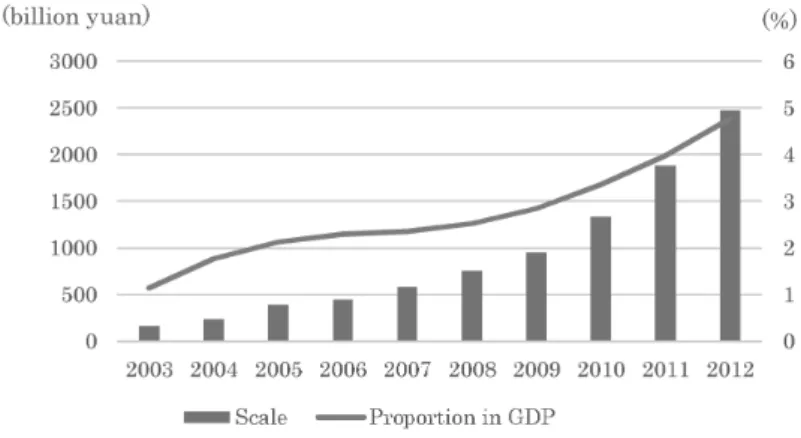
Figure 1 indicates that the scale of the Chinese software industry has grown by more than tenfold in nine years, i.e., from 2003 to 2012. Its proportion of GDP has increased from 1% in 2003 to 5% in 2012. This means that the industry grows much faster than the economy. In other words, the demand for software has been tremendously increasing in China.
Figure 2 explains the composition of the Chinese IT industry in 2011. This figure demonstrates that hardware occupies the majority of the Chinese IT industry. The scale
Figure 1 Scale of the Chinese software industry and its proportion of GDP Source: Author’s calculation based on the data from the department of Commerce,
the Chinese government.
Figure 2 Composition of the Chinese IT industry (2011) Source: Author’s construction based on the data from CCID
of software is much smaller than that of hardware. As described later, in the Indian IT industry, the ratio of software and IT service is 69% in 2014. This gap between China and India is caused by the historical development processes of the software industry in two countries. In China, the development of the software industry occurred along with its economic development. In contrast, in India, the software industry developed mainly to supply to its foreign clients.
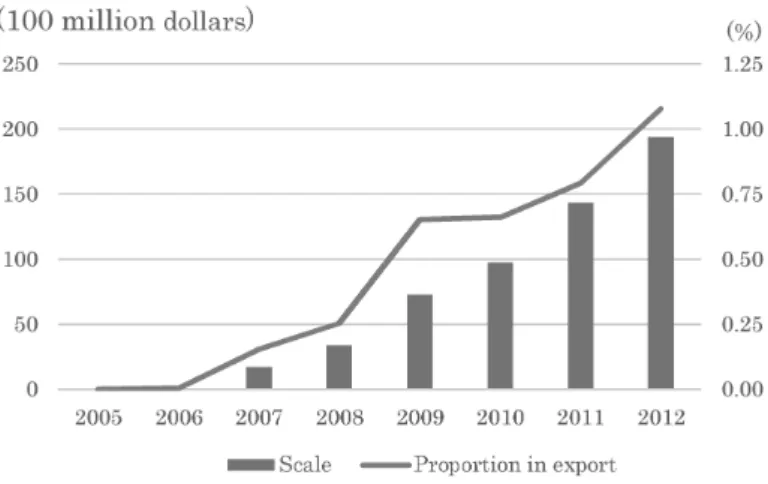
Figure 3 depicts the scale of Chinese software and IT service exports. It has rapidly grown, and its proportion in the Chinese export is over 1% in 2012. This means that the weight of software in the Chinese export has been surging.
Figure 3 Scale of Chinese software and IT service export and its export proportion in China Note: Excluding embedded software.
Source: Same as Figure 1.
Figure 4-1 Regional distribution of Chinese software and IT service exports in 2005 Source: Same as Figure 1.
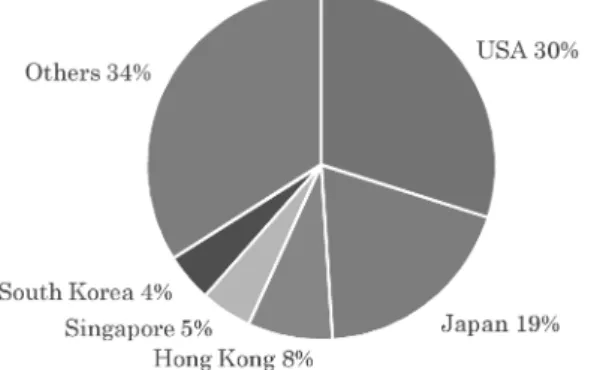
Figure 4 demonstrates the regional distribution of the Chinese software and IT service exports. Figure 4-1 illustrates that Japan is the largest export destination in 2005. It comprises 59% of the Chinese software exports. However, as Figure 4-2 reveals, in 2012, exports to the USA is 30%, whereas that to Japan is 19%. This means that Chinese software firms increased their exports to USA more rapidly than that to Japan. Consequently, exports to the USA exceeded that of Japan.
2.2 The Indian software industry
Second, we reveal the characteristics of the Indian software industry.
Figure 5 displays the scale of Indian IT-BPM (Business Process Management)
Figure 5 Scale of the Indian IT-BPM industry and its proportion of GDP Note: Fiscal year.
Source: Author’s calculation based on the yearly data from NASSCOM.
Figure 4-2 Regional distribution of the Chinese software and IT service exports in 2012 Source: Same as Figure 1.
industry and its proportion of GDP.1 Figure 5 indicates that the industry has been
growing rapidly; its ratio in the GDP is over 5% in 2013. Figure 6 depicts the composition of the Indian IT-BPM industry in 2014. This figure reveals that hardware is just 11% in Indian IT-BPM industry. This ratio is much lower than that of China.
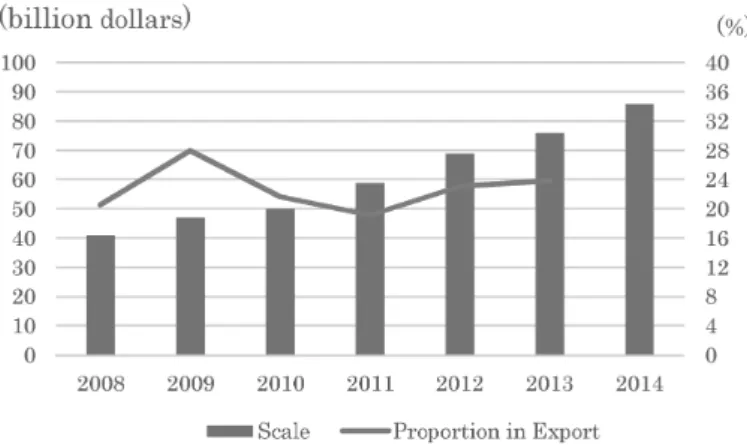
Figure 7 illustrates that the Indian IT-BPM export have been rapidly increasing. Figure 8 demonstrates that the export ratio in the Indian IT-BPM industry has been approximately 70% in the early 2010s. These figures indicate that the Indian IT-BPM
1 Recently, NASSCOM (National Association of Software and Services Companies), which is the
association of software and IT service firms in India, uses the word “BPM” instead of “BPO (Business Process Outsourcing).”
Figure 6 Composition of the Indian IT-BPM industry (2014) Notes: Fiscal year.
ER&D means Engineering Research & Development. Source: Data from NASSCOM.
Figure 7 Scale of the Indian IT-BPM export and its export proportion in India Note: Fiscal year.
largely depends on its exports.
Figure 9 displays the regional distribution of the Indian IT-BPM export in 2010. Contrary to China, the proportion of India’s exports to Japan is just 1%. Most of the Indian export goes to western countries.
We have outlined the scale and other characteristics of the software industry in China and India. The Indian IT-BPM industry mainly depends on exports, and the Chinese IT industry mainly depends on domestic demand. However, software and IT service exports from China have been increasing. The Chinese software exports have been increasing at a faster rate than that of India. In particular, its software exports to USA have been increasing. Therefore, software exports contribute significantly to the
Figure 8 Ratio of domestic market and export in the Indian IT-BPM industry Note: Fiscal year.
Source: Data from NASSCOM.
Figure 9 Regional distribution of Indian IT-BPM export (2010) Note: Fiscal year.
development of the Chinese software industry.
3 Literature
This section examines the development strategy framework for the software industry.
3.1 Three strategies for promoting software exports
Correa (1996) described three strategies for promoting software exports in developing countries. Strategy 1 is the export of labor that requires software engineers to work in developed countries for brief periods. These operations are primarily limited to programming, and the learning process with respect to design is not substantial. Software firms in India and the Philippines adopted this strategy.
Strategy 2 is the export of software development services, which, in the case of China, typically comprises software firms developing custom software in accordance with their clients’ specifications or taking on part of the development process as subcontractors. Software engineers may participate in the design and implementation of systems— work which is likely to be higher value-added and more profitable than the activities mentioned in Strategy 1. The learning process is likely to be substantial. Software firms in Taiwan, Singapore, and Chile used this strategy.
Strategy 3 involves IT product exports. In the case of China, this strategy requires the Chinese suppliers to develop or obtain access to a distribution network and ensure the provision of post-sales services. However, competition can be intense, and the advantage of low labor costs in a developing country loses its relative importance. Software firms in Israel, Ireland, and Chile implemented this strategy.
3.2 Software firms’ five strategies
In contrast to Correa (1996), who did not analyze strategies for domestic markets, Heeks (1999) classified software firms’ strategies into five positions in terms of markets and business. Based on the experiences of countries such as India, Russia, Ireland, China, and Vietnam, the paper considered the development strategies of the software industries.
services or offshore development. In this position, developed countries entrust software firms in developing countries with either the entire software development or subsections thereof. Position B is the export of software packages. Position C is the production of packages for the domestic market. Position D is software development and the sale of software services to the domestic market. Finally, Position E represents the supply for niche markets, including sector, application, and linguistic niches.
Positions A and B are export strategies. These two positions are attractive to countries having a low-cost labor force. Many Indian firms are part of Position A. Some Israeli firms are part of Position B.
Position C is adopted by firms that hope to achieve a status similar to that of Microsoft in their home country. Heeks (1999) considered the position less prospective. Firms that target this position face fierce competition with foreign rivals. In addition, copy products of packaged software spread in developed countries. Therefore, this position is not easy to enter for most software firms.
Position D focuses on the domestic software service market. Many software firms in developing countries are in this position because the entry of foreign firms to this position is not prevalent compared with Position C. Thus, it is easier for domestic firms to enter this position. Additionally, Position D is the most appropriate place to shift to Positions A and B of export strategies.
Position E is the niche market strategy. This position includes (1) some industries
Figure 10 Strategic positioning for developing country software enterprises Source: Heeks (1999).
such as bank, insurance, medicine, government, hotel management, mining, and forestry; (2) some application such as plug-in software for web browser and utility software; and (3) some languages such as Spanish and Swahili. Software firms in developing countries
are successful in this position.2
Based on this approach, McManus, Li, and Moitra argued as follows: [Position B] is almost non-existent in China’s software industry. The majority of software programming in China is for the outsourcing and domestic services segment, which tends to be at the lower end of the software industry value chain. Currently, China lacks an entrepreneurial environment that fosters innovation (McManus, Li, and Moitra, 2007, p. 131).
4 Development policy of the Chinese software industry
This section examines the development policy of the Chinese software industry based on the considerations of Sections 2 and 3.
Li and Gao (2003) applied Heeks’ (1999) model to China and argue that Positions A, B, and C are not good strategies for the country’s particular circumstances. As a latecomer in the software export market, China faces insurmountable obstacles in Positions A and B in the immediate future. Moreover, these export-oriented approaches have a serious side effect: The advanced technology that firms acquire through the software services export often fails to trickle down into the domestic market. Position C is also inadvisable. For example, the Chinese software firm, Kingsoft, developed the first word processing software package in simplified Chinese in 1988. However, 10 years later, Windows-based Microsoft Office captured most of the market share.
In contrast, Positions D and E are suitable strategies for Chinese software firms. Position D is an appropriate starting point for several reasons. First, this segment is the easiest for new firms to enter. Second, this position can be a good starting point for progressing into exports. A sizable and demand-driven domestic market could be the springboard required to launch China into the export market, as the domestic market
2 Kingsoft was the monopoly firm in the Chinese word processor software market for Kingsoft Office
2007. Later, Microsoft developed their Chinese word processor software and Kingsoft lost their market share. This indicates that the Chinese word processor software market is not a niche market anymore. Therefore, Kingsoft shifted to Positon B by exporting the software to Japan and other countries.
can provide a suitable base for relevant skills and experience, and a strong record of accomplishments. Third, a sizable domestic market attracts a large number of IT multinationals. Collaboration with multinational firms can create export opportunities for local partners. In addition, Position E provides thriving market opportunities. Given China’s high economic growth rate, an increasing number of large firms are operating across various industries, making Position E promising (Li and Gao, 2003, pp. 68-70). However, as the analysis in Section 2 demonstrated, software and IT service exports from China have been rapidly increasing. The size of each Chinese firm is small in the global market (McFarlan, Jia, and Wong, 2012), but the growth rate of Chinese software exports is higher than that of the Chinese software industry. This means that the increase of exports contributes significantly to the development of the Chinese software industry.
McManus, Li, and Moitra (2007) argued that, although the Chinese software industry had an inherent advantage of cost leadership, it needs to build trust and credibility with international clients, and to acquire the ability to remotely deliver large and complex projects. Therefore, the Chinese software industry has to overcome those problems to increase their exports.
The Chinese government should support these initiatives. Accordingly, the Chinese government should focus on policies that promote both domestic supply and export of software services. The Chinese government has already implemented a number of policies to promote the export of software. The 10th five-year plan (2001-2005) included tax reductions, subsidies, low-interest bank loans, and other preferential treatment. The 11th five-year plan (2006-2010) and 12th five-year plan (2011-2015) also included these promotional policies. They should further intensify the export promotion policies.
In summary, some Chinese software firms have been shifting from Position D to Position A. This indicates that the Chinese software industry is in the transition process for further development. The Chinese government should support this transition.
5 Conclusion
This article discussed the development policy of the software industry in China. We showed that the Chinese IT industry mainly depends on domestic demand, but software
and IT service exports from China have been rapidly increasing. Software exports contribute significantly to the development of the Chinese software industry. The literature on development strategies of the Chinese software industry overlooked this fact.
Our research results indicate a possible development strategy for China. Li and Gao (2003) insisted that the best strategy for China’s software industry was to sell software services to the domestic market. However, software exports have contributed significantly to the development of the software industry in China. Therefore, the Chinese software industry should intensify the export of software services, and the government has to support these efforts. Consequently, the Chinese government should further strengthen the export promotion policies.
The software industry supports the production of goods and services by exploiting information technology. Consecutively, the manufacturing and other sectors make their production and management more efficient by using the information technology. This means that the software industry is indispensable in the development process. Thus, the government should design its development strategies based on the present situation of the industry.
References
Correa, C. M., “Strategies for Software Exports from Developing Countries,” World Development, vol. 24(1), 1996, pp. 171–182.
Gregory, N., Nollen, S. D., and Tenev, S., New Industries from New Places: The Emergence of the Hardware and Software Industries in China and India, Washington, DC, USA: World Bank, 2009.
Heeks, R., Software Strategies in Developing Countries, Development Informatics Working Paper Series, 6, Manchester, UK: University of Manchester, Institute for Development Policy and Management, 1999.
Huang, Y., “Understanding the Software Industry in China: Export Performance and Regional Development,” Journal of Emerging Knowledge on Emerging Markets, 3, 2011, pp. 289–307. Li, M. and Gao, M., “Strategies for Developing China’s Software Industry,” Information
Technologies and International Development, vol. 1(1), 2003, pp. 61–73.
Journal of Chemical and Pharmaceutical Research, vol. 6(4), 2014, pp. 493-497.
McFarlan, F. M., Jia, N., and Wong, J., “China’s Growing IT Services and Software Industry: Challenges and Implications,” MIS Quarterly Executive, vol. 11(1), 2012, pp. 1-9.
McManus, J., Li, M., and Moitra, D., China and India: Opportunities and Threats for the Global Software Industry, Oxford, UK: Chandos Publishing, 2007.
NASSCOM (National Association of Software and Services Companies), Strategic Review Report, every year.
Tschang, T. and Xue, L., The Chinese Software Industry: A Strategy of Creating Products for the Domestic Market, ADB Institute Working Paper, Tokyo, Japan: Asian Development Bank Institute, 2003.
Tschang, T. and Xue, L., “The Chinese Software Industry,” in A. Arora and A. Gambardella eds., From Underdogs to Tigers: The Rise and Growth of the Software Industry in Brazil, China, India, Ireland, and Israel, New York, USA: Oxford University Press, 2005.