
Adaptive One-Step Byzantine Consensus
9
0
0
全文
(2) Vol.2010-AL-128 No.2 2010/1/26 IPSJ SIG Technical Report. approach defines a set of inputs, called condition, for which the algorithm guarantees a certain kind of good property. The first result with this approach7) gives a sufficient class of conditions such that we can construct the algorithm guaranteeing one-step decision for any input in the condition. This result is extended by Izumi and Masuzawa6) . It gives the complete characterization of conditions that makes one-step decision possible. While all of the above results are considered on crash-failure models, a recent work3) devises one-step consensus algorithms on Byzantine failure models. They show two variants of one-step Byzantine consensus problem, weak and strong ones. The weak one-step Byzantine consensus guarantees one-step decision in any situation where all processes propose the same value and no process is faulty, but the strong must guarantee it in the situation only with a common proposed value, regardless of the number of faulty processes. They propose two algorithms for those variants, and also prove the assumption n > 5t and n > 7t is necessary for weak and strong one-step Byzantine consensus respectively, where n is the number of processes and t is the maximum number of faulty processes. 1.2 Our Contribution As seen in the above, the research challenge centered in one-step consensus is to enhance and clarify the situations making the system reach one-step decision. With the same research direction, this paper also explores Byzantine consensus algorithms with better one-step decision schemes. In particular, we focus on two features for one-step decision schemes shown as follows:. faulty. The notion of the adaptive condition-based approach is first introduced by Izumi and Masuzawa8) , and applied to one-step consensus problem in crashfailure models6) . However, there is no results to apply it in Byzantine-failure models. Double Expedition of One-Step Consensus One of serious drawback incurred by one-step decision schemes is the impossibility of zero-degradation4),9) . Informally, the zero-degradation is one of important features of consensus algorithms based on failure detectors, which always guarantees the best complexity (i.e., two steps) in stable runs where the failure detector does not mistake and its output is stable. The intuition of this result is that, to achieve one-step decision, any algorithm must sacrifice the decision at the end of the second step. It is also shown that achieving both one-step decision and zero-degradation needs more stronger assumption about failure detections such as eventually perfect failure detectors ⋄P . However, similar with the impossibility of one-step decision, this result does not necessarily imply the impossibility of two-step decision for any inputs. Thus, it yields an interest to realize a doubly-expedited consensus algorithm, which equips a “conditional” two-step decision scheme combined with one-step decision. The contribution of this paper is to propose a doubly-expedited Byzantine consensus algorithm based on the adaptive condition-based approach. The distinguished features of the proposed algorithm can be summarized as follows: • In our construction, we show a generic framework of the algorithm based on the notion of the adaptive condition-based approach. Generally, the adaptiveness property in the condition-based approach can be characterized by a condition sequence, which is defined as a sequence of t conditions such that the k-th condition is valid when the actual number of correct processes is k. To handle double-expedition property in adaptive manner, the framework is instantiated by a pair of condition sequences, each of which corresponds to the situations of one-step and two-step decision respectively. We also show a sufficient criteria, say legality, of condition-sequence pair for which doublyexpedited algorithms can be instantiated. • Two examples of legal condition-sequence pairs are proposed, called. Adaptive Condition-Based Approach Most of one-step decision scheme is designed so that it never violates the agreement even if the number of faulty processes is at the maximum. However, such a design works as a pessimistic approach when actual number of faulty processes are small, which is the usual case in real systems. An approach to circumvent this drawback is the use of adaptive condition-based approach. Informally, the adaptive condition-based approach handles the condition that dynamically changes according to the actual number of faulty processes (typically, less faults allows the condition with larger number of inputs). In the context of one-step consensus, it means that the algorithm can terminate in one-step for large number of inputs when less processes are. 2. c 2010 Information Processing Society of Japan ⃝.
(3) Vol.2010-AL-128 No.2 2010/1/26 IPSJ SIG Technical Report. frequency-based pair and privileged-value-based pair. They have distinct advantages in the sense that the expedited situations corresponding to each pair is complementary. Interestingly, the algorithm instantiated by the frequencybased pair takes more chances to decide in one or two steps, compared to existing one-step Byzantine consensus algorithms. • One drawback of the proposed framework is that it trades the decision scheme at third step for double-expedition property. This drawback may causes a performance degradation of consensus-based applications if we consider pessimistic runs (that is, the given input is out of the condition). However, standing on its optimistic counterpart, we make more inputs belong to the conditions, which implies that the algorithm decides in two steps for many cases, and totally achieves better performance in average. To the best of our knowledge, the property of double expedition is the concept newly introduced in this paper. Hence, this paper is the first result showing the feasibility of taking both one- and two-step decision schemes simultaneously with no help of additional stronger assumptions. 1.3 Roadmap The paper is organized as follows: Section 2 presents the system model, the definitions of Byzantine consensus problem, and other necessary formalizations. Section 3 provides the legality criteria for doubly-expedited consensus and its examples. In Section 4, we present our generic framework of doubly-expedited one-step consensus algorithms. Section 5 provides our final remarks.. the number of faulty processes, which is denoted by t. Every process knows the value of t in advance. Throughout this paper, we assume 5t < n, which is the necessary assumption to make one-step decision possible. We also denote by f , the actual number of failures during executions. Notice that each process cannot be aware of the value of f . 2.2 Byzantine Consensus and Underlying Consensus Primitive The Byzantine consensus problem has been informally stated in the introduction: Each process proposes a value, and all correct processes have to decide a common value which is proposed by at least one process. Formally, the Byzantine consensus is defined by the following requirements. Termination Each correct process eventually decides a value. Agreement If two correct processes decide, they must decide the same value. Unanimity If all correct processes propose the same value v, then no correct process decides the value different from v. In general, Byzantine consensus is not solvable in the asynchronous system with no additional assumption. Thus, we need some assumptions to guarantee correct termination for arbitrary inputs. While many kinds of assumptions are considered in past literatures, our research objective is finding the feasibility of one-step decision, and thus we simply assume an abstraction of them. More precisely, the system is assumed to be equipped with the underlying consensus primitive. This primitive ensures agreement, termination, and unanimity, but has no guarantees about its running time. 2.3 Condition-Based Approach In the condition-based approach, an input vector is a n dimensional vector, whose i-th entry contains the value proposed by process pi . A condition defined for n processes is a subset of all possible input vectors. Adaptiveness in the condition-based approach is the property that a condition can change dynamically according to the actual number of faulty processes. Thus, it is defined by a condition sequence (C0 , C1 , ...Ck ...Ct ) satisfying Ck ⊇ Ck+1 for any k(0 ≤ k ≤ t − 1), where k-th condition corresponds to the set of input vectors that is valid when actual number of faults is equal to k. 2.4 Doubly-Expedited Consensus In this subsection, we introduce a novel feature of consensus algorithms, called. 2. Preliminaries 2.1 System model ∏ An asynchronous distributed system consists of n processes = {p1 , p2 , ...pn }. Each pair of processes can communicate with each other by sending messages over a reliable link where neither message loss, creation nor corruption occurs. Since we assume asynchronous systems, there is no assumption on relative speed of processes or message delay. As we consider the Byzantine failure model, a faulty process can behave arbitrarily, which means that even it is allowed not to follow the deployed algorithm. A process that is not faulty is said to be correct. We assume the upper bound on. 3. c 2010 Information Processing Society of Japan ⃝.
(4) Vol.2010-AL-128 No.2 2010/1/26 IPSJ SIG Technical Report. : Vtn → {True, False}⋆1 and a function F : Vtn → V. Then, (S 1 , S 2 ) is said to be legal if we can define P 1, P 2 and F satisfying the following five properties: • LT1: ∀J ∈ Vtn : ∃I : I ∈ Ck1 ∧ dist(J, I) ≤ k ⇒ P 1(J). • LT2 :∀J ∈ Vtn : ∃I : I ∈ Ck2 ∧ dist(J, I) ≤ k ⇒ P 2(J). • LA3 : ∀J, J ′ ∈ It : P 1(J) ∧ dist(J, J ′ ) ≤ t + #⊥ (J) + #⊥ (J ′ ) ⇒ F (J) = F (J ′ ). • LA4 : ∀J, J ′ ∈ It : P 2(J) ∧ dist(J, J ′ ) ≤ #⊥ (J) + #⊥ (J ′ ) ⇒ F (J) = F (J ′ ). • LV5 : ∀J ∈ Vtn ⇒ F (J) = (the most common non ⊥ value in J) ∨F (J) = a : #a (J) > t. These properties are used to enforce the basic requirements of the doublyexpedited Byzantine consensus. Informally, P 1 and P 2 are the predicates to test whether the current view contains sufficient information to decide in one or two step(s) respectively, and F is the function to obtain the decision from the current view. Thus, the first property LT1 is for imposing one-step termination. The predicate P1 must allow each correct process to decide in one step if its own view has the possibility to come from an input vector included in the condition. Similarly, the property LT2 corresponds to two-step decision. The property LA3 (or LA4) implies the agreement between one-step (or two-step) decision and others. The last property LV5 is the one to guarantee unanimity. 3.3 Example 1: Construction by the Frequency-Based Condition This subsection introduces a legal condition-sequence pair that is based on frequency-based conditions and prove its legality. Let 1st(J) be a non ⊥ value that appears most often in a vector J. If two or more values appear most often in J, then the largest one is selected. Let Jˆ be the vector obtained by replacing ˆ That is, 2nd(J) is the 1st(J) from J by ⊥, and we define 2nd(J) = 1st(J). second most frequent value in J. The frequency-based condition Cdf req is defined as follows: Cdf req = {I ∈ V n |#1st(I) (I) − #2nd(I) (I) > d} It is known that Cdf req belongs to d-legal conditions7) , which are necessary and sufficient to solve the consensus in failure prone asynchronous systems, where at most d processes can crash.. double-expedition property. In the execution of doubly-expedited algorithms, each process has two chances for faster decision by running one-step and two-step decision schemes concurrently. Since both decision schemes guarantees faster decision only for good inputs, we can characterize their property by a pair of condition sequences: Throughout this paper, we introduce a pair of condition sequences (S 1 , S 2 ) = ((C01 , C11 , · · · Ck1 , · · · Ct1 ), (C02 , C12 , · · · Ck2 , · · · Ct2 )), where S 1 and S 2 correspond to the condition sequences identifying the situations that guarantee one-step and two-step decisions respectively. For example, consider 1 the input vector I such that I ̸∈ Ck1 , I ∈ Ck−1 and I ∈ Ck2 hold. Then, if I is given to the consensus algorithm and the number of faulty processes is less than 1 k, all processes decide in one step because I ∈ Ck−1 . If (exactly) k processes are faulty, one-step decision is no more guaranteed, but all processes necessarily decide within two steps because of I ∈ Ck2 . 3. Legality for Double Expedition It is clear that we cannot design the doubly-expedited consensus algorithm for any pair of condition sequences. In this section, we propose a sufficient criteria such that we can construct the doubly-expedited algorithm characterized by the condition-sequence pair satisfying it. It is also shown that two examples of condition-sequence pairs satisfying the criteria. 3.1 Notations Let V be the domain of possible proposed values. We introduce the default value ⊥ not in V. Letting I be an input vector in V n , we define a view J of I to be a vector in (V ∪ {⊥})n which is obtained by replacing at most t entries in I by ⊥. As well as, we define ⊥n be a vector with all entries equal to ⊥. The number of occurrences of value v in a view J is denoted by #v (J). For two views J1 and J2 , let dist(J1 , J2 ) be the Hamming distance between J1 and J2 (that is, dist(J1 , J2 ) = |{k ∈ {1, 2, ..n}|J1 [k] ̸= J2 [k]}|). As well as Vkn denotes the set of all views where ⊥ values appears at most k times. The number of non-default values in J is denoted by |J|. We define Ik as the set of all possible views J such that dist(J, I) ≤ k. 3.2 Legality Criteria Given a pair of condition sequences (S,1 S 2 ), we consider two predicates P 1, P 2. ⋆1 In what follows P 1(J) = true is abbreviated as P 1(J). 4. c 2010 Information Processing Society of Japan ⃝.
(5) Vol.2010-AL-128 No.2 2010/1/26 IPSJ SIG Technical Report. entries of J ′ can contain the value x, which are occupied by ⊥ in J. Hence, #1st(J) (J ′ ) ≥ #1st(J) (J) − t − #⊥ (J ′ ) and #x (J ′ ) ≤ #x (J) + t + #⊥ (J). Since 2nd(J) is the most frequent value in J except for 1st(J), #x (J ′ ) ≤ #2nd(J) (J) + t+#⊥ (J). Hence, #1st(J) (J ′ )−#x (J ′ ) > #1st(J) (J)−t−#⊥ (J ′ )−#2nd(J) (J)− t−#⊥ (J). Since J, J ′ ∈ It , #⊥ (J) ≤ t and #⊥ (J ′ ) ≤ t. Consequently, we obtain #1st(J) (J ′ ) − #x (J ′ ) > 0. It implies that 1st(J ′ ) = 1st(J).. Using this condition, we can construct a legal condition-sequence pair (S f req1 , S f req2 ) = ((C0f req1 ,C1f req1 ,...Ckf req1 ...Ctf req1 ), (C0f req2 ,C1f req2 ...Ckf req2 ...Ctf req2 )) with the associated parameters P 1f req , P 2f req and F f req as follows: f req Ckf req1 = C4t+2k f req2 f req Ck = C2t+2k f req • P1 (J) ≡ #1st(J) (J) − #2nd(J) (J) > 4t. • P 2f req (J) ≡ #1st(J) (J) − #2nd(J) (J) > 2t. • F f req (J) = 1st(J). Notice that, since there are at most t Byzantine processes, the stronger assumption n > 7t is required to construct (S f req1 , S f req2 ).. LA4: Consider J, J ′ ∈ It . It suffices to show that if P 2f req (J) ∧ dist(J, J ′ ) ≤ #⊥ (J) + #⊥ (J ′ ), 1st(J) = 1st(J ′ ) holds. Since P 2f req (J), we have #1st(J) (J)−#2nd(J) (J) > 2t. Let x be any value such that x ̸= 1st(J). Since dist(J, J ′ ) ≤ #⊥ (J) + #⊥ (J ′ ), at most #⊥ (J) entries of J ′ can contain the value x, which are occupied by ⊥ in J. In addition, at most #⊥ (J ′ ) entries of J ′ can contain ⊥, which are occupied by 1st(J) in J (due to asynchrony). As a result, #1st(J) (J ′ ) ≥ #1st(J) (J) − #⊥ (J ′ ) and #x (J ′ ) ≤ #x (J) + #⊥ (J). Since 2nd(J) is the most frequent value in J except 1st(J), #x (J ′ ) ≤ #2nd(J) (J) + #⊥ (J). Therefore, #1st(J) (J ′ ) − #x (J ′ ) > #1st(J) (J) − #⊥ (J ′ ) − #2nd(J) (J) − #⊥ (J). Since J, J ′ ∈ It , #⊥ (J) ≤ t and #⊥ (J ′ ) ≤ t. Hence, we obtain #1st(J) (J ′ ) − #x (J ′ ) > 0. It implies that 1st(J ′ ) = 1st(J).. Theorem 1 Let n > 7t. The condition-sequence pair (S f req1 , S f req2 ) is legal. Proof LT1: We show that #1st(I) (I) − #2nd(I) (I) > 4t + 2k ∧ dist(J, I) ≤ k ⇒ #1st(J) (J) − #2nd(J) (J) > 4t. Assume I satisfies #1st(I) (I) − #2nd(I) (I) > 4t + 2k. Since dist(J, I) ≤ k, #1st(I) (J) ≥ #1st(I) (I) − k. Also, for any value x ̸= 1st(I) , #x (J) ≤ #x (I) + k. Since 2nd(I) is the second most frequent value in I, #x (J) ≤ #2nd(I) (I) + k. Hence, #1st(I) (J) − #x (J) > #1st(I) (I) − k − #2nd(I) (I) − k. Thus, we get #1st(I) (J) − #x (J) > 4t. It implies that 1st(I) = 1st(J), and thus we obtain #1st(J) (J) − #2nd(J) (J) > 4t.. LV5: This property is trivially satisfied since F f req (J) = the most frequent non ⊥ value in J. 2. LT2: We show that #1st(I) (I) − #2nd(I) (I) > 2t + 2k ∧ dist(J, I) ≤ k ⇒ #1st(J) (J) − #2nd(J) (J) > 2t. The proof is exactly the same as the proof LT1 with only replacing 4t by 2t.. 3.4 Example 2: Construction by the Privileged-Value-Based Condition In this subsection, we present another legal condition-sequence pair (S prv1 , S prv2 ) constructed from privileged-value-based conditions, and prove its legality. In some practical agreement problems such as atomic commitment, a single value (i.e., Commit) is often proposed by most of the processes. The previous results2) have showed that, if this value is assigned some privilege, it is possible to expedite the decision. Let us assume that there is a value (say m) that is privileged among the set of all proposal values. Each process knows the prv(m) value m a priori. Then, the privileged-based condition Cd can be defined as. LA3: Consider J, J ′ ∈ It . We show that if P 1f req (J) ∧ dist(J, J ′ ) ≤ t + #⊥ (J) + #⊥ (J ′ ), 1st(J) = 1st(J ′ ) holds. Since P 1f req (J), we have #1st(J) (J) − #2nd(J) (J) > 4t. Let x be any value such that x ̸= 1st(J). Since dist(J, J ′ ) ≤ t + #⊥ (J) + #⊥ (J ′ ), J ′ can contain at most t entries with the value x, which are occupied by the value 1st(J) in J (due to Byzantine). In addition, J ′ can contain #⊥ (J ′ ) entries with the default value, which are also occupied by 1st(J) in J (due to asynchrony) and at most #⊥ (J). 5. c 2010 Information Processing Society of Japan ⃝.
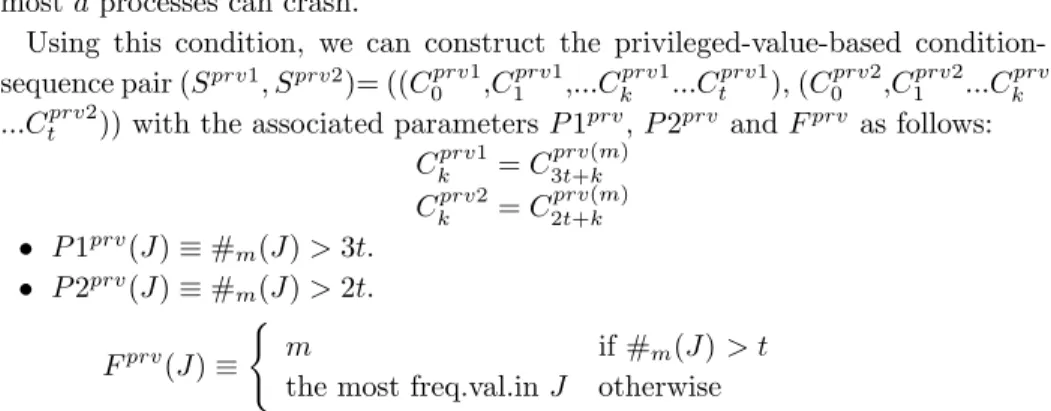
(6) Vol.2010-AL-128 No.2 2010/1/26 IPSJ SIG Technical Report. at most #⊥ (J ′ ) entries of J ′ can contain ⊥ value, which are also occupied by the value m in J(due to asynchrony) and at most #⊥ (J) entries of J ′ can contain some values, which are occupied by ⊥ in J. Thus, #m (J ′ ) ≥ #m (J)−t−#⊥ (J ′ ). Since #m (J) > 3t and #⊥ (J ′ ) ≤ t, we obtain #m (J ′ ) > t. This implies that, F prv (J ′ ) = m = F prv (J).. follows: prv(m) Cd. = {I ∈ V |#m (I) > d} prv(m) Note that Cd also belongs to d-legal conditions7) , which are necessary and sufficient to solve the consensus in failure prone asynchronous systems where at most d processes can crash. Using this condition, we can construct the privileged-value-based conditionsequence pair (S prv1 , S prv2 )= ((C0prv1 ,C1prv1 ,...Ckprv1 ...Ctprv1 ), (C0prv2 ,C1prv2 ...Ckprv2 ...Ctprv2 )) with the associated parameters P 1prv , P 2prv and F prv as follows: prv(m) Ckprv1 = C3t+k prv(m) Ckprv2 = C2t+k • P 1prv (J) ≡ #m (J) > 3t. • P 2prv (J) ≡ #m (J) > 2t. { m if #m (J) > t prv F (J) ≡ the most freq.val.in J otherwise n. LA4: Consider J, J ′ ∈ It . We show that if P 2prv (J) ∧ dist(J, J ′ ) ≤ #⊥ (J) + #⊥ (J ′ ), F prv (J) = F prv (J ′ ) holds. Since P 2prv (J), we have #m (J) > 2t and F prv (J ′ ) = m. Since dist(J, J ′ ) ≤ #⊥ (J) + #⊥ (J ′ ) and Byzantine failures appear as crash failures, J ′ can contain at most #⊥ (J ′ ) entries with the default value, which are occupied by the value m in J. As well as, at most #⊥ (J) entries of J ′ can contain some values different from m, which are occupied by ⊥ in J. Thus, #m (J ′ ) ≥ #m (J) − #⊥ (J ′ ). Since #m (J) > 2t and #⊥ (J ′ ) ≤ t, we get #m (J ′ ) > t. This implies that, F prv (J) = m = F prv (J ′ ).. Notice that, since there are at most t Byzantine processes, the assumption n > 5t is required to make (S prv1 , S prv2 ) meaningful.. LV5: This property is trivially satisfied because F prv (J) is either m (when #m (J) > t) or the most frequent value in J. 2. • Theorem 2 Let n > 5t. The condition-sequence pair (S prv1 , S prv2 ) is legal. 4. Algorithm DEX. Proof LT1: We show that #m (I) > 3t + k ∧ dist(J, I) ≤ k ⇒ #m (J) > 3t. Let I satisfies #m (I) > 3t + k. Since dist(J, I) ≤ k, #m (J) ≥ #m (I) − k. Hence #m (J) > 3t + k − k. Thus we obtain #m (J) > 3t.. In this section, we present a generic doubly-expedited algorithm DEX for onestep Byzantine consensus. The algorithm can be instantiated with any legal condition-sequence pair. Figure 1 provides the pseudocode of the algorithm. It uses an extra communication primitive, called identical broadcast, which corresponds to the primitives Id-Send() and Id-Receive() in Figure 1. In contrast, P-Send() and P-Receive() correspond to the standard send/receive primitives. The underlying consensus is served by two primitives UC propose(v) and UC decide(v), each of which corresponds to proposal of value v and decision by v. Informally, the identical broadcast guarantees the delivery of the same message to all processes, even if the message is sent by a faulty process. Its formal specification is described as follows:. LT2: We show that #m (I) > 2t + k ∧ dist(J, I) ≤ k ⇒ #m (J) > 2t. This proof is exactly the same as the proof of LT1 (with only replacing 3t by 2t). LA3: Consider J, J ′ ∈ It . It suffices to show that if P 1prv (J) ∧ dist(J, J ′ ) ≤ t + #⊥ (J) + #⊥ (J ′ ), F prv (J) = F prv (J ′ ) holds. Since P 1prv (J), we have #m (J) > 3t and F prv (J) = m. Since dist(J, J ′ ) ≤ t + #⊥ (J) + #⊥ (J ′ ), J ′ can contain at most t entries with some values different from m, which are occupied by the value m in J(due to Byzantine). In addition,. 6. c 2010 Information Processing Society of Japan ⃝.
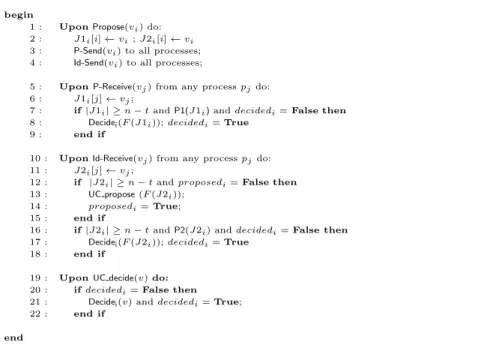
(7) Vol.2010-AL-128 No.2 2010/1/26 IPSJ SIG Technical Report. by using only the standard send/receive primitives. The implementation is easily obtained as a weaker form of simulating identical Byzantine failure on the top of general Byzantine failure models10) . It should be noted that in that simulation, a single communication step of the identical broadcast is realized by two communications steps of the standard send/receive primitive. Our algorithm uses the identical broadcast to develop the two-step decision scheme. In that sense, our two-step decision scheme can be regarded as a one-step decision scheme in identical Byzantine failure models. In our algorithm, the part made up of lines 5-9 corresponds to one-step decision, and the another one made up of lines 10-18 corresponds to two-step decision. The algorithm works as follows: Each process pi starts a consensus execution with invocation of Consensus(vi ) where vi is its initial proposal value. The process pi sends vi to other processes by using both P-send() and Id-send() concurrently, and wait for receiving messages from other processes. By receiving messages, each process constructs views J1i and J2i , which correspond to one- and twostep decision. The views J1i and J2i are maintained incrementally. That is, they are updated by the reception of a message. When at least n − t messages are received in J1i , pi tries to make a decision by evaluating P 1(J1i ). If P 1(J1i ) is true, pi immediately decides F (J1i ), that is, decides in one-step. Otherwise, pi continues to update J1i . Similarly, when pi receives at least n − t messages at J2i , it activates the underlying consensus with F (J2i ). In addition, pi evaluates P 2(J2i ) to check whether J2i is sufficient for taking decision. If P 2(J2i ) is true, pi immediately decides F (J2i ), that is, decides in two steps. Otherwise, pi repeats the check of J2i with update of J2i . When the underlying consensus decides, each pi simply borrows the decision of the underlying consensus unless it has decided already. 4.0.1 Correctness. We prove the correctness of our algorithm by showing that it provides one-step or two-step decision when it is instantiated with any legal condition-sequence pair (S 1 , S 2 ).. Function Consensus(vi ) n. init: J1i , J2i ←⊥. , decidedi ← False , proposedi ← False. begin 1 2 3 4. : : : :. Upon Propose(vi ) do: J1i [i] ← vi ; J2i [i] ← vi P-Send(vi ) to all processes; Id-Send(vi ) to all processes;. 5 6 7 8 9. : : : : :. Upon P-Receive(vj ) from any process pj do: J1i [j] ← vj ; if |J1i | ≥ n − t and P1(J1i ) and decidedi = False then Decidei (F (J1i )); decidedi = True end if. 10 11 12 13 14 15 16 17 18. : : : : : : : : :. Upon Id-Receive(vj ) from any process pj do: J2i [j] ← vj ; if |J2i | ≥ n − t and proposedi = False then UC propose (F (J2i )); proposedi = True; end if if |J2i | ≥ n − t and P2(J2i ) and decidedi = False then Decidei (F (J2i )); decidedi = True end if. 19 20 21 22. : : : :. Upon UC decide(v) do: if decidedi = False then Decidei (v) and decidedi = True; end if. end. Fig. 1 Algorithm DEX: Doubly-Expedited Adaptive algorithm for Byzantine Consensus. Termination If a correct process invokes Id-Send(m), Id-Receive(m) occurs on all correct processes. Agreement If two processes invoke Id-Receive(m1 ) and Id-Receive(m2 ) for the same sender, m1 = m2 holds. Validity If a correct process invokes Id-Receive(m) for a correct sender pi , pi invokes Id-Send(m) exactly at once. Notice that the use of the identical broadcast does not imply introducing additional assumptions to the system. The identical broadcast can be implemented. Lemma 1 (Termination) Each correct process pi eventually decides.. 7. c 2010 Information Processing Society of Japan ⃝.
(8) Vol.2010-AL-128 No.2 2010/1/26 IPSJ SIG Technical Report. Proof Since there are at most t Byzantine processes, each correct process pi receives messages from at least n−t processes. It implies that |J2i | > n−t. Hence, pi certainly initiates the underlying consensus. Since the underlying consensus guarantees termination, pi can decide when the underlying consensus decides. It follows that each process eventually decides.. every process pk proposes vi . • (Case 5:) When pi decides in two steps at line 17 and pj decides using underlying consensus at line 21. Since pj decides by the underlying consensus, similar to Case 4, we have to show that every correct process pk proposes vi to the underlying consensus at line 13. Since pi decides in two steps, P 2(J2i ) holds. In addition, by the same way as the case 3, we obtain dist(J2i , J2k ) ≤ #⊥ (J2i ) + #⊥ (J2k ) for any view J2k . By property LA4, F (J2i ) = F (J2k ). It implies that every process pk proposes vi to the underlying consensus. • (Case 6:) When both pi and pj decide at line 21: Since the underlying consensus guarantees agreement property, we can conclude vi = vj .. Lemma 2 (Agreement) No two correct processes decide different values. Proof Let two correct processes pi and pj decide vi and vj respectively. Then we prove vi = vj . Consider the following six cases. • (Case 1:) When both pi and pj decide in one step at line 8. Since pi and pj decide in one step, P 1(J1i ) and P 1(J1j ) hold. Since there are at most t Byzantine processes, we obtain dist(J1i , J1j ) ≤ t + #⊥ (J1i ) + #⊥ (J1j ). From property LA3, it follows that vi = F (J1i ) = F (J1j ) = vj . • (Case 2:) When pi decides in one step at line 8 and pj decides in two steps at line 17. As pi decides in one step, P 1(J1i ) holds. In any view J2j , since there are at most t Byzantine processes, dist(J1i , J2j ) ≤ t + #⊥ (J1i ) + #⊥ (J2j ). By property LA3, it is clear vi = F (J1i ) = F (J2j ) = vj . Hence, if pj decides in two steps using J2j , then its decision value vj = vi . • (Case 3:) When both pi and pj decide in two steps at line 17. Since pi and pj decide in two steps, P 2(J2i ) and P 2(J2j ) hold. From the agreement property of the identical broadcast primitive, if an entry in J2i contains a non-default value v, then the same entry in J2j also contains v. Thus, we obtain dist(J2i , J2j ) ≤ #⊥ (J2i ) + #⊥ (J2j ). Because of property LA4, if pi and pj decide in two steps, then vi = vj holds. • (Case 4:) When pi decides in one step at line 8 and pj decides using underlying consensus at line 21. Since pj decides vi by the underlying consensus and the underlying consensus satisfies unanimity, it suffices to show that every correct process pk proposes vi at line 13. Since pi decides in one step, P 1(J1i ) becomes true. In addition, dist(J1i , J2k ) ≤ t + #⊥ (J1i ) + #⊥ (J2k ) because at most t processes are Byzantine. By property LA3, vk = F (J2k ) = F (J1i ) = vi . It implies that. Lemma 3 (Unanimity) If all correct processes propose the same value v, then no correct process decides the value different from v. Proof Let f be the actual number of Byzantine processes, and all correct processes propose the same value v. Since f ≤ t, in each correct process pi , the views J1i and J2i contain no value except v more than t times. If pi decides at line 8 or 17, its decision value is either F (J1i ) or F (J2i ). From the definition of LV5, it is clear that it decides only v. Similarly, since each pi proposes F (J2i ) to the underlying consensus, and the underlying consensus satisfies unanimity, any correct process that decides using underlying consensus decides only v. Hence, the unanimity holds. Lemma 4 The algorithm DEX guarantees one-step decision for any input vector I, I ∈ Ck1 if at most k processes exhibit Byzantine behavior. Proof Since there are at most k Byzantine processes, each correct process pi receives messages from all (n−k) correct processes. Thus, eventually J1i becomes a member of [Ck1 ]k . This implies that pi decides in one step. Lemma 5 The algorithm DEX guarantees two-step decision if the input vector I belongs to Ck2 and at most k processes are Byzantine.. 8. c 2010 Information Processing Society of Japan ⃝.
(9) Vol.2010-AL-128 No.2 2010/1/26 IPSJ SIG Technical Report. Proof Since there are at most k Byzantine processes each correct process pi receives messages from all (n−k) correct processes. Thus, eventually J2i becomes a member of [Ck2 ]k . This implies that pi decides in two steps.. 4) D.Dobre and N. Suri : One-step Consensus with Zero-Degradation, In proc. of the International Conference on Dependable Systems and Networks(DSN’06), pp. 137–146 (2006) 5) P. Dutta and R. Guerraoui : Fast Indulgent Consensus with Zero Degradation, In proc. of the 4th European Dependable Computing Conference on Dependable Computing, Vol. 2485 of LNCS, pp.191–208, Springer-Verlag (2002) 6) T. Izumi and T. Masuzawa : One-Step Consensus Solvability, In proc. of the 22nd international symposium on Distributed Computing(DISC’06), Vol.4167 of LNCS, Springer, pp.224–237 (2006) 7) A. Mostefaoui, S. Rajsbaum and M. Raynal : Conditions on input vectors for consensus solvability in asynchronous distributed systems, In proc. of the thirtythird annual ACM symposium on Theory of computing (STOC’01), pp. 153–162 (2001) 8) T. Izumi and T. Masuzawa : Condition Adaptation in Synchronous Consensus, IEEE Transactions on Computers, Vol.55(7), pp.843–853 (2006) 9) R. Guerraoui and M. Raynal : The Information Structure of Indulgent Consensus, IEEE Transactions on Computers, Vol.53(4), pp.453–466 (2004) 10) H. Attiya and J. Welch : Distributed Computing: Fundamentals, Simulations and Advanced Topics, Wiley (2004). The above lemmas imply the following theorem: Theorem 3 For any instantiation with legal condition-sequence pairs, the algorithm DEX is a doubly-expedited one-step consensus algorithm. 5. Conclusion We proposed a novel one-step Byzantine algorithm DEX has two distinguished features: Adaptiveness and double-expedition property. Due to adaptiveness, its condition is sensitive to the actual number of failures, and hence achieves fast termination for large number of inputs when less number of processes are faulty. In addition, due to double-expedition property, it supports two-step decision in addition to one-step decision. Even though DEX takes four steps at worst in well-behaved runs while existing algorithms takes only three, it provides fast termination for large number inputs. Practically, this is a favorable feature because the worst case is not so often in real systems, and thus our algorithm can work efficiently in average. Acknowledgments This work is supported in part by the Japan Society for the Promotion Of Science Grant-in-Aid for Scientific Research(C) 21500013, and the Telecommunication Advancement Foundation. References 1) I. Keider and S. Rajsbaum : On the cost of fault-tolerant consensus when there are no faults, SIGACT News, Vol.32(9), pp.45–63 (2001) 2) V.F Brasileiro, F. Greve, A. Most´efaoui and M.Raynal : Consensus in One Communication Step, In proc. of the 6th International Conference on Parallel Computing Technologies, Vol.2127 of LNCS, pp.42–50, Springer-Verlag (2001) 3) Y.J. Song and R.V. Renesse : Bosco: One-Step Byzantine Asynchronous Consensus, In proc. of the 22nd international symposium on Distributed Computing(DISC’08), Vol.5218 of LNCS, pp.438–450, Springer-Verlag (2008). 9. c 2010 Information Processing Society of Japan ⃝.
(10)
図
関連したドキュメント
Moving a step length of λ along the generated single direction reduces the step lengths of the basic directions (RHS of the simplex tableau) to (b i - λd it )... In addition, the
The result is close to the one obtained in the independent case, and, as stressed in the introduction, it holds interest from the perspective of numerical simulation, in cases where
In section 2 we present the model in its original form and establish an equivalent formulation using boundary integrals. This is then used to devise a semi-implicit algorithm
This generalized excursion measure is applied to explain and generalize the convergence theorem of Kasahara and Watanabe [8] in terms of the Poisson point fields, where the inverse
In this work we give definitions of the notions of superior limit and inferior limit of a real distribution of n variables at a point of its domain and study some properties of
1 Miko laj Marciniak was supported by Narodowe Centrum Nauki, grant number 2017/26/A/ST1/00189 and.. Narodowe Centrum Bada´ n i Rozwoju, grant
Maria Cecilia Zanardi, São Paulo State University (UNESP), Guaratinguetá, 12516-410 São Paulo,
We construct a sequence of a Newton-linearized problems and we show that the sequence of weak solutions converges towards the solution of the nonlinear one in a quadratic way.. In
