South East Asian Studies, Vol. 15, No.2, September 1977
Interdependence of the ASEAN Region*
The Transaction Analysis of Trade Flows, 1950, 1960, 1970Susumu YAMAKAGE
**
Abstract
Attempting to discuss the transactional interdependence of the ASEAN region consist-ing of Indonesia, Malaysia, the Philippines, Sconsist-ingapore and Thailand in comparison with that between the region and its adjacent countries, this paper analyzes trade flows in Southeast Asia in 1950, 1960 and 1970. The level of interdependence is measured herein by the percentage of exports and the Relative Acceptance index which is applied to inter-national relations in Southeast Asia for the first time. Major findings are that the ASEAN countries have been relatively interdependent with one another, and that the ASEAN region has been relatively distinct from its adjacent region. The interdependence of the ASEAN region may be characterized by the heterogeneity of the level of interdependence among the member countries, rather than the lack of interdependence which has been believed.
I Introduction
The Association of Southeast Asian Nations (ASEAN) was founded by Indonesia, Malaysia, the Philippines, Singapore and Thailand in 1967, and its membership has not changed. Although ASEAN is becoming recognized as an organization whose purpose is the pursuit of regional cooperation, whether it is integrating or interdependent is still a controversial subject among the students of international relations. As for the ASEAN nations, intra-regional trades are much less important to their national economies than, for example, trades within European Community. This is the case in both aggregate terms and disaggregated commodity terms. Such little interdependence is not only the outside scholars' view but also the ASEAN members' own view. For instance, in No-vember 1973, Malaysia's deputy finance minister noted this as a problem for ASEAN.1
) Also, in the Bali Declaration of 1976, the improvement of trade relations among the members was made an economic priority.
According to the theories of international integration, economic interdependence, within which trade is regarded as an important factor, is one of the background conditions
*
Comments to earlier drafts of this paper by Professors Karl W. Deutsch (Harvard University), Hayward R. Alker, .Jr. (Massachusetts Institute of Technology), Nazli Choucri (M.LT.) and Yasukichi Yasuba (Kyoto University), and also by my colleagues, notably Richard]. Samuels (M.LT.), are gratefully appreciated.**
ili~ :ii§, The Center for Southeast Asian Studies, Kyoto University.for pursuing integration among nations.2) Therefore, these theories would suggest that
ASEAN would not have come into being, or that it would soon collapse short of inter-dependence. Nevertheless, ASEAN has been existing for a decade despite its low levels of economic interdependence, which is seemingly a counter-example against a thesis on international integration. It may be a way to argue that other factors than economic interdependence have made ASEAN coherent, and hence have maintained it (see Pollard 1970). In the present paper, however, the prevailing view that the ASEAN nations have not been interdependent in terms of the trade will be re-examined.
The objective aimed at herein is to demonstrate that the ASEAN nations are indeed interdependent in a relative sense. Specifically, taking Southeast Asia into considera-tion, (1) the ASEAN nations are relatively interdependent with one another; and (2) the ASEAN region is relatively distinct from the other part of Southeast Asia. At the same time, however, the heterogeneity of trade ties within the ASEAN region will be clarified so as to approach a more realistic view than the simple dichotomy of inter-dependence and ininter-dependence. For these purposes, firstly, contending views about transactional interdependence will be briefly surveyed. Second, the methodology of the present paper will be presented. Specifically, the Relative Acceptance Index is employed in the study of ASEAN's interdependence for the first time, and is designed to provide a new perspective with the complementary use of the Proportional Outflow Index. Third, the results of trade flow analyses will be summarized. Finally, speculative discus-sions will be conducted based on our fact findings.
II Theories and Methodologies
Interdependence among nations is doubtlessly a multidimensional concept (Alker
et
at.
1974; Keohane and Nye 1975). As one of the dimensions, various types of trans-actions constitute interdependent networks among nations, such as international trades, tourism, exc~anges of mails and foreign students, reciprocal visits of national leaders, etc. Note tl t transactional interdependence must be distinguished from psychological or de jure interdependence, though they are interrelated to one another. Particularly in recent years, as the range and scope of international relations has steadily widened, and as traditionally important components of international relations like wars and dip-lomatic relations have lost their paramount and unrivaled status in international rela-tions studies, transactional interdependence, especially in terms of political economy, has been drawing the attention of the students of international relations increasingly. Thus,2) The paradigm of international integration studies includes three major approaches, i.e., the federalist approach, the communication approach, and the neo-functionalist approach. In particular, the latter two approaches are relevant in this regard. See, for instance, (Haas 1971) and (Dougherty and Pfaltzgraff 1971, pp. 279-311) for detailed discussions.
S. YAMAKAGE: Interdependence of the ASEAN Region
interdependence has already acquired a pre-eminent position in the literature of inter-national relations.
However, the implication of transactional interdependence has been one of the controversial subject matters in international relations studies. An extreme view is that international conflicts tend to increase as transactional interdependence deepens because the latter raises the chances of clash in interests (Waltz 1970). The other ex-treme is the view that transactional interdependence is one of the processes of integra-tion, where a number of types of interdependence reinforce one another, and which are followed by institutional integration (Haas 1961; Haas and Schmitter 1964). It seems obvious that such a controversy stems from the lack of a thorough specification of context where transactional interdependence is dealt with. In order to resolve this, it is neces-sary to distinguish the covariance of interests generated by the transactions in question, from the level of transactional interdependence, and then to establish both positive and negative correlations between these two variables in such a way as Deutsch (1966) mod-elled international relations.
In terms of ASEAN, this paper shall not attempt to answer a question of whether transactional interdependence contributes to the regional integration of the members. Rather, a modest objective will be pursued for the purpose of determining the level of transactional interdependence, and this unanswered question must be dealt with else-where.3)
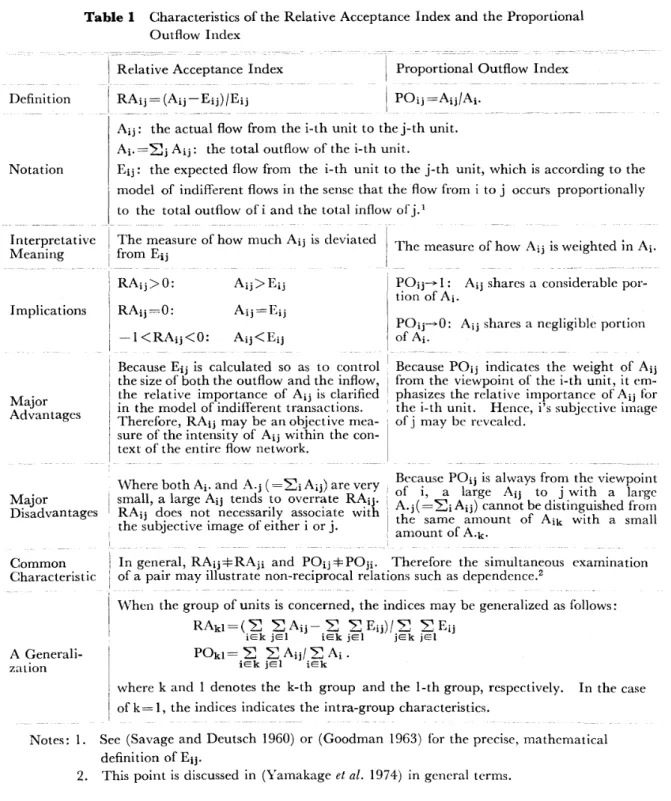
To measure the level of transactional interdependence, the Relative Acceptance In-dex (RA) and the Proportional Outflow InIn-dex (PO) shall be used, though some other indices have been proposed for this purpose.4) The reason to choose these two is that they complement each other, as will be described later. Because interdependence is so abstract a concept that the operationalization of it is possible in more than one way, complementarity which enables the revealing of different aspects of interdependence is preferable to an
a priori
assumption to use a single index. RA was proposed by Savage and Deutsch (1960), and subsequently it has been applied, reviewed, criticized and improved by Goodman (1963), Russett (1963), Foltz (1965), Alker and Puchala (1967), Hughes (1971; 1972), Chadwick and Deutsch (1973), Clark (1973), Yamakage etat.
(1974), etc. Consequently, the characteristics of the index, limits of application, and problems of interpretation have been thoroughly examined. On the other hand, PO is more conventional. It simply calculates the percentage of each trade flow to the total exports of respective countries. Like other social indices, both RA and PO have their3) Of course, the relationship, if any, between the level of interdependence and interest patterns, inte-grative or disinteinte-grative, is of much interest. This subject matter is to be discussed extensively else-where (Yoshii 1975; Yamakage in preparation).
4) Puchala (1971) reviews some of them with special reference to the application to European Com· munity for the comparative purposes.
Table I Characteristics of the Relative Acceptance Index and the Proportional Outflow Index
Definition
Relative Acceptance Index Proportional Outflow Index
Notation
Interpretative Meaning
Aij: the actual flow from the i-th unit to the j-th unit. Ai. =~jAij: the total outflow of the i-th unit.
Eij: the expected flow from the i-th unit to the j-th unit, which is according to the model of indifferent flows in the sense that the flow from i to j occurs proportionally to the total outflow of i and the total inflow ofj.l
The measure of how much Aij is deviated The measure of how Aij is weighted in Ai. from Eij
Implications
RAij>O: RAij=O: -1< RAij<O:
POw-~I: Aij shares a considerable por-tion of Ai.
POw-~O: Aij shares a negligible portion of Ai.
Major Advantages
Major Disadvantages
Because Eij is calculated so as to control the size of both the outflow and the inflow, the relative importance of A ij is clarified in the model of indifferent transactions. Therefore, RAij may be an objective mea-sure of the intensity of Aij within the con-text of the entire flow network.
Where both Ai. and A. j ( =~iAij) are very small, a large Aij tends to overrate RAij. RAij does not necessarily associate with the subjective image of either i or j.
Because POij indicates the weight of Aij from the viewpoint of the i-th unit, it em-phasizes the relative importance of Aij for the i-th unit. Hence, i's subjective image ofj may be revealed.
Because POij is always from the viewpoint of i, a large Aij to j with a large A. j(=~iAij) cannot be distinguished from the same amount of Aik with a small amount of A.k.
Common Characteristic
A Generali-zation
In general, RAWl=RAji and POij'=l=POji. Therefore the simultaneous examination of a pair may illustrate non-reciprocal relations such as dependence.2
When the group of units is concerned, the indices may be generalized as follows: RAkl = (~ ~Aij - ~ ~Eij)I~ '5:Eij
iEk jEI iEk jEI jEk jEI POkl=~ ~Aij/~Ai.
iEk jEI iEk
where k and 1 denotes the k-th group and the I-th group, respectively. In the case of k = 1, the indices indicates the intra-group characteristics.
Notes: 1. See (Savage and Deutsch 1960) or (Goodman 1963) for the precise, mathematical definition of Eij.
2. This point is discussed in (Yamakageetat. 1974) in general terms.
own advantages and disadvantages, which are summarized in Table 1 with the definition and other characteristics. It can be easily seen in Table 1 that these two indices com-plement each other, and that they measure two distinctive aspects of transactional in-terdependence.
In the literature of Southeast Asian studies, the level of transactional interdependence has been discussed mainly based on the aspect which seems measured by PO or similar
S. YAMAKAGE: Interdependence of the ASEAN Region
indices.5
) Therefore, the analysis by RA will hopefully provide new information about the subject matter and a new perspective of ASEAN's interdependence.
III The Analysis of Trade Flows
III-I. Procedures
The individual country is set as the unit of analysis. Those countries taken into consideration in this paper may be divided into two groups: the ASEAN region, and the adjacent countries to it. The former group consists of Indonesia, Malaysia, the Philippines, Singapore, and Thailand. The latter includes South Vietnam, Laos, Cambodia, Burma, Taiwan, Hong Kong, and Australia. Trade flows shall be analyzed in terms of (I) those among the countries of the first group, and (2) those between the countries of the first group and those of the second one. This study chooses three time points in ten-year intervals, i.e., 1950, 1960, and 1970, so as to disclose the trend since the era of independence in Southeast Asia until the recent days.
Data are based on statistics published from the United Nations and/or International Monetary Fund and International Bank of Reconstruction and Development.6) The
trade matrix of countries in question turned out to have three types of difficulties in measurement. First, trade from a certain country to another is not reported by either exporter or importer. Second, trade is reported by one of either exporter or importer. Finally, though trade is reported by the both partners, the difference in the reported amount is unreasonably large. For these reasons, this study is not able to take an or-dinary method to use either exportation or importation matrix. Rather, the volume of transaction arc redefined according to the following principle:
(Xij+Mji)/2, if both Xi j and Mj i are available,
Xij, if only Xij is available,
Ai j =--=
Mji , if only Mj i is available, and
0, if neither of them is available,
where Aij indicates the redefined volume of transaction from i toj,
Xij indicates iJs report of its exports toj, and
Mji indicates)'s report of its imports from i.
The transaction data redefined in the above way are used throughout this study. The
5) I ndeed, the view presented in the introduction of this paper is based on the percentage of trade to the total trade or to GNP. Also, antecedent quantitative research on the interdependence of the ASEAN region such as (Gordon 1971) and (Kegley and Howell 1975) ha, utilized this type of measure. 6) Specifically, the data in 1950 are made from (I) Statistical Papers Series T, vol. II, no. 12: Direction of
International Trade: Quartery Issue: January-December 1951, April 1952, and (2) Statistical Yearbook 1953: the Fifth Issue, 1953, the data in 1960 are made from Direction of Trade: a Supplement to Inter-national Financial ,')tatistics: Anual1960-1964; the data in 1970 are made from Direction of Trade: Annual /970-/974.
computation of POij and RAi j is based on the above redefined Ai j and the reported
value of total exports and total imports. Note that RAij is not calculated in terms of
the trade matrix of Southeast Asian countries, but in terms of that of the entire world. Also, in the trade matrix of 1950, Malaysia and Singapore are treated as a single unit of Malay-Singapore, and three countries in Indochina are aggregated into Indochina, due to their unified colonial situations.
III-2. Terminology
As mentioned above, transactional interdependence is the subject matter. In this regard, dependence is defined as a dyadic characteristic of countries such that the transac-tion from one country to another is significant for the former in either relative or abosolute sense. Operationally, the i-th country is dependent on the J-th country when POi j
and/or RAi j is relatively large. Needless to say, this operational definition captures
limited aspects of the multidimensional nature of interdependence.
Nonetheless, it is meaningful to regard an aspect of transactional dependence as the distribution of the total transaction, based on the assumption that the larger propor-tion correlates to the higher dependence. Interdependence is defined in this paper as a dyadic characteristic of countries of being dependent on each other, applying the above operational definition of dependence.
On the other hand, cohesion is a systemic characteristic rather than a dyadic one, indicating the overall interdependence among countries of the group or the region in question. The level of cohesion, or cohesiveness, ranges from the case where all countries are interdependent with one another to the case where neither are.
111-3. Regional Distinctiveness
First of all, the transactions within the ASEAN region shall be compared with those between the ASEAN and the adjacent region in aggregate terms. Figure 1 reveals the intra-ASEAN regional relations and the two-way relations between the ASEAN region and the adjacent one. As can be seen easily, the interdependence of the ASEAN region is clearly distinct from the inter-regional interdependence. It is likely that the ASEAN region has been distinct from the adjoining region throughout the years this study covers, characterized by the intra-regional high interdependence in the sample years. Nonetheless, two reservations must be kept in mind. First, neither Figure I-a nor l-b shows the increasing trend of the cohesion of the ASEAN region. Rather, the level in 1960 is the peak as long as the three time points are concerned, which might be evidence supporting the view that the ASEAN region is not in the integrative process. Second, however clearly is the ASEAN region distinct from the adjoining region, it is misleading to draw a conclusion that it is highly cohesive.
de-S. YAMAKAGE: Interdependence of the ASEAN Region
pendence on one another. As Figure 2 indicates, the standard deviation is considerably large, the mean value being taken into account.7) This point raises the possibility of
POij (%) 20 Intra·ASEAN region RAij 10 10
Adjacent region-+ ASEAN region
Ia-':':-':::~=~~'-'-'_'_'"
ASEAN region:-Adj~;;~t-;e~i;
Adjacent region-+ ASEAN region
_.-'
-'-:~-='='':::::1
---ASEAN region -+ Adjacent region
OL_,..-L-'- - - : - : ' - '::-:---::-:':::'~
1950 1960 1970
o
--I'--1-9'-S(-)---j-9'-6(-)---1...J9
-7
(-)-(a) According to PO (bl According to RA
Fig. 1 Trade Interdependence: Intra-ASEAN Region, and between the ASEAN and Adjacent Regions l'Oij (%) 20 RAij 20 IS 15 10 T
,
I I I I I I+---
* I I I o I -1'--j....9"-S-O---1....9"-6(-j --'I0Io-_ 1970 1960 T I I I I I IIr---T
I I I L_ I I r --___ I Il
---
t---
~*
I I I o 1950 5 10(a) According to PO (b) According to RA
Fig.2 Individual Countries' Trade Interdependence: Mean and Standard Deviation of
the ASEAN Countries (Solid Lines), and between the ASEAN Countries and the Adjacent Countries (Dotted Lines)
Note: *In 1970, Laos is excluded from the calculations due to its extraordinarily large effect on both mean and standard deviation. The inclusion of Laos would make mean and S.D. 3.23 and 6.12 in terms of PO, and 7.01 and 15.32 in terms of RA, respectively.
7) This fact imples that, if trade flow was employed as the only one criterion to draw the boundary of the system, it might be different from the membership of ASEAN.
that not only intra-regional but also inter-regional interdependence is heterogeneous despite the distinctiveness between the two regions as shown in Figure 1. In order to take a closer look at this possibility, the relations between the ASEAN region and respec-tive adjoining countries firstly, and then, the relations among the ASEAN countries, shall be examined.
III-4. The Relations of the Adjacent Countries with the ASEAN Region
The individual countries adjacent to the ASEAN region are related to that region as shown in Figure 3. In terms of findings in Figure 3-a, which is based on PO, many of adjacent countries are dependent on the ASEAN region, while the ASEAN region is not; therefore, it can be said that the adjacent region is by and large dependent on the ASEAN region unilaterally; and moreover, this characteristic tends to become clearer over time. In terms of RA in Figure 3-b, the adjacent countries are relatively independent of the ASEAN region; however, there are three noteworthy exceptions: (l) Taiwan was interdependent in 1950, (2) South Vietnam and Laos were
interde-Indochina Hong Kong Taiwan
Indochina~
~ASEANi
I/
/ R e g i o n
Burma Australia
South Vietnam Honf Kong Taiwan
C"ml"J;'~
il/
ASEAN Laos-/---p Heg~~"
"
'lto. Burma ' . AustrallaSouthV~f~~tnamHon
f
1
Ko;:yng ~iwan " I / Cambodia,,<'lI ///
~ASEAN Laos 7RegiO~,~ Burma Australia (a) According toPO 1950 1960 1970HQ'1I7'"
ASEAN Region B u r m a / AustraliaSouth Vletnam Hong Kong T,iwan
'"
I
,,/
Cambodia... " , ,I // ..."
,
... ASEAN L a O S 4 ? Region Burma Australia :~::od~.gKo.g T,;w,"
dia ~ASEAN Laos:;;::: ~ Region B u r m a / Australia (hi According to RAFig. 3 Trade Interdependence Between the ASEAN Region and Individual Adjacent Countries
Legends:i -j POij(RAij»The mean PO (RA) among the ASEAN countries The mean of PO (RA) The mean PO (RA)
i - - -4 j of both intra- and inter-
<
POij(RAij)<
among the ASEAN regional relations* countriesS. YAMAKAGE: Interdependence of the ASEAN Region
pendent with the ASEAN region in 1970, and (3) Burma has been always unilaterally dependent on the region; finally, declining trends in the interdependence of Taiwan and Hong Kong with the ASEAN region can be seen.
Thus, the ASEAN region and the adjacent region are not so distinctive from each other as Figure 1 indicates. Supposing POij reflects i's subjective image on
J,
we couldinfer that the gap in subjective dependence exists between the two regions. Further-more, it may be said that the adjacent region constitutes a subordinate periphery of the ASEAN region. At least, this speculation is consistent with the Cascade Structure of international relations in (Hayashi et
at.
1973). On the other hand, an "objective" dependence based on RA is not so obvious as an "subjective" one. As for Burma, the dependence upon the ASEAN region is invariably high in both indicators, which sug-gests the existence of structural reasons of Burma's dependence on the ASEAN region, from a phenomenological viewpoint.In short, it is certainly hasty to argue that the ASEAN region is an artifact, or an illusory, artificial subset, within a larger interdependent region. Nonetheless, the ASEAN region is not isolated from the adjacent region. These inter-regional relations may be hypothesized as the center-periphery dichotomy or vertical (inter-) dependence on the regional level, and more detailed political investigation is required.
111-5. The Cohesion of the ASEAN Region
The network of relations among the ASEAN countries are summarized in Figure 4. The heterogeneity of regional interdependence can be easily understood through the charts. In terms of PO in Figure 4-a, heterogeneity is attributed to the following charac-teristics in the pattern of relations: (1) Malaysia and Singapore make themselves the core of the ASEAN region; (2) Indonesia and Thailand are dependent on the core without close relations between themselves; and (3) the Philippines is relatively isolated from the clique consisting of the other countries. Figure 4-b, whose charts are based on RA, reveals very similar results, i.e., (1) high interdependence between Malaysia and Singapore, (2) dependence of Indonesia and Thailand upon Malaysia and Singapore, and not vice versa, (3) relatively weak relations between Indonesia and Thailand, and
(4) the isolated Philippines. It is quite an interesting point that the findings based on PO and those based on RA are very much consistent with each other, which may suggest that the "subjective" image of interdependence in the ASEAN region coincides with the "objective" one. Ifthis is the case, it can be said that the arguments and evaluations concerning ASEAN's interdependence which are based on the viewpoint of individual countries vis-a.-vis their own (inter-) dependence on other member countries, are more or less relevant to the "objective" situation of ASEAN. Also, it is noteworthy that the above findings hold in all the sample years, which suggests that the ASEAN region has been possibly stable throughout the years covered by the sample years. Hence, it
the Philippines
/_
....Malaysia
IT""
1\la lay. Singapore~ Indonesia
Thailand the Philippines
/
~',\, '><:......~ ...-'" "-Malaysia ...,~
\//?~d()neSia
Singapore~ (a) According toPO 195U 196U 1970.I!.ha~lan~ the Philippines I " I ' ... I ... I ' I • " . Malay-Singapore • IndoneSIa
Thailand the Philippines
', ....~ +
...><.,
I " I' ... l
~
....-:;:::::::: IndonesiaSingapOre~
(b) According to l{A Fig.4 Trade Interdependence among the ASEAN CountriesLegends:i - j POij(RAij)
>
The mean PO (RA) among the ASEAN countries The mean of PO (RA) The mean PO (RA)i--- ....j of both intra- and inter-
<
POij(RAij) > among the ASEAN regional relations* countriesNote: *Laos is excluded from the data in 1970. See the note of Fig. 2, in detail.
seems an informative study to examine the trade flow more closely in terms of the 1960's; for, drastic changes in international relations occurred in the region during that period. In sum, the ASEAN region consists of heterogeneous relations: the highly interde-pendent core made of Malaysia and Singapore, relatively deinterde-pendent Indonesia and Thailand, and the isolated Philippines. Moreover, such heterogeneity has been probably stable over time, though this point is to be checked elsewhere.
IV SUDlInary
In the present paper, the transaction analysis of trade flows has been conducted so as to illustrate the transactional interdependence within the ASEAN region consisting of Indonesia, Malaysia, the Philippines, Singapore and Thailand, and that between the ASEAN region and the adjacent region formed by Taiwan, Hong Kong, South Vietnam, Cambodia, Laos, Burma and Australia. In order to cover two decades of the post World War II era, 1950, 1960 and 1970 have been chosen as the data points. Employ-ing the Relative Acceptance Index and the Proportional Outflow Index, the present analysis has disclosed the findings described below.
S. YAMAKAGE: Interdependence of the ASEAN Region
As a whole, the ASEAN region seems to have been clearly distinct from the ad-jacent region. Especially, the cohesiveness in 1960 is its peak of the three sample years. As for the relations between individual countries, however, a wide range in the level of interdependence can be seen not only between the two regions but also within the ASEAN region. In terms of adjacent countries, Taiwan in 1950, and Laos and South Vietnam in 1970 were so interdependent upon the ASEAN region that they would have been relevant actors of an expanded ASEAN. Burma might have been so, due to its deep dependence on the ASEAN region. The relations within the ASEAN region are as heterogeneous as the inter-regional relations. First of all, the core-like high interde-pendence between Malaysia and Singapore is the most distinct characteristic. Then, relatively strong relations are seen between the Malaysia-Singapore complex on the one hand, and Indonesia and Thailand on the other, where the latter is relatively de-pendent on the former. The relations between Indonesia and Thailand are not parti-cularly interdependent. Finally, the Philippines is clearly isolated from the other four countries. Those heterogeneous characteristics of the ASEAN region are seen in all the sample years without an exception; therefore, the ASEAN region has been possibly more stable and unchanged than it has been believed in terms of transactional inter-dependence.
The ASEAN region is not unquestionably a cohesive system. Rather, the boundary is empirically vague, and heterogeneity exists within the system. Nevertheless, con-taining Malaysia and Singapore as its core, the ASEAN region can be recognized sub-ject to the above anomalies.
V Discussions
V-I. Some Policy Implications
Although the present analysis has revealed the potentiality of South Vietnam and Cambodia as relevant countries for an expanded ASEAN, situations in Indochina have been completely changed since 1970, the latest sample year, and the membership prob-lem of Indochinese countries will not be questioned for the time being. On the other, the cohesion of ASEAN would be improved by the withdrawal of the Philippines as long as only trade relations are taken into account. Also, because Burma has been dependent on the ASEAN region, and it will be so in foreseeable future, it would not be surprising even if Burma would join ASEAN. However, as a member, Burma might be as problematic as the Philippines, because of the lack of even moderate interdepend-ence with the other members.
Keeping in mind the possibility of changing membership, let us consider the ways to decrease the heterogeneity among the present members. Obviously, increasing the
in-terdependence of the Philippines with the other members seems one of the first ques-tions to encounter. As for interdependence between Malaysia and Singapore, further increase may be a disturbing factor rather than a contributing factor for the development of ASEAN. For, it tends to increase the imbalance among the ASEAN countries, too. In this sense, strategies to increase intra-regional trade may not be effective for the purpose of enhancing the cohesion of ASEAN as a whole. It seems important as well to deal with trade relations between individual countries in accordance with the overall regional trade interdependence.
V-2. For Further Studies
The preliminary trade flow analysis conducted herein has turned out very sug-gestive, though by no means conclusive, in the sense that it has provided crude sketches of the systemic features of the ASEAN region and its adjacent region. This kind of transaction analysis must be developed into three directions: (1) increasing the types of transactions, (2) increasing the countries under consideration, and (3) sampling the year of data point more frequently, possibly annually. Particularly, the relationship between the ASEAN region and developed countries, including the former colonial powers of the region, must be analyzed for the purpose of more comprehensive under-standing of the transactional interdependence of the ASEAN region (Yamakage 1977).
At the same time, the studies orienting causal modellings and hypothesis testing, and the theory-conscious studies are no less important than the fact-finding approaches in transaction analyses. Hypotheses may be generated by closer examination of findings provided herein and other information sources such as historical studies, in addition to a few hypotheses already mentioned earlier. For instance, the fact that 1960 is the year of the peak in intra-ASEAN interdependence may be more than a mere coincidence with the fact that several integration programs were attempted during the late 1950's and the early 1960's. Or, it could be hypothesized that ASEAN is rather an organiza-tion for increasing self-reliance of developing countries especially in terms of collective actions vis-a.-vis developed countries, than a vehicle to pursue regional integration.
Finally, the validation problems of operationalization, viz., the use of indices, must be always checked in the course of studies, especially in testing causal models. Develop-ing indices to capture many aspects of transactional interdependence and interdepend-ence in general, is still an important part of international relations studies.
References
Alker, Hayward R., Jr., and Donald Puchala. 1967. "Trends in Economic Partnership: the North At-lantic Area, 1928-1963," In Singer, J. David (Ed.). QJlantitative International Politics: Insights and Evidence. New York: Press Free.
S. YAMAKAGE: Interdependence of the ASEAN Region
Cambridge, Massachusetts: Center for International Studies, Massachusetts Institute of Technology. Chadwick, Richard W., and Karl W. Deutsch. 1973. "International Trade and Economic Integration: Further Developments in Trade Matrix Analysis," Comparative Political Studies, Vol. 6, No. I, pp. 84-109. Clark, Cal. 1973. "The Impact of Size on the Savage-Deutsch RA Statistic," Comparative Political Studies,
Vol. 6, No. I, pp. 110--122.
Deutsch, Karl W. 1966. "Power and Communication in International Society," In de Reuck, Anthony, and]ulie Knight (Eds.). COlifiict in Society: Symposium on C01!flict in Society, London, 1965. London: Churchill.
Dougherty, James E., and Robert L. Pfaltzgraff,]r. 1971. Contending Theories of International Relations. Philadelphia: Lippincott.
Foltz, William]. 1965. From French West Africa to the Mali Federation. New Haven, Connecticut: Yale Uni-versity Press.
Goodman, Leo. 1963. "Statistical Methods for the Preliminary Analysis of Transaction Flows," Econo-metrica, Vol. 31, pp. 197-208.
Gordon, Barnard K., with Kathryn Young. 1971. Asia Defense Postures (ADPOST): Implications of an Asian Transaction Analycis for Identifying Key States in US Difense Policy: the Use of Transaction Analysis in Identifying Prominent Asian States. McLean, Verginia: Research Analysis Corporation.
Haas, Ernst B. 1961. "International Integration: the European and the Universal Process," International Organization, Vol. 15, No.3, pp. 366-392.
- - - - . 1971. "The Study of Regional Integration: Reflections on the]oy and Anguish of Pre theorizing," In Lindberg, Leon N., and Stuart A. Scheingold (Eds.). Regionallntegratioll: Theory and Research. Cam-bridge, Massachusetts: Harvard University Press.
Haas, Ernst B., and Philippe C. Schmitter. 1964. "Economics and Differential Pattern of Political In-tegration: Projection about Unity in Latin America," Intemational Organization, Vol. 18, No.4, pp. 705-737.
Hayashi, Yujiro, Susumu Yamakage, and Hiroaki Yoshii. 1973. "Kasukedo-gata Kokusai-kozo-no naka-no Nippon (Japan in the World of Cascade Structure)," Sekai Keizai Hyoron (World Economic Review), Vol. 17, No.9, pp. 4-15.
Hughes, Barry B. 1971. "Transaction Analysis: the Impact of Operationalization," International Organi-zation, Vol. 25, pp. 132-145.
- - - - . 1972. "Transaction Data and Analysis: in Search of Concepts," Intemational OrganizatiolZ, Vol. 26, pp. 661-680.
Kegley, Charles W.,Jr., and Llewellyn D. Howell,]r. 1975. "The Dimensionality of Regional Integration: Construct Validation in the Southeast Asian Context," International Organization, Vo!. 29, pp. 997-1020. Keohane, Robert 0., and Joseph S. Nye, Jr. 1975. "International Interdependence and Integration," In Greestein, Fred 1. and Nelson W. Polsby (Eds.). Handbook of Political Science, Vol. 8: Intemational Politics. Reading, Massachusetts: Addison-Wesley.
van der Kroef,]ustus M. 1974. "ASEAN's Security Needs and Policies," Pac{fic Allairs, Vol. 47, pp. 154-170. Pollard, Vincent K. 1970. "ASA and ASEAN, 1961-1967: Southeast Asain Regionalism," Asian Survey,
Vol. 10, No.3, pp. 244-255.
Puchala, Donald,]. 1971. "International Transaction and Regional Integration," In Lindberg, Leon N., and Stuart A. Scheingold (Eds.). Regional Integration: Theory and Research. Cambridge, Massachusetts: Harvard University Press.
Russett, Bruce M. 1963. Communi~yand Contention: Britain and America in the Twentieth Century.Cambridge, Massachusetts: the M.LT. Press.
Waltz, Kenneth N. 1970. "The Myth of National Interdependence," In Kindleberger, Charles P. (Ed.). The International Corporation. Cambridge, Massachusetts: the M.I.T. Press.
Yamakage, Susumu. 1977. "Extra-Regional Dependence of the ASEAN Region: the Transaction Analysis of Trade Flows, 1950, 1960, 1970," Discussion Paper No. 93, the Center for Southeast Asian Studies, Kyoto University.
- - - - . (In preparation.) "Modelling Transactional Interdependence," (tentative title).
Yamakage, Susumu, NobuoJo, and Hiroaki Yoshii. 1974. "A Measurement Technique of the Intensity and Skewness of Dyadic Interaction," The Japanese Journal of Behaviormetrics, Vol. 2, pp. 33-40. Yoshii, Hiroaki. 1975. "Sogo-izon to so-no Koy6 (Interdependence and Its Utility)," Noda Kei::ai,