Economic Change and Social Stratification in Kampung
Sungai Limau, Selangor, Malaysia
*
MOHAMED SALLEH LAMR
v**
Introduction
This is a report of a study conducted from April to May 1987 in Kampung (Kg.) Sungai (Sg.) Limau, Sabak Bernam dis-trict, Selangor, Malaysia. Its main aim was to examine the impact of government's development projects, particularly in the field of agriculture, upon the economy and social stratification of the area studied.
It is relevant to note at the outset that I previously conducted field research in the same location for about four months in 1976, for a master's degree thesis. The emphasis of the research then was on the moderni-zation experience of rice and coconut culti-vators in the area. This report is thus in-formed by my previous findings. In some ways, it presents the findings of re-study. It could also be viewed as a longitudinal study of Kg. Sg. Limau.
The discussion in this report is divided into three parts. The first concerns the general background of Kg. Sg. Limau; the second examines the economic changes it has
ex-*
This report is originally in Malay and has been translated into English by Dr. Shamsul Amri Baharuddin.**
Jabatan Antropologi dan Sosiologi, Universiti Kebangsaan Malaysia, Bangi, Selangor, Ma· laysiaperienced to date; and the final part focuses on the changes in the pattern Gf social stratification in the village. As this is a preliminary report, I have provided a rather lengthy account of the community's
back-ground.
Kg. Sungai Limau: A Background
(a) Loca/'ion
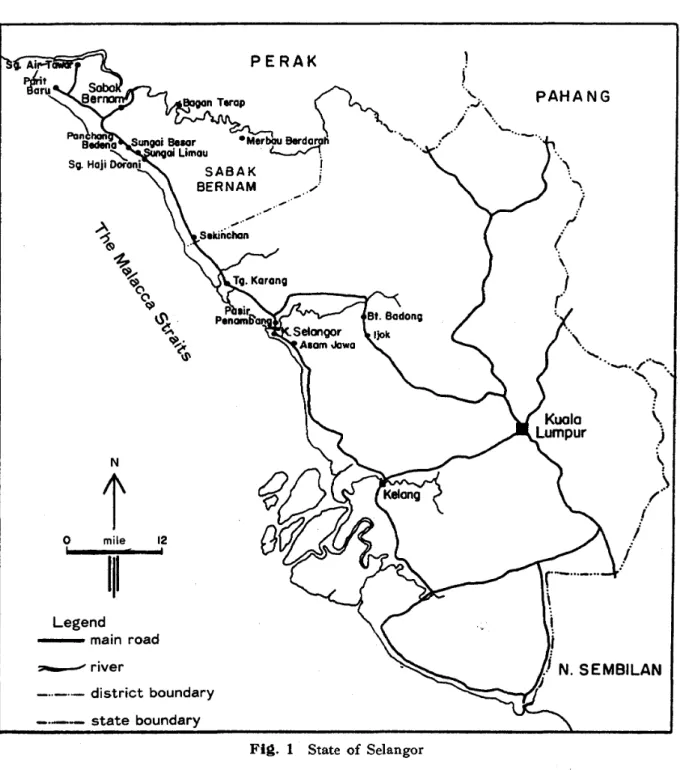
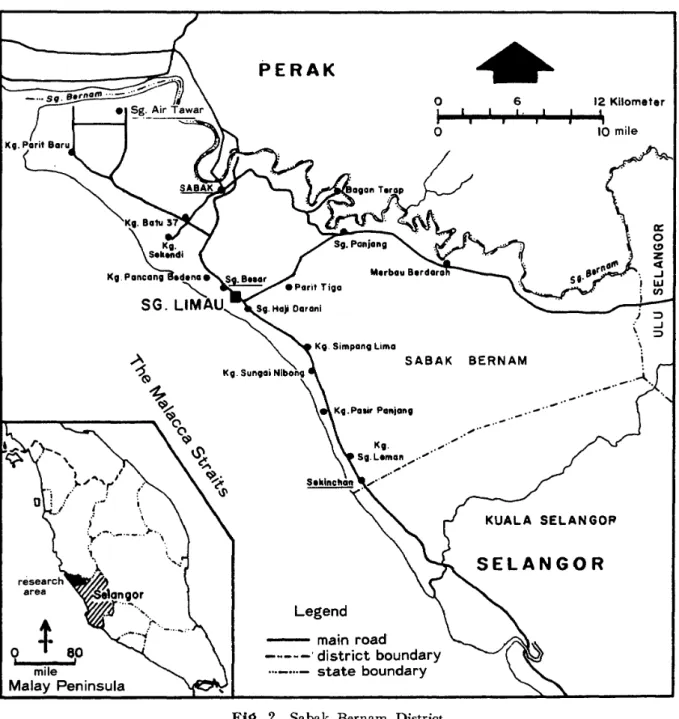
Kg. Sg. Limau is located in the western part of Sabak Bernam district. It is sepa-rated from the coast of the Malacca Straits only by an impenetrable mangrove swamp (Fig. 1, 2). A network of roads links the village with other areas in the district, in particular, the three important towns of the district, namely, Sabak Bernam and Sungai Besar, which are about 15 kilometres and 3 kilometres to the north, respectively, and Sekinchan, which is 23 kilometres to the south. Kuala Lumpur, the capital city of
Malaysia, is about 110 kilometres away. The village is made up to two agricultural areas, namely, rice and cocon ut. Of the village's 200 acres, about 130 acres are in coconut and about 70 acres in rice. The latter forms the "rice bowl" of Selangor, that is, the Sabak Bernam-Tanjung Karang area. The village has a mosque, five surau
_ .._.- district boundary _ .._-- state boundary Legend - - - main road ~river ""
.
...
" ' _ . / " ' . ". .
)
\.
)
"
:./'~
i
I
/
1
;'
"~" PAHA NG :',
I ". /"" ~...
_
... PERAK_T....
0\..,
·Mer~1i ... SABAK J BERNAM ../ 12 IIII
Nt
mile o,Fig. 1 State of Selangor
(small prayer houses), a primary school, and twelve shops. Other infrastructures of the village are listed in Table 1.
(b) Vt-1lage H<istory
The area whkh is now the village was opened up in 1918 by Malays of Javanese origin from Kampung Assam Jawa in the
neighbouring district to the south, that is, Kuala Selangor (Fig. 2). The early settlers grew rice and later planted coconut. To-gether with the Javanese, local Malays from within the district also settled in what is now Kg. Sg. Limau.
The first permanent settlers numbered about ten to twenty families. The rest was
mile Malay Peninsula KUALA SELANGOP SELANGOR a:: o (!) Z 4: -I W (I)
,
10 mile 12 Kilometer,
... 6•
.. -", .. -",0 ... oI
"
o
SABAK BERNAM Legend - main road _ .. _"-' district boundary "'-"'- state boundary PERAK*
ep
QFig. 2 Sabak Bernarn District
"occasional settlers" who spent part of a year at Kg. Sg. Limau as peasant cultiva-tors and the other part at Kg. Assam Jawa as wage-earners in privately owned planta-tions. It was not until 1935, when its pop-Ulation had become stable, th.at Kg. Sg. Limau was officially recognised as a bona fide village by the colonial government.
It was in fact the introd uction of a colonial
government irrigation scheme in 1932, at Pancang Bedena sub-district, in which part of the present Kg. Sg. Limau is located, that encouraged most of the pioneers and other, new migrants to settle permanently in the village. The first batch of these perma-nent settlers came from Kg. Sg. Air Tawar in Sabak Bernam district, led by the village leader Haji (Hj.) Hashim Ronosentono, who
-,; ;ta·
i
·If·.
.
.
.
..
-• -• -• -• -• -• If' • •• • , .,. 'If : 't "f • • • ••
='road '_···-:--·-kampung boundary ~coconut -house
=
'school -canal C":~:::::Jpadi field ~~mangroveswanp cshopm
mosque/surauFig. 3 Kampung Sg. Limau
was also known as kepala tebang, which lit-erally means the leader (kepala) of tree-cutting (tebang). Indeed, the pioneers had to invest a lot of time and labour to clear the area for cultivation.
Once settled, Hj. Hashim encouraged many of his family members and friends from other areas in Selangor, Perak and Johore to corne and make their homes in the newly established settlement. Although he was not officially appointed as the village head by the colonial government, for all in-tents and purposes he was leader to all the settlers in Kg. Sg. Limau. When rice was first cultivated in 1935, Hj. Hashim was officially appointed by the authorities as the village head. With his appointment Kg. Sg. Limau officially became a village.
Between 1932 and 1937, the colonial
government invested heavily in the construc-tion of an efficient irrigaconstruc-tion and drainage system for the coastal area stretching for about fifty miles from Air Tawar to Tanjung Kaiang (Fig. 1), in which Kg. Sg. Limau is located. Once this was completed, rice cultivation became an important economic activity to the villagers of the area, including Sg. Limau. During the construction of the irrigation networks many villagers were able to work as labourers and earned cash. Hj. Hashim himself became a sub-contractor and was responsible for the construction of a small section of the irrigation and drainage system. He was handsomely paid for the job. He thus became economically better estab-lished.
By early 1950s the villagers of Kg. Sg. Limau had been able to build their own
Table 1 A Comparison of Infrastructure in Sungai Limau, Sg. Besar and Sabak Bernam
Type of Infrastructure Sg. Limau Sg. Besar BernamSabak
l. Primary school Yes Yes Yes
2. Secondary school Yes Yes Yes
3. Bank No Yes Yes
4. Post office No Yes Yes
5. Health centre No Yes Yes
6. Private clinics No Yes Yes
7. Pawn shop No Yes Yes
8. Agricultural Machinery shop No Yes Yes
9. Agricultural goods shop Yes Yes Yes
10. Tractor workshop No Yes Yes
11. Petrol pump No Yes Yes
12. Police station No Yes Yes
13. Fire station No No Yes
14. Cinema No Yes Yes
15. Supermarket No Yes No
Source: Survey conducted in May 1987
mosque and a private primary school. The villagers bore the cost of both building the school and hiring the teachers. However, the school was taken over by the govern-ment in the late 19'50s and the mosque is now substantially extended and renovated. Tarmac roads linking the village and other areas were built and completed in 1965. Around the same time, a piped water supply was made available to the village, and electricity came at the end of 1970s.
(c) Populatz"on and Economz"c Actzvztz"es
The exact number of people settling in Kg. Sg. Limau in 1932 is not available, and neither is its population growth up to mid-1970. In 1976, I recorded the total
popula-tion of the village as 1,380 individuals be-longing to 248 households, and as of May 1987, it was 1,125 individuals belonging to 205 households. Except for one Indian
family, the rest of the population is mainly made up of Malays of Javanese origin. The Javanese could be further sub-divided into a number of smaller groups according to their place of origin in Java, namely, Ponorogo, Pacitan, Madiun, Kendal, Benyumas and Solo. There are smaller groups of local Malays and Banja.rese (from Bandjarmasin, Kalimatan, Indonesia) who formed the rest of the Malays in Kg. Sg. Limau.
The Malays of Javanese origin are mainly coconut growers. Some also grow rice and cocoa. Hence it is no surprise to find most of them residing amongst the coconut and cocoa trees In Kg. Sg. Limau. The
Banjarese seem to be most at home planting rice, and hence the pockets of homesteads in the rice fields of Kg. Sg. Limau are all Banjarese occupied. In the off-season most
Table 2 Main Occupations of Household Heads, Sg. Limau in 1987
Main Occupation 1. Agriculture and fishing
(a) Agriculture (b) Fishing
2. Non-agricultural and Non-fishing (a) Wage-earners Teachers Religious teachers Clerks NRB inspector Drivers Storekeeper
Government manual labourers Attendant Contract labourer (b) Self-employed Entrepreneurs Petty traders Mosque attendant Total
Source: Survey conducted in May 1987
Male Female Total
116 24 140 8 8 10 10 4 4 3 3 1 1 3 3 1 1 18 18 1 1 1 1 3 3 3 1 4 1 1 173 25 198
coast of the Malacca Straits. A small num-ber are also involved in the cultivation of coconut trees. The local Malays, on the other hand, seem most happy to fish at sea, though some of them own coconut holdings or rice lands on which they reside.
Not all villagers of Kg. Sg. Limau are agriculturalist or fishermen. About 25 percent of them subsist on non-fishing and non-agricultural activities. Of these, nearly 85 percent are wage-earners, mostly em-ployed by the government or semi- govern-ment authorities. The rest are self-employed mainly as petty entrepreneurs. It is also in-teresting to note that the local Malays, who are poorly educated, seem to dominate the low-paying jobs whilst the Javanese and Banjarese occupy the better-paid jobs
be-cause of their better educational qualifica-tions.
A more detailed indication on the distri-bution of economic activities amongst the villagers, especially amongst the 198 house-hold heads I studied in 1987, is found in Table 2, which shows the following useful information. Firstly, the majority of the household heads, 148 or 74.7 percent, are involved in fishing and agriculture, and 50 of them, or 25.3 percent are wage-earners or self-employed locally. It is important to note here that nearly 50 percent of the non-fishing and non-agricultural household heads also own land. A few of them complement their wage-earning activities with cultivation of foodcrops for their own consumption.
(d) Administration and Leadership
Since 1935, the village has had an official village head. Before independence in 1957, the role of the village head was mainly to oversee the daily social activities of the villagers and maintain peace and order. He also took care of the general welfare of the needy, besides ensuring that the rest paid their taxes on time.
For purposes of administrative efficiency, Kg. Sg. Limau was divided into two unoffi-cial administrative areas from 1935 to 1957, and from 1957 onwards into four. Each area has a "Community Leader" with a "Youth Leader" as his assistant. These designations were created by the villagers and not govern-ment initiated. Their role is minimal but important, particularly in cooperative cam-paigns or gotong royong and also during
weddings.
The religious leaders, namely Imam, B£lal
and Siak, form another important group of
village leaders. They not only conduct reli-gious services at the mosque and take care of the mosque, but also carry out important religious rituals in the village such as offi-ciating marriages, collecting tithes and so on. They are also the local cemetery caretakers. From 1947 onwards a mosque committee was set up to run the general administration of the mosque. The members include the
Imam, Bz1al and Sz·ak and four others,
namely, a Nazz'r (supervisor and chairman), the village head, "Community Leader," and the "Youth Leader."
After 1957, the structure of administration and leadership in Kg. Sg. Limau was changed due to three factors. First, the establishment of a Village Development
Committee in 1962; second, the setting up various village-level voluntary organizations in the mid- 1960s, such as the Youth Club and Farmers Association; third, the estab-lishment of a local branch of the UMNO (United Malays National Organization)-Malaysia's dominant partner in the ruling coalition-in 1971.
The Village Development Committee is set up to oversee the developmental efforts of the government at the village level. The village head automatically becomes chairman of the committee. At first it had eleven mem-bers but later increased to fifteen. The members are nominated and represent the various interest groups in the village, such as the youths, the women and the religious group. They are usually the leaders of these interest groups.
The voluntary organizations m Kg. Sg. Limau have their own programmes for their members. A formal committee for each group exists to run all the activities con-ducted by the group. An overlap of per-sonalities involved in these or ganizations is common. Hence they form the village elites.
Similarly, the UMNO branch of Sg. Limau has its own formal organizing com-mittee responsible for recruitment of new party members and organizing party activi-ties. It also has Women's and Youth Wings, each with a different set of committee mem-bers. Together they form the political leadership of the village. They are quite influential in view of the fact that the State Legislative Assembly of Selangor and the National Parliament of Malaysia are controlled by UMNO politicians. The
party channel forms an important conduit through which development benefits are distributed.
In short, Kg. Sg. Limau has at least two sets of leaders, one "old" and one "new." The "old" ones, such as the religious leaders and the village head, have been there since 1937. The "new" ones entered the village socio-political arena after the independence and with the introduction of the so-called development projects in the mid-1960s. Obviously, many of these leaders hold vari-ous posts, spanning the "old" and "new" spheres of leadership. As control of the developmental process is very much cen-tralized and mainly in the hands of local politicians, it is only natural for them to dominate the social life of Kg. Sg. Limau villagers.
Economic Change
(a) .Agricultural Sector
The two main agricultural activities of Kg. Sg. Limau are rice cultivation and coconut growing, and the village is thus also divided into two .agricultural areas. The cocon ut growing area has almost double the acreage of that planted with rice: 130 acres versus 70 acres. However, of the two, the rice growers seem to have received more atten-tion from the authorities, be it during the colonial or post-colonial period. This is because the government of the day has always been concerned to increase the food supply for the ever-increasing population, particUlarly the workforce in the extractive industries, such as cash crop plantations,
tin mining, transportation and so on. Thus a substantial amount of capital has been invested in many large irrigation schemes, one of which includes Kg. Sg. Limau. Coconut, though important, is not a staple food like rice is. Hence it never surpassed rice in importance, though it still receives government attention to a lesser degree. We shall now examine how this general trend affects Sg. Limau cultivators of rice and coconut.
Rice was first planted in Kg. Sg. Limau in 1932. Initially it was grown mainly for consumption and was complemented by coconut grown as a source of cash. However, after World War II, the rice producers of Kg. Sg. Limau managed to produce a sur-plus which they sold for cash. This they did in small portions as and when cash was needed.
Once they began to sell rice they had to establish contacts with Chinese rice millers of Teluk Intan, Perak and Bagan Terap, Selangor. These millers became the buyers of their surplus rice from the early 1950s. However, in 1963, a Rice Milling Coopera-tive of Sg. Limau was set up. Almost all rice growers of the village became members and sold their surpl us rice to the cooperative. Itwas, however, controlled by the rich pea-sants and landowners of the village. Owing to mismanagement and the lower rice prices which it offered, the cooperative became ineffective. Slowly the villagers began to sell their rice surpl us to the Chinese again, who offered not only a better price but also credit.
This situation was changed in the
double-crop-ping under the Green Revolution programme of the government and a new agricultural marketing body called Federal Agricultural Marketing Authority (FAMA). Double-cropping involved all the rice growers of Kg. Sg. Limau from 1965. New high-yield variety seeds were introduced along with new inputs such as chemical fertilizer and the use of agricultural machinery. Most of these facilities are made available to the villagers by the government on a subsidized basis. However, the cost of ploughing the rice fields, planting the seedlings and har-vesting have to be borne by the villagers. In short, there was a definite increase in pro-duction costs with the intropro-duction of the double-cropping.
The increased production cost, however, is easily recouped, for villagers can now pro-duce more surplus rice for sale. Slowly but surely the peasants ceased producing rice for subsistence. The resultant increase in pro-duction and income through double-crop-ping has also increased the price and rental for rice holdings. In the 1960's an acre of rice land was priced at M$5,000.00 and rented out for M$100.00 per season, but now the figures are M$15,000.00 and M$300.00, respectively. This trend has put into jeop-ardy the future of landless peasants who could afford neither to buy land nor rent. The richer peasants have considerably in-creased their incomes, through either work-ing on their own land or rentwork-ing it out, and through the sale of off-season crops.
FAMA became the main buyer for both rice ~nd non-rice produce of the Sg. Limau peasants. In 1972, when the National Rice Board (NRB) was set up by the government,
it became the sole buyer of rice thus replac-ing partly F AMA's function. However, by 1973, the peasants became unhappy with the monopolistic tendencies of both F AMA and NRB as expressed in their pricing of the rice and non-rice produce. Often their prices for both commodities were lower than the prevailing market price. As a reaction to the peasants' dissatisfaction, not only in Sg. Limau but elsewhere in Malaysia, NRB increased the ceiling of its price to a level more competitive with that of private buyers. Coconut growing in Kg. Sg. Limau has been equally challenging to the peasants. The marketing of the produce has been in the firm control of Chinese middlemen, who often offer unattractive prices. The peasants had no choice until F AMA was set up. Although F AMA buys coconut at a higher price, the majority of the coconut growers in Sg. Limau still sell their prod uce to the Chinese, to whom they are tied by the credit owed from before F AMA entered the scene. It was not until the early 1970's that this situation started to change when the govern-ment introduced cocoa to the coconut grow-ers. The new crop was grown between coco-nut seedlings. The coconut growers could therefore obtain two incomes from growing the two crops simultaneously. Should the cocon ut price fall, the income from cocoa growing would provide an economic cushion for the peasants. This new crop has boosted the economic position of most of the coconut growers in Sg. Limau.
However, the rice growers continue to re-ceive more help from the authorities, almost outdoing that received by the coconut grow-ers. Since 1986 the government has
in-troduced a "rice mini estate scheme" and combine harvesters to help to boost rice pro-duction in Sg. Limau and elsewhere in the "rice bowl" of Selangor. The mini estates are under the supervision of the Farmers Organization Authority (FaA).
All the rice land in Kg. Sg. Limau has been put together as a mini estate managed by FaA on the peasants' behalf with loans borrowed from the Agricultural Bank at 6 percent per annum using the peasants' lands as collateral. The "workers" in this mini estate are the owners of the land themselves, together with some local im-ported labour. They are both paid according to piece rate. Once the crop is harvested the income from the sale of the prod uce is expected to be triple that before the mini estate scheme. In other words, with the full use of modern technology and efficient management the same low-productivity plots could be transformed to high-productivity ones. The combine harvester is most useful in the process.
Three important consequences have re-sulted from the introduction of the mini estate concept in the context of the economic life of Kg. Sg. Limau villagers. Firstly, all rice land in the village is cultivated-there is no more idle land-and all work in the rice fields is bound by definite sched ule. Secondly, more and more elderly village folks have chosen to work in cocoa and coconut holdings instead of rice, hence avoiding the demanding work load and exacting schedule of rIce production. Thirdly, more unemployed village youths are now involved in the mini estate scheme as labourers, thus greatly reducing local
unem-ployment. Itis expected that when the big combine harvesters come into action some of the villagers whose livelihood depends on harvesting will be displaced. One wonders where they will go!
(b) Non-Agricultural Sector
In the 1960s almost all Sg. Limau vil-lagers survived by working on their agri-cultural plots, whether growing rice or other crops. The odd few who worked as wage-earners seldom worked in the village itself. But the situation changed in the late 1960s as the percentage working in the non-agricultural sector increased.
The increase is due to three main factors. Firstly, the increase in the number of the village youths who have received secondary ed ucation. They naturally sought jobs, mainly white-collar ones, outside the village. Secondly, concomitant to the first was the increase in the intake of new recruits into the government service, particularly at the lower levels, which enabled the secondary-ed ucatsecondary-ed youth to obtain employment in government departments like the Drainage and Irrigation Department, Department of Public Works and others. Thirdly, the ex-pansion of local bureaucracies such as the local government in and around Sabak Bernam enabled many youths from Kg. Sg. Limau to obtain jobs locally without having to migrate.
The increase of petty entrepreneurs from within Kg. Sg. Limau has been significant because of the opportunities created by the government through its pro- Malay New Economic Policy (NEP) launched in 1971. These new entrepreneurs, often involved in
sub-contracting especially of government-funded projects, employed many local youths and adults. Almost automatically they re-cruited people from Kg. Sg. Limau.
Changes in the Pattern of Social
Stratification
Changes in social stratification can be ob-served from three aspects. First, in terms of status change; second, in terms of class structure; and finally, in the context of power distribution. It must be emphasised these changes have to be understood in the context of the economic changes experienced by the villagers of Sg. Limau as previously described.
(a) Status Change
Since its inception in 1918 and up to the 1920s, one could say that because of their similar occupations and economic standing, the population of the pioneers was hardly differentiated in terms of status. Perhaps there were only two factors, both non-economic, which could have created differ-ences in status in the eyes of the villagers themselves, namely, personal qualities (sin-cerity, kindness, etc.) and religiosity. Both of these put individ uals in a special position from the social actor's point of view.
Such status differentiation came to be clearly expressed and accepted by the Sg. Limau villagers once rice production became a government-sponsored activity from 1932. The new and intensive rice-growing activity allowed some individuals to obtain more land to work on and hence to become not only landowners but also more well-to-do economically. Those with less labour or
capital and who were unable to take advan-tage of this new opportunity remained where they were. The rich, the not-so-rich, and the poor became real categories and social reference was made in terms of status.
When the new school was built in 1950, teachers came to reside in the village. Be-cause of their education or 'educatedness' and their ability to help the village folks to relate with the increasingly complex state bureaucracy, they became indispensible to the villagers. Coupled with the fact that education was seen as the only way out of poverty and/or to climb the social ladder, the local teachers were almost revered by the villagers. They therefore enjoyed a high status in the village.
In the late 1960s, when more and more of the educated youths of Sg. Limau became white-collar workers, this new social group began to receive respect from village folks. Their involvement in local politics, voluntary associations and so on further enhanced their status in the eyes of Sg. Limau villagers. Needless to say, the village elders, religious leaders, the rich and other "traditional leaders" of the village remained important and enjoyed much respect from all villagers, along with the "new educated group." Re-cently, however, politicians and college or university graduates have come to receive special respect and almost open deference from people in Sg. Limau. Politicians, be they local or national, are seen as "providers of development benefits," who can transform villages from poor to rich by introducing various projects and infrastructure. The grad uates, on the other hand, hold well-paid high-ranking jobs both in the public
Table 3 Household Heads of Sungai Limau and Their Class Categories
Class Categories Male Female Total
1- Landlords 3 9 12 2. Rich peasants 21 5 26 3. Middle peasants 56 8 64 4. Poor peasants 36 2 38 5. Petty fishermen 8 8 6. Entrepreneurs 3 3 7. Petty traders 3 1 4
8. Village middle class 19 19
9. Labourers 24 24
Total 173 25 198
Source: Survey conducted in May 1987
and private sectors. They represent the epitomy of successful Malays and hence have a high status in the villagers' eyes.
(b) Class Structure
People in Kg. Sg. Limau could be divided into at least nine classes (Table 3) based on my household heads survey. The "middle peasant class" was the first to appear and they were the pioneers. They owned and worked their own lands. The introduction of intensive rice production in 1932 engendered a new class, the "rich peasant class," who owned large plots ofland, which they worked using family labour. Around the same time a "petty fisherman class" came into exis-tence. They were mainly the children of the pioneers or the "middle peasant class" who preferred to become fishermen.
The class transformation experienced in Kg. Sg. Limau was most obvious after the mid-1960s. The "labourer class" appeared as a result of local government authorities re-cruiting many Sg. Limau villagers as la-bourers. The local "middle class" came into
existence as more and more villagers or new residents held white-collar jobs as teachers, clerks, office attendants and so on. There was also the "petty trader class" whose members were mainly sundry shop owners or coffee stall holders. A "landlord class" began to establish itself from the mid-1960s as in-tensive rice cultivation began to be stepped up by the government. However, most of them were elderly persons who could not work on their lands but had to rent them out, and they usually did not have really large land holdings.
The "middle peasant class," "rich peasant class" and "landlord class" continue to exist by taking advantage of the benefits from various government rural development pro-jects. They have also been transformed, as it were, from "traditional peasants" to "modern peasants" by their deep involvement in the double-cropping fostered by the government. Many of their children also received better education because they could afford to pay school fees, buy books and clothe their children. These children became the new local "middle class" when they became white-collar workers and worked in the village.
On the negative side, a new class of young and landless peasant began to emerge in the mid-1960s. They were children of the "middle peasant class" who owned small plots of land. These children had to work on others' land in the village both on share-cropping and rental basis. Some became agricultural labourers. This "poor peasant class" was there to stay by the early 1970s. The new "entrepreneur class" is a product of the N EP. Most of them are children of
the "rich peasant class," the "landlord class" and the "middle peasant class" who used their parents' land holdings as collateral for loans from local banks and launched new business ventures. One of them is Mahbot Hj. Hashim, currently the village head of Sg. Limau, whose father was the leader of the pioneers. He owns a petrol station.
The detailed evolution of these classes is an interesting aspect of the social life of Kg. Sg. Limau which I intend to study deeper in my next field research. It should reveal new, interesting information on the expansion of some classes and the demise of others owing to the present economic recession and politi-cal problems in Malaysia.
(c) The Distribution of Power
The distribution of power in Kg. Sg. Limau is closely associated with the class and status positions discussed previously. It is also inevitably linked to the economic changes elaborated in the first half of this report. Therefore, it is against this background that the following discussion must be made in order to get more meaningful insights.
Between 1918 and 1932, it is almost im-possible to pinpoint those individuals with and without power in Kg. Sg. Limau. The one exceptio'nis Hj. Hashim, the leader of the pioneers and owner of a considerable acreage of rice and coconut holdings, who stood high above everyone in Sg. Limau. When the colonial government accorded the village official status in 1935, Hj. Hashim was the automatic choice as its .head. And for the next 37 years, until 1972, when he died, he remained the unchallenged leader and powerful landowner of Kg. Sg. Limau.
Below him were two groups of local leaders, namely, the "Community Leaders" and the "Youth Leaders." Both of these groups were particularly important in the following con-texts: first, during gotong royong or public
cooperative exercises, and second during weddings. They were usually rich peasants. The power distribution in Kg. Sg. Limau became more diffuse from the early 1960s, after the introduction of the Village Devel-opment Committee. Since then more and more individuals in the village became in-volved, directly or indirectly, in the decision-making process governing the course of village development. Between ten to fifteen individuals of Kg. Sg. Limau were members of this new village-level committee, half of whom were new faces. They were rich peasants, teachers, office workers and so on. At present, beside the village head, who is also the chairman of the committee, the secretary is also influential in the village. Because he is in-charge of running the com-mittee and organizing meetings with high-level bureaucrats and politicians, he now controls the important channel that links the village with the important personnels in de-velopment outside the village. He now ranks third behind the village head and the local UMNO branch chief in terms of "powerful-ness" in the villagers' eyes.
The UMNO branch chief commands the deference of nearly all the villagers because he is often associated with the State Legis-lative Assembly Member and the Member of Parliament of the district. Usually the villagers refer important matters to the UMNO chief, who then relays them to the powers that be at the local, state, or national
levels. The establishment of the UMNO Youth and Women's Wings creates two more important individ uals. These party leaders are either rich peasants or their children. Teachers are equally active in local politics. Another set of individ uals with power in Kg. Sg. Limau was created when voluntary organizations such as the Youth Club, Women's Organization and Farmers Coop-erative were established. Each of these or-ganizations has its own formal committees. The members of these committees do not wield that much power individually. But as a group, they form the increasingly im-portant local elites.
It must be mentioned that many of these individuals hold multiple official positions in the various formal committees of the existing organizations in Kg. Sg. Limau. If one were to construct a network of the spheres of activities of these individuals one would notice these lingkages and overlappings. Therefore, at the highest level in the village, four or five individuals could be identified as influential and powerful leaders. The second rung of leaders may be less powerful, but they remain important in the context of the political process and power distribution in Sg. Limau.
Conclusion
In the economic sphere, the most impor-tant source of change has been the "Green Revolution," under which the irrigation and double-cropping programme are imple-mented. This affects the agriculturalists of Kg. Sg. Limau greatly, but not the
non-agriculturists. The latter have been affected more by developments outside the village, especially those generated by the govern-ment efforts to expand its services.
In the social sphere, educational qualifi-cations and political positions have rear-ranged status positions in the village. In terms of class formation, many new classes have been created as a result of changes in the economic sphere. Social mobility has also become more fluid. Power distribution amongst the villagers has been affected by the host of changes mentioned above.
The internal dynamics of these changes and details of their causes and consequences will be examined in detail in the forthcoming main field research from April to July 1988. Hopefully, the new data will reveal more exciting information on the social formation in Kg. Sg. Limau.
Bibliography
Beteille, A. 1965. Caste, Class and Power.
Berkeley, Los Angeles: University of Cali-fornia Press.
Federated Malay State. 1935. Annual Report.
Kuala Lumpur: Government Printer. Husin Ali, S. 1977. Masyarakat dan PtOmpt·nan
Kampung dt: Malayst"a. Kuala Lumpur: Fajar
BaktL
Mohamed Salleh Lamry.1978. Modernisasi Perta-nian di Kalangan Pesawah dan Pekebun Kelapa Tani Melayu: Satu Kajian Kes di Kampung Sungai Limau, Sabak Bernam. MA thesis, Universiti Kebangsaan Malaysia. Narkswadi, U.; and Selvadurai, S. 1968. Eco-nomt'c Survey of Padt· Productz"on t·n West Malaysta. Kuala Lumpur: Ministry of Agri-culture and Cooperatives Malaysia.
Weber, M. 19480 From Max Weber: Essays t·n Sociology, edited by H. H. Gerth; and C. W.