Note on markaracter tables of finite groups
Hossein Shabani, Ali Reza Ashrafi and Modjtaba Ghorbani
(Received July 9, 2015; Revised November 20, 2016)
Abstract. The markaracter table of a finite group G is a matrix obtained from
the mark table of G in which we select rows and columns corresponding to cyclic subgroups of G. This concept was introduced by a Japanese chemist Shinsaku Fujita in the context of stereochemistry and enumeration of molecules. In this note, the markaracter table of generalized quaternion groups and finite groups of order pqr, p, q and r are prime numbers and p≥ q ≥ r, are computed. AMS 2010 Mathematics Subject Classification. 20C15, 192E10.
Key words and phrases. Markaracter table, finite group.
§1. Introduction
Let G be a finite group acting transitively on a finite set X. Then it is well-known that X is G−isomorphic to the set of left cosets G/H = {(e = g1)H,· · · , gmH}, for some subgroup H of G. Moreover, two transitive G−sets
G/H and G/K are G−isomorphic if and only if H and K are conjugate. If U is a subgroup of G, then the mark βX(U ) is defined as βX(U ) =|F ixX(U )|,
where F ixX(U ) = {x ∈ X : ux = x, ∀u ∈ U}. Set Sub(G) = {U|U ≤ G}.
The group G is acting on Sub(G) by conjugation. Assume that the set of orbits of this action is ΓG/G ={GGi }ri=1, where G1(= 1), G2, . . ., Gr(= G) are
representatives of the conjugacy classes of subgroups of G and|G1| ≤ |G2| ≤ · · · ≤ |Gr|. The table of marks of G, is the square matrix M(G) = (Mij)ri,j=1,
where Mij = βG/Gi(Gj) [3]. This table has substantial applications in isomer
counting [1]. For the main properties of this matrix we refer to the interesting paper of Pfeiffer [14].
The matrix M C(G) obtained from M (G) in which we select rows and columns corresponding to cyclic subgroups of G is called the markaracter table of G. It is merit to mention here that the markaracter table of finite groups was firstly introduced by Shinsaku Fujita to discuss marks and charac-ters of a finite group in a common basis. Fujita originally developed his theory
to be the foundation for enumeration of molecules [4]. We encourage the inter-ested readers to consult papers [5, 6, 7] for some applications in chemistry, the papers [2, 11] for applications in nanoscience and two recent books [8, 9] for more information on this topic. We also refer to [10], for a history of Fujita’s theory.
The cyclic group of order n and the generalized quaternion group of order 2n are denoted by Zn and Q2n, respectively. The number of rows in the
markaracter table of a finite group G is denoted by N RM (G). Our other notations are standard and mainly taken from the standard books of group theory such as, e.g., [13, 15].
§2. Main Result
The aim of this section is to calculate generally the markaracter tables of groups of order p, pq and pqr, where p, q and r are distinct prime numbers and p > q > r.
Theorem 2.1. Suppose G is a finite group, M C(G) = (Mi,j) and G1, G2, . . ., Gr are all non conjugated cyclic subgroups of G, where |G1| ≤ |G2| ≤ · · · ≤ |Gr|. Then
a) The matrix M C(G) is a lower triangular matrix, b) Mi,j|M1,j, for all 1≤ i, j ≤ r,
c) Mi,1= |G|G|i|, for all 1≤ i ≤ r,
d Mi,i= [NG(Gi) : Gi],
e if Gi is a normal subgroup of G then Mij is|G|/|Gi| when Gj ⊆ Gi, and
zero otherwise.
Proof. The proof follows from definition and the fact that Mi,j = βG/Gi(Gj) =
|F ixG/Gi(Gj)| = |{xGi | Gj ⊆ xGix−1}|.
As an immediate consequence of Theorem 2.1, the markaracter table of a cyclic group G of prime order p can be computed as:
Table 1. The Markaracter Table of Cyclic Group of Order p, p is Prime.
M C(G) G1 G2
G/G1 p 0
where G1 = 1 and G2 = G.
Suppose A and B are m× n and p × q matrices, respectively. The tensor product A⊗ B of matrices A and B is the mp × nq block matrix:
A⊗ B = a11B · · · a1nB .. . . .. ... am1B · · · amnB .
Lemma 2.2. Suppose that G1 and G2 are two finite groups with co-prime orders. Then the markaracter table of G1 × G2 is obtained from the tensor product of M C(G1) and M C(G2) by permuting rows and columns suitably. Proof. Let A, A1 and A2 be the set of all non-conjugate cyclic subgroups of G1 × G2, G1 and G2, respectively. Suppose that U = ⟨u⟩ ∈ A1 and V = ⟨v⟩ ∈ A2, then U × V is a cyclic group generated by (u, v). So, U × V is conjugate with a cyclic subgroup in A. On the other hand, if H =⟨h⟩ ∈ A, then h = (u, v) such that u∈ G1, v∈ G2 and gcd(o(u), o(v)) = 1. Then there are U ∈ A1 and V ∈ A2 conjugate with ⟨u⟩ and ⟨v⟩, respectively, such that H = U × V . Therefore, NRM(G1 × G2) = N RM (G1)N RM (G2) and the result follows from Theorem 2.1.
Let G be a cyclic group of order n = pα1
1 . . . aαrr. Then Lemma 2.2 shows
that M C(Zn) = M C(Zpα1
1 )⊗ . . . ⊗ MC(Zp
αr
r ). Let p be a prime number and
q be a positive integer such that q|p − 1. Define the group Fp,q to be presented
by Fp,q = ⟨a, b : ap = bq = 1, b−1ab = au⟩, where u is an element of order
q in multiplicative group Z∗p [13, Page 290]. It is easy to see that Fp,q is a
Frobenius group of order pq.
Theorem 2.3. Let p be a prime number and q be a positive integer such
that q|p − 1 and q = qα1
1 q
α2
2 . . . qsαs be its decomposition into distinct primes
q1 < q2 < · · · < qs. Suppose τ (n) denotes the number of divisors of n and
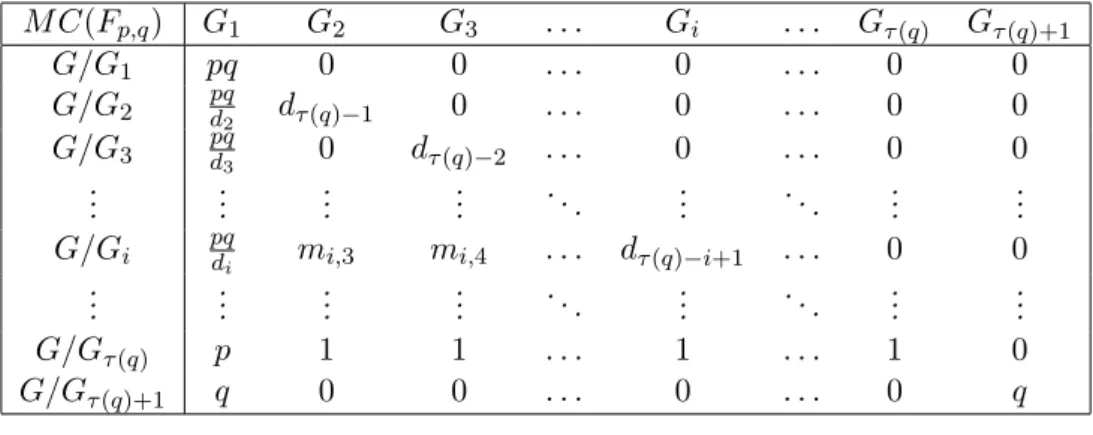
d1 <· · · < dτ (q) are positive divisors of q. Then the markaracter table of the
Frobenius group Fp,q can be computed as Table 2.
Proof. The group Fp,q has order pq and its non-conjugate cyclic subgroups
are Gi = ⟨ bki⟩ where ki = dqi for 1 ≤ i ≤ τ(q) and Gτ (q)+1 = ⟨a⟩. Set
M C(Fp,q) = (Mi,j). The first column of this table can be computed from
Theorem 2.1 (c). The normalizer of Gi, 1 < i ≤ τ(q), is equal to ⟨b⟩ and so
for each 1 < i≤ τ(q), we have Mi,i = dqi = dτ (q)−i+1. But by Sylow theorem,
Gτ (q)+1 is normal subgroup of Fp,q and by using Theorem 2.1, Mτ (q)+1,1 =
Mτ (q)+1,τ (q)+1= q and Mτ (q)+1,j = 0, where 2≤ j ≤ τ(q) − 1.
Since Mi,j =|{xGi | Gj ⊆ xGix−1}|, 1 < j < i ≤ τ(q), Gj ⊆ xGix−1 if and
of Gi in Gτ (q). Finally, this equals to dqi if and only if dj|di. This completes
the proof.
Table 2. The Markaracter Table of the Frobenius Group Fp,q.
M C(Fp,q) G1 G2 G3 . . . Gi . . . Gτ (q) Gτ (q)+1 G/G1 pq 0 0 . . . 0 . . . 0 0 G/G2 pqd2 dτ (q)−1 0 . . . 0 . . . 0 0 G/G3 pqd3 0 dτ (q)−2 . . . 0 . . . 0 0 .. . ... ... ... . .. ... . .. ... ... G/Gi pqd
i mi,3 mi,4 . . . dτ (q)−i+1 . . . 0 0
.. . ... ... ... . .. ... . .. ... ... G/Gτ (q) p 1 1 . . . 1 . . . 1 0 G/Gτ (q)+1 q 0 0 . . . 0 . . . 0 q where mi,j = { q di, dj|di 0, o.w. .
Corollary 2.4. Let p and q be two prime numbers such that p > q and G
is isomorphic to Fp,q. Then the group Fp,q has three non-conjugate subgroups
G1 = ⟨id⟩, G2 = ⟨a⟩ and G3 = ⟨b⟩ and the markaracter table of Fp,q is as
follows:
Table 3. The Markaracter Table of Non-abelian Group of Order pq.
M C(Fp,q) G1 G2 G3
G/G1 pq 0 0
G/G2 p 1 0
G/G3 q 0 q
where |G1| = 1, |G2| = q and |G3| = p.
Suppose G(p, q, r) be the set of all groups of order pqr where p, q and r are distinct prime numbers with p > q > r. H¨older [12] classified groups in G(p, q, r). By his result, it can be proved that all groups of order pqr, p > q > r, are isomorphic to one of the following groups:
• G1=Zpqr,
• G2=Zr× Fp,q(q|p − 1),
• G3=Zq× Fp,r(r|p − 1),
• G4=Zp× Fq,r(r|q − 1),
• Gi+5 = ⟨a, b, c : ap = bq = cr = 1, ab = ba, c−1bc = bu, c−1ac = av
i
⟩, where r|p − 1, q − 1, o(u) = r in Z∗q and o(v) = r inZ∗p (1≤ i ≤ r − 1). Theorem 2.5. Let p, q and r be prime numbers such that p > q > r and
G ∈ G(p, q, r). Then the markaracter table of G has one of the following shapes: 1. M C(G) = M C(Zp)⊗ MC(Zq)⊗ MC(Zr), 2. M C(G) = M C(Fp,q)⊗ MC(Zr)(q|p − 1), 3. M C(G) = M C(Fp,r)⊗ MC(Zq)(r|p − 1), 4. M C(G) = M C(Fq,r)⊗ MC(Zp)(r|q − 1), 5. M C(G) = M C(Fp,qr)(qr|p − 1),
6. M C(G) = M C(Gi+5) (r|p−1, q−1) and the markaracter table MC(Gi+5)
is as follows:
Table 4. The Markaracter Table of Group G ∼= Gi+5 of Order pqr.
M C(G) H1 H2 H3 H4 H5 G/H1 pqr 0 0 0 0 G/H2 pq 1 0 0 0 G/H3 pr 0 pr 0 0 G/H4 qr 0 0 qr 0 G/H5 r 0 r r r
Proof. If G ∼= G1, then the markaracter table of G can be computed by The-orem 2.1. If G is isomorphic to G2, G3 or G4 then by applying Lemma 2.2 and Corollary 2.4, the result is obtained. If G is isomorphic to G5 then the markaracter of G can be computed directly from Theorem 2.3. It is remained to compute the markaracter table of groups G ∼= Gi+5.
Let G = Gi+5 for 1 ≤ i ≤ r − 1. It is easy to see that ⟨aα⟩ = ⟨aβ⟩,
⟨bδ⟩ = ⟨bη⟩, ⟨cθ⟩ = ⟨cλ⟩ and ⟨bµaν⟩ = ⟨bρaφ⟩, where 1 ≤ α, β, ν, φ ≤ p − 1,
1 ≤ δ, η, µ, ρ ≤ q − 1 and 1 ≤ θ, λ ≤ r − 1. Therefore, all of non-conjugate cyclic subgroups of G are ⟨id⟩, ⟨a⟩, ⟨b⟩, ⟨ab⟩, ⟨c⟩. Let H1 = ⟨id⟩, H2 = ⟨c⟩, H3 =⟨b⟩, H4 =⟨a⟩ and H5 =⟨ab⟩. One can easily check that NG(H2) = H2
and NG(H3) = NG(H4) = NG(H5) = G and so by applying Theorem 2.1, the
entries of diagonal and the first column of markaracter table can be calculated. Since p, q, r are distinct prime numbers, M3,2 = M4,2 = M4,3= M5,2 = 0 and the proof is completed.
We notice that by our results, the markaracter table of cyclic groups Zpqr,
Table 5. The Markaracter Table of Cyclic Groups G ∼= Zpqr, p < q < r are Primes. M C(G) H1 H2 H3 H4 H5 G/H1 pqr 0 0 0 0 G/H2 pq pq 0 0 0 G/H3 pr 0 pr 0 0 G/H4 qr 0 0 qr 0 G/H5 r 0 r r r
In the end of this paper, we compute the markaracter table of the general-ized quaternion groups. For n≥ 3, the generalized quaternion groups can be defined as:
Q2n = (Z2
n−1⋊ Z4)
⟨(2n−2, 2)⟩ ,
where the semi-direct product has group law (a, b)(c, d) = (a + (−1)bc, b + d). The order of Q2n is equal to 2n.
Theorem 2.6. The markaracter table of G ∼= Q2n is as follows:
M C(Q2n) G1 G2 G3 G4 G5 G6 · · · Gr G/G1 2n 0 0 0 0 0 · · · 0 G/G2 2n−1 2n−1 0 0 0 0 · · · 0 G/G3 2n−2 2n−2 2n−2 0 0 0 · · · 0 G/G4 2n−2 2n−2 0 2 0 0 · · · 0 G/G5 2n−2 2n−2 0 0 2 0 · · · 0 G/G6 2n−3 2n−3 2n−3 0 0 2n−3 · · · 0 .. . ... ... ... ... ... ... . .. ... G/Gr 2 2 2 0 0 2 · · · 2
where r is the number of non-conjugate subgroups of G. Proof. Suppose a = (1, 0) and b = (0, 1). It is well-known that,
• |⟨a⟩| = 2n−1 and |⟨b⟩| = 4,
• a2n−2
= b2, bab−1 = a−1 and for all g ∈ Q2n \ ⟨a⟩, g has order 4 and
gag−1 = a−1,
• the elements of this group have the forms ax or ayb where x, y ∈ Z,
• the 2n−2+ 3 conjugacy classes of Q
2n with representatives 1, a, a2, . . . ,
a2n−2−1, a2n−2, b, ab.
Therefore, all non-conjugate cyclic subgroups of Q2n are⟨b⟩, ⟨ab⟩ and all
non-conjugate subgroups of⟨a⟩. Note that the table obtained from removing the rows and columns 3 and 4, is equal to the markaracter table of Z2n−1.
Acknowledgments
The authors are indebted to the referee for his/her suggestions and helpful remarks. The research of the first and second authors are partially supported by the University of Kashan under grant no 159020/183 and the third author is partially supported by Shahid Rajaee Teacher Training University under grant no 29226.
References
[1] C. Alden Mead, Table of marks and double cosets in isomer counting, J. Am. Chem. Soc. 109 (1987), 2130–2137.
[2] A. R. Ashrafi and M. Ghorbani, A note on markaracter tables of finite groups, MATCH Commun. Math. Comput. Chem. 59 (2008), 595–603.
[3] W. Burnside, Theory of groups of finite order, The University Press, Cambridge, 1987.
[4] S. Fujita, Dominant representations and a markaracter table for a group of finite order, Theor. Chim. Acta 91 (1995), 291–314.
[5] S. Fujita, Markaracter tables and Q-conjugacy character tables for cyclic groups. an application to combinatorial enumeration, Bull. Chem. Soc. Jpn. 71 (1998), 1587–1596.
[6] S. Fujita, The unit-subduced-cycle-index methods and the characteristic-monomial method. Their relationship as group-theoretical tools for chemical combinatorics, J. Math. Chem. 30 (2001), 249–270.
[7] S. Fujita and S. El-Basil, Graphical models of characters of groups, J. Math. Chem. 33 (2003), 255–277.
[8] S. Fujita, Diagrammatical Approach to Molecular Simmetry and Enumeration of Stereoisomers, Mathematical Chemistry Monographs, No. 4, University of Kragujevac, 2007.
[9] S. Fujita, Combinatorial Enumeration of Graphs, Three-Dimensional Structures, and Chemical Compounds, Mathematical Chemistry Monographs, No. 15, Uni-versity of Kragujevac, 2013.
[10] S. Fujita, Type-itemized enumeration of RS-stereoisomers of octahedral com-plexes, Iranian J. Math. Chem. 7 (2016), 113–153.
[11] M. Ghorbani, Remarks on markaracter table of fullerene graphs, J. Comput. Theor. Nanosci. 11 (2014), 363–379.
[12] H. H¨older, Die Gruppen der Ordnungen p3, pq2, pqr, p4, Math. Ann. XLIII (1893), 371–410.
[13] G. James and M. Liebeck, Representations and characters of groups, Cambridge University Press, Cambridge, 1993.
[14] G. Pfeiffer, The subgroups of M24 or how to compute a table of marks, Experi-ment. Math. 6 (1997), 247–270.
[15] H. Shabani, A. R. Ashrafi and M. Ghorbani, Rational Character Table of some Finite Groups, J. Algebraic Sys. 3 2 (2016), 151–169.
Hossein Shabani
Department of Pure Mathematics, Faculty of Mathematical Sciences, University of Kashan, Kashan 87317-51167, I. R. Iran
E-mail : [email protected] Ali Reza Ashrafi
Department of Pure Mathematics, Faculty of Mathematical Sciences, University of Kashan, Kashan 87317-51167, I. R. Iran
E-mail : [email protected] Mosjtaba Ghorbani
Department of Mathematics, Faculty of Science,
Shahid Rajaee Teachers Training University, Tehran, I. R. Iran E-mail : [email protected]