Lowering Rate of Freshness and Relative
Thermo-stabilities of Actomyosin-ATPase of
Muscles of Some Fish from Amami Island Sea
著者
NISHIMOTO Jun-ichi, ELOMINA Rene L., MIKI
Hidemasa
journal or
publication title
鹿児島大学水産学部紀要=Memoirs of Faculty of
Fisheries Kagoshima University
volume
30
page range
405-409
別言語のタイトル
奄美大島産魚類筋肉の鮮度低下速度およびアクトミ
オシンATPaseの温度安定性
Vol. 30 pp. 405-409 (1981)
Lowering Rate of Freshness and Relative Thermo
stabilities of Actomyosin-ATPase of Muscles of
Some Fish from Amami Island Sea
Jun-ichi Nishimoto*, Rene L. Elomina* and Hidemasa Miki*
Abstract
To determine the freshness qualities of fish caught from the fishing grounds of Amami Island, the fishK-values at 0, 10,20 and 30°C,and alsothe thermo-stabilities of the actomyosin-ATPase at 20, 25, 30, 35 and 40°C were monitored.
The rate constant (K/) of the decrease in the remaining K-values washighestin Yumekasago>
Sokohobo>Mahata>Sokodara>Ohmonhata>Ohhime at low temperatures. On the other
hand, the first order rate constant (Ad) of the inactivation of actomyosin-ATPase was highest
in Sokohobo at 30°C. The actomyosin of Mahata and Ohhime appeared to be more stable
than Sokohobo, Yumekasago, Sokodara and Ohmonhata.
Compared with frigid water fish at 30°C, the actomyosin of the above sub-tropical fish was
apparently more unstable.
As a key to handling and storage of fish, one fundamental information that must
be known is the inherent capacity of the fish to maintain its freshness at varying
temperatures. Some fish are very sensitive to temperature effect but others have
been noted to deteriorate less even on prolong storage.
Thisproperty can be regarded
as inherent with the fish species1'2) and perhaps may vary with the place of catch,
being of different ambient temperatures. For measurement of freshness of fish,the degradation of ATP (Adenosine 5'-triphosphate) related compounds (K-value)
coupled with the characteristic actomyosin-ATPase (AM-ATPase) activity are usually
monitored. These information on freshness quality of most common fish such asmackerel, cod and trout have already been made known, but for others which may
have far economic importance like the fish from sub-tropical sub-deep sea, they are
yet to be reported.
In this regard, this studydealt on the fish coming from the fishing
grounds of Amami Island, a sub-tropical sea north of Ryukyu Island.Materials and Methods
Sample preparation
Fresh frozen fish from the fishing grounds of Amami Island namely Ohmonhata
(Epinephelus areolatus), Ohhime (Pristipomoides filamentosus), Mahata (Epinephelus
* Laboratory of Food Preservation Science, Faculty of Fisheries, Kagoshima University.406 Mem. Fac. Fish., Kagoshima Univ. Vol. 30 (1981)
spetemfasciatus), Yumekasago (Helicolemus hilgendorfi), Sokodara (Coryphaenoides sp.),
Sokohobo (Peterygotrigle hemisticta) and Tsumaritsunozame (Squalus megalops) were
placed in —706C freezer and withdrawn on sampling. Anterior dorsal muscles
were ground and used for determination of AM-ATPase activities at 20, 25, and 30°C. Ground whole fish muscles which were kept at 0, 10, 20 and 30°C were used
for determination of K-values.
Chemical analyses
A. K-value3) Muscle perchloric acid extract was chromatographed through Dowex 1x4 (CI", 50-100 mesh) with dilute HC1 and NaCl, and the fractionated nucleotides were read at 250 nm. The K-value was calculated by Saito's formula4). B. AM-ATPase activity The AM solution was prepared using the method of
Takashi et al.5). The solution was incubated at 20, 25 and 30°C and then reacted
with ATP substrate at 25°C for 5 minutes. The liberated phosphorus was measured by Fiske-Sabbrow's method6).
Results and Discussion
Lowering offreshness
The freshness of the fish sample muscle apparently. decreased. with ..time and ..the
logarithm of the decrease, log (100-K), gave characteristically straight lines in all the fish sample muscles. This suggests that the decomposition of ATP and its de
rivatives followed a first order reaction, and as such the deterioration rate constants
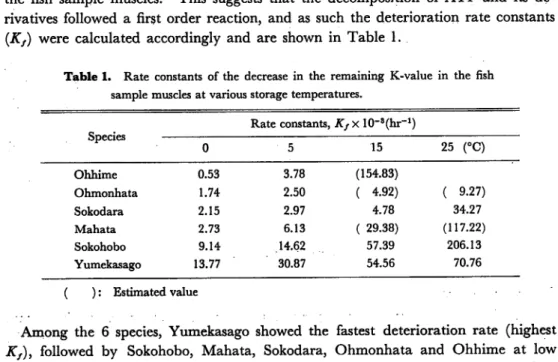
(Kf) were calculated accordingly and are shown in Table 1.
Table 1. Rate constants of the decrease in the remaining K-value in the fish sample muscles at various storage temperatures.
Rate constants,/^xlO-^hr-1) Species 0 5 15 25 (°C) Ohhime 0.53 3.78 (154.83) Ohmonhata 1.74 2.50 ( 4.92) ( 9.27) Sokodara 2.15 2.97 4.78 34.27 Mahata 2.73 6.13 ( 29.38) (117.22) Sokohobo 9.14 .14.62 57.39 206.13 Yumekasago 13.77 30.87 54.56 70.76 ( ): Estimated value
Among the 6 species, Yumekasago showed the fastest deterioration rate (highest
Kf), followed by Sokohobo, Mahata, Sokodara, Ohmonhata and Ohhime at low
fast-deteriorating at low keeping temperatures. In fact, they are even faster than known
fast-deteriorating Saba (mackerel) and Hanafuedai2) (Tropidinus ameonus) from Ryukyu
fishing grounds.
Thermostabilities of the AM-A TPase activities
Apparently in Fig. 1, the logarithm of the remaining specific AM-Ca2+-ATPase activities of the samples decreased with incubation period at 20, 25 and 30°C (at 35 and 40°C in the case of shark muscles), and the decrease was greater at higher
temperatures. The plots of log remaining specific AM-Ca2+-ATPase activities with
incubation time were linear with correlation coefficient ranging from 0.9 to 1.0 indicating almost perfect linearity and first-order nature of the reaction. Accordingly, the inactivation rate constants (Kd) were calculated. The first-order rate constants of the inactivation of the AM-ATPase activities evidently increased with temperature (Table 2). The order of their thermo-stabilities at 30°C was as follows: Mahata> Ohhime> Ohmonhata> Sokodara> Yumekasago > Sokohobo.
The thermo-stabilities of the shark muscle AM-Ca2+-ATPase activities however
were higher than any of the samples at 30°C.
Effect of temperature on the inactivation of AM-Ca2+-ATPase in the dorsal muscles of samples
The rates of inactivation of AM-Ca2+-ATPase on incubation for definite periods
Yumekasago w 0 S -2 0 10 20 30 40 0 10 20 30 40 0 10 20 30 40 0 10 20 30 40 Sokodara Time (min.)
Sokohobo Aozame Tsumaritsunozame
X
•\
N.
\ .
\ .
V
0 10 20 30 - 40 0 10 20 30 40 0 10 20 30 40 0 10 20 30 40 Time (min.)Fig. 1. Logarithm of activities of actomyosin Ca2+-ATPase from the dorsal muscles as a function
of time.
408 Mem. Fac. Fish., Kagoshima Univ. Vol. 30 (1981)
Table 2. Rate constants of the inactivation of actomyosin Ca2+-ATPase from the dorsal muscle of samples in 0.6 M KC1 at various temperatures.
Rate constants (Kd) (X10~4/sec)
20 25 30 35 40 (°C) Ohmonhata 2.4 5.8 13.7 — — Ohhime 1.9 5.2 11.5 — — Mahata 1.7 3.6 8.3 — — Yumekasago 3.9 8.8 17.9 — — Sokodara 2.5 4.0 16.3 — — Sokohobo 2.0 10.1 27.0 — — Aozame — — 1.0 2.1 11.7 Tsumaritsunozame — — 1.1 2.5 12.8
as affected by temperature were measured and their curves are shown in Fig. 2. The temperature at which approximately fifty percent of the ATPase activity was lost within 30 minutes varied among AM of the various fish species. Shark muscles gave high stability even at about 30°C, while Mahata gave at about 27.8°C, Sokodara about 25.6°C, Ohhime about 23.0°C, Ohmonhata about 22.6°C, and Yumekasago
about 20.2°C.
100
30
Temp. ( °C )
Fig, 2. Effect of temperature on inactivation of actomyosin Ca3+-ATPase from the dorsal muscle of samples (pH 6.8 for 30 min).
O: Aozame, A : Tsumaritsunozame, • : Mahata, • : Ohhime, A : Sokodara, • : Ohmonhata, <g): Yumekasago
Many investigators7'8-9) have reported that the thermo-stabilities of the AM or
myofibrils-ATPase prepared from dorsal muscles of epipelagic and mesopelagic and
ofvarious fish species living in the frigid water zone were very unstable.
Comparing
the rate constants and the temperatures of fifty percent reduction in the activity
with representative frigid water fish like Atka mackerel and Alaska pollack, the sub
tropical fish have generally lower values. In other words, the AM of the muscles of Sokohobo, Yumekasago and Sokodara can be said to be more unstable than those of
frigid water fish.
While it has been considered that the thermo-stability of
AM-ATPase in the fish muscle is adapted to the fish environmental temperature7*10), the
finding of this experiment showed otherwise.
For confirmation, it will be necessary to check whether the thermo-stability
ofAM-ATPase of the muscles of the sub-tropical fish samples are more unstable than those
of frigid water fish.
Acknowledgment
This work was supported in part by a special project research fund from the Edu
cation Ministry (Head: Professor Tadao Takahashi, Kagoshima University). The
authors are grateful to Mr. Nakajima for his technical assistance.
References
1) S. Ehira and H. Uchiyama: Bull. Japan. Soc. Sci. Fish., 40, 479-487 (1974). 2) J. Nishimoto and H. Miki: Mem. Fac. Fish., Kagoshima Univ., 28, 65-72 (1979). 3) H. Kobayashi and H. Uchiyama: Bull. Tokai Reg. Fish. Res. Lab., 61, 21-26 (1970). 4) T. Saito, K. Arai and M. Matsuyoshi: Bull. Japan. Soc. Sci. Fish., 24, 749-750 (1959). 5) R. Takashi, K. Arai and T. Saito: Bull. Japan. Soc. Sci. Fish., 36, 169-172 (1970). 6) C. Fiske and Y. Sabbarow: J. Biol. Chem., 66, 375-400 (1925).
7) K. Arai, K. Kawamura and C. Hayashi: Bull. Japan. Soc. Sci. Fish., 39, 1077-1085 (1973).
8) H. Uchiyama, N. Kato, Y. Kudo and K. Arai: Bull. Japan. Soc. Sci. Fish., 44, 491-497 (1978). 9) K. Yabe, K. Nakamura, M. Suzuki and Y. Ito: Bull. Japan. Soc. Sci. Fish., 44, 1345-1350 (1978).