Studies on the Sterol Metabolism in Marine
Crustaceans
著者
TESHIMA Shinichi
journal or
publication title
鹿児島大学水産学部紀要=Memoirs of Faculty of
Fisheries Kagoshima University
volume
21
number
2
page range
69-147
別言語のタイトル
海産甲殻類のステロール代謝に関する研究
Mem. Fac. Fish., Kagoshima Univ. Vol. 21, No. 2, pp. 69-147 (1972)
STUDIES ON THE STEROL METABOLISM IN MARINE CRUSTACEANS*
Shin-ichi Teshima**
Contents Page
INTRODUCTION 69- 71
Part-1. Sterol Composition of Marine Crustaceans 71— 77
Part-2. Sterol Biosynthesis in Marine Crustaceans 77— 83
A. Sterol-synthesizing ability in the carnivorous crustaceans, the lobster, Panulirus japonica, the prawn, Penaeus japonicus, and the crab, Portunus
trituberculatus
B. Sterol-synthesizing ability in the herbivorous crustacean, Artemia salina
Part-3. Sterol Requirements of Marine Crustaceans: Sterol Requirements of the Prawn,
Penaeus japonicus 83— 86
Part-4. Utilization of Dietary Sterols by Marine Crustaceans 87— 91
A. Utilization of the dietary sterols by Artemia salina
B. Utilization of the dietary sterols by the prawn, Penaeusjaponicus
Part-5. Bioconversion of Sterol Molecules in Marine Crustaceans 91 —110 A. Bioconversion of ergosterol to cholesterol in Artemia salina
B. Bioconversion of ergosterol to cholesterol in the crab, Portunus trituberculatus C. Bioconversion of 24-methylcholesterol to cholesterol in Artemia salina
D. Bioconversion of brassicasterol to cholesterol in Artemia salina
E. Bioconversion of ^-sitosterol to cholesterol in the prawn, Penaeus japonicus Part-6. Distribution and Fate of Cholesterol in the Lobster, Panulirusjaponica 110—114 Part-7. Bioconversion of Cholesterol to Steroid Hormones in the Lobster, Panulirus
japonica 114—121
Part-8. Metabolism of Steroid Hormones in Marine Crustaceans: Biosynthesis of Steroid Hormones in the Crab, Portunus trituberculatus 121—137
A. Bioconversion of non-radioactive progesterone by the slices of the ovaries B. Bioconversion of progesterone-4-14C by the slices of the ovaries C. Bioconversion of progesterone-4-14C by the slices of the testes
Part-9. ABSTRACT 137-142
ACKNOWLEDGEMENT 142
REFERENCES 142-147
INTRODUCTION
Sterols are present in all aminals, plants, and microorganisms except bacteria as a constituent of lipids. In higher animals, cholesterol is found from their tissues as * %t)\\j<^^:$£^tilM'X (Thesis submitted for the degree of Doctor of Agriculture at the University
of Kyushu, 1972)
** W&%±¥7kM¥%7kM\t¥W£& (Laboratory of Fisheries Chemistry, Faculty of Fisheries.
70 Mem. Fac. Fish., Kagoshima Univ. Vol. 21-2 (1972)
a main sterol.
In marine invertebrates, belonging to the more primitive animals,
however, there is a great diversity in the occurrence and distribution of sterols as compared with higher animals. For example, (1) a number of sterols differing in the number and position of double bonds in rings or side-chain, or the attachment to the side-chain of substituents such as alkyl groups at C-24 occur in marine invertebrates; (2) a certain family or class of marine invertebrates contains one or more sterols in addition to cholesterol in their tissues; (3) some marine invertebrates contain other
sterols in stead of cholesterol as a main sterol.
The above facts are interesting in the
viewpoint of comparative biochemistry.
Bergmann (1952, 1962) has discussed the
relationship between the species of animals and the types of sterols. However, the
relationship is not fully established on account of the difficulty in separating completely
the sterol mixtures occurring in marine animals, especially minor components. On the other hand, no report has been presented on the metabolism of sterols in marine invertebrates except a few mollusks, although it has been suggested that the
sterol metabolism in marine invertebrates is not necessarily similar to that of higher
animals.
For this reason, the followings are conceivable: (1) The pure sterols are not
obtainable from commercial sources except for a few sterols; (2) the separation of
sterols with a closely related structure is not always easy; (3) it is relatively difficult to cultivate marine crustaceans by the diet composed of chemically known substances;
(4) the suitable radioactive sterols can not be prepared so easily by chemical methods.
Recently, the culture of marine crustaceans not to speak of the prawn, Penaeus japonicus, has been practiced in the various districts of Japan. However, the nutri
tional requirements of these crustaceans have not been well establisehd. In the
insects, belonging to the same arthropods as marine crustaceans, it is generally recog
nized that most insects lack sterol-synthesizing ability from acetate and/or mevalonate and require sterols as a diet for their normal growth in contrast with higher animals. Hence, the author has attempted to clarify the metabolism of sterols in marine crus taceans.
On the sterol composition of marine crustaceans, there are only a few reports although this class embraces a great number of species. An early investigation has demonstrated that cholesterol is regarded as a typical sterol for marine crustaceans. In exceptional case, the barnacle, Balanus glandula, was found to contain a relatively large amount of 24-dehydrocholesterol(35%) in addition to cholesterol (65%) (Fager-lund & Idler, 1957). However, the sterol compositions reported in an earlier report may be somewhat corrected, because the identification of sterols was not performed by sensitive method such as gas-liquid chromatography (GLC). In the present study, therefore, the sterol composition of the several marine crustaceans was first clarified by GLC prior to the investigation of sterol metabolism in them. Next, the sterol-synthesizing ability was investigated on the lobster, Panulirus japonica, the prawn, P.
japonicus, the crab, Portunus trituberculatus, and Artemia salina. From the above experi ments, it was assumed that most marine crustaceans lack sterol-synthesizing ability
Teshima: Sterol Metabolism in Marine Crustaceans 71
prawn, P. japonicus, it was also demonstrated by the nutritional experiment that this crustacean requires sterols as a diet. The above results suggested that the sterols found in marine crustaceans originate from exogenous sources and some endogenous sterols are derived from dietary C28- and C29-sterols. Hence, the utilization and bioconversion of dietary sterols were investigated by the feeding trials and tracer tech niques. In addition, for the purpose of clarifying some function of sterols in marine crustaceans, the distribution and fate of exogenous cholesterol in the tissues and the bioconversion of cholesterol to steroid hormones were examined by use of the lobster,
P. japonica. Furthermore, the in vitro bioconversion of progesterone by the slices of the
ovaries and testes of the crab, P. trituberculatus, was investigated in order to clarify the steroidgenesis in marine crustaceans.
The present paper deals with the results of the above experiments.
The trivial names and the corresponding systematic names used in this paper are as follows: Cholesterol, cholest-5-ene-3£-ol; 22-dehydrocholesterol, cholest-5, 22-diene-3j8-ol; desmostrol, cholest-5, 24-diene-30-ol; brassicasterol, 24(S)-24-methyl-cholest-5,22-diene-3/S-ol; campesterol, 24 (R)-24-methylcholest-5-ene-3^-ol; 24-methylenecholesterol, ergost-5, 24(28)-diene-3^-ol; ergosterol, ergost-5, 7, 22-triene-3£-ol; stigmasterol, stigmast-5, 22-diene-3j8-ol; ^-sitosterol, stigmast-5-ene-3j3-ol; proge sterone, pregn-4-ene-3, 20-dione; 17a-hydroxyprogesterone, 17a-hydroxy-pregn-4-ene-3, 20-dione; androstenedione, androst-4-ene-3, 17-dione; testosterone, androst-4-ene-17/3-ol-3-one; deoxycortico sterone, 21-hydroxy-pregn-4-ene-3, 20-dione; corticosterone, 11)3, 21-dihydroxy-pregn-4-ene-3, 20-dione; cortisone, 17or, 21-dihydroxy-pregn-4-ene-3, 11, 20-trione; Cortisol, 11£, 17a, 21-trihydroxy-pregn-4-ene-3, 20-dione; 11-deoxycortisol, 17a, 21-dihydroxy-pregn-4-21-trihydroxy-pregn-4-ene-3, 20-dione; 11jQ-hydroxyandro-stenedione, 11j9-hydroxy-androst-4-ene-3, 17-dione; 11-ketotestosterone, 17jS-hydroxy-androst-4-ene-3,
11-dione; la-hydroxycorticosterone, la, lljS, 21-trihydroxy-pregn-4-ene-3, 20-dione.
Part-1. Sterol Composition of Marine Crustaceans
It is a well-known fact that some marine invertebrates contain a variety of sterols
in their tissues. The occurrence and distribution of the sterols in animals were
extensively reviewed by Bergmann (1952, 1962) and by Austin (1970). The diversity of sterols in marine invertebrates is of interest in the viewpoint of both chemotaxonomy and comparative biochemistry. In the early studies, however, the separation of closely related sterols is not always complete for lack of a suitable isolation method. Recently, Kritchevsky et al. (1967) have shown by using gas-liquid chromatography (GLC) that a certain crab contains 22-dehydrocholesterol (3.9%), cholesterol (57.4%), brassicasterol (36.7%), and 24-methylenecholesterol (2.0%) as a sterol. Further more, Idler and Wiseman (1968) have demonstrated by GLC that the Alaskan king crab, Paralithodes camtschatica, and the North Atlantic queen crab, Chionoecetes opilio, contain six and three sterols in adidtion to cholesterol, respectively, and they have pointed out that these crabs contain a relatively large amount of desmosterol which was found only in the chick embryo (Stokes et al., 1956) and the barnacle, Balanus
72 Mem. Fac. Fish., Kagoshima Univ. Vol. 21-2 (1972)
glandula, (Fagerlund & Idler, 1957). Considering these results, the sterol composi tion of marine crustaceans reported in early papers should be reinvestigated by a more sensitive method, especially on the minor sterols.
Therefore, the author attempted to clarify the composition of naturally occurring sterols in marine crustaceans prior to the investigation of sterol metabolism in them. This part deals with the sterol composition of the several marine crustaceans, the sterols of which have not been shown so distinctly.
Materials and Methods
Crustaceans. The lobster, Panulirus japonica, prawn, Penaeus japonicus, and crab,
Portunus triberculatus, were obtained from the commerical sources, in July, 1969. The Amphipoda, Caprella sp., and Mysidaces, Neomysis intermedia, were collected at the Hanase-point and Shibushi-bay in Kagoshima, respectively, in June, 1969. The three species of mantis crabs, Gonodactylus chiragra, Gonodactylusfalcatus, and Odontodactylus
scyllarus, were caught on the seashore of Zamami Island in Okinawa during the
August in 1969, and they were pooled in acetone until use.
Isolation of sterols. The lobster, prawn, crab, and Mysidacea were minced with a meat mincer, and the lipids were extracted with chloroform-methanol accord ing to the method of Bligh and Dyer (1959). The Amphipoda was extracted with ether in a Soxhlet apparatus for 48 hours after being bried below 70°C. In the case of the mantis crabs, the samples pooled in acetone were filtered through a glass filter, and then the lipids were extracted with ether from the residues by using a Soxhlet apparatus. The nitrate and ether extract were combined and concentrated under reduced pressure with a rotary evaporator. The lipids so obtained from the eight species ofmarine crustaceans were saponified with 10% solution of potassium hydroxide in 90% aqueous ethanol, and then non-saponifiable materials were extracted with ether in the usual manner. The sterols were isolated from the non-saponifiable materi als by the digitonin-precipitation method (Idler & Baumann, 1952) or by the column chromatography on alumina (grade II, Merck) (Van den Oord, 1964). In the column chromatography, the elution was carried out with hexane, hexane-benzene (1: 1), benzene, benzene-ethyl acetate (9: 1), benzene-ethyl acetate (85: 15), and ethyl acetate-methanol (96:4), successively. The presence of sterols in the eluates was checked by thin-layer chromatography on Kiesel gel G (Merck) with benzene-ethyl acetate (4: 1). The sterols on the plate were detected by spraying cone, sul furic acid -ethanol (1: 1, v/v) followed by heating 5 minutes at 100-105°C.
GLC of sterols. The sterols so isolated were purified by recrystallization from methanol and subjected to GLC. During the present study, a Shimadzu gas-chro-matographic unit, model GC-3AF, with dual hydrogen flame inonization* detectors was used. The identification of sterols was performed by using at least two or more different columns. In the use of the column 1.0% NGS-1.0% XE-60 (1:1), the sterols were trimethylsilylated (Luukkainen et al., 1961) and then subjected to GLC. The operating condition in GLC is shown in Table 1. Stigmasterol and desmosterol
Teshima : Sterol Metabolism in Marine Crustaceans 73
were purchased from Gas-chrokogyo Co., Ltd. Ergosterol and cholesterol were
obtained from Nakarai Chemicals Co. and purified by recrystallization from methanol.
^-Sitosterol obtained from Tokyo Chemicals Co. Ltd. was determined to be the
mixture of ^-sitosterol and campesterol (1:1) by GLC on 1.5% SE-30 and mass
spectral analysis. 22-Dehydrocholesterol, brassicasterol, and 24-methylenecholesterol
were isolated in this laboratory from the red alga, Porphyridium cruentum, the diatom,
Cyclotella nana, and the clam, Tapes philippinarum, respectively.
Table 1. The operating condition in GLC.
Column packing Column length Column temp. (°C)
Hydrogen (kg/cm2) 1.5% SE-30 on 60-80 mesh Chromosorb W 2.0 mx4mm I. D. 225 1.0 1.5% OV-17 on 80-100 mesh Shimalite W 3.0mx4mm I. D. 233 1.0
1.0% XE-60 on 60-80 mesh Chromosorb W 2.0mx4mm I. D. 205 1.0
1.0% NGS-1.0% XE-60 (1:1, v/v) 2.5 mx4mm I. D. 215 0.75
on 60-80 mesh Chromosorb W * Nitrogen: 2.0 kg/cm2
Infrared and mass spectral analyses. Infrared absorption spectrum was obtained with a Nippon Bunko DS-301 spectrometer in chloroform. Mass spectrum was measured on a Hitachi RMU-6D instrument (chamber volatage, 70 eV).
Results and Discussion
Recently, for the purpose of clarifyingthe sterol compositionof marine invertebrates
the several workers have attempted to separate the sterol mixtures by GLC. Conse
quently, the problem of separating the sterol mixtures occurring in these animals
appears to be completely resolved by the use of GLC. Idler etal. have reported that
a variety of sterols in the red algae (Idler etal, 1968) and the crabs (Idler & Wiseman,
1968) are separable by the GLC usinga combined systemof3% NGS-3% XE-60 (1: 1)
and 14 ft column. In spite of good separation, however, there is only the inconvenience that the GLC adopted by them was considerably time-consuming. In the present study, their method was slightly modified as follows: Sterols were subjected to GLC as trimethylsilyl derivative instead of methyl ether and analyzed by using 1.0% NGS-1.0% XE-60 (1:1) and 2.5 m of column. As shown in Table 2, the sterol mixture containing brassicasterol and desmosterol which have not been separated by the GLC using a usual column was separated in considerably short times.
The content and composition of the sterols isolated from the eight species of the marine crustaceans examined in the present study are given in Tables 3 and 4. All crustaceans examined were found to contain mainly cholesterol as a sterol, although considerable differences were perceived in the content and composition of sterols among these species. In the case of the Amphipoda, prawn, Mysidacea, however, other sterols such as 22-dehydrocholesterol, brassicasterol, desmosterol, and 24-methylene cholesterol were detected as a minor component. Fig. 1 shows the results of GLC of the sterols isolated from the Amphipoda. 22-Dehydrocholesterol was contained
74 Mem. Fac. Fish., Kagohsima Univ. Vol. 21-2 (1972)
Table 2. Relative retention time of sterols in GLC.
Relative retention time
Sterol Column
SE-30 XE-60 OV-17 NGS-XE-60*
Cholestane 1.00 (8.80) 1.00 (4.20) 1.00 (8.50) — 22-Dehydrocholesterol 1.67 4.26 1.69 0.90 Cholesterol 1.83 4.29 1.79 1.00 (18.4) Brassicasterol 2.04 5.02 — 1.07 Desmosterol 2.04 5.03 2.00 1.20 24-Methylenecholesterol 2.32 — — 1.28 Ergosterol 2.20 5.98 2.19 1.43 Campesterol 2.34 6.61 2.29 1.31 Stigmasterol 2.59 6.00 2.51 1.40 ^-Sitosterol 2.93 8.01 2.84 1.63
The trimethylsilyl derivative of sterols was subjected to GLC. ( ): Retention time (min.)
Table 3. Content of sterols in the marine crustaceans.
Animal Total fresh Lipids Non-sap. materials Sterols
weight (g) g (%) g (%) g (%) Lobster 200.0 6.12 (3.1) 2.03 (1.02) 0.455 (0.22) Prawn 30.0 0.74 (2.5) 0.20 (0.65) 0.019 (0.064) Crab 143.0 3.50 (2.4) 0.21 (0.15) 0.024 (0.017) Amphipoda 7.50* 0.43 (5.8) 0.16 (2.10) 0.014 (0.019) Mysidacea 1000 16.3 (1.6) 2.10 (0.21) 0.69 (0.069) G. chiragra 700 14.6 (2.1) 3.67 (0.52) 0.15 (0.021) G.falcatus 46.6 0.56 (1.2) 0.32 (0.69) 0.003 (0.07) 0. scyllarus 31.2 0.71 (2.3) 0.15 (0.49) 0.001 (0.03) dry weight v_
y
U'
0 10 20 30Retention time ( min.)
Fig. 1. GLC on 1.0% NGS-1.0% XE-60 (1: 1) of the
sterols from the Amphipoda.
1, 22-dehydrocholesterol; 2, cholesterol;
Teshima: Sterol Metabolism in Marine Crustaceans
Table 4. Percentage composition of the sterols isolated from the eight species of crustaceans determined by GLC. Sterol % Composition D 22-Dehydrocholesterol — 3 — 4 3 Cholesterol 100 90 100 73 78 Brassicasterol — — — — 9 Desmosterol — — — 22 — 24-Methylenecholesterol — 7 — 1 10 Stigmasterol — trace
^-Sitosterol — trace — — trace
100 100 C o •H w to o> u u P-4 A; lobster, P. japonica B; prawn, P. japonicus C; crab, P.trituberculatus D; Amphipoda, Caprella sp. 3000 2200 E; Mysidacea, N. intermedia F; mantis crab, G. chiragra G; mantis crab, G.falcatus H; mantis crab, G. scyllarus
1700 1300 Wave number 1050 (cm ) 850 H 100
Fig. 2. Infrared spectra of the sterol (A) isolated from the mantis crab, G. chiragra,
and authentic cholesterol (B).
76 Mem. Fac. Fish., Kagoshima Univ. Vol. 21-2 (1972)
in the Amphipoda (4%), the prawn (3%), and the Mysidacea (3%). 24-Methylene-cholesterol was found in the above three species of crustaceans. Desmosterol and brassicasterol were present in the Amphipoda (22%) and the Mysidacea (9%), respec tively. In the case of the crab, lobster, and three species of mantis crabs, the isolated sterol was composed of only cholesterol. On the sterol isolated from the mantis crab,
G. chiragra, the sterol was further analyzed by infrared absorption and mass spectro
metries in order to confirm the identification The results are shown in Figs. 2 and 3. The infrared spectrum of the sterol from the mantis crab was identical with that of authentic cholesterol. Also, the mass spectrum of this sterol showed one molecular ion peak at m/e 386 corresponding to cholesterol.
if) C 386 368 A 275
"'1
J
353ill
2731
1
255 . 246 231 ,ll 1 213 386 368 B 275 371 , J 3531
j!" i
255 246 II 231 ,il 213ll
400 300 m/eFig. 3. Mass spectra of the sterol (A) isolated from the mantis crab, G. chiragra, and
authentic cholesterol (B).
The other peaks were interpreted as follows: m/e 371 (M+-CH3), 368 (M+-HOH), 353[M+-(CH3+HOH)], 275 [M+-(HOH+C7H9)], 273 (M+-R, R=alkyl side chain), 255 [M+-(R+HOH)], 246 [M+-(R+27)], 231 [M+-(R+42)], and 213 [M+-(R+42+HOH)] (Knights, 1967). These results indicated that the sterol of
this crab is identical with cholesterol.
As stated above, it was demonstrated that some crustaceans contain other sterols besides cholesterol. In the present study, however, it was obscure whether these sterols originate from exogenous or endogenous sources. On the other hand, it is a
well known fact that the minor sterols contained in the marine crustaceans are also
found in some algae and marine animals as a major sterol. Accordingly, it may be assumed that some sterols occurring in crustaceans originate from exogenous sources
such as diets.
Summary
In this part, the composition of naturally occurring sterols in the lobster, Panulirus 200
Teshima: Sterol Metabolism in Marine Crustaceans 77
japonica, prawn, Penaeus japonicus, crab, Portunus trituberculatus, Amphipoda, Caprella sp., Mysidacea, Neomysis intermedia, and three species of mantis crabs, Gonodactylus chiragra, Gonodactylus falcatus, and Odontodactylus scyllarus, was investigated mainly by using GLC. The results obtained are as follows:
1) The sterols isolated from the eight species of crustaceans were mainly composed of cholesterol (73-100%).
2) In the case of the prawn, Amphipoda, and Mysidacea, several sterols besides cholesterol were contained as minor constituents. The prawn was found to contain 22-dehydrocholesterol (3%), 24-methylenecholesterol (7%), stigmasterol (trace), and ^-sitosterol (trace) in addition to cholesterol (90%). The Amphipoda contained 22-dehydrocholesterol (4%), desmosterol (22%), and 24-methylenecholesterol (1%) besides cholesterol (73%). The Mysidacea contained 22-dehydrocholesterol (3%), brassicasterol (9%), 24-methylenecholesterol (10%), ^-sitosterol (trace), and cholesterol (78%).
3) On the other hand, the lobster, crab, and three species of mantis crabs were found to contain only cholesterol as a sterol.
Part-2« Sterol Biosynthesis in Marine Crustaceans
It is commonly recognized that animals are capable of synthesizing cholesterol from acetate via squalene. As an exceptional case, it was shown that the insects possess no ability for sterol-synthesis and require cholesterol or other sterols as a diet for their normal growth (Bloch et al., 1956; Clark & Bloch, 1959a; Kodicek & Levinson, 1960; Robbins et al., 1960; Kaplanis et al., 1961; Sedee, 1961). The utilization of sterols by insects was extensively reviewed by Clayton (1964). Recent ly, it has been found that several marine invertebrates are incapable of synthesizing cholesterol from acetate or mevalonate as also occurs in insects. The crab, Cancer
pagurus (Van den Oord, 1964), the crayfish, Astacus astacus (Zandee, 1922, 1964a,
1966a, b; Gosselin, 1965), and the lobster, Homarus gammarus (Zandee, 1964b, 1967a), were shown to be incapable of incorporating acetate-1-14C and/or mevalonate-2-14C into squalene and cholesterol. In other marine invertebrates, it has also been reported that the sea urchin, Paracentrotus lividus (Salaque et al., 1966), the whelk, Buccinum
undatum (Voogt, 1967b), the oyster, Ostrea gryphea (Salaque et al., 1966), the cuttle
fish, Sepia offcinalis (Zandee, 1967b), and the Japanese holothurian, Stichopus japonicus (Nomura et al., 1969) lack ability for sterol synthesis. However, the mussel, Mytilis californianus (Fagerlund & Idler, 1960), the clam, Saxidomus giganteus (Fagerlund & Idler, 1960), the snails, Helix pomatia (Addink & Ververgaert, 1963) and Arion
rufus (Voogt, 1967a), and some marine Annelida (Wooton & Wright, 1962) have
been demonstrated to synthesize their sterols from acetate and mevalonate.
On the other hand, it was demonstrated that some marine invertebrates contain
78 Mem. Fac. Fish., Kagoshima Univ. Vol. 21-2 (1972)
Paralithodes camtschatica, was shown to contain 22-dehydrocholesterol (3.1 %), cholesterol
(61.3%), brassicasterol (1.7%), desmosterol (31.1%), 24-methylenecholesterol (< 0.1%), ^9-sitosterol (0.8%), fucosterol (<0.1%) and unknown components (1.0%) (Idler & Wiseman, 1968). The source of these sterols was obscure although it has been assumed that some originate from the diets. In investigating the sterol metabolism of marine invertebrates, therefore, sterol-synthesizing ability should be first clarified because it appears to be different according to the species of marine animals.
In this part, the sterol-synthesizing ability of the carnivorous crustaceans, the lob ster, prawn, and crab, and the herbivorous crustacean, Artemia salina, was investigated by using acetate-1-14C as a tracer.
A. Sterol-synthesizing ability in the carnivorous crustaceans, the lobster,
Panulirus japonica, the prawn, Penaeus japonicus, and the crab,
Portunus trituberculatus.Materials and Methods
Animals and injection of acetate-l-14C. Three species of marine crustaceans, lobster, prawn, and crab, were obtained from the Subtropical Marine Biological Laboratory, Kagoshima, in August 1969. During the experimental period, these animals were kept in a circulatory trough at 20-22°C, and no food was given to them. One lobster, 200 g body weight, was injected three times with acetate- 1-14C at inter vals of 24 hours. Each injection consisted of 30/zCi of sodium acetate-1-14C (specific activity, 50.0 mCi/mM) in 0.1 ml of distilled water. By a similar method, two prawns, 30 g total body weight, and one crab, 143 g body weight, were injected twice with
\2fjC\ and 10 fiCi of acetate-1-14C, respectively.
Isolation of lipids. At 2 days after the last injection, the experimental animals were killed by freezing at —20°C. All tissues of the animals were chopped up with a meat mincer and homogenized for 2 minutes in a Waring Blender. The lipids were extracted from the homogenates with chloroform-methanol (Bligh & Dyer, 1959), and saponified with 2N potassium hydroxide in 80% methanol for 3 hours. The saponification mixtures were filtered, and the non-saponifiable materials and fatty acids were separated by extraction with ether in the usual manner. In the case of the lobster, the non-saponifiable materials were separated into the various fractions by column chromatography on alumina (grade II). The elution was carried out with hexane, hexane-benzene, benzene-ethyl acetate and ethyl acetate-methanol successively (Van den Oord, 1964). The crude sterol fraction, eluted with benzene-ethyl acetate (85: 15), was purified by thin-layer chromatography (TLC) on Kiesel gel G using benzene-ethyl acetate (4: 1) as a solvent, and then recrystallized several times from methanol. The hydrocarbon fraction, eluted with hexane, was subjected to TLC using heptane-hexane (3: 2) and the crude squalene fraction was isolated. The
Teshima: Sterol Metabolism in Marine Crustaceans 79
plate, and then squalene was extracted with petroleum ether and subjected to the
measurement of radioactivity. The presence ofsqualene in the eluate was investigated
by gas-liquid chromatography (GLC) on 1.5% SE-30. In the case of the prawn
and crab, the sterols were isolated from the non-saponifiable materials by the
digitonin-precipitation method (Idler & Baumann, 1952).
After decomposing by pyridine,
the sterols so obtained were purified by recrystallization from methanol. The com
position of the purified sterols was investigated by GLC using two different columns,
1.5% SE-30 and 1.0% NGS-1.0% XE-60 (1: 1). The details of the operatingcondi
tions in GLC have been described in part-1.
Measurement of radioactivity.
The radioactivity of the materials was measured
with a Beckman liquid scintillation counter, model LS-150. The toluene solu
tion of 2,5-diphenyloxazole (PPO) (0.6%) and 2,2/-j&-phenylene-bis-5-phenyoxazole
(POPOP) (0.02%) was usedas a scintillator.
The efficiency ofcountingofradioactive
materials was approximately 65 per cent.
Results
After injection of acetate-1-14C, the radioactivity of the lipid fractions isolated
from the lobster, prawn, and crab was measured. The results are shown in Tables5, 7, and 9. In GLC, the sterols isolated from these crustaceans were composed of
the following components:
Lobster (cholesterol, 100%), prawn (cholesterol, 90%;
22-dehydrocholesterol, 3%; 24-methylenecholesterol, 7%) and crab (cholesterol,
100%). In all crustaceans, a relatively high radioactivity was recovered in the fatty
acids and non-saponifiable materials. These results indicated that the animals utilized
acetate for the synthesis of fatty acids and some non-saponifiable materials.
In
all animals, however, the sterols were labelled to a strikingly low degree in comparison
with the other lipid fractions, and the radioactivities of the sterols were rapidly lost
according to the consecutive crystallizations as shown in Talbes 6, 8, and 10.
Finally,
nosignificant radioactivity was found in thesterols from the threespecies ofcrustaceans.
In the case of the lobster, the hydrocarbon fraction was chromatographed by TLC
and the crude squalene fraction was obtained.
In GLC, however, no squalene was
Table 5. Radioactivity of the lipid fractions isolated from the lobster, P. japonica,
after injection of acetate-1-14C.
Weight
Radioactivity
Lipid fraction Total activity Specific activity
(mg) (dpm) (dpm/mg)
Total fresh weight 200,000 — —
Non-saponifiable materials 2,034 2,560,000 1,260
Fatty acids 1,028 732,000 712
Hydrocarbon fraction 698 2,530,000 3,370
Crude squalene fraction* 42.0 280,000 6,970
Crude sterols 12.9 3,920 304
80 Mem. Fac. Fish., Kagoshima Univ. Vol. 21-2 (1972)
Table 6. Recrystallization of the sterols
isolated from the lobster, P. japonica
Crystallization 1 st 2 nd 3 rd Specific activity (dpm/mg) 112 32.3 0
Table 7. Radioactivity of the lipid fractions isolated from the prawn, P. japonicus, after injection of acetate-1-14C.
Weight
Radioactivity
Lipid fraction Total activity Specific activity
(nig) (dpm) (dpm/mg)
Total fresh weight 30,000 — —
Total lipids 741 980,000 1,320
Non-saponifiable materials 195 501,000 2,570
Fatty acids 170 136,000 797
Crude 3jQ-sterols* 19.2 2,230 116
Table 8. Recrystallization of the 3£-sterols isolated from the prawn, P. japonicus.
Specific activity (dpm/mg) Crystallization 1 st 2 nd 3 rd 90.5 22.2 0
Table 9. Radioactivity of the lipid fractions isolated from the crab, P. trituberculatus,
after injection of acetate-1-14C.
•
Weight
Radioactivity
Lipid fraction Total activity Specific activity
(mg) (dpm) (dpm/mg)
Total fresh weight 143,000 — —
Total lipids 3,501 1,690,000 483
Non-saponifiable materials 2,112 785,000 372
Fatty acids 342 50,400 148
Crude 3 /3-sterols* 4.8 390 81.3
* Obtained by the digitonin -precipitation method
Table 10. Recrystallization of the
3£-sterols isolated from the crab, P.
trituberculatus. Crystallization 2 nd 3 rd Specific activity (dpm/mg) 70.2 12.3 0
Teshima: Sterol Metabolism in Marine Crustaceans 81
detected in this fraction which revealed a high radioactivity. Accordingly, no further investigation was carried out on the hydrocarbon fraction. From the results mention ed above, it may be suggested that the lobster, P. japonica, the prawn, P. japonicus, and the crab, P. trituberculatus, lack sterol-synthesizing ability or that the biosynthesis of sterols proceeds extremely slowly in these crustaceans.
B. Sterol-synthesizing ability in the hervivorous crustacean, Artemia
salina.
Materials and Methods
Artemia salina was obtained from the Brine Shrimp Sale Co., Inc. (Hayward, Califor
nia). The hatched Artemia was cultivated in a trough (30 X30 X60 cm.) The culti vation was carried out in circulating natural sea water of which the specific gravity had been adjusted previously to 1.040 with sodium chloride (Shimaya et al., 1967). The Artemia was cultivated with "Wakamoto" (Wakamoto Pharmaceutical Co., Ltd. Japan) until this crustacean grew into 5-6 mm in body length, spooned up with the net (0.5 mm I.D.), and subjected to the incubation with acetate-l-14C (57.0 mCi/ mM). In group 1, Artemia (about 50 g in fresh matter) was transferred into 3 liter Erlenmeyer flask containing 2 liters of the natural sea water filtered through a glass filter (No. 5). To this, 50 ^Ci of acetate-1-14C, antibiotics (106 units of penicillin G and 25 mg of streptomycin), and 5 g of the sterilized "Wakamoto" were added, and the flask was kept with aeration at 25-26°C for 30 hours. In group 2, Artemia was
incubated with acetate- 1-14C and non-sterilized "Wakamoto" without addition of
antibiotics under the same conditions as in group 1. After incubation, the Artemia was collected with the net, and washed thoroughly with a tap water, and the lipids were extracted with chloroform-methanol and fractionated into the non-saponifiable materials, fatty acids, and crude sterols by the same method as men tioned in part-2-A.
Results
In both incubation groups, a high radioactivity was recovered in the non-saponi fiable materials and fatty acids as shown in Table 11. On the other hand, the crude sterols obtained by column chromatography on alumina revealed a low radioactivity in comparison with both the above fractions. To ascertain the incorporation of acetate-l-14C into sterols, the sterols were recrystallized several times from the different solvent systems. During the consecutive crystallizations, the radioactivity of the sterols decreased extremely. Finally, no detectable radioactivity was perceived in the crystal ofsterols. In the present study, a significant difference on the incorpora tion of acetate-1-14C was not perceived between two incubation groups. The above results suggest that Artemia salina, herbivorous crustacean, lacks sterol-synthesizing ability from acetate or that the biosynthesis of sterols proceeds extremely slowly in
82 Mem. Fac. Fish., Kagoshima Univ. Vol. 21-2 (1972)
Table 11. Incorporation of acetate-1-14C into the lipid fractions of Artemia.
Incubation
Without antibiotics With antibiotics
,ipid fraction Weight Activity Specific Weight Activity Specific (mg) (dpm) activity (dpm/mg) (mg) (dpm) activity (dpm/mg) Total lipids 169.4 2,130,000 12,500 124.3 1,570,000 12,700 Non-sap. materials 55.2 575,000 10,400 38.5 364,000 9,460 Fatty acids 72.2 1,250,000 17,300 40.5 946,000 23,400 Crude sterols* 4.1 11,500 2,810 2.3 5,750 2,500
* The crude sterols were obtained from the non-saponifiable materials by column chromato
graphy on alumina (grade II) with hexane-benzene.
Table 12. Recrystallization of the sterols isolated from the Artemia incubated with
acetate-1-14C.
Solvent system
Specific activity (dpm/mg)*
Crystallization Incubation
Without antibiotics With antibiotics
1 st 2 nd 3 rd Methanol Methanol Acetone-water 75.0 16.5 25.1 5.6 0 0
* To the crude sterols isolated from the Artemia, about 10 mg of non-radioactive cholesterol was added and recrystallized.
Discussion
In the present study, it was shown that both the herbivorous and carnivorous crustaceans examined may lack sterol-synthesizing ability or that the biosynthesis of sterols proceeds extremely slowly in them. In the rat, Longdon and Bloch (1953) have reported that the cholesterol-synthesizing ability was reduced by addition of a large amount of cholesterol to the diet. In the present experimental conditions, however, it was not conceivable that the crustaceans revealed no sterol-synthesizing ability due to such a reason.
These findings have also been reported for several marine crustaceans. Zandee (1962, 1964a, 1966a, b) has shown that the crayfish, A. astacus, lacks the ability to synthesize cholesterol from acetate and mevalonate. Furthermore, he has demon strated no sterol-synthesizing ability in the lobster, H. gammarus (Zandee, 1964b, 1967a). Van den Oord (1964) has reported that the crab, C. pagurus, did not incor porate acetate and mevalonate into sterols. The results obtained in the present study agree with the above results for other crustaceans. In addition, the absence of sterol-synthesizing ability has been also perceived in other groups of Arthro-poda, the spider, Avicularia avicularia, and the millepede, Graphidostreptus tumuliporus (Zandee, 1967a). From these facts, it may be suggested that a number of marine crustaceans are probably incapable of synthesizing their sterols from acetate. There fore, it may be also assumed that these animals require cholesterol or other sterols as
Teshima: Sterol Metabolism in Marine Crustaceans 83
a nutrient and that the herbivorous ones such as the brine shrimp probably modify
phyto-sterols, which are found in algae, protozoa, and phyto-planktons, to cholesterol.
Summary
1) In this part, the sterol-synthesizing ability of the lobster, Panulirus japonica, the prawn, Penaeus japonicus, the crab, Portunus triberculatus, and Artemia salina was investigated by using acetate-1-14C.
2) It was shown that these crustaceans incorporated acetate-1-14C into the fatty acids and some non-saponifiable materials but not into sterols.
3) From the results, it was suggested that the lobster, prawn, crab, and Artemia lack sterol-synthesizing ability or that the biosynthesis of sterols proceeds extremely slowly in these crustaceans.
Part-3. Sterol Requirements of Marine Crustaceans: Sterol Requirements
of the Prawn, Penaeus japonicus
It is generally accepted that insects possess no ability for sterol-synthesis in contrast with higher animals. In part-2, the author showed that the several marine crustaceans are incapable of incorporating acetate into sterols, and suggested that marine crus taceans may lack sterol-synthesizing ability and require sterols as a diet. However, it has not been demonstrated up to the present whether marine crustaceans require sterols or not, probably on account of the difficulty in cultivating them only with the artificial diet composed of chemically defined materials. Recently, Kanazawa et al. (1970) have succeeded in preparing the artificial diet sufficient for the feeding trials as to the nutritional requirements of the prawn, Penaeus japonicus.
Hence, in this part, the requirements of the prawn for sterols were investigated by using the artificial diet.
Materials and Methods
Prawn. The prawn, P. japonicus, 0.5-1.0 g body weight, was kindly supplied from the Subtropical Marine Biological Laboratory (Kagoshima) and the Fisheries Experi mental Stations of Kumamoto and Kagoshima. After transportation to the laboratory, the prawn was precultivated with a clam, Tapes philippinarum, for 1 week.
Sterols. Cholesterol, ergosterol, and stigmasterol were obtained from Nakarai Chemicals Co., Ltd. (Japan). jQ-Sitosterol was purchased from Nutritional Biochem-icals Co. (U.S.A.). The purity of these sterols was checked by gas-liquid chromato graphy on 1.5% SE-30 and the results obtained are as follows: Cholesterol, 99.9%; ergosterol, 99.8%; stigmasterol, 99.9%; ^-sitosterol, 94.4% ^-sitosterol and 5.6% campesterol. In the present study, the commercial ^Q-sitosterol was used without further purification on account of the difficulty in separating campesterol from
84 Mem. Fac. Fish., Kagoshima Univ. Vol. 21-2 (1972)
Test diets. In the present experiment, the artificial diet for nutritional require ments of the prawn, P. japonicus, devised by Kanazawa et al. (1970) was used as a basal diet (sterol-free). The composition of the basal diet is given in Table 13. The soybean oil obtained from Nakarai Chemicals Co., Ltd. was found to contain 0.2% of sterols (jS-sitosterol and stigmasterol). However, the content may be regarded as negligible in comparison with the amount of sterols added to the test diets. The test diets were prepared as follows: To the basal diet, the sterols dissolved in a small amount of ethanol were added, mixed thoroughly, and then the diets were sealed up in a Kurehalon tube, heated at 100°C for 30 minutes, and stored in a refrigerator
until use.
Table 13. Composition of the basal diet.
T ,. . Composition _ .. Composition
Ingredient f Ingredient F
\/o) \ /o)
Glucose 5.5 Glycine 0.1
Sucrose 10.0 Citric acid 0.3
Starch 4.0 Succinic acid 0.3
Chitin 4.0 Soybean oil 8.0
Glucosamine-HCI 1.5 Salt mixture* 7.7
Cellulose powder 4.0 Vitamin mixture** 2.6
Soybean casein 50.0 Morin 0.1
Methionine 1.0 Total 100.0
Tryptophan 0.2 Agar 5.0
Glutamic acid 0.2 Distilled water 100.0
* Salt mixture (g/lOOg of dry diet): K2HP04, 2.313; KC1, 0.723; MgS04, 1.149; FeS04-7H20, 0.107; Ca3(P04)2, 2.109; MnS04-7H20, 0.015; CaCOs, 1.293
** Vitamin mixture (mg/lOOg of dry diet): /)-Aminobenzoic acid, 5; biotin, 0.2; inositol, 200; niacin, 20; Ca-pantothenate, 30; pyridoxine-HCl, 6; riboflavin, 4; thiamine-HCl, 2; menadione, 2; ^-carotene, 4.8; or-tocopherol, 10; cyanocobalamin,
0.04; calciferol, 0.6; ascorbic acid, 2000; folic acid, 0.4; choline-HCl, 300
Feeding method. The prawn was cultivated with the several test diets in a circulatory trough (30 X 30 X60 cm) at 25°C for 30 or 40 days. The feeding method was essentially the same as reported by Kanazawa et al. (1970).
Results and Discussion
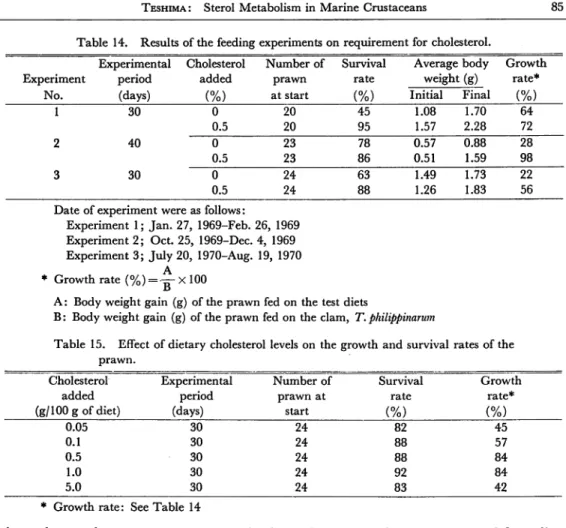
Cholesterol is present in the tissues of the prawn, P. japonicus, as a predominant sterol (see part-1.). Accordingly, the requirement for cholesterol was first investi gated. The results of the feeding trials of the prawns maintained on the sterol-free and cholesterol-containing diets are shown in Table 14.
In the experiments 1, 2, and 3, the prawn fed on the cholesterol-containing diet grew normally to outward appearances, and the growth rate and survival rate of the prawn were 56-98% and 86-95%, respectively. On the other hand, the growth rate of the prawn fed on the sterol-free diet was inferior to that of the prawn fed on the cholesterol-containing diet, although a definite difference was not perceived between both the experimental groups on the survival rate. Also, a detectable abnormality on the length of antennae, the color of body, and the furtive movement, creeping
Teshima: Sterol Metabolism in Marine Crustaceans 85
Table 14. Results of the feeding experiments orl requirement for cholesterol.
Experiment No. Experimental period (days) Cholesterol added (%) Number of prawn at start Survival rate (%) Average body weight (g) Initial Final Growth rate* (%) 1 30 40 30 0 0.5 20 20 45 95 1.08 1.57 1.70 2.28 64 72 2 0 0.5 23 23 78 86 0.57 0.51 0.88 1.59 28 98 3 0 0.5 24 24 63 88 1.49 1.26 1.73 1.83 22 56
Date of experiment were as follows:
Experiment 1; Jan. 27, 1969-Feb. 26, 1969 Experiment 2; Oct. 25, 1969-Dec. 4, 1969 Experiment 3; July 20, 1970-Aug. 19, 1970 Growth rate (%)=-— x 100
r>
A: Body weight gain (g) of the prawn fed on the test diets
B: Body weight gain (g) of the prawn fed on the clam, T. philippinarum
Table 15. Effect of dietary cholesterol levels on the growth and survival rates of the
prawn.
Cholesterol Experimental Number of Survival Growth
added period prawn at rate rate*
(g/lOOgofdiet) (days) start (%) (%)
0.05 30 24 82 45
0.1 30 24 88 57
0.5 30 24 88 84
1.0 30 24 92 84
5.0 30 24 83 42
* Growth rate: See Table 14
into the sands, etc., was not perceived in the prawn fed on the sterol-free diet throughout the experimental period. From the results, it was conceivable that the prawn requires to some extent cholesterol or other sterols as a nutrient, although the
metabolic role of sterols in this crustacean was obscure.
Hence, to estimate the quantitative requirement of the prawn for cholesterol, the prawns were divided into five groups and fed on the test diets containing the different levels of cholesterol (0.05, 0.1, 0.5, 1.0, and 5.0 g/100 g diet). The results are shown in Table 15. On the survival rate, a definite difference was not observed among the five experimental groups. However, the high growth rate was found to attain when the diet contained 0.5-1.0 g of cholesterol per 100 g of diet. From the results, the quantitative requirement of the prawn, P. japonicus, for cholesterol was estimated to be near 0.5 g per 100 g of diet under the experimental conditions adopted. The value obtained in this experiment generally agreed with the requirement of the insects for cholesterol (Ito, 1961; Ism, 1964; Clayton, 1964).
A phytoplankton or yeast has been generally used as a diet for young prawn. Hence, the nutritional effect of other sterols such as mycosterols and phytosterols on the prawn
86 Mem. Fac. Fish., Kagoshima Univ. Vol. 21-2 (1972)
were each added to the basal diet and supplied to the prawns. The results are shown in Table 16. The survival rate of the prawns fed on the test diets containing ergosterol, stigmasterol, and ^-sitosterol (83-96%) was similar to that of the prawn fed on the cholesterol-containing diet. . On the growth rate, ergosterol, stigmasterol, and £-sitosterol were seen to be effective, but inferior to cholesterol. These results suggest that the prawns is capable of utilizing these C28- and C29-sterols to some extent for normal growth. However, it is obscure whether these sterols are digested and accumulated as an endogenous sterol in the prawn.
Table 16. Effect of cholesterol and other sterols on the growth and survival rates of the
prawn.
Survival rate(%) Growth rate (%)* Sterol added. (0 5 p7100 0 nf diet1! Experiment ♦* Experiment** 1 2 3 1 2 3 Cholesterol Ergosterol Stigmasterol ^-Sitosterol 95 94 96 89 86 87 83 83 86 92 88 92 72 51 62 56 98 56 79 48 67 56 29 50
* Growth rate: See table 14.
** Experimental period: Experiment, 1, for 40 days; experiment 2 and 3 for 30 days.
In parts-1 and 2, it was shown that the naturally occurring sterols of the prawn are composed of cholesterol (90%), 22-dehydrocholesterol (3%), and 24-methylenecho lesterol (7%), and that the prawn did not incorporate acetate-1-14C into sterol frac tion. Considering these facts, it is conceivable that the prawn, P. japonicus, probably lacks sterol-synthesizing ability and requires cholesterol or other sterols for normal growth, and that this crustacean may modify some C28- and C29-sterols to endogenous
sterols somewhat.
Summary
In this part, the requirements of the prawn, Penaeus japonicus, for sterols were in vestigated by the feeding trials using the artificial diet devised by Kanazawa et al.
(1970). The results obtained are as follows:
1) The prawn fed on the cholesterol-containing diet grew normally, and the survi val and growth rates were 86-95% and 56-98%, respectively. However, the growth rate of the prawn fed on the sterol-free diet was poor (22-64%).
2) The quantitative requirement of the prawn for cholesterol was estimated to be approximately 0.5 g per 100 g of diet under the experimental conditions adopted. 3) The survival rate of the prawns fed on the test diets containing ergosterol, stigmasterol, and ^-sitosterol was similar to that of the prawn fed on the cholesterol-containing diet. However, the growth rate of the prawns fed on these sterols was
inferior to that of them fed on cholesterol.
From the above results, it was suggested that the prawn, P. japonicus, requires sterols for normal growth.
Teshima: Sterol Metabolism in Marine Crustaceans 87
Part-4. Utilization of Dietary Sterols by Marine Crustaceans
In part-2, it has been assumed that most marine crustaceans probably lack ability for sterol-synthesis as also occurs in insects. In the case of the prawn, Penaeusjaponicus, it has been manifested by the nutritional experiment that this crustacean requires sterols as a diet for normal growth (see part-3). In this part, the author intended to obtain the knowledge on the utilization of sterols other than cholesterol by marine
crustaceans.
In this approach, the prawn, P. japonicus, and Artemia salina were used
as experimental animals.
A. Utilization of the dietary sterols by Artemia.
Materials and Methods
Sterol composition of Cryptococcus albidus and "Wakamoto". The sterol
composition of the diets used for Artemia, marine-occurring yeast, Cryptococcus albidus, and "Wakamoto" (Wakamoto Pharmaceutical Co., Japan), was first investigated. C. albidus was incubated on a reciprocal shaker at 25°C for 48 hours according to the same method as reported elsewhere (Teshima & Kanazawa, 1971), and then the cells were collected by the centrifugation method (3000 rpm, 15 min.) and subjected to isolation of sterols. The incubation medium used for C. albidus was composed of 8 g of molasses, 1 g of polypeptone, 0.5 g of yeast extract, and 1000 ml of the natural sea water filtered through a glass filter No. 5. The cells of C. albidus and "Wakamoto" were saponified with alcoholic potassium hydroxide, and then the sterols were isolated from the non-saponifiable materials by column chromatography on alumina (grade II). The composition of sterols was analyzed by gas-liquid chromatography (GLC). The identification of sterols was carried out by using at least two or more columns (1.5% SE-30, 1.5% OV-17, 1.0% XE-60, and 1.0% NGS-1.0% XE-60). The details of the procedures for isolation of sterols and for GLC were mentioned in part-1.Feeding experiment using marine-occurring yeast and "Wakamoto". The hatched Artemia was cultivated with the two types of diets, marine-occurr ing yeast, C. albidus, and "Wakamoto" The cultivation was carried out at 25-27°C for 8 days by the similar manner to that described in part-2-B. After cultivation, the sterols were isolated from each Artemia fed on the above diets, and then the sterol composition was analyzed by GLC.
Results
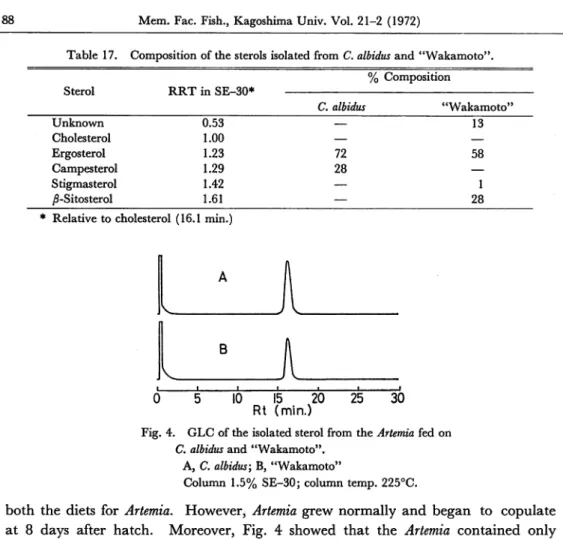
The sterol composition of C. albidus and "Wakamoto" is shown in Table 17. The GLC analysis showed that C. albidus contained ergosterol (72%) and campesterol (28%), and also that "Wakamoto" contained ergosterol (58%), stigmasterol (1%), /3-sitosterol (28%), and an unknown sterol (13%). No cholesterol was detected in
88 Mem. Fac. Fish., Kagoshima Univ. Vol. 21-2 (1972)
Table 17. Compositionof the sterols isolated from C. albidus and *Wakamoto".
Sterol RRTin SE-30* % Composition C. albidus "Wakamoto" Unknown Cholesterol Ergosterol Campesterol Stigmasterol ^-Sitosterol 0.53 1.00 1.23 1.29 1.42 1.61 72 28 13 58 1 28
* Relative to cholesterol (16.1 min.)
JV_
10 15 20
Rt (min.)
25 30
Fig. 4. GLC of the isolated sterol from the Artemia fed on
C. albidus and "Wakamoto".
A, C. albidus; B, "Wakamoto"
Column 1.5% SE-30; column temp. 225°C.
both the diets for Artemia. However, Artemia grew normally and began to copulate at 8 days after hatch. Moreover, Fig. 4 showed that the Artemia contained only cholesterol in spite of being cultivated with the diets containing C28- and C29-sterols and no cholesterol. In part-2-B, Artemia was found to be incapable of synthesizing sterols from acetate. Considering these results, it is suggested that Artemia modifies ergosterol and ^-sitosterol to cholesterol.
B.
Utilization of the dietary sterols by the prawn, P. japonicus.
Materials and Methods
Analysis of the sterols of clam. The clam, Tapes philippinarum3 was obtained from the commercial source in May, 1970. From the edible parts of clams, the sterols were isolated by the same manner as described in part-1, and then the composition of sterols was investigated by gas-liquid chromatography (GLC) on 1.5% SE-30 and 1.0% NGS-1.0% XE-60.
Feeding experiment using the artificial diet and the clam. The prawn, P. japonicus, 1-2 g body weight, was cultivated with the clam and the artificial diets with cholesterol, ergosterol, stigmasterol, or ^-sitosterol or without sterols for 30 days at 20-22°C. In this experiment, each 0.5 g of sterols was added to lOOg of the basal
Teshima : Sterol Metabolism in Marine Crustaceans 89
diet (sterol-free) devised by Kanazawa etal. (1970). The details of the methods for preparation of diets and for feeding were essentially the same as reported by Kana zawa et al. (1970). After cultivation, the sterols were isolated from the whole tissues of the prawns fed on the six different diets, and then the content and composition of sterols were determined by the digitonin method (Idler & Baumann, 1952) and by GLC on 1.5% SE-30, respectively.
Results
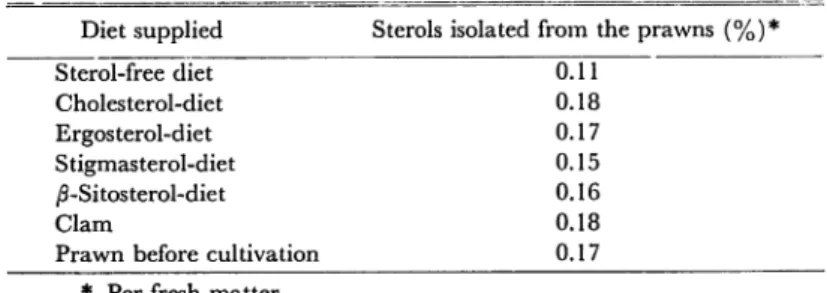
The sterol content of the prawns fed on the clam and artificial diet is shown in Table 18. After 30 days, the sterol content of tissues slightly decreased in the prawn fed on the sterol-free diet. In the prawns fed on the clam and the sterol-containing
Table 18. The sterol content of the prawns fed on the clam and artificial diets.
Diet supplied Sterols isolated from the prawns (%)*
Sterol-free diet 0~f1 Cholesterol-diet 0.18 Ergosterol-diet 0.17 Stigmasterol-diet 0.15 /3-Sitosterol-diet 0.16 Clam 0.18
Prawn before cultivation 0.17 * Per fresh matter
diets, however, the sterol content was approximately equal to that of the prawn before cultivation. These results suggest that the prawn digested cholesterol and other sterols and accumulated as endogenous sterols. The sterol composition of the prawns fed on the artificial diets is given in Table 19. The sterols isolated from the prawn before cultivation were composed of cholesterol (90%), 22-dehydrocholesterol (3%), 24-methylenecholesterol (7%), and ^-sitosterol (trace). After 30 days, the sterol com position of the prawns fed on the artificial diets changed considerably. In the prawns fed on the diets containing only ergosterol, stigmasterol, and /3-sitosterol, no detectable
Table 19. Sterol composition of the prawns fed on the artificial diets. % Comp<ositionof the sterols5 in theprawns*
Sterol identified Before After cultivation with the artificial diets**
cultivation 1 2 3 4 5 22-Dehydrocholesterol Cholesterol 3 90 98 trace 99 99 99 trace 96 Desmosterol 24-Methylenecholesterol Stigmasterol Ergosterol ^-Sitosterol 7 trace 1 1 trace 1 trace 1 trace trace 1 trace 3 1 trace * Determined by GLC on 1.5% SE-30
** 1, sterol-free; 2, cholesterol-containing; 3, ergosterol-containing; 4, stigmasterol-containing; 5,/3-sitosterol-containing
90 Mem. Fac. Fish., Kagoshim Univ. Vol. 21-2 (1972)
increase of these sterols was perceived. Moreover, the percentages of cholesterol were found to be high as compared with that of the prawn before cultivation. These results suggest that the prawn probably converts these C28- and C29-sterols to chole
sterol. Identified sterol Unknown sterol 22-Dehydrocholesterol Cholesterol Desmosterol 24-Methylenecholesterol jS-Sitosterol 10 20 30
Retention time (min.)
Fig. 5. GLC of the sterols isolated from the clam, T. philippinarum.
Column 1.5% SE-30; column temp. 225°C
1, unknown sterol; 2, 22-dehydrocholesterol; 3, chole sterol 4, desmosterol; 5, 24-methylenecholesterol; 6, ^-sitosterol
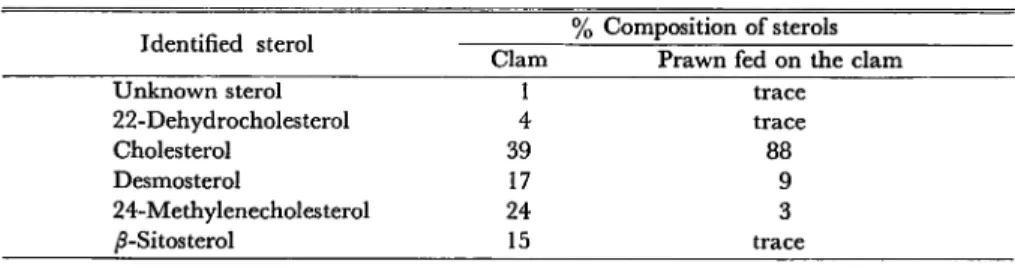
On the other hand, the sterols of the clam were composed of 22-dehydrochole sterol (4%), cholesterol (39%), desmosterol (17%), 24-methylenecholesterol (24%), ^-sitosterol (15%), and an unknown sterol (1%) as shown in Fig. 5 and Table 20. From the prawn fed on the clam containing the above sterols, large amounts of desmo sterol and 24-methylenecholesterol were detected as compared with that of the prawn fed on the sterol-free diet. The results may lead the following assumptions: (1) Some desmosterol and 24-methylenecholesterol found in the tissues of wild prawn may originate from dietary sources such as clams. (2) The turnover of desmosterol and 24-methylenecholesterol may proceeds slowly in comparison with that of ergosterol, stigmasterol, and ^-sitosterol if the conversion of the two sterols to cholesterol takes place in the prawn.
Table 20. Sterol composition of the clam and the prawn fed on the clam.
Clam 1 4 39 17 24 15 % Composition of sterols
Prawn fed on the clam
trace trace 88 9 3 trace Discussion
Teshima: Sterol Metabolism in Marine Crustaceans 91
sterol-synthesizing ability from acetate and requires sterols as a diet.
In marine
crustaceans, however, there is no report on the utilization of sterols other than chole sterol. In the insects, it has been shown that cholesterol is generally effective for grow th of the insects, although ergosterol, stigmasterol, and /3-sitosterol are also utilized
considerably as a substituent for cholesterol (Clayton, 1964). Furthermore, it has
been pointed out that the ability for utilization of sterols may be related to the feeding
habits of insects: That is, most herbivorous and omnivorous insects seem to be
capable of utilizing phyto- and fungal sterols (C28- and C29-sterols) in addition to zoo
sterols (C27-sterols), whereas carnivorous ones are incapable of utilizing C28- and
C29-sterols (Fraenkel et al., 1941: Levinson, 1960). In the present study, it was demonstrated that Artemia, herbivorous crustacean, is capable of utilizing ergosterol
and/or campersterol for normal growth, and also that the prawn may digest ergosterol,
stigmasterol, and ^-sitosterol and convert these sterols to cholesterol.
Considering
these results, it may be assumed that marine crustaceans possess ability for modifi cation of some phyto- and fungal sterols. However, this assumption should be confirmed by a more suitable experiment.
Summary
In this part, the utilization of sterols in marine crustaceans was investigated by using Artemia salina and the prawn, Penaeus japonicus. The results obtained are as follows:
1) In spite of being supplied with the diets containing ergosterol, stigmasterol,
campesterol, and ^-sitosterol, Artemia was found to contain only cholesterol as a sterol,
in the tissues2) In the prawns fed on the artificial diets containing each stigmasterol, ergosterol,
and ^-sitosterol, the percentages of cholesterol increased in comparison with that of
the prawn before cultivation, although the sterol content was approximately equal to that of the prawn before cultivation.
3) From the prawn fed on the clam, the sterols of which were composed of 22-dehydrocholesterol (4%,), cholesterol (39%), desmosterol (17%), 24-methylene cholesterol (24%), ^-sitosterol (15%) and an unknown sterol (1%)? large amounts of desmosterol and 24-methylenecholesterol were detected as compared with that of the prawn fed on the sterol-free diet.
4) From the above results, it was assumed that Artemia is capable of modifying ergosterol and/or campesterol for normal growth, and also that the prawn, P. japonicus, may digest ergosterol, stigmasterol, and ^-sitosterol and convert them to cholesterol. However, the turnover of desmosterol and 24-methylenecholesterol was conceivable to proceed relatively slowly in the prawn.
Part-5. Bioconversion of Sterol Molecules in Marine Crustaceans
92 Mem. Fac. Fish., Kagoshima Univ. Vol. 21-2 (1972)
by Zandee (1962), and he demonstrated that the crayfish, Astacus astacus, is incapable of synthesizing cholesterol from acetate. In other marine crustaceans, it was also found that the crab, Cancer pagurus (Van den Oord, 1964), and the lobster, Homarus gammarus (Zandee, 1964, 1967), lack sterol-synthesizing ability from acetate or mevalonate. In addition, the author showed in part-2 that the lobster, Panulirus japonica, the prawn, Penaeus japonicus, and the crab, Portunus trituberculatus, probably lack sterol-synthesizing ability, though acetate-1-14C was utilized to yield both radio active fatty acids and non-saponifiable materilas. These findings suggest that most marine crustaceans probably lack sterol-synthesizing ability from acetate and mevalo nate. Therefore, some sterols found in their tissuesmay originate from dietary sources.
Especially, in the herbivorous ones, the phyto- and fungal sterols such as ^-sitosterol,
stigmasterol, and ergosterol may be transformed metabolically to C27-sterols such as
cholesterol.
However, the metabolic fate of dietary sterols in marine crustaceans has not been shown so distinctly probably due to the following reasons: (1) The pure sterols cannot be obtainable from commercial sources except a few sterols; (2) the separation of sterol mixture with a closely related structure is not always easy in a usual chromatographic method; (3) the suitalbe radioactive sterols for investigation of sterol metabolism are not obtainable from commercial sources, and it is very difficult to prepare radioactive sterols by chemical methods.
In the present study, the author intended to labell sterols with 14C by the biological method. As a result, the author succeeded in labelling the several sterols with 14C by incubating the protozoan, Euglena gracilis, marine-occurring yeast, Cryptococcus albidus, and diatom, Cyclotella nana, with acetate-1-14C. The present part deals with the bioconversions of ergosterol, ^-sitosterol, 24-methylcholesterol,and brassicasterol
to cholesterol in the several marine custaceans.
A. Bioconversion of ergosterol to cholesterol in Artemia salina.
Materials and Methods
Chemicals. Authentic cholesterol and ergosterol were obtained from Nakarai Chemicals Co., Ltd. (Japan) and purified by recrystallization from methanol. Acetate-1-14C (50.0 mCi/mM) was purchased from Daiichi Chemicals Co., Ltd. (Japan).
Incubation of Euglena. Two loops of the cells of Euglena were incubated in 5 ml
of Hutner's neutral medium (Hutner et al., 1949) at 30°C for 6 days. The large-scale incubation was carried out in 1000 ml Erlenmeyer flask containg 500 ml of the same medium. During the present study, the incubation of Euglena was carried out in thedark.
Biosynthesis of ergosterol-14C in Euglena.
The cells of Euglena were collected
by centrifugation (1500 rpm, 5 min.) and 1 g of cells was incubated in 10 ml of phos phate buffer (pH 7.4) with 100 ^Ci of acetate-1-14C at 30°C for 6 hours. After incuba tion, the cells were harvested and washed three times with phosphate buffer by using
Teshima: Sterol Metabolism in Marine Crustaceans 93
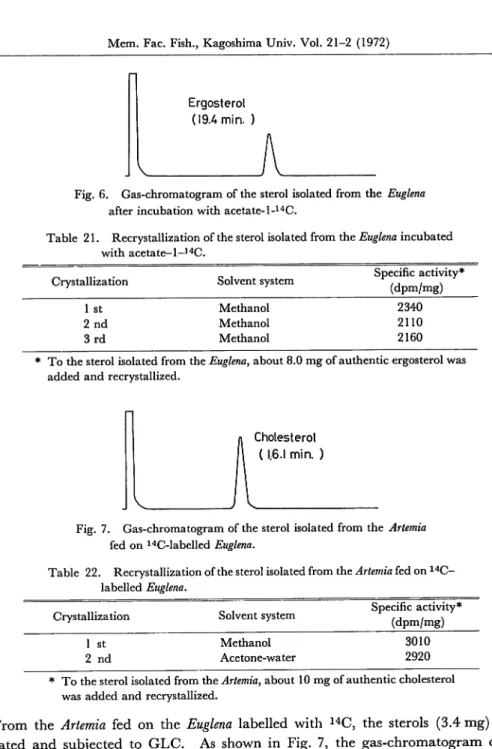
the centrifugation method. The wet cells were saponified with alcoholic potassium hydroxide solution (95% ethanol-50% aqueous potassium hydroxide (10: 4)) at 80°C for 3 hours (Teshima & Kanazawa, 1971). The saponification mixture was filtered through a glass filter and then non-saponifiable materials were extracted with ether in the usual manner. The crude sterols were isolated from the non-saponifiable mate rials by the digitonin-precipitation method (Idler & Baumann, 1952). After de composing the digitonide by dry pyridine, the sterols so obtained were recrystallized several times from methanol and the radioactivity of the crystals was measured. The composition of sterols was investigated by gas-liquid chromatography (GLC). In addition, as the diet of Artemia, 6 g of the cells of Euglena was incubated with acetate-1-14C (46 ^Cix6) by the same method.
Bioconversion of ergosterol-14C in Artemia. The hatched Artemia was cultivat ed in a trough (30 X 30 X 60 cm) at 25°C. The cultivation was carried out in circulat
ing natural sea water of which the specific gravity had been adjusted previously to
1.040with sodium chloride (Shimaya etal., 1967). The Artemia was given "Wakamoto"
(Wakomoto Pharmaceutical Co.) as the diet. When Artemia began to copulate,
6.0 g of the 14C-labelled Euglena was supplied to Artemia over 3 days. From the Artemia
fed on 14C-labelled Euglena, the lipids were extracted with chloroform-methanol
(Bligh & Dyer, 1959) and saponified with 2N potassium hydroxide in 80% methanol.
The crude sterols were obtained from the non-saponifiable materials by the same
method as used for Euglena. The crude sterols were recrystallized several times from
methanol or acetone-water.
The radioactivity and composition of the sterols were
investigated by a liquid scintillation counter and by GLC, respectively.
GLC and measurement of radioactivity. In GLC, a Shimadzu model GC-3AF
gas-chromatographic unit with hydrogen flame ionization detectors and glasscolumn
(200 cm x 4 mm I. D.) was used. The column was 1.5% SE-30 on 60-80 mesh
Chromosorb W (see part-1).
The radioactivity was measured with a Beckman liquid
scintillation counter, model LS-150.
The toluene solution of PPO (0.6%) and
POPOP (0.02%) was used as a scintillator.
The efficiency of counting of radioactive
sterols was approximately 65 per cent.
Results and Discussion